lock YAMAHA TDM 900 2003 User Guide
[x] Cancel search | Manufacturer: YAMAHA, Model Year: 2003, Model line: TDM 900, Model: YAMAHA TDM 900 2003Pages: 110, PDF Size: 7.38 MB
Page 27 of 110
3-13
INSTRUMENT AND CONTROL FUNCTIONS
3
EC000114
cC
The following precautions must be
observed to prevent a fire hazard
or other damages.
8Use only unleaded gasoline.
The use of leaded gasoline will
cause unrepairable damage to
the catalytic converter.
8Never park the motorcycle
near possible fire hazards
such as grass or other materi-
als that easily burn.
8Do not allow the engine to idle
too long.
EAU02925
Seat
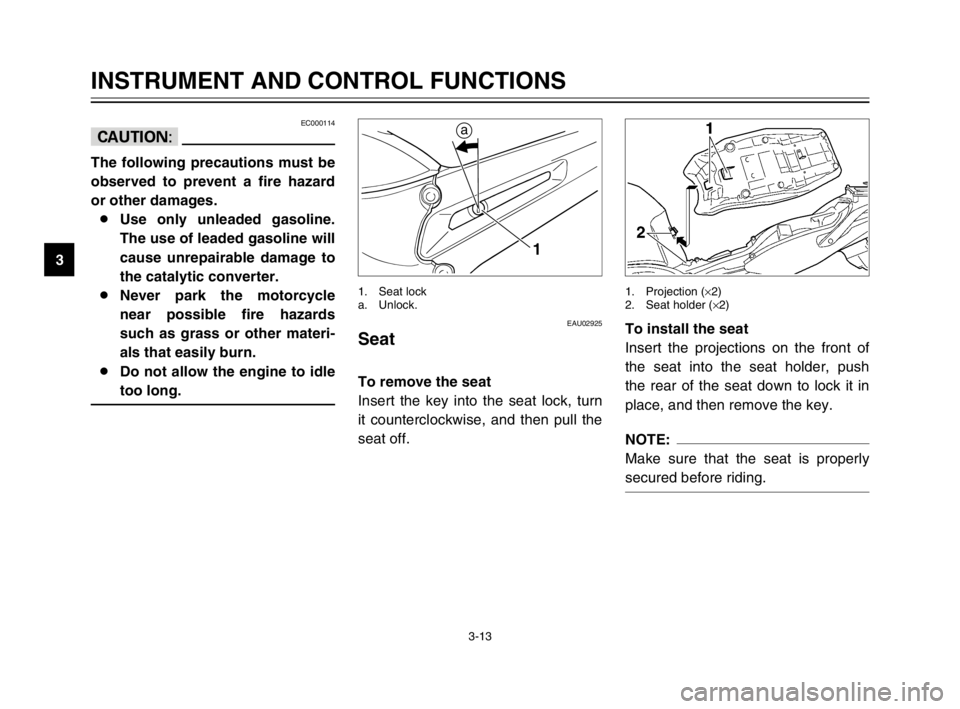
SeatTo remove the seat
Insert the key into the seat lock, turn
it counterclockwise, and then pull the
seat off.
1 a
1. Seat lock
a. Unlock.
To install the seat
Insert the projections on the front of
the seat into the seat holder, push
the rear of the seat down to lock it in
place, and then remove the key.
NOTE:
Make sure that the seat is properly
secured before riding.
1. Projection (×2)
2. Seat holder (×2)
5PS-28199-E1 8/29/02 9:16 AM Page 26
Page 28 of 110
3-14
INSTRUMENT AND CONTROL FUNCTIONS
3
EAU04292
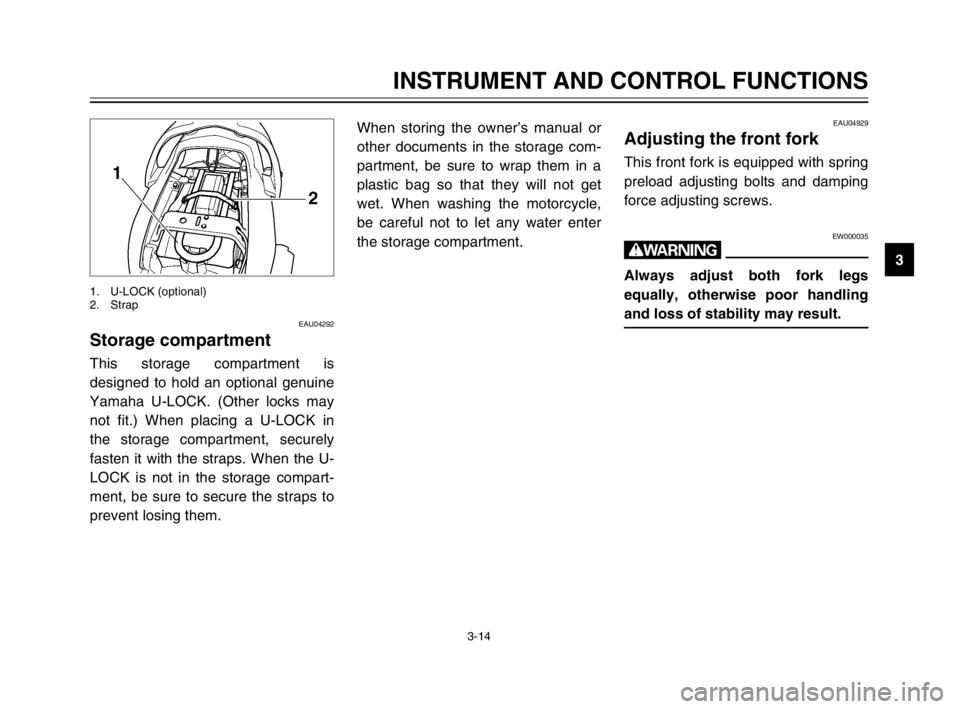
Storage compartmentStorage compartmentThis storage compartment is
designed to hold an optional genuine
Yamaha U-LOCK. (Other locks may
not fit.) When placing a U-LOCK in
the storage compartment, securely
fasten it with the straps. When the U-
LOCK is not in the storage compart-
ment, be sure to secure the straps to
prevent losing them.
1. U-LOCK (optional)
2. Strap
When storing the owner’s manual or
other documents in the storage com-
partment, be sure to wrap them in a
plastic bag so that they will not get
wet. When washing the motorcycle,
be careful not to let any water enter
the storage compartment.EAU04929
Adjusting the front forkFront fork, adjustingThis front fork is equipped with spring
preload adjusting bolts and damping
force adjusting screws.
EW000035
w
Always adjust both fork legs
equally, otherwise poor handling
and loss of stability may result.
5PS-28199-E1 8/29/02 9:16 AM Page 27
Page 68 of 110
6-22
PERIODIC MAINTENANCE AND MINOR REPAIR
6
EAU03773
Cast wheelsWheelsTo maximize the performance, dura-
bility, and safe operation of your
motorcycle, note the following points
regarding the specified wheels.
8The wheel rims should be
checked for cracks, bends or
warpage before each ride. If any
damage is found, have a
Yamaha dealer replace the
wheel. Do not attempt even the
smallest repair to the wheel. A
deformed or cracked wheel must
be replaced.
8The wheel should be balanced
whenever either the tire or wheel
has been changed or replaced.
An unbalanced wheel can result
in poor performance, adverse
handling characteristics, and a
shortened tire life.
EAU00694
Adjusting the clutch lever
free play
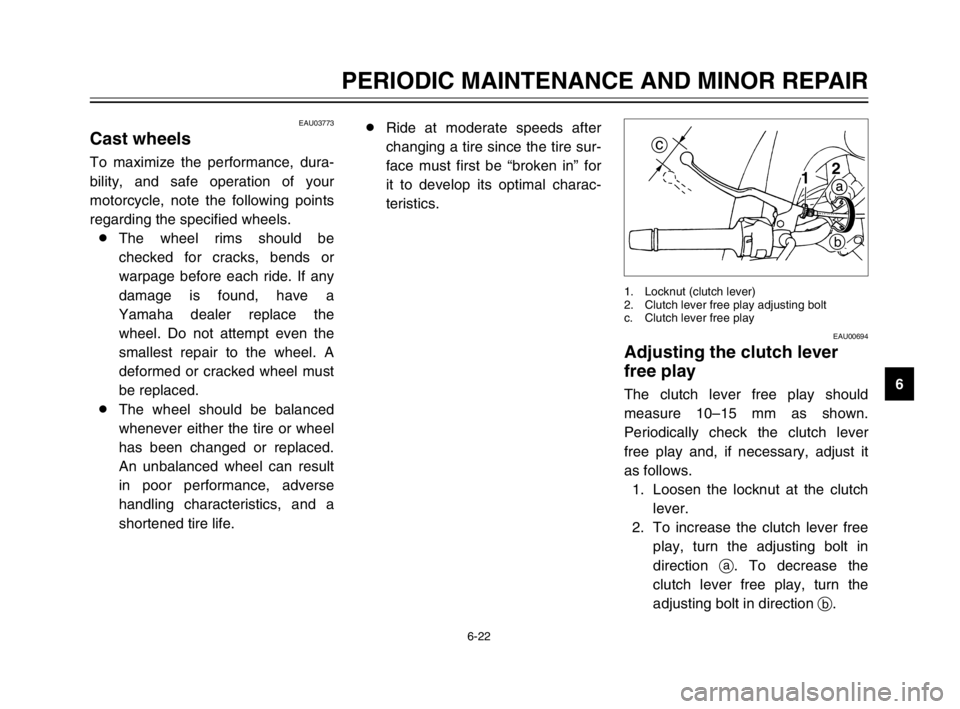
Clutch lever free play, adjustingThe clutch lever free play should
measure 10–15 mm as shown.
Periodically check the clutch lever
free play and, if necessary, adjust it
as follows.
1. Loosen the locknut at the clutch
lever.
2. To increase the clutch lever free
play, turn the adjusting bolt in
direction a. To decrease the
clutch lever free play, turn the
adjusting bolt in direction b.
1
a2
a c
b
1. Locknut (clutch lever)
2. Clutch lever free play adjusting bolt
c. Clutch lever free play
8Ride at moderate speeds after
changing a tire since the tire sur-
face must first be “broken in” for
it to develop its optimal charac-
teristics.
5PS-28199-E1 8/29/02 9:16 AM Page 67
Page 69 of 110
6-23
PERIODIC MAINTENANCE AND MINOR REPAIR
63. If the specified clutch lever free
play could be obtained as
described above, tighten the
locknut and skip the rest of the
procedure, otherwise proceed as
follows.
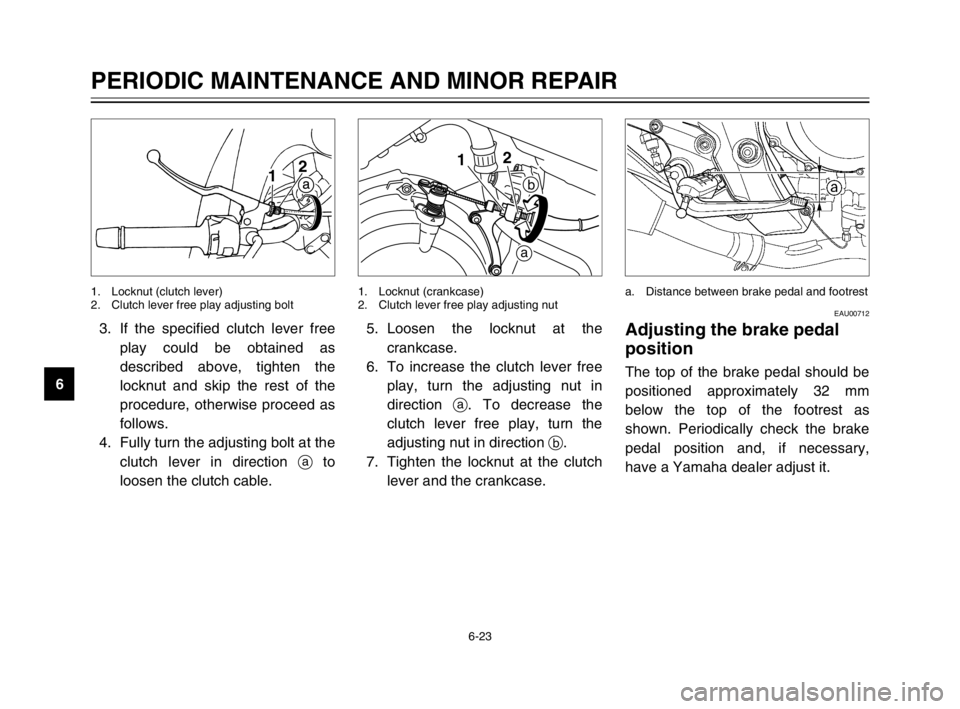
4. Fully turn the adjusting bolt at the
clutch lever in direction ato
loosen the clutch cable.
1
a2
a
1. Locknut (clutch lever)
2. Clutch lever free play adjusting bolt
EAU00712
Adjusting the brake pedal
position
Brake pedal position, adjustingThe top of the brake pedal should be
positioned approximately 32 mm
below the top of the footrest as
shown. Periodically check the brake
pedal position and, if necessary,
have a Yamaha dealer adjust it.
a. Distance between brake pedal and footrest
5. Loosen the locknut at the
crankcase.
6. To increase the clutch lever free
play, turn the adjusting nut in
direction a. To decrease the
clutch lever free play, turn the
adjusting nut in direction b.
7. Tighten the locknut at the clutch
lever and the crankcase.
12
b
a
1. Locknut (crankcase)
2. Clutch lever free play adjusting nut
5PS-28199-E1 8/29/02 9:16 AM Page 68
Page 72 of 110
6-26
PERIODIC MAINTENANCE AND MINOR REPAIR
6 Observe these precautions:
8When checking the fluid level,
make sure that the top of the
brake fluid reservoir is level.
8Use only the recommended qual-
ity brake fluid, otherwise the rub-
ber seals may deteriorate, caus-
ing leakage and poor braking
performance.
1
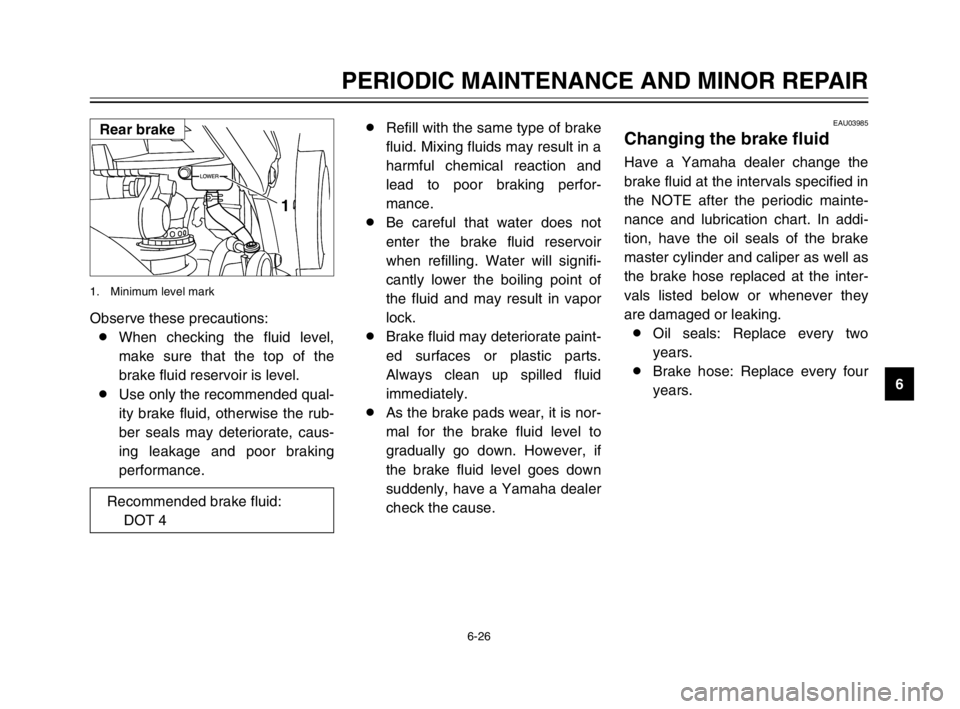
1. Minimum level mark
EAU03985
Changing the brake fluidBrake fluid, changingHave a Yamaha dealer change the
brake fluid at the intervals specified in
the NOTE after the periodic mainte-
nance and lubrication chart. In addi-
tion, have the oil seals of the brake
master cylinder and caliper as well as
the brake hose replaced at the inter-
vals listed below or whenever they
are damaged or leaking.
8Oil seals: Replace every two
years.
8Brake hose: Replace every four
years. 8Refill with the same type of brake
fluid. Mixing fluids may result in a
harmful chemical reaction and
lead to poor braking perfor-
mance.
8Be careful that water does not
enter the brake fluid reservoir
when refilling. Water will signifi-
cantly lower the boiling point of
the fluid and may result in vapor
lock.
8Brake fluid may deteriorate paint-
ed surfaces or plastic parts.
Always clean up spilled fluid
immediately.
8As the brake pads wear, it is nor-
mal for the brake fluid level to
gradually go down. However, if
the brake fluid level goes down
suddenly, have a Yamaha dealer
check the cause.
Rear brake
Recommended brake fluid:
DOT 4
5PS-28199-E1 8/29/02 9:16 AM Page 71
Page 73 of 110
6-27
PERIODIC MAINTENANCE AND MINOR REPAIR
6
EAU00744
Drive chain slackDrive chain slackThe drive chain slack should be
checked before each ride and adjust-
ed if necessary.
To check the drive chain slack
Checking1. Place the motorcycle on a level
surface and hold it in an upright
position.
NOTE:
When checking and adjusting the
drive chain slack, the motorcycle
should be positioned straight up and
there should be no weight on it.EAU04372
To adjust the drive chain slackAdjusting1. Loosen the axle nut, the brake
caliper bracket bolt and the lock-
nut on each side of the
swingarm.
2. To tighten the drive chain, turn
the adjusting bolt on each side of
the swingarm in direction a. To
loosen the drive chain, turn the
adjusting bolt on each side of the
swingarm in direction b, and
then push the rear wheel for-
ward.
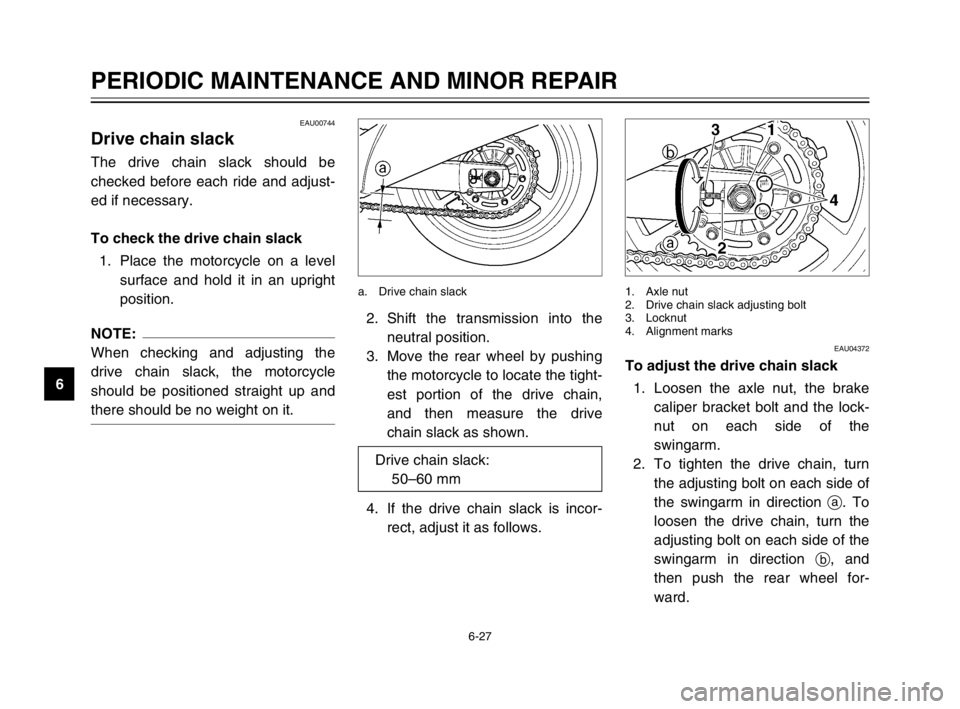
1. Axle nut
2. Drive chain slack adjusting bolt
3. Locknut
4. Alignment marks
2. Shift the transmission into the
neutral position.
3. Move the rear wheel by pushing
the motorcycle to locate the tight-
est portion of the drive chain,
and then measure the drive
chain slack as shown.
4. If the drive chain slack is incor-
rect, adjust it as follows.
a. Drive chain slack
Drive chain slack:
50–60 mm
5PS-28199-E1 8/29/02 9:16 AM Page 72
Page 74 of 110
6-28
PERIODIC MAINTENANCE AND MINOR REPAIR
6
NOTE:
Using the alignment marks on each
side of the swingarm, make sure that
both chain pullers are in the same
position for proper wheel alignment.
EC000096
cC
Improper drive chain slack will
overload the engine as well as
other vital parts of the motorcycle
and can lead to chain slippage or
breakage. To prevent this from
occurring, keep the drive chain
slack within the specified limits.
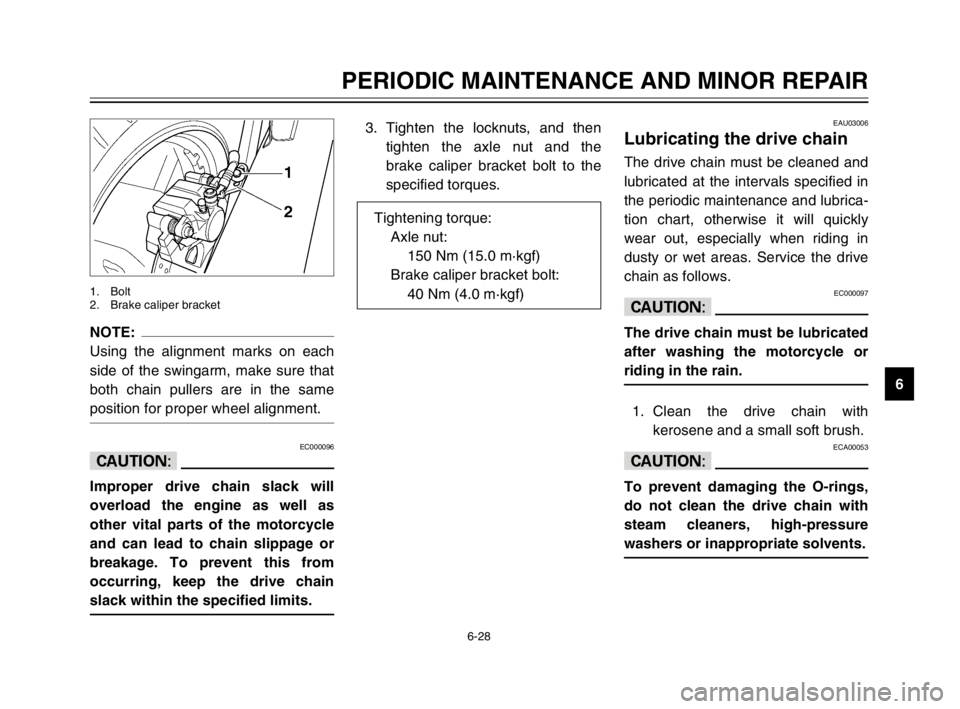
1. Bolt
2. Brake caliper bracket
EAU03006
Lubricating the drive chainDrive chain, lubricatingThe drive chain must be cleaned and
lubricated at the intervals specified in
the periodic maintenance and lubrica-
tion chart, otherwise it will quickly
wear out, especially when riding in
dusty or wet areas. Service the drive
chain as follows.
EC000097
cC
The drive chain must be lubricated
after washing the motorcycle or
riding in the rain.
1. Clean the drive chain with
kerosene and a small soft brush.
ECA00053
cC
To prevent damaging the O-rings,
do not clean the drive chain with
steam cleaners, high-pressure
washers or inappropriate solvents.
3. Tighten the locknuts, and then
tighten the axle nut and the
brake caliper bracket bolt to the
specified torques.
Tightening torque:
Axle nut:
150 Nm (15.0 m·kgf)
Brake caliper bracket bolt:
40 Nm (4.0 m·kgf)
5PS-28199-E1 8/29/02 9:16 AM Page 73
Page 80 of 110
6-34
PERIODIC MAINTENANCE AND MINOR REPAIR
6 To store the battery
1. If the motorcycle will not be used
for more than one month,
remove the battery, fully charge
it, and then place it in a cool, dry
place.
2. If the battery will be stored for
more than two months, check it
at least once a month and fully
charge it if necessary.
3. Fully charge the battery before
installation.
4. After installation, make sure that
the battery leads are properly
connected to the battery termi-
nals.
EAU04880
Replacing the fusesFuses, replacingThe main fuse and the fuse box,
which contains the fuses for the indi-
vidual circuits, are located under the
seat. (See page 3-13 for seat
removal and installation procedures.)
If a fuse is blown, replace it as fol-
lows.
1. Turn the key to “OFF” and turn
off the electrical circuit in ques-
tion.
12 34 5 689 7
7
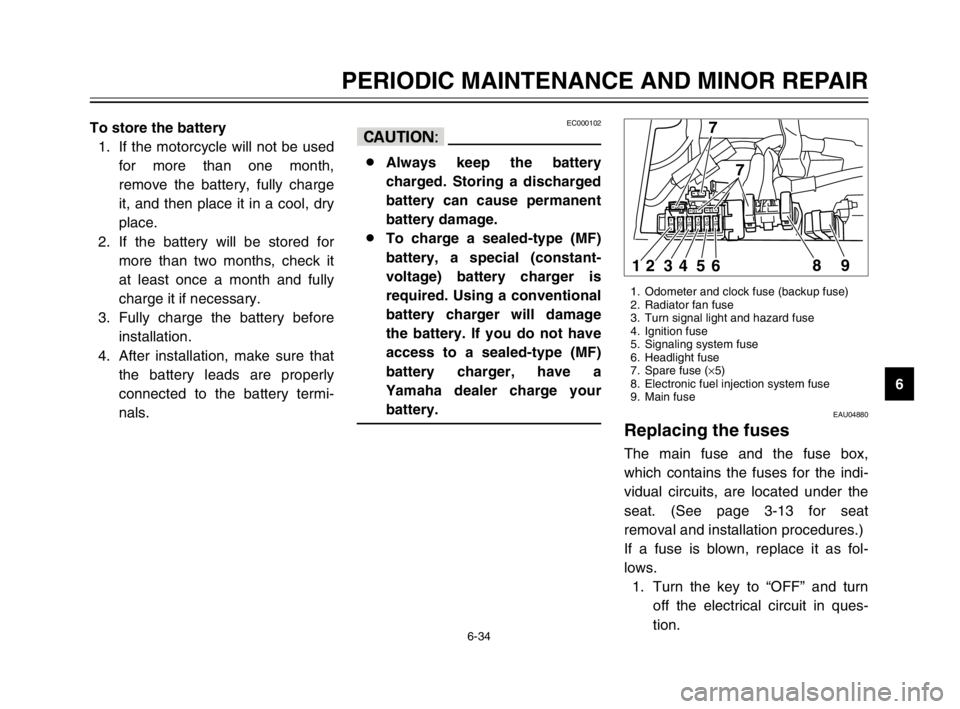
1. Odometer and clock fuse (backup fuse)
2. Radiator fan fuse
3. Turn signal light and hazard fuse
4. Ignition fuse
5. Signaling system fuse
6. Headlight fuse
7. Spare fuse (×5)
8. Electronic fuel injection system fuse
9. Main fuse
EC000102
cC
8Always keep the battery
charged. Storing a discharged
battery can cause permanent
battery damage.
8To charge a sealed-type (MF)
battery, a special (constant-
voltage) battery charger is
required. Using a conventional
battery charger will damage
the battery. If you do not have
access to a sealed-type (MF)
battery charger, have a
Yamaha dealer charge your
battery.
5PS-28199-E1 8/29/02 9:17 AM Page 79
Page 81 of 110
6-35
PERIODIC MAINTENANCE AND MINOR REPAIR
62. Remove the blown fuse, and
then install a new fuse of the
specified amperage.
EC000103
cC
Do not use a fuse of a higher
amperage rating than recommend-
ed to avoid causing extensive
damage to the electrical system
and possibly a fire.
EAU04503
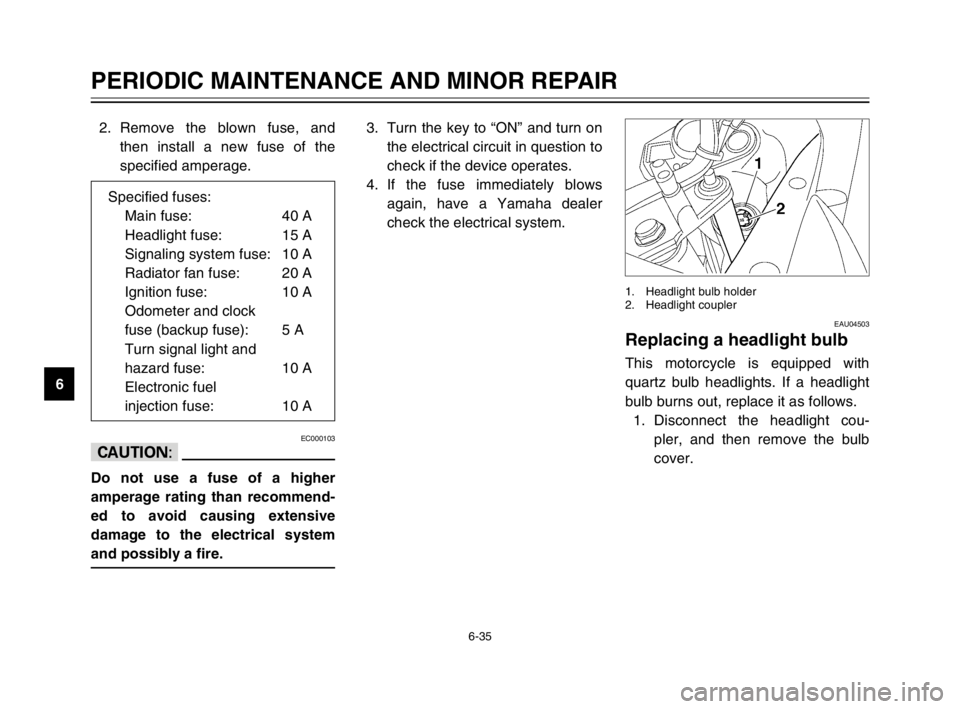
Replacing a headlight bulbHeadlight bulb, replacingThis motorcycle is equipped with
quartz bulb headlights. If a headlight
bulb burns out, replace it as follows.
1. Disconnect the headlight cou-
pler, and then remove the bulb
cover.
1. Headlight bulb holder
2. Headlight coupler
3. Turn the key to “ON” and turn on
the electrical circuit in question to
check if the device operates.
4. If the fuse immediately blows
again, have a Yamaha dealer
check the electrical system. Specified fuses:
Main fuse: 40 A
Headlight fuse: 15 A
Signaling system fuse: 10 A
Radiator fan fuse: 20 A
Ignition fuse: 10 A
Odometer and clock
fuse (backup fuse): 5 A
Turn signal light and
hazard fuse: 10 A
Electronic fuel
injection fuse: 10 A
5PS-28199-E1 8/29/02 9:17 AM Page 80
Page 83 of 110
6-37
PERIODIC MAINTENANCE AND MINOR REPAIR
6
EAU04411
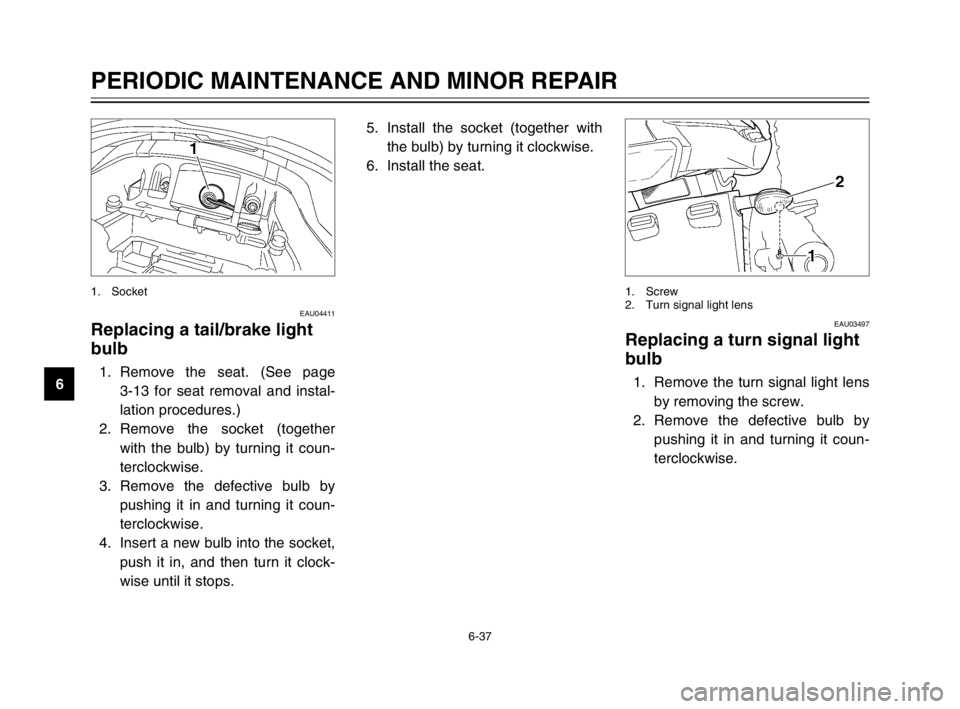
Replacing a tail/brake light
bulb
Tail/brake light bulb, replacing1. Remove the seat. (See page
3-13 for seat removal and instal-
lation procedures.)
2. Remove the socket (together
with the bulb) by turning it coun-
terclockwise.
3. Remove the defective bulb by
pushing it in and turning it coun-
terclockwise.
4. Insert a new bulb into the socket,
push it in, and then turn it clock-
wise until it stops.
1. Socket
EAU03497
Replacing a turn signal light
bulb
Turn signal light bulb, replacing1. Remove the turn signal light lens
by removing the screw.
2. Remove the defective bulb by
pushing it in and turning it coun-
terclockwise.
1. Screw
2. Turn signal light lens
5. Install the socket (together with
the bulb) by turning it clockwise.
6. Install the seat.
5PS-28199-E1 8/29/02 9:17 AM Page 82