ABS YAMAHA TDM 900 2009 User Guide
[x] Cancel search | Manufacturer: YAMAHA, Model Year: 2009, Model line: TDM 900, Model: YAMAHA TDM 900 2009Pages: 94, PDF Size: 3.75 MB
Page 42 of 94
5-1
1
2
3
4
5
6
7
8
9
OPERATION AND IMPORTANT RIDING POINTS
EAU15951
Read the Owner’s Manual carefully to
become familiar with all controls. If
there is a control or function you do not
understand, ask your Yamaha dealer.
WARNING
EWA10271
Failure to familiarize yourself with
the controls can lead to loss of con-
trol, which could cause an accident
or injury.
EAU45310
TIP
This model is equipped with a lean an-
gle sensor to stop the engine in case of
a turnover. To start the engine after a
turnover, be sure to turn the main
switch to “OFF” and then to “ON”. Fail-
ing to do so will prevent the engine from
starting even though the engine will
crank when pushing the start switch.
EAU39893
Starting the engine
In order for the ignition circuit cut-off
system to enable starting, one of the
following conditions must be met:
●
The transmission is in the neutral
position.
●
The transmission is in gear with
the clutch lever pulled and the sid-
estand up.
See page 3-21 for more information.
1. Turn the key to “ON” and make
sure that the engine stop switch is
set to “ ”.
The following warning lights and
indicator light should come on for a
few seconds, then go off.
●
Oil level warning light
●
Engine trouble warning light
●
Immobilizer system indicator light
●
ABS warning light
NOTICE
ECA11831
If a warning or indicator light does
not go off, see page 3-4 for the corre-
sponding warning and indicator
light circuit check.
2. Shift the transmission into the neu-
Page 49 of 94
PERIODIC MAINTENANCE AND ADJUSTMENT
6-4
2
3
4
5
67
8
9
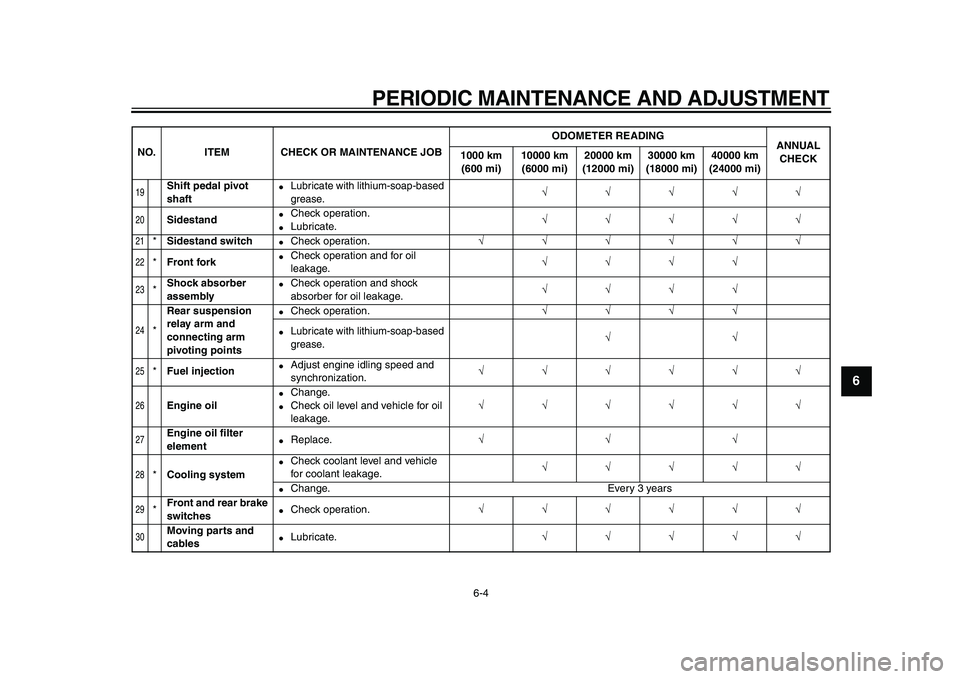
19
Shift pedal pivot
shaft
●
Lubricate with lithium-soap-based
grease.
√√√√√
20
Sidestand
●
Check operation.
●
Lubricate.
√√√√√
21
*
Sidestand switch
●
Check operation.
√√√√√√
22
*
Front fork
●
Check operation and for oil
leakage.
√√√√
23
*
Shock absorber
assembly
●
Check operation and shock
absorber for oil leakage.
√√√√
24
*
Rear suspension
relay arm and
connecting arm
pivoting points
●
Check operation.
√√√√
●
Lubricate with lithium-soap-based
grease.
√√
25
*
Fuel injection
●
Adjust engine idling speed and
synchronization.
√√√√√√
26
Engine oil
●
Change.
●
Check oil level and vehicle for oil
leakage.
√√√√√√
27
Engine oil filter
element
●
Replace.
√√√
28
*
Cooling system
●
Check coolant level and vehicle
for coolant leakage.
√√√√√
●
Change. Every 3 years
29
*
Front and rear brake
switches
●
Check operation.
√√√√√√
30
Moving parts and
cables
●
Lubricate.
√√√√√
NO. ITEM CHECK OR MAINTENANCE JOBODOMETER READING
ANNUAL
CHECK 1000 km
(600 mi)10000 km
(6000 mi)20000 km
(12000 mi)30000 km
(18000 mi)40000 km
(24000 mi)
Page 66 of 94
PERIODIC MAINTENANCE AND ADJUSTMENT
6-21
1
2
3
4
5
6
7
8
9
Observe these precautions:
●
When checking the fluid level,
make sure that the top of the brake
fluid reservoir is level.
●
Use only the recommended quality
brake fluid, otherwise the rubber
seals may deteriorate, causing
leakage and poor braking perfor-
mance.
●
Refill with the same type of brake
fluid. Mixing fluids may result in a
harmful chemical reaction and
lead to poor braking performance.
●
Be careful that water or dust does
not enter the brake fluid reservoir
when refilling. Water will signifi-
cantly lower the boiling point of the
fluid and may result in vapor lock,
and dirt may clog the ABS hydrau-
lic unit valves.
●
Brake fluid may deteriorate paint-
ed surfaces or plastic parts. Al-
ways clean up spilled fluid
immediately.
●
As the brake pads wear, it is nor-mal for the brake fluid level to grad-
ually go down. However, if the
brake fluid level goes down sud-
denly, have a Yamaha dealer
check the cause.
EAU22731
Changing the brake fluid
Have a Yamaha dealer change the
brake fluid at the intervals specified in
the TIP after the periodic maintenance
and lubrication chart. In addition, have
the oil seals of the master cylinders and
calipers as well as the brake hoses re-
placed at the intervals listed below or
whenever they are damaged or leak-
ing.
●
Oil seals: Replace every two
years.
●
Brake hoses: Replace every four
years.
Recommended brake fluid:
DOT 4
Page 74 of 94
PERIODIC MAINTENANCE AND ADJUSTMENT
6-29
1
2
3
4
5
6
7
8
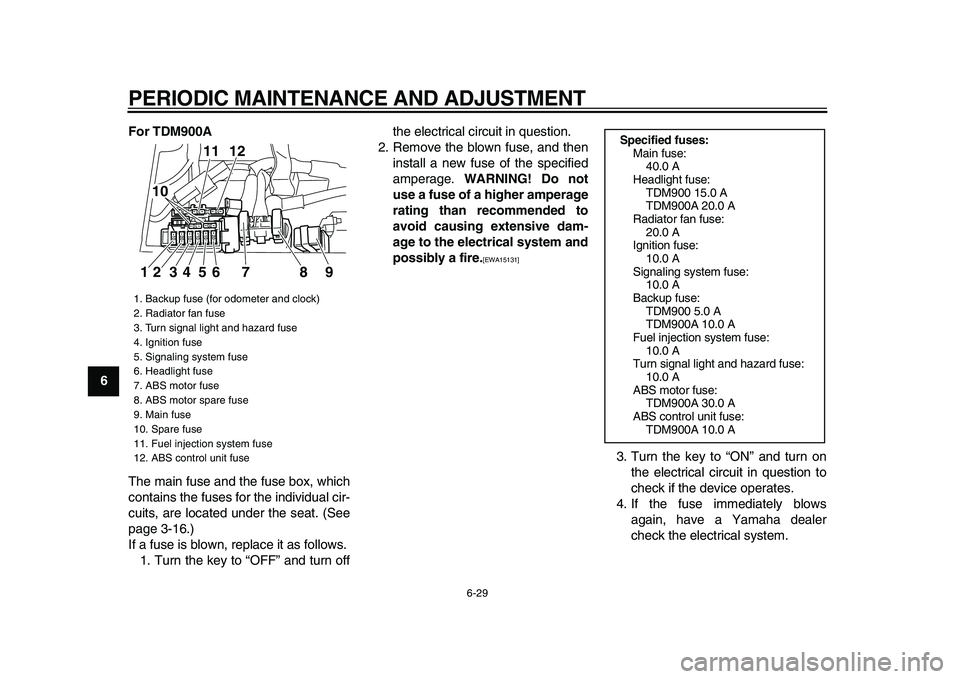
9For TDM900A
The main fuse and the fuse box, which
contains the fuses for the individual cir-
cuits, are located under the seat. (See
page 3-16.)
If a fuse is blown, replace it as follows.
1. Turn the key to “OFF” and turn offthe electrical circuit in question.
2. Remove the blown fuse, and then
install a new fuse of the specified
amperage.
WARNING! Do not
use a fuse of a higher amperage
rating than recommended to
avoid causing extensive dam-
age to the electrical system and
possibly a fire.
[EWA15131]
3. Turn the key to “ON” and turn on
the electrical circuit in question to
check if the device operates.
4. If the fuse immediately blows
again, have a Yamaha dealer
check the electrical system.
1. Backup fuse (for odometer and clock)
2. Radiator fan fuse
3. Turn signal light and hazard fuse
4. Ignition fuse
5. Signaling system fuse
6. Headlight fuse
7. ABS motor fuse
8. ABS motor spare fuse
9. Main fuse
10. Spare fuse
11. Fuel injection system fuse
12. ABS control unit fuse
12 34 5 6 7 8 911 12
10
Specified fuses:
Main fuse:
40.0 A
Headlight fuse:
TDM900 15.0 A
TDM900A 20.0 A
Radiator fan fuse:
20.0 A
Ignition fuse:
10.0 A
Signaling system fuse:
10.0 A
Backup fuse:
TDM900 5.0 A
TDM900A 10.0 A
Fuel injection system fuse:
10.0 A
Turn signal light and hazard fuse:
10.0 A
ABS motor fuse:
TDM900A 30.0 A
ABS control unit fuse:
TDM900A 10.0 A
Page 82 of 94
MOTORCYCLE CARE AND STORAGE
7-2
1
2
3
4
5
6
7
8
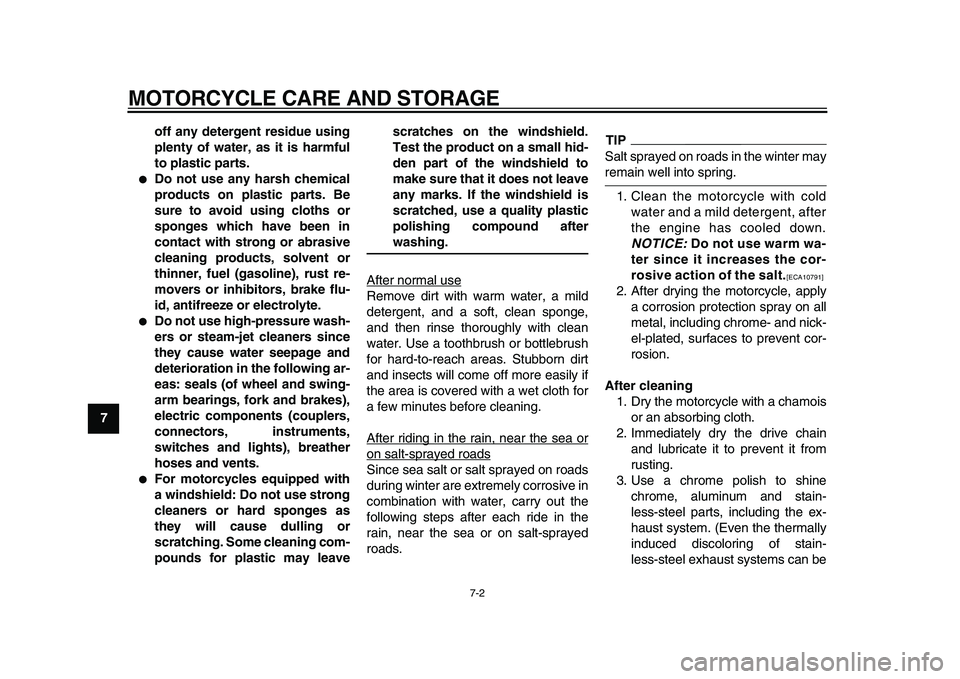
9off any detergent residue using
plenty of water, as it is harmful
to plastic parts.
●
Do not use any harsh chemical
products on plastic parts. Be
sure to avoid using cloths or
sponges which have been in
contact with strong or abrasive
cleaning products, solvent or
thinner, fuel (gasoline), rust re-
movers or inhibitors, brake flu-
id, antifreeze or electrolyte.
●
Do not use high-pressure wash-
ers or steam-jet cleaners since
they cause water seepage and
deterioration in the following ar-
eas: seals (of wheel and swing-
arm bearings, fork and brakes),
electric components (couplers,
connectors, instruments,
switches and lights), breather
hoses and vents.
●
For motorcycles equipped with
a windshield: Do not use strong
cleaners or hard sponges as
they will cause dulling or
scratching. Some cleaning com-
pounds for plastic may leavescratches on the windshield.
Test the product on a small hid-
den part of the windshield to
make sure that it does not leave
any marks. If the windshield is
scratched, use a quality plastic
polishing compound after
washing.
After normal use
Remove dirt with warm water, a mild
detergent, and a soft, clean sponge,
and then rinse thoroughly with clean
water. Use a toothbrush or bottlebrush
for hard-to-reach areas. Stubborn dirt
and insects will come off more easily if
the area is covered with a wet cloth for
a few minutes before cleaning.
After riding in the rain, near the sea oron salt-sprayed roadsSince sea salt or salt sprayed on roads
during winter are extremely corrosive in
combination with water, carry out the
following steps after each ride in the
rain, near the sea or on salt-sprayed
roads.
TIP
Salt sprayed on roads in the winter may
remain well into spring.
1.Clean the motorcycle with cold
water and a mild detergent, after
the engine has cooled down.
NOTICE:
Do not use warm wa-
ter since it increases the cor-
rosive action of the salt.
[ECA10791]
2. After drying the motorcycle, apply
a corrosion protection spray on all
metal, including chrome- and nick-
el-plated, surfaces to prevent cor-
rosion.
After cleaning
1. Dry the motorcycle with a chamois
or an absorbing cloth.
2. Immediately dry the drive chain
and lubricate it to prevent it from
rusting.
3. Use a chrome polish to shine
chrome, aluminum and stain-
less-steel parts, including the ex-
haust system. (Even the thermally
induced discoloring of stain-
less-steel exhaust systems can be
Page 87 of 94
SPECIFICATIONS
8-3
2
3
4
5
6
7
89
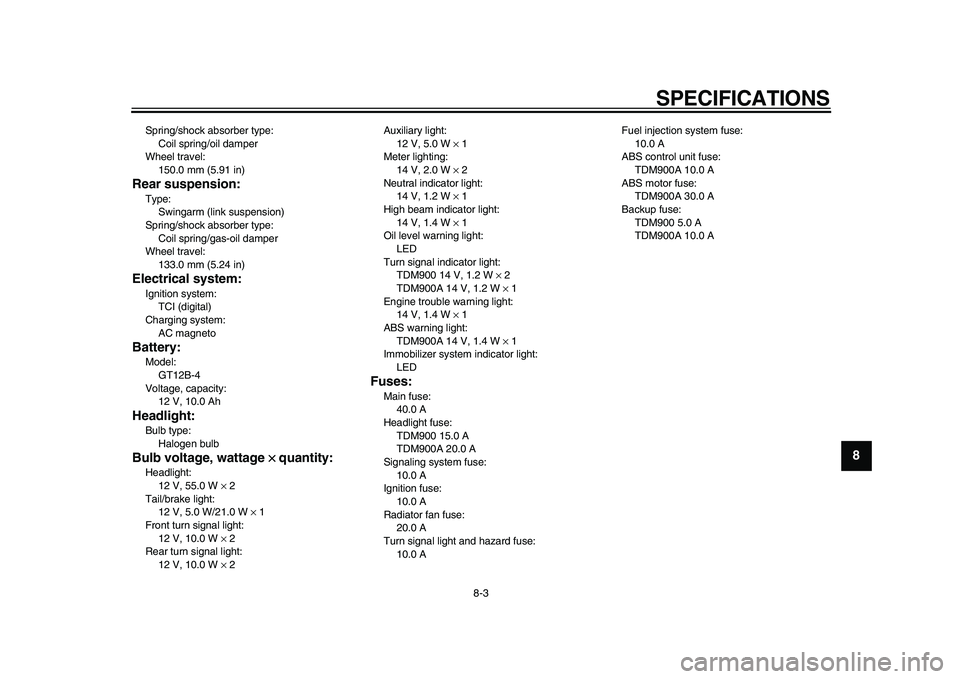
Spring/shock absorber type:
Coil spring/oil damper
Wheel travel:
150.0 mm (5.91 in)
Rear suspension:
Type:
Swingarm (link suspension)
Spring/shock absorber type:
Coil spring/gas-oil damper
Wheel travel:
133.0 mm (5.24 in)
Electrical system:
Ignition system:
TCI (digital)
Charging system:
AC magneto
Battery:
Model:
GT12B-4
Voltage, capacity:
12 V, 10.0 Ah
Headlight:
Bulb type:
Halogen bulb
Bulb voltage, wattage
×× × ×
quantity:
Headlight:
12 V, 55.0 W
×
2
Tail/brake light:
12 V, 5.0 W/21.0 W
×
1
Front turn signal light:
12 V, 10.0 W
×
2
Rear turn signal light:
12 V, 10.0 W
×
2Auxiliary light:
12 V, 5.0 W
×
1
Meter lighting:
14 V, 2.0 W
×
2
Neutral indicator light:
14 V, 1.2 W
×
1
High beam indicator light:
14 V, 1.4 W
×
1
Oil level warning light:
LED
Turn signal indicator light:
TDM900 14 V, 1.2 W
×
2
TDM900A 14 V, 1.2 W
×
1
Engine trouble warning light:
14 V, 1.4 W
×
1
ABS warning light:
TDM900A 14 V, 1.4 W
×
1
Immobilizer system indicator light:
LED
Fuses:
Main fuse:
40.0 A
Headlight fuse:
TDM900 15.0 A
TDM900A 20.0 A
Signaling system fuse:
10.0 A
Ignition fuse:
10.0 A
Radiator fan fuse:
20.0 A
Turn signal light and hazard fuse:
10.0 AFuel injection system fuse:
10.0 A
ABS control unit fuse:
TDM900A 10.0 A
ABS motor fuse:
TDM900A 30.0 A
Backup fuse:
TDM900 5.0 A
TDM900A 10.0 A
Page 90 of 94
INDEX
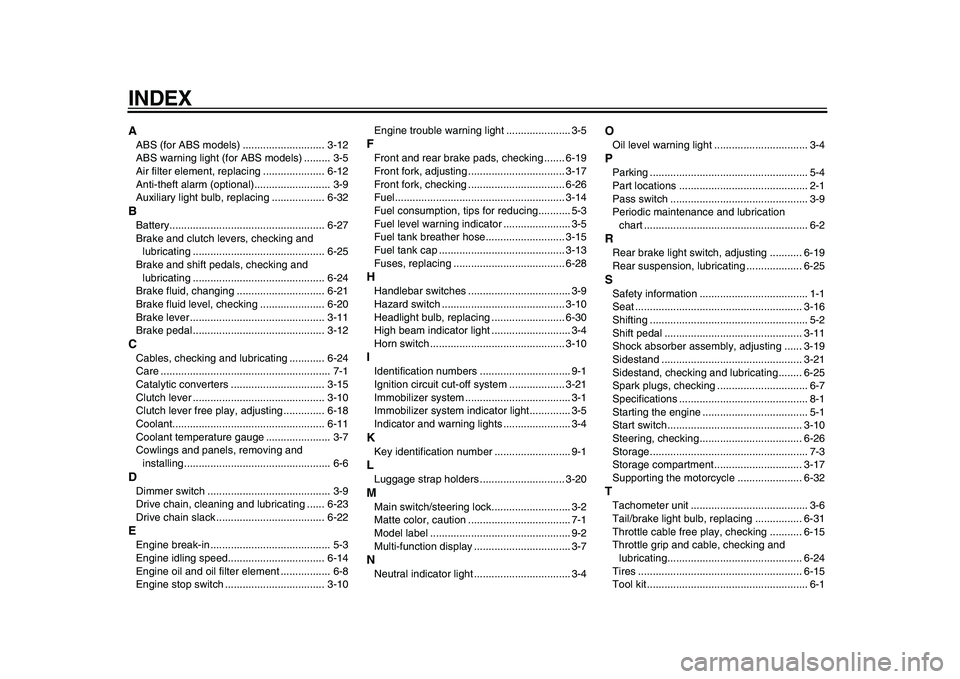
A
ABS (for ABS models) ............................ 3-12
ABS warning light (for ABS models) ......... 3-5
Air filter element, replacing ..................... 6-12
Anti-theft alarm (optional).......................... 3-9
Auxiliary light bulb, replacing .................. 6-32
B
Battery..................................................... 6-27
Brake and clutch levers, checking and
lubricating ............................................. 6-25
Brake and shift pedals, checking and
lubricating ............................................. 6-24
Brake fluid, changing .............................. 6-21
Brake fluid level, checking ...................... 6-20
Brake lever .............................................. 3-11
Brake pedal ............................................. 3-12
C
Cables, checking and lubricating ............ 6-24
Care .......................................................... 7-1
Catalytic converters ................................ 3-15
Clutch lever ............................................. 3-10
Clutch lever free play, adjusting .............. 6-18
Coolant.................................................... 6-11
Coolant temperature gauge ...................... 3-7
Cowlings and panels, removing and
installing.................................................. 6-6
D
Dimmer switch .......................................... 3-9
Drive chain, cleaning and lubricating ...... 6-23
Drive chain slack ..................................... 6-22
E
Engine break-in ......................................... 5-3
Engine idling speed................................. 6-14
Engine oil and oil filter element ................. 6-8
Engine stop switch .................................. 3-10Engine trouble warning light ...................... 3-5
F
Front and rear brake pads, checking ....... 6-19
Front fork, adjusting ................................. 3-17
Front fork, checking ................................. 6-26
Fuel.......................................................... 3-14
Fuel consumption, tips for reducing........... 5-3
Fuel level warning indicator ....................... 3-5
Fuel tank breather hose........................... 3-15
Fuel tank cap ........................................... 3-13
Fuses, replacing ...................................... 6-28
H
Handlebar switches ................................... 3-9
Hazard switch .......................................... 3-10
Headlight bulb, replacing ......................... 6-30
High beam indicator light ........................... 3-4
Horn switch .............................................. 3-10
I
Identification numbers ............................... 9-1
Ignition circuit cut-off system ................... 3-21
Immobilizer system .................................... 3-1
Immobilizer system indicator light.............. 3-5
Indicator and warning lights ....................... 3-4
K
Key identification number .......................... 9-1
L
Luggage strap holders ............................. 3-20
M
Main switch/steering lock........................... 3-2
Matte color, caution ................................... 7-1
Model label ................................................ 9-2
Multi-function display ................................. 3-7
N
Neutral indicator light ................................. 3-4
O
Oil level warning light ................................ 3-4
P
Parking ...................................................... 5-4
Part locations ............................................ 2-1
Pass switch ............................................... 3-9
Periodic maintenance and lubrication
chart ........................................................ 6-2
R
Rear brake light switch, adjusting ........... 6-19
Rear suspension, lubricating ................... 6-25
S
Safety information ..................................... 1-1
Seat ......................................................... 3-16
Shifting ...................................................... 5-2
Shift pedal ............................................... 3-11
Shock absorber assembly, adjusting ...... 3-19
Sidestand ................................................ 3-21
Sidestand, checking and lubricating........ 6-25
Spark plugs, checking ............................... 6-7
Specifications ............................................ 8-1
Starting the engine .................................... 5-1
Start switch .............................................. 3-10
Steering, checking................................... 6-26
Storage...................................................... 7-3
Storage compartment.............................. 3-17
Supporting the motorcycle ...................... 6-32
T
Tachometer unit ........................................ 3-6
Tail/brake light bulb, replacing ................ 6-31
Throttle cable free play, checking ........... 6-15
Throttle grip and cable, checking and
lubricating.............................................. 6-24
Tires ........................................................ 6-15
Tool kit....................................................... 6-1