brake YAMAHA TDM 900 2009 Owner's Manual
[x] Cancel search | Manufacturer: YAMAHA, Model Year: 2009, Model line: TDM 900, Model: YAMAHA TDM 900 2009Pages: 94, PDF Size: 3.75 MB
Page 66 of 94
PERIODIC MAINTENANCE AND ADJUSTMENT
6-21
1
2
3
4
5
6
7
8
9
Observe these precautions:
●
When checking the fluid level,
make sure that the top of the brake
fluid reservoir is level.
●
Use only the recommended quality
brake fluid, otherwise the rubber
seals may deteriorate, causing
leakage and poor braking perfor-
mance.
●
Refill with the same type of brake
fluid. Mixing fluids may result in a
harmful chemical reaction and
lead to poor braking performance.
●
Be careful that water or dust does
not enter the brake fluid reservoir
when refilling. Water will signifi-
cantly lower the boiling point of the
fluid and may result in vapor lock,
and dirt may clog the ABS hydrau-
lic unit valves.
●
Brake fluid may deteriorate paint-
ed surfaces or plastic parts. Al-
ways clean up spilled fluid
immediately.
●
As the brake pads wear, it is nor-mal for the brake fluid level to grad-
ually go down. However, if the
brake fluid level goes down sud-
denly, have a Yamaha dealer
check the cause.
EAU22731
Changing the brake fluid
Have a Yamaha dealer change the
brake fluid at the intervals specified in
the TIP after the periodic maintenance
and lubrication chart. In addition, have
the oil seals of the master cylinders and
calipers as well as the brake hoses re-
placed at the intervals listed below or
whenever they are damaged or leak-
ing.
●
Oil seals: Replace every two
years.
●
Brake hoses: Replace every four
years.
Recommended brake fluid:
DOT 4
Page 67 of 94
PERIODIC MAINTENANCE AND ADJUSTMENT
6-22
2
3
4
5
67
8
9
EAU22760
Drive chain slack
The drive chain slack should be
checked before each ride and adjusted
if necessary.
EAU22773
To check the drive chain slack
1. Place the motorcycle on the side-
stand.
TIP
When checking and adjusting the drive
chain slack, there should be no weight
on the motorcycle.
2. Shift the transmission into the neu-
tral position.
3. Move the rear wheel by pushing
the motorcycle to locate the tight-
est portion of the drive chain, and
then measure the drive chain slack
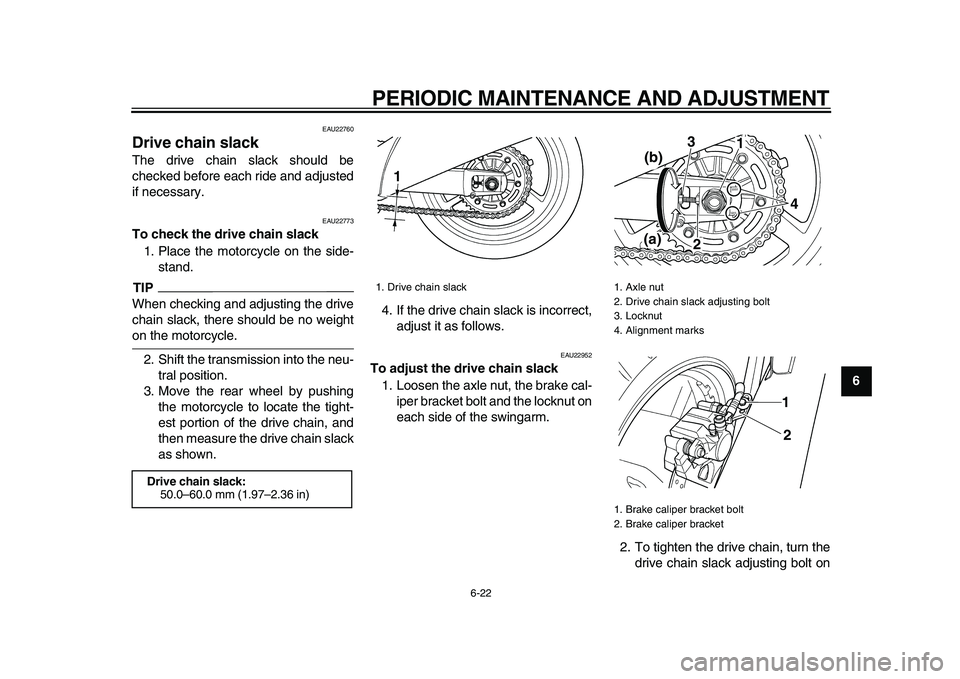
as shown.4. If the drive chain slack is incorrect,
adjust it as follows.
EAU22952
To adjust the drive chain slack
1. Loosen the axle nut, the brake cal-
iper bracket bolt and the locknut on
each side of the swingarm.
2. To tighten the drive chain, turn the
drive chain slack adjusting bolt on
Drive chain slack:
50.0–60.0 mm (1.97–2.36 in)
1. Drive chain slack
1
1. Axle nut
2. Drive chain slack adjusting bolt
3. Locknut
4. Alignment marks
1. Brake caliper bracket bolt
2. Brake caliper bracket
3
4 1
2 (b)
(a)
1
2
Page 68 of 94
PERIODIC MAINTENANCE AND ADJUSTMENT
6-23
1
2
3
4
5
6
7
8
9
each side of the swingarm in direc-
tion (a). To loosen the drive chain,
turn the adjusting bolt on each side
of the swingarm in direction (b),
and then push the rear wheel for-
ward.
NOTICE:
Improper drive
chain slack will overload the en-
gine as well as other vital parts
of the motorcycle and can lead
to chain slippage or breakage.
To prevent this from occurring,
keep the drive chain slack with-
in the specified limits.
[ECA10571]
TIP
Using the alignment marks on each
side of the swingarm, make sure that
both chain pullers are in the same posi-
tion for proper wheel alignment.
3. Tighten the locknuts, and then
tighten the axle nut and the brake
caliper bracket bolt to the specified
torques.
EAU23023
Cleaning and lubricating the
drive chain
The drive chain must be cleaned and
lubricated at the intervals specified in
the periodic maintenance and lubrica-
tion chart, otherwise it will quickly wear
out, especially when riding in dusty or
wet areas. Service the drive chain as
follows.
NOTICE
ECA10581
The drive chain must be lubricated
after washing the motorcycle and
riding in the rain.
1.Clean the drive chain with kero-
sene and a small soft brush.
NOTICE:
To prevent damaging
the O-rings, do not clean the
drive chain with steam cleaners,
high-pressure washers or inap-
propriate solvents.
[ECA11121]
2. Wipe the drive chain dry.
3. Thoroughly lubricate the drive
chain with a special O-ring chain
lubricant.
NOTICE:
Do not use
engine oil or any other lubri-
cants for the drive chain, as theymay contain substances that
could damage the O-rings.
[ECA11111]
Tightening torque:
Axle nut:
150 Nm (15.0 m·kgf, 108.5 ft·lbf)
Brake caliper bracket bolt:
40 Nm (4.0 m·kgf, 29 ft·lbf)
Page 69 of 94
PERIODIC MAINTENANCE AND ADJUSTMENT
6-24
2
3
4
5
67
8
9
EAU23101
Checking and lubricating the
cables
The operation of all control cables and
the condition of the cables should be
checked before each ride, and the ca-
bles and cable ends should be lubricat-
ed if necessary. If a cable is damaged
or does not move smoothly, have a
Yamaha dealer check or replace it.
WARNING! Damage to the outer
sheath may interfere with proper ca-
ble operation and will cause the in-
ner cable to rust. Replace a
damaged cable as soon as possible
to prevent unsafe conditions.
[EWA10721]
EAU23111
Checking and lubricating the
throttle grip and cable
The operation of the throttle grip should
be checked before each ride. In addi-
tion, the cable should be lubricated at
the intervals specified in the periodic
maintenance chart.
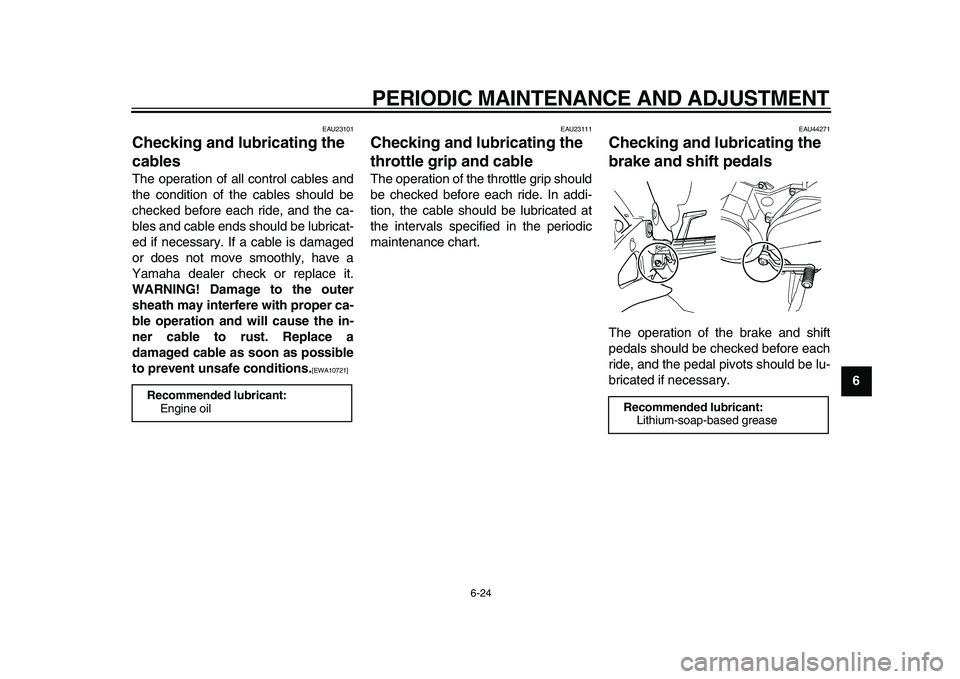
EAU44271
Checking and lubricating the
brake and shift pedals
The operation of the brake and shift
pedals should be checked before each
ride, and the pedal pivots should be lu-
bricated if necessary.
Recommended lubricant:
Engine oil
Recommended lubricant:
Lithium-soap-based grease
Page 70 of 94
PERIODIC MAINTENANCE AND ADJUSTMENT
6-25
1
2
3
4
5
6
7
8
9
EAU23142
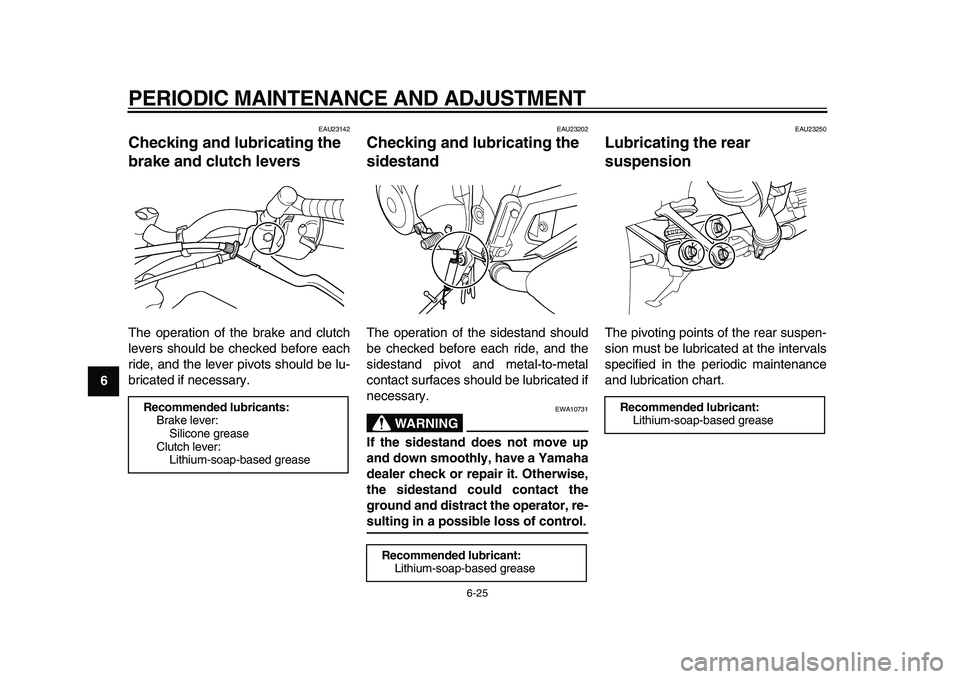
Checking and lubricating the
brake and clutch levers
The operation of the brake and clutch
levers should be checked before each
ride, and the lever pivots should be lu-
bricated if necessary.
EAU23202
Checking and lubricating the
sidestand
The operation of the sidestand should
be checked before each ride, and the
sidestand pivot and metal-to-metal
contact surfaces should be lubricated if
necessary.
WARNING
EWA10731
If the sidestand does not move up
and down smoothly, have a Yamaha
dealer check or repair it. Otherwise,
the sidestand could contact the
ground and distract the operator, re-
sulting in a possible loss of control.
EAU23250
Lubricating the rear
suspension
The pivoting points of the rear suspen-
sion must be lubricated at the intervals
specified in the periodic maintenance
and lubrication chart.
Recommended lubricants:
Brake lever:
Silicone grease
Clutch lever:
Lithium-soap-based grease
Recommended lubricant:
Lithium-soap-based grease
Recommended lubricant:
Lithium-soap-based grease
Page 71 of 94
PERIODIC MAINTENANCE AND ADJUSTMENT
6-26
2
3
4
5
67
8
9
EAU23272
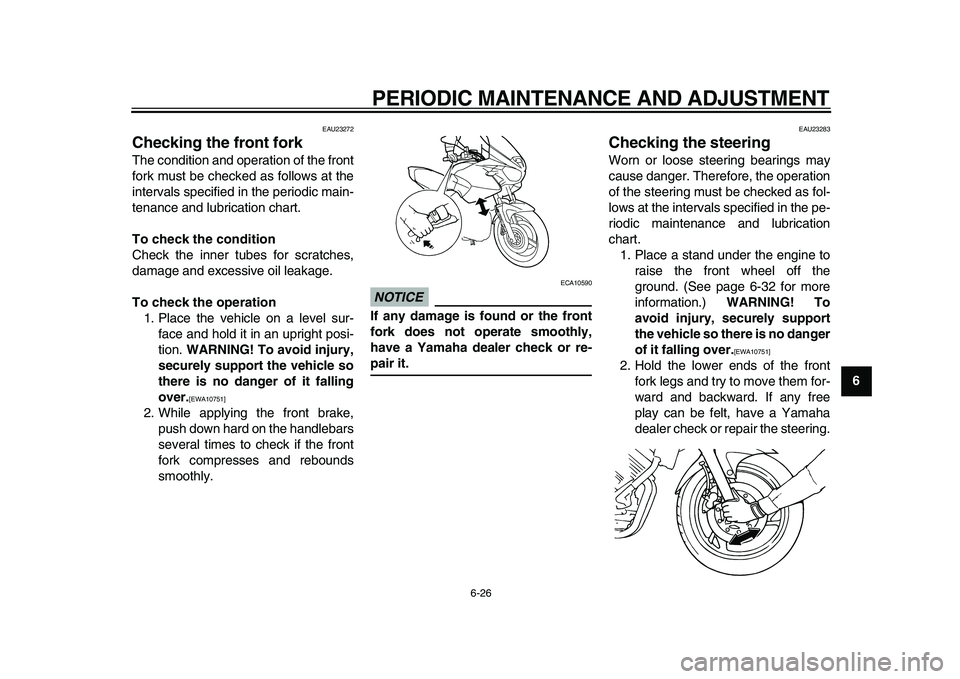
Checking the front fork
The condition and operation of the front
fork must be checked as follows at the
intervals specified in the periodic main-
tenance and lubrication chart.
To check the condition
Check the inner tubes for scratches,
damage and excessive oil leakage.
To check the operation
1. Place the vehicle on a level sur-
face and hold it in an upright posi-
tion.
WARNING! To avoid injury,
securely support the vehicle so
there is no danger of it falling
over.
[EWA10751]
2. While applying the front brake,
push down hard on the handlebars
several times to check if the front
fork compresses and rebounds
smoothly.
NOTICE
ECA10590
If any damage is found or the front
fork does not operate smoothly,
have a Yamaha dealer check or re-
pair it.
EAU23283
Checking the steering
Worn or loose steering bearings may
cause danger. Therefore, the operation
of the steering must be checked as fol-
lows at the intervals specified in the pe-
riodic maintenance and lubrication
chart.
1. Place a stand under the engine to
raise the front wheel off the
ground. (See page 6-32 for more
information.)
WARNING! To
avoid injury, securely support
the vehicle so there is no danger
of it falling over.
[EWA10751]
2. Hold the lower ends of the front
fork legs and try to move them for-
ward and backward. If any free
play can be felt, have a Yamaha
dealer check or repair the steering.
Page 76 of 94
PERIODIC MAINTENANCE AND ADJUSTMENT
6-31
1
2
3
4
5
6
7
8
9
EAU24081
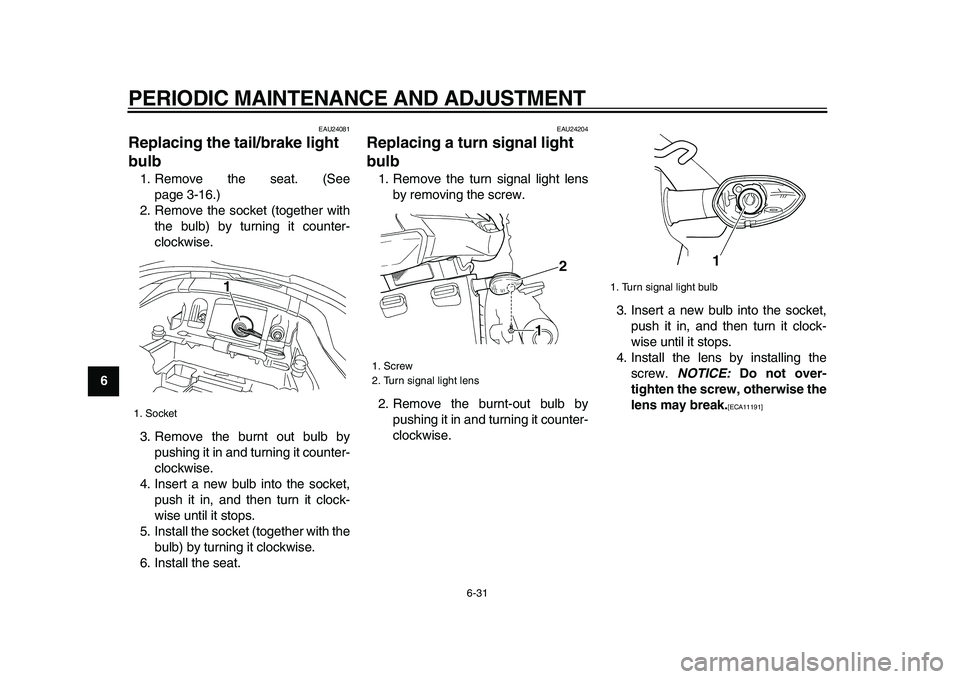
Replacing the tail/brake light
bulb
1. Remove the seat. (See
page 3-16.)
2. Remove the socket (together with
the bulb) by turning it counter-
clockwise.
3. Remove the burnt out bulb by
pushing it in and turning it counter-
clockwise.
4. Insert a new bulb into the socket,
push it in, and then turn it clock-
wise until it stops.
5. Install the socket (together with the
bulb) by turning it clockwise.
6. Install the seat.
EAU24204
Replacing a turn signal light
bulb
1. Remove the turn signal light lens
by removing the screw.
2. Remove the burnt-out bulb by
pushing it in and turning it counter-
clockwise.3. Insert a new bulb into the socket,
push it in, and then turn it clock-
wise until it stops.
4. Install the lens by installing the
screw.
NOTICE:
Do not over-
tighten the screw, otherwise the
lens may break.
[ECA11191]
1. Socket
1
1. Screw
2. Turn signal light lens
12
1. Turn signal light bulb
1
Page 82 of 94
MOTORCYCLE CARE AND STORAGE
7-2
1
2
3
4
5
6
7
8
9off any detergent residue using
plenty of water, as it is harmful
to plastic parts.
●
Do not use any harsh chemical
products on plastic parts. Be
sure to avoid using cloths or
sponges which have been in
contact with strong or abrasive
cleaning products, solvent or
thinner, fuel (gasoline), rust re-
movers or inhibitors, brake flu-
id, antifreeze or electrolyte.
●
Do not use high-pressure wash-
ers or steam-jet cleaners since
they cause water seepage and
deterioration in the following ar-
eas: seals (of wheel and swing-
arm bearings, fork and brakes),
electric components (couplers,
connectors, instruments,
switches and lights), breather
hoses and vents.
●
For motorcycles equipped with
a windshield: Do not use strong
cleaners or hard sponges as
they will cause dulling or
scratching. Some cleaning com-
pounds for plastic may leavescratches on the windshield.
Test the product on a small hid-
den part of the windshield to
make sure that it does not leave
any marks. If the windshield is
scratched, use a quality plastic
polishing compound after
washing.
After normal use
Remove dirt with warm water, a mild
detergent, and a soft, clean sponge,
and then rinse thoroughly with clean
water. Use a toothbrush or bottlebrush
for hard-to-reach areas. Stubborn dirt
and insects will come off more easily if
the area is covered with a wet cloth for
a few minutes before cleaning.
After riding in the rain, near the sea oron salt-sprayed roadsSince sea salt or salt sprayed on roads
during winter are extremely corrosive in
combination with water, carry out the
following steps after each ride in the
rain, near the sea or on salt-sprayed
roads.
TIP
Salt sprayed on roads in the winter may
remain well into spring.
1.Clean the motorcycle with cold
water and a mild detergent, after
the engine has cooled down.
NOTICE:
Do not use warm wa-
ter since it increases the cor-
rosive action of the salt.
[ECA10791]
2. After drying the motorcycle, apply
a corrosion protection spray on all
metal, including chrome- and nick-
el-plated, surfaces to prevent cor-
rosion.
After cleaning
1. Dry the motorcycle with a chamois
or an absorbing cloth.
2. Immediately dry the drive chain
and lubricate it to prevent it from
rusting.
3. Use a chrome polish to shine
chrome, aluminum and stain-
less-steel parts, including the ex-
haust system. (Even the thermally
induced discoloring of stain-
less-steel exhaust systems can be
Page 83 of 94
MOTORCYCLE CARE AND STORAGE
7-3
2
3
4
5
6
78
9
removed through polishing.)
4. To prevent corrosion, it is recom-
mended to apply a corrosion pro-
tection spray on all metal,
including chrome- and nickel-plat-
ed, surfaces.
5. Use spray oil as a universal clean-
er to remove any remaining dirt.
6. Touch up minor paint damage
caused by stones, etc.
7. Wax all painted surfaces.
8. Let the motorcycle dry completely
before storing or covering it.
WARNING
EWA11131
Contaminants on the brakes or tires
can cause loss of control.
●
Make sure that there is no oil or
wax on the brakes or tires.
●
If necessary, clean the brake
discs and brake linings with a
regular brake disc cleaner or ac-
etone, and wash the tires with
warm water and a mild deter-
gent. Before riding at higher
speeds, test the motorcycle’s
braking performance and cor-
nering behavior.
NOTICE
ECA10800
●
Apply spray oil and wax spar-
ingly and make sure to wipe off
any excess.
●
Never apply oil or wax to any
rubber and plastic parts, but
treat them with a suitable care
product.
●
Avoid using abrasive polishing
compounds as they will wear
away the paint.
TIP
●
Consult a Yamaha dealer for ad-
vice on what products to use.
●
Washing, rainy weather or humid
climates can cause the headlight
lens to fog. Turning the headlight
on for a short period of time will
help remove the moisture from the
lens.
EAU26202
Storage
Short-term
Always store your motorcycle in a cool,
dry place and, if necessary, protect it
against dust with a porous cover.
NOTICE
ECA10810
●
Storing the motorcycle in a
poorly ventilated room or cover-
ing it with a tarp, while it is still
wet, will allow water and humid-
ity to seep in and cause rust.
●
To prevent corrosion, avoid
damp cellars, stables (because
of the presence of ammonia)
and areas where strong chemi-
cals are stored.
Long-term
Before storing your motorcycle for sev-
eral months:
1. Follow all the instructions in the
“Care” section of this chapter.
2. Fill up the fuel tank and add fuel
stabilizer (if available) to prevent
the fuel tank from rusting and the
Page 86 of 94
SPECIFICATIONS
8-2
1
2
3
4
5
6
7
8
9
Transmission type:
Constant mesh 6-speed
Operation:
Left foot operation
Gear ratio:
1st:
33/12 (2.750)
2nd:
37/19 (1.947)
3rd:
34/22 (1.545)
4th:
31/25 (1.240)
5th:
26/25 (1.040)
6th:
24/26 (0.923)
Chassis:
Frame type:
Diamond
Caster angle:
25.50 °
Trail:
114.0 mm (4.49 in)
Front tire:
Type:
Tubeless
Size:
120/70 ZR18M/C (59W)
Manufacturer/model:
TDM900 METZELER/MEZ4 FRONT
TDM900A DUNLOP/D220FSTJ
Manufacturer/model:
TDM900 DUNLOP/D220FSTJ
Rear tire:
Type:
Tubeless
Size:
160/60 ZR17M/C (69W)
Manufacturer/model:
TDM900 METZELER/MEZ4
TDM900A DUNLOP/D220STJ
Manufacturer/model:
TDM900 DUNLOP/D220STJ
Loading:
Maximum load:
TDM900 201 kg (443 lb)
TDM900A 198 kg (437 lb)
*(Total weight of rider, passenger, cargo
and accessories)
Tire air pressure (measured on cold
tires):
Loading condition:
0–90 kg (0–198 lb)
Front:
225 kPa (2.25 kgf/cm2, 33 psi)
Rear:
250 kPa (2.50 kgf/cm2, 36 psi)
Loading condition:
TDM900 90–201 kg (198–443 lb)
TDM900A 90–198 kg (198–437 lb)
Front:
225 kPa (2.25 kgf/cm
2
, 33 psi)
Rear:
290 kPa (2.90 kgf/cm
2
, 42 psi)
High-speed riding:
Front:
225 kPa (2.25 kgf/cm 2
, 33 psi)Rear:
250 kPa (2.50 kgf/cm
2
, 36 psi)
Front wheel:
Wheel type:
Cast wheel
Rim size:
18M/C x MT3.50
Rear wheel:
Wheel type:
Cast wheel
Rim size:
17M/C x MT5.00
Front brake:
Type:
Dual disc brake
Operation:
Right hand operation
Recommended fluid:
DOT 4
Rear brake:
Type:
Single disc brake
Operation:
Right foot operation
Recommended fluid:
DOT 4
Front suspension:
Type:
Telescopic fork