ignition YAMAHA TDM 900 2009 Owners Manual
[x] Cancel search | Manufacturer: YAMAHA, Model Year: 2009, Model line: TDM 900, Model: YAMAHA TDM 900 2009Pages: 94, PDF Size: 3.75 MB
Page 6 of 94
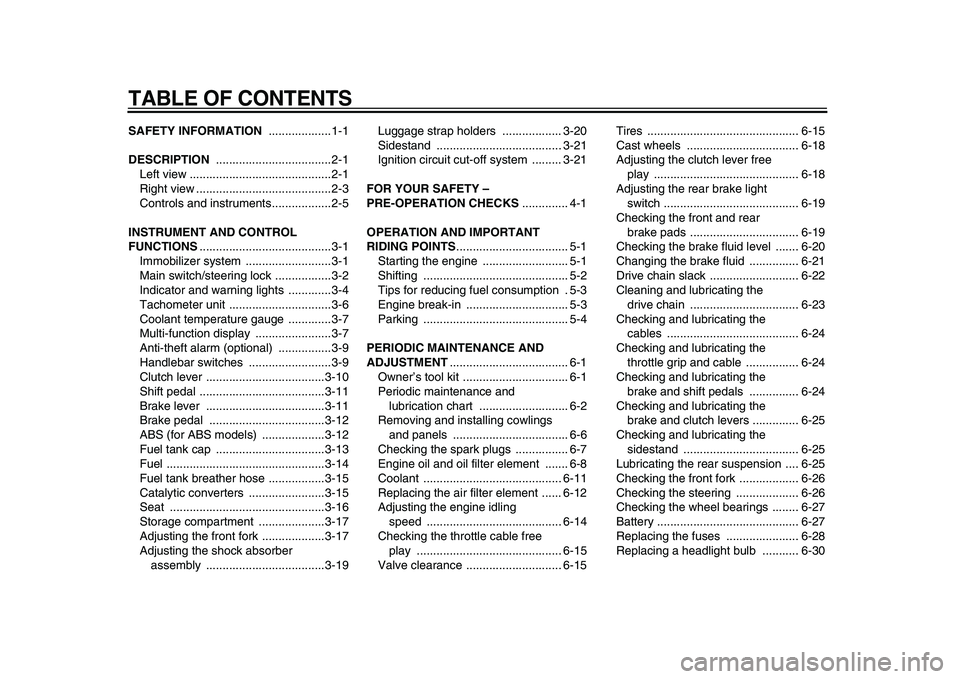
TABLE OF CONTENTS
SAFETY INFORMATION
...................1-1
DESCRIPTION
...................................2-1
Left view ...........................................2-1
Right view .........................................2-3
Controls and instruments..................2-5
INSTRUMENT AND CONTROL
FUNCTIONS
........................................3-1
Immobilizer system ..........................3-1
Main switch/steering lock .................3-2
Indicator and warning lights .............3-4
Tachometer unit ...............................3-6
Coolant temperature gauge .............3-7
Multi-function display .......................3-7
Anti-theft alarm (optional) ................3-9
Handlebar switches .........................3-9
Clutch lever ....................................3-10
Shift pedal ......................................3-11
Brake lever ....................................3-11
Brake pedal ...................................3-12
ABS (for ABS models) ...................3-12
Fuel tank cap .................................3-13
Fuel ................................................3-14
Fuel tank breather hose .................3-15
Catalytic converters .......................3-15
Seat ...............................................3-16
Storage compartment ....................3-17
Adjusting the front fork ...................3-17
Adjusting the shock absorber
assembly ....................................3-19Luggage strap holders .................. 3-20
Sidestand ...................................... 3-21
Ignition circuit cut-off system ......... 3-21
FOR YOUR SAFETY –
PRE-OPERATION CHECKS
.............. 4-1
OPERATION AND IMPORTANT
RIDING POINTS
.................................. 5-1
Starting the engine .......................... 5-1
Shifting ............................................ 5-2
Tips for reducing fuel consumption . 5-3
Engine break-in ............................... 5-3
Parking ............................................ 5-4
PERIODIC MAINTENANCE AND
ADJUSTMENT
.................................... 6-1
Owner’s tool kit ................................ 6-1
Periodic maintenance and
lubrication chart ........................... 6-2
Removing and installing cowlings
and panels ................................... 6-6
Checking the spark plugs ................ 6-7
Engine oil and oil filter element ....... 6-8
Coolant .......................................... 6-11
Replacing the air filter element ...... 6-12
Adjusting the engine idling
speed ......................................... 6-14
Checking the throttle cable free
play ............................................ 6-15
Valve clearance ............................. 6-15Tires .............................................. 6-15
Cast wheels .................................. 6-18
Adjusting the clutch lever free
play ............................................ 6-18
Adjusting the rear brake light
switch ......................................... 6-19
Checking the front and rear
brake pads ................................. 6-19
Checking the brake fluid level ....... 6-20
Changing the brake fluid ............... 6-21
Drive chain slack ........................... 6-22
Cleaning and lubricating the
drive chain ................................. 6-23
Checking and lubricating the
cables ........................................ 6-24
Checking and lubricating the
throttle grip and cable ................ 6-24
Checking and lubricating the
brake and shift pedals ............... 6-24
Checking and lubricating the
brake and clutch levers .............. 6-25
Checking and lubricating the
sidestand ................................... 6-25
Lubricating the rear suspension .... 6-25
Checking the front fork .................. 6-26
Checking the steering ................... 6-26
Checking the wheel bearings ........ 6-27
Battery ........................................... 6-27
Replacing the fuses ...................... 6-28
Replacing a headlight bulb ........... 6-30
Page 18 of 94
INSTRUMENT AND CONTROL FUNCTIONS
3-2
1
2
3
4
5
6
7
8
9as they may cause signal inter-
ference.
EAU10471
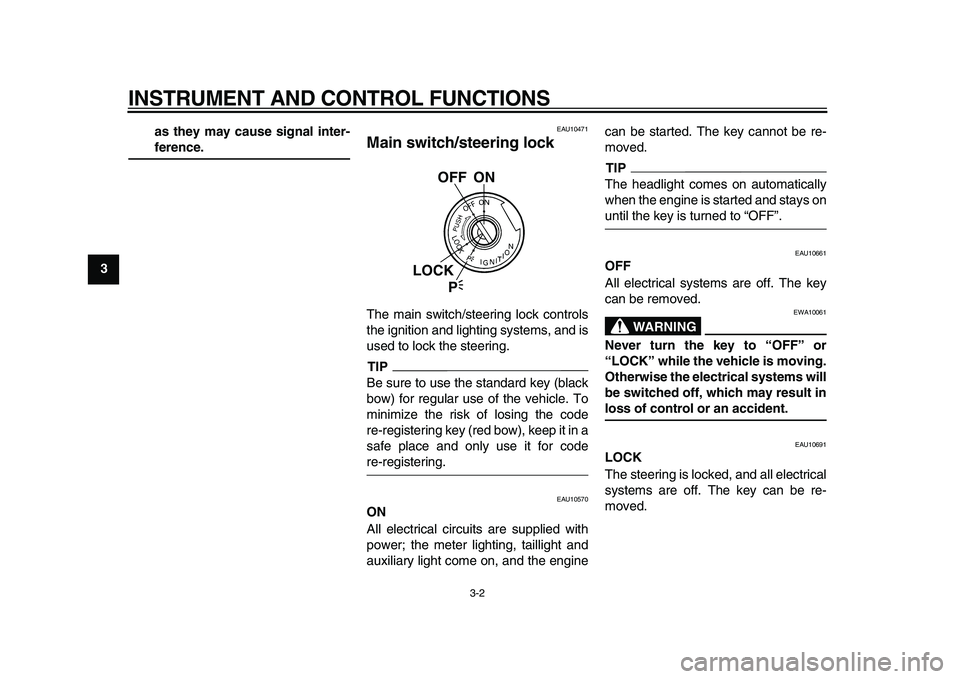
Main switch/steering lock
The main switch/steering lock controls
the ignition and lighting systems, and is
used to lock the steering.
TIP
Be sure to use the standard key (black
bow) for regular use of the vehicle. To
minimize the risk of losing the code
re-registering key (red bow), keep it in a
safe place and only use it for code
re-registering.
EAU10570
ON
All electrical circuits are supplied with
power; the meter lighting, taillight and
auxiliary light come on, and the enginecan be started. The key cannot be re-
moved.
TIP
The headlight comes on automatically
when the engine is started and stays on
until the key is turned to “OFF”.
EAU10661
OFF
All electrical systems are off. The key
can be removed.
WARNING
EWA10061
Never turn the key to “OFF” or
“LOCK” while the vehicle is moving.
Otherwise the electrical systems will
be switched off, which may result in
loss of control or an accident.
EAU10691
LOCK
The steering is locked, and all electrical
systems are off. The key can be re-
moved.
OFF ON
LOCK
P
Page 30 of 94

INSTRUMENT AND CONTROL FUNCTIONS
3-14
1
2
3
4
5
6
7
8
9
EAU13212
Fuel
Make sure there is sufficient gasoline in
the tank.
WARNING
EWA10881
Gasoline and gasoline vapors are
extremely flammable. To avoid fires
and explosions and to reduce the
risk of injury when refueling, follow
these instructions.
1. Before refueling, turn off the en-
gine and be sure that no one is sit-
ting on the vehicle. Never refuel
while smoking, or while in the vi-
cinity of sparks, open flames, or
other sources of ignition such as
the pilot lights of water heaters and
clothes dryers.
2. Do not overfill the fuel tank. Stop
filling when the fuel reaches the
bottom of the filler tube. Because
fuel expands when it heats up,
heat from the engine or the sun
can cause fuel to spill out of the
fuel tank.3. Wipe up any spilled fuel immedi-
ately.
NOTICE:
Immediately wipe
off spilled fuel with a clean, dry,
soft cloth, since fuel may deteri-
orate painted surfaces or plastic
parts.
[ECA10071]
4. Be sure to securely close the fuel
tank cap.
WARNING
EWA15151
Gasoline is poisonous and can
cause injury or death. Handle gaso-
line with care. Never siphon gaso-
line by mouth. If you should swallow
some gasoline or inhale a lot of gas-
oline vapor, or get some gasoline inyour eyes, see your doctor immedi-
ately. If gasoline spills on your skin,
wash with soap and water. If gaso-
line spills on your clothing, change
your clothes.
EAU13320
NOTICE
ECA11400
Use only unleaded gasoline. The use
of leaded gasoline will cause severe
damage to internal engine parts,
such as the valves and piston rings,
as well as to the exhaust system.
Your Yamaha engine has been de-
signed to use regular unleaded gaso-
line with a research octane number of
91 or higher. If knocking (or pinging) oc-
curs, use a gasoline of a different brand
1. Fuel tank filler tube
2. Fuel level
1 2
Recommended fuel:
REGULAR UNLEADED GASOLINE
ONLY
Fuel tank capacity:
20.0 L (5.28 US gal, 4.40 Imp.gal)
Fuel reserve amount:
3.5 L (0.92 US gal, 0.77 Imp.gal)
Page 37 of 94
INSTRUMENT AND CONTROL FUNCTIONS
3-21
2
34
5
6
7
8
9
EAU15301
Sidestand
The sidestand is located on the left side
of the frame. Raise the sidestand or
lower it with your foot while holding the
vehicle upright.
TIP
The built-in sidestand switch is part of
the ignition circuit cut-off system, which
cuts the ignition in certain situations.
(See further down for an explanation of
the ignition circuit cut-off system.)
WARNING
EWA10240
The vehicle must not be ridden with
the sidestand down, or if the side-
stand cannot be properly moved up
(or does not stay up), otherwise the
sidestand could contact the ground
and distract the operator, resulting
in a possible loss of control.
Yamaha’s ignition circuit cut-off
system has been designed to assist
the operator in fulfilling the respon-
sibility of raising the sidestand be-
fore starting off. Therefore, check
this system regularly as described
below and have a Yamaha dealer re-pair it if it does not function proper-
ly.
EAU44892
Ignition circuit cut-off system
The ignition circuit cut-off system (com-
prising the sidestand switch, clutch
switch and neutral switch) has the fol-
lowing functions.
●
It prevents starting when the trans-
mission is in gear and t
he side-
stand is up, but the clutch lever is
not pulled.
●
It prevents starting when the trans-
mission is in gear and the clutch le-
ver is pulled, but the sidestand is
still down.
●
It cuts the running engine when the
transmission is in gear and the sid-
estand is moved down.
Periodically check the operation of the
ignition circuit cut-off system according
to the following procedure.
Page 41 of 94
FOR YOUR SAFETY – PRE-OPERATION CHECKS
4-3
2
3
45
6
7
8
9
Chassis fasteners
●
Make sure that all nuts, bolts and screws are properly tightened.
●
Tighten if necessary.—
Instruments, lights, signals
and switches
●
Check operation.
●
Correct if necessary.—
Sidestand switch
●
Check operation of ignition circuit cut-off system.
●
If system is not working correctly, have Yamaha dealer check vehicle.3-21
ITEM CHECKS PAGE
Page 42 of 94
5-1
1
2
3
4
5
6
7
8
9
OPERATION AND IMPORTANT RIDING POINTS
EAU15951
Read the Owner’s Manual carefully to
become familiar with all controls. If
there is a control or function you do not
understand, ask your Yamaha dealer.
WARNING
EWA10271
Failure to familiarize yourself with
the controls can lead to loss of con-
trol, which could cause an accident
or injury.
EAU45310
TIP
This model is equipped with a lean an-
gle sensor to stop the engine in case of
a turnover. To start the engine after a
turnover, be sure to turn the main
switch to “OFF” and then to “ON”. Fail-
ing to do so will prevent the engine from
starting even though the engine will
crank when pushing the start switch.
EAU39893
Starting the engine
In order for the ignition circuit cut-off
system to enable starting, one of the
following conditions must be met:
●
The transmission is in the neutral
position.
●
The transmission is in gear with
the clutch lever pulled and the sid-
estand up.
See page 3-21 for more information.
1. Turn the key to “ON” and make
sure that the engine stop switch is
set to “ ”.
The following warning lights and
indicator light should come on for a
few seconds, then go off.
●
Oil level warning light
●
Engine trouble warning light
●
Immobilizer system indicator light
●
ABS warning light
NOTICE
ECA11831
If a warning or indicator light does
not go off, see page 3-4 for the corre-
sponding warning and indicator
light circuit check.
2. Shift the transmission into the neu-
Page 73 of 94
PERIODIC MAINTENANCE AND ADJUSTMENT
6-28
2
3
4
5
67
8
9 To charge the battery
Have a Yamaha dealer charge the bat-
tery as soon as possible if it seems to
have discharged. Keep in mind that the
battery tends to discharge more quickly
if the vehicle is equipped with optional
electrical accessories.
NOTICE
ECA16520
To charge a VRLA (Valve Regulated
Lead Acid) battery, a special (con-
stant-voltage) battery charger is re-
quired. Using a conventional battery
charger will damage the battery. If
you do not have access to a con-
stant-voltage battery charger, have a
Yamaha dealer charge your battery.
To store the battery
1.If the vehicle will not be used for
more than one month, remove
the battery, fully charge it, and
then place it in a cool, dry place.
NOTICE:
When removing the
battery, be sure the key is turned
to “OFF”, then disconnect the
negative lead before discon-
necting the positive lead.
[ECA16302]
2. If the battery will be stored for more
than two months, check it at least
once a month and fully charge it if
necessary.
3. Fully charge the battery before in-
stallation.
4. After installation, make sure that
the battery leads are properly con-
nected to the battery terminals.
NOTICE
ECA16530
Always keep the battery charged.
Storing a discharged battery can
cause permanent battery damage.
EAU38592
Replacing the fuses
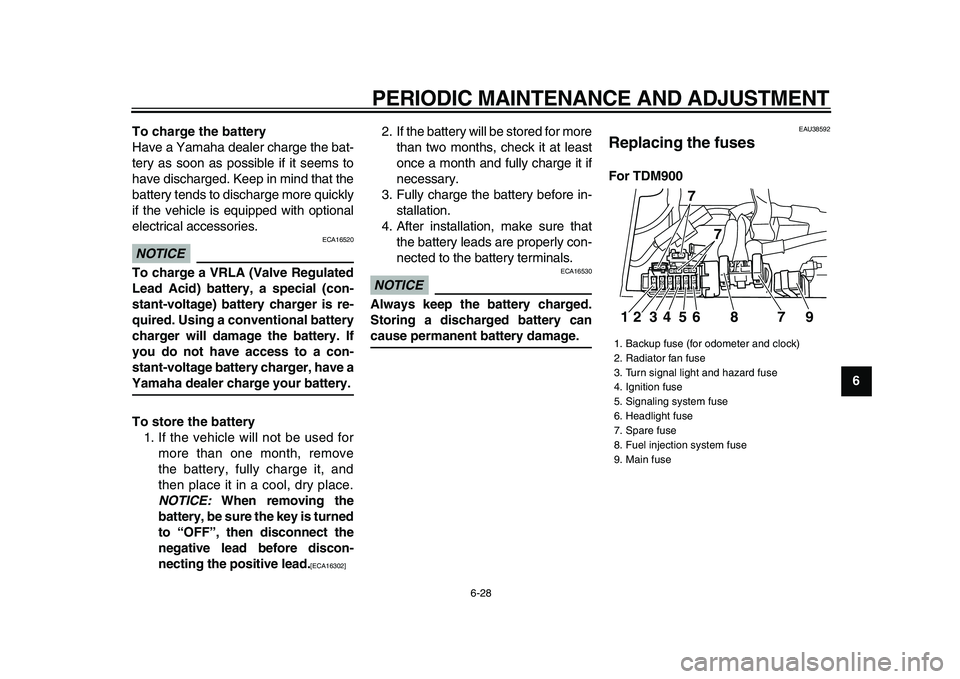
For TDM900
1. Backup fuse (for odometer and clock)
2. Radiator fan fuse
3. Turn signal light and hazard fuse
4. Ignition fuse
5. Signaling system fuse
6. Headlight fuse
7. Spare fuse
8. Fuel injection system fuse
9. Main fuse
12 34 5 6 7 97
7
8
Page 74 of 94
PERIODIC MAINTENANCE AND ADJUSTMENT
6-29
1
2
3
4
5
6
7
8
9For TDM900A
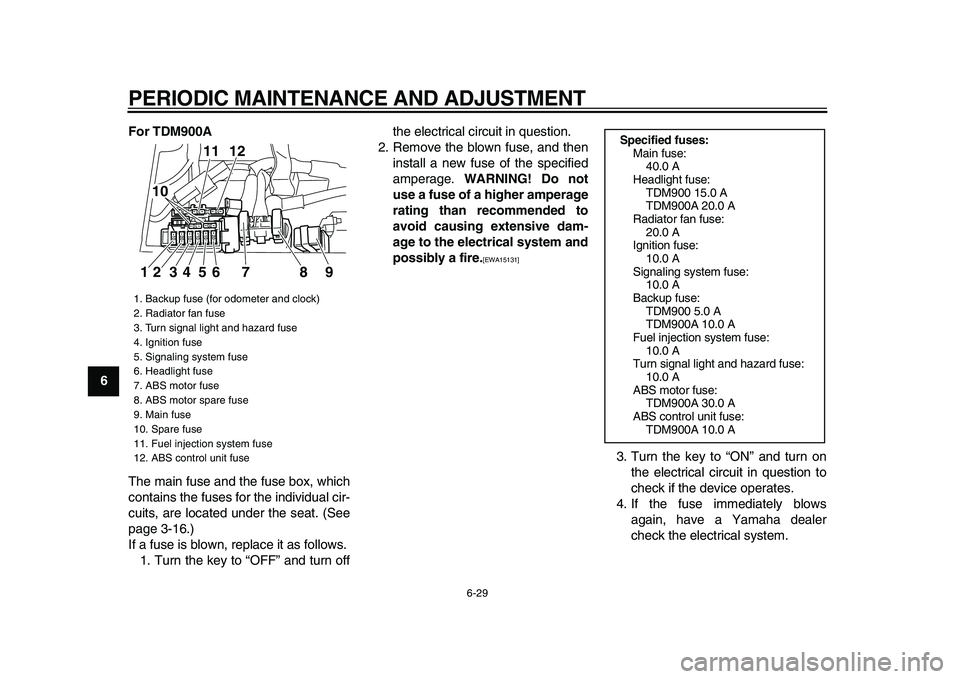
The main fuse and the fuse box, which
contains the fuses for the individual cir-
cuits, are located under the seat. (See
page 3-16.)
If a fuse is blown, replace it as follows.
1. Turn the key to “OFF” and turn offthe electrical circuit in question.
2. Remove the blown fuse, and then
install a new fuse of the specified
amperage.
WARNING! Do not
use a fuse of a higher amperage
rating than recommended to
avoid causing extensive dam-
age to the electrical system and
possibly a fire.
[EWA15131]
3. Turn the key to “ON” and turn on
the electrical circuit in question to
check if the device operates.
4. If the fuse immediately blows
again, have a Yamaha dealer
check the electrical system.
1. Backup fuse (for odometer and clock)
2. Radiator fan fuse
3. Turn signal light and hazard fuse
4. Ignition fuse
5. Signaling system fuse
6. Headlight fuse
7. ABS motor fuse
8. ABS motor spare fuse
9. Main fuse
10. Spare fuse
11. Fuel injection system fuse
12. ABS control unit fuse
12 34 5 6 7 8 911 12
10
Specified fuses:
Main fuse:
40.0 A
Headlight fuse:
TDM900 15.0 A
TDM900A 20.0 A
Radiator fan fuse:
20.0 A
Ignition fuse:
10.0 A
Signaling system fuse:
10.0 A
Backup fuse:
TDM900 5.0 A
TDM900A 10.0 A
Fuel injection system fuse:
10.0 A
Turn signal light and hazard fuse:
10.0 A
ABS motor fuse:
TDM900A 30.0 A
ABS control unit fuse:
TDM900A 10.0 A
Page 78 of 94
PERIODIC MAINTENANCE AND ADJUSTMENT
6-33
1
2
3
4
5
6
7
8
9
frame in front of the rear wheel or under
each side of the swingarm.
EAU25871
Troubleshooting
Although Yamaha motorcycles receive
a thorough inspection before shipment
from the factory, trouble may occur dur-
ing operation. Any problem in the fuel,
compression, or ignition systems, for
example, can cause poor starting and
loss of power.
The following troubleshooting charts
represent quick and easy procedures
for checking these vital systems your-
self. However, should your motorcycle
require any repair, take it to a Yamaha
dealer, whose skilled technicians have
the necessary tools, experience, and
know-how to service the motorcycle
properly.
Use only genuine Yamaha replace-
ment parts. Imitation parts may look like
Yamaha parts, but they are often inferi-
or, have a shorter service life and can
lead to expensive repair bills.
WARNING
EWA15141
When checking the fuel system, do
not smoke, and make sure there are
no open flames or sparks in the ar-
ea, including pilot lights from waterheaters or furnaces. Gasoline or
gasoline vapors can ignite or ex-
plode, causing severe injury or
property damage.
Page 79 of 94
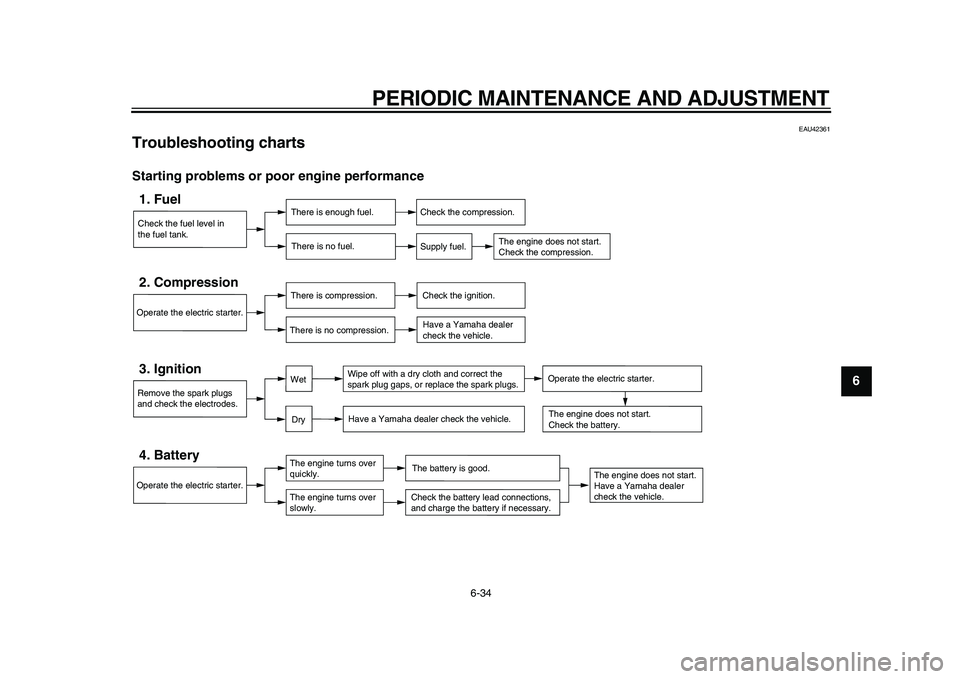
PERIODIC MAINTENANCE AND ADJUSTMENT
6-34
2
3
4
5
67
8
9
EAU42361
Troubleshooting charts
Starting problems or poor engine performance
Check the fuel level in
the fuel tank.1. Fuel
There is enough fuel.
There is no fuel.
Check the compression.
Supply fuel.
The engine does not start.
Check the compression.
Operate the electric starter.2. Compression
There is compression.
There is no compression.
Check the ignition.
Have a Yamaha dealer
check the vehicle.
Remove the spark plugs
and check the electrodes.3. Ignition
Wipe off with a dry cloth and correct the
spark plug gaps, or replace the spark plugs.
Have a Yamaha dealer check the vehicle.
The engine does not start.
Have a Yamaha dealer
check the vehicle.
The engine does not start.
Check the battery.
Operate the electric starter.4. Battery
The engine turns over
quickly.
The engine turns over
slowly.
The battery is good.Check the battery lead connections,
and charge the battery if necessary.
DryWet
Operate the electric starter.