seat adjustment YAMAHA TDM 900 2009 Owners Manual
[x] Cancel search | Manufacturer: YAMAHA, Model Year: 2009, Model line: TDM 900, Model: YAMAHA TDM 900 2009Pages: 94, PDF Size: 3.75 MB
Page 6 of 94
TABLE OF CONTENTS
SAFETY INFORMATION
...................1-1
DESCRIPTION
...................................2-1
Left view ...........................................2-1
Right view .........................................2-3
Controls and instruments..................2-5
INSTRUMENT AND CONTROL
FUNCTIONS
........................................3-1
Immobilizer system ..........................3-1
Main switch/steering lock .................3-2
Indicator and warning lights .............3-4
Tachometer unit ...............................3-6
Coolant temperature gauge .............3-7
Multi-function display .......................3-7
Anti-theft alarm (optional) ................3-9
Handlebar switches .........................3-9
Clutch lever ....................................3-10
Shift pedal ......................................3-11
Brake lever ....................................3-11
Brake pedal ...................................3-12
ABS (for ABS models) ...................3-12
Fuel tank cap .................................3-13
Fuel ................................................3-14
Fuel tank breather hose .................3-15
Catalytic converters .......................3-15
Seat ...............................................3-16
Storage compartment ....................3-17
Adjusting the front fork ...................3-17
Adjusting the shock absorber
assembly ....................................3-19Luggage strap holders .................. 3-20
Sidestand ...................................... 3-21
Ignition circuit cut-off system ......... 3-21
FOR YOUR SAFETY –
PRE-OPERATION CHECKS
.............. 4-1
OPERATION AND IMPORTANT
RIDING POINTS
.................................. 5-1
Starting the engine .......................... 5-1
Shifting ............................................ 5-2
Tips for reducing fuel consumption . 5-3
Engine break-in ............................... 5-3
Parking ............................................ 5-4
PERIODIC MAINTENANCE AND
ADJUSTMENT
.................................... 6-1
Owner’s tool kit ................................ 6-1
Periodic maintenance and
lubrication chart ........................... 6-2
Removing and installing cowlings
and panels ................................... 6-6
Checking the spark plugs ................ 6-7
Engine oil and oil filter element ....... 6-8
Coolant .......................................... 6-11
Replacing the air filter element ...... 6-12
Adjusting the engine idling
speed ......................................... 6-14
Checking the throttle cable free
play ............................................ 6-15
Valve clearance ............................. 6-15Tires .............................................. 6-15
Cast wheels .................................. 6-18
Adjusting the clutch lever free
play ............................................ 6-18
Adjusting the rear brake light
switch ......................................... 6-19
Checking the front and rear
brake pads ................................. 6-19
Checking the brake fluid level ....... 6-20
Changing the brake fluid ............... 6-21
Drive chain slack ........................... 6-22
Cleaning and lubricating the
drive chain ................................. 6-23
Checking and lubricating the
cables ........................................ 6-24
Checking and lubricating the
throttle grip and cable ................ 6-24
Checking and lubricating the
brake and shift pedals ............... 6-24
Checking and lubricating the
brake and clutch levers .............. 6-25
Checking and lubricating the
sidestand ................................... 6-25
Lubricating the rear suspension .... 6-25
Checking the front fork .................. 6-26
Checking the steering ................... 6-26
Checking the wheel bearings ........ 6-27
Battery ........................................... 6-27
Replacing the fuses ...................... 6-28
Replacing a headlight bulb ........... 6-30
Page 36 of 94
INSTRUMENT AND CONTROL FUNCTIONS
3-20
1
2
3
4
5
6
7
8
9
force and thereby harden the compres-
sion damping, turn the adjusting knob
in direction (a). To decrease the com-
pression damping force and thereby
soften the compression damping, turn
the adjusting knob in direction (b).
TIP
To obtain a precise adjustment, it is ad-
visable to check the actual total number
of clicks or turns of each damping force
adjusting mechanism. This adjustment
range may not exactly match the spec-
ifications listed due to small differences
in production.
WARNING
EWA10221
This shock absorber assembly con-
tains highly pressurized nitrogen
gas. Read and understand the fol-lowing information before handling
the shock absorber assembly.
●
Do not tamper with or attempt to
open the cylinder assembly.
●
Do not subject the shock ab-
sorber assembly to an open
flame or other high heat source.
This may cause the unit to ex-
plode due to excessive gas
pressure.
●
Do not deform or damage the
cylinder in any way. Cylinder
damage will result in poor
damping performance.
●
Do not dispose of a damaged or
worn-out shock absorber as-
sembly yourself. Take the shock
absorber assembly to a Yamaha
dealer for any service.
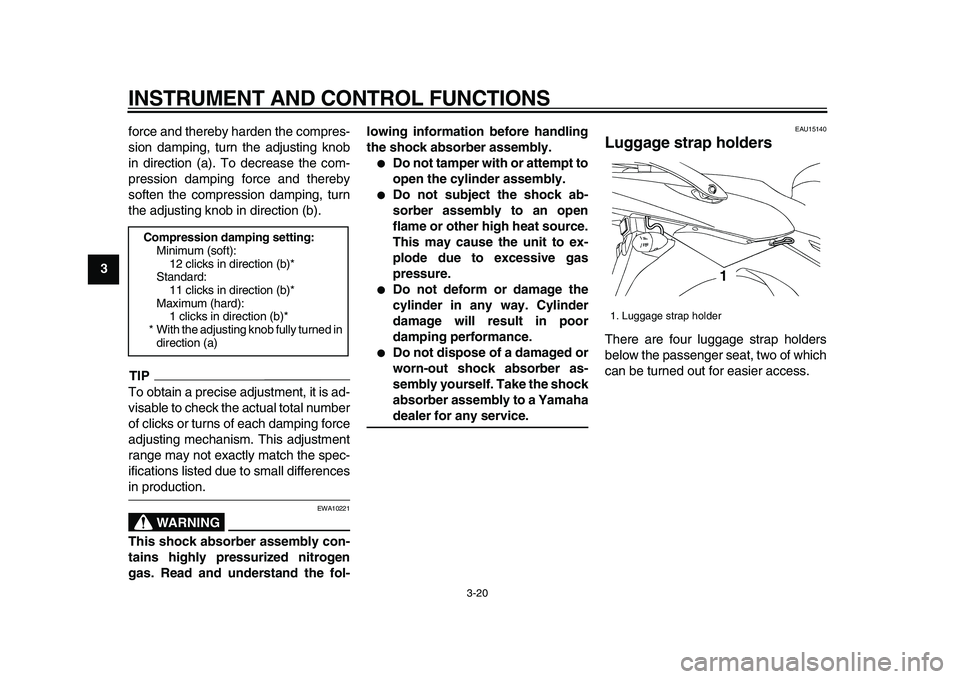
EAU15140
Luggage strap holders
There are four luggage strap holders
below the passenger seat, two of which
can be turned out for easier access.
Compression damping setting:
Minimum (soft):
12 clicks in direction (b)*
Standard:
11 clicks in direction (b)*
Maximum (hard):
1 clicks in direction (b)*
*With the adjusting knob fully turned in
direction (a)
1. Luggage strap holder
1
Page 46 of 94
6-1
1
2
3
4
5
6
7
8
9
PERIODIC MAINTENANCE AND ADJUSTMENT
EAU17241
Periodic inspection, adjustment, and lu-
brication will keep your vehicle in the
safest and most efficient condition pos-
sible. Safety is an obligation of the vehi-
cle owner/operator. The most important
points of vehicle inspection, adjust-
ment, and lubrication are explained on
the following pages.
The intervals given in the periodic
maintenance and lubrication chart
should be simply considered as a gen-
eral guide under normal riding condi-
tions. However, depending on the
weather, terrain, geographical location,
and individual use, the maintenance in-
tervals may need to be shortened.
WARNING
EWA10321
Failure to properly maintain the ve-
hicle or performing maintenance
activities incorrectly may increase
your risk of injury or death during
service or while using the vehicle. If
you are not familiar with vehicle
service, have a Yamaha dealer per-
form service.
WARNING
EWA15121
Turn off the engine when performing
maintenance unless otherwise
specified.
●
A running engine has moving
parts that can catch on body
parts or clothing and electrical
parts that can cause shocks or
fires.
●
Running the engine while ser-
vicing can lead to eye injury,
burns, fire, or carbon monoxide
poisoning – possibly leading to
death. See page 1-1 for more in-
formation about carbon monox-
ide.
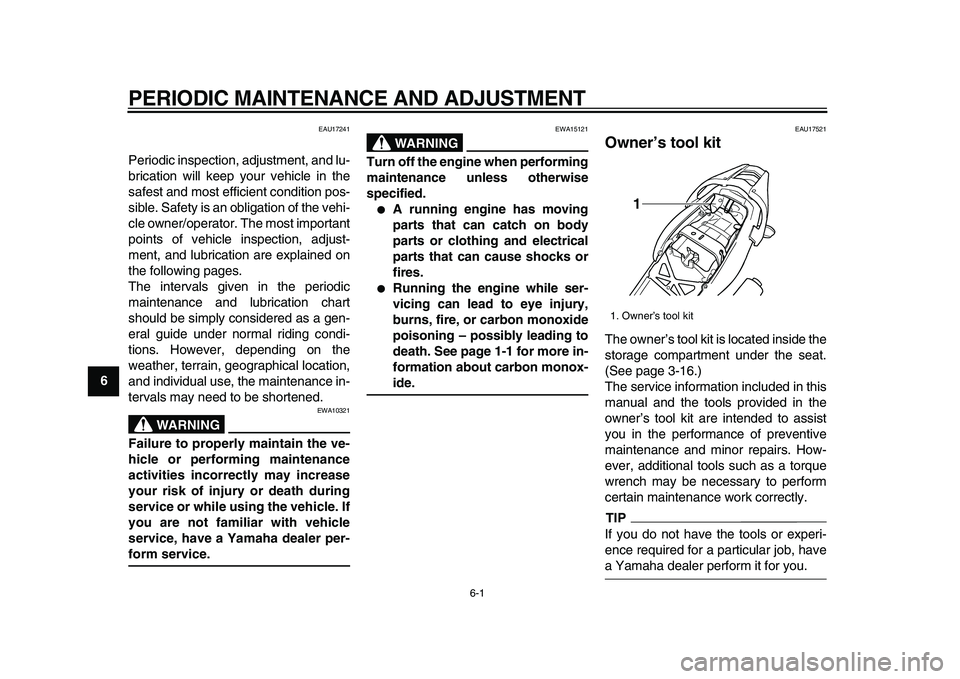
EAU17521
Owner’s tool kit
The owner’s tool kit is located inside the
storage compartment under the seat.
(See page 3-16.)
The service information included in this
manual and the tools provided in the
owner’s tool kit are intended to assist
you in the performance of preventive
maintenance and minor repairs. How-
ever, additional tools such as a torque
wrench may be necessary to perform
certain maintenance work correctly.
TIP
If you do not have the tools or experi-
ence required for a particular job, have
a Yamaha dealer perform it for you.
1. Owner’s tool kit
1
Page 52 of 94
PERIODIC MAINTENANCE AND ADJUSTMENT
6-7
1
2
3
4
5
6
7
8
9
To install the cowling
Place the cowling in the original posi-
tion, and then install the screws and the
quick fastener.TIP
To install the quick fastener, push the
center pin out so that it will protrude
from the fastener head, insert the fas-
tener into the cowling, and then push
the protruding pin in until it is flush with
the fastener head.
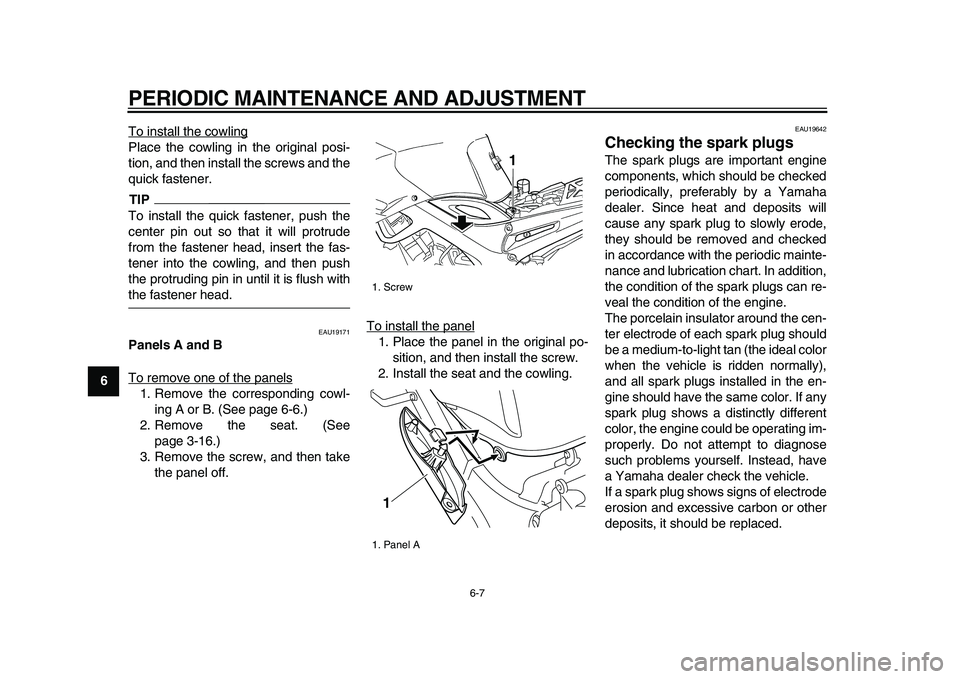
EAU19171
Panels A and B
To remove one of the panels
1. Remove the corresponding cowl-
ing A or B. (See page 6-6.)
2. Remove the seat. (See
page 3-16.)
3. Remove the screw, and then take
the panel off.To install the panel
1. Place the panel in the original po-
sition, and then install the screw.
2. Install the seat and the cowling.
EAU19642
Checking the spark plugs
The spark plugs are important engine
components, which should be checked
periodically, preferably by a Yamaha
dealer. Since heat and deposits will
cause any spark plug to slowly erode,
they should be removed and checked
in accordance with the periodic mainte-
nance and lubrication chart. In addition,
the condition of the spark plugs can re-
veal the condition of the engine.
The porcelain insulator around the cen-
ter electrode of each spark plug should
be a medium-to-light tan (the ideal color
when the vehicle is ridden normally),
and all spark plugs installed in the en-
gine should have the same color. If any
spark plug shows a distinctly different
color, the engine could be operating im-
properly. Do not attempt to diagnose
such problems yourself. Instead, have
a Yamaha dealer check the vehicle.
If a spark plug shows signs of electrode
erosion and excessive carbon or other
deposits, it should be replaced.
1. Screw
1. Panel A
1
1
Page 55 of 94
PERIODIC MAINTENANCE AND ADJUSTMENT
6-10
2
3
4
5
67
8
9
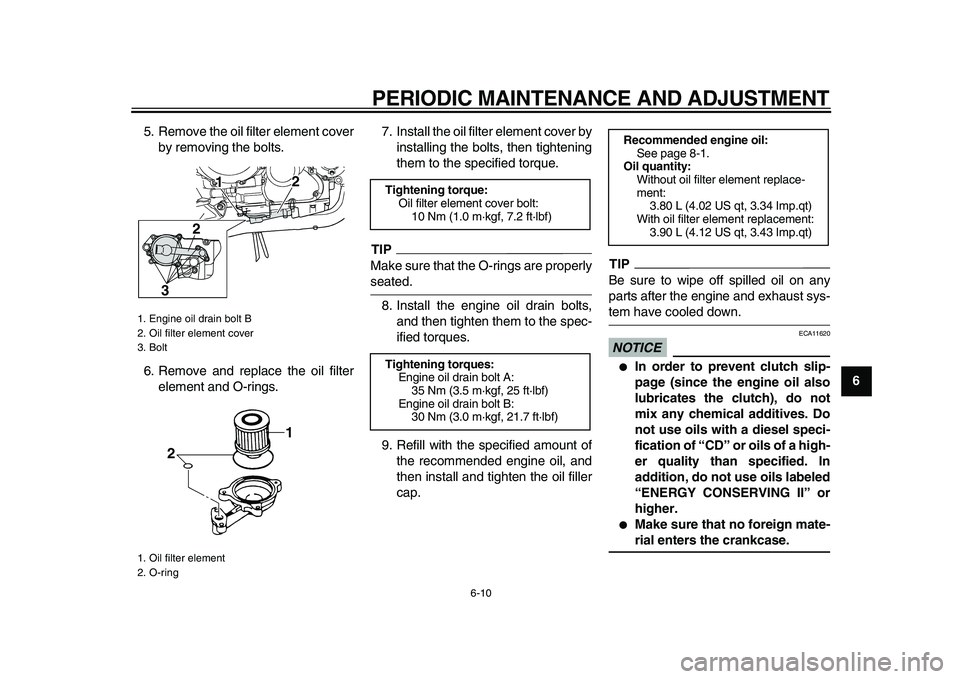
5. Remove the oil filter element cover
by removing the bolts.
6. Remove and replace the oil filter
element and O-rings.7. Install the oil filter element cover by
installing the bolts, then tightening
them to the specified torque.
TIP
Make sure that the O-rings are properly
seated.
8. Install the engine oil drain bolts,
and then tighten them to the spec-
ified torques.
9. Refill with the specified amount of
the recommended engine oil, and
then install and tighten the oil filler
cap.
TIP
Be sure to wipe off spilled oil on any
parts after the engine and exhaust sys-
tem have cooled down.
NOTICE
ECA11620
●
In order to prevent clutch slip-
page (since the engine oil also
lubricates the clutch), do not
mix any chemical additives. Do
not use oils with a diesel speci-
fication of “CD” or oils of a high-
er quality than specified. In
addition, do not use oils labeled
“ENERGY CONSERVING II” or
higher.
●
Make sure that no foreign mate-
rial enters the crankcase.
1. Engine oil drain bolt B
2. Oil filter element cover
3. Bolt
1. Oil filter element
2. O-ring
12
2
3
1
2
Tightening torque:
Oil filter element cover bolt:
10 Nm (1.0 m·kgf, 7.2 ft·lbf)
Tightening torques:
Engine oil drain bolt A:
35 Nm (3.5 m·kgf, 25 ft·lbf)
Engine oil drain bolt B:
30 Nm (3.0 m·kgf, 21.7 ft·lbf)
Recommended engine oil:
See page 8-1.
Oil quantity:
Without oil filter element replace-
ment:
3.80 L (4.02 US qt, 3.34 Imp.qt)
With oil filter element replacement:
3.90 L (4.12 US qt, 3.43 Imp.qt)
Page 57 of 94
PERIODIC MAINTENANCE AND ADJUSTMENT
6-12
2
3
4
5
67
8
9
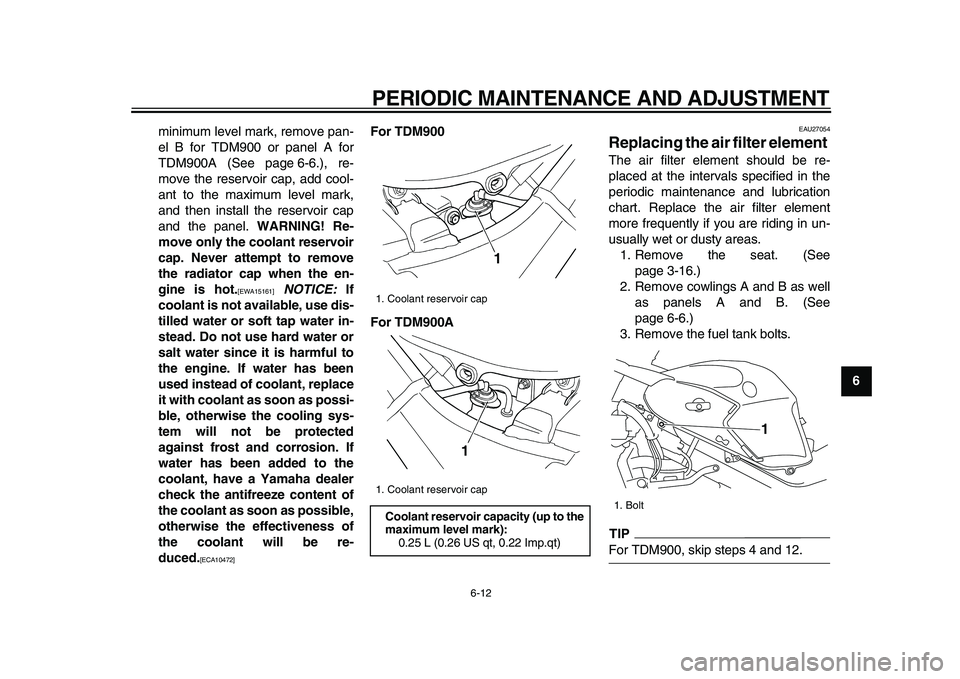
minimum level mark, remove pan-
el B for TDM900 or panel A for
TDM900A (See page 6-6.), re-
move the reservoir cap, add cool-
ant to the maximum level mark,
and then install the reservoir cap
and the panel.
WARNING! Re-
move only the coolant reservoir
cap. Never attempt to remove
the radiator cap when the en-
gine is hot.
[EWA15161]
NOTICE:
If
coolant is not available, use dis-
tilled water or soft tap water in-
stead. Do not use hard water or
salt water since it is harmful to
the engine. If water has been
used instead of coolant, replace
it with coolant as soon as possi-
ble, otherwise the cooling sys-
tem will not be protected
against frost and corrosion. If
water has been added to the
coolant, have a Yamaha dealer
check the antifreeze content of
the coolant as soon as possible,
otherwise the effectiveness of
the coolant will be re-
duced.
[ECA10472]
For TDM900
For TDM900A
EAU27054
Replacing the air filter element
The air filter element should be re-
placed at the intervals specified in the
periodic maintenance and lubrication
chart. Replace the air filter element
more frequently if you are riding in un-
usually wet or dusty areas.
1. Remove the seat. (See
page 3-16.)
2. Remove cowlings A and B as well
as panels A and B. (See
page 6-6.)
3. Remove the fuel tank bolts.
TIP
For TDM900, skip steps 4 and 12.
1. Coolant reservoir cap
1. Coolant reservoir cap
Coolant reservoir capacity (up to the
maximum level mark):
0.25 L (0.26 US qt, 0.22 Imp.qt)
1
1
1. Bolt
1
Page 58 of 94
PERIODIC MAINTENANCE AND ADJUSTMENT
6-13
1
2
3
4
5
6
7
8
9
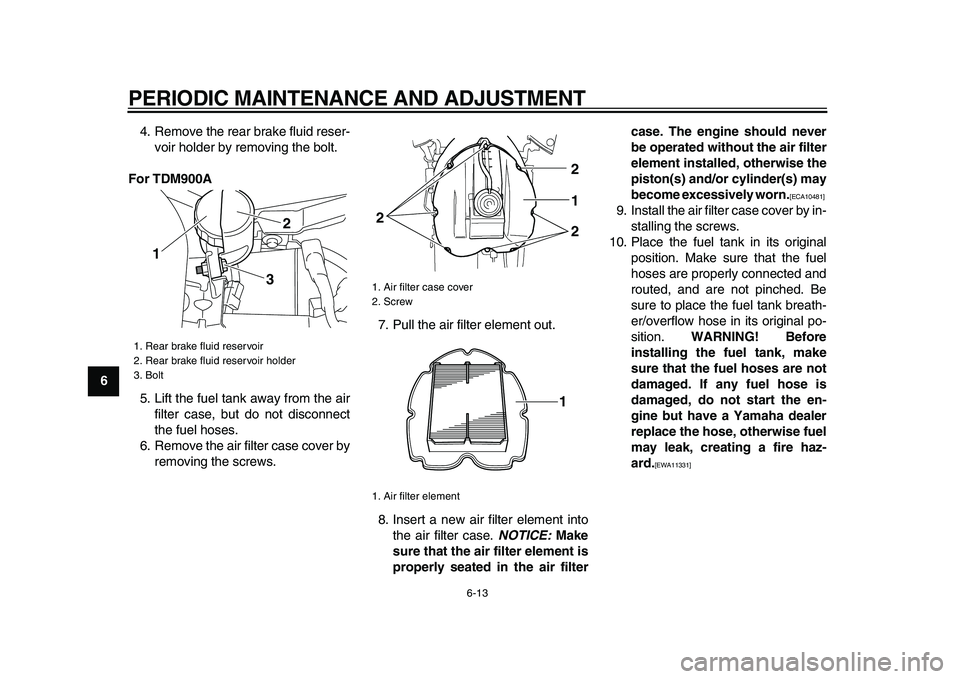
4. Remove the rear brake fluid reser-
voir holder by removing the bolt.
For TDM900A
5. Lift the fuel tank away from the air
filter case, but do not disconnect
the fuel hoses.
6. Remove the air filter case cover by
removing the screws.7. Pull the air filter element out.
8. Insert a new air filter element into
the air filter case.
NOTICE:
Make
sure that the air filter element is
properly seated in the air filtercase. The engine should never
be operated without the air filter
element installed, otherwise the
piston(s) and/or cylinder(s) may
become excessively worn.
[ECA10481]
9. Install the air filter case cover by in-
stalling the screws.
10. Place the fuel tank in its original
position. Make sure that the fuel
hoses are properly connected and
routed, and are not pinched. Be
sure to place the fuel tank breath-
er/overflow hose in its original po-
sition.
WARNING! Before
installing the fuel tank, make
sure that the fuel hoses are not
damaged. If any fuel hose is
damaged, do not start the en-
gine but have a Yamaha dealer
replace the hose, otherwise fuel
may leak, creating a fire haz-
ard.
[EWA11331]
1. Rear brake fluid reservoir
2. Rear brake fluid reservoir holder
3. Bolt
12
3
1. Air filter case cover
2. Screw
1. Air filter element
1 2
2 21
Page 59 of 94
PERIODIC MAINTENANCE AND ADJUSTMENT
6-14
2
3
4
5
67
8
9
11. Install the fuel tank bolts.
12. Install the rear brake fluid reservoir
holder by installing the bolt.
13. Install the panels and cowlings.
14. Install the seat.
EAU34301
Adjusting the engine idling
speed
The engine idling speed must be
checked and, if necessary, adjusted as
follows at the intervals specified in the
periodic maintenance and lubrication
chart.
The engine should be warm before
making this adjustment.
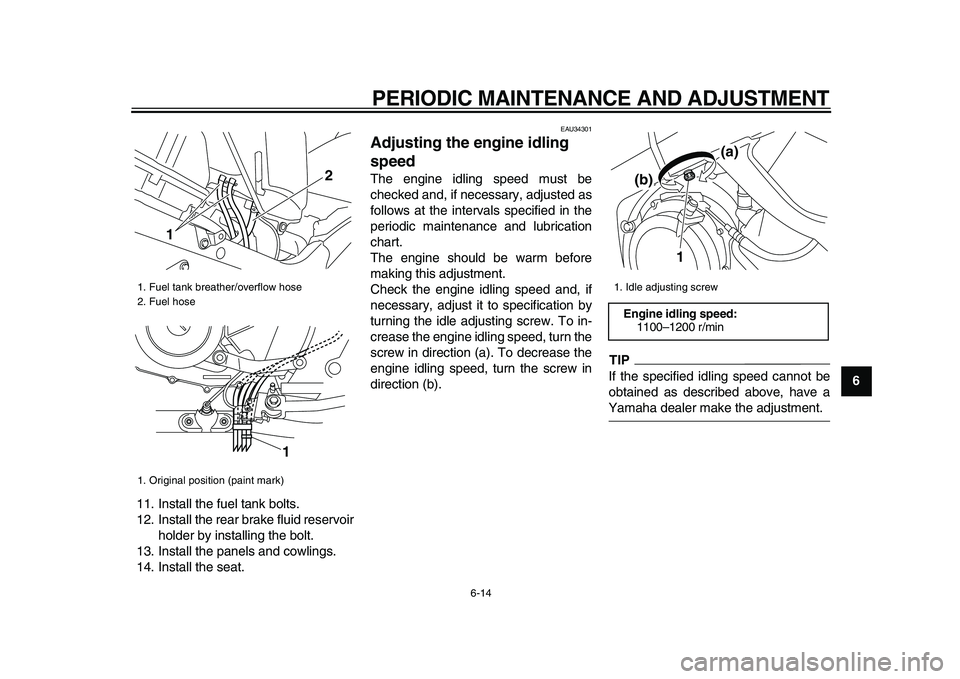
Check the engine idling speed and, if
necessary, adjust it to specification by
turning the idle adjusting screw. To in-
crease the engine idling speed, turn the
screw in direction (a). To decrease the
engine idling speed, turn the screw in
direction (b).
TIP
If the specified idling speed cannot be
obtained as described above, have a
Yamaha dealer make the adjustment.
1. Fuel tank breather/overflow hose
2. Fuel hose
1. Original position (paint mark)
12
1
1. Idle adjusting screw
Engine idling speed:
1100–1200 r/min
1(a)
(b)
Page 65 of 94
PERIODIC MAINTENANCE AND ADJUSTMENT
6-20
2
3
4
5
67
8
9
indicator groove has almost disap-
peared, have a Yamaha dealer replace
the brake pads as a set.
EAU22500
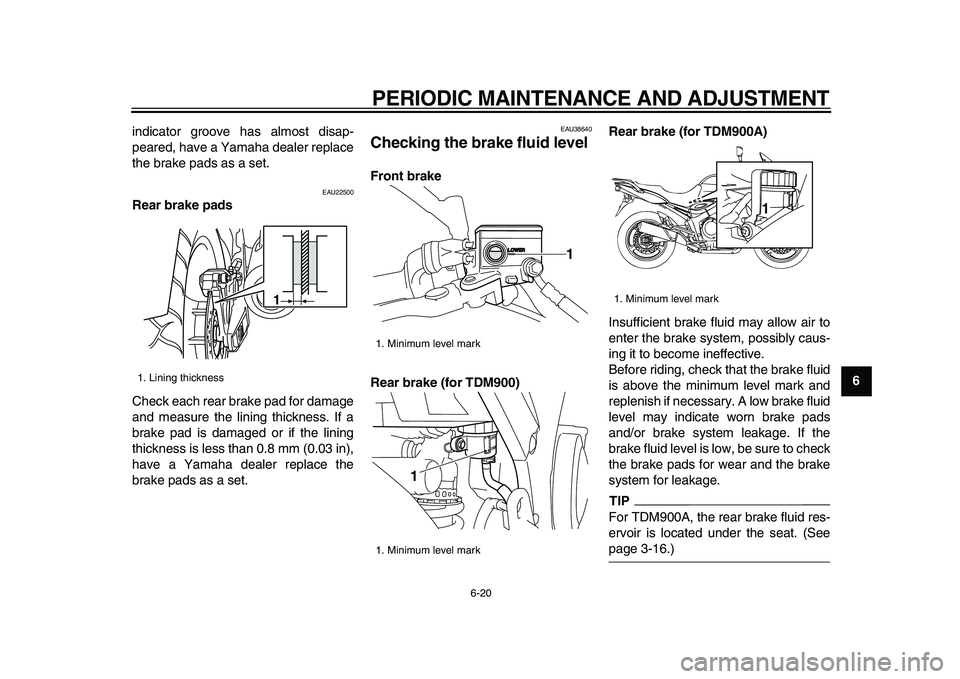
Rear brake pads
Check each rear brake pad for damage
and measure the lining thickness. If a
brake pad is damaged or if the lining
thickness is less than 0.8 mm (0.03 in),
have a Yamaha dealer replace the
brake pads as a set.
EAU38640
Checking the brake fluid level
Front brake
Rear brake (for TDM900)Rear brake (for TDM900A)
Insufficient brake fluid may allow air to
enter the brake system, possibly caus-
ing it to become ineffective.
Before riding, check that the brake fluid
is above the minimum level mark and
replenish if necessary. A low brake fluid
level may indicate worn brake pads
and/or brake system leakage. If the
brake fluid level is low, be sure to check
the brake pads for wear and the brake
system for leakage.
TIP
For TDM900A, the rear brake fluid res-
ervoir is located under the seat. (See
page 3-16.)
1. Lining thickness
1
1. Minimum level mark
1. Minimum level mark
1
1
1. Minimum level mark
1
Page 74 of 94
PERIODIC MAINTENANCE AND ADJUSTMENT
6-29
1
2
3
4
5
6
7
8
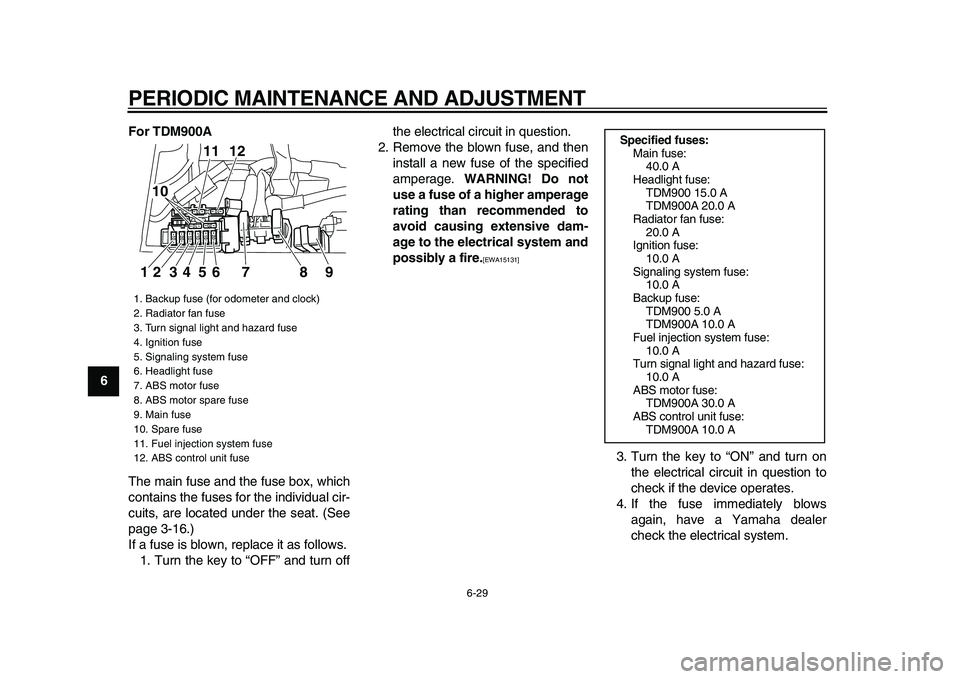
9For TDM900A
The main fuse and the fuse box, which
contains the fuses for the individual cir-
cuits, are located under the seat. (See
page 3-16.)
If a fuse is blown, replace it as follows.
1. Turn the key to “OFF” and turn offthe electrical circuit in question.
2. Remove the blown fuse, and then
install a new fuse of the specified
amperage.
WARNING! Do not
use a fuse of a higher amperage
rating than recommended to
avoid causing extensive dam-
age to the electrical system and
possibly a fire.
[EWA15131]
3. Turn the key to “ON” and turn on
the electrical circuit in question to
check if the device operates.
4. If the fuse immediately blows
again, have a Yamaha dealer
check the electrical system.
1. Backup fuse (for odometer and clock)
2. Radiator fan fuse
3. Turn signal light and hazard fuse
4. Ignition fuse
5. Signaling system fuse
6. Headlight fuse
7. ABS motor fuse
8. ABS motor spare fuse
9. Main fuse
10. Spare fuse
11. Fuel injection system fuse
12. ABS control unit fuse
12 34 5 6 7 8 911 12
10
Specified fuses:
Main fuse:
40.0 A
Headlight fuse:
TDM900 15.0 A
TDM900A 20.0 A
Radiator fan fuse:
20.0 A
Ignition fuse:
10.0 A
Signaling system fuse:
10.0 A
Backup fuse:
TDM900 5.0 A
TDM900A 10.0 A
Fuel injection system fuse:
10.0 A
Turn signal light and hazard fuse:
10.0 A
ABS motor fuse:
TDM900A 30.0 A
ABS control unit fuse:
TDM900A 10.0 A