engine YAMAHA TDR 125 2001 User Guide
[x] Cancel search | Manufacturer: YAMAHA, Model Year: 2001, Model line: TDR 125, Model: YAMAHA TDR 125 2001Pages: 94, PDF Size: 5.07 MB
Page 21 of 94
3-10
INSTRUMENT AND CONTROL FUNCTIONS
1
23
4
5
6
7
8
9
EC000114
cCThe following precautions must be
observed to prevent a fire hazard
or other damages.
8Use only unleaded gasoline.
The use of leaded gasoline will
cause unrepairable damage to
the catalytic converter.
8Never park the motorcycle
near possible fire hazards
such as grass or other materi-
als that easily burn.
8Do not allow the engine to idle
too long.
EAU03750
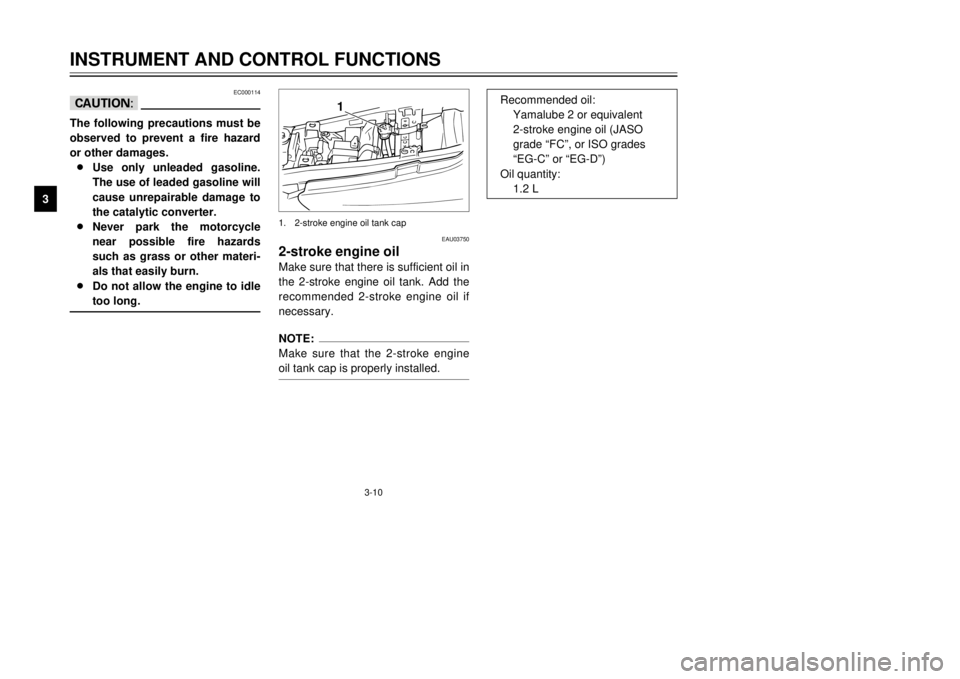
2-stroke engine oilMake sure that there is sufficient oil in
the 2-stroke engine oil tank. Add the
recommended 2-stroke engine oil if
necessary.NOTE:
Make sure that the 2-stroke engine
oil tank cap is properly installed.
1
1.2-stroke engine oil tank cap
Recommended oil:
Yamalube 2 or equivalent
2-stroke engine oil (JASO
grade ÒFCÓ, or ISO grades
ÒEG-CÓ or ÒEG-DÓ)
Oil quantity:
1.2 L
5AE-9-E4 (ENG) 8/30/00 5:04 PM Page 20
Page 22 of 94
3-11
INSTRUMENT AND CONTROL FUNCTIONS
1
23
4
5
6
7
8
9
ON
1
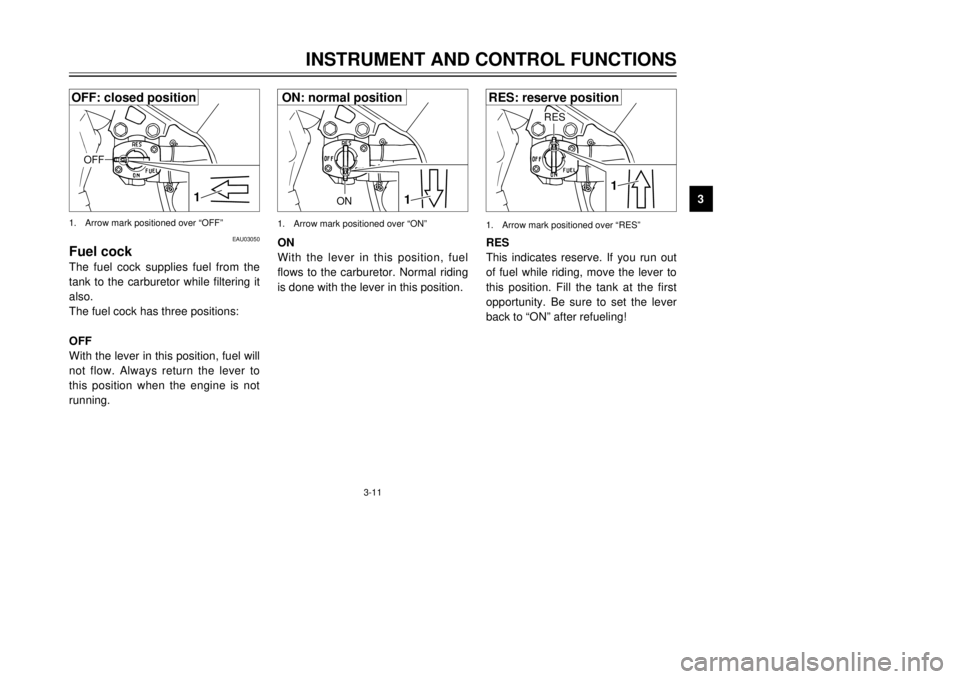
1.Arrow mark positioned over ÒONÓ
EAU03050
Fuel cockThe fuel cock supplies fuel from the
tank to the carburetor while filtering it
also.
The fuel cock has three positions:
OFF
With the lever in this position, fuel will
not flow. Always return the lever to
this position when the engine is not
running.ON
With the lever in this position, fuel
flows to the carburetor. Normal riding
is done with the lever in this position.
1
OFF
1.Arrow mark positioned over ÒOFFÓOFF: closed position
ON: normal position
RES
This indicates reserve. If you run out
of fuel while riding, move the lever to
this position. Fill the tank at the first
opportunity. Be sure to set the lever
back to ÒONÓ after refueling!
1
RES
1.Arrow mark positioned over ÒRESÓRES: reserve position
5AE-9-E4 (ENG) 8/30/00 5:04 PM Page 21
Page 23 of 94
a
EAU01619
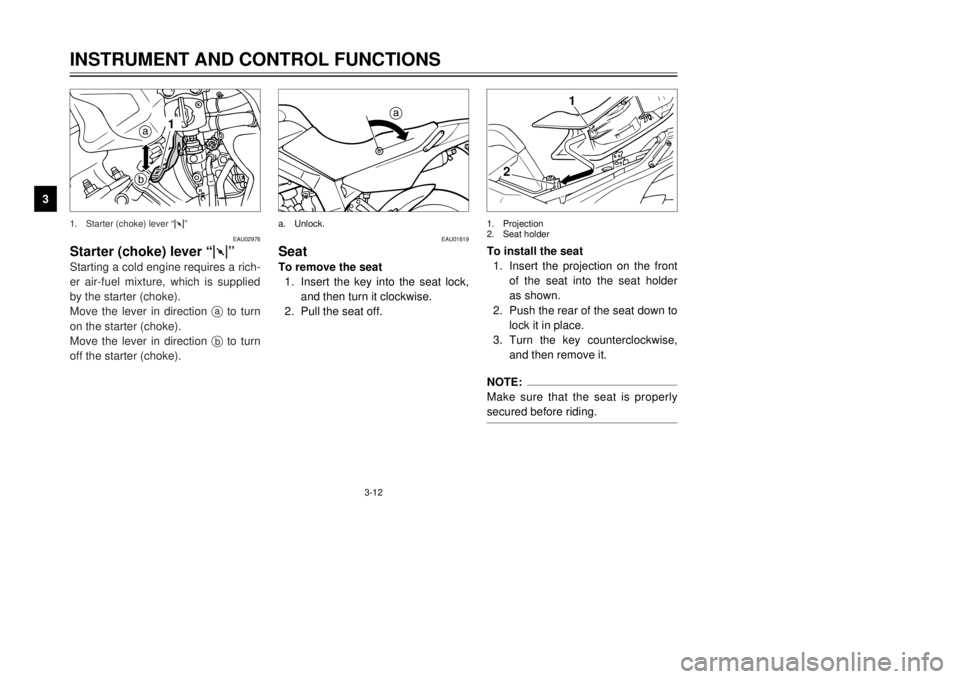
SeatTo remove the seat
1.Insert the key into the seat lock,
and then turn it clockwise.
2.Pull the seat off.a.Unlock.
3-12
INSTRUMENT AND CONTROL FUNCTIONS
1
23
4
5
6
7
8
9To install the seat
1.Insert the projection on the front
of the seat into the seat holder
as shown.
2.Push the rear of the seat down to
lock it in place.
3.Turn the key counterclockwise,
and then remove it.
NOTE:
Make sure that the seat is properly
secured before riding.
1
2
1.Projection
2.Seat holder
1
a
b
EAU02976
Starter (choke) lever Ò
1Ó
Starting a cold engine requires a rich-
er air-fuel mixture, which is supplied
by the starter (choke).
Move the lever in direction ato turn
on the starter (choke).
Move the lever in direction bto turn
off the starter (choke).1.Starter (choke) lever Ò1Ó
5AE-9-E4 (ENG) 8/30/00 5:04 PM Page 22
Page 26 of 94
3-15
EAU00326
YPVSThis model is equipped with the
YPVS (Yamaha Power Valve
System). This system boosts engine
performance and efficiency by means
of a variable valve in the exhaust
port. The YPVS valve is constantly
adjusted in accordance with the
engine speed by a computer-con-
trolled servomotor.
Since the YPVS is an important part
of the engine and requires very
sophisticated adjustment, have a
Yamaha dealer, who has the neces-
sary professional knowledge and
experience, make this adjustment.
EC000023
cCThe YPVS has been set and exten-
sively tested at the Yamaha facto-
ry. Changing these settings with-
out sufficient technical knowledge
may result in poor performance of
or damage to the engine.
YPVS operation noises can be heard
in the following instances:
8When the key is turned to ÒONÓ
and the engine is started.
8When the engine stalls with the
key in the ÒONÓ position.
EC000024
cCIf the YPVS does not operate, have
a Yamaha dealer check it.
EAU00330
SidestandThe sidestand is located on the left
side of the frame. Raise the side-
stand or lower it with your foot while
holding the motorcycle upright.NOTE:
The built-in sidestand switch is part of
the ignition circuit cut-off system,
which cuts the ignition in certain situ-
ations. (See further down for an
explanation of the ignition circuit cut-
off system.)
INSTRUMENT AND CONTROL FUNCTIONS
1
23
4
5
6
7
8
9
5AE-9-E4 (ENG) 8/30/00 5:04 PM Page 25
Page 27 of 94

3-16
EAU03720
Ignition circuit cut-off
systemThe ignition circuit cut-off system
(comprising the sidestand switch,
clutch switch and neutral switch) has
the following functions.
8It prevents starting when the
transmission is in gear and the
sidestand is up, but the clutch
lever is not pulled.
8It prevents starting when the
transmission is in gear and the
clutch lever is pulled, but the
sidestand is still down.
8It cuts the running engine when
the transmission is in gear and
the sidestand is moved down.
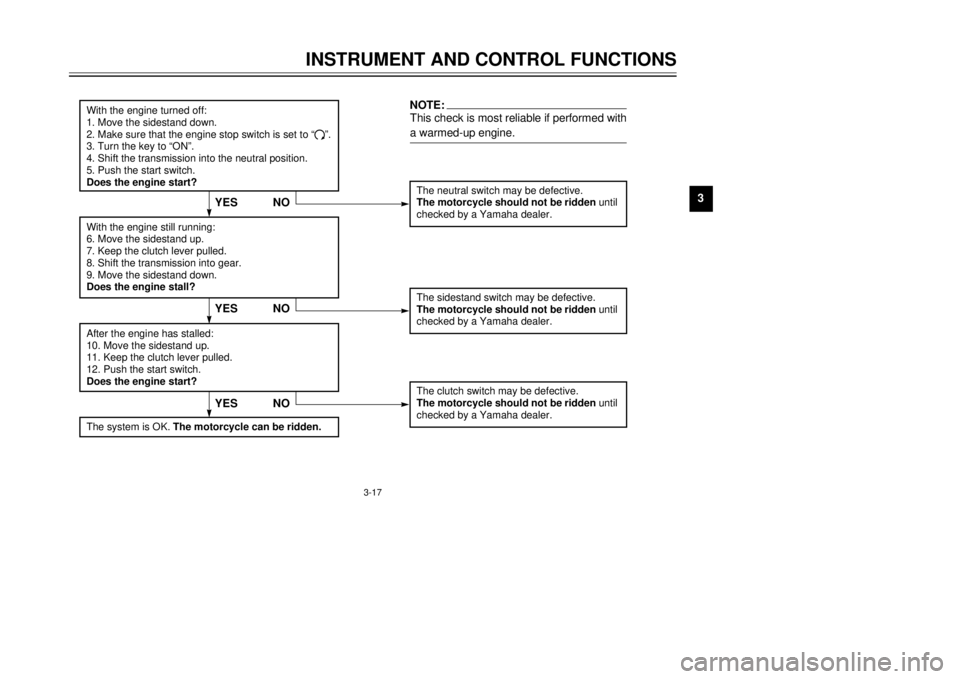
Periodically check the operation of
the ignition circuit cut-off system
according to the following procedure.
EW000045
wIf a malfunction is noted, have a
Yamaha dealer check the system
before riding.
INSTRUMENT AND CONTROL FUNCTIONS
1
23
4
5
6
7
8
9
EW000044
wThe motorcycle must not be ridden
with the sidestand down, or if the
sidestand cannot be properly
moved up (or does not stay up),
otherwise the sidestand could con-
tact the ground and distract the
operator, resulting in a possible
loss of control. Yamaha’s ignition
circuit cut-off system has been
designed to assist the operator in
fulfilling the responsibility of rais-
ing the sidestand before starting
off. Therefore, check this system
regularly as described below and
have a Yamaha dealer repair it if it
does not function properly.
5AE-9-E4 (ENG) 8/30/00 5:04 PM Page 26
Page 28 of 94
3-17
INSTRUMENT AND CONTROL FUNCTIONS
1
23
4
5
6
7
8
9
With the engine turned off:
1. Move the sidestand down.
2. Make sure that the engine stop switch is set to Ò
#Ó.
3. Turn the key to ÒONÓ.
4. Shift the transmission into the neutral position.
5. Push the start switch.
Does the engine start?
The neutral switch may be defective.
The motorcycle should not be ridden until
checked by a Yamaha dealer.
With the engine still running:
6. Move the sidestand up.
7. Keep the clutch lever pulled.
8. Shift the transmission into gear.
9. Move the sidestand down.
Does the engine stall?After the engine has stalled:
10. Move the sidestand up.
11. Keep the clutch lever pulled.
12. Push the start switch.
Does the engine start?
The sidestand switch may be defective.
The motorcycle should not be ridden until
checked by a Yamaha dealer.The clutch switch may be defective.
The motorcycle should not be ridden until
checked by a Yamaha dealer.
NO
NOTE:This check is most reliable if performed with
a warmed-up engine.
YESYESNO
The system is OK.
The motorcycle can be ridden.
YESNO
5AE-9-E4 (ENG) 8/30/00 5:04 PM Page 27
Page 29 of 94

4-1
EAU01114
PRE-OPERATION CHECKS
1
2
34
5
6
7
8
9The condition of a vehicle is the ownerÕs responsibility. Vital components can start to deteriorate quickly and unexpect-
edly, even if the vehicle remains unused (for example, as a result of exposure to the elements). Any damage, fluid leak-
age or loss of tire air pressure could have serious consequences. Therefore, it is very important, in addition to a thor-
ough visual inspection, to check the following points before each ride.
EAU03439
Pre-operation check list
ITEMCHECKSPAGE
Fuel¥Check fuel level in fuel tank.
¥Refuel if necessary.
¥Check fuel line for leakage.3-7Ð3-9
Two-stroke engine oil¥Check oil level in oil tank.
¥If necessary, add recommended oil to specified level.
¥Check vehicle for oil leakage.3-10
Transmission oil¥Check oil level in transmission case.
¥If necessary, add recommended oil to specified level.6-8Ð6-10
Coolant¥Check coolant level in reservoir.
¥If necessary, add recommended coolant to specified level.
¥Check cooling system for leakage.6-10Ð6-13
Front brake¥Check operation.
¥If soft or spongy, have Yamaha dealer bleed hydraulic system.
¥Check lever free play.
¥Adjust if necessary.
¥Check fluid level in reservoir.
¥If necessary, add recommended brake fluid to specified level.
¥Check hydraulic system for leakage.3-7, 6-21, 6-23Ð6-24
5AE-9-E4 (ENG) 8/30/00 5:04 PM Page 28
Page 32 of 94

5-1
EAU00373
w8Become thoroughly familiar
with all operating controls and
their functions before riding.
Consult a Yamaha dealer
regarding any control or func-
tion that you do not thorough-
ly understand.
8Never start the engine or oper-
ate it in a closed area for any
length of time. Exhaust fumes
are poisonous, and inhaling
them can cause loss of con-
sciousness and death within a
short time. Always make sure
that there is adequate ventila-
tion.
8Before starting out, make sure
that the sidestand is up. If the
sidestand is not raised com-
pletely, it could contact the
ground and distract the opera-
tor, resulting in a possible loss
of control.
EAU00381
Starting a cold engineIn order for the ignition circuit cut-off
system to enable starting, one of the
following conditions must be met:
8The transmission is in the neutral
position.
8The transmission is in gear with
the clutch lever pulled and the
sidestand up.
EW000054
w8Before starting the engine,
check the function of the igni-
tion circuit cut-off system
according to the procedure
described on page 3-17.
8Never ride with the sidestand
down.1.Turn the fuel cock lever to ÒONÓ.
2.Turn the key to ÒONÓ and make
sure that the engine stop switch
is set to Ò#Ó.3.Shift the transmission into the
neutral position.
NOTE:
When the transmission is in the neu-
tral position, the neutral indicator light
should be on, otherwise have a
Yamaha dealer check the electrical
circuit.4.Turn the starter (choke) on and
completely close the throttle.
(See page 3-12 for starter
(choke) operation.)
5.Start the engine by pushing the
start switch.NOTE:
If the engine fails to start, release the
start switch, wait a few seconds, and
then try again. Each starting attempt
should be as short as possible to pre-
serve the battery. Do not crank the
engine more than 10 seconds on any
one attempt.
EAU00372
OPERATION AND IMPORTANT RIDING POINTS
1
2
3
45
6
7
8
9
5AE-9-E4 (ENG) 8/30/00 5:04 PM Page 31
Page 33 of 94

5-2
EC000034
cCThe oil level warning light should
come on when the start switch is
pushed, and it should go off when
the start switch is released. If the
oil level warning light flickers or
remains on after starting, immedi-
ately stop the engine, and then
check the engine oil level and the
vehicle for oil leakage. If neces-
sary, add engine oil, and then
check the warning light again. If
the warning light does not come
on when pushing the start switch,
or if it does not go off after starting
with sufficient engine oil, have a
Yamaha dealer check the electrical
circuit.6.After starting the engine, move
the starter (choke) lever back
halfway.
ECA00045
cCFor maximum engine life, never
accelerate hard when the engine is
cold!7.When the engine is warm, turn
the starter (choke) off.NOTE:
The engine is warm when it responds
normally to the throttle with the starter
(choke) turned off.
EAU01258
Starting a warm engineFollow the same procedure as for
starting a cold engine with the excep-
tion that the starter (choke) is not
required when the engine is warm.
OPERATION AND IMPORTANT RIDING POINTS
1
2
3
45
6
7
8
95AE-9-E4 (ENG) 8/30/00 5:04 PM Page 32
Page 34 of 94
5-3
EAU00423
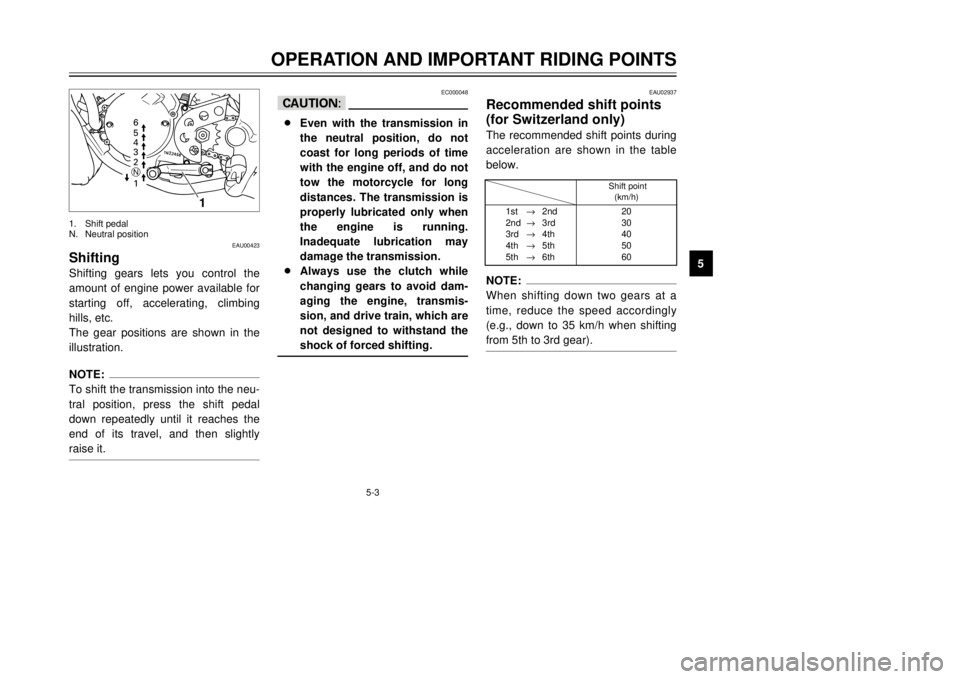
ShiftingShifting gears lets you control the
amount of engine power available for
starting off, accelerating, climbing
hills, etc.
The gear positions are shown in the
illustration.NOTE:
To shift the transmission into the neu-
tral position, press the shift pedal
down repeatedly until it reaches the
end of its travel, and then slightly
raise it.
EC000048
cC8Even with the transmission in
the neutral position, do not
coast for long periods of time
with the engine off, and do not
tow the motorcycle for long
distances. The transmission is
properly lubricated only when
the engine is running.
Inadequate lubrication may
damage the transmission.
8Always use the clutch while
changing gears to avoid dam-
aging the engine, transmis-
sion, and drive train, which are
not designed to withstand the
shock of forced shifting.
OPERATION AND IMPORTANT RIDING POINTS
1
2
3
45
6
7
8
9
6
5
4
3
2
1 N
1
1.Shift pedal
N.Neutral position
EAU02937
Recommended shift points
(for Switzerland only)The recommended shift points during
acceleration are shown in the table
below.NOTE:
When shifting down two gears at a
time, reduce the speed accordingly
(e.g., down to 35 km/h when shifting
from 5th to 3rd gear).
Shift point
(km/h)
1st®2nd
2nd®3rd
3rd®4th
4th®5th
5th®6th20
30
40
50
60
5AE-9-E4 (ENG) 8/30/00 5:04 PM Page 33