battery YAMAHA TMAX 2014 Owners Manual
[x] Cancel search | Manufacturer: YAMAHA, Model Year: 2014, Model line: TMAX, Model: YAMAHA TMAX 2014Pages: 100, PDF Size: 3.01 MB
Page 6 of 100

TABLE OF CONTENTSSAFETY INFORMATION................... 1-1
Further safe-riding points................. 1-5
DESCRIPTION ................................... 2-1
Left view .......................................... 2-1
Right view ........................................ 2-2
Controls and instrument s................. 2-3
INSTRUMENT AND CONTROL
FUNCTIONS ....................................... 3-1
Immobilizer system ....... ................... 3-1
Main switch/steering lock................. 3-2
Indicator lights and warning lights ............................................. 3-3
Speedometer ................................... 3-5
Tachometer ..................................... 3-5
Multi-function display ....................... 3-5
Handlebar switches ....................... 3-12
Front brake lever ........................... 3-13
Rear brake lever ............................ 3-14
Rear brake lock lever..................... 3-15
ABS (for ABS models) .. ................. 3-15
Fuel tank cap ................................. 3-16
Fuel................................................ 3-17
Catalytic converter ......................... 3-19
Seat ............................................... 3-19
Adjusting the rider backrest ........... 3-20
Helmet holder ................................ 3-21
Storage compartments .................. 3-21
Windshield ..................................... 3-23
Rear view mirrors .......................... 3-25 Shock absorber assembly ............. 3-25
Sidestand ...................................... 3-26
Ignition circuit cut-
off system ......... 3-26
FOR YOUR SAFETY –
PRE-OPERATION CHECKS ............. 4-1
OPERATION AND IMPORTANT
RIDING POINTS ................................. 5-1
Starting the engine .......................... 5-1
Starting off ....................................... 5-2
Acceleration and deceleration ......... 5-3
Braking ............................................ 5-3
Tips for reducing fuel
consumption ................................ 5-4
Engine break-in ............................... 5-4
Parking ............................................ 5-5
PERIODIC MAINTENANCE AND
ADJUSTMENT ................................... 6-1
Owner’s tool kit................................ 6-2
Periodic maintenance chart for the emission control system .............. 6-3
General maintenance and lubrication chart ........................... 6-4
Removing and installing panels ...... 6-8
Checking the spark plugs .............. 6-10
Engine oil and oil filter cartridge .... 6-11
Coolant .......................................... 6-14
Replacing the air filter element...... 6-15 Adjusting the engine idling
speed............ ............................ .. 6-16
Checking the throttle grip free play ............................................. 6-17
Valve clearance ............................. 6-17
Tires ............................................... 6-17
Cast wheels ................................... 6-19
Checking the front and rear brake
lever free play ............................. 6-20
Adjusting the rear brake lock cable ........................................... 6-21
Checking the rear brake lock ......... 6-21
Checking the front and rear brake pads............................................ 6-22
Checking the brake fluid level ........ 6-23
Changing the brake fluid ................ 6-24
Drive belt slack .............................. 6-24
Checking and lubricating the cables ......................................... 6-24
Checking and lubricating the
throttle grip and cable ................. 6-25
Lubricating the front and rear brake levers ................................ 6-25
Checking and lubricating the centerstand and sidestand ......... 6-26
Checking the front fork................... 6-26
Checking the steering .................... 6-27
Checking the wheel bearings......... 6-27
Battery ........................................... 6-28
Replacing the fuses ....................... 6-30
Replacing the headlight bulb ......... 6-3259C-9-E2.book 1 ページ 2013年6月18日 火曜日 午後1時33分
Page 13 of 100

2-1
12
DESCRIPTION
EAU10411
Left view
3
5
98
7
6
10
1
4
2
1. Battery (page 6-28)
2. Helmet holder (page 3-21)
3. Rear storage compartment (page 3-21)
4. Grab bar (page 5-2)
5. Engine oil filler cap (page 6-11)
6. Sidestand (page 3-26)
7. Engine oil drain bolt (page 6-11)
8. Engine oil level check window (page 6-11) 9. Oil filter cartridge (page 6-11)
10.Coolant level check window (page 6-14)
59C-9-E2.book 1 ページ 2013年6月18日 火曜日 午後1時33分
Page 18 of 100
INSTRUMENT AND CONTROL FUNCTIONS
3-3
1
23
4
5
6
7
8
9the left.
2. Push the key in from the “OFF” po- sition, and then turn it to “LOCK”
while still pushing it.
3. Remove the key.
To unlock the steering
Push the key in, and then turn it to
“OFF” while still pushing it.
EAU34342
(Parking)
The steering is locked, and the taillight,
license plate light and auxiliary light are
on. The hazard lights and turn signal
lights can be turned on, but all other
electrical systems are off. The key can
be removed.
The steering must be locked before the
key can be turned to “ ”.NOTICE
ECA11021
Do not use the parking position for
an extended length of time, other-wise the battery may discharge.
EAU49394
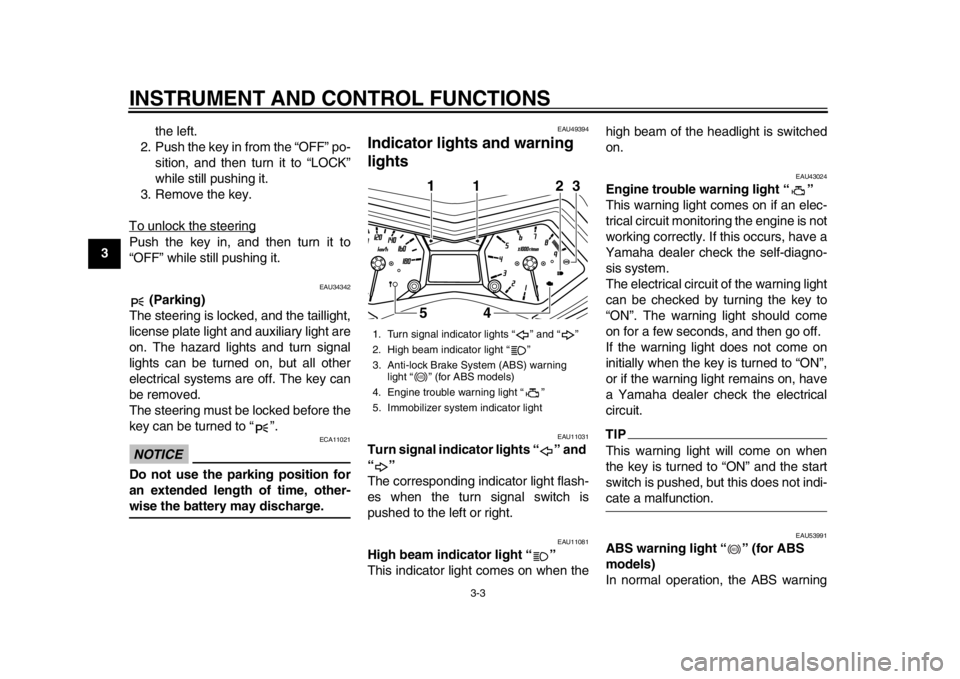
Indicator lights and warning
lights
EAU11031
Turn signal indicator lights “ ” and
“”
The corresponding indicator light flash-
es when the turn signal switch is
pushed to the left or right.
EAU11081
High beam indicator light “ ”
This indicator light comes on when the high beam of the headlight is switched
on.
EAU43024
Engine trouble warning light “ ”
This warning light comes on if an elec-
trical circuit monitoring the engine is not
working correctly. If this occurs, have a
Yamaha dealer check the self-diagno-
sis system.
The electrical circui
t of the warning light
can be checked by turning the key to
“ON”. The warning light should come
on for a few seconds, and then go off.
If the warning light does not come on
initially when the key is turned to “ON”,
or if the warning light remains on, have
a Yamaha dealer check the electrical
circuit.TIPThis warning light will come on when
the key is turned to “ON” and the start
switch is pushed, but this does not indi-cate a malfunction.
EAU53991
ABS warning light “ ” (for ABS
models)
In normal operation, the ABS warning
1. Turn signal indicator lights “ ” and “ ”
2. High beam indicator light “ ”
3. Anti-lock Brake System (ABS) warning light “ ” (for ABS models)
4. Engine trouble warning light “ ”
5. Immobilizer system indicator light
1
541
1
2
3
ABS
ABS
59C-9-E2.book 3 ページ 2013年6月18日 火曜日 午後1時33分
Page 37 of 100
INSTRUMENT AND CONTROL FUNCTIONS
3-22
234
5
6
7
8
9
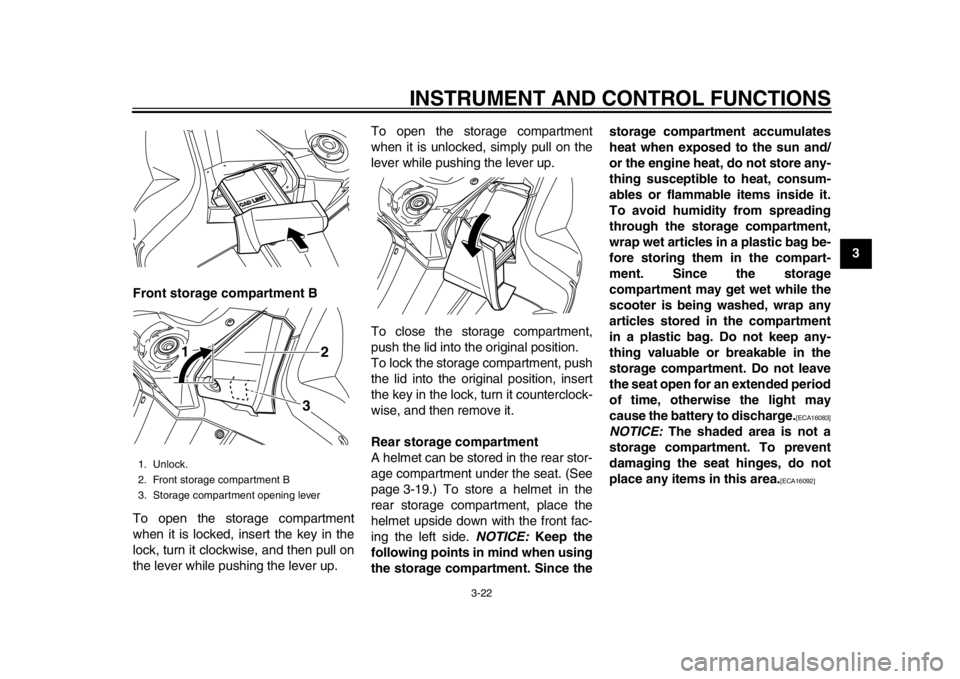
Front storage compartment B
To open the storage compartment
when it is locked, insert the key in the
lock, turn it clockwise, and then pull on
the lever while pushing the lever up. To open the storage compartment
when it is unlocked,
simply pull on the
lever while pushing the lever up.
To close the storage compartment,
push the lid into the original position.
To lock the storage compartment, push
the lid into the original position, insert
the key in the lock, turn it counterclock-
wise, and then remove it.
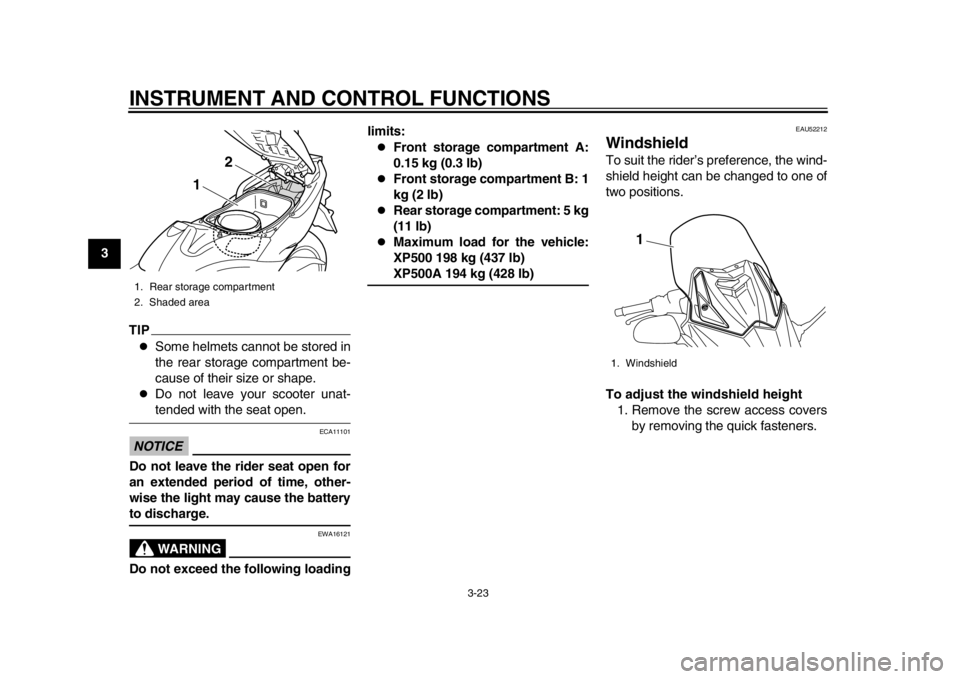
Rear storage compartment
A helmet can be stored in the rear stor-
age compartment under the seat. (See
page 3-19.) To store a helmet in the
rear storage compartment, place the
helmet upside down with the front fac-
ing the left side. NOTICE: Keep the
following points in mind when using
the storage compartment. Since the storage compartment accumulates
heat when exposed to the sun and/
or the engine heat, do not store any-
thing susceptible to heat, consum-
ables or flammable items inside it.
To avoid humidity from spreading
through the storage compartment,
wrap wet articles in a plastic bag be-
fore storing them in the compart-
ment. Since the storage
compartment may get wet while the
scooter is being washed, wrap any
articles stored in the compartment
in a plastic bag. Do not keep any-
thing valuable or breakable in the
storage compartment. Do not leave
the seat open for an extended period
of time, otherwise the light may
cause the battery to discharge.
[ECA16083]
NOTICE:
The shaded area is not a
storage compartment. To prevent
damaging the seat hinges, do not
place any items in this area.
[ECA16092]
1. Unlock.
2. Front storage compartment B
3. Storage compartment opening lever
1 2
3
59C-9-E2.book 22 ページ 2013年6月18日 火曜日 午後1時33分
Page 38 of 100
INSTRUMENT AND CONTROL FUNCTIONS
3-23
1
23
4
5
6
7
8
9
TIP
Some helmets cannot be stored in
the rear storage compartment be-
cause of their size or shape.
Do not leave your scooter unat-tended with the seat open.
NOTICE
ECA11101
Do not leave the rider seat open for
an extended period of time, other-
wise the light may cause the batteryto discharge.
WARNING
EWA16121
Do not exceed the following loadinglimits:
Front storage compartment A:
0.15 kg (0.3 lb)
Front storage compartment B: 1
kg (2 lb)
Rear storage compartment: 5 kg
(11 lb)
Maximum load for the vehicle:
XP500 198 kg (437 lb)XP500A 194 kg (428 lb)
EAU52212
WindshieldTo suit the rider’s preference, the wind-
shield height can be changed to one of
two positions.
To adjust the windshield height
1. Remove the screw access covers by removing the quick fasteners.
1. Rear storage compartment
2. Shaded area
1
2
1. Windshield
1
59C-9-E2.book 23 ページ 2013年6月18日 火曜日 午後1時33分
Page 77 of 100
PERIODIC MAINTENANCE AND ADJUSTMENT
6-28
2
3
4
567
8
9
EAU52043
BatteryThe battery is located under front stor-
age compartment A. (See page 3-21.)
This model is equipped with a VRLA
(Valve Regulated Lead Acid) battery.
There is no need to check the electro-
lyte or to add distilled water. However,
the battery lead connections need to be
checked and, if necessary, tightened.
WARNING
EWA10761
Electrolyte is poisonous and
dangerous since it contains sul-
furic acid, which causes severe
burns. Avoid any contact with
skin, eyes or clothing and al-
ways shield your eyes when
working near batteries. In case
of contact, administer the fol-
lowing FIRST AID.
EXTERNAL: Flush with plentyof water.
INTERNAL: Drink large quan- tities of water or milk and im-
mediately call a physician.
EYES: Flush with water for 15 minutes and seek prompt
medical attention.
Batteries produce explosive hy-
drogen gas. Therefore, keep
sparks, flames, cigarettes, etc.,
away from the battery and pro-
vide sufficient ventilation when
charging it in an enclosed
space.
KEEP THIS AND ALL BATTER-
IES OUT OF THE REACH OFCHILDREN.
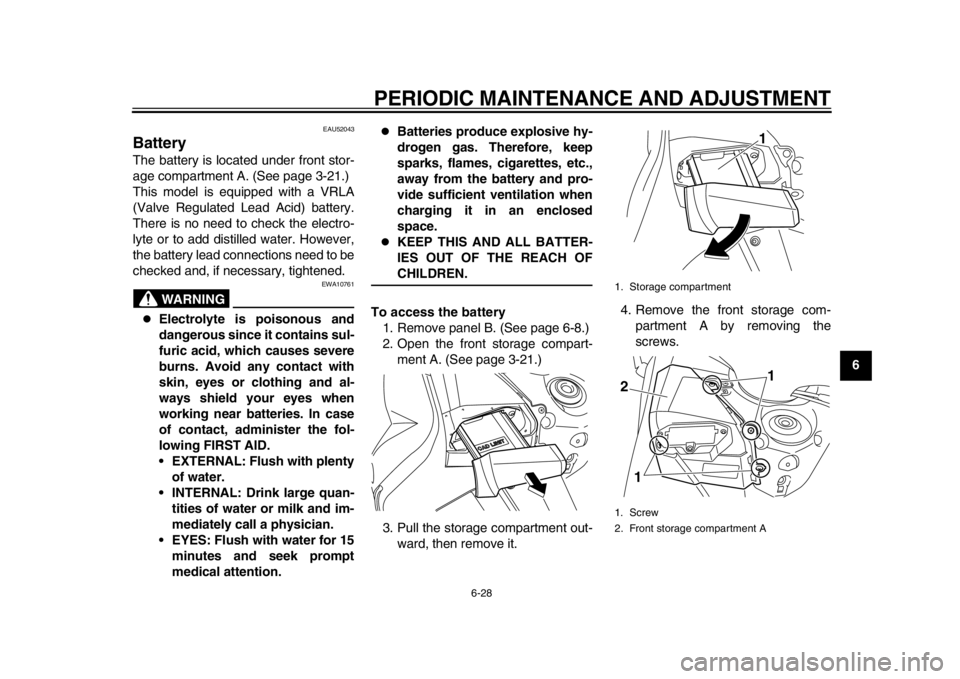
To access the battery 1. Remove panel B. (See page 6-8.)
2. Open the front storage compart- ment A. (See page 3-21.)
3. Pull the storage compartment out- ward, then remove it. 4. Remove the front storage com-
partment A by removing the
screws.
1. Storage compartment
1. Screw
2. Front storage compartment A
11
1
2
59C-9-E2.book 28 ページ 2013年6月18日 火曜日 午後1時33分
Page 78 of 100
PERIODIC MAINTENANCE AND ADJUSTMENT
6-29
1
2
3
4
56
7
8
9To charge the battery
Have a Yamaha dealer charge the bat-
tery as soon as possible if it seems to
have discharged. Keep in mind that the
battery tends to discharge more quickly
if the vehicle is equipped with optional
electrical accessories.
NOTICE
ECA16522
To charge a VRLA (Valve Regulated
Lead Acid) battery, a special (con-
stant-voltage) battery charger is re-
quired. Using a conventional batterycharger will damage the battery. To store the battery
1. If the vehicle will not be used for more than one month, remove the
battery, fully charge it, and then
place it in a cool, dry place.
NOTICE: When removing the
battery, be sure the key is
turned to “OFF”, then discon-
nect the negative lead before
disconnecting the positive
lead.
[ECA16303]
2. If the battery will be stored for more than two months, check it at least
once a month and fully charge it if
necessary.
3. Fully charge the battery before in- stallation. NOTICE: When install-
ing the battery, be sure the key
is turned to “OFF”, then con-
nect the positive lead before
connecting the negative
lead.
[ECA16841]
4. After installation, make sure that the battery leads are properly con-
nected to the battery terminals.NOTICE
ECA16531
Always keep the battery charged.
Storing a discharged battery can
cause permanent battery damage.
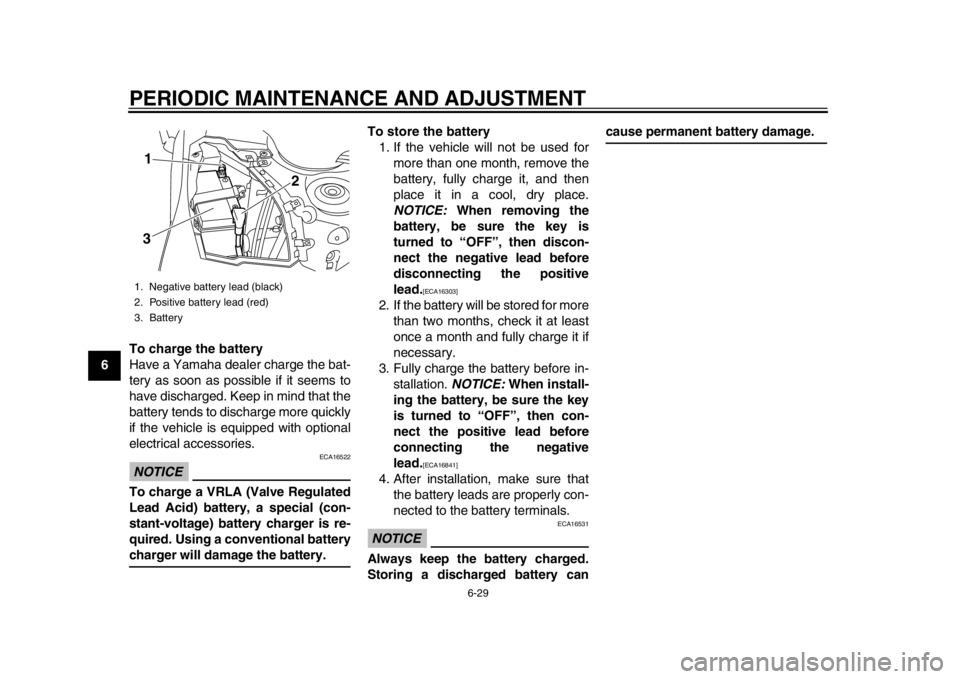
1. Negative battery lead (black)
2. Positive battery lead (red)
3. Battery
2
3 1
59C-9-E2.book 29 ページ 2013年6月18日 火曜日 午後1時33分
Page 86 of 100
PERIODIC MAINTENANCE AND ADJUSTMENT
6-37
1
2
3
4
56
7
8
9
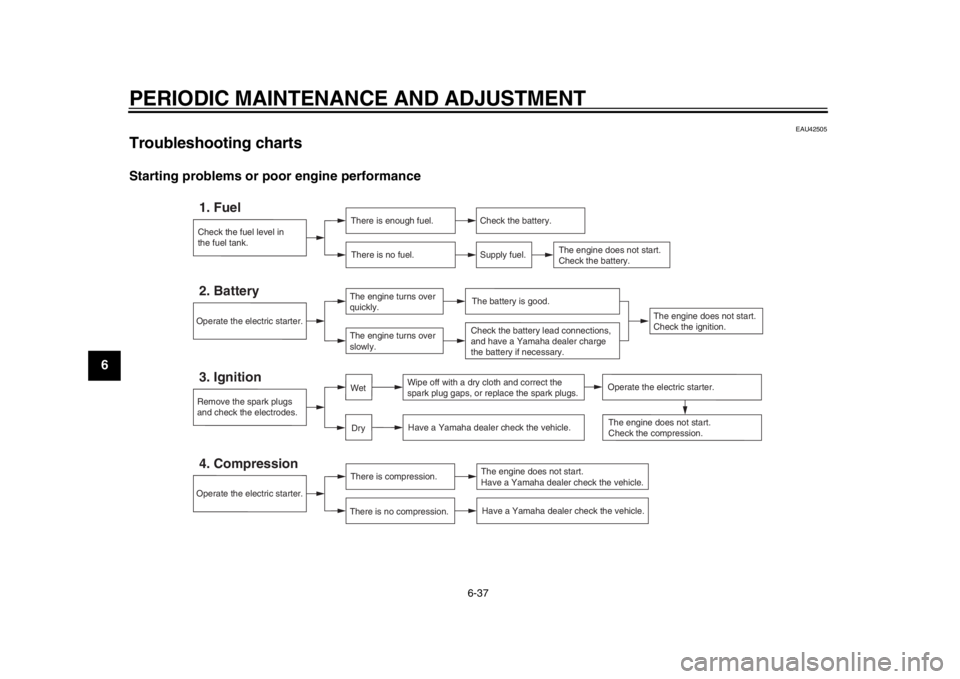
EAU42505
Troubleshooting chartsStarting problems or poor engine performance
Check the fuel level in
the fuel tank.1. Fuel
There is enough fuel.There is no fuel.
Check the battery.
Supply fuel.
The engine does not start.
Check the battery.
Remove the spark plugs
and check the electrodes.3. Ignition
Wipe off with a dry cloth and correct the
spark plug gaps, or replace the spark plugs.
Have a Yamaha dealer check the vehicle.
Operate the electric starter.4. Compression
There is compression.
There is no compression.
The engine does not start.
Have a Yamaha dealer check the vehicle.Have a Yamaha dealer check the vehicle.
The engine does not start.
Check the compression.
Operate the electric starter.2. Battery
The engine turns over
quickly.
The engine turns over
slowly.
The engine does not start.
Check the ignition.
The battery is good.Check the battery lead connections,
and have a Yamaha dealer charge
the battery if necessary.
DryWet
Operate the electric starter.
59C-9-E2.book 37 ページ 2013年6月18日 火曜日 午後1時33分
Page 91 of 100
SCOOTER CARE AND STORAGE
7-4
2
3
4
5
678
9
stabilizer (if available) to prevent
the fuel tank from rusting and the
fuel from deteriorating.
3. Perform the following steps to pro- tect the cylinders, piston rings, etc.
from corrosion.
a. Remove the spark plug caps and the spark plugs.
b. Pour a teaspoonful of engine oil into the spark plug bores.
c. Install the spark plug caps onto the spark plugs, and then place
the spark plugs on the cylinder
head so that the electrodes are
grounded. (This will limit spark-
ing during the next step.)
d. Turn the engine over several times with the starter. (This will
coat the cylinder walls with oil.)
e. Remove the spark plug caps from the spark plugs, and then
install the spark plugs and the
spark plug caps. WARNING!
To prevent damage or injury
from sparking, make sure to
ground the spark plug elec-
trodes while turning the en-
gine over.
[EWA10952]
4. Lubricate all control cables and the pivoting points of all levers and
pedals as well as of the sidestand/
centerstand.
5. Check and, if necessary, correct the tire air pressure, and then lift
the scooter so that both of its
wheels are off the ground. Alterna-
tively, turn the wheels a little every
month in order to prevent the tires
from becoming degraded in one
spot.
6. Cover the muffler outlet with a plastic bag to prevent moisture
from entering it.
7. Remove the battery and fully charge it. Store it in a cool, dry
place and charge it once a month.
Do not store the battery in an ex-
cessively cold or warm place [less
than 0 C (30 F) or more than 30
C (90 F)]. For more information
on storing the battery, see page
6-28.
TIPMake any necessary repairs beforestoring the scooter.
59C-9-E2.book 4 ページ 2013年6月18日 火曜日 午後1時33分
Page 93 of 100

SPECIFICATIONS
8-2
2
3
4
5
6
789
Rear tire:Type:Tubeless
Size: 160/60R15 M/C 67H
Manufacturer/model: DUNLOP/GPR-100L
Manufacturer/model:
BRIDGESTONE/BT012RLoading:Maximum load:XP500 198 kg (437 lb)
XP500A 194 kg (428 lb)
* (Total weight of rider, passenger, cargo and accessories)Tire air pressure (measured on cold
tires):Loading condition:0–90 kg (0–198 lb)
Front:225 kPa (2.25 kgf/cm
2, 33 psi)
Rear: 250 kPa (2.50 kgf/cm2, 36 psi)
Loading condition: XP500 90–198 kg (198–437 lb)
XP500A 90–194 kg (198–428 lb)
Front:225 kPa (2.25 kgf/cm2, 33 psi)
Rear:
280 kPa (2.80 kgf/cm2, 41 psi)
Front wheel:Wheel type: Cast wheel Rim size:
15M/C x MT3.50
Rear wheel:Wheel type:Cast wheel
Rim size: 15M/C x MT5.00Front brake:Type:Dual disc brake
Operation: Right hand operation
Specified brake fluid:
DOT 4Rear brake:Type:Single disc brake
Operation:
Left hand operation
Specified brake fluid: DOT 4Front suspension:Type:
Telescopic fork
Spring/shock absorber type: Coil spring/oil damper
Wheel travel: 120.0 mm (4.72 in)Rear suspension:Type:Swingarm
Spring/shock absorber type: Coil spring/gas-oil damper Wheel travel:
116.0 mm (4.57 in)
Electrical system:Ignition system:TCI
Charging system: AC magnetoBattery:Model:YTZ12S
Voltage, capacity: 12 V, 11.0 AhHeadlight:Bulb type:Halogen bulbBulb voltage, wattage quantity:Headlight:
12 V, 55.0 W 2
Tail/brake light: LED
Front turn signal light: 12 V, 21.0 W 2
Rear turn signal light:
12 V, 21.0 W 2
Auxiliary light: 12 V, 5.0 W 1
License plate light: 12 V, 5.0 W 1
Meter lighting:
LED
High beam indicator light: LED
Turn signal indicator light: LED
59C-9-E2.book 2 ページ 2013年6月18日 火曜日 午後1時33分