warning YAMAHA TRACER 900 GT 2018 Owner's Manual
[x] Cancel search | Manufacturer: YAMAHA, Model Year: 2018, Model line: TRACER 900 GT, Model: YAMAHA TRACER 900 GT 2018Pages: 120, PDF Size: 9.6 MB
Page 52 of 120
Instrument and control functions
3-37
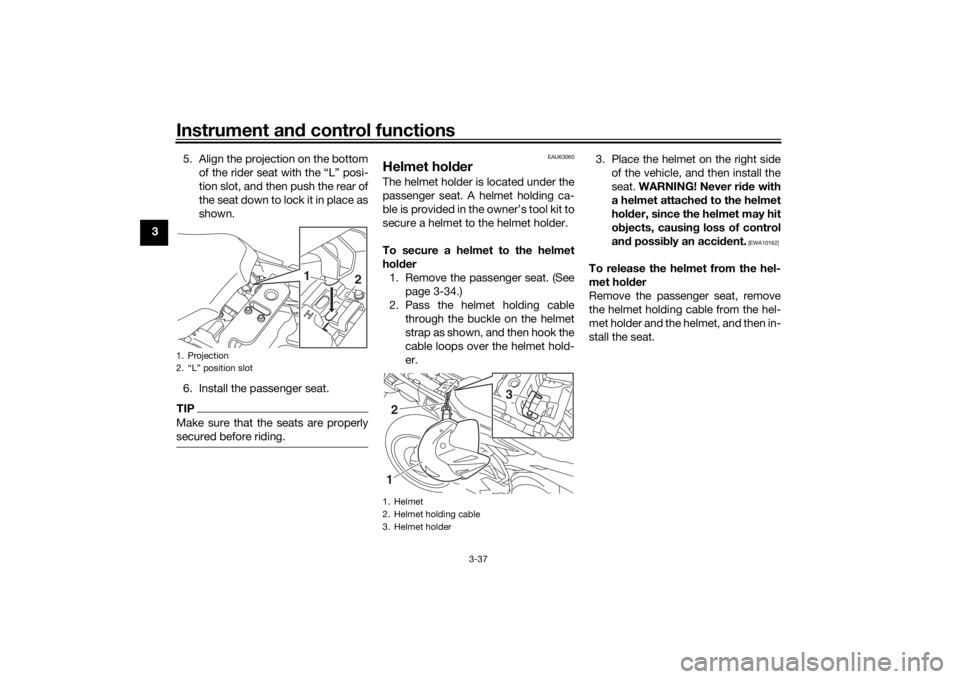
3 5. Align the projection on the bottom
of the rider seat with the “L” posi-
tion slot, and then push the rear of
the seat down to lock it in place as
shown.
6. Install the passenger seat.
TIPMake sure that the seats are properly
secured before riding.
EAU63060
Helmet hold erThe helmet holder is located under the
passenger seat. A helmet holding ca-
ble is provided in the owner’s tool kit to
secure a helmet to the helmet holder.
To secure a helmet to the helmet
holder
1. Remove the passenger seat. (See page 3-34.)
2. Pass the helmet holding cable through the buckle on the helmet
strap as shown, and then hook the
cable loops over the helmet hold-
er. 3. Place the helmet on the right side
of the vehicle, and then install the
seat. WARNING! Never ri de with
a helmet attached to the helmet
hol der, since the helmet may hit
o bjects, causin g loss of control
an d possi bly an acci dent.
[EWA10162]
To release the helmet from the hel-
met hol der
Remove the passenger seat, remove
the helmet holding cable from the hel-
met holder and the helmet, and then in-
stall the seat.
1. Projection
2. “L” position slot
1
2
1. Helmet
2. Helmet holding cable
3. Helmet holder
3
21
UB1JE0E0.book Page 37 Tuesday, February 13, 2018 9:12 AM
Page 53 of 120
Instrument and control functions
3-38
3
EAU62550
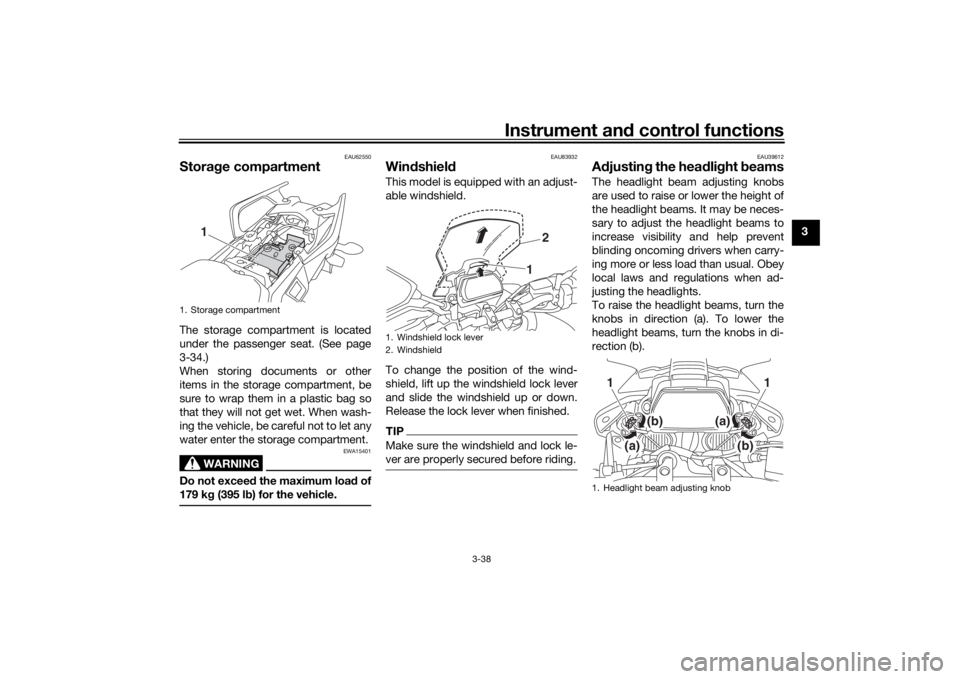
Stora ge compartmentThe storage compartment is located
under the passenger seat. (See page
3-34.)
When storing documents or other
items in the storage compartment, be
sure to wrap them in a plastic bag so
that they will not get wet. When wash-
ing the vehicle, be careful not to let any
water enter the storage compartment.
WARNING
EWA15401
Do not exceed the maximum loa d of
179 k g (395 l b) for the vehicle.
EAU83932
Win dshiel d This model is equipped with an adjust-
able windshield.
To change the position of the wind-
shield, lift up the windshield lock lever
and slide the windshield up or down.
Release the lock lever when finished.TIPMake sure the windshield and lock le-
ver are properly secured before riding.
EAU39612
A djustin g the hea dlig ht beamsThe headlight beam adjusting knobs
are used to raise or lower the height of
the headlight beams. It may be neces-
sary to adjust the headlight beams to
increase visibility and help prevent
blinding oncoming drivers when carry-
ing more or less load than usual. Obey
local laws and regulations when ad-
justing the headlights.
To raise the headlight beams, turn the
knobs in direction (a). To lower the
headlight beams, turn the knobs in di-
rection (b).
1. Storage compartment
1
1. Windshield lock lever
2. Windshield
1 2
1. Headlight beam adjusting knob
(a)
(b)
1
(b)
(a)
1
UB1JE0E0.book Page 38 Tuesday, February 13, 2018 9:12 AM
Page 54 of 120
Instrument and control functions
3-39
3
EAU46833
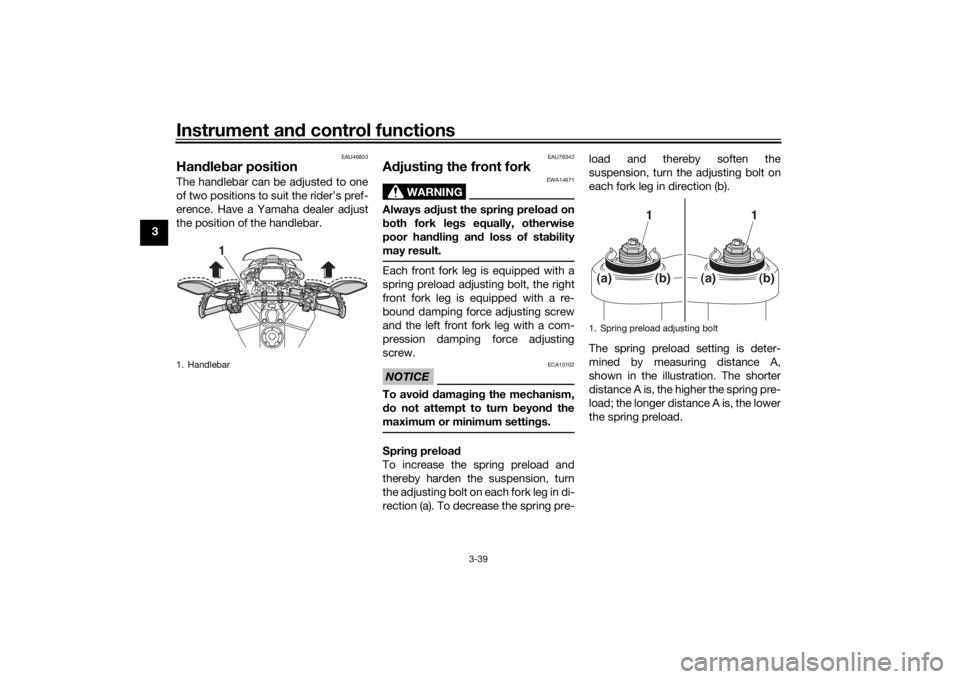
Han dle bar position The handlebar can be adjusted to one
of two positions to suit the rider’s pref-
erence. Have a Yamaha dealer adjust
the position of the handlebar.
EAU76342
A djustin g the front fork
WARNING
EWA14671
Always a djust the sprin g preloa d on
b oth fork le gs equally, otherwise
poor han dlin g an d loss of sta bility
may result.Each front fork leg is equipped with a
spring preload adjusting bolt, the right
front fork leg is equipped with a re-
bound damping force adjusting screw
and the left front fork leg with a com-
pression damping force adjusting
screw.NOTICE
ECA10102
To avoi d d amag ing the mechanism,
d o not attempt to turn b eyond the
maximum or minimum settin gs.Sprin g preloa d
To increase the spring preload and
thereby harden the suspension, turn
the adjusting bolt on each fork leg in di-
rection (a). To decrease the spring pre- load and thereby soften the
suspension, turn the adjusting bolt on
each fork leg in direction (b).
The spring preload setting is deter-
mined by measuring distance A,
shown in the illustration. The shorter
distance A is, the higher the spring pre-
load; the longer distance A is, the lower
the spring preload.
1. Handlebar
1
1. Spring preload adjusting bolt
1
1
(a)
(b)
(a)
(b)
UB1JE0E0.book Page 39 Tuesday, February 13, 2018 9:12 AM
Page 57 of 120
Instrument and control functions
3-42
3
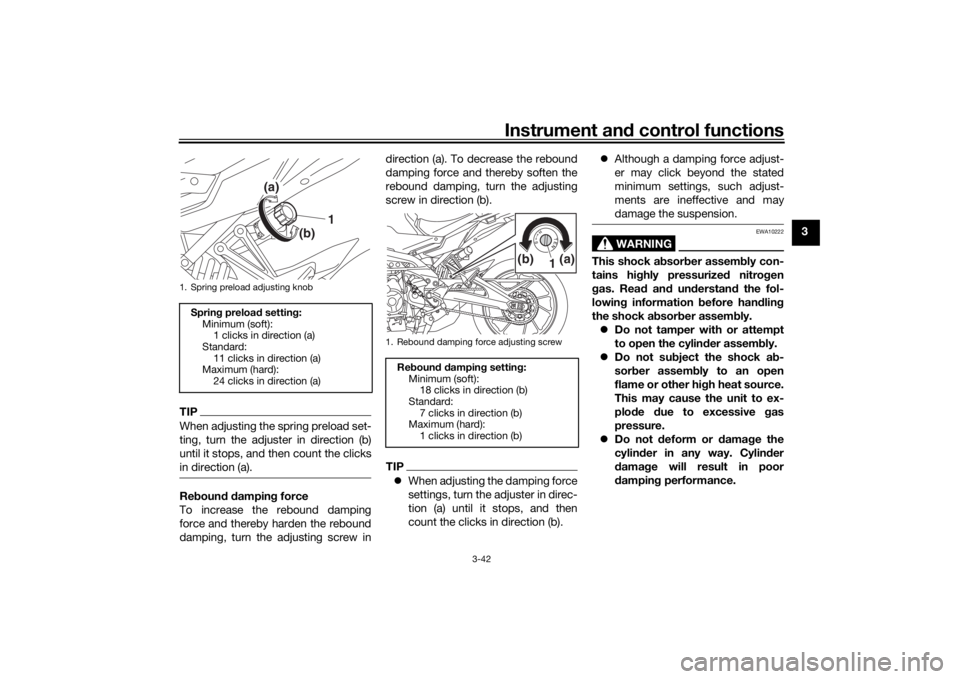
TIPWhen adjusting the spring preload set-
ting, turn the adjuster in direction (b)
until it stops, and then count the clicks
in direction (a).Re boun d d ampin g force
To increase the rebound damping
force and thereby harden the rebound
damping, turn the adjusting screw in direction (a). To decrease the rebound
damping force and thereby soften the
rebound damping, turn the adjusting
screw in direction (b).
TIP
When adjusting the damping force
settings, turn the adjuster in direc-
tion (a) until it stops, and then
count the clicks in direction (b).
Although a damping force adjust-
er may click beyond the stated
minimum settings, such adjust-
ments are ineffective and may
damage the suspension.
WARNING
EWA10222
This shock a bsor ber assem bly con-
tains hig hly pressurize d nitro gen
g as. Rea d an d un derstan d the fol-
lowin g information before han dlin g
the shock a bsor ber assem bly.
Do not tamper with or attempt
to open the cylind er assembly.
Do not su bject the shock a b-
sor ber assem bly to an open
flame or other hi gh heat source.
This may cause the unit to ex-
plo de due to excessive gas
pressure.
Do not deform or damag e the
cylin der in any way. Cylin der
d ama ge will result in poor
d ampin g performance.
1. Spring preload adjusting knobSprin g preloa d settin g:
Minimum (soft): 1 clicks in direction (a)
Standard: 11 clicks in direction (a)
Maximum (hard):
24 clicks in direction (a)
(b)
(a)
1
1. Rebound damping force adjusting screw
Re boun d d ampin g settin g:
Minimum (soft): 18 clicks in direction (b)
Standard: 7 clicks in direction (b)
Maximum (hard):
1 clicks in direction (b)
1(a)(b)
UB1JE0E0.book Page 42 Tuesday, February 13, 2018 9:12 AM
Page 58 of 120
Instrument and control functions
3-43
3
Do not dispose of a damag ed or
worn-out shock a bsor ber as-
sem bly yourself. Take the shock
a b sor ber assem bly to a Yamaha
d ealer for any service.
EAU49454
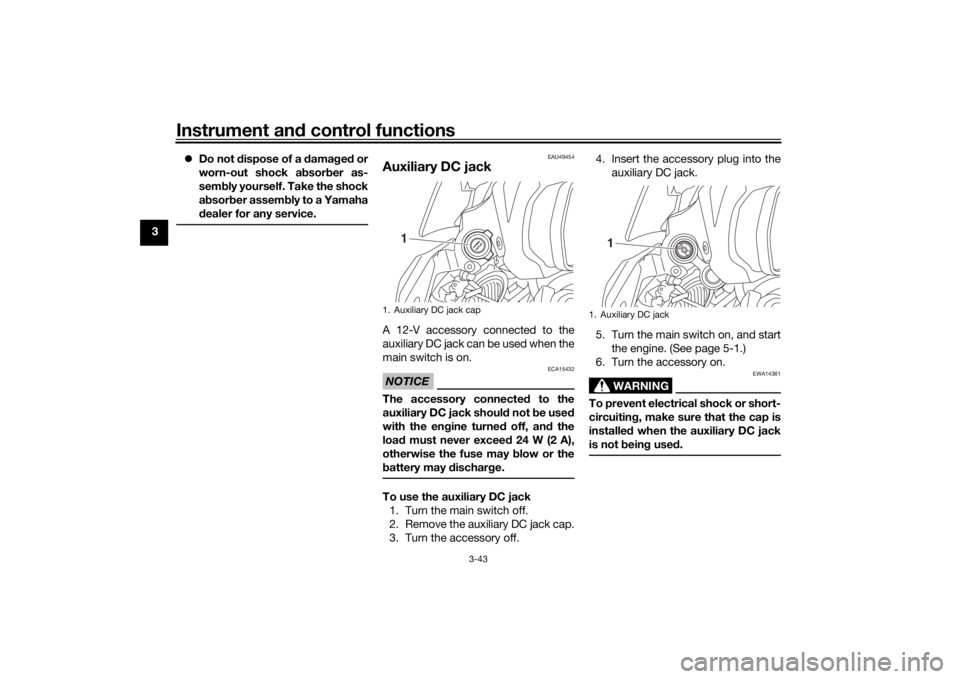
Auxiliary DC jackA 12-V accessory connected to the
auxiliary DC jack can be used when the
main switch is on.NOTICE
ECA15432
The accessory connecte d to the
auxiliary DC jack shoul d not b e used
with the en gine turne d off, an d the
loa d must never excee d 24 W (2 A),
otherwise the fuse may blow or the
b attery may d ischarge.To use the auxiliary DC jack
1. Turn the main switch off.
2. Remove the auxiliary DC jack cap.
3. Turn the accessory off. 4. Insert the accessory plug into the
auxiliary DC jack.
5. Turn the main switch on, and start the engine. (See page 5-1.)
6. Turn the accessory on.
WARNING
EWA14361
To prevent electrical shock or short-
circuitin g, make sure that the cap is
installe d when the auxiliary DC jack
is not bein g use d.
1. Auxiliary DC jack cap
1
1. Auxiliary DC jack
1
UB1JE0E0.book Page 43 Tuesday, February 13, 2018 9:12 AM
Page 59 of 120
Instrument and control functions
3-44
3
EAU70641
Auxiliary DC connectorThis vehicle is equipped with an auxil-
iary DC connector. Consult your
Yamaha dealer before installing any accessories.
EAU15306
Si destan dThe sidestand is located on the left
side of the frame. Raise the sidestand
or lower it with your foot while holding
the vehicle upright.TIPThe built-in sidestand switch is part of
the ignition circuit cut-off system,
which cuts the ignition in certain situa-
tions. (See the following section for an
explanation of the ignition circuit cut-
off system.)
WARNING
EWA10242
The vehicle must not b e ridden with
the si destan d d own, or if the si de-
stan d cannot b e properly move d up
(or does not stay up), otherwise the
si destan d coul d contact the groun d
an d d istract the operator, resultin g
in a possib le loss of control.
Yamaha’s ig nition circuit cut-off
system has been desi gne d to assist
the operator in fulfillin g the respon-
si bility of raisin g the si destan d b e-
fore startin g off. Therefore, check this system re
gularly an d have a
Yamaha dealer repair it if it does not
function properly.
UB1JE0E0.book Page 44 Tuesday, February 13, 2018 9:12 AM
Page 61 of 120
Instrument and control functions
3-46
3
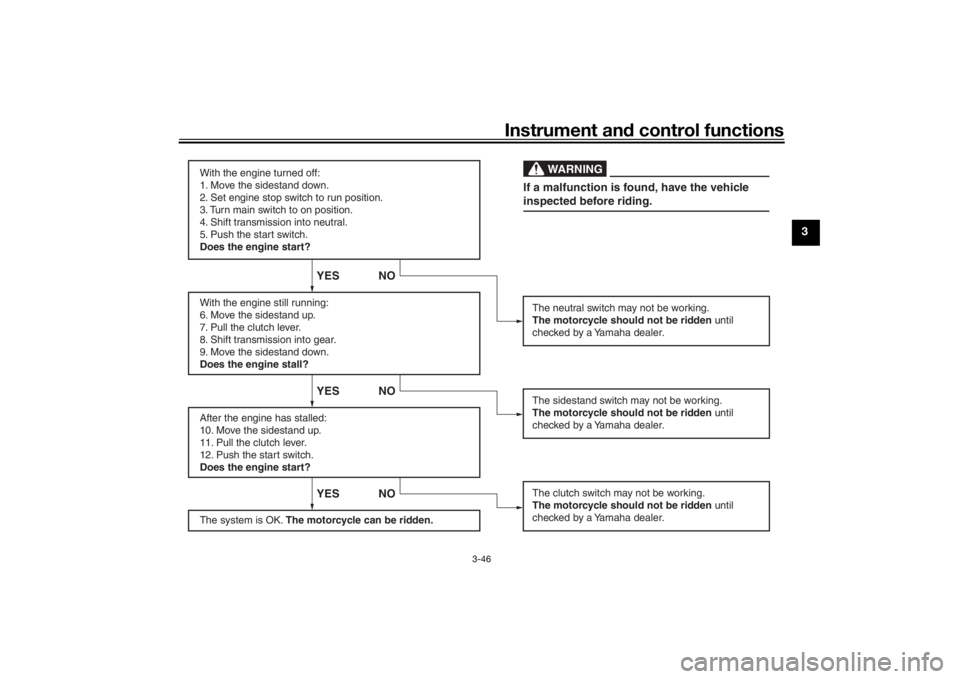
With the engine turned off:
1. Move the sidestand down.
2. Set engine stop switch to run position.
3. Turn main switch to on position.
4. Shift transmission into neutral.
5. Push the start switch.
Does the engine start?
With the engine still running:
6. Move the sidestand up.
7. Pull the clutch lever.
8. Shift transmission into gear.
9. Move the sidestand down.
Does the engine stall?
After the engine has stalled:
10. Move the sidestand up.
11. Pull the clutch lever.
12. Push the start switch.
Does the engine start?
The system is OK. The motorcycle can be ridden.
YES NO YES NO YES NO
The neutral switch may not be working.
The motorcycle should not be ridden until
checked by a Yamaha dealer.
The clutch switch may not be working.
The motorcycle should not be ridden until
checked by a Yamaha dealer.The sidestand switch may not be working.
The motorcycle should not be ridden until
checked by a Yamaha dealer.If a malfunction is found, have the vehicle
inspected before riding.
WARNING
UB1JE0E0.book Page 46 Tuesday, February 13, 2018 9:12 AM
Page 62 of 120
For your safety – pre-operation checks
4-1
4
EAU15599
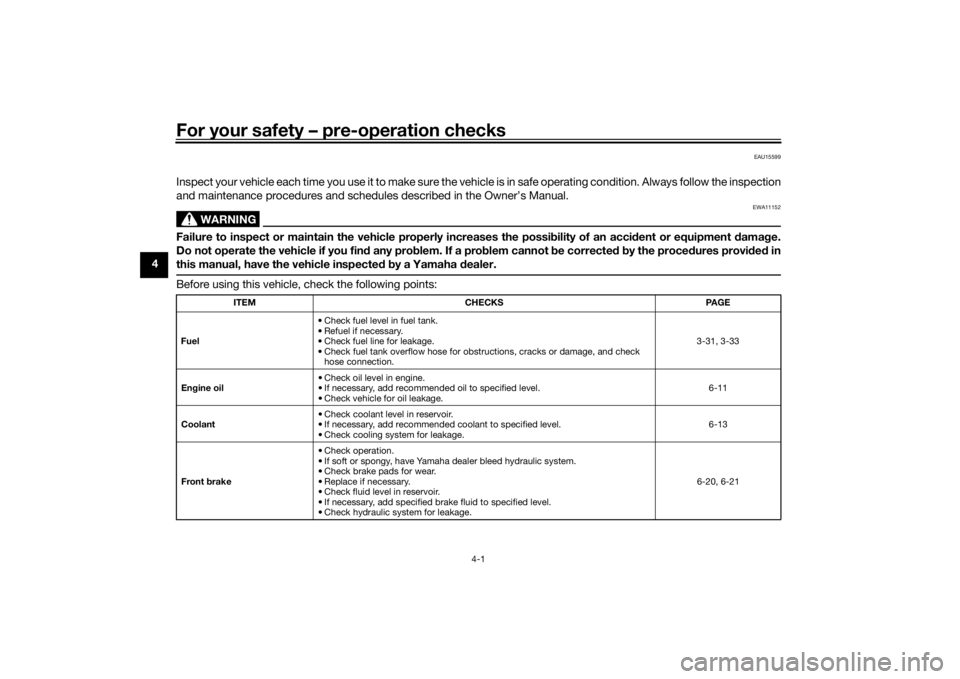
Inspect your vehicle each time you use it to make sure the vehicle is in safe operating condition. Always follow the inspection
and maintenance procedures and schedules described in the Owner’s Manual.
WARNING
EWA11152
Failure to inspect or maintain the vehicle properly increases the possibility of an acci dent or equipment damag e.
Do not operate the vehicle if you fin d any pro blem. If a pro blem cannot be corrected b y the proce dures provi ded in
this manual, have the vehicle inspecte d b y a Yamaha dealer.Before using this vehicle, check the following points:
ITEM CHECKS PAGE
Fuel • Check fuel level in fuel tank.
• Refuel if necessary.
• Check fuel line for leakage.
• Check fuel tank overflow hose for obstructions, cracks or damage, and check
hose connection. 3-31, 3-33
En gine oil • Check oil level in engine.
• If necessary, add recommended oil to specified level.
• Check vehicle for oil leakage. 6-11
Coolant • Check coolant level in reservoir.
• If necessary, add recommended coolant to specified level.
• Check cooling system for leakage. 6-13
Front brake • Check operation.
• If soft or spongy, have Yamaha dealer bleed hydraulic system.
• Check brake pads for wear.
• Replace if necessary.
• Check fluid level in reservoir.
• If necessary, add specified brake fluid to specified level.
• Check hydraulic system for leakage. 6-20, 6-21
UB1JE0E0.book Page 1 Tuesday, February 13, 2018 9:12 AM
Page 65 of 120
Operation and important ri din g points
5-1
5
EAU15952
Read the Owner’s Manual carefully to
become familiar with all controls. If
there is a control or function you do not
understand, ask your Yamaha dealer.
WARNING
EWA10272
Failure to familiarize yourself with
the controls can lead to loss of con-
trol, which coul d cause an acci dent
or injury.
EAUM3631
TIPThis model is equipped with: a lean angle sensor to stop the en-
gine in case of a turnover. In this
case, the engine trouble warning
light will come on, but this is not a
malfunction. Turn the key to
“OFF” and then to “ON” to turn off
the warning light. Failing to do so
will prevent the engine from start-
ing even though the engine will
crank when pushing the start
switch.
an engine auto-stop system. The
engine stops automatically if left
idling for 20 minutes. If the engine
stops, simply push the start
switch to restart the engine.
EAU84361
Startin g the en gineUnder normal conditions, shift the
transmission into neutral before start-
ing the engine. To start the engine with
the transmission in gear, the sidestand
must be up and the clutch lever pulled.
To start the engine1. Turn the main switch to “ON”, and
set the engine stop switch to “ ”.
2. Confirm the following lights per- form a circuit check. Engine trouble warning light
ABS warning light
Traction control system indi-
cator light
Cruise control indicator lights
Shift indicator light
Engine oil and Coolant warn-
ing light
Immobilizer system indicator
lightTIP The ABS warning light should go
off after reaching a speed of 10
km/h (6 mi/h) or higher.
UB1JE0E0.book Page 1 Tuesday, February 13, 2018 9:12 AM
Page 68 of 120

Operation and important rid ing points
5-4
5
EAU17214
Parkin gWhen parking, stop the engine, and
then remove the key from the main
switch.
WARNING
EWA10312
Since the en gine an d exhaust
system can become very hot,
park in a place where pe destri-
ans or chil dren are not likely to
touch them and b e burne d.
Do not park on a slope or on soft
groun d, otherwise the vehicle
may overturn, increasin g the
risk of a fuel leak an d fire.
Do not park near g rass or other
flammab le materials which
mi ght catch fire.
UB1JE0E0.book Page 4 Tuesday, February 13, 2018 9:12 AM