lock YAMAHA TRICITY 2016 User Guide
[x] Cancel search | Manufacturer: YAMAHA, Model Year: 2016, Model line: TRICITY, Model: YAMAHA TRICITY 2016Pages: 87, PDF Size: 2.59 MB
Page 28 of 87
Instrument and control functions
3-12
3
EAU37473
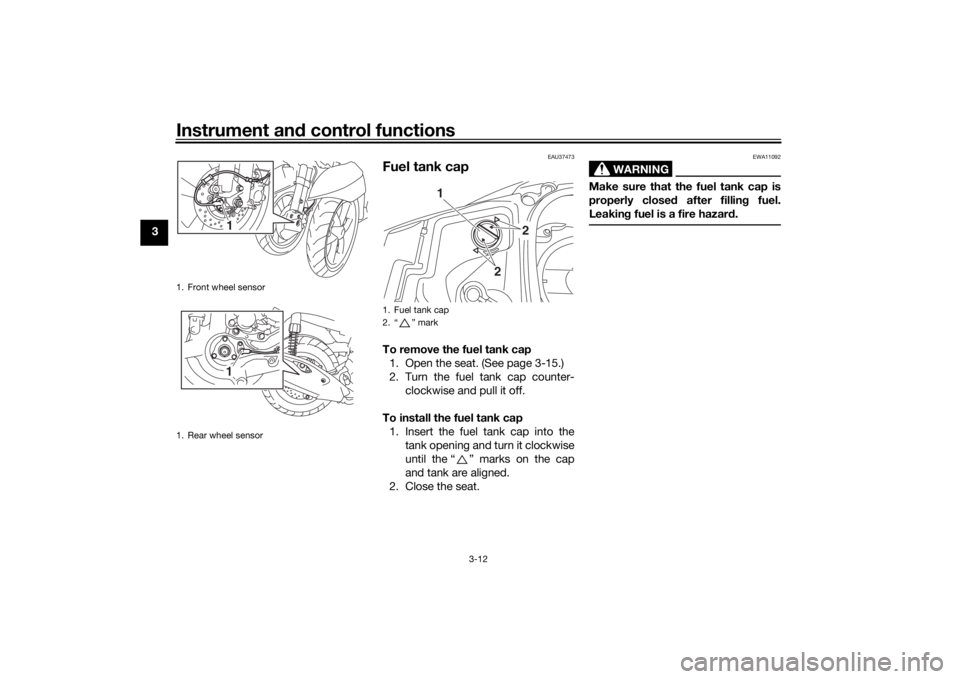
Fuel tank capTo remove the fuel tank cap
1. Open the seat. (See page 3-15.)
2. Turn the fuel tank cap counter- clockwise and pull it off.
To install the fuel tank cap 1. Insert the fuel tank cap into the tank opening and turn it clockwise
until the “ ” marks on the cap
and tank are aligned.
2. Close the seat.
WARNING
EWA11092
Make sure that the fuel tank cap is
properly close d after fillin g fuel.
Leakin g fuel is a fire hazar d.
1. Front wheel sensor
1. Rear wheel sensor
11
1. Fuel tank cap
2. “ ” mark
2
2
1
U2CME2E0.book Page 12 Friday, August 21, 2015 9:16 AM
Page 31 of 87
Instrument and control functions
3-15
3
EAU60621
SeatTo open the seat
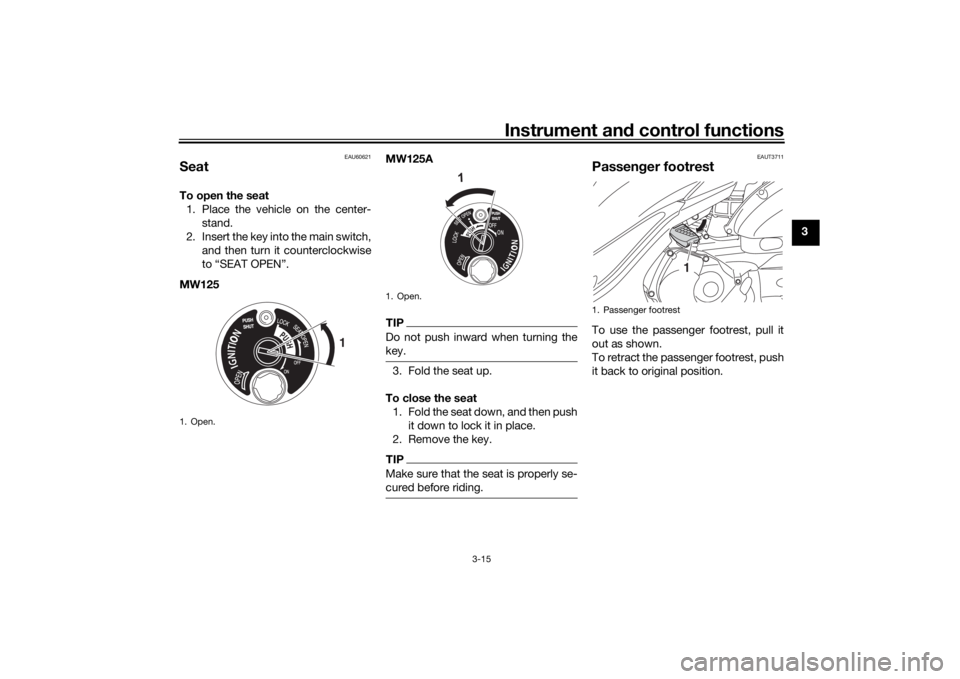
1. Place the vehicle on the center- stand.
2. Insert the key into the main switch, and then turn it counterclockwise
to “SEAT OPEN”.
MW125 MW125A
TIPDo not push inward when turning the
key.3. Fold the seat up.
To close the seat 1. Fold the seat down, and then push it down to lock it in place.
2. Remove the key.TIPMake sure that the seat is properly se-
cured before riding.
EAUT3711
Passen ger footrestTo use the passenger footrest, pull it
out as shown.
To retract the passenger footrest, push
it back to original position.
1. Open.
1
1. Open.
1
1. Passenger footrest
1
U2CME2E0.book Page 15 Friday, August 21, 2015 9:16 AM
Page 63 of 87
Periodic maintenance an d a djustment
6-21
6
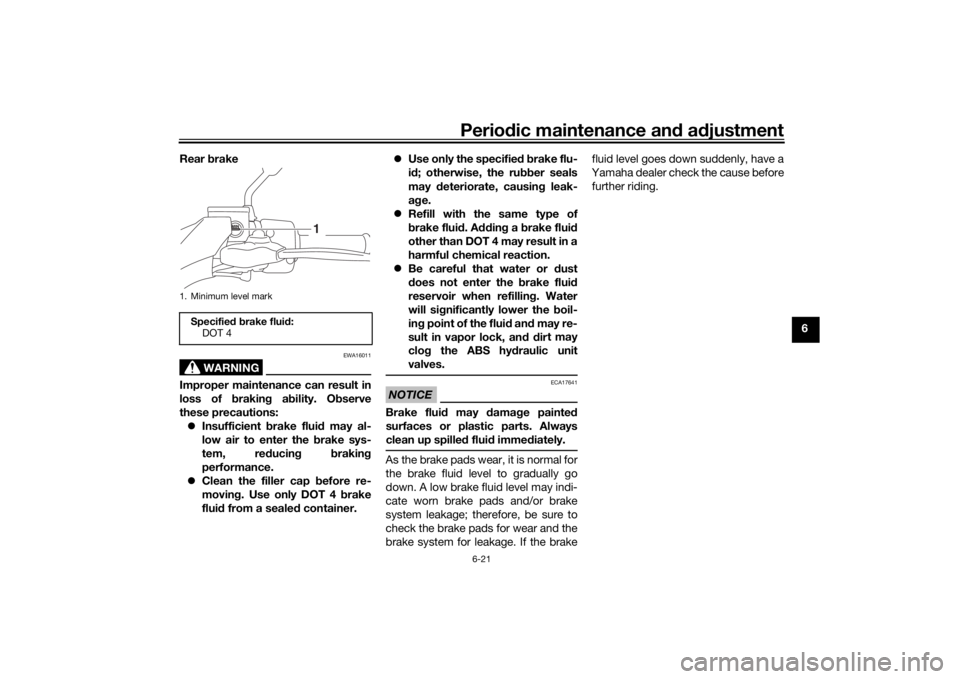
Rear
brake
WARNING
EWA16011
Improper maintenance can result in
loss of b raking a bility. O bserve
these precautions: Insufficient brake flui d may al-
low air to enter the brake sys-
tem, re ducin g brakin g
performance.
Clean the filler cap before re-
movin g. Use only DOT 4 brake
flui d from a seale d container.
Use only the specified b rake flu-
i d ; otherwise, the ru bber seals
may deteriorate, causin g leak-
a g e.
Refill with the same type of
brake flui d. A dding a brake fluid
other than DOT 4 may result in a
harmful chemical reaction.
Be careful that water or d ust
d oes not enter the brake flui d
reservoir when refillin g. Water
will si gnificantly lower the boil-
in g point of the flui d an d may re-
sult in vapor lock, an d d ir t may
cl
o g the ABS hy draulic unit
valves.
NOTICE
ECA17641
Brake flui d may d amage painte d
surfaces or plastic parts. Always
clean up spilled fluid imme diately.As the brake pads wear, it is normal for
the brake fluid level to gradually go
down. A low brake fluid level may indi-
cate worn brake pads and/or brake
system leakage; therefore, be sure to
check the brake pads for wear and the
brake system for leakage. If the brake fluid level goes down suddenly, have a
Yamaha dealer check the cause before
further riding.
1. Minimum level markSpecifie
d b rake flui d:
DOT 4
1
U2CME2E0.book Page 21 Friday, August 21, 2015 9:16 AM
Page 70 of 87
Periodic maintenance an d a djustment
6-28
6 MW125 MW125A
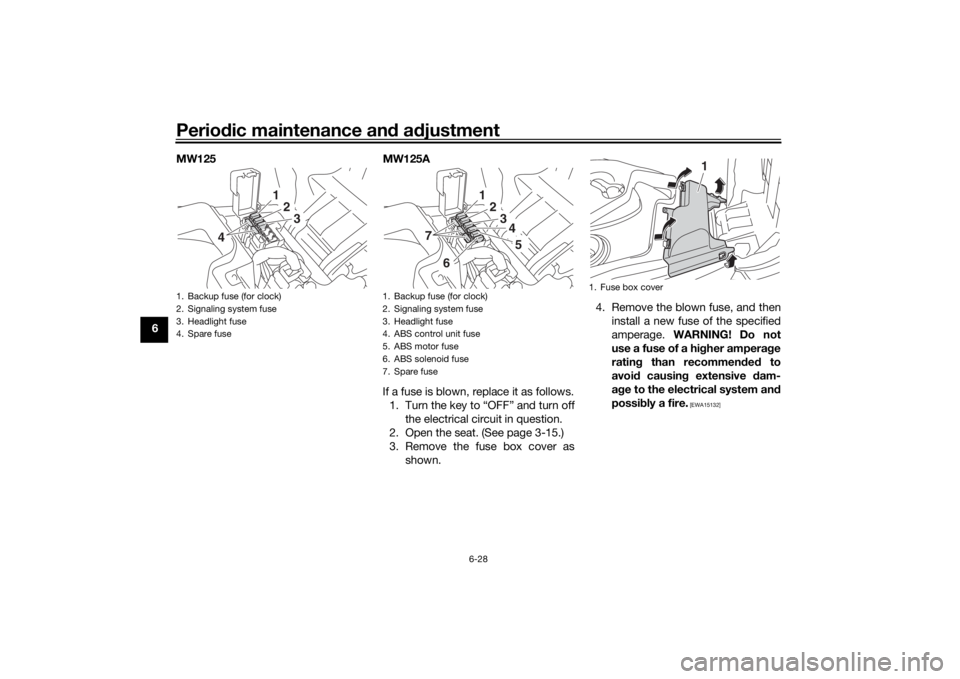
If a fuse is blown, replace it as follows.1. Turn the key to “OFF” and turn off the electrical circuit in question.
2. Open the seat. (See page 3-15.)
3. Remove the fuse box cover as shown. 4. Remove the blown fuse, and then
install a new fuse of the specified
amperage. WARNING! Do not
use a fuse of a hi gher ampera ge
ratin g than recommen ded to
avoi d causin g extensive d am-
a g e to the electrical system an d
possi bly a fire.
[EWA15132]
1. Backup fuse (for clock)
2. Signaling system fuse
3. Headlight fuse
4. Spare fuse
123
4
1. Backup fuse (for clock)
2. Signaling system fuse
3. Headlight fuse
4. ABS control unit fuse
5. ABS motor fuse
6. ABS solenoid fuse
7. Spare fuse
12345
6
7
1. Fuse box cover
1
U2CME2E0.book Page 28 Friday, August 21, 2015 9:16 AM
Page 75 of 87
Periodic maintenance an d a djustment
6-33
6
En
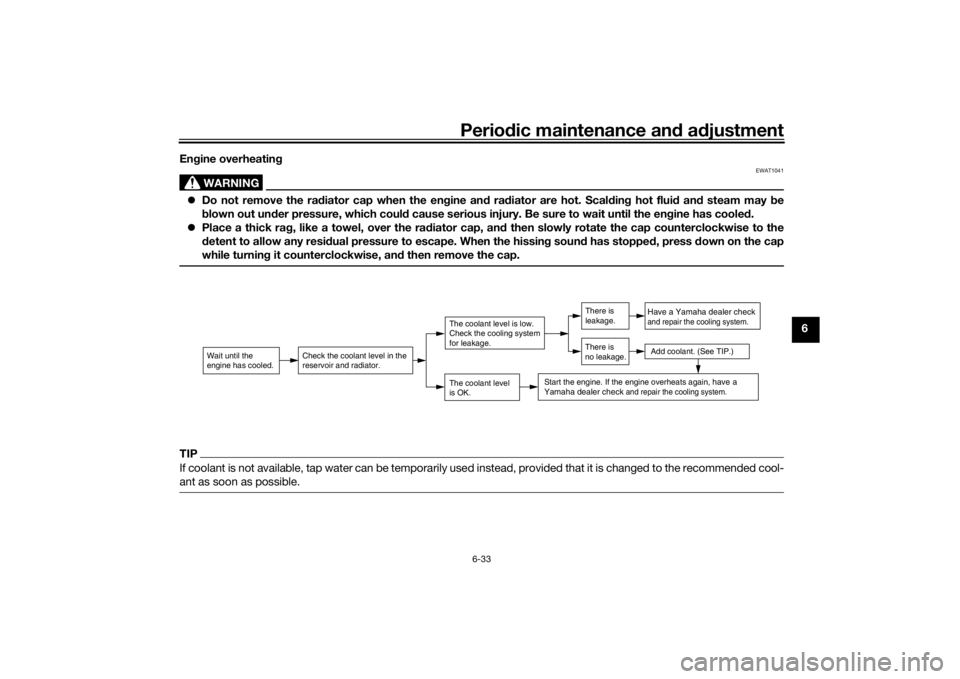
gine overheatin g
WARNING
EWAT1041
Do not remove the ra diator cap when the en gine an d ra diator are hot. Scal din g hot flui d an d steam may be
b lown out un der pressure, which coul d cause serious injury. Be sure to wait until the en gine has coole d.
Place a thick rag , like a towel, over the ra diator cap, an d then slowly rotate the cap counterclockwise to the
d etent to allow any resi dual pressure to escape. When the hissin g soun d has stopped , press down on the cap
while turnin g it counterclockwise, an d then remove the cap.TIPIf coolant is not available, tap water can be temporarily used instead, provided that it is changed to the recommended cool-
ant as soon as possible.
Wait until the
engine has cooled.
Check the coolant level in the
reservoir and radiator.
The coolant level
is OK.The coolant level is low.
Check the cooling system
for leakage.
Have a Yamaha dealer checkand repair the cooling system.Add coolant. (See TIP.)
Start the engine. If the engine overheats again,
have a
Yamaha dealer check
and repair the cooling system.
There is
leakage.
There is
no leakage.
U2CME2E0.book Page 33 Friday, August 21, 2015 9:16 AM
Page 85 of 87

10-1
10
Index
AABS (for ABS models) .......................... 3-11
ABS warning light (for ABS models) ....... 3-4
Acceleration and deceleration ................ 5-3
Air filter and V-belt case air filter
elements ............................................. 6-14
Auxiliary DC connector ......................... 3-20
Auxiliary lights....................................... 6-30BBattery .................................................. 6-26
Brake fluid, changing............................ 6-22
Brake fluid level, checking.................... 6-20
Brake lever, front .................................. 3-10
Brake lever, rear ................................... 3-10
Brake levers, lubricating ....................... 6-23
Braking ................................................... 5-3CCables, checking and lubricating ......... 6-22
Care ........................................................ 7-1
Catalytic converter ............................... 3-14
Centerstand and sidestand, checking and lubricating .................... 6-23
Coolant ................................................. 6-13
Coolant temperature warning light ......... 3-4DDimmer switch...................................... 3-10EEngine break-in ...................................... 5-4
Engine oil and oil strainer ..................... 6-10
Engine serial number .............................. 9-1
Engine trouble warning light ................... 3-4FFinal transmission oil ............................ 6-12
Front and rear brake pads, checking ... 6-20 Front brake lever free play, checking ... 6-19
Front fork, checking ............................. 6-24
Fuel ...................................................... 3-13
Fuel consumption, tips for reducing ...... 5-3
Fuel tank cap........................................ 3-12
Fuses, replacing ................................... 6-27
HHandlebar switches ............................... 3-9
Headlight bulb, replacing ..................... 6-29
High beam indicator light ....................... 3-4
Horn switch .......................................... 3-10IIdentification numbers ........................... 9-1
Ignition circuit cut-off system .............. 3-18
Indicator lights and warning lights ......... 3-3KKeyhole shutter ...................................... 3-3LLeaning system, checking ................... 6-26
Luggage hook ...................................... 3-17MMain switch/steering lock ...................... 3-1
Maintenance and lubrication, periodic... 6-4
Maintenance, emission control
system ................................................. 6-3
Matte color, caution ............................... 7-1
Model label............................................. 9-1
Multi-function meter unit ........................ 3-5PPanel, removing and installing ............... 6-8
Parking ................................................... 5-4
Part locations ......................................... 2-1
Passenger footrest ............................... 3-15
RRear brake lever free play, checking .... 6-19SSafe-riding points ................................... 1-5
Safety information................................... 1-1
Seat....................................................... 3-15
Self-diagnosis device ............................. 3-5
Sidestand.............................................. 3-17
Spark plug, checking .............................. 6-8
Specifications ......................................... 8-1
Starting off .............................................. 5-2
Starting the engine ................................. 5-1
Start switch ........................................... 3-10
Steering, checking ................................ 6-25
Steering tie rod, checking..................... 6-25
Storage ................................................... 7-4
Storage compartment........................... 3-16TTail/brake light ...................................... 6-30
Throttle grip and cable,
checking and lubricating .................... 6-22
Throttle grip free play, checking ........... 6-16
Tires ...................................................... 6-17
Tool kit .................................................... 6-2
Troubleshooting .................................... 6-31
Troubleshooting charts ......................... 6-32
Turn signal indicator lights...................... 3-3
Turn signal light bulb ............................ 6-31
Turn signal switch ................................. 3-10VValve clearance..................................... 6-16
Vehicle identification number ................. 9-1
U2CME2E0.book Page 1 Friday, August 21, 2015 9:16 AM