service YAMAHA TTR110 2013 Owners Manual
[x] Cancel search | Manufacturer: YAMAHA, Model Year: 2013, Model line: TTR110, Model: YAMAHA TTR110 2013Pages: 88, PDF Size: 2.02 MB
Page 6 of 88

INTRODUCTIONAN IMPORTANT SAFETY MESSAGE:●
Read this manual completely before operating your motorcycle. Make sure you understand all instructions.
●
Pay close attention to the warning and notice labels on the motorcycle.
●
Never operate a motorcycle without proper training or instruction.
●
Weight of the rider should not exceed 60.0 kg (132 lb).
AN IMPORTANT NOTE TO PARENTS:
This motorcycle is not a toy. Before you let your child ride this motorcycle, you should understand the instructions and warn-
ings in this Owner’s Manual. Then be sure your child understands and will follow them. Children differ in skills, physical abil -
ities, and judgment. Some children may not be able to operate a motorcycle safely. Parents should supervise their child’s
use of the motorcycle at all times. Parents should permit continued use only if they determine that the child has the ability t o
operate the motorcycle safely.
Motorcycles are single track vehicles. Their safe use and operation are dependent upon the use of proper riding
techniques as well as the expertise of the operator. Every operator should know the following requirements before
riding this motorcycle.
He or she should:
●
Obtain thorough instructions from a competent source on all aspects of motorcycle operation.
●
Observe the warnings and maintenance requirements in this Owner’s Manual.
●
Obtain qualified training in safe and proper riding techniques.
●
Obtain professional technical service as indicated in this Owner’s Manual and/or when made necessary by mechanical
conditions.
U5B685E0.book Page 2 Tuesday, July 10, 2012 5:06 PM
Page 36 of 88
INSTRUMENT AND CONTROL FUNCTIONS
4-9
4
EAU46021
Shock absorber assembly
WARNING
EWA10221
This shock absorber assembly con-
tains highly pressurized nitrogen
gas. Read and understand the fol-
lowing information before handling
the shock absorber assembly.●
Do not tamper with or attempt to
open the cylinder assembly.
●
Do not subject the shock ab-
sorber assembly to an open
flame or other high heat source.
This may cause the unit to ex-
plode due to excessive gas
pressure.
●
Do not deform or damage the
cylinder in any way. Cylinder
damage will result in poor
damping performance.
●
Do not dispose of a damaged or
worn-out shock absorber as-
sembly yourself. Take the shock
absorber assembly to a Yamaha
dealer for any service.
EAU37490
Sidestand The sidestand is located on the left side
of the frame. Raise the sidestand or
lower it with your foot while holding the
vehicle upright.
WARNING
EWA14190
The vehicle must not be ridden with
the sidestand down, or if the side-
stand cannot be properly moved up (or does not stay up), otherwise the
sidestand could contact the ground
and distract the operator, resulting
in a possible loss of control.
EAU41611
Starting circuit cut-off system The starting circuit cut-off system pre-
vents starting when the transmission is
in gear.
Periodically check the operation of the
starting circuit cut-off system according
to the following procedure.TIPThis check is most reliable if performed
with a warmed-up engine.
U5B685E0.book Page 9 Tuesday, July 10, 2012 5:06 PM
Page 44 of 88
PERIODIC MAINTENANCE AND ADJUSTMENT
7-1
7
EAU17244
Periodic inspection, adjustment, and lu-
brication will keep your vehicle in the
safest and most efficient condition pos-
sible. Safety is an obligation of the vehi-
cle owner/operator. The most important
points of vehicle inspection, adjust-
ment, and lubrication are explained on
the following pages.
The intervals given in the periodic
maintenance charts should be simply
considered as a general guide under
normal riding conditions. However, de-
pending on the weather, terrain, geo-
graphical location, and individual use,
the maintenance intervals may need to
be shortened.
WARNING
EWA10321
Failure to properly maintain the ve-
hicle or performing maintenance ac-
tivities incorrectly may increase
your risk of injury or death during
service or while using the vehicle. If
you are not familiar with vehicle ser-
vice, have a Yamaha dealer perform
service.
WARNING
EWA15122
Turn off the engine when performing
maintenance unless otherwise
specified.●
A running engine has moving
parts that can catch on body
parts or clothing and electrical
parts that can cause shocks or
fires.
●
Running the engine while ser-
vicing can lead to eye injury,
burns, fire, or carbon monoxide
poisoning – possibly leading to
death. See page 2-2 for more in-
formation about carbon monox-
ide.WARNING
EWA15460
Brake discs, calipers, drums, and
linings can become very hot during
use. To avoid possible burns, let
brake components cool before
touching them.
EAU17302
Emission controls not only function to
ensure cleaner air, but are also vital to
proper engine operation and maximum
performance. In the following periodic
maintenance charts, the services relat-
ed to emissions control are grouped
separately. These services require
specialized data, knowledge, and
equipment. Maintenance, replacement,
or repair of the emission control devic-
es and systems may be performed by
any repair establishment or individual
that is certified (if applicable). Yamaha
dealers are trained and equipped to
perform these particular services.
U5B685E0.book Page 1 Tuesday, July 10, 2012 5:06 PM
Page 45 of 88

PERIODIC MAINTENANCE AND ADJUSTMENT
7-2
7
EAU17311
Owner’s tool kit The service information included in this
manual and the tools provided in the
owner’s tool kit are intended to assist
you in the performance of preventive
maintenance and minor repairs. How-
ever, additional tools such as a torque
wrench may be necessary to perform
certain maintenance work correctly.TIPIf you do not have the tools or experi-
ence required for a particular job, have
a Yamaha dealer perform it for you.
U5B685E0.book Page 2 Tuesday, July 10, 2012 5:06 PM
Page 49 of 88
PERIODIC MAINTENANCE AND ADJUSTMENT
7-6
7
EAU40000
TIPThe air filter needs more frequent service if you are riding in unusually wet or dusty areas.
U5B685E0.book Page 6 Tuesday, July 10, 2012 5:06 PM
Page 65 of 88
PERIODIC MAINTENANCE AND ADJUSTMENT
7-22
7
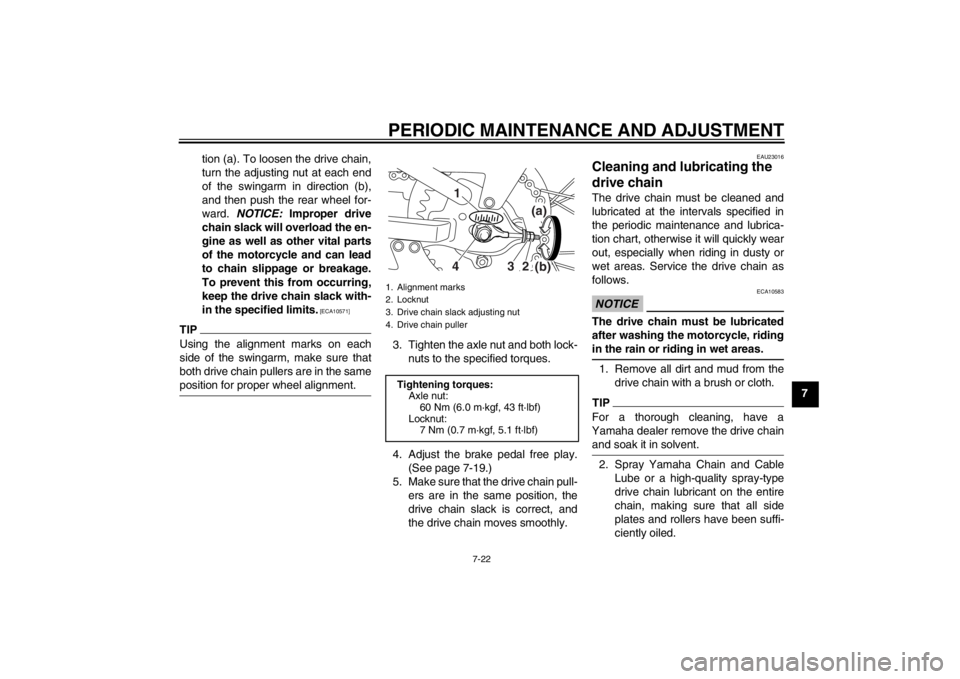
tion (a). To loosen the drive chain,
turn the adjusting nut at each end
of the swingarm in direction (b),
and then push the rear wheel for-
ward.
NOTICE: Improper drive
chain slack will overload the en-
gine as well as other vital parts
of the motorcycle and can lead
to chain slippage or breakage.
To prevent this from occurring,
keep the drive chain slack with-
in the specified limits.
[ECA10571]
TIPUsing the alignment marks on each
side of the swingarm, make sure that
both drive chain pullers are in the same
position for proper wheel alignment.
3. Tighten the axle nut and both lock- nuts to the specified torques.
4. Adjust the brake pedal free play. (See page 7-19.)
5. Make sure that the drive chain pull- ers are in the same position, the
drive chain slack is correct, and
the drive chain moves smoothly.
EAU23016
Cleaning and l ubricating the
drive chain The drive chain must be cleaned and
lubricated at the intervals specified in
the periodic maintenance and lubrica-
tion chart, otherwise it will quickly wear
out, especially when riding in dusty or
wet areas. Service the drive chain as
follows.NOTICE
ECA10583
The drive chain must be lubricated
after washing the motorcycle, riding
in the rain or riding in wet areas.1. Remove all dirt and mud from the
drive chain with a brush or cloth.TIPFor a thorough cleaning, have a
Yamaha dealer remove the drive chain
and soak it in solvent.2. Spray Yamaha Chain and CableLube or a high-quality spray-type
drive chain lubricant on the entire
chain, making sure that all side
plates and rollers have been suffi-
ciently oiled.
1. Alignment marks
2. Locknut
3. Drive chain slack adjusting nut
4. Drive chain puller
Tightening torques:Axle nut:60 Nm (6.0 m·kgf, 43 ft·lbf)
Locknut: 7 Nm (0.7 m·kgf, 5.1 ft·lbf)
(a)
(b)
432 1
U5B685E0.book Page 22 Tuesday, July 10, 2012 5:06 PM
Page 71 of 88
![YAMAHA TTR110 2013 Owners Manual PERIODIC MAINTENANCE AND ADJUSTMENT
7-28
7
avoid causing extensive dam-
age to the electrical system and
possibly a fire.
[EWA15131]
4. Connect the battery coupler.
5. Turn the key to “ON”.
6. If](/img/51/51628/w960_51628-70.png "YAMAHA TTR110 2013 Owners Manual PERIODIC MAINTENANCE AND ADJUSTMENT
7-28
7
avoid causing extensive dam-
age to the electrical system and
possibly a fire.
[EWA15131]
4. Connect the battery coupler.
5. Turn the key to “ON”.
6. If")
PERIODIC MAINTENANCE AND ADJUSTMENT
7-28
7
avoid causing extensive dam-
age to the electrical system and
possibly a fire.
[EWA15131]
4. Connect the battery coupler.
5. Turn the key to “ON”.
6. If the fuse immediately blows
again, have a Yamaha dealer
check the electrical system.
EAU24350
Supporting the motorcycle Since this model is not equipped with a
centerstand, follow these precautions
when removing the front and rear
wheel or performing other maintenance
requiring the motorcycle to stand up-
right. Check that the motorcycle is in a
stable and level position before starting
any maintenance. A strong wooden
box can be placed under the engine for
added stability.
To service the front wheel1. Stabilize the rear of the motorcycle by using a motorcycle stand or, if
an additional motorcycle stand is
not available, by placing a jack un-
der the frame in front of the rear
wheel.
2. Raise the front wheel off the ground by using a motorcycle
stand.
To service the rear wheel
Raise the rear wheel off the ground by
using a motorcycle stand or, if a motor-
cycle stand is not available, by placing a jack either under each side of the
frame in front of the rear wheel or under
each side of the swingarm.
Specified fuse:
10.0 A
U5B685E0.book Page 28 Tuesday, July 10, 2012 5:06 PM
Page 75 of 88
PERIODIC MAINTENANCE AND ADJUSTMENT
7-32
7
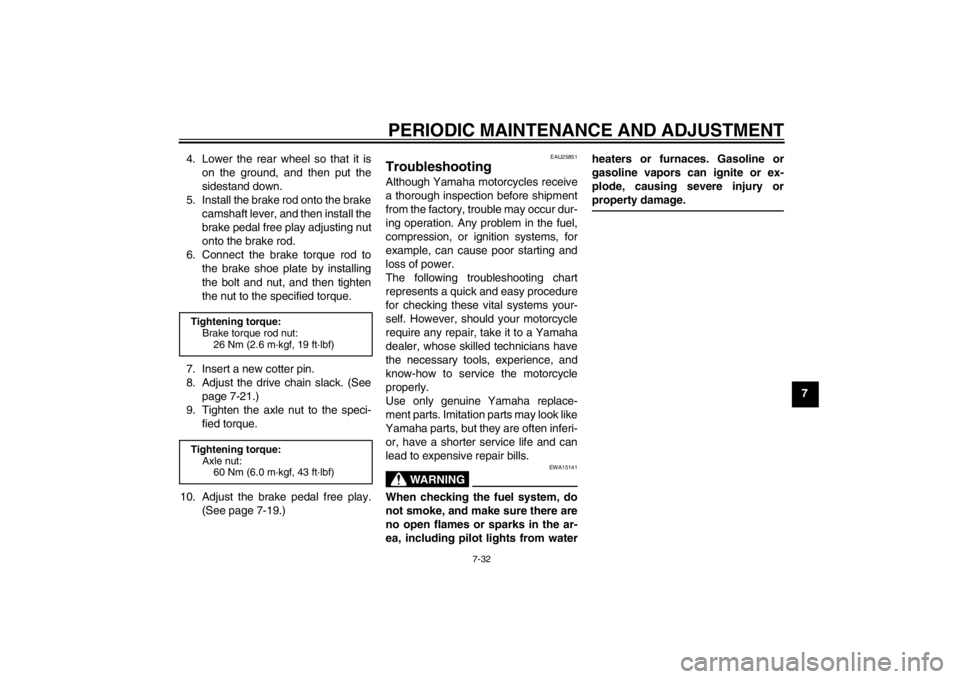
4. Lower the rear wheel so that it is
on the ground, and then put the
sidestand down.
5. Install the brake rod onto the brake camshaft lever, and then install the
brake pedal free play adjusting nut
onto the brake rod.
6. Connect the brake torque rod to the brake shoe plate by installing
the bolt and nut, and then tighten
the nut to the specified torque.
7. Insert a new cotter pin.
8. Adjust the drive chain slack. (See page 7-21.)
9. Tighten the axle nut to the speci- fied torque.
10. Adjust the brake pedal free play. (See page 7-19.)
EAU25851
Troubleshooting Although Yamaha motorcycles receive
a thorough inspection before shipment
from the factory, trouble may occur dur-
ing operation. Any problem in the fuel,
compression, or ignition systems, for
example, can cause poor starting and
loss of power.
The following troubleshooting chart
represents a quick and easy procedure
for checking these vital systems your-
self. However, should your motorcycle
require any repair, take it to a Yamaha
dealer, whose skilled technicians have
the necessary tools, experience, and
know-how to service the motorcycle
properly.
Use only genuine Yamaha replace-
ment parts. Imitation parts may look like
Yamaha parts, but they are often inferi-
or, have a shorter service life and can
lead to expensive repair bills.
WARNING
EWA15141
When checking the fuel system, do
not smoke, and make sure there are
no open flames or sparks in the ar-
ea, including pilot lights from water heaters or furnaces. Gasoline or
gasoline vapors can ignite or ex-
plode, causing severe injury or
property damage.
Tightening torque:
Brake torque rod nut:26 Nm (2.6 m·kgf, 19 ft·lbf)
Tightening torque: Axle nut:60 Nm (6.0 m·kgf, 43 ft·lbf)
U5B685E0.book Page 32 Tuesday, July 10, 2012 5:06 PM
Page 81 of 88
SPECIFICATIONS
9-1
9
Dimensions:Overall length:1565 mm (61.6 in)
Overall width:
680 mm (26.8 in)
Overall height: 923 mm (36.3 in)
Seat height: 670 mm (26.4 in)
Wheelbase:
1080 mm (42.5 in)
Ground clearance: 180 mm (7.09 in)
Minimum turning radius: 1660 mm (65.4 in)Weight:Curb weight:72 kg (159 lb)
Technical permissible mass (Maximum load +
curb weight): 132 kg (291 lb)Noise and vibration level:Noise level (77/311/EEC):
TT-R110E 78.9 dB(A)
Vibration on seat (EN1032, ISO5008): TT-R110E Will not exceed 0.5 m/s²
Vibration on handlebar (EN1032, ISO5008): TT-R110E Will not exceed 2.5 m/s²Engine:Engine type:Air cooled 4-stroke, SOHC
Cylinder arrangement: Single cylinder Displacement:
110 cm³
Bore × stroke:
51.0 × 54.0 mm (2.01 × 2.13 in)
Compression ratio:
9.30 : 1
Starting system: Electric starter and kickstarter
Lubrication system: Wet sump
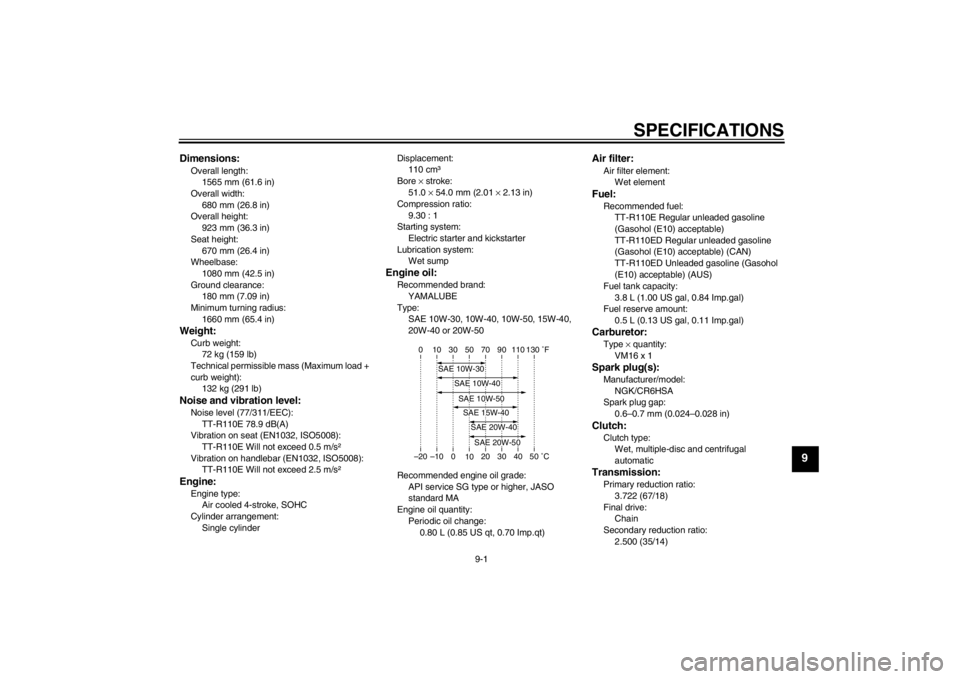
Engine oil:Recommended brand:YAMALUBE
Type: SAE 10W-30, 10W-40, 10W-50, 15W-40,
20W-40 or 20W-50
Recommended engine oil grade: API service SG type or higher, JASO
standard MA
Engine oil quantity: Periodic oil change:0.80 L (0.85 US qt, 0.70 Imp.qt)
Air filter:Air filter element:Wet elementFuel:Recommended fuel:TT-R110E Regular unleaded gasoline
(Gasohol (E10) acceptable)
TT-R110ED Regular unleaded gasoline
(Gasohol (E10) acceptable) (CAN)
TT-R110ED Unleaded gasoline (Gasohol
(E10) acceptable) (AUS)
Fuel tank capacity:
3.8 L (1.00 US gal, 0.84 Imp.gal)
Fuel reserve amount: 0.5 L (0.13 US gal, 0.11 Imp.gal)Carburetor:Type × quantity:
VM16 x 1Spark plug(s):Manufacturer/model: NGK/CR6HSA
Spark plug gap:
0.6–0.7 mm (0.024–0.028 in)Clutch:Clutch type:Wet, multiple-disc and centrifugal
automaticTransmission:Primary reduction ratio:
3.722 (67/18)
Final drive: Chain
Secondary reduction ratio: 2.500 (35/14)
–20 –10 0 1020 30 40 50 C
10 30 50 70 90 110
0 130 F
SAE 10W-30
SAE 15W-40SAE 20W-40SAE 20W-50
SAE 10W-40SAE 10W-50
U5B685E0.book Page 1 Tuesday, July 10, 2012 5:06 PM