transmission YAMAHA TTR110 2013 Owners Manual
[x] Cancel search | Manufacturer: YAMAHA, Model Year: 2013, Model line: TTR110, Model: YAMAHA TTR110 2013Pages: 88, PDF Size: 2.02 MB
Page 21 of 88

SAFETY INFORMATION
2-2
2
●
Many accidents involve inexperi-
enced operators. Make sure that you are qualified and that you only lend your mo-
torcycle to other qualified opera-
tors.
Know your skills and limits. Staying within your limits may
help you to avoid an accident.
We recommend that you prac- tice riding your motorcycle until
you have become thoroughly fa-
miliar with the motorcycle and all
of its controls.
●
Many accidents have been caused
by error of the motorcycle opera-
tor. A typical error made by the op-
erator is veering wide on a turn
due to excessive speed or under-
cornering (insufficient lean angle
for the speed). Never travel faster
than warranted by conditions.
●
Ride cautiously in unfamiliar ar-
eas. You may encounter hidden
obstacles that could cause an ac-
cident.
●
The posture of the operator is im-
portant for proper control. The op-
erator should keep both hands on the handlebar and both feet on the
operator footrests during operation
to maintain control of the motorcy-
cle.
●
Never ride under the influence of
alcohol or other drugs.
●
Be sure the transmission is in neu-
tral before starting the engine.
Protective Apparel
The majority of fatalities from motorcy-
cle accidents are the result of head in-
juries. The use of a safety helmet is the
single most critical factor in the preven-
tion or reduction of head injuries.
●
Always wear an approved helmet.
●
Wear a face shield or goggles.
Wind in your unprotected eyes
could contribute to an impairment
of vision that could delay seeing a
hazard.
●
The use of a jacket, heavy boots,
trousers, gloves, etc., is effective in
preventing or reducing abrasions
or lacerations.
●
Never wear loose-fitting clothes,
otherwise they could catch on the
control levers, footrests, or wheels
and cause injury or an accident.
●
Always wear protective clothing
that covers your legs, ankles, and
feet. The engine or exhaust sys-
tem become very hot during or af-
ter operation and can cause burns.
Avoid Carbon Monoxide Poisoning
All engine exhaust contains carbon
monoxide, a deadly gas. Breathing car-
bon monoxide can cause headaches,
dizziness, drowsiness, nausea, confu-
sion, and eventually death.
Carbon Monoxide is a colorless, odor-
less, tasteless gas which may be
present even if you do not see or smell
any engine exhaust. Deadly levels of
carbon monoxide can collect rapidly
and you can quickly be overcome and
unable to save yourself. Also, deadly
levels of carbon monoxide can linger
for hours or days in enclosed or poorly
ventilated areas. If you experience any
symptoms of carbon monoxide poison-
ing, leave the area immediately, get
fresh air, and SEEK MEDICAL TREAT-
MENT.
U5B685E0.book Page 2 Tuesday, July 10, 2012 5:06 PM
Page 23 of 88

SAFETY INFORMATION
2-4
2
ucts or having other modifications per-
formed to your vehicle that change any
of the vehicle’s design or operation
characteristics can put you and others
at greater risk of serious injury or death.
You are responsible for injuries related
to changes in the vehicle.
Keep the following guidelines in mind,
as well as those provided under “Load-
ing” when mounting accessories.
●
Never install accessories that
would impair the performance of
your motorcycle. Carefully inspect
the accessory before using it to
make sure that it does not in any
way reduce ground clearance or
cornering clearance, limit suspen-
sion travel, steering travel or con-
trol operation.
Accessories fitted to the handle- bar or the front fork area can
create instability due to improper
weight distribution. If accesso-
ries are added to the handlebar
or front fork area, they must be
as lightweight as possible and
should be kept to a minimum. Bulky or large accessories may
seriously affect the stability of
the motorcycle. Wind may at-
tempt to lift the motorcycle, or
the motorcycle may become un-
stable in cross winds.
Certain accessories can dis- place the operator from his or
her normal riding position. This
improper position limits the free-
dom of movement of the opera-
tor and may limit control ability,
therefore, such accessories are
not recommended.
●
Use caution when adding electri-
cal accessories. If electrical acces-
sories exceed the capacity of the
motorcycle’s electrical system, an
electric failure could result, which
could cause a dangerous loss of
lights or engine power.
Aftermarket Tires and Rims
The tires and rims that came with your
motorcycle were designed to match the
performance capabilities and to provide
the best combination of handling, brak-
ing, and comfort. Other tires, rims, siz-
es, and combinations may not be appropriate. Refer to page 7-15 for tire
specifications and more information on
replacing your tires.
Transporting the Motorcycle
Be sure to observe following instruc-
tions before transporting the motorcy-
cle in another vehicle.
●
Remove all loose items from the
motorcycle.
●
Check that the fuel cock (if
equipped) is in the “OFF” position
and that there are no fuel leaks.
●
Point the front wheel straight
ahead on the trailer or in the truck
bed, and choke it in a rail to pre-
vent movement.
●
Shift the transmission in gear (for
models with a manual transmis-
sion).
●
Secure the motorcycle with tie-
downs or suitable straps that are
attached to solid parts of the mo-
torcycle, such as the frame or up-
per front fork triple clamp (and not,
for example, to rubber-mounted
handlebars or turn signals, or parts
that could break). Choose the lo-
U5B685E0.book Page 4 Tuesday, July 10, 2012 5:06 PM
Page 29 of 88
INSTRUMENT AND CONTROL FUNCTIONS
4-2
4
EAU12660
Engine stop switch “ / ”
Set this switch to “ ” before starting
the engine. Set this switch to “ ” to
stop the engine in case of an emergen-
cy, such as when the vehicle overturns
or when the throttle cable is stuck.
EAU12711
Start switch “ ”
Push this switch to crank the engine
with the starter. See page 6-1 for start-
ing instructions prior to starting the en-
gine.
EAU39851
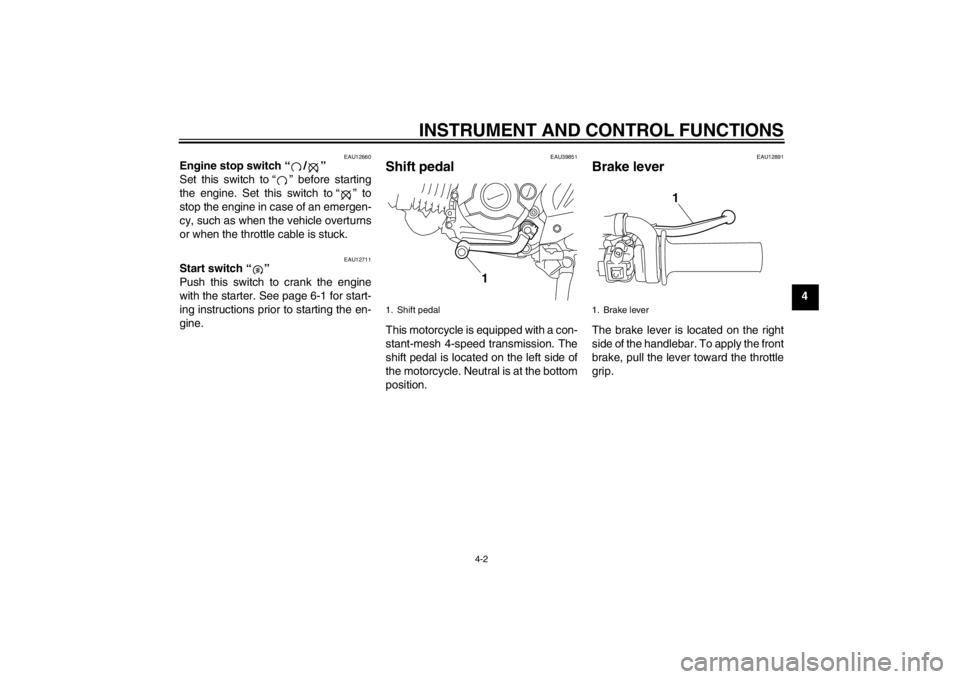
Shift pedal This motorcycle is equipped with a con-
stant-mesh 4-speed transmission. The
shift pedal is located on the left side of
the motorcycle. Neutral is at the bottom
position.
EAU12891
Brake lever The brake lever is located on the right
side of the handlebar. To apply the front
brake, pull the lever toward the throttle
grip.
1. Shift pedal
1
1. Brake lever
1
U5B685E0.book Page 2 Tuesday, July 10, 2012 5:06 PM
Page 36 of 88
INSTRUMENT AND CONTROL FUNCTIONS
4-9
4
EAU46021
Shock absorber assembly
WARNING
EWA10221
This shock absorber assembly con-
tains highly pressurized nitrogen
gas. Read and understand the fol-
lowing information before handling
the shock absorber assembly.●
Do not tamper with or attempt to
open the cylinder assembly.
●
Do not subject the shock ab-
sorber assembly to an open
flame or other high heat source.
This may cause the unit to ex-
plode due to excessive gas
pressure.
●
Do not deform or damage the
cylinder in any way. Cylinder
damage will result in poor
damping performance.
●
Do not dispose of a damaged or
worn-out shock absorber as-
sembly yourself. Take the shock
absorber assembly to a Yamaha
dealer for any service.
EAU37490
Sidestand The sidestand is located on the left side
of the frame. Raise the sidestand or
lower it with your foot while holding the
vehicle upright.
WARNING
EWA14190
The vehicle must not be ridden with
the sidestand down, or if the side-
stand cannot be properly moved up (or does not stay up), otherwise the
sidestand could contact the ground
and distract the operator, resulting
in a possible loss of control.
EAU41611
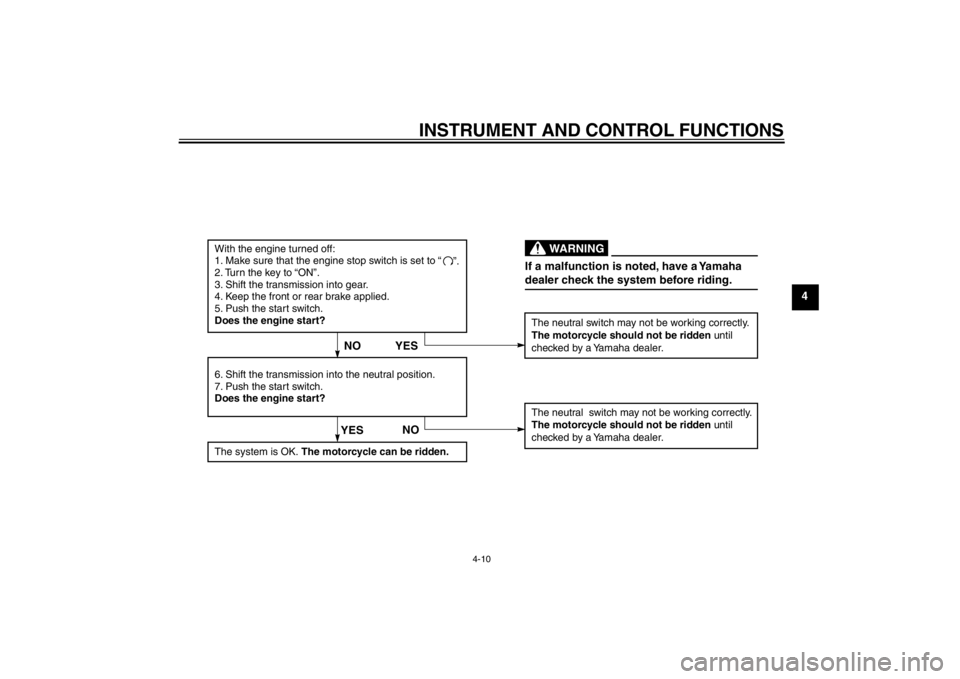
Starting circuit cut-off system The starting circuit cut-off system pre-
vents starting when the transmission is
in gear.
Periodically check the operation of the
starting circuit cut-off system according
to the following procedure.TIPThis check is most reliable if performed
with a warmed-up engine.
U5B685E0.book Page 9 Tuesday, July 10, 2012 5:06 PM
Page 37 of 88
INSTRUMENT AND CONTROL FUNCTIONS
4-10
4
With the engine turned off:
1. Make sure that the engine stop switch is set to “”.
2. Turn the key to “ON”.
3. Shift the transmission into gear.
4. Keep the front or rear brake applied.
5. Push the start switch.
Does the engine start?
The neutral switch may not be working correctly.
The motorcycle should not be ridden until
checked by a Yamaha dealer.
6. Shift the transmission into the neutral position.
7. Push the start switch.
Does the engine start?
The neutral switch may not be working correctly.
The motorcycle should not be ridden
until
checked by a Yamaha dealer.
YES
NO
The system is OK. The motorcycle can be ridden.
YES
NO
If a malfunction is noted, have a Yamaha
dealer check the system before riding.
WARNING
U5B685E0.book Page 10 Tuesday, July 10, 2012 5:06 PM
Page 40 of 88
OPERATION AND IMPORTANT RIDING POINTS
6-1
6
EAU15951
Read the Owner’s Manual carefully to
become familiar with all controls. If
there is a control or function you do not
understand, ask your Yamaha dealer.
WARNING
EWA10271
Failure to familiarize yourself with
the controls can lead to loss of con-
trol, which could cause an accident
or injury.
EAU44814
Starting and warming up a
cold engine 1. Turn the fuel cock lever to “ON”.
2. Turn the key to “ON” and makesure that the engine stop switch is
set to “ ”.
3. Shift the transmission into the neu- tral position.
WARNING
EWA14410
●
Be sure to shift the transmis-
sion into neutral before starting
the engine.
●
Never ride with the sidestand
down.
4. Turn the starter (choke) on andcompletely close the throttle. (See
page 4-7.)
5. Start the engine by pushing the start switch or by pushing the kick-
starter lever down.
6. When the engine is warm, turn the starter (choke) off.
TIPThe engine is warm when it responds
quickly to the throttle with the starter
(choke) turned off.NOTICE
ECA11042
For maximum engine life, never ac-
celerate hard when the engine is
cold!
U5B685E0.book Page 1 Tuesday, July 10, 2012 5:06 PM
Page 41 of 88
OPERATION AND IMPORTANT RIDING POINTS
6-2
6
EAU16640
Starting a warm engine Follow the same procedure as for start-
ing a cold engine with the exception
that the starter (choke) is not required
when the engine is warm.
EAU39901
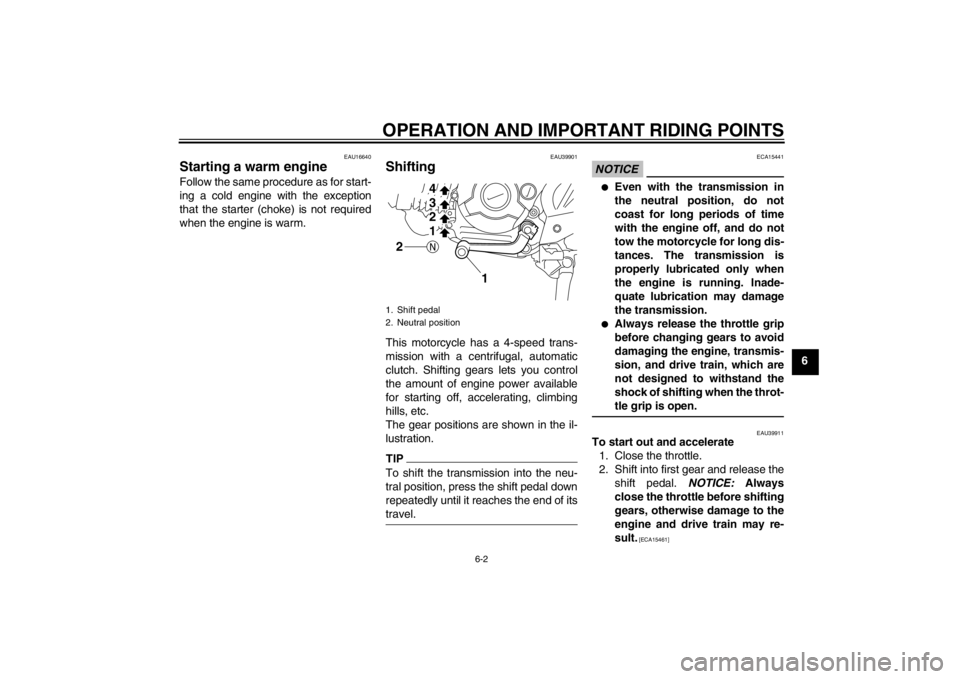
Shifting This motorcycle has a 4-speed trans-
mission with a centrifugal, automatic
clutch. Shifting gears lets you control
the amount of engine power available
for starting off, accelerating, climbing
hills, etc.
The gear positions are shown in the il-
lustration.TIPTo shift the transmission into the neu-
tral position, press the shift pedal down
repeatedly until it reaches the end of its
travel.
NOTICE
ECA15441
●
Even with the transmission in
the neutral position, do not
coast for long periods of time
with the engine off, and do not
tow the motorcycle for long dis-
tances. The transmission is
properly lubricated only when
the engine is running. Inade-
quate lubrication may damage
the transmission.
●
Always release the throttle grip
before changing gears to avoid
damaging the engine, transmis-
sion, and drive train, which are
not designed to withstand the
shock of shifting when the throt-
tle grip is open.
EAU39911
To start out and accelerate1. Close the throttle.
2. Shift into first gear and release the shift pedal. NOTICE: Always
close the throttle before shifting
gears, otherwise damage to the
engine and drive train may re-
sult.
[ECA15461]
1. Shift pedal
2. Neutral position
1
2
1 2
34
U5B685E0.book Page 2 Tuesday, July 10, 2012 5:06 PM
Page 42 of 88

OPERATION AND IMPORTANT RIDING POINTS
6-3
63. Open the throttle gradually.
4. Once the motorcycle has reached
a speed high enough to change
gears, close the throttle.
5. Shift into second gear and release the shift pedal.
6. Open the throttle gradually.
7. Follow the same procedure when shifting to the next higher gear.
EAU16710
To decelerate1. Close the throttle and apply both the front and the rear brakes to
slow the motorcycle.
2. Downshift through the gears and shift the transmission into the neu-
tral position when the motorcycle
is almost completely stopped.
EAU39920
Engine break-in There is never a more important period
in the life of your engine than the first 5
hours of riding. It is also important to ac-
custom the rider to the motorcycle dur-
ing this time. Please read the following
information carefully.
Since the engine is brand new, do not
put an excessive load on it for the first 5
hours of operation. The various parts in
the engine wear and polish themselves
to the correct operating clearances.
During this period, prolonged full-throt-
tle operation or any condition that might
result in engine overheating must be
avoided. However, momentary full-
throttle operation under load (i.e., two
to three seconds maximum) does not
harm the engine. Each full-throttle ac-
celeration should be followed with a
substantial rest period for the engine.
To allow the engine to cool down from
the temporary buildup of heat, cruise at
a lower engine speed.
After the first 5 hours of operation, thor-
oughly check the motorcycle for loose
parts, oil leakage and any other prob-
lems. Be sure to inspect and make ad- justments thoroughly, especially cable
and drive chain slack and loose
spokes. In addition, check all fittings
and fasteners for looseness, and tight-
en if necessary.
NOTICE
ECA10270
If any engine trouble should occur
during the engine break-in period,
immediately have a Yamaha dealer
check the vehicle.
U5B685E0.book Page 3 Tuesday, July 10, 2012 5:06 PM
Page 64 of 88
PERIODIC MAINTENANCE AND ADJUSTMENT
7-21
7
EAU22760
Drive chain slack The drive chain slack should be
checked before each ride and adjusted
if necessary.
EAU22774
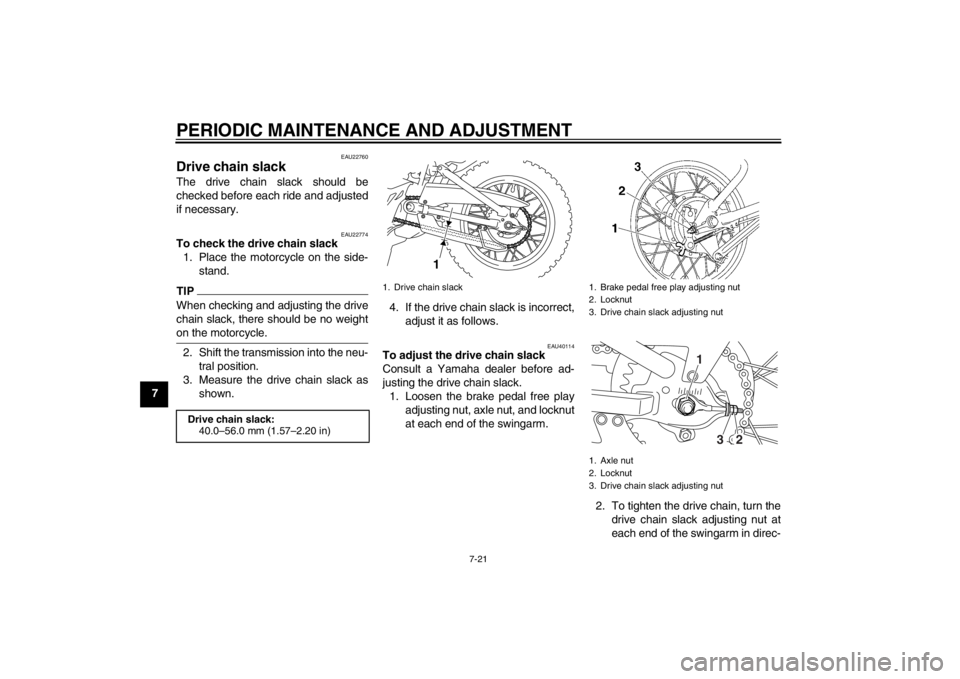
To check the drive chain slack1. Place the motorcycle on the side- stand.TIPWhen checking and adjusting the drive
chain slack, there should be no weight
on the motorcycle.2. Shift the transmission into the neu-tral position.
3. Measure the drive chain slack as shown. 4. If the drive chain slack is incorrect,
adjust it as follows.
EAU40114
To adjust the drive chain slack
Consult a Yamaha dealer before ad-
justing the drive chain slack.1. Loosen the brake pedal free play adjusting nut, axle nut, and locknut
at each end of the swingarm.
2. To tighten the drive chain, turn thedrive chain slack adjusting nut at
each end of the swingarm in direc-
Drive chain slack:40.0–56.0 mm (1.57–2.20 in)
1. Drive chain slack
1
1. Brake pedal free play adjusting nut
2. Locknut
3. Drive chain slack adjusting nut
1. Axle nut
2. Locknut
3. Drive chain slack adjusting nut
32
1
U5B685E0.book Page 21 Tuesday, July 10, 2012 5:06 PM
Page 81 of 88
SPECIFICATIONS
9-1
9
Dimensions:Overall length:1565 mm (61.6 in)
Overall width:
680 mm (26.8 in)
Overall height: 923 mm (36.3 in)
Seat height: 670 mm (26.4 in)
Wheelbase:
1080 mm (42.5 in)
Ground clearance: 180 mm (7.09 in)
Minimum turning radius: 1660 mm (65.4 in)Weight:Curb weight:72 kg (159 lb)
Technical permissible mass (Maximum load +
curb weight): 132 kg (291 lb)Noise and vibration level:Noise level (77/311/EEC):
TT-R110E 78.9 dB(A)
Vibration on seat (EN1032, ISO5008): TT-R110E Will not exceed 0.5 m/s²
Vibration on handlebar (EN1032, ISO5008): TT-R110E Will not exceed 2.5 m/s²Engine:Engine type:Air cooled 4-stroke, SOHC
Cylinder arrangement: Single cylinder Displacement:
110 cm³
Bore × stroke:
51.0 × 54.0 mm (2.01 × 2.13 in)
Compression ratio:
9.30 : 1
Starting system: Electric starter and kickstarter
Lubrication system: Wet sump
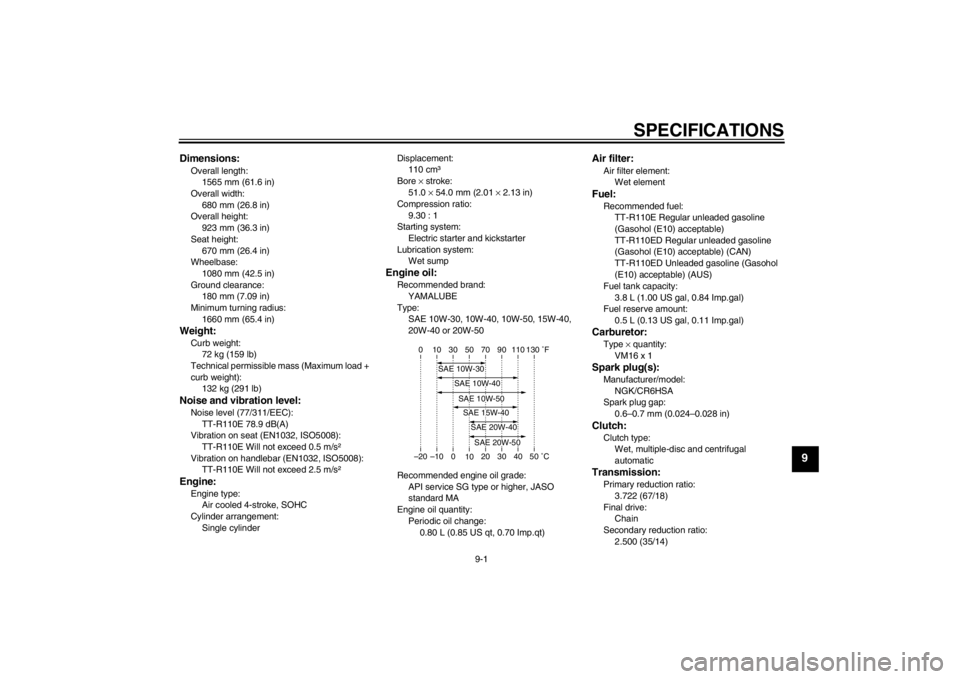
Engine oil:Recommended brand:YAMALUBE
Type: SAE 10W-30, 10W-40, 10W-50, 15W-40,
20W-40 or 20W-50
Recommended engine oil grade: API service SG type or higher, JASO
standard MA
Engine oil quantity: Periodic oil change:0.80 L (0.85 US qt, 0.70 Imp.qt)
Air filter:Air filter element:Wet elementFuel:Recommended fuel:TT-R110E Regular unleaded gasoline
(Gasohol (E10) acceptable)
TT-R110ED Regular unleaded gasoline
(Gasohol (E10) acceptable) (CAN)
TT-R110ED Unleaded gasoline (Gasohol
(E10) acceptable) (AUS)
Fuel tank capacity:
3.8 L (1.00 US gal, 0.84 Imp.gal)
Fuel reserve amount: 0.5 L (0.13 US gal, 0.11 Imp.gal)Carburetor:Type × quantity:
VM16 x 1Spark plug(s):Manufacturer/model: NGK/CR6HSA
Spark plug gap:
0.6–0.7 mm (0.024–0.028 in)Clutch:Clutch type:Wet, multiple-disc and centrifugal
automaticTransmission:Primary reduction ratio:
3.722 (67/18)
Final drive: Chain
Secondary reduction ratio: 2.500 (35/14)
–20 –10 0 1020 30 40 50 C
10 30 50 70 90 110
0 130 F
SAE 10W-30
SAE 15W-40SAE 20W-40SAE 20W-50
SAE 10W-40SAE 10W-50
U5B685E0.book Page 1 Tuesday, July 10, 2012 5:06 PM