valve YAMAHA TTR110 2013 Owners Manual
[x] Cancel search | Manufacturer: YAMAHA, Model Year: 2013, Model line: TTR110, Model: YAMAHA TTR110 2013Pages: 88, PDF Size: 2.02 MB
Page 9 of 88

TABLE OF CONTENTS
LOCATION OF IMPORTANT
LABELS ............................................1-1
SAFETY INFORMATION .................. 2-1
DESCRIPTION .................................. 3-1
Left view .......................................... 3-1
Right view ........................................ 3-2
Controls and instruments ................3-3
INSTRUMENT AND CONTROL
FUNCTIONS ....................................... 4-1
Main switch ..................................... 4-1
Handlebar switches ........................ 4-1
Shift pedal ......................................4-2
Brake lever ..................................... 4-2
Brake pedal .................................... 4-3
Fuel tank cap .................................. 4-3
Fuel ................................................ 4-3
Fuel tank breather hose ................. 4-6
Fuel cock ........................................ 4-6
Starter (choke) lever ....................... 4-7
Kickstarter ......................................4-8
Seat ................................................ 4-8
Shock absorber assembly .............. 4-9
Sidestand ....................................... 4-9
Starting circuit cut-off system ......... 4-9 FOR YOUR SAFETY –
PRE-OPERATION CHECKS
............. 5-1
OPERATION AND IMPORTANT
RIDING POINTS ................................ 6-1
Starting and warming up a cold engine ......................................... 6-1
Starting a warm engine .................. 6-2
Shifting ........................................... 6-2
Engine break-in .............................. 6-3
Parking ........................................... 6-4
PERIODIC MAINTENANCE AND
ADJUSTMENT ................................... 7-1
Owner’s tool kit .............................. 7-2
Periodic maintenance chart for the emission control system ............. 7-3
General maintenance and lubrication chart .......................... 7-4
Removing and installing panels ..... 7-7
Checking the spark plug ................ 7-8
Engine oil ....................................... 7-9
Cleaning the air filter element ...... 7-11
Cleaning the spark arrester ......... 7-13
Adjusting the carburetor ............... 7-14
Adjusting the engine idling
speed ........................................ 7-14
Checking the throttle grip free play ........................................... 7-15
Valve clearance ........................... 7-15
Tires ............................................. 7-15 Spoke wheels ............................... 7-17
Adjusting the clutch free play ....... 7-17
Adjusting the brake lever free
play ........................................... 7-18
Adjusting the brake pedal free
play ........................................... 7-19
Checking the shift pedal ............... 7-20
Checking the front and rear brake shoes ........................................ 7-20
Drive chain slack .......................... 7-21
Cleaning and lubricating the drive chain ......................................... 7-22
Checking and lubricating the cables ....................................... 7-23
Checking and lubricating the throttle grip and cable ............... 7-23
Checking and lubricating the
brake lever ................................ 7-23
Checking and lubricating the brake pedal ............................... 7-24
Checking and lubricating the sidestand .................................. 7-24
Lubricating the swingarm pivots ... 7-24
Checking the front fork ................. 7-25
Checking the steering .................. 7-25
Checking the wheel bearings ....... 7-26
Battery .......................................... 7-26
Replacing the fuse ....................... 7-27
Supporting the motorcycle ........... 7-28
Front wheel .................................. 7-29
Rear wheel ................................... 7-30
U5B685E0.book Page 1 Tuesday, July 10, 2012 5:06 PM
Page 31 of 88
INSTRUMENT AND CONTROL FUNCTIONS
4-4
4
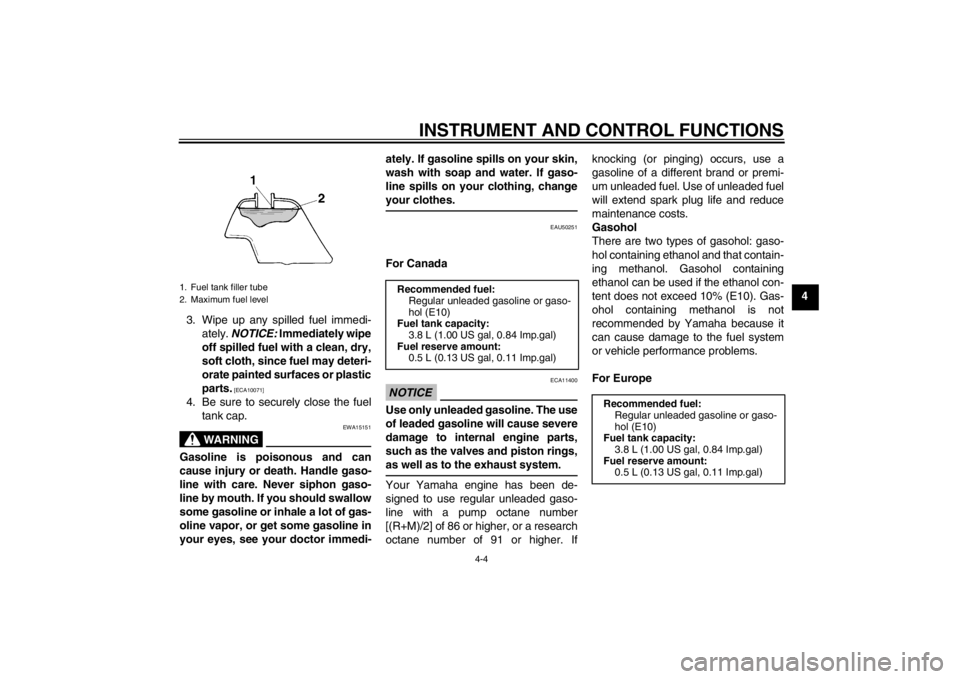
3. Wipe up any spilled fuel immedi- ately. NOTICE: Immediately wipe
off spilled fuel with a clean, dry,
soft cloth, since fuel may deteri-
orate painted surfaces or plastic
parts.
[ECA10071]
4. Be sure to securely close the fuel tank cap.
WARNING
EWA15151
Gasoline is poisonous and can
cause injury or death. Handle gaso-
line with care. Never siphon gaso-
line by mouth. If you should swallow
some gasoline or inhale a lot of gas-
oline vapor, or get some gasoline in
your eyes, see your doctor immedi- ately. If gasoline spills on your skin,
wash with soap and water. If gaso-
line spills on your clothing, change
your clothes.
EAU50251
For CanadaNOTICE
ECA11400
Use only unleaded gasoline. The use
of leaded gasoline will cause severe
damage to internal engine parts,
such as the valves and piston rings,
as well as to the exhaust system.Your Yamaha engine has been de-
signed to use regular unleaded gaso-
line with a pump octane number
[(R+M)/2] of 86 or higher, or a research
octane number of 91 or higher. If knocking (or pinging) occurs, use a
gasoline of a different brand or premi-
um unleaded fuel. Use of unleaded fuel
will extend spark plug life and reduce
maintenance costs.
Gasohol
There are two types of gasohol: gaso-
hol containing ethanol and that contain-
ing methanol. Gasohol containing
ethanol can be used if the ethanol con-
tent does not exceed 10% (E10). Gas-
ohol containing methanol is not
recommended by Yamaha because it
can cause damage to the fuel system
or vehicle performance problems.
For Europe
1. Fuel tank filler tube
2. Maximum fuel level
Recommended fuel:
Regular unleaded gasoline or gaso-
hol (E10)
Fuel tank capacity:
3.8 L (1.00 US gal, 0.84 Imp.gal)
Fuel reserve amount: 0.5 L (0.13 US gal, 0.11 Imp.gal)
Recommended fuel:
Regular unleaded gasoline or gaso-
hol (E10)
Fuel tank capacity:
3.8 L (1.00 US gal, 0.84 Imp.gal)
Fuel reserve amount: 0.5 L (0.13 US gal, 0.11 Imp.gal)
U5B685E0.book Page 4 Tuesday, July 10, 2012 5:06 PM
Page 32 of 88
INSTRUMENT AND CONTROL FUNCTIONS
4-5
4
NOTICE
ECA11400
Use only unleaded gasoline. The use
of leaded gasoline will cause severe
damage to internal engine parts,
such as the valves and piston rings,
as well as to the exhaust system.Your Yamaha engine has been de-
signed to use regular unleaded gaso-
line with a research octane number of
95 or higher. If knocking (or pinging) oc-
curs, use a gasoline of a different brand
or premium unleaded fuel. Use of un-
leaded fuel will extend spark plug life
and reduce maintenance costs.
Gasohol
There are two types of gasohol: gaso-
hol containing ethanol and that contain-
ing methanol. Gasohol containing
ethanol can be used if the ethanol con-
tent does not exceed 10% (E10). Gas-
ohol containing methanol is not
recommended by Yamaha because it
can cause damage to the fuel system
or vehicle performance problems.For Oceania
NOTICE
ECA11400
Use only unleaded gasoline. The use
of leaded gasoline will cause severe
damage to internal engine parts,
such as the valves and piston rings,
as well as to the exhaust system.Your Yamaha engine has been de-
signed to use unleaded gasoline with a
research octane number of 91 or high-
er. If knocking (or pinging) occurs, use
a gasoline of a different brand or premi-
um unleaded fuel. Use of unleaded fuel
will extend spark plug life and reduce
maintenance costs.
Gasohol
There are two types of gasohol: gaso-
hol containing ethanol and that contain-
ing methanol. Gasohol containing
ethanol can be used if the ethanol con-tent does not exceed 10% (E10). Gas-
ohol containing methanol is not
recommended by Yamaha because it
can cause damage to the fuel system
or vehicle performance problems.
For South Africa
NOTICE
ECA11400
Use only unleaded gasoline. The use
of leaded gasoline will cause severe
damage to internal engine parts,
such as the valves and piston rings,
as well as to the exhaust system.Your Yamaha engine has been de-
signed to use regular unleaded gaso-
line with a research octane number of
91 or higher. If knocking (or pinging) oc-
curs, use a gasoline of a different brand
Recommended fuel:
Unleaded gasoline or gasohol (E10)
Fuel tank capacity: 3.8 L (1.00 US gal, 0.84 Imp.gal)
Fuel reserve amount: 0.5 L (0.13 US gal, 0.11 Imp.gal)
Recommended fuel:
Regular unleaded gasoline or gaso-
hol (E10)
Fuel tank capacity:
3.8 L (1.00 US gal, 0.84 Imp.gal)
Fuel reserve amount: 0.5 L (0.13 US gal, 0.11 Imp.gal)
U5B685E0.book Page 5 Tuesday, July 10, 2012 5:06 PM
Page 46 of 88
PERIODIC MAINTENANCE AND ADJUSTMENT
7-3
7
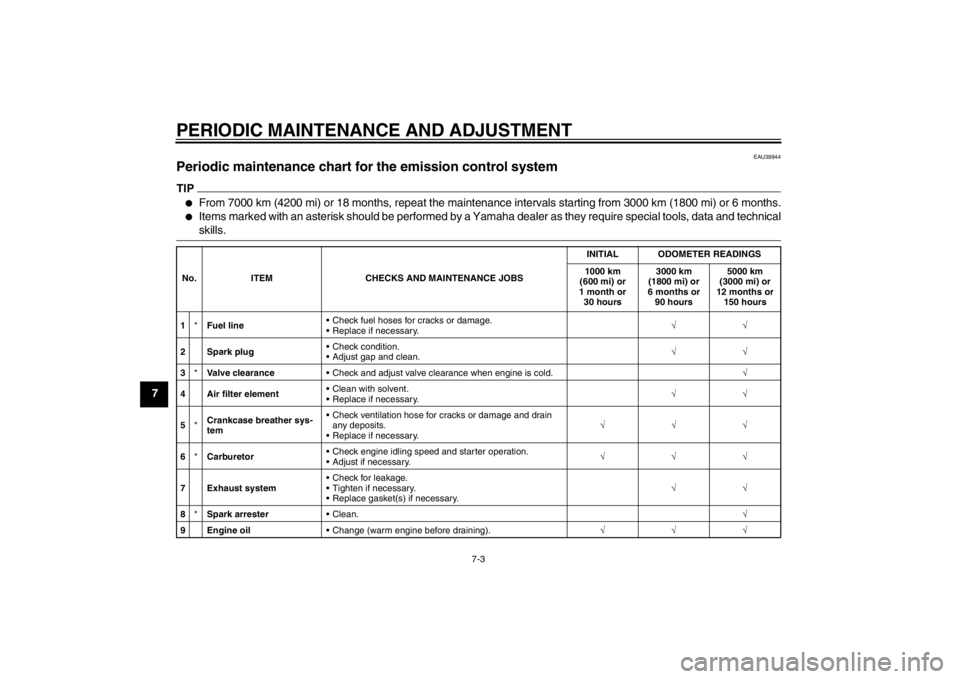
EAU39944
Periodic maintenance chart for the emission control system TIP●
From 7000 km (4200 mi) or 18 months, repeat the maintenance intervals starting from 3000 km (1800 mi) or 6 months.
●
Items marked with an asterisk should be performed by a Yamaha dealer as they require special tools, data and technical
skills.
No.ITEM CHECKS AND MAINTENANCE JOBS INITIAL ODOMETER READINGS
1000 km
(600 mi) or
1 month or 30 hours 3000 km
(1800 mi) or
6 months or 90 hours 5000 km
(3000 mi) or
12 months or 150 hours
1 *Fuel line Check fuel hoses for cracks or damage.
Replace if necessary. √√
2 Spark plug Check condition.
Adjust gap and clean.
√√
3 *Valve clearance Check and adjust valve clearance when engine is cold. √
4 Air filter element Clean with solvent.
Replace if necessary. √√
5 *Crankcase breather sys-
tem Check ventilation hose for cracks or damage and drain
any deposits.
Replace if necessary. √√√
6 *Carburetor Check engine idling speed and starter operation.
Adjust if necessary.
√√√
7 Exhaust system Check for leakage.
Tighten if necessary.
Replace gasket(s) if necessary. √√
8 *Spark arrester Clean. √
9 Engine oil Change (warm engine before draining). √√√
U5B685E0.book Page 3 Tuesday, July 10, 2012 5:06 PM
Page 58 of 88
PERIODIC MAINTENANCE AND ADJUSTMENT
7-15
7
EAU21384
Checking the throttle grip free
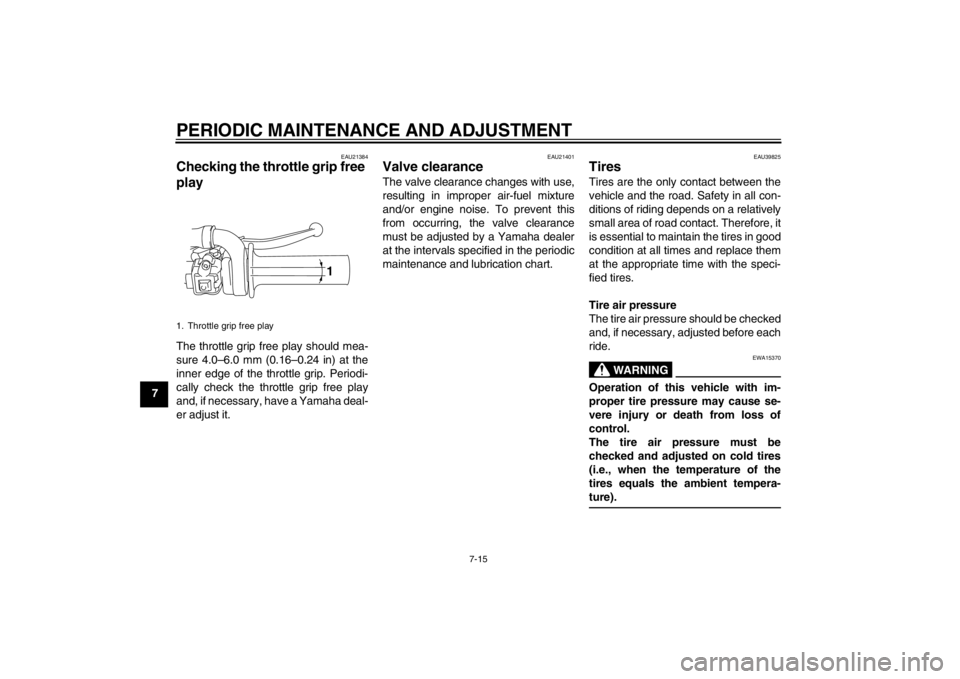
play The throttle grip free play should mea-
sure 4.0–6.0 mm (0.16–0.24 in) at the
inner edge of the throttle grip. Periodi-
cally check the throttle grip free play
and, if necessary, have a Yamaha deal-
er adjust it.
EAU21401
Valve clearance The valve clearance changes with use,
resulting in improper air-fuel mixture
and/or engine noise. To prevent this
from occurring, the valve clearance
must be adjusted by a Yamaha dealer
at the intervals specified in the periodic
maintenance and lubrication chart.
EAU39825
Tires Tires are the only contact between the
vehicle and the road. Safety in all con-
ditions of riding depends on a relatively
small area of road contact. Therefore, it
is essential to maintain the tires in good
condition at all times and replace them
at the appropriate time with the speci-
fied tires.
Tire air pressure
The tire air pressure should be checked
and, if necessary, adjusted before each
ride.
WARNING
EWA15370
Operation of this vehicle with im-
proper tire pressure may cause se-
vere injury or death from loss of
control.
The tire air pressure must be
checked and adjusted on cold tires
(i.e., when the temperature of the
tires equals the ambient tempera-
ture).
1. Throttle grip free play
1
U5B685E0.book Page 15 Tuesday, July 10, 2012 5:06 PM
Page 69 of 88
PERIODIC MAINTENANCE AND ADJUSTMENT
7-26
7
EAU23291
Checking the wheel bearings The front and rear wheel bearings must
be checked at the intervals specified in
the periodic maintenance and lubrica-
tion chart. If there is play in the wheel
hub or if the wheel does not turn
smoothly, have a Yamaha dealer check
the wheel bearings.
EAU23396
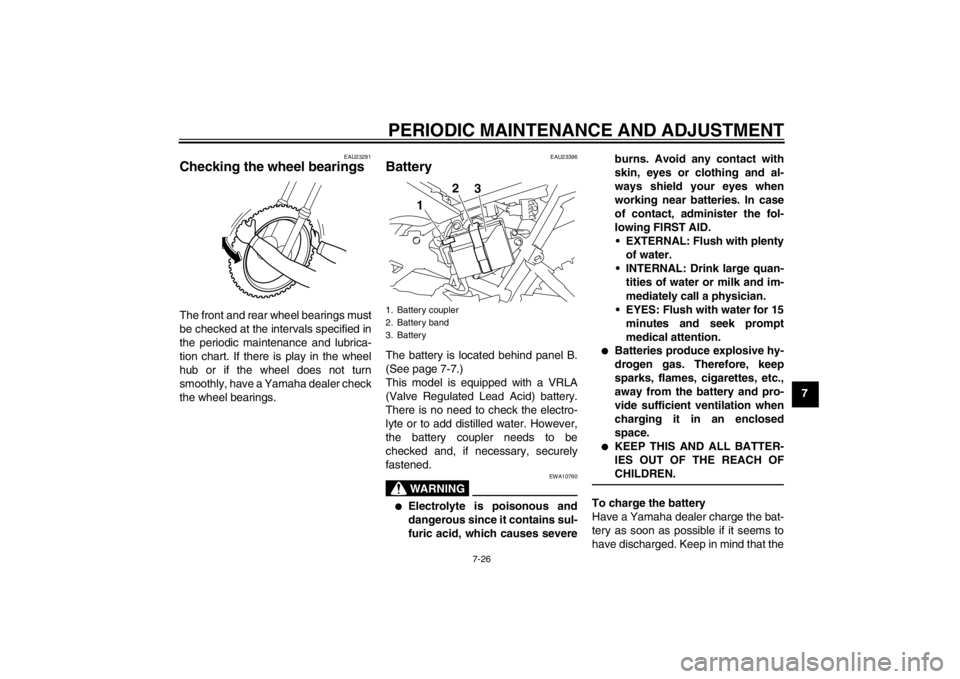
Battery The battery is located behind panel B.
(See page 7-7.)
This model is equipped with a VRLA
(Valve Regulated Lead Acid) battery.
There is no need to check the electro-
lyte or to add distilled water. However,
the battery coupler needs to be
checked and, if necessary, securely
fastened.
WARNING
EWA10760
●
Electrolyte is poisonous and
dangerous since it contains sul-
furic acid, which causes severeburns. Avoid any contact with
skin, eyes or clothing and al-
ways shield your eyes when
working near batteries. In case
of contact, administer the fol-
lowing FIRST AID.
EXTERNAL: Flush with plenty of water.
INTERNAL: Drink large quan- tities of water or milk and im-
mediately call a physician.
EYES: Flush with water for 15 minutes and seek prompt
medical attention.
●
Batteries produce explosive hy-
drogen gas. Therefore, keep
sparks, flames, cigarettes, etc.,
away from the battery and pro-
vide sufficient ventilation when
charging it in an enclosed
space.
●
KEEP THIS AND ALL BATTER-
IES OUT OF THE REACH OF
CHILDREN.
To charge the battery
Have a Yamaha dealer charge the bat-
tery as soon as possible if it seems to
have discharged. Keep in mind that the
1. Battery coupler
2. Battery band
3. Battery
2 3
1
U5B685E0.book Page 26 Tuesday, July 10, 2012 5:06 PM
Page 70 of 88
PERIODIC MAINTENANCE AND ADJUSTMENT
7-27
7battery tends to discharge more quickly
if the vehicle is equipped with optional
electrical accessories.
NOTICE
ECA16521
To charge a VRLA (Valve Regulated
Lead Acid) battery, a special (con-
stant-voltage) battery charger is re-
quired. Using a conventional battery
charger will damage the battery.To store the battery
1. If the model will not be used for more than one month, remove the
battery, fully charge it, and then
place it in a cool, dry place.
NOTICE: When removing the
battery, be sure the key is
turned to “OFF” before discon-
necting the coupler.
[ECA16322]
2. If the battery will be stored for more than two months, check it at least
once a month and fully charge it if
necessary.
3. Fully charge the battery before in- stallation. NOTICE: When install-
ing the battery, be sure the key
is turned to “OFF” before con-
necting the coupler.
[ECA16930]
NOTICE
ECA16530
Always keep the battery charged.
Storing a discharged battery can
cause permanent battery damage.
EAU50430
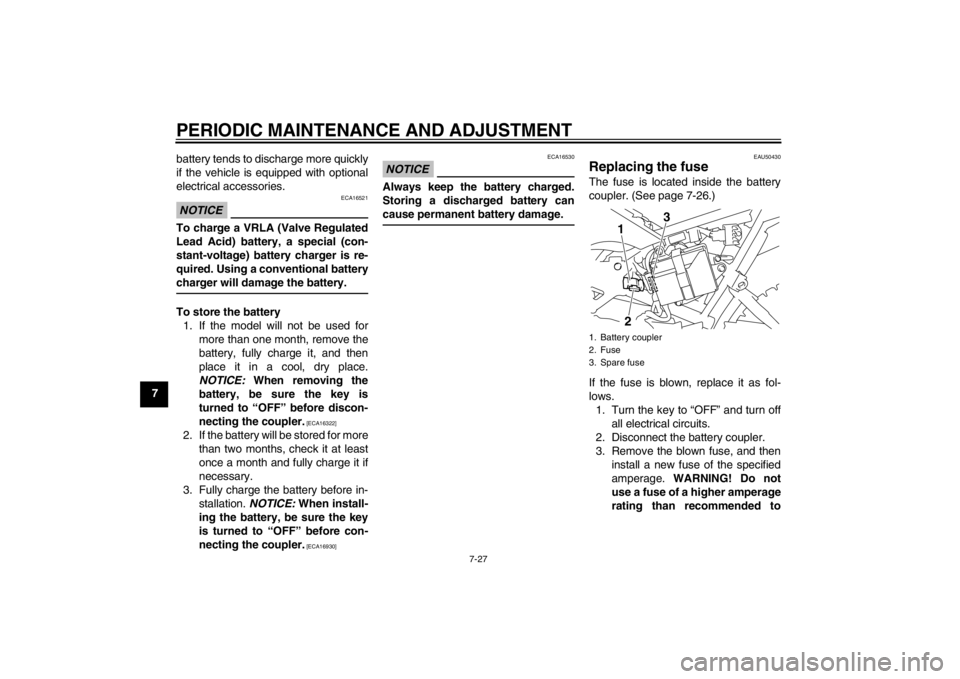
Replacing the fuse The fuse is located inside the battery
coupler. (See page 7-26.)
If the fuse is blown, replace it as fol-
lows. 1. Turn the key to “OFF” and turn off all electrical circuits.
2. Disconnect the battery coupler.
3. Remove the blown fuse, and then install a new fuse of the specified
amperage. WARNING! Do not
use a fuse of a higher amperage
rating than recommended to1. Battery coupler
2. Fuse
3. Spare fuse
1 3
2
U5B685E0.book Page 27 Tuesday, July 10, 2012 5:06 PM
Page 86 of 88

INDEXAAir filter element, cleaning..................... 7-11BBattery................................................... 7-26
Brake lever .............................................. 4-2
Brake lever, checking and lubricating ... 7-23
Brake lever free play, adjusting............. 7-18
Brake pedal ............................................. 4-3
Brake pedal, checking and lubricating ........................................... 7-24
Brake pedal free play, adjusting............ 7-19
Brake shoes, checking .......................... 7-20CCables, checking and lubricating .......... 7-23
Carburetor, adjusting ............................ 7-14
Care ........................................................ 8-1
Clutch free play, adjusting..................... 7-17DDrive chain, cleaning and lubricating .... 7-22
Drive chain slack ................................... 7-21EEngine break-in ....................................... 6-3
Engine idling speed............................... 7-14
Engine oil ................................................ 7-9
Engine, starting a warm .......................... 6-2
Engine stop switch .................................. 4-2FFront fork, checking .............................. 7-25
Fuel ......................................................... 4-3
Fuel cock................................................. 4-6
Fuel tank breather hose .......................... 4-6
Fuel tank cap .......................................... 4-3
Fuse, replacing ..................................... 7-27
HHandlebar switches ................................ 4-1IIdentification numbers .......................... 10-1KKickstarter............................................... 4-8LLabels, location....................................... 1-1MMain switch ............................................. 4-1
Maintenance and lubrication, periodic .... 7-4
Maintenance, emission control system... 7-3
Matte color, caution ................................ 8-1
Model label ........................................... 10-1PPanels, removing and installing .............. 7-7
Parking ................................................... 6-4
Part locations .......................................... 3-1SSafety information................................... 2-1
Seat ........................................................ 4-8
Shifting.................................................... 6-2
Shift pedal............................................... 4-2
Shift pedal, checking ............................ 7-20
Shock absorber assembly ...................... 4-9
Sidestand................................................ 4-9
Sidestand, checking and lubricating ..... 7-24
Spark arrester, cleaning ....................... 7-13
Spark plug, checking .............................. 7-8
Specifications ......................................... 9-1
Starter (choke) lever ............................... 4-7
Starting and warming up a cold engine .................................................. 6-1
Starting circuit cut-off system ................. 4-9 Start switch.............................................. 4-2
Steering, checking................................. 7-25
Storage.................................................... 8-3
Supporting the motorcycle .................... 7-28
Swingarm pivots, lubricating ................. 7-24
TThrottle grip and cable, checking and
lubricating ........................................... 7-23
Throttle grip free play, checking ............ 7-15
Tires ...................................................... 7-15
Tool kit..................................................... 7-2
Troubleshooting .................................... 7-32
Troubleshooting chart ........................... 7-33VValve clearance..................................... 7-15
Vehicle Emission Control Information label (For Canada) .............................. 10-2
Vehicle identification number ................ 10-1WWheel bearings, checking ..................... 7-26
Wheel (front) ......................................... 7-29
Wheel (rear) .......................................... 7-30
Wheels .................................................. 7-17
U5B685E0.book Page 1 Tuesday, July 10, 2012 5:06 PM