fuel YAMAHA TTR110 2015 User Guide
[x] Cancel search | Manufacturer: YAMAHA, Model Year: 2015, Model line: TTR110, Model: YAMAHA TTR110 2015Pages: 88, PDF Size: 2.09 MB
Page 38 of 88

FOR YOUR SAFETY – PRE-OPERATION CHECKS
5-1
5
EAU15598
Inspect your vehicle each time you use it to make sure the vehicle is in safe operating condition. Always follow the inspection
and maintenance procedures and schedules described in the Owner’s Manual.
WARNING
EWA11152
Failure to inspect or maintain the vehicle properly increases the possibility of an acci dent or equipment damag e.
Do not operate the vehicle if you fin d any pro blem. If a pro blem cannot be corrected b y the proce dures provi ded in
this manual, have the vehicle inspecte d b y a Yamaha dealer.Before using this vehicle, check the following points:
ITEM CHECKS PAGE
Fuel • Check fuel level in fuel tank.
• Refuel if necessary.
• Check fuel line for leakage.
• Check fuel tank breather hose for obstructions, cracks or damage, and check
hose connection. 4-3, 4-6
En gine oil • Check oil level in engine.
• If necessary, add recommended oil to specified level.
• Check vehicle for oil leakage. 7-9
Front brake • Check operation.
• Lubricate cable if necessary.
• Check lever free play.
• Adjust if necessary.
7-18, 7-20
Rear brake • Check operation.
• Check pedal free play.
• Adjust if necessary. 7-19, 7-20
Throttle g rip • Make sure that operation is smooth.
• Check throttle grip free play.
• If necessary, have Yamaha dealer adjust throttle grip free play and lubricate ca-
ble and grip housing. 7-15, 7-23
UB5180E0.book Page 1 Monday, June 9, 2014 1:20 PM
Page 40 of 88

OPERATION AND IMPORTANT RIDING POINTS
6-1
6
EAU15952
Read the Owner’s Manual carefully to
become familiar with all controls. If
there is a control or function you do not
understand, ask your Yamaha dealer.
WARNING
EWA10272
Failure to familiarize yourself with
the controls can lead to loss of con-
trol, which coul d cause an acci dent
or injury.
EAU44815
Startin g an d warmin g up a
col d en gine1. Turn the fuel cock lever to “ON”.
2. Turn the key to “ON” and make
sure that the engine stop switch is
set to “ ”.
3. Shift the transmission into the neutral position.
WARNING
EWA14411
Be sure to shift the transmission
into neutral b efore starting the
en gine.
Never ri de with the si destan d
d own.4. Turn the starter (choke) on and
completely close the throttle. (See
page 4-7.)
5. Start the engine by pushing the start switch or by pushing the
kickstarter lever down.
6. When the engine is warm, turn the starter (choke) off.
TIPThe engine is warm when it responds
quickly to the throttle with the starter
(choke) turned off.NOTICE
ECA11043
For maximum en gine life, never ac-
celerate har d when the en gine is
col d!
UB5180E0.book Page 1 Monday, June 9, 2014 1:20 PM
Page 43 of 88

OPERATION AND IMPORTANT RIDING POINTS
6-4
6
EAU17172
ParkingWhen parking, stop the engine, re-
move the key from the main switch,
and then turn the fuel cock lever to
“OFF”.
WARNING
EWA10312
Since the en gine an d exhaust
system can b ecome very hot,
park in a place where pe destri-
ans or chil dren are not likely to
touch them an d b e burne d.
Do not park on a slope or on soft
groun d, otherwise the vehicle
may overturn, increasin g the
risk of a fuel leak an d fire.
Do not park near grass or other
flamma ble materials which
mi ght catch fire.
UB5180E0.book Page 4 Monday, June 9, 2014 1:20 PM
Page 46 of 88

PERIODIC MAINTENANCE AND ADJUSTMENT
7-3
7
EAU39945
Periodic maintenance chart for the emission control systemTIP From 7000 km (4200 mi) or 18 months, repeat the maintenance intervals starting from 3000 km (1800 mi) or 6 months.
Items marked with an asterisk should be performed by a Yamaha dealer as they require special tools, data and tech-
nical skills.No. ITEM CHECKS AND MAINTENANCE JOBS INITIAL ODOMETER READINGS
1000 km
(600 mi) or
1 month or 30 hours 3000 km
(1800 mi) or
6 months or 90 hours 5000 km
(3000 mi) or
12 months or 150 hours
1 *Fuel line • Check fuel hoses for cracks or damage.
• Replace if necessary. √√
2Spark plu g • Check condition.
• Adjust gap and clean.
√√
3 *Valve clearance • Check and adjust valve clearance when engine is cold. √
4 Air filter element • Clean with solvent.
• Replace if necessary. √√
5 *Crankcase
breather sys-
tem • Check ventilation hose for cracks or damage and drain
any deposits.
• Replace if necessary. √√√
6 *Car buretor • Check engine idling speed and starter operation.
• Adjust if necessary.
√√√
7 Exhaust system • Check for leakage.
• Tighten if necessary.
• Replace gasket(s) if necessary. √√
8 *Spark arrester • Clean. √
9En gine oil • Change (warm engine before draining). √√√
UB5180E0.book Page 3 Monday, June 9, 2014 1:20 PM
Page 58 of 88

PERIODIC MAINTENANCE AND ADJUSTMENT
7-15
7
EAU21385
Checking the throttle grip free
playThe throttle grip free play should mea-
sure 4.0–6.0 mm (0.16–0.24 in) at the
inner edge of the throttle grip. Periodi-
cally check the throttle grip free play
and, if necessary, have a Yamaha deal-
er adjust it.
EAU21402
Valve clearanceThe valve clearance changes with use,
resulting in improper air-fuel mixture
and/or engine noise. To prevent this
from occurring, the valve clearance
must be adjusted by a Yamaha dealer
at the intervals specified in the periodic
maintenance and lubrication chart.
EAU40916
TiresTires are the only contact between the
vehicle and the road. Safety in all con-
ditions of riding depends on a relatively
small area of road contact. Therefore, it
is essential to maintain the tires in good
condition at all times and replace them
at the appropriate time with the speci-
fied tires.
Tire air pressure
The tire air pressure should be
checked and, if necessary, adjusted
before each ride.
WARNING
EWA15371
Operation of this vehicle with im-
proper tire pressure may cause se-
vere injury or death from loss of
control.
The tire air pressure must be
checked and a djuste d on col d tires
(i.e., when the temperature of the
tires equals the am bient tempera-
ture).
1. Throttle grip free play
1
UB5180E0.book Page 15 Monday, June 9, 2014 1:20 PM
Page 75 of 88

PERIODIC MAINTENANCE AND ADJUSTMENT
7-32
7
TIPThe drive chain does not need to be
disassembled in order to remove and
install the wheel.8. Remove the wheel.
To install the rear wheel 1. Install the drive chain onto the rear sprocket.
2. Lift the rear wheel off the ground, and then install the drive chain
puller and the wheel by inserting
the wheel axle from the right-hand
side.
3. Install the drive chain puller, wash- er and axle nut. 4. Lower the rear wheel so that it is
on the ground, and then put the
sidestand down.
5. Install the brake rod onto the brake camshaft lever, and then in-
stall the brake pedal free play ad-
justing nut onto the brake rod.
6. Connect the brake torque rod to the brake shoe plate by installing
the bolt and nut, and then tighten
the nut to the specified torque.
7. Insert a new cotter pin.
8. Adjust the drive chain slack. (See page 7-21.)
9. Tighten the axle nut to the speci- fied torque.
10. Adjust the brake pedal free play. (See page 7-19.)
EAU25852
Trou bleshootin gAlthough Yamaha motorcycles receive
a thorough inspection before shipment
from the factory, trouble may occur
during operation. Any problem in the
fuel, compression, or ignition systems,
for example, can cause poor starting
and loss of power.
The following troubleshooting chart
represents a quick and easy procedure
for checking these vital systems your-
self. However, should your motorcycle
require any repair, take it to a Yamaha
dealer, whose skilled technicians have
the necessary tools, experience, and
know-how to service the motorcycle
properly.
Use only genuine Yamaha replace-
ment parts. Imitation parts may look
like Yamaha parts, but they are often
inferior, have a shorter service life and
can lead to expensive repair bills.
WARNING
EWA15142
When checkin g the fuel system, d o
not smoke, an d make sure there are
no open flames or sparks in the ar-
ea, inclu din g pilot li ghts from water
Ti ghtenin g torque:
Brake torque rod nut: 26 Nm (2.6 m·kgf, 19 ft·lbf)
Ti ghtenin g torque:
Axle nut: 60 Nm (6.0 m·kgf, 43 ft·lbf)
UB5180E0.book Page 32 Monday, June 9, 2014 1:20 PM
Page 77 of 88

PERIODIC MAINTENANCE AND ADJUSTMENT
7-34
7
EAU25905
Troubleshootin g chart
Check the fuel level in
the fuel tank.1. Fuel
There is enough fuel.
There is no fuel.
Check the battery.
Supply fuel.
The engine does not start.
Check the battery.
The engine does not start.
Have a Yamaha dealer check the vehicle.
Operate the electric starter.4. Compression
There is compression.
There is no compression.
Remove the spark plug
and check the electrodes.3. Ignition
Wipe off with a dry cloth and correct the
spark plug gap, or replace the spark plug. Have a Yamaha dealer check the vehicle.
Have a Yamaha dealer check the vehicle.
The engine does not start.
Check the compression.
The engine does not start.
Check the ignition.
Operate the electric starter.2. Battery
The engine turns over
quickly.
The engine turns over
slowly.
The battery is good.Check the battery lead connections,
and have a Yamaha dealer charge
the battery if necessary.
DryWet
Open the throttle halfway and operate
the electric starter.
UB5180E0.book Page 34 Monday, June 9, 2014 1:20 PM
Page 79 of 88

MOTORCYCLE CARE AND STORAGE8-2
8
off any
deter gent resi due usin g
plenty of water, as it is harmful
to plastic parts.
Do not use any harsh chemical
prod ucts on plastic parts. Be
sure to avoi d usin g cloths or
spon ges which have b een in
contact with stron g or a brasive
cleanin g prod ucts, solvent or
thinner, fuel ( gasoline), rust re-
movers or inhi bitors, brake flui d,
antifreeze or electrolyte.
Do not use hi gh-pressure wash-
ers or steam-jet cleaners since
they cause water seepag e and
d eterioration in the followin g ar-
eas: seals (of wheel an d swin g-
arm bearin gs, fork an d b rakes),
electric components (couplers,
connectors, instruments,
switches an d li ghts), breather
hoses an d vents.
For motorcycles equippe d with
a win dshiel d: Do not use stron g
cleaners or har d spon ges as
they will cause dullin g
or
sc
ratchin g. Some cleanin g
compoun ds for plastic may
leave scratches on the win d- shiel
d. Test the pro duct on a
small hi dden part of the win d-
shiel d to make sure that it does
not leave any marks. If the win d-
shiel d is scratche d, use a quality
plastic polishin g compoun d af-
ter washing .
After normal useRemove dirt with warm water, a mild
detergent, and a soft, clean sponge,
and then rinse thoroughly with clean
water. Use a toothbrush or bottlebrush
for hard-to-reach areas. Stubborn dirt
and insects will come off more easily if
the area is covered with a wet cloth for
a few minutes before cleaning.
After riding in the rain or near the seaSince sea salt is extremely corrosive,
carry out the following steps after each
ride in the rain or near the sea.
1. Clean the motorcycle with cold water and a mild detergent, after
the engine has cooled down.
NOTICE: Do not use warm wa-
ter since it increases the corro-
sive action of the salt.
[ECA10792]
2. Apply a corrosion protection spray on all metal, including chrome-
and nickel-plated, surfaces to pre-
vent corrosion.
After cleanin g
1. Dry the motorcycle with a chamois or an absorbing cloth.
2. Immediately dry the drive chain and lubricate it to prevent it from
rusting.
3. Use a chrome polish to shine chrome, aluminum and stainless-
steel parts, including the exhaust
system. (Even the thermally in-
duced discoloring of stainless-
steel exhaust systems can be re-
moved through polishing.)
4. To prevent corrosion, it is recom- mended to apply a corrosion pro-
tection spray on all metal,
including chrome- and nickel-plat-
ed, surfaces.
5. Use spray oil as a universal clean- er to remove any remaining dirt.
6. Touch up minor paint damage caused by stones, etc.
7. Wax all painted surfaces.
UB5180E0.book Page 2 Monday, June 9, 2014 1:20 PM
Page 81 of 88

MOTORCYCLE CARE AND STORAGE8-4
8
2. For motorcycles equipped with a
fuel cock that has an “OFF” posi-
tion: Turn the fuel cock lever to
“OFF”.
3. Drain the carburetor float chamber by loosening the drain bolt; this
will prevent fuel deposits from
building up. Pour the drained fuel
into the fuel tank.
4. Fill up the fuel tank and add fuel stabilizer (if available) to prevent
the fuel tank from rusting and the
fuel from deteriorating.
5. Perform the following steps to protect the cylinder, piston rings,
etc. from corrosion.a. Remove the spark plug cap and spark plug.
b. Pour a teaspoonful of engine oil into the spark plug bore.
c. Install the spark plug cap onto the spark plug, and then place
the spark plug on the cylinder
head so that the electrodes are
grounded. (This will limit spark-
ing during the next step.)
d. Turn the engine over several times with the starter. (This will
coat the cylinder wall with oil.) WARNING! To prevent
dam-
a g e or injury from sparkin g,
make sure to groun d the
spark plu g electro des while
turnin g the en gine over.
[EWA10952]
e. Remove the spark plug cap
from the spark plug, and then
install the spark plug and the
spark plug cap.
6. Lubricate all control cables and the pivoting points of all levers and
pedals as well as of the side-
stand/centerstand.
7. Check and, if necessary, correct the tire air pressure, and then lift
the motorcycle so that both of its
wheels are off the ground. Alterna-
tively, turn the wheels a little every
month in order to prevent the tires
from becoming degraded in one
spot.
8. Cover the muffler outlet with a plastic bag to prevent moisture
from entering it.
9. Remove the battery and fully char- ge it. Store it in a cool, dry place
and charge it once a month. Do
not store the battery in an exces- sively cold or warm place [less
than 0 °C (30 °F) or more than 30
°C (90 °F)]. For more information
on storing the battery, see page
7-26.
TIPMake any necessary repairs before
storing the motorcycle.
UB5180E0.book Page 4 Monday, June 9, 2014 1:20 PM
Page 82 of 88
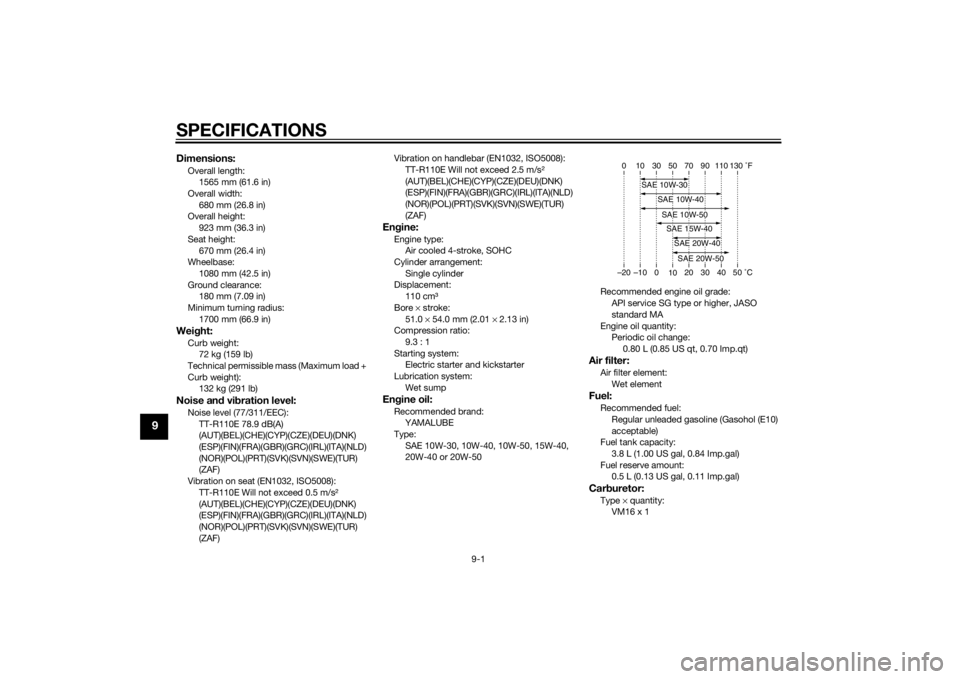
SPECIFICATIONS
9-1
9
Dimensions:Overall length:1565 mm (61.6 in)
Overall width:
680 mm (26.8 in)
Overall height: 923 mm (36.3 in)
Seat height: 670 mm (26.4 in)
Wheelbase:
1080 mm (42.5 in)
Ground clearance: 180 mm (7.09 in)
Minimum turning radius: 1700 mm (66.9 in)Wei ght:Curb weight:
72 kg (159 lb)
Technical permissible mass (Maximum load +
Curb weight): 132 kg (291 lb)Noise an d vi bration level:Noise level (77/311/EEC):
TT-R110E 78.9 dB(A)
(AUT)(BEL)(CHE)(CYP)(CZE)(DEU)(DNK)
(ESP)(FIN)(FRA)(GBR)(GRC)(IRL)(ITA)(NLD)
(NOR)(POL)(PRT)(SVK)(SVN)(SWE)(TUR)
(ZAF)
Vibration on seat (EN1032, ISO5008):
TT-R110E Will not exceed 0.5 m/s²
(AUT)(BEL)(CHE)(CYP)(CZE)(DEU)(DNK)
(ESP)(FIN)(FRA)(GBR)(GRC)(IRL)(ITA)(NLD)
(NOR)(POL)(PRT)(SVK)(SVN)(SWE)(TUR)
(ZAF) Vibration on handlebar (EN1032, ISO5008):
TT-R110E Will not exceed 2.5 m/s²
(AUT)(BEL)(CHE)(CYP)(CZE)(DEU)(DNK)
(ESP)(FIN)(FRA)(GBR)(GRC)(IRL)(ITA)(NLD)
(NOR)(POL)(PRT)(SVK)(SVN)(SWE)(TUR)
(ZAF)
Engine:Engine type:
Air cooled 4-stroke, SOHC
Cylinder arrangement:
Single cylinder
Displacement: 110 cm³
Bore × stroke:
51.0 × 54.0 mm (2.01 × 2.13 in)
Compression ratio:
9.3 : 1
Starting system: Electric starter and kickstarter
Lubrication system: Wet sumpEngine oil:Recommended brand:
YAMALUBE
Type: SAE 10W-30, 10W-40, 10W-50, 15W-40,
20W-40 or 20W-50 Recommended engine oil grade:
API service SG type or higher, JASO
standard MA
Engine oil quantity: Periodic oil change:
0.80 L (0.85 US qt, 0.70 Imp.qt)
Air filter:Air filter element:Wet elementFuel:Recommended fuel:Regular unleaded gasoline (Gasohol (E10)
acceptable)
Fuel tank capacity: 3.8 L (1.00 US gal, 0.84 Imp.gal)
Fuel reserve amount: 0.5 L (0.13 US gal, 0.11 Imp.gal)Car buretor:Type × quantity:
VM16 x 1
–20 –10 0 1020 30 40 50 C
10 30 50 70 90 110
0 130 F
SAE 10W-30
SAE 15W-40SAE 20W-40SAE 20W-50
SAE 10W-40SAE 10W-50
UB5180E0.book Page 1 Monday, June 9, 2014 1:20 PM