ignition YAMAHA TTR50 2006 Owners Manual
[x] Cancel search | Manufacturer: YAMAHA, Model Year: 2006, Model line: TTR50, Model: YAMAHA TTR50 2006Pages: 390, PDF Size: 9.69 MB
Page 24 of 390
CHAPTER 4ENGINE
FRONT FENDER, SEAT ASSEMBLY
AND FUEL TANK .......................................4-1
MUFFLER ...................................................4-3
CARBURETOR ...........................................4-4
CYLINDER HEAD .....................................4-10
CAMSHAFT AND ROCKER ARMS .........4-15
VALVES AND VALVE SPRINGS .............4-18
CYLINDER AND PISTON .........................4-23
CLUTCH ....................................................4-29
SHIFT SHAFT ...........................................4-37
OIL PUMP .................................................4-39
AC MAGNETO AND
STARTER CLUTCH ..................................4-42
ENGINE REMOVAL ..................................4-47
CRANKCASE AND CRANKSHAFT .........4-51
SHIFT FORK, SHIFT CAM AND
TRANSMISSION .......................................4-54
CHAPTER 5
CHASSIS
FRONT WHEEL AND REAR WHEEL ........5-1
HANDLEBAR ............................................5-10
STEERING AND
FRONT SUSPENSION .............................5-13
SWINGARM ..............................................5-17
CHAPTER 6
ELECTRICAL
ELECTRICAL COMPONENTS AND
WIRING DIAGRAM .....................................6-1
IGNITION SYSTEM .....................................6-2
ELECTRIC STARTING SYSTEM ...............6-6
CHARGING SYSTEM ...............................6-14
CARBURETOR HEATING SYSTEM ........6-16
MAINTENANCE RECORD .......................6-20
Page 37 of 390
GEN
INFO
1 - 7
SPECIAL TOOLS
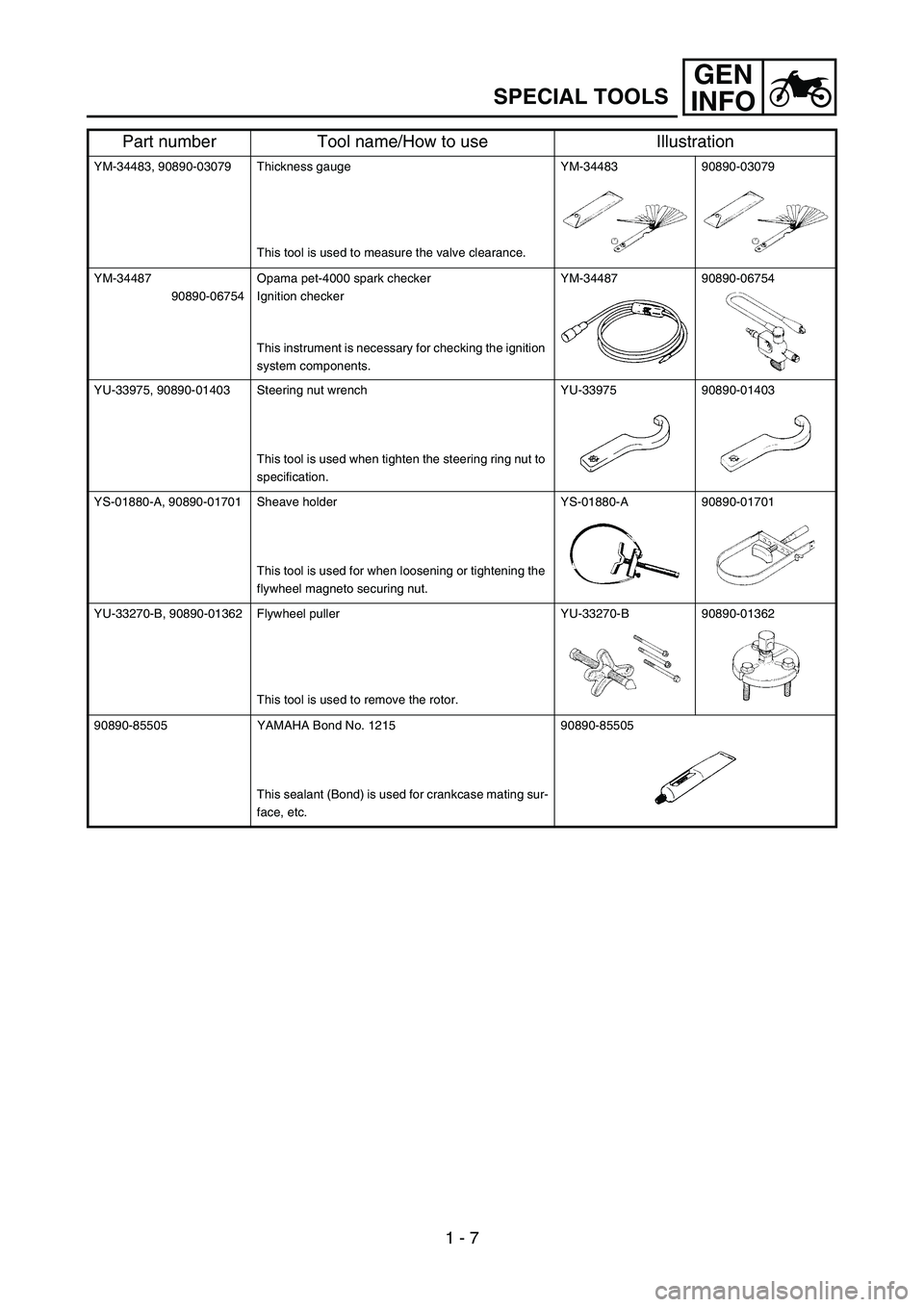
YM-34483, 90890-03079 Thickness gauge
This tool is used to measure the valve clearance. YM-34483 90890-03079
YM-34487 90890-06754 Opama pet-4000 spark checker
Ignition checker
This instrument is necessary for checking the ignition
system components. YM-34487 90890-06754
YU-33975, 90890-01403 Steering nut wrench This tool is used when tighten the steering ring nut to
specification. YU-33975 90890-01403
YS-01880-A, 90890-01701 Sheave holder This tool is used for when loosening or tightening the
flywheel magneto securing nut. YS-01880-A 90890-01701
YU-33270-B, 90890-01362 Flywheel puller This tool is used to remove the rotor. YU-33270-B 90890-01362
90890-85505 YAMAHA Bond No. 1215 This sealant (Bond) is used for crankcase mating sur-
face, etc. 90890-85505
Part number Tool name/How to use Illustration
Page 50 of 390
GEN
INFO
1 - 12
STARTING AND OPERATION
STARTING AND OPERATION
CAUTION:
Prior to operating the machine, perform
steps listed in pre-operation check list.
WARNING
Never start your engine or let it run for any
length of time in a closed area. The exhaust
fumes are poisonous and can cause loss of
consciousness and death within a short
time. Always operate your machine in an
area with adequate ventilation.
STARTING A COLD ENGINE
WARNING
Before starting the engine, be sure to shift
the transmission into neutral.
NOTE:
This model is equipped with an ignition cir-
cuit cut-off system. In case of electric start-
ing, the engine can be started only when the
transmission is in neutral.
If the engine fails to start by pushing the start
switch, release the switch, wait a few sec-
onds, and then try again. Each starting
attempt should be as short as possible to
preserve the battery. Do not crank the
engine more than 10 seconds on any one
attempt.
1. Turn the fuel cock to “ON ”.
2. Turn the main switch to “ON ”.
3. Shift the transmission into neutral.
4. Operate the starter (choke) and completely close the throttle grip.
5. Slide the “engine stop ” switch to the “”.
6. Start the engine by pushing the start switch.
7. After the engine starts, warm up for one or
two minutes. Make sure the stater (choke) is
returned to the original position before riding. STARTING A WARM ENGINE
To start a warm engine, refer to the
“START-
ING A COLD ENGINE ” section. The starter
(choke) should not be used. The throttle
should be opened slightly.
CAUTION:
See “Engine break-in Section ” prior to
operating engine for the first time.
WARMING UP
To get maximum engine life, always “warm-up ”
the engine before starting off. Never accelerate
hard with a cold engine! To see whether or not
the engine is warm, see if it responds to throttle
normally with the stater (choke) turned off.
WARNING
Before starting off, be sure to turn up or
remove the side stand.
Failure to retract the side stand completely
can result in a serious accident when you
try to turn a corner.
ENGINE BREAK-IN
Break-in is important to better fit the moving
and sliding parts as well as the installed parts.
It is also important to accustom the rider to the
machine better.
Avoid full-throttle run on a new machine for the
first 5 hours.
After the trial run, check for loose parts, oil
leakage and other problems.
Make full inspection and adjustment especially of
slack cables and drive chain and loose spokes.
CAUTION:
After the break-in period, check every fit-
ting and fastener for looseness.
If any loose is found, retighten it securely.
Page 58 of 390
SPEC
2 - 3
Suspension:
Front suspension Telescopic fork
Rear suspension Swingarm (monocross suspension)
Shock absorber:
Front shock absorber Coil spring
Rear shock absorber Coil spring/oil damper
Wheel travel: Front wheel travel 96.0 mm (3.78 in)
Rear wheel travel 71.0 mm (2.80 in)
Electrical: Ignition system CDI
Charging system AC magneto
GENERAL SPECIFICATIONS
Page 69 of 390
SPEC
2 - 14
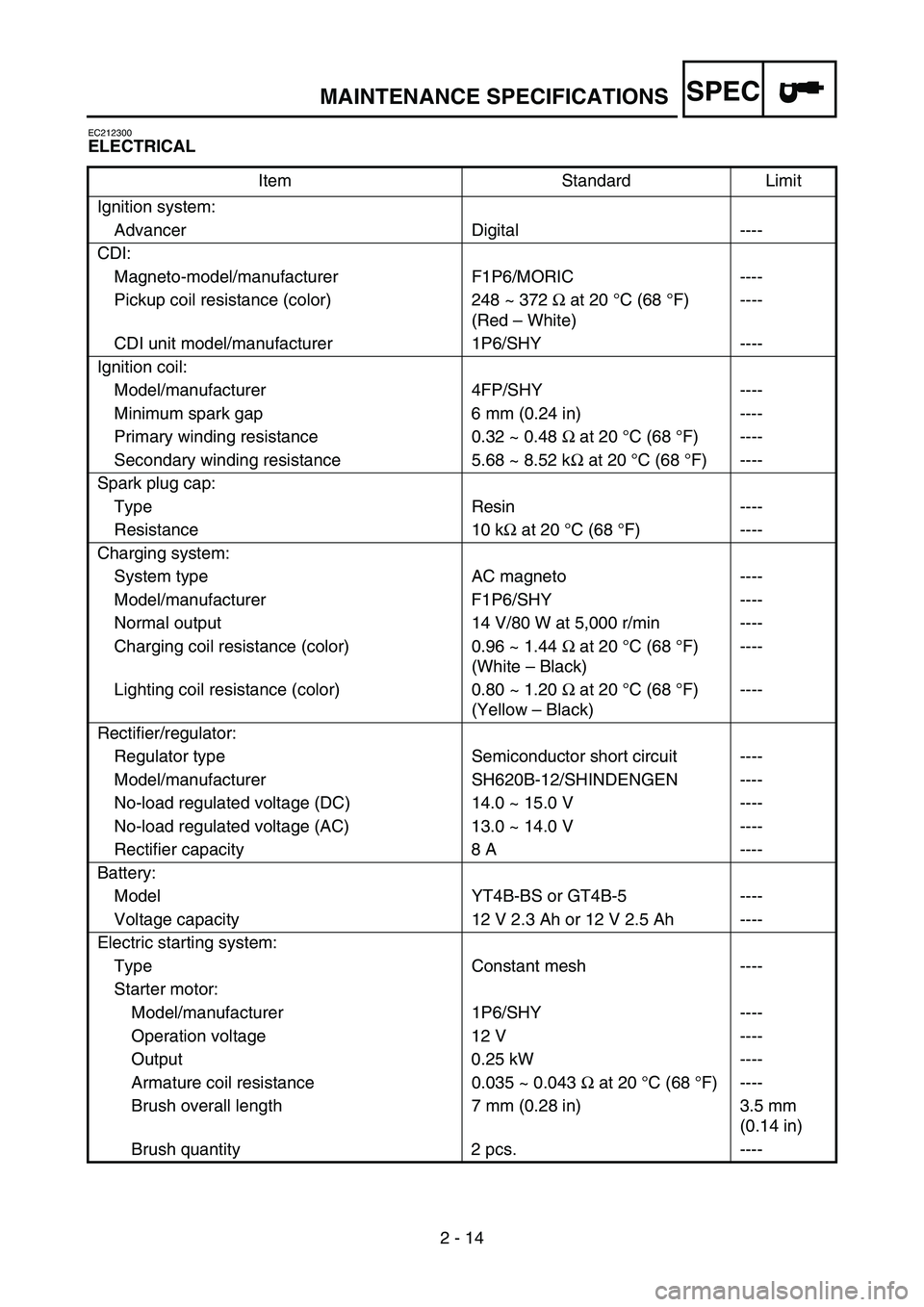
EC212300
ELECTRICALItem Standard Limit
Ignition system: Advancer Digital ----
CDI: Magneto-model/manufacturer F1P6/MORIC ----
Pickup coil resistance (color) 248 ~ 372 Ω at 20 °C (68 °F)
(Red – White) ----
CDI unit model/manufacturer 1P6/SHY ----
Ignition coil: Model/manufacturer 4FP/SHY ----
Minimum spark gap 6 mm (0.24 in) ----
Primary winding resistance 0.32 ~ 0.48 Ω at 20 °C (68 °F) ----
Secondary winding resistance 5.68 ~ 8.52 k Ω at 20 °C (68 °F) ----
Spark plug cap: Type Resin ----
Resistance 10 k Ω at 20 °C (68 °F) ----
Charging system: System type AC magneto ----
Model/manufacturer F1P6/SHY ----
Normal output 14 V/80 W at 5,000 r/min ----
Charging coil resistance (color) 0.96 ~ 1.44 Ω at 20 °C (68 °F)
(White – Black) ----
Lighting coil resistance (color) 0.80 ~ 1.20 Ω at 20 °C (68 °F)
(Yellow – Black) ----
Rectifier/regulator: Regulator type Semiconductor short circuit ----
Model/manufacturer SH620B-12/SHINDENGEN ----
No-load regulated voltage (DC) 14.0 ~ 15.0 V ----
No-load regulated voltage (AC) 13.0 ~ 14.0 V ----
Rectifier capacity 8 A ----
Battery: Model YT4B-BS or GT4B-5 ----
Voltage capacity 12 V 2.3 Ah or 12 V 2.5 Ah ----
Electric starting system: Type Constant mesh ----
Starter motor: Model/manufacturer 1P6/SHY ----
Operation voltage 12 V ----
Output 0.25 kW ----
Armature coil resistance 0.035 ~ 0.043 Ω at 20 °C (68 °F) ----
Brush overall length 7 mm (0.28 in) 3.5 mm (0.14 in)
Brush quantity 2 pcs. ----
MAINTENANCE SPECIFICATIONS
Page 106 of 390
2 - 18
SPECCABLE ROUTING DIAGRAM
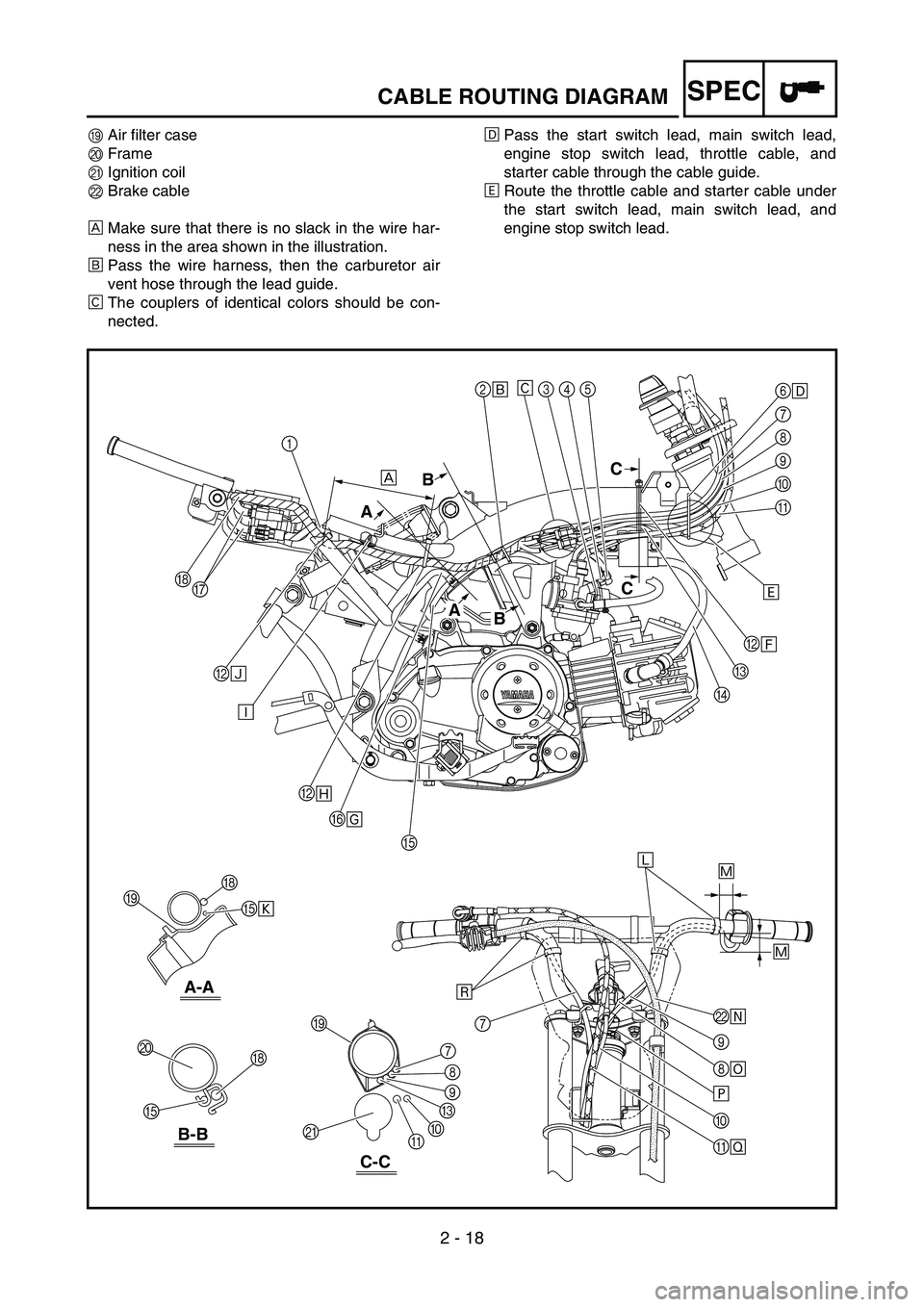
IAir filter case
J Frame
K Ignition coil
L Brake cable
È Make sure that there is no slack in the wire har-
ness in the area shown in the illustration.
É Pass the wire harness, then the carburetor air
vent hose through the lead guide.
Ê The couplers of identical colors should be con-
nected. Ë
Pass the start switch lead, main switch lead,
engine stop switch lead, throttle cable, and
starter cable through the cable guide.
Ì Route the throttle cable and starter cable under
the start switch lead, main switch lead, and
engine stop switch lead.
2
É
BÍ
B Ñ
BÏ
F Î
LÕ
\b
8 \b
×
0
\f Ø
E
E Ò 6
\f
7
8
\b
0
\f
C
D
H
H
7
J
I
I
K 8
7
\b
C
0
\f
E H
G 345
Ê
Ì
Ð
ÙÓ
Ô
Ô
È
B
A C
C
B
A
B-B
A-A
C-C
1
Page 112 of 390
2 - 21
SPECCABLE ROUTING DIAGRAM
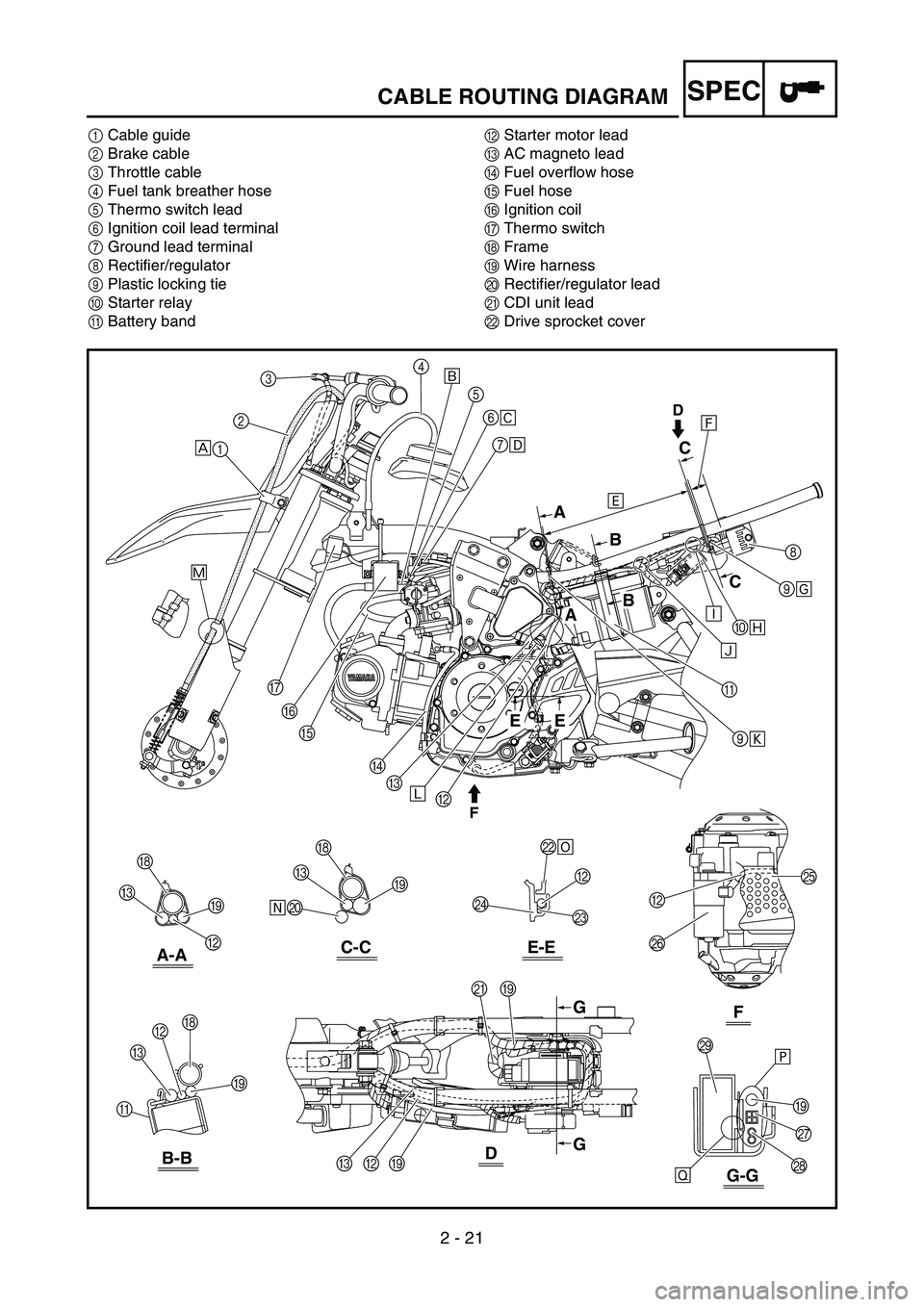
1Cable guide
2 Brake cable
3 Throttle cable
4 Fuel tank breather hose
5 Thermo switch lead
6 Ignition coil lead terminal
7 Ground lead terminal
8 Rectifier/regulator
9 Plastic locking tie
0 Starter relay
A Battery band B
Starter motor lead
C AC magneto lead
D Fuel overflow hose
E Fuel hose
F Ignition coil
G Thermo switch
H Frame
I Wire harness
J Rectifier/regulator lead
K CDI unit lead
L Drive sprocket cover
RES
OFF
FUEL
A
EE
A
B C
C
B
G
G
D
F
È1
ÕJ
2
3
4
5
8
\f
6
Ê
\bÎ
0 Ï
\b Ò
L \b
B
C
D
E
F
G
H I
B I
H
C
NB
M B
P O
R Q
I
S
I
K
I
B
C
I
H
B
C
\f C
Ó
×
Ø
Ô
ÐÑ
Ì
Í
7 \f
É
C-C
E-EA-A
B-B
G-G
D
F
Page 114 of 390
2 - 22
SPECCABLE ROUTING DIAGRAM
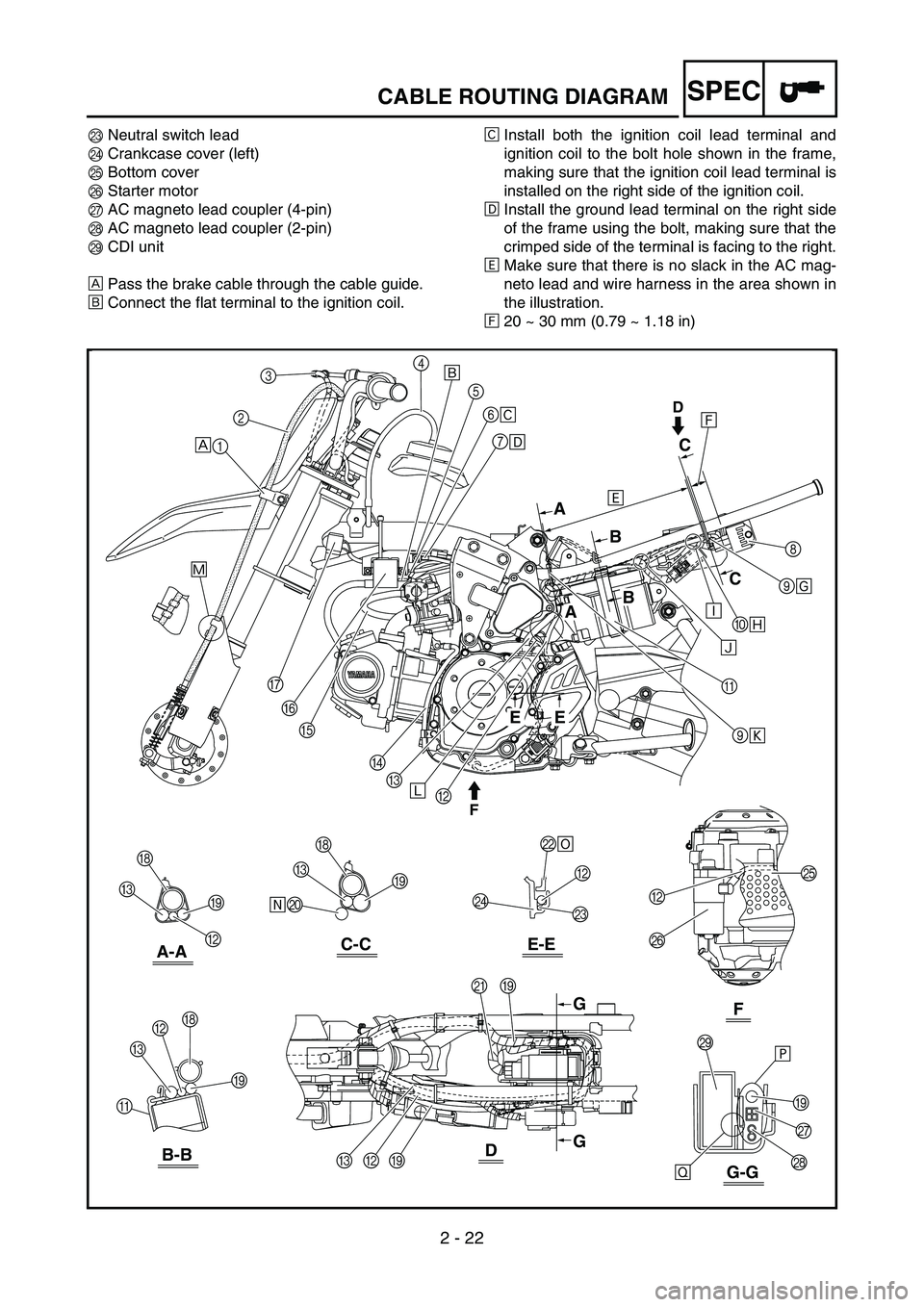
MNeutral switch lead
N Crankcase cover (left)
O Bottom cover
P Starter motor
Q AC magneto lead coupler (4-pin)
R AC magneto lead coupler (2-pin)
S CDI unit
È Pass the brake cable through the cable guide.
É Connect the flat terminal to the ignition coil. Ê
Install both the ignition coil lead terminal and
ignition coil to the bolt hole shown in the frame,
making sure that the ignition coil lead terminal is
installed on the right side of the ignition coil.
Ë Install the ground lead terminal on the right side
of the frame using the bolt, making sure that the
crimped side of the terminal is facing to the right.
Ì Make sure that there is no slack in the AC mag-
neto lead and wire harness in the area shown in
the illustration.
Í 20 ~ 30 mm (0.79 ~ 1.18 in)
RES
OFF
FUEL
A
EE
A
B C
C
B
G
G
D
F
È1
ÕJ
2
3
4
5
8
\f
6
Ê
\bÎ
0 Ï
\b Ò
L \b
B
C
D
E
F
G
H I
B I
H
C
NB
M B
P O
R Q
I
S
I
K
I
B
C
I
H
B
C
\f C
Ó
×
Ø
Ô
ÐÑ
Ì
Í
7 \f
É
C-C
E-EA-A
B-B
G-G
D
F
Page 126 of 390
3 - 3
INSPADJ
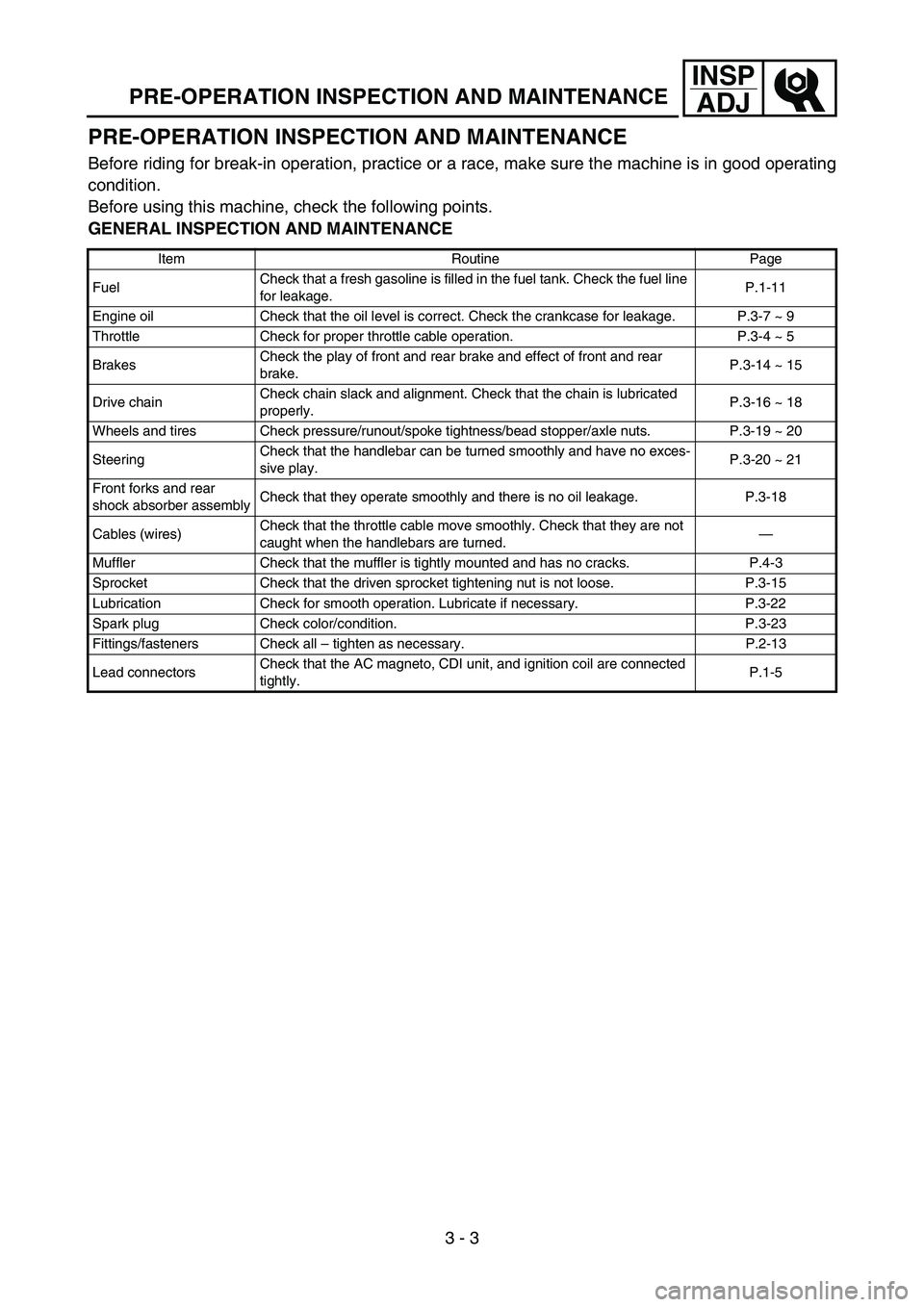
PRE-OPERATION INSPECTION AND MAINTENANCE
PRE-OPERATION INSPECTION AND MAINTENANCE
Before riding for break-in operation, practice or a race, make sure the machine is in good operating
condition.
Before using this machine, check the following points.
GENERAL INSPECTION AND MAINTENANCE
Item Routine Page
Fuel Check that a fresh gasoline is filled in the fuel tank. Check the fuel line
for leakage. P.1-11
Engine oil Check that the oil level is correct. Check the crankcase for leakage. P.3-7 ~ 9
Throttle Check for proper throttle cable operation. P.3-4 ~ 5
Brakes Check the play of front and rear brake and effect of front and rear
brake. P.3-14 ~ 15
Drive chain Check chain slack and alignment. Check that the chain is lubricated
properly. P.3-16 ~ 18
Wheels and tires Check pressure/runout/spoke tightness/bead stopper/axle nuts. P.3-19 ~ 20
Steering Check that the handlebar can be turned smoothly and have no exces-
sive play. P.3-20 ~ 21
Front forks and rear
shock absorber assembly Check that they operate smoothly and there is no oil leakage. P.3-18
Cables (wires) Check that the throttle cable move smoothly. Check that they are not
caught when the handlebars are turned. —
Muffler Check that the muffler is tightly mounted and has no cracks. P.4-3
Sprocket Check that the driven sprocket tightening nut is not loose. P.3-15
Lubrication Check for smooth operation. Lubricate if necessary. P.3-22
Spark plug Check color/condition. P.3-23
Fittings/fasteners Check all – tighten as necessary. P.2-13
Lead connectors Check that the AC magneto, CDI unit, and ignition coil are connected
tightly. P.1-5
Page 186 of 390
3 - 31
INSPADJ
FUSE INSPECTION
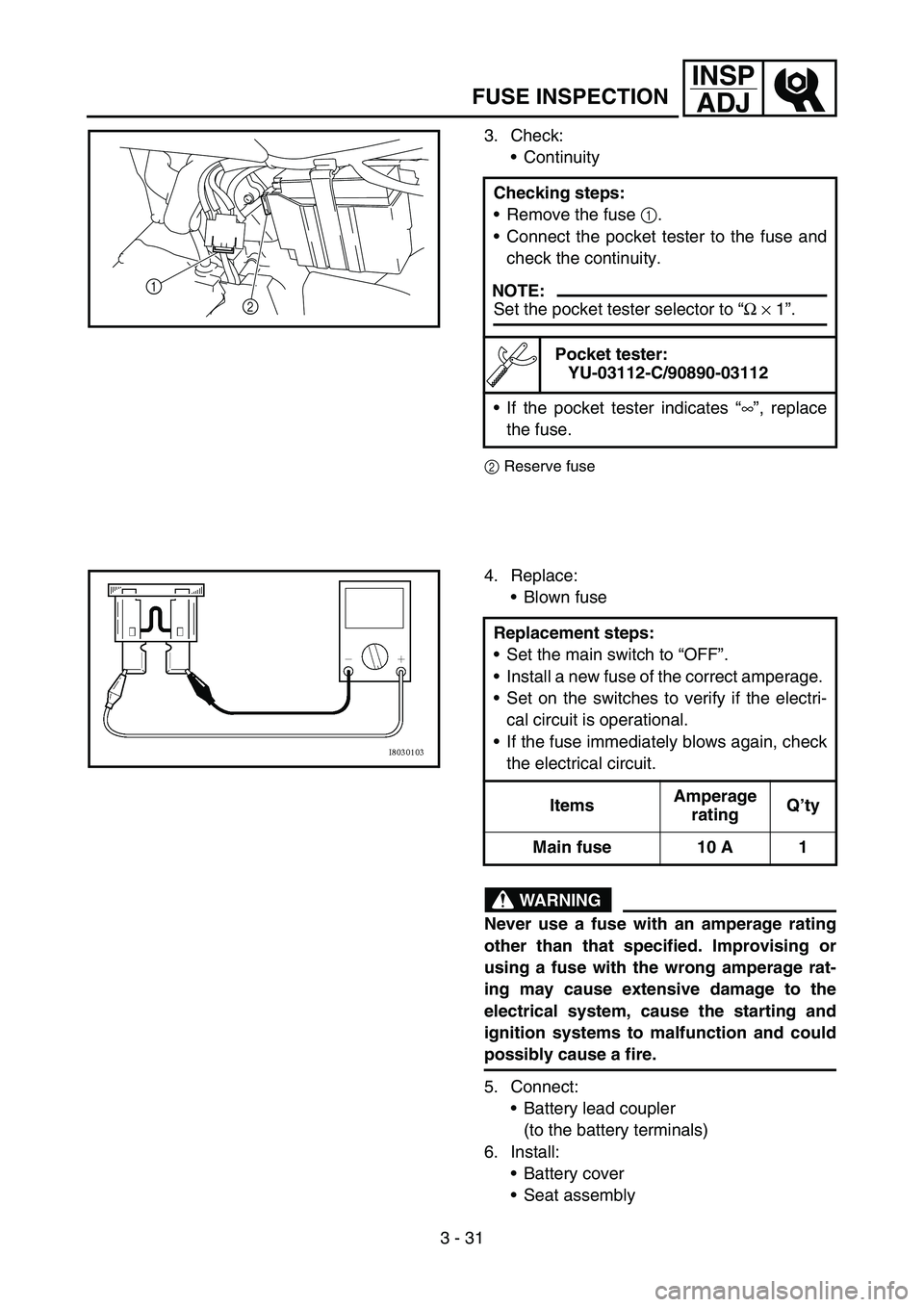
3. Check:
Continuity
2 Reserve fuse
Checking steps:
Remove the fuse 1
.
Connect the pocket tester to the fuse and
check the continuity.
NOTE:
Set the pocket tester selector to “Ω × 1 ”.
Pocket tester:
YU-03112-C/90890-03112
If the pocket tester indicates “∞ ”, replace
the fuse.
1 2
4. Replace:
Blown fuse
WARNING
Never use a fuse with an amperage rating
other than that specified. Improvising or
using a fuse with the wrong amperage rat-
ing may cause extensive damage to the
electrical system, cause the starting and
ignition systems to malfunction and could
possibly cause a fire.
5. Connect:
Battery lead coupler
(to the battery terminals)
6. Install: Battery cover
Seat assembly
Replacement steps:
Set the main switch to “OFF ”.
Install a new fuse of the correct amperage.
Set on the switches to verify if the electri-
cal circuit is operational.
If the fuse immediately blows again, check
the electrical circuit.
Items Amperage
rating Q
’ty
Main fuse 10 A 1