engine YAMAHA TW125 2001 User Guide
[x] Cancel search | Manufacturer: YAMAHA, Model Year: 2001, Model line: TW125, Model: YAMAHA TW125 2001Pages: 88, PDF Size: 1.43 MB
Page 24 of 88
3-12
INSTRUMENT AND CONTROL FUNCTIONS
1
23
4
5
6
7
8
9
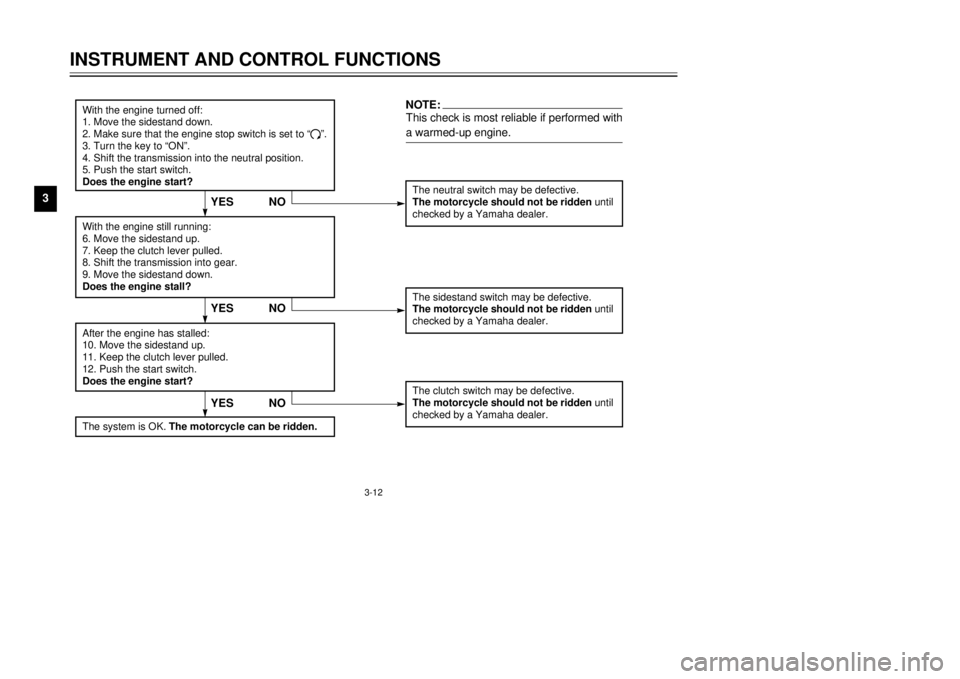
With the engine turned off:
1. Move the sidestand down.
2. Make sure that the engine stop switch is set to Ò
#Ó.
3. Turn the key to ÒONÓ.
4. Shift the transmission into the neutral position.
5. Push the start switch.
Does the engine start?
The neutral switch may be defective.
The motorcycle should not be ridden until
checked by a Yamaha dealer.
With the engine still running:
6. Move the sidestand up.
7. Keep the clutch lever pulled.
8. Shift the transmission into gear.
9. Move the sidestand down.
Does the engine stall?After the engine has stalled:
10. Move the sidestand up.
11. Keep the clutch lever pulled.
12. Push the start switch.
Does the engine start?
The sidestand switch may be defective.
The motorcycle should not be ridden until
checked by a Yamaha dealer.The clutch switch may be defective.
The motorcycle should not be ridden until
checked by a Yamaha dealer.
NO
NOTE:This check is most reliable if performed with
a warmed-up engine.
YESYES NO
The system is OK. The motorcycle can be ridden.
YES NO
5EK-9-E2 (TW125)<3.3Passport> 5/23/00 9:47 AM Page 22
Page 25 of 88

4-1
EAU01114
PRE-OPERATION CHECKS
1
2
34
5
6
7
8
9 The condition of a vehicle is the ownerÕs responsibility. Vital components can start to deteriorate quickly and unexpect-
edly, even if the vehicle remains unused (for example, as a result of exposure to the elements). Any damage, fluid leak-
age or loss of tire air pressure could have serious consequences. Therefore, it is very important, in addition to a thor-
ough visual inspection, to check the following points before each ride.
EAU03328
Pre-operation check list
ITEM CHECKS PAGE
Front brake9Check operation, free play, fluid level and vehicle for fluid leakage.
3-4, 6-20, 6-23Ð6-25
9Fill with DOT 4 brake fluid if necessary.
Rear brake9Check operation, condition and free play.
3-5, 6-21Ð6-239Adjust if necessary.
Clutch9Check operation, condition and free play.
3-4, 6-19Ð6-209Adjust if necessary.
Throttle grip and housing9Check smooth operation.
6-15, 6-289Lubricate if necessary.
Engine oil9Check oil level.
6-9Ð6-129Add oil if necessary.
Drive chain9Check chain slack and condition.
6-25Ð6-279Adjust if necessary.
Wheels and tires9Check tire air pressure, for wear, damage and spoke tightness.
6-16Ð6-199Tighten spokes if necessary.
Brake and shift pedal shafts9Check smooth operation.
6-289Lubricate if necessary.
Brake and clutch lever pivots9Check smooth operation.
6-299Lubricate if necessary.
Sidestand pivot9Check smooth operation.
6-299Lubricate if necessary.
Chassis fasteners9Make sure that all nuts, bolts and screws are properly tightened.
Ñ
9Tighten if necessary.
5EK-9-E2 (TW125)<3.3Passport> 5/23/00 9:47 AM Page 23
Page 27 of 88

5-1
EAU00372
OPERATION AND IMPORTANT RIDING POINTS
1
2
3
45
6
7
8
9
EAU00373
w8Become thoroughly familiar
with all operating controls and
their functions before riding.
Consult a Yamaha dealer
regarding any control or func-
tion that you do not thorough-
ly understand.
8Never start the engine or oper-
ate it in a closed area for any
length of time. Exhaust fumes
are poisonous, and inhaling
them can cause loss of con-
sciousness and death within a
short time. Always make sure
that there is adequate ventila-
tion.
8Before starting out, make sure
that the sidestand is up. If the
sidestand is not raised com-
pletely, it could contact the
ground and distract the opera-
tor, resulting in a possible loss
of control.
EAU03515
Starting the engineIn order for the ignition circuit cut-off
system to enable starting, one of the
following conditions must be met:
8The transmission is in the neutral
position.
8The transmission is in gear with
the clutch lever pulled and the
sidestand up.
EW000054
w8Before starting the engine,
check the function of the igni-
tion circuit cut-off system
according to the procedure
described on page 3-12.
8Never ride with the sidestand
down.
1. Turn the fuel cock lever to ÒONÓ.
2. Turn the key to ÒONÓ and make
sure that the engine stop switch
is set to Ò#Ó.
3. Shift the transmission into the
neutral position.NOTE:
When the transmission is in the neu-
tral position, the neutral indicator light
should be on, otherwise have a
Yamaha dealer check the electrical
circuit.1. Arrow mark positioned over ÒONÓ
ON
FUEL
RES
OFF
1
ON
5EK-9-E2 (TW125)<3.3Passport> 5/23/00 9:47 AM Page 25
Page 28 of 88
5-2
OPERATION AND IMPORTANT RIDING POINTS
1
2
3
45
6
7
8
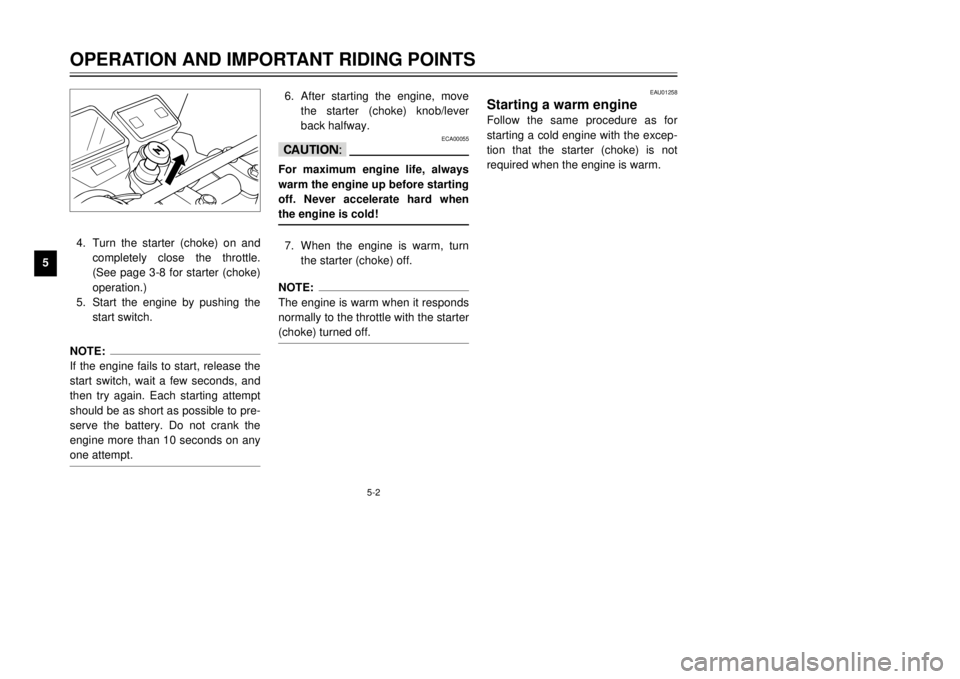
94. Turn the starter (choke) on and
completely close the throttle.
(See page 3-8 for starter (choke)
operation.)
5. Start the engine by pushing the
start switch.
NOTE:
If the engine fails to start, release the
start switch, wait a few seconds, and
then try again. Each starting attempt
should be as short as possible to pre-
serve the battery. Do not crank the
engine more than 10 seconds on any
one attempt.
6. After starting the engine, move
the starter (choke) knob/lever
back halfway.
ECA00055
cCFor maximum engine life, always
warm the engine up before starting
off. Never accelerate hard when
the engine is cold!7. When the engine is warm, turn
the starter (choke) off.NOTE:
The engine is warm when it responds
normally to the throttle with the starter
(choke) turned off.
EAU01258
Starting a warm engineFollow the same procedure as for
starting a cold engine with the excep-
tion that the starter (choke) is not
required when the engine is warm.
5EK-9-E2 (TW125)<3.3Passport> 5/23/00 9:47 AM Page 26
Page 29 of 88
5-3
OPERATION AND IMPORTANT RIDING POINTS
1
2
3
45
6
7
8
9
EC000048
cC8Even with the transmission in
the neutral position, do not
coast for long periods of time
with the engine off, and do not
tow the motorcycle for long
distances. The transmission is
properly lubricated only when
the engine is running.
Inadequate lubrication may
damage the transmission.
8Always use the clutch while
changing gears to avoid dam-
aging the engine, transmis-
sion, and drive train, which are
not designed to withstand the
shock of forced shifting.
1
N5
4
3
2
1
EAU00423
ShiftingShifting gears lets you control the
amount of engine power available for
starting off, accelerating, climbing
hills, etc.
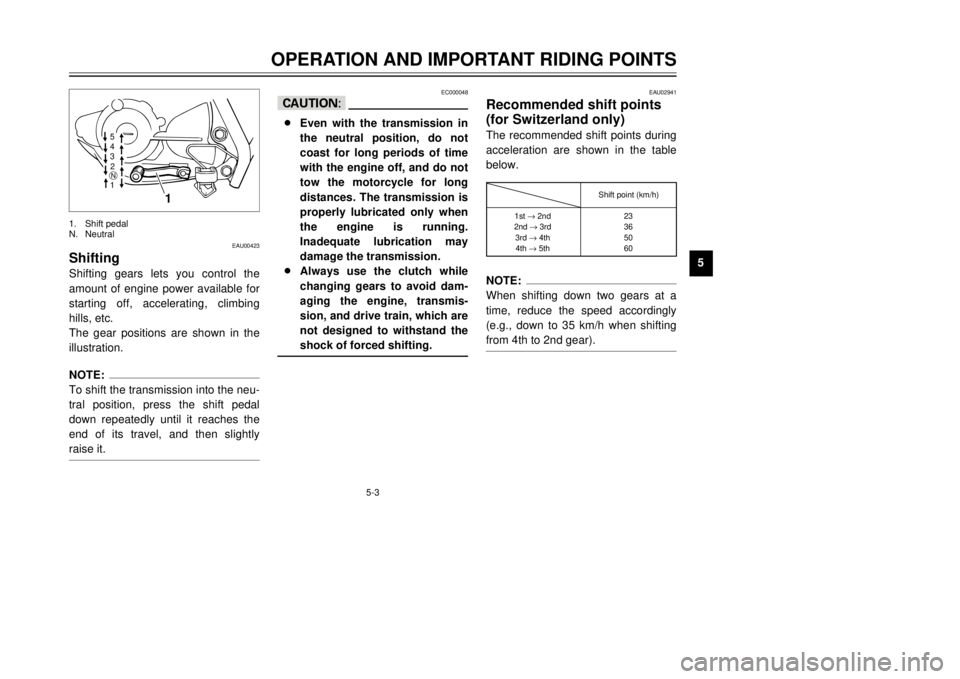
The gear positions are shown in the
illustration.NOTE:
To shift the transmission into the neu-
tral position, press the shift pedal
down repeatedly until it reaches the
end of its travel, and then slightly
raise it.1. Shift pedal
N. Neutral
EAU02941
Recommended shift points
(for Switzerland only)The recommended shift points during
acceleration are shown in the table
below.NOTE:
When shifting down two gears at a
time, reduce the speed accordingly
(e.g., down to 35 km/h when shifting
from 4th to 2nd gear).
Shift point (km/h)
1st ®2nd 23
2nd ®3rd 36
3rd ®4th 50
4th ®5th 60
5EK-9-E2 (TW125)<3.3Passport> 5/23/00 9:47 AM Page 27
Page 30 of 88

5-4
OPERATION AND IMPORTANT RIDING POINTS
1
2
3
45
6
7
8
9
EAU00424
Tips for reducing fuel
consumptionFuel consumption depends largely on
your riding style. Consider the follow-
ing tips to reduce fuel consumption:
8Thoroughly warm up the engine.
8Turn the starter (choke) off as
soon as possible.
8Shift up swiftly, and avoid high
engine speeds during accelera-
tion.
8Do not rev the engine while shift-
ing down, and avoid high engine
speeds with no load on the
engine.
8Turn the engine off instead of let-
ting it idle for an extended length
of time (e.g., in traffic jams, at
traffic lights or at railroad cross-
ings).
EAU01128
Engine break-inThere is never a more important peri-
od in the life of your engine than the
period between 0 and 1,600 km. For
this reason, you should read the fol-
lowing material carefully.
Since the engine is brand new, do
not put an excessive load on it for the
first 1,600 km. The various parts in
the engine wear and polish them-
selves to the correct operating clear-
ances. During this period, prolonged
full-throttle operation or any condition
that might result in engine overheat-
ing must be avoided.
EAU01500
0Ð1,000 km
Avoid prolonged operation above 1/3
throttle.
1,000Ð1,600 km
Avoid prolonged operation above 1/2
throttle.
EC000057
cCAfter 1,000 km of operation, the
engine oil must be changed, the oil
filter cartridge/element replaced,
and the oil strainer cleaned.1,600 km and beyond
The vehicle can now be operated
normally.
EC000049
cCIf any engine trouble should occur
during the engine break-in period,
immediately have a Yamaha dealer
check the vehicle.
5EK-9-E2 (TW125)<3.3Passport> 5/23/00 9:47 AM Page 28
Page 31 of 88
5-5
OPERATION AND IMPORTANT RIDING POINTS
1
2
3
45
6
7
8
9
EAU00457
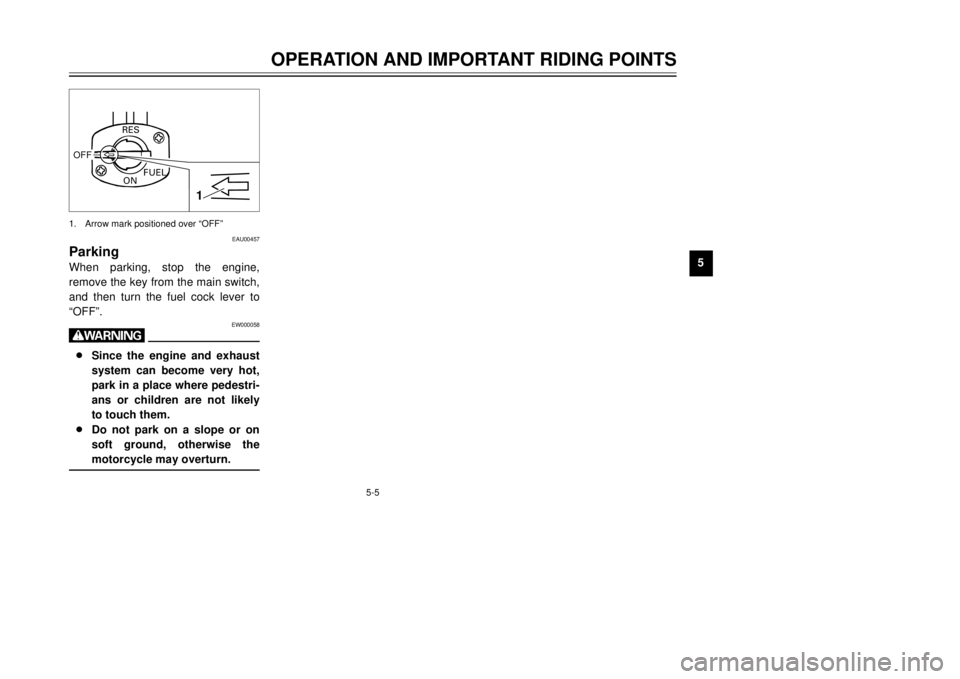
ParkingWhen parking, stop the engine,
remove the key from the main switch,
and then turn the fuel cock lever to
ÒOFFÓ.
EW000058
w8Since the engine and exhaust
system can become very hot,
park in a place where pedestri-
ans or children are not likely
to touch them.
8Do not park on a slope or on
soft ground, otherwise the
motorcycle may overturn.1. Arrow mark positioned over ÒOFFÓ
RES
ONFUEL
OFF
1
5EK-9-E2 (TW125)<3.3Passport> 5/23/00 9:47 AM Page 29
Page 34 of 88

6-3
PERIODIC MAINTENANCE AND MINOR REPAIR
1
2
3
4
56
7
8
9
10
*Wheels¥ Check runout, spoke tightness and for damage.
¥ Tighten spokes if necessary.ÖÖÖÖ
11*Tires¥ Check tread depth and for damage.
¥ Replace if necessary.
¥ Check air pressure.
¥ Correct if necessary.ÖÖÖÖ
12*Wheel bearings¥ Check bearing for looseness or damage.ÖÖÖÖ
13*Swingarm¥ Check operation and for excessive play.ÖÖÖÖ
¥ Lubricate with lithium-soap-based grease. Every 24,000km
14 Drive chain¥ Check chain slack.
¥ Make sure that the rear wheel is properly aligned.
¥ Clean and lubricate.Every 500 km and after washing
the motorcycle in the rain
15*Steering bearings¥ Check bearing play and steering for roughness.ÖÖÖÖÖ
¥ Lubricate with lithium-soap-based greaseEvery 24,000km
16*Chassis fasteners¥ Make sure that all nuts, bolts and screws are properly tightened.ÖÖÖÖ Ö
17 Sidestand¥ Check operation.
¥ Lubricate.ÖÖÖÖ Ö
18*Sidestand switch¥ Check operation.ÖÖÖÖÖ Ö
19*Front fork¥ Check operation and for oil leakage.ÖÖÖÖ
20*Rear shock absorber
assembly pivoting
points¥ Check operation and shock absorber for oil leakage.ÖÖÖÖ
¥ Lubricate with lithium-soap-based grease.ÖÖ
21*Carburetor¥ Check starter (choke) operation.
¥ Adjust engine idling speed.ÖÖÖÖÖ Ö NO. ITEM CHECK OR MAINTENANCE JOBODOMETER READING (´1,000 km)
ANNUAL
CHECK
1 6 12 18 24
5EK-9-E2 (TW125)<3.3Passport> 5/23/00 9:47 AM Page 32
Page 35 of 88

6-4
PERIODIC MAINTENANCE AND MINOR REPAIR
1
2
3
4
56
7
8
9
EAU03541
NOTE:
8The air filter needs more frequent service if you are riding in unusually wet or dusty areas.
8Hydraulic brake service
8
Regularly check and, if necessary, correct the brake fluid level.
8
Every two years replace the internal components of the brake master cylinder and caliper, and change the brake fluid.
8
Replace the brake hoses every four years and if cracked or damaged.
22 Engine oil¥ Change.ÖÖÖÖÖ Ö
23 Engine oil filter element¥ Replace.ÖÖÖ
24
*Engine oil strainer¥ Clean.ÖÖÖ
25*Front and rear brake
switches¥ Check operation.ÖÖÖÖÖ Ö
26 Moving parts and cables¥ Lubricate.ÖÖÖÖ Ö
27*Lights, signals and
switches¥ Check operation.
¥ Adjust headlight beam.ÖÖÖÖÖ Ö NO. ITEM CHECK OR MAINTENANCE JOBODOMETER READING (´1,000 km)
ANNUAL
CHECK
1 6 12 18 24
5EK-9-E2 (TW125)<3.3Passport> 5/23/00 9:47 AM Page 33
Page 38 of 88
6-7
PERIODIC MAINTENANCE AND MINOR REPAIR
1
2
3
4
56
7
8
9
EAU01833
Checking the spark plugThe spark plug is an important
engine component, which is easy to
check. Since heat and deposits will
cause any spark plug to slowly erode,
the spark plug should be removed
and checked in accordance with the
periodic maintenance and lubrication
chart. In addition, the condition of the
spark plug can reveal the condition of
the engine.
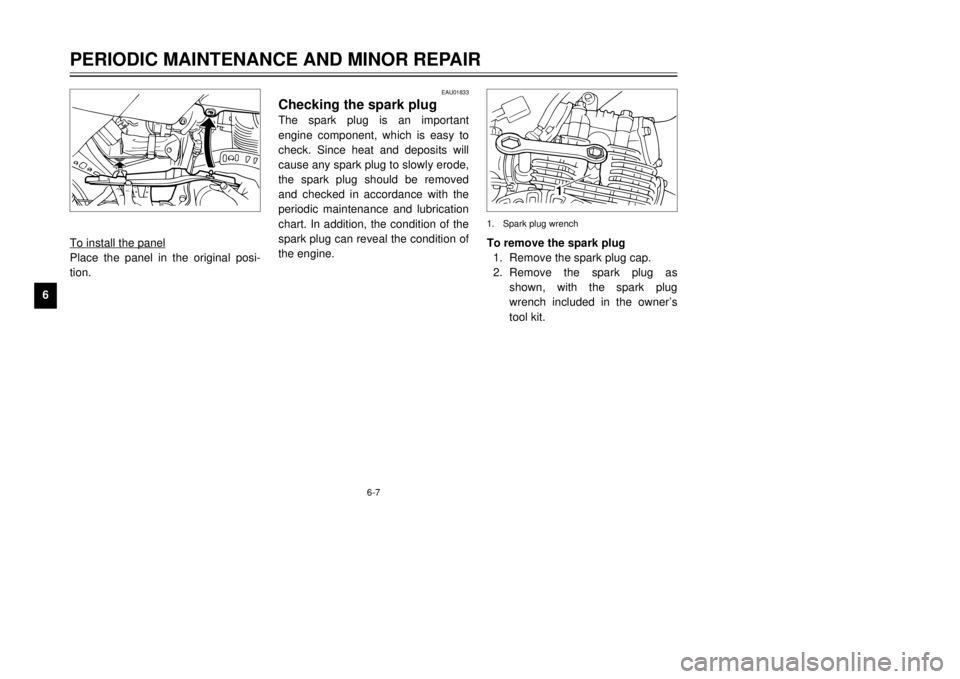
1. Spark plug wrenchTo remove the spark plug
1. Remove the spark plug cap.
2. Remove the spark plug as
shown, with the spark plug
wrench included in the ownerÕs
tool kit.
1
To install the panelPlace the panel in the original posi-
tion.
5EK-9-E2 (TW125)<3.3Passport> 5/23/00 9:47 AM Page 36