tires YAMAHA TZR50 2010 Owners Manual
[x] Cancel search | Manufacturer: YAMAHA, Model Year: 2010, Model line: TZR50, Model: YAMAHA TZR50 2010Pages: 88, PDF Size: 1.83 MB
Page 6 of 88
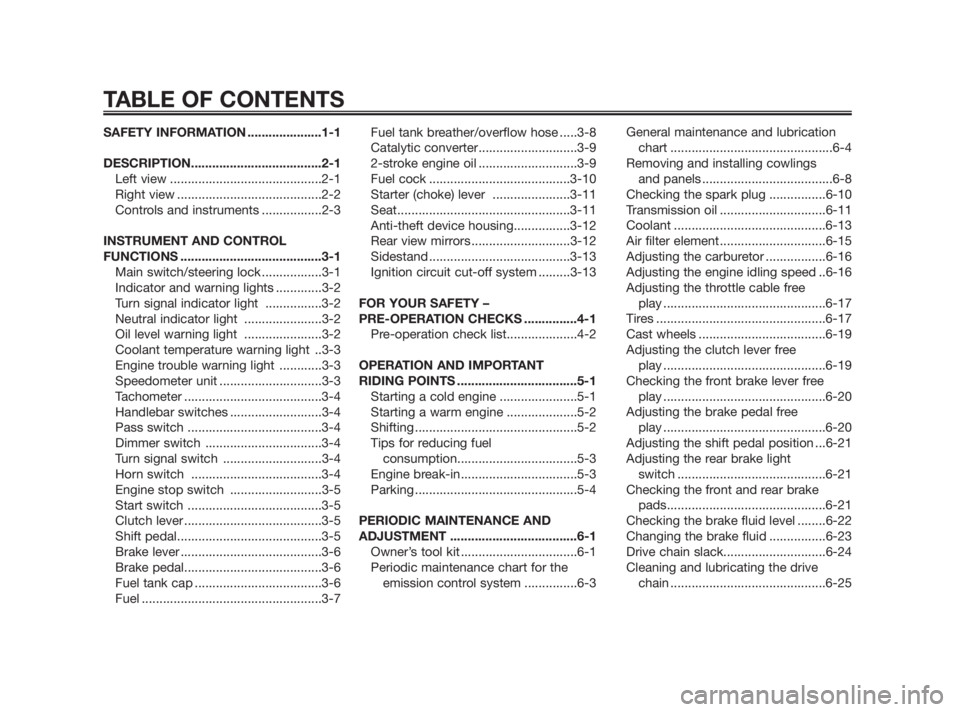
SAFETY INFORMATION .....................1-1
DESCRIPTION.....................................2-1
Left view ...........................................2-1
Right view .........................................2-2
Controls and instruments .................2-3
INSTRUMENT AND CONTROL
FUNCTIONS ........................................3-1
Main switch/steering lock .................3-1
Indicator and warning lights .............3-2
Turn signal indicator light ................3-2
Neutral indicator light ......................3-2
Oil level warning light ......................3-2
Coolant temperature warning light ..3-3
Engine trouble warning light ............3-3
Speedometer unit .............................3-3
Tachometer .......................................3-4
Handlebar switches ..........................3-4
Pass switch ......................................3-4
Dimmer switch .................................3-4
Turn signal switch ............................3-4
Horn switch .....................................3-4
Engine stop switch ..........................3-5
Start switch ......................................3-5
Clutch lever .......................................3-5
Shift pedal.........................................3-5
Brake lever ........................................3-6
Brake pedal.......................................3-6
Fuel tank cap ....................................3-6
Fuel ...................................................3-7Fuel tank breather/overflow hose .....3-8
Catalytic converter............................3-9
2-stroke engine oil ............................3-9
Fuel cock ........................................3-10
Starter (choke) lever ......................3-11
Seat.................................................3-11
Anti-theft device housing................3-12
Rear view mirrors ............................3-12
Sidestand ........................................3-13
Ignition circuit cut-off system .........3-13
FOR YOUR SAFETY –
PRE-OPERATION CHECKS ...............4-1
Pre-operation check list....................4-2
OPERATION AND IMPORTANT
RIDING POINTS ..................................5-1
Starting a cold engine ......................5-1
Starting a warm engine ....................5-2
Shifting ..............................................5-2
Tips for reducing fuel
consumption..................................5-3
Engine break-in.................................5-3
Parking ..............................................5-4
PERIODIC MAINTENANCE AND
ADJUSTMENT ....................................6-1
Owner’s tool kit .................................6-1
Periodic maintenance chart for the
emission control system ...............6-3General maintenance and lubrication
chart ..............................................6-4
Removing and installing cowlings
and panels .....................................6-8
Checking the spark plug ................6-10
Transmission oil ..............................6-11
Coolant ...........................................6-13
Air filter element ..............................6-15
Adjusting the carburetor .................6-16
Adjusting the engine idling speed ..6-16
Adjusting the throttle cable free
play ..............................................6-17
Tires ................................................6-17
Cast wheels ....................................6-19
Adjusting the clutch lever free
play ..............................................6-19
Checking the front brake lever free
play ..............................................6-20
Adjusting the brake pedal free
play ..............................................6-20
Adjusting the shift pedal position ...6-21
Adjusting the rear brake light
switch ..........................................6-21
Checking the front and rear brake
pads.............................................6-21
Checking the brake fluid level ........6-22
Changing the brake fluid ................6-23
Drive chain slack.............................6-24
Cleaning and lubricating the drive
chain ............................................6-25
TABLE OF CONTENTS
5WX-F8199-E3 7/11/08 16:50 Página 6
Page 10 of 88
●Do not run engine indoors. Even
if you try to ventilate engine
exhaust with fans or open win-
dows and doors, carbon monoxi-
de can rapidly reach dangerous
levels.
●Do not run engine in poorly venti-
lated or partially enclosed areas
such as barns, garages, or car-
ports.
●Do not run engine outdoors whe-
re engine exhaust can be drawn
into a building through openings
such as windows and doors.
Loading
Adding accessories or cargo to your
motorcycle can adversely affect sta-
bility and handling if the weight distri-
bution of the motorcycle is changed.
To avoid the possibility of an acci-
dent, use extreme caution when
adding cargo or accessories to your
motorcycle. Use extra care when
riding a motorcycle that has added
cargo or accessories. Here, along
with the information about accesso-
ries below, are some general guideli-
nes to follow if loading cargo to yourmotorcycle:
The total weight of the operator, pas-
senger, accessories and cargo must
not exceed the maximum load limit.
Operation of an overloaded vehicle
could cause an accident.
When loading within this weight limit,
keep the following in mind:
●Cargo and accessory weight
should be kept as low and close
to the motorcycle as possible.
Securely pack your heaviest
items as close to the center of
the vehicle as possible and make
sure to distribute the weight as
evenly as possible on both sides
of the motorcycle to minimize
imbalance or instability.
●Shifting weights can create a
sudden imbalance. Make sure
that accessories and cargo are
securely attached to the
motorcycle before riding. Check
accessory mounts and cargo res-
traints frequently.• Properly adjust the suspension
for your load (suspension-
adjustable models only), and
check the condition and pres-
sure of your tires.
• Never attach any large or
heavy items to the handlebar,
front fork, or front fender. The-
se items, including such cargo
as sleeping bags, duffel bags,
or tents, can create unstable
handling or a slow steering res-
ponse.
●This vehicle is not designed to
pull a trailer or to be attached
to a sidecar.
Genuine Yamaha Accessories
Choosing accessories for your vehicle
is an important decision. Genuine
Yamaha accessories, which are avai-
lable only from a Yamaha dealer, have
been designed, tested, and approved
by Yamaha for use on your vehicle.
Many companies with no connection
to Yamaha manufacture parts and
accessories or offer other modifica-
tions for Yamaha vehicles. Yamaha is
not in a position to test the products
Maximum load:
196 kg (432 lb)
1
SAFETY INFORMATION
1-3
5WX-F8199-E3 7/11/08 16:50 Página 10
Page 11 of 88
1
SAFETY INFORMATION
1-4
that these aftermarket companies
produce. Therefore, Yamaha can neit-
her endorse nor recommend the use
of accessories not sold by Yamaha or
modifications not specifically recom-
mended by Yamaha, even if sold and
installed by a Yamaha dealer.
Aftermarket Parts, Accessories,
and Modifications
While you may find aftermarket pro-
ducts similar in design and quality to
genuine Yamaha accessories, recog-
nize that some aftermarket accesso-
ries or modifications are not suitable
because of potential safety hazards to
you or others. Installing aftermarket
products or having other modifica-
tions performed to your vehicle that
change any of the vehicle’s design or
operation characteristics can put you
and others at greater risk of serious
injury or death. You are responsible
for injuries related to changes in the
vehicle.
Keep the following guidelines in mind,
as well as those provided under “Loa-
ding” when mounting accessories.●Never install accessories or carry
cargo that would impair the perfor-
mance of your motorcycle. Care-
fully inspect the accessory before
using it to make sure that it does
not in any way reduce ground cle-
arance or cornering clearance, limit
suspension travel, steering travel
or control operation, or obscure
lights or reflectors.
• Accessories fitted to the hand-
lebar or the front fork area can
create instability due to impro-
per weight distribution or
aerodynamic changes. If
accessories are added to the
handlebar or front fork area,
they must be as lightweight as
possible and should be kept to
a minimum.
• Bulky or large accessories may
seriously affect the stability of
the motorcycle due to aerody-
namic effects. Wind may
attempt to lift the motorcycle,
or the motorcycle may become
unstable in cross winds. These
accessories may also cause
instability when passing orbeing passed by large vehicles.
• Certain accessories can displa-
ce the operator from his or her
normal riding position. This
improper position limits the free-
dom of movement of the opera-
tor and may limit control ability,
therefore, such accessories are
not recommended.
●Use caution when adding electri-
cal accessories. If electrical
accessories exceed the capacity
of the motorcycle’s electrical sys-
tem, an electric failure could
result, which could cause a dan-
gerous loss of lights or engine
power.
Aftermarket Tires and Rims
The tires and rims that came with your
motorcycle were designed to match
the performance capabilities and to
provide the best combination of
handling, braking, and comfort. Other
tires, rims, sizes, and combinations
may not be appropriate. Refer to
page 6-17 for tire specifications and
more information on replacing your
tires.
5WX-F8199-E3 7/11/08 16:50 Página 11
Page 31 of 88
FOR YOUR SAFETY – PRE-OPERATION CHECKS
4-3
4
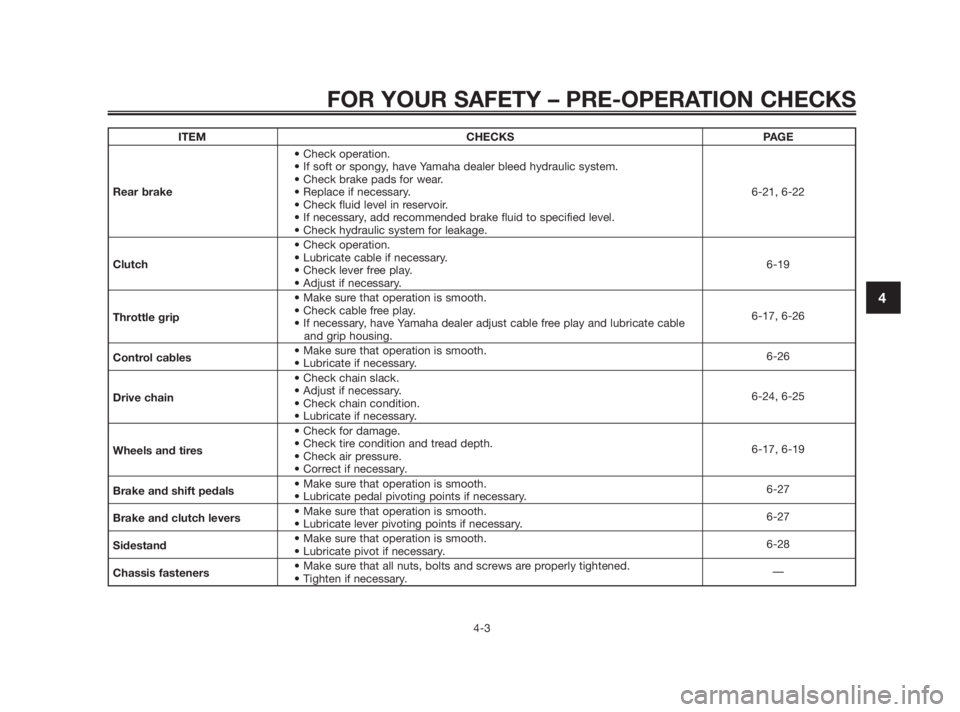
ITEM CHECKS PAGE
• Check operation.
• If soft or spongy, have Yamaha dealer bleed hydraulic system.
• Check brake pads for wear.
Rear brake• Replace if necessary. 6-21, 6-22
• Check fluid level in reservoir.
• If necessary, add recommended brake fluid to specified level.
• Check hydraulic system for leakage.
• Check operation.
Clutch• Lubricate cable if necessary.
6-19
• Check lever free play.
• Adjust if necessary.
• Make sure that operation is smooth.
Throttle grip• Check cable free play.
• If necessary, have Yamaha dealer adjust cable free play and lubricate cable 6-17, 6-26
and grip housing.
Control cables• Make sure that operation is smooth.
• Lubricate if necessary.6-26
• Check chain slack.
Drive chain• Adjust if necessary.
• Check chain condition.6-24, 6-25
• Lubricate if necessary.
• Check for damage.
Wheels and tires• Check tire condition and tread depth.
• Check air pressure.6-17, 6-19
• Correct if necessary.
Brake and shift pedals• Make sure that operation is smooth.
• Lubricate pedal pivoting points if necessary.6-27
Brake and clutch levers• Make sure that operation is smooth.
• Lubricate lever pivoting points if necessary.6-27
Sidestand• Make sure that operation is smooth.
• Lubricate pivot if necessary.6-28
Chassis fasteners• Make sure that all nuts, bolts and screws are properly tightened.
• Tighten if necessary.—
5WX-F8199-E3 7/11/08 16:50 Página 31
Page 40 of 88
EAU17716
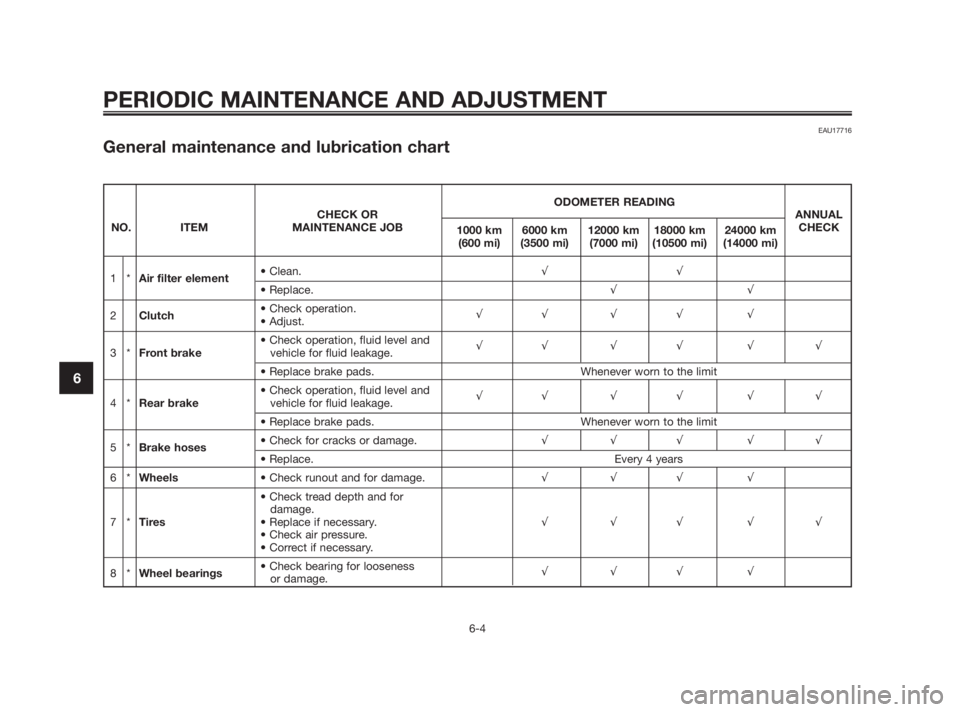
General maintenance and lubrication chart
PERIODIC MAINTENANCE AND ADJUSTMENT
6-4
6
ODOMETER READING
CHECK OR ANNUAL
NO. ITEM MAINTENANCE JOB 1000 km 6000 km 12000 km 18000 km 24000 kmCHECK
(600 mi) (3500 mi) (7000 mi) (10500 mi) (14000 mi)
1*
Air filter element • Clean.
√√• Replace. √√
2 Clutch • Check operation.
• Adjust. √√ √ √ √
• Check operation, fluid level and
3* Front brake vehicle for fluid leakage. √√ √ √ √ √
• Replace brake pads.
Whenever worn to the limit
• Check operation, fluid level and
4* Rear brake vehicle for fluid leakage. √√ √ √ √ √
• Replace brake pads.
Whenever worn to the limit
5*Brake hoses • Check for cracks or damage.
√√√ √√• Replace. Every 4 years
6*Wheels • Check runout and for damage. √√√ √
• Check tread depth and for damage.
7* Tires • Replace if necessary. √√√ √√
• Check air pressure.
• Correct if necessary.
8* Wheel bearings • Check bearing for looseness
or damage. √√√ √
5WX-F819D-E3 24/11/08 20:10 Página 40
Page 53 of 88
EAU21370
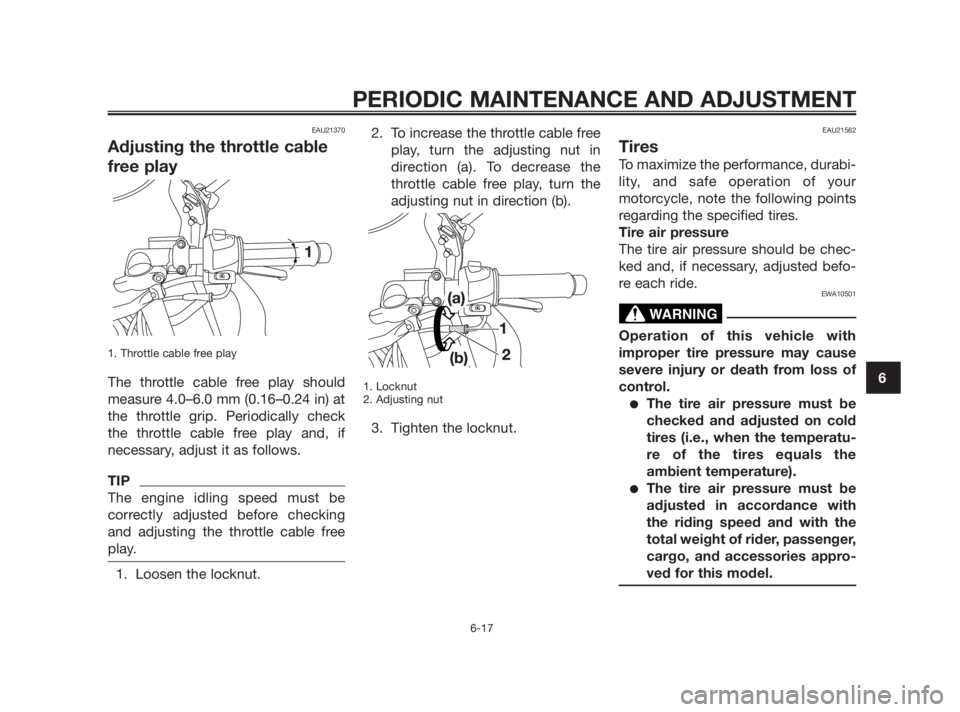
Adjusting the throttle cable
free play
1. Throttle cable free play
The throttle cable free play should
measure 4.0–6.0 mm (0.16–0.24 in) at
the throttle grip. Periodically check
the throttle cable free play and, if
necessary, adjust it as follows.
TIP
The engine idling speed must be
correctly adjusted before checking
and adjusting the throttle cable free
play.
1. Loosen the locknut.2. To increase the throttle cable free
play, turn the adjusting nut in
direction (a). To decrease the
throttle cable free play, turn the
adjusting nut in direction (b).
1. Locknut
2. Adjusting nut
3. Tighten the locknut.
EAU21562
Tires
To maximize the performance, durabi-
lity, and safe operation of your
motorcycle, note the following points
regarding the specified tires.
Tire air pressure
The tire air pressure should be chec-
ked and, if necessary, adjusted befo-
re each ride.
EWA10501
Operation of this vehicle with
improper tire pressure may cause
severe injury or death from loss of
control.
●The tire air pressure must be
checked and adjusted on cold
tires (i.e., when the temperatu-
re of the tires equals the
ambient temperature).
●The tire air pressure must be
adjusted in accordance with
the riding speed and with the
total weight of rider, passenger,
cargo, and accessories appro-
ved for this model.
WARNING
PERIODIC MAINTENANCE AND ADJUSTMENT
6-17
6
5WX-F8199-E3 7/11/08 16:51 Página 53
Page 54 of 88
EWA10511
Never overload your vehicle. Ope-
ration of an overloaded vehicle
could cause an accident.
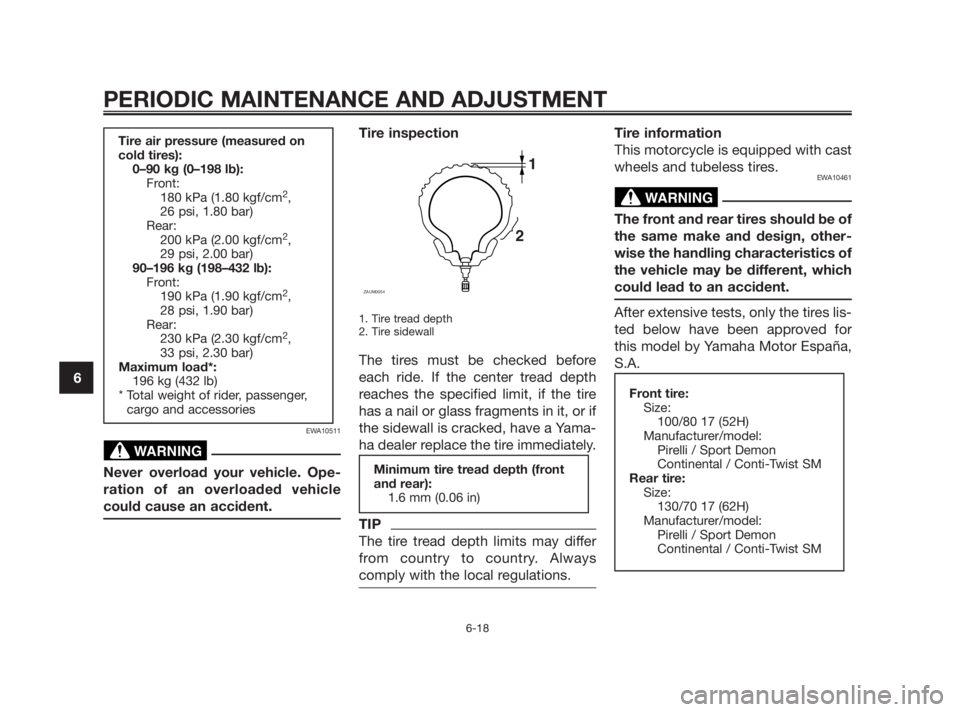
Tire inspection
1. Tire tread depth
2. Tire sidewall
The tires must be checked before
each ride. If the center tread depth
reaches the specified limit, if the tire
has a nail or glass fragments in it, or if
the sidewall is cracked, have a Yama-
ha dealer replace the tire immediately.
TIP
The tire tread depth limits may differ
from country to country. Always
comply with the local regulations.
Tire information
This motorcycle is equipped with cast
wheels and tubeless tires.
EWA10461
The front and rear tires should be of
the same make and design, other-
wise the handling characteristics of
the vehicle may be different, which
could lead to an accident.
After extensive tests, only the tires lis-
ted below have been approved for
this model by Yamaha Motor España,
S.A.
Front tire:
Size:
100/80 17 (52H)
Manufacturer/model:
Pirelli / Sport Demon
Continental / Conti-Twist SM
Rear tire:
Size:
130/70 17 (62H)
Manufacturer/model:
Pirelli / Sport Demon
Continental / Conti-Twist SM
WARNING
Minimum tire tread depth (front
and rear):
1.6 mm (0.06 in)
1
2
ZAUM0054
WARNING
Tire air pressure (measured on
cold tires):
0–90 kg (0–198 lb):
Front:
180 kPa (1.80 kgf/cm
2,
26 psi, 1.80 bar)
Rear:
200 kPa (2.00 kgf/cm
2,
29 psi, 2.00 bar)
90–196 kg (198–432 lb):
Front:
190 kPa (1.90 kgf/cm
2,
28 psi, 1.90 bar)
Rear:
230 kPa (2.30 kgf/cm
2,
33 psi, 2.30 bar)
Maximum load*:
196 kg (432 lb)
* Total weight of rider, passenger,
cargo and accessories
PERIODIC MAINTENANCE AND ADJUSTMENT
6-18
6
5WX-F8199-E3 7/11/08 16:51 Página 54
Page 55 of 88
EWA10470
●Have a Yamaha dealer replace
excessively worn tires. Besides
being illegal, operating the
vehicle with excessively worn
tires decreases riding stability
and can lead to loss of control.
●The replacement of all wheel
and brake related parts, inclu-
ding the tires, should be left to
a Yamaha dealer, who has the
necessary professional know-
ledge and experience.
EAU21960
Cast wheels
To maximize the performance, durabi-
lity, and safe operation of your vehi-
cle, note the following points regar-
ding the specified wheels.
●The wheel rims should be chec-
ked for cracks, bends or warpage
before each ride. If any damage
is found, have a Yamaha dealer
replace the wheel. Do not
attempt even the smallest repair
to the wheel. A deformed or crac-
ked wheel must be replaced.
●The wheel should be balanced
whenever either the tire or wheel
has been changed or replaced.
An unbalanced wheel can result
in poor performance, adverse
handling characteristics, and a
shortened tire life.
●Ride at moderate speeds after
changing a tire since the tire sur-
face must first be “broken in” for
it to develop its optimal characte-
ristics.
EAU22020
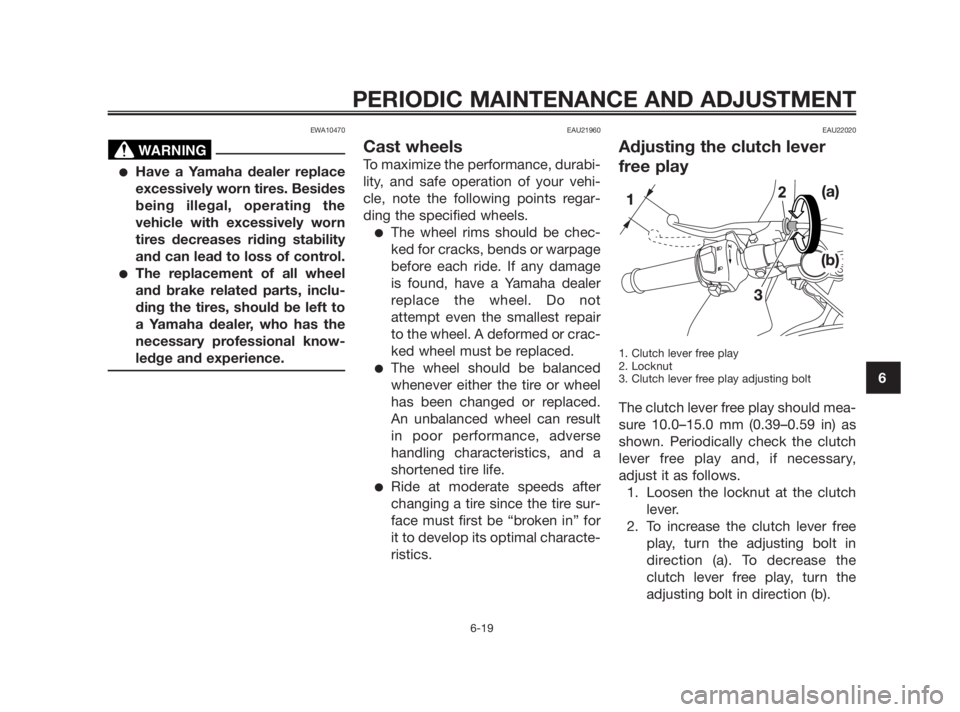
Adjusting the clutch lever
free play
1. Clutch lever free play
2. Locknut
3. Clutch lever free play adjusting bolt
The clutch lever free play should mea-
sure 10.0–15.0 mm (0.39–0.59 in) as
shown. Periodically check the clutch
lever free play and, if necessary,
adjust it as follows.
1. Loosen the locknut at the clutch
lever.
2. To increase the clutch lever free
play, turn the adjusting bolt in
direction (a). To decrease the
clutch lever free play, turn the
adjusting bolt in direction (b).
WARNING
PERIODIC MAINTENANCE AND ADJUSTMENT
6-19
6
5WX-F8199-E3 7/11/08 16:51 Página 55
Page 77 of 88
exhaust systems can be removed
through polishing.)
4. To prevent corrosion, it is recom-
mended to apply a corrosion pro-
tection spray on all metal, inclu-
ding chrome- and nickel-plated,
surfaces.
5. Use spray oil as a universal clea-
ner to remove any remaining dirt.
6. Touch up minor paint damage
caused by stones, etc.
7. Wax all painted surfaces.
8. Let the motorcycle dry comple-
tely before storing or covering it.
EWA11131
Contaminants on the brakes or
tires can cause loss of control.
●Make sure that there is no oil or
wax on the brakes or tires.
●If necessary, clean the brake
discs and brake linings with a
regular brake disc cleaner or
acetone, and wash the tires
with warm water and a mild
detergent. Before riding at hig-
her speeds, test the motorcy-cle’s braking performance and
cornering behavior.
ECA10800
●Apply spray oil and wax spa-
ringly and make sure to wipe
off any excess.
●Never apply oil or wax to any
rubber and plastic parts, but
treat them with a suitable care
product.
●Avoid using abrasive polishing
compounds as they will wear
away the paint.
TIP
●Consult a Yamaha dealer for
advice on what products to use.
●Washing, rainy weather or humid
climates can cause the headlight
lens to fog. Turning the headlight
on for a short period of time will
help remove the moisture from
the lens.
EAU37221
Storage
Short-term
Always store your motorcycle in a
cool, dry place and, if necessary, pro-
tect it against dust with a porous
cover.
ECA10810
●Storing the motorcycle in a
poorly ventilated room or cove-
ring it with a tarp, while it is still
wet, will allow water and humi-
dity to seep in and cause rust.
●To prevent corrosion, avoid
damp cellars, stables (because
of the presence of ammonia)
and areas where strong chemi-
cals are stored.
Long-term
Before storing your motorcycle for
several months:
1. Follow all the instructions in the
“Care” section of this chapter.
2. Turn the fuel cock lever to “OFF”.
3. Drain the carburetor float cham-
ber by loosening the drain bolt;
this will prevent fuel deposits
NOTICE
NOTICE
WARNING
MOTORCYCLE CARE AND STORAGE
7-3
7
5WX-F8199-E3 7/11/08 16:51 Página 77
Page 78 of 88
from building up. Pour the drai-
ned fuel into the fuel tank.
4. Fill up the fuel tank and add fuel
stabilizer (if available) to prevent
the fuel tank from rusting and the
fuel from deteriorating.
5. Perform the following steps to
protect the cylinder, piston rings,
etc. from corrosion.
a Remove the spark plug cap
and spark plug.
b Pour a teaspoonful of engine
oil into the spark plug bore.
c Install the spark plug cap
onto the spark plug, and then
place the spark plug on the
cylinder head so that the
electrodes are grounded.
(This will limit sparking during
the next step.)
d Turn the engine over several
times with the starter. (This
will coat the cylinder wall with
oil.)
e Remove the spark plug cap
from the spark plug, and then
install the spark plug and the
spark plug cap. WARNING!
To prevent damage or injuryfrom sparking, make sure
to ground the spark plug
electrodes while turning the
engine over.
[EWA10951]
6. Lubricate all control cables and
the pivoting points of all levers
and pedals as well as of the
sidestand/centerstand.
7. Check and, if necessary, correct
the tire air pressure, and then lift
the motorcycle so that both of its
wheels are off the ground. Alter-
natively, turn the wheels a little
every month in order to prevent
the tires from becoming degra-
ded in one spot.
8. Cover the muffler outlet with a
plastic bag to prevent moisture
from entering it.
9. Remove the battery and fully
charge it. Store it in a cool, dry
place and charge it once a
month. Do not store the battery in
an excessively cold or warm pla-
ce [less than 0 °C (30 °F) or more
than 30 °C (90 °F)]. For more
information on storing the bat-
tery, see page 6-30.
TIP
Make any necessary repairs before
storing the motorcycle.
MOTORCYCLE CARE AND STORAGE
7-4
7
5WX-F8199-E3 7/11/08 16:51 Página 78