engine YAMAHA TZR50 2011 User Guide
[x] Cancel search | Manufacturer: YAMAHA, Model Year: 2011, Model line: TZR50, Model: YAMAHA TZR50 2011Pages: 88, PDF Size: 1.83 MB
Page 22 of 88
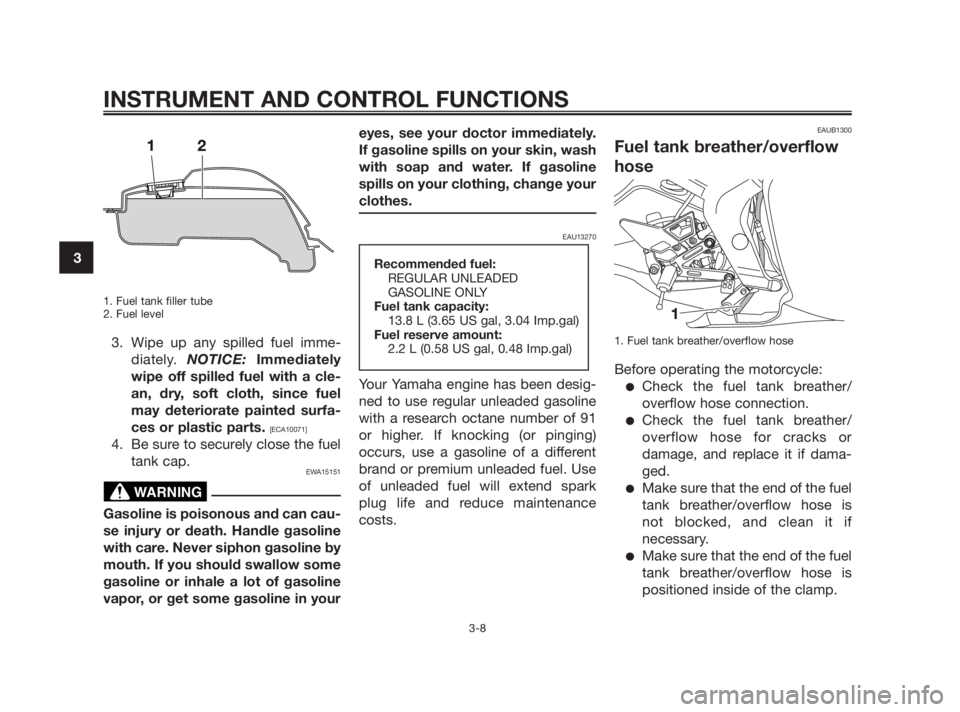
1. Fuel tank filler tube
2. Fuel level
3. Wipe up any spilled fuel imme-
diately. NOTICE:Immediately
wipe off spilled fuel with a cle-
an, dry, soft cloth, since fuel
may deteriorate painted surfa-
ces or plastic parts.
[ECA10071]
4. Be sure to securely close the fuel
tank cap.
EWA15151
Gasoline is poisonous and can cau-
se injury or death. Handle gasoline
with care. Never siphon gasoline by
mouth. If you should swallow some
gasoline or inhale a lot of gasoline
vapor, or get some gasoline in youreyes, see your doctor immediately.
If gasoline spills on your skin, wash
with soap and water. If gasoline
spills on your clothing, change your
clothes.
EAU13270
Your Yamaha engine has been desig-
ned to use regular unleaded gasoline
with a research octane number of 91
or higher. If knocking (or pinging)
occurs, use a gasoline of a different
brand or premium unleaded fuel. Use
of unleaded fuel will extend spark
plug life and reduce maintenance
costs.
EAUB1300
Fuel tank breather/overflow
hose
1. Fuel tank breather/overflow hose
Before operating the motorcycle:
●Check the fuel tank breather/
overflow hose connection.
●Check the fuel tank breather/
overflow hose for cracks or
damage, and replace it if dama-
ged.
●Make sure that the end of the fuel
tank breather/overflow hose is
not blocked, and clean it if
necessary.
●Make sure that the end of the fuel
tank breather/overflow hose is
positioned inside of the clamp.
Recommended fuel:
REGULAR UNLEADED
GASOLINE ONLY
Fuel tank capacity:
13.8 L (3.65 US gal, 3.04 Imp.gal)
Fuel reserve amount:
2.2 L (0.58 US gal, 0.48 Imp.gal)
WARNING
INSTRUMENT AND CONTROL FUNCTIONS
3-8
3
5WX-F819D-E3 15/11/08 15:27 Página 22
Page 23 of 88
EAU13433
Catalytic converter
This model is equipped with a cataly-
tic converter in the exhaust system.
EWA10862
The exhaust system is hot after
operation. To prevent a fire hazard
or burns:
●Do not park the vehicle near
possible fire hazards such as
grass or other materials that
easily burn.
●Park the vehicle in a place
where pedestrians or children
are not likely to touch the hot
exhaust system.
●Make sure that the exhaust
system has cooled down befo-
re doing any maintenance
work.
●Do not allow the engine to idle
more than a few minutes. Long
idling can cause a build-up of
heat.
ECA10701
Use only unleaded gasoline. The
use of leaded gasoline will cause
unrepairable damage to the cataly-
tic converter.
EAUS1550
2-stroke engine oil
Make sure that there is sufficient 2-
stroke engine oil in the oil tank. Add
the recommended 2-stroke engine oil
as necessary.
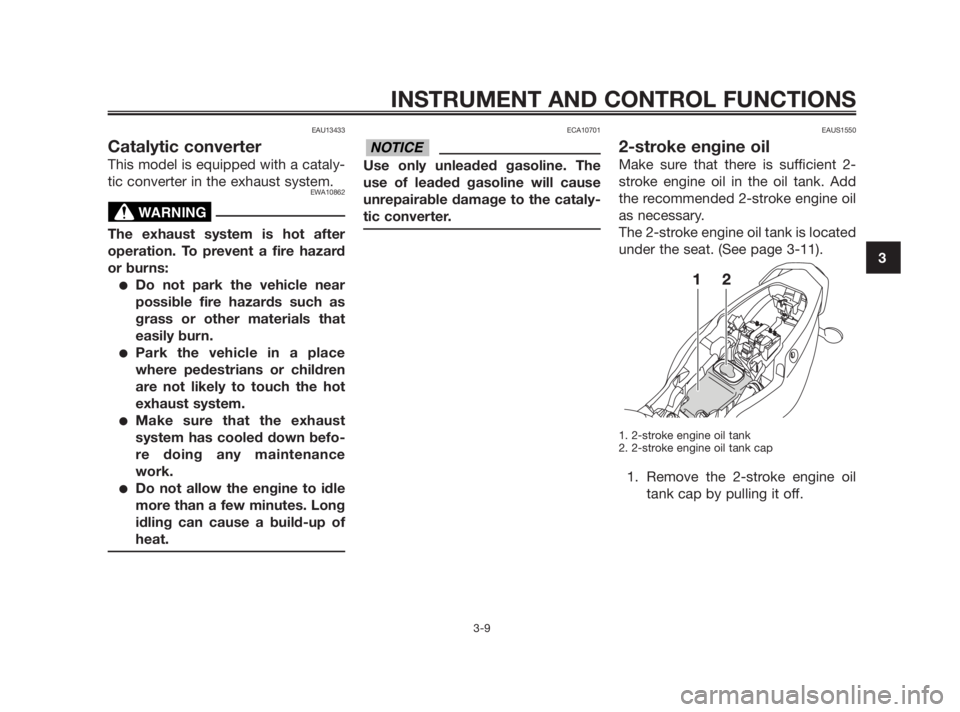
The 2-stroke engine oil tank is located
under the seat. (See page 3-11).
1. 2-stroke engine oil tank
2. 2-stroke engine oil tank cap
1. Remove the 2-stroke engine oil
tank cap by pulling it off.
NOTICE
WARNING
INSTRUMENT AND CONTROL FUNCTIONS
3-9
3
5WX-F819D-E3 15/11/08 15:27 Página 23
Page 24 of 88
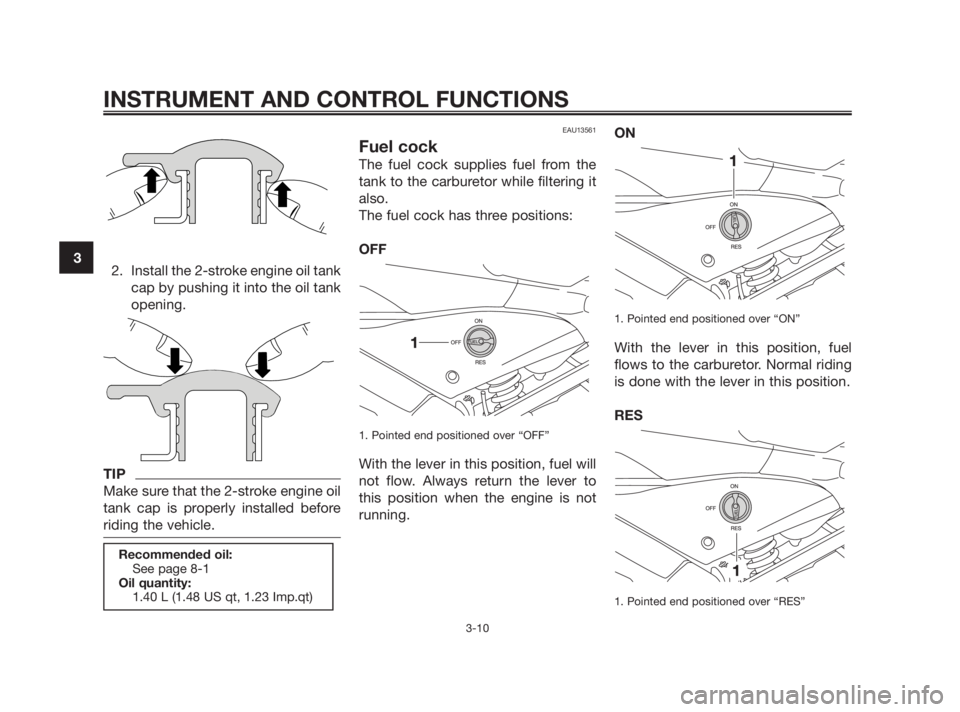
2. Install the 2-stroke engine oil tank
cap by pushing it into the oil tank
opening.
TIP
Make sure that the 2-stroke engine oil
tank cap is properly installed before
riding the vehicle.
EAU13561
Fuel cock
The fuel cock supplies fuel from the
tank to the carburetor while filtering it
also.
The fuel cock has three positions:
OFF
1. Pointed end positioned over “OFF”
With the lever in this position, fuel will
not flow. Always return the lever to
this position when the engine is not
running.ON
1. Pointed end positioned over “ON”
With the lever in this position, fuel
flows to the carburetor. Normal riding
is done with the lever in this position.
RES
1. Pointed end positioned over “RES”
Recommended oil:
See page 8-1
Oil quantity:
1.40 L (1.48 US qt, 1.23 Imp.qt)
INSTRUMENT AND CONTROL FUNCTIONS
3-10
3
5WX-F819D-E3 15/11/08 15:27 Página 24
Page 25 of 88
This indicates reserve. If you run out
of fuel while riding, move the lever to
this position. Fill the tank at the first
opportunity. Be sure to set the lever
back to “ON” after refueling!EAU13590
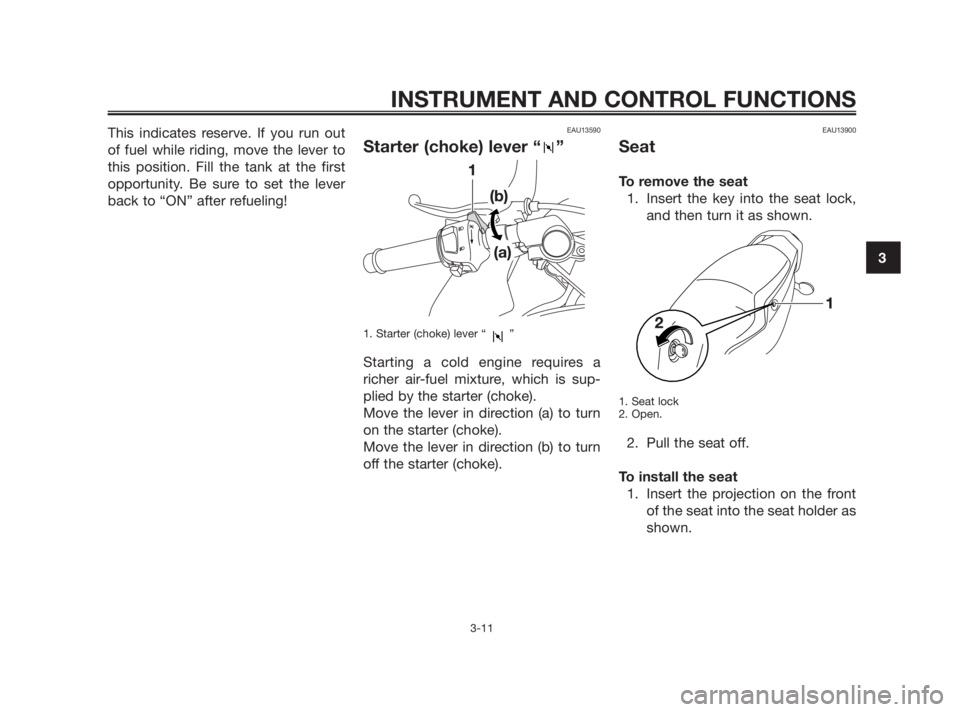
Starter (choke) lever “ ”
1. Starter (choke) lever “ ”
Starting a cold engine requires a
richer air-fuel mixture, which is sup-
plied by the starter (choke).
Move the lever in direction (a) to turn
on the starter (choke).
Move the lever in direction (b) to turn
off the starter (choke).
EAU13900
Seat
To remove the seat
1. Insert the key into the seat lock,
and then turn it as shown.
1. Seat lock
2. Open.
2. Pull the seat off.
To install the seat
1. Insert the projection on the front
of the seat into the seat holder as
shown.
INSTRUMENT AND CONTROL FUNCTIONS
3-11
3
5WX-F819D-E3 15/11/08 15:27 Página 25
Page 27 of 88
EAU15301
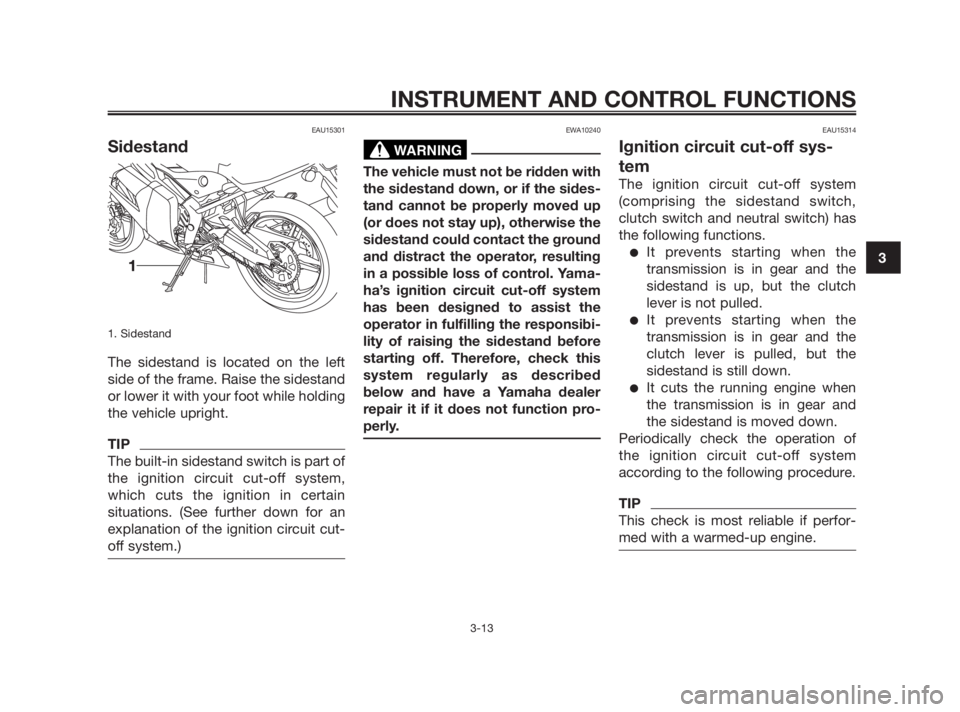
Sidestand
1. Sidestand
The sidestand is located on the left
side of the frame. Raise the sidestand
or lower it with your foot while holding
the vehicle upright.
TIP
The built-in sidestand switch is part of
the ignition circuit cut-off system,
which cuts the ignition in certain
situations. (See further down for an
explanation of the ignition circuit cut-
off system.)
EWA10240
The vehicle must not be ridden with
the sidestand down, or if the sides-
tand cannot be properly moved up
(or does not stay up), otherwise the
sidestand could contact the ground
and distract the operator, resulting
in a possible loss of control. Yama-
ha’s ignition circuit cut-off system
has been designed to assist the
operator in fulfilling the responsibi-
lity of raising the sidestand before
starting off. Therefore, check this
system regularly as described
below and have a Yamaha dealer
repair it if it does not function pro-
perly.
EAU15314
Ignition circuit cut-off sys-
tem
The ignition circuit cut-off system
(comprising the sidestand switch,
clutch switch and neutral switch) has
the following functions.
●It prevents starting when the
transmission is in gear and the
sidestand is up, but the clutch
lever is not pulled.
●It prevents starting when the
transmission is in gear and the
clutch lever is pulled, but the
sidestand is still down.
●It cuts the running engine when
the transmission is in gear and
the sidestand is moved down.
Periodically check the operation of
the ignition circuit cut-off system
according to the following procedure.
TIP
This check is most reliable if perfor-
med with a warmed-up engine.
WARNING
INSTRUMENT AND CONTROL FUNCTIONS
3-13
3
5WX-F819D-E3 15/11/08 15:27 Página 27
Page 28 of 88
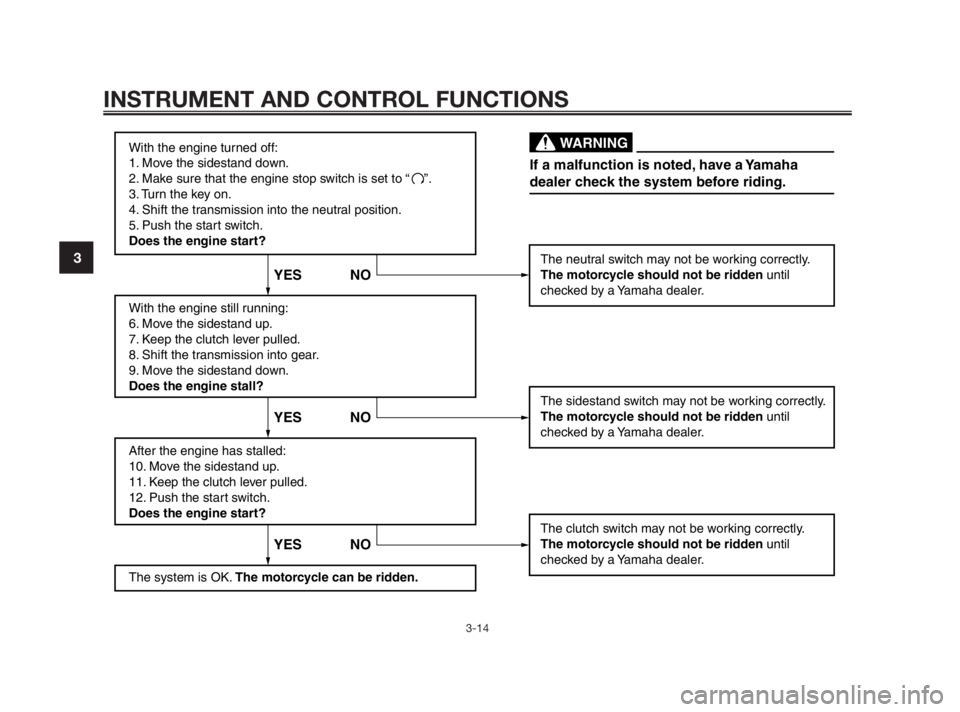
With the engine turned off:
1. Move the sidestand down.
2. Make sure that the engine stop switch is set to “
3. Turn the key on.
4. Shift the transmission into the neutral position.
5. Push the start switch.
Does the engine start?
With the engine still running:
6. Move the sidestand up.
7. Keep the clutch lever pulled.
8. Shift the transmission into gear.
9. Move the sidestand down.
Does the engine stall?
After the engine has stalled:
10. Move the sidestand up.
11. Keep the clutch lever pulled.
12. Push the start switch.
Does the engine start?
The system is OK. The motorcycle can be ridden.The neutral switch may not be working correctly.
The motorcycle should not be ridden until
checked by a Yamaha dealer.
The sidestand switch may not be working correctly.
The motorcycle should not be ridden until
checked by a Yamaha dealer.
The clutch switch may not be working correctly.
The motorcycle should not be ridden until
checked by a Yamaha dealer.
YES NO YES NO YES NO
If a malfunction is noted, have a Yamaha
dealer check the system before riding.
WARNING
”.
INSTRUMENT AND CONTROL FUNCTIONS
3-14
3
5WX-F819D-E3 15/11/08 15:27 Página 28
Page 30 of 88
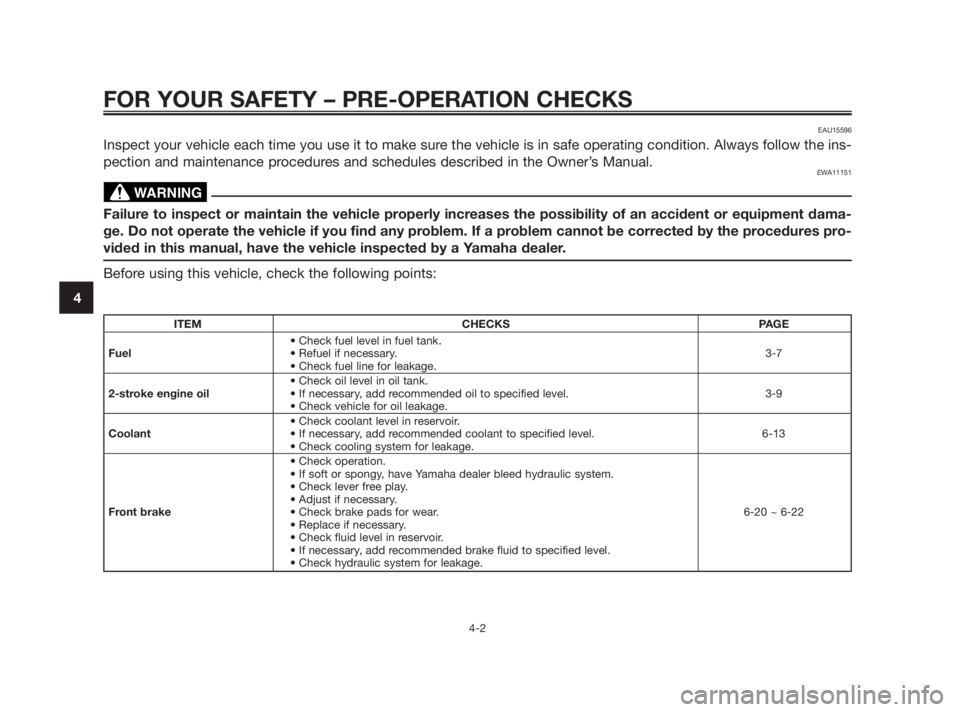
FOR YOUR SAFETY – PRE-OPERATION CHECKS
4-2
4
ITEM CHECKS PAGE
• Check fuel level in fuel tank.
Fuel• Refuel if necessary.3-7
• Check fuel line for leakage.
• Check oil level in oil tank.
2-stroke engine oil• If necessary, add recommended oil to specified level. 3-9
• Check vehicle for oil leakage.
• Check coolant level in reservoir.
Coolant• If necessary, add recommended coolant to specified level. 6-13
• Check cooling system for leakage.
• Check operation.
• If soft or spongy, have Yamaha dealer bleed hydraulic system.
• Check lever free play.
• Adjust if necessary.
Front brake• Check brake pads for wear. 6-20 ~ 6-22
• Replace if necessary.
• Check fluid level in reservoir.
• If necessary, add recommended brake fluid to specified level.
• Check hydraulic system for leakage.
EAU15596
Inspect your vehicle each time you use it to make sure the vehicle is in safe operating condition. Always follow the ins-
pection and maintenance procedures and schedules described in the Owner’s Manual.
EWA11151
Failure to inspect or maintain the vehicle properly increases the possibility of an accident or equipment dama-
ge. Do not operate the vehicle if you find any problem. If a problem cannot be corrected by the procedures pro-
vided in this manual, have the vehicle inspected by a Yamaha dealer.
Before using this vehicle, check the following points:
WARNING
5WX-F819D-E3 15/11/08 15:27 Página 30
Page 32 of 88
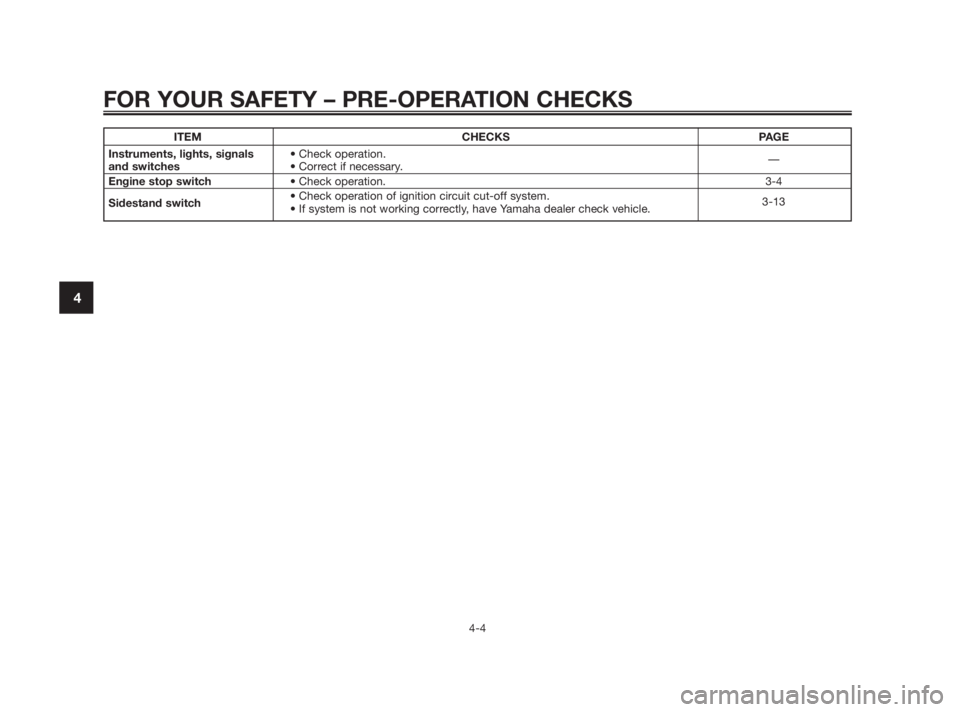
ITEM CHECKS PAGE
Instruments, lights, signals • Check operation.
and switches• Correct if necessary.—
Engine stop switch• Check operation.3-4
Sidestand switch • Check operation of ignition circuit cut-off system.
• If system is not working correctly, have Yamaha dealer check vehicle.3-13
FOR YOUR SAFETY – PRE-OPERATION CHECKS
4-4
4
5WX-F819D-E3 15/11/08 15:27 Página 32
Page 33 of 88
EAU15951
Read the Owner’s Manual carefully to
become familiar with all controls. If
there is a control or function you do
not understand, ask your Yamaha
dealer.
EWA10271
Failure to familiarize yourself with
the controls can lead to loss of
control, which could cause an acci-
dent or injury.
EAU16053
Starting a cold engine
In order for the ignition circuit cut-off
system to enable starting, one of the
following conditions must be met:
●The transmission is in the neutral
position.
●The transmission is in gear with
the clutch lever pulled and the
sidestand up.
See page 3-13 for more information.
1. Turn the fuel cock lever to “ON”.
2. Turn the key to “ ” and make
sure that the engine stop switch
is set to “ ”.
3. Shift the transmission into the
neutral position. (See page 5-2.)
The neutral indicator light should
come on. If not, ask a Yamaha
dealer to check the electrical cir-
cuit.
4. Turn the starter (choke) on and
completely close the throttle.
(See page 3-11).
5. Start the engine by pushing the
start switch.
If the engine fails to start, release
the start switch, wait a few
seconds, and then try again.Each starting attempt should be
as short as possible to preserve
the battery. Do not crank the
engine more than 10 seconds on
any one attempt.
6. After starting the engine, move
the starter (choke) back halfway.
NOTICE:For maximum engine
life, never accelerate hard
when the engine is cold!
[ECA11041]
7. When the engine is warm, turn
the starter (choke) off.
TIP
The engine is warm when it responds
normally to the throttle with the starter
(choke) turned off.
WARNING
OPERATION AND IMPORTANT RIDING POINTS
5-1
5
5WX-F819D-E3 15/11/08 15:27 Página 33
Page 34 of 88
EAU16640
Starting a warm engine
Follow the same procedure as for
starting a cold engine with the excep-
tion that the starter (choke) is not
required when the engine is warm.
EAU16671
Shifting
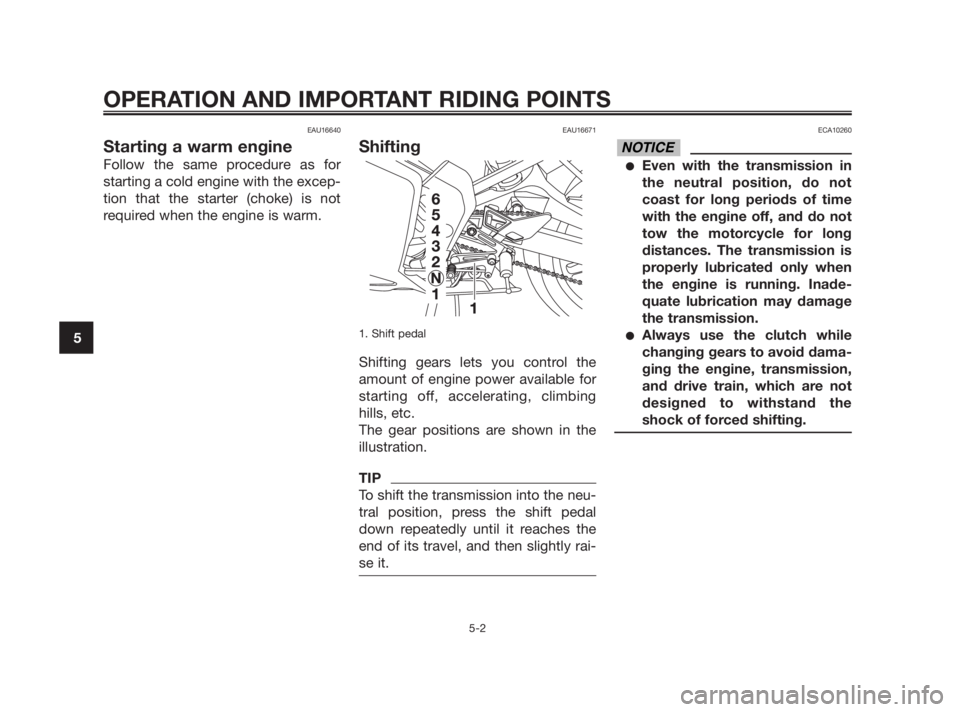
1. Shift pedal
Shifting gears lets you control the
amount of engine power available for
starting off, accelerating, climbing
hills, etc.
The gear positions are shown in the
illustration.
TIP
To shift the transmission into the neu-
tral position, press the shift pedal
down repeatedly until it reaches the
end of its travel, and then slightly rai-
se it.
ECA10260
●Even with the transmission in
the neutral position, do not
coast for long periods of time
with the engine off, and do not
tow the motorcycle for long
distances. The transmission is
properly lubricated only when
the engine is running. Inade-
quate lubrication may damage
the transmission.
●Always use the clutch while
changing gears to avoid dama-
ging the engine, transmission,
and drive train, which are not
designed to withstand the
shock of forced shifting.
NOTICE
OPERATION AND IMPORTANT RIDING POINTS
5-2
5
5WX-F819D-E3 15/11/08 15:27 Página 34