fuel YAMAHA TZR50 2011 User Guide
[x] Cancel search | Manufacturer: YAMAHA, Model Year: 2011, Model line: TZR50, Model: YAMAHA TZR50 2011Pages: 88, PDF Size: 1.83 MB
Page 35 of 88
EAU16800
Tips for reducing fuel con-
sumption
Fuel consumption depends largely on
your riding style. Consider the follo-
wing tips to reduce fuel consumption:
●Turn the starter (choke) off as
soon as possible.
●Shift up swiftly, and avoid high
engine speeds during accelera-
tion.
●Do not rev the engine while shif-
ting down, and avoid high engine
speeds with no load on the engi-
ne.
●Turn the engine off instead of let-
ting it idle for an extended length
of time (e.g., in traffic jams, at
traffic lights or at railroad cros-
sings).
EAU16830
Engine break-in
There is never a more important
period in the life of your engine than
the period between 0 and 1000 km
(600 mi). For this reason, you should
read the following material carefully.
Since the engine is brand new, do not
put an excessive load on it for the first
1000 km (600 mi). The various parts in
the engine wear and polish themsel-
ves to the correct operating clearan-
ces. During this period, prolonged
full-throttle operation or any condition
that might result in engine overhea-
ting must be avoided.
EAUS1560
0–500 km (0–300 mi)
●Avoid prolonged operation above
4000 r/min.
●After every hour of operation,
stop the engine, and then let it
cool for five to ten minutes.
●Vary the engine speed from time
to time. Do not operate the engi-
ne at one set throttle position.500–1000 km (300–600 mi)
●Avoid prolonged operation above
6000 r/min.
●Rev the engine freely through the
gears, but do not use full throttle
at any time. NOTICE:After 1000
km (600 mi) of operation, the
transmission oil must be chan-
ged.
[ECA10370]
1000 km (600 mi) and beyond
●The vehicle can now be operated
normally.
ECA10310
●Keep the engine speed out of
the tachometer red zone.
●If any engine trouble should
occur during the engine break-
in period, immediately have a
Yamaha dealer check the vehi-
cle.
NOTICE
OPERATION AND IMPORTANT RIDING POINTS
5-3
5
5WX-F819D-E3 15/11/08 15:27 Página 35
Page 36 of 88
EAU17171
Parking
When parking, stop the engine, remo-
ve the key from the main switch, and
then turn the fuel cock lever to “OFF”.
EWA10311
●Since the engine and exhaust
system can become very hot,
park in a place where pedes-
trians or children are not likely
to touch them and be burned.
●Do not park on a slope or on
soft ground, otherwise the
vehicle may overturn, increa-
sing the risk of a fuel leak and
fire.
●Do not park near grass or other
flammable materials which
might catch fire.
WARNING
OPERATION AND IMPORTANT RIDING POINTS
5-4
5
5WX-F819D-E3 15/11/08 15:27 Página 36
Page 39 of 88
EAU46870
TIP
●The annual checks must be performed every year, except if a kilometer-based maintenance, or for the UK,
a mileage-based maintenance, is performed instead.
●From 30000 km (17500 mi), repeat the maintenance intervals starting from 6000 km (3500 mi).
●Items marked with an asterisk should be performed by a Yamaha dealer as they require special tools, data and
technical skills.
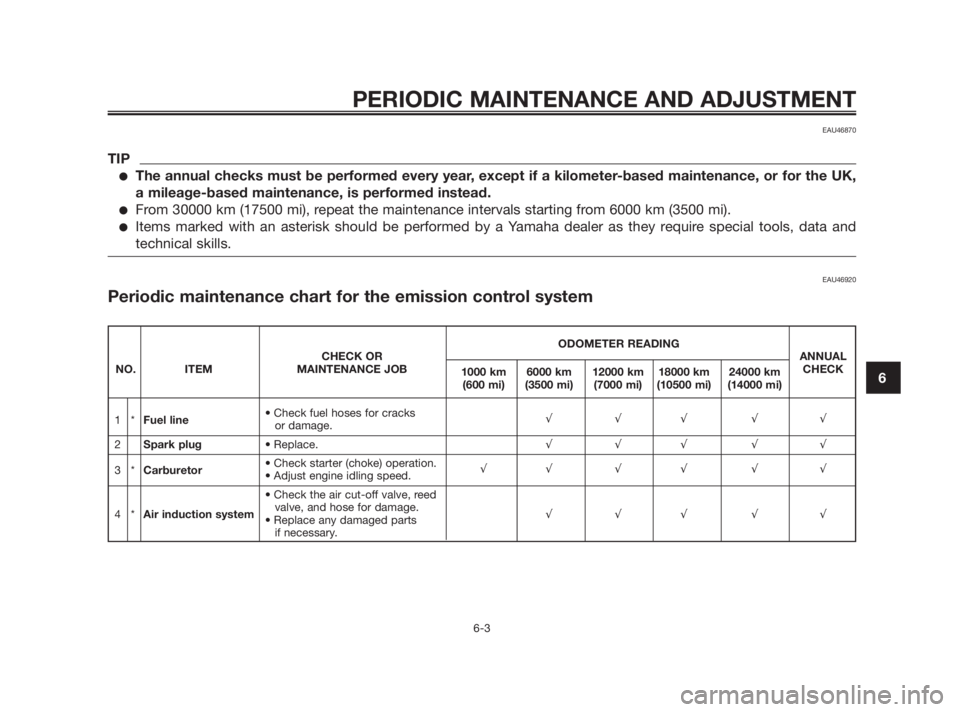
EAU46920
Periodic maintenance chart for the emission control system
PERIODIC MAINTENANCE AND ADJUSTMENT
6-3
6
ODOMETER READING
CHECK OR ANNUAL
NO. ITEM MAINTENANCE JOB
1000 km 6000 km 12000 km 18000 km 24000 kmCHECK
(600 mi) (3500 mi) (7000 mi) (10500 mi) (14000 mi)
1*Fuel line• Check fuel hoses for cracks
or damage.√√√ √√
2Spark plug• Replace.√√√ √√
3*Carburetor• Check starter (choke) operation.
• Adjust engine idling speed.√√ √√ √ √
• Check the air cut-off valve, reed
4*Air induction systemvalve, and hose for damage.
√√√ √√
• Replace any damaged parts
if necessary.
5WX-F819D-E3 15/11/08 15:27 Página 39
Page 72 of 88
EAU25871
Troubleshooting
Although Yamaha motorcycles recei-
ve a thorough inspection before ship-
ment from the factory, trouble may
occur during operation. Any problem
in the fuel, compression, or ignition
systems, for example, can cause poor
starting and loss of power.
The following troubleshooting charts
represent quick and easy procedures
for checking these vital systems your-
self. However, should your motorcy-
cle require any repair, take it to a
Yamaha dealer, whose skilled techni-
cians have the necessary tools, expe-
rience, and know-how to service the
motorcycle properly.
Use only genuine Yamaha replace-
ment parts. Imitation parts may look
like Yamaha parts, but they are often
inferior, have a shorter service life and
can lead to expensive repair bills.
EWA15141
When checking the fuel system, do
not smoke, and make sure there
are no open flames or sparks in the
area, including pilot lights from
water heaters or furnaces. Gasoli-
ne or gasoline vapors can ignite or
explode, causing severe injury or
property damage.
WARNING
PERIODIC MAINTENANCE AND ADJUSTMENT
6-36
6
5WX-F819D-E3 15/11/08 15:27 Página 72
Page 73 of 88

EAU25922
Troubleshooting charts
Starting problems or poor engine performance
Check the fuel level in
the fuel tank.
1. FuelThere is enough fuel.
There is no fuel.Check the compression.
Supply fuel.
The engine does not start.
Check the compression.
Operate the electric starter.
2. CompressionThere is compression.
There is no compression.Check the ignition.
Have a Yamaha dealer
check the vehicle.
Remove the spark plug
and check the electrodes.
3. IgnitionWipe off with a dry cloth and correct the
spark plug gap, or replace the spark plug.
Have a Yamaha dealer check the vehicle.
The engine does not start.
Have a Yamaha dealer
check the vehicle.
The engine does not start.
Check the battery.
Operate the electric starter.
4. BatteryThe engine turns over
quickly.
The engine turns over
slowly.The battery is good.
Check the battery lead connections,
and charge the battery if necessary.
Dry
WetOpen the throttle halfway and operate
the electric starter.
PERIODIC MAINTENANCE AND ADJUSTMENT
6-37
6
5WX-F819D-E3 15/11/08 15:27 Página 73
Page 76 of 88

water, diluted mild detergent
with water may be used. Be
sure to rinse off any detergent
residue using plenty of water,
as it is harmful to plastic parts.
●Do not use any harsh chemical
products on plastic parts. Be
sure to avoid using cloths or
sponges which have been in
contact with strong or abrasive
cleaning products, solvent or
thinner, fuel (gasoline), rust
removers or inhibitors, brake
fluid, antifreeze or electrolyte.
●Do not use high-pressure was-
hers or steam-jet cleaners sin-
ce they cause water seepage
and deterioration in the follo-
wing areas: seals (of wheel and
swingarm bearings, fork and
brakes), electric components
(couplers, connectors, instru-
ments, switches and lights),
breather hoses and vents.
●For motorcycles equipped with
a windshield: Do not use strong
cleaners or hard sponges as
they will cause dulling or scrat-
ching. Some cleaning com-pounds for plastic may leave
scratches on the windshield.
Test the product on a small hid-
den part of the windshield to
make sure that it does not lea-
ve any marks. If the windshield
is scratched, use a quality
plastic polishing compound
after washing.
After normal use
Remove dirt with warm water, a mild
detergent, and a soft, clean sponge,
and then rinse thoroughly with clean
water. Use a toothbrush or bottle-
brush for hard-to-reach areas. Stub-
born dirt and insects will come off
more easily if the area is covered with
a wet cloth for a few minutes before
cleaning.
After riding in the rain, near the sea or
on salt-sprayed roads
Since sea salt or salt sprayed on
roads during winter are extremely
corrosive in combination with water,
carry out the following steps aftereach ride in the rain, near the sea or
on salt-sprayed roads.
TIP
Salt sprayed on roads in the winter
may remain well into spring.
1. Clean the motorcycle with cold
water and a mild detergent, after
the engine has cooled down.
NOTICE: Do not use warm
water since it increases the
corrosive action of the salt.
[ECA10791]
2. Apply a corrosion protection
spray on all metal, including
chrome- and nickel-plated, surfa-
ces to prevent corrosion.
After cleaning
1. Dry the motorcycle with a cha-
mois or an absorbing cloth.
2. Immediately dry the drive chain
and lubricate it to prevent it from
rusting.
3. Use a chrome polish to shine
chrome, aluminum and stainless-
steel parts, including the exhaust
system. (Even the thermally indu-
ced discoloring of stainless-steel
MOTORCYCLE CARE AND STORAGE
7-2
7
5WX-F819D-E3 15/11/08 15:27 Página 76
Page 77 of 88

exhaust systems can be removed
through polishing.)
4. To prevent corrosion, it is recom-
mended to apply a corrosion pro-
tection spray on all metal, inclu-
ding chrome- and nickel-plated,
surfaces.
5. Use spray oil as a universal clea-
ner to remove any remaining dirt.
6. Touch up minor paint damage
caused by stones, etc.
7. Wax all painted surfaces.
8. Let the motorcycle dry comple-
tely before storing or covering it.
EWA11131
Contaminants on the brakes or
tires can cause loss of control.
●Make sure that there is no oil or
wax on the brakes or tires.
●If necessary, clean the brake
discs and brake linings with a
regular brake disc cleaner or
acetone, and wash the tires
with warm water and a mild
detergent. Before riding at hig-
her speeds, test the motorcy-cle’s braking performance and
cornering behavior.
ECA10800
●Apply spray oil and wax spa-
ringly and make sure to wipe
off any excess.
●Never apply oil or wax to any
rubber and plastic parts, but
treat them with a suitable care
product.
●Avoid using abrasive polishing
compounds as they will wear
away the paint.
TIP
●Consult a Yamaha dealer for
advice on what products to use.
●Washing, rainy weather or humid
climates can cause the headlight
lens to fog. Turning the headlight
on for a short period of time will
help remove the moisture from
the lens.
EAU37221
Storage
Short-term
Always store your motorcycle in a
cool, dry place and, if necessary, pro-
tect it against dust with a porous
cover.
ECA10810
●Storing the motorcycle in a
poorly ventilated room or cove-
ring it with a tarp, while it is still
wet, will allow water and humi-
dity to seep in and cause rust.
●To prevent corrosion, avoid
damp cellars, stables (because
of the presence of ammonia)
and areas where strong chemi-
cals are stored.
Long-term
Before storing your motorcycle for
several months:
1. Follow all the instructions in the
“Care” section of this chapter.
2. Turn the fuel cock lever to “OFF”.
3. Drain the carburetor float cham-
ber by loosening the drain bolt;
this will prevent fuel deposits
NOTICE
NOTICE
WARNING
MOTORCYCLE CARE AND STORAGE
7-3
7
5WX-F819D-E3 15/11/08 15:27 Página 77
Page 78 of 88

from building up. Pour the drai-
ned fuel into the fuel tank.
4. Fill up the fuel tank and add fuel
stabilizer (if available) to prevent
the fuel tank from rusting and the
fuel from deteriorating.
5. Perform the following steps to
protect the cylinder, piston rings,
etc. from corrosion.
a Remove the spark plug cap
and spark plug.
b Pour a teaspoonful of engine
oil into the spark plug bore.
c Install the spark plug cap
onto the spark plug, and then
place the spark plug on the
cylinder head so that the
electrodes are grounded.
(This will limit sparking during
the next step.)
d Turn the engine over several
times with the starter. (This
will coat the cylinder wall with
oil.)
e Remove the spark plug cap
from the spark plug, and then
install the spark plug and the
spark plug cap. WARNING!
To prevent damage or injuryfrom sparking, make sure
to ground the spark plug
electrodes while turning the
engine over.
[EWA10951]
6. Lubricate all control cables and
the pivoting points of all levers
and pedals as well as of the
sidestand/centerstand.
7. Check and, if necessary, correct
the tire air pressure, and then lift
the motorcycle so that both of its
wheels are off the ground. Alter-
natively, turn the wheels a little
every month in order to prevent
the tires from becoming degra-
ded in one spot.
8. Cover the muffler outlet with a
plastic bag to prevent moisture
from entering it.
9. Remove the battery and fully
charge it. Store it in a cool, dry
place and charge it once a
month. Do not store the battery in
an excessively cold or warm pla-
ce [less than 0 °C (30 °F) or more
than 30 °C (90 °F)]. For more
information on storing the bat-
tery, see page 6-30.
TIP
Make any necessary repairs before
storing the motorcycle.
MOTORCYCLE CARE AND STORAGE
7-4
7
5WX-F819D-E3 15/11/08 15:27 Página 78
Page 79 of 88
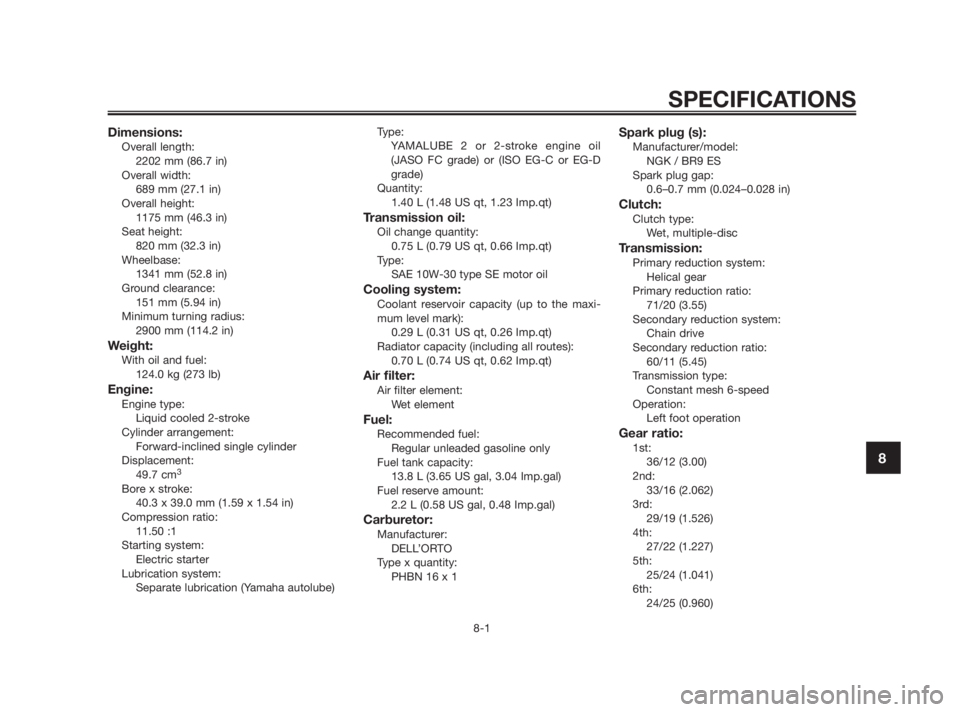
Dimensions:Overall length:
2202 mm (86.7 in)
Overall width:
689 mm (27.1 in)
Overall height:
1175 mm (46.3 in)
Seat height:
820 mm (32.3 in)
Wheelbase:
1341 mm (52.8 in)
Ground clearance:
151 mm (5.94 in)
Minimum turning radius:
2900 mm (114.2 in)
Weight:With oil and fuel:
124.0 kg (273 lb)
Engine:Engine type:
Liquid cooled 2-stroke
Cylinder arrangement:
Forward-inclined single cylinder
Displacement:
49.7 cm
3
Bore x stroke:
40.3 x 39.0 mm (1.59 x 1.54 in)
Compression ratio:
11.50 :1
Starting system:
Electric starter
Lubrication system:
Separate lubrication (Yamaha autolube)Type:
YAMALUBE 2 or 2-stroke engine oil
(JASO FC grade) or (ISO EG-C or EG-D
grade)
Quantity:
1.40 L (1.48 US qt, 1.23 Imp.qt)
Transmission oil:Oil change quantity:
0.75 L (0.79 US qt, 0.66 Imp.qt)
Type:
SAE 10W-30 type SE motor oil
Cooling system:Coolant reservoir capacity (up to the maxi-
mum level mark):
0.29 L (0.31 US qt, 0.26 Imp.qt)
Radiator capacity (including all routes):
0.70 L (0.74 US qt, 0.62 Imp.qt)
Air filter:Air filter element:
Wet element
Fuel:Recommended fuel:
Regular unleaded gasoline only
Fuel tank capacity:
13.8 L (3.65 US gal, 3.04 Imp.gal)
Fuel reserve amount:
2.2 L (0.58 US gal, 0.48 Imp.gal)
Carburetor:Manufacturer:
DELL’ORTO
Type x quantity:
PHBN 16 x 1
Spark plug (s):Manufacturer/model:
NGK / BR9 ES
Spark plug gap:
0.6–0.7 mm (0.024–0.028 in)
Clutch:Clutch type:
Wet, multiple-disc
Transmission:Primary reduction system:
Helical gear
Primary reduction ratio:
71/20 (3.55)
Secondary reduction system:
Chain drive
Secondary reduction ratio:
60/11 (5.45)
Transmission type:
Constant mesh 6-speed
Operation:
Left foot operation
Gear ratio:1st:
36/12 (3.00)
2nd:
33/16 (2.062)
3rd:
29/19 (1.526)
4th:
27/22 (1.227)
5th:
25/24 (1.041)
6th:
24/25 (0.960)
SPECIFICATIONS
8-1
8
5WX-F819D-E3 15/11/08 15:27 Página 79
Page 84 of 88
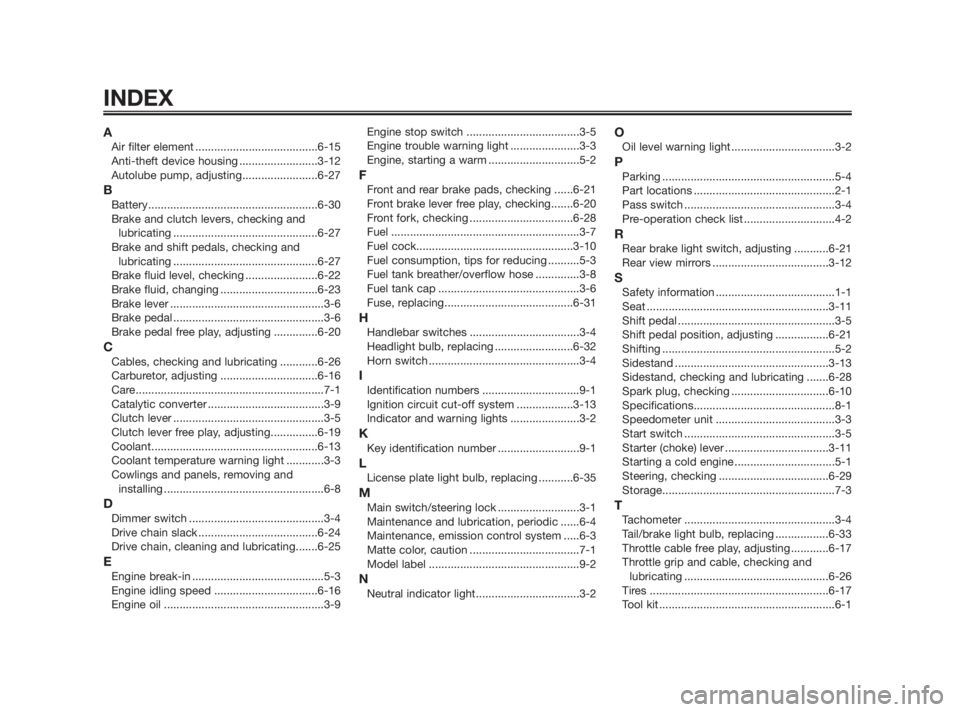
AAir filter element .......................................6-15
Anti-theft device housing .........................3-12
Autolube pump, adjusting........................6-27
BBattery......................................................6-30
Brake and clutch levers, checking and
lubricating ..............................................6-27
Brake and shift pedals, checking and
lubricating ..............................................6-27
Brake fluid level, checking .......................6-22
Brake fluid, changing ...............................6-23
Brake lever .................................................3-6
Brake pedal ................................................3-6
Brake pedal free play, adjusting ..............6-20
CCables, checking and lubricating ............6-26
Carburetor, adjusting ...............................6-16
Care............................................................7-1
Catalytic converter .....................................3-9
Clutch lever ................................................3-5
Clutch lever free play, adjusting...............6-19
Coolant.....................................................6-13
Coolant temperature warning light ............3-3
Cowlings and panels, removing and
installing ...................................................6-8
DDimmer switch ...........................................3-4
Drive chain slack ......................................6-24
Drive chain, cleaning and lubricating.......6-25
EEngine break-in ..........................................5-3
Engine idling speed .................................6-16
Engine oil ...................................................3-9Engine stop switch ....................................3-5
Engine trouble warning light ......................3-3
Engine, starting a warm .............................5-2
FFront and rear brake pads, checking ......6-21
Front brake lever free play, checking.......6-20
Front fork, checking .................................6-28
Fuel ............................................................3-7
Fuel cock..................................................3-10
Fuel consumption, tips for reducing ..........5-3
Fuel tank breather/overflow hose ..............3-8
Fuel tank cap .............................................3-6
Fuse, replacing.........................................6-31
HHandlebar switches ...................................3-4
Headlight bulb, replacing .........................6-32
Horn switch ................................................3-4
IIdentification numbers ...............................9-1
Ignition circuit cut-off system ..................3-13
Indicator and warning lights ......................3-2
KKey identification number ..........................9-1
LLicense plate light bulb, replacing ...........6-35
MMain switch/steering lock ..........................3-1
Maintenance and lubrication, periodic ......6-4
Maintenance, emission control system .....6-3
Matte color, caution ...................................7-1
Model label ................................................9-2
NNeutral indicator light.................................3-2
OOil level warning light .................................3-2
PParking .......................................................5-4
Part locations .............................................2-1
Pass switch ................................................3-4
Pre-operation check list .............................4-2
RRear brake light switch, adjusting ...........6-21
Rear view mirrors .....................................3-12
SSafety information ......................................1-1
Seat ..........................................................3-11
Shift pedal ..................................................3-5
Shift pedal position, adjusting .................6-21
Shifting .......................................................5-2
Sidestand .................................................3-13
Sidestand, checking and lubricating .......6-28
Spark plug, checking ...............................6-10
Specifications.............................................8-1
Speedometer unit ......................................3-3
Start switch ................................................3-5
Starter (choke) lever .................................3-11
Starting a cold engine ................................5-1
Steering, checking ...................................6-29
Storage.......................................................7-3
TTachometer ................................................3-4
Tail/brake light bulb, replacing .................6-33
Throttle cable free play, adjusting ............6-17
Throttle grip and cable, checking and
lubricating ..............................................6-26
Tires .........................................................6-17
Tool kit ........................................................6-1
INDEX
5WX-F819D-E3 15/11/08 15:27 Página 84