brake light YAMAHA VERSITY 300 2004 Owners Manual
[x] Cancel search | Manufacturer: YAMAHA, Model Year: 2004, Model line: VERSITY 300, Model: YAMAHA VERSITY 300 2004Pages: 104, PDF Size: 2.82 MB
Page 17 of 104
EAU00027
INSTRUMENT AND CONTROL FUNCTIONS
Main switch/steering lock .................................................................... 3-1
Indicator lights ..................................................................................... 3-2
Speedometer ...................................................................................... 3-2
Fuel gauge .......................................................................................... 3-3
Battery voltage/coolant temperature gauge ........................................ 3-3
Multi-function display .......................................................................... 3-4
Anti-theft alarm (optional) .................................................................... 3-7
Handlebar switches ............................................................................. 3-8
Front brake lever ................................................................................. 3-9
Rear brake lever .................................................................................. 3-9
Fuel tank cap .................................................................................... 3-10
Fuel ................................................................................................... 3-10
Catalytic converter ............................................................................ 3-11
Seat ................................................................................................... 3-12
Storage compartments ...................................................................... 3-12
Anti-theft device housing ................................................................... 3-14
Adjusting the shock absorber assemblies ......................................... 3-14
Luggage hook ................................................................................... 3-15
Sidestand .......................................................................................... 3-16
Ignition circuit cut-off system ............................................................. 3-16
Auxiliary DC jack ............................................................................... 3-18
3
Page 25 of 104
INSTRUMENT AND CONTROL FUNCTIONS
3
1
2
3
4ZAUM0407
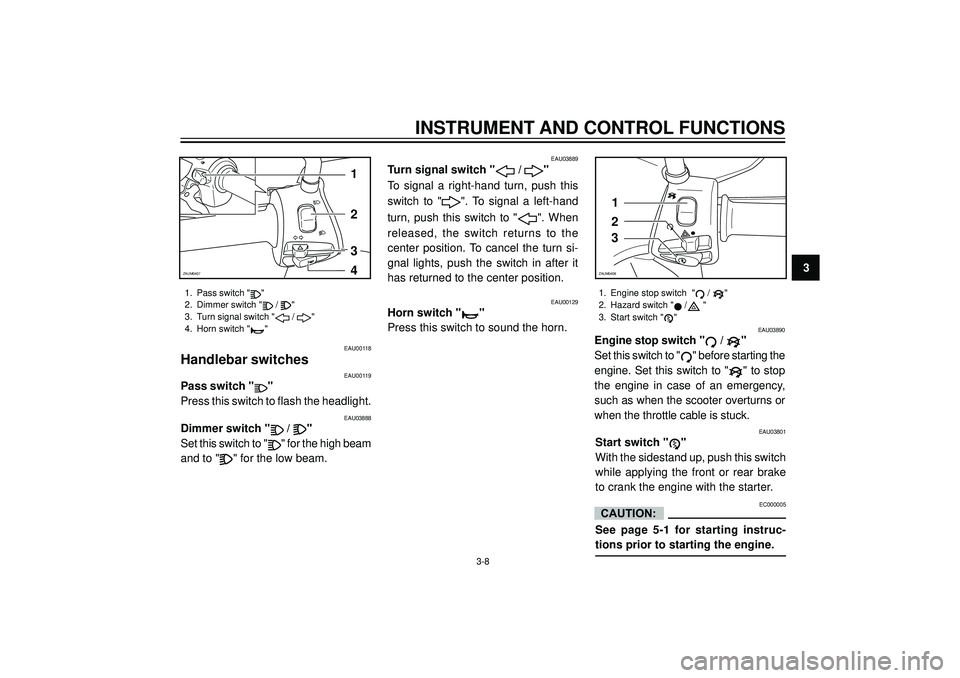
1. Pass switch ""
2. Dimmer switch "
/ "
3. Turn signal switch "
/ "
4. Horn switch "
"
EAU00118
Handlebar switches
EAU00119
Pass switch ""
Press this switch to flash the headlight.
EAU03888
Dimmer switch " / "
Set this switch to "
" for the high beam
and to "
" for the low beam.
EAU03889
Turn signal switch " / "
To signal a right-hand turn, push this
switch to "
". To signal a left-hand
turn, push this switch to "
". When
released, the switch returns to the
center position. To cancel the turn si-
gnal lights, push the switch in after it
has returned to the center position.
EAU00129
Horn switch ""
Press this switch to sound the horn.
1
2
3
ZAUM0408
1. Engine stop switch " / "
2. Hazard switch "
/ "
3. Start switch "
"
EAU03890
Engine stop switch " / "
Set this switch to "
" before starting the
engine. Set this switch to "
" to stop
the engine in case of an emergency,
such as when the scooter overturns or
when the throttle cable is stuck.
3-8
EAU03801
Start switch ""
With the sidestand up, push this switch
while applying the front or rear brake
to crank the engine with the starter.
EC000005
See page 5-1 for starting instruc-
tions prior to starting the engine.
CAUTION:
Page 26 of 104
3
INSTRUMENT AND CONTROL FUNCTIONS
CAUTION:
1
ZAUM0084
1
ZAUM0085
EAU03882
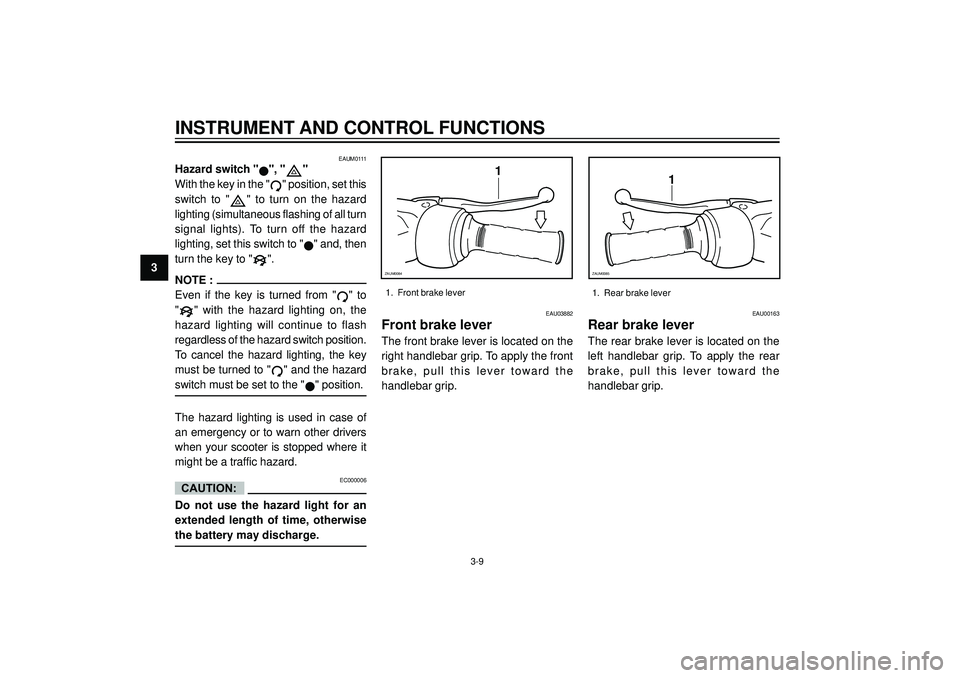
Front brake lever
The front brake lever is located on the
right handlebar grip. To apply the front
brake, pull this lever toward the
handlebar grip.
EAU00163
Rear brake lever
The rear brake lever is located on the
left handlebar grip. To apply the rear
brake, pull this lever toward the
handlebar grip.
1. Front brake lever
1. Rear brake lever
3-9
EC000006
Do not use the hazard light for an
extended length of time, otherwise
the battery may discharge.
EAUM0111
Hazard switch "", ""
With the key in the "
" position, set this
switch to "
" to turn on the hazard
lighting (simultaneous flashing of all turn
signal lights). To turn off the hazard
lighting, set this switch to "
" and, then
turn the key to "
".
NOTE :
Even if the key is turned from "
" to
"
" with the hazard lighting on, the
hazard lighting will continue to flash
regardless of the hazard switch position.
To cancel the hazard lighting, the key
must be turned to "
" and the hazard
switch must be set to the "" position.
The hazard lighting is used in case of
an emergency or to warn other drivers
when your scooter is stopped where it
might be a traffic hazard.
Page 33 of 104
INSTRUMENT AND CONTROL FUNCTIONS
3
1
ZAUM0416
EAU00330
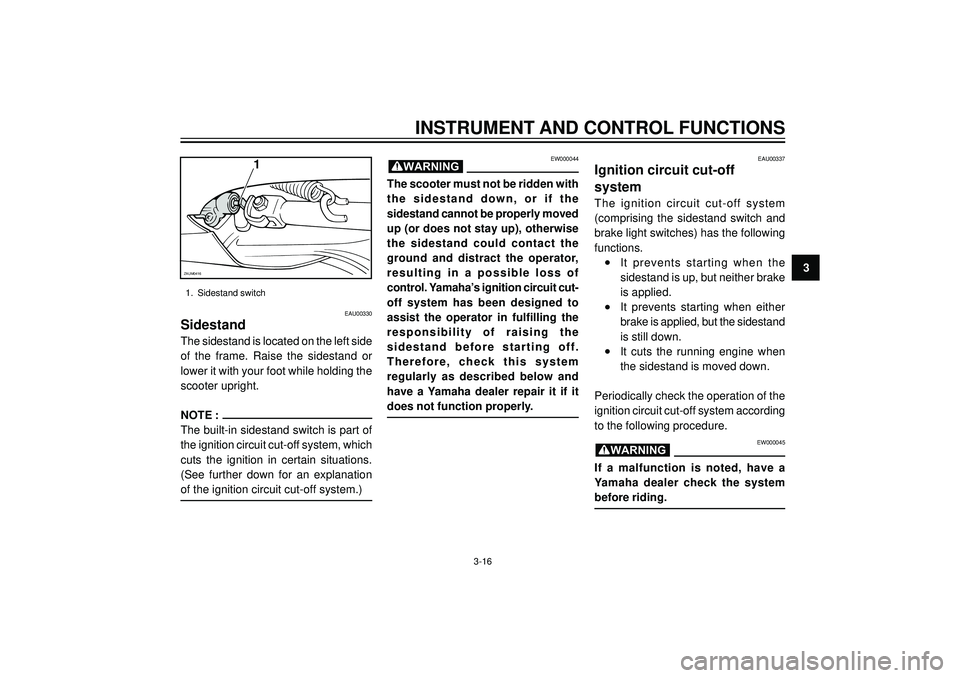
Sidestand
The sidestand is located on the left side
of the frame. Raise the sidestand or
lower it with your foot while holding the
scooter upright.
NOTE :
The built-in sidestand switch is part of
the ignition circuit cut-off system, which
cuts the ignition in certain situations.
(See further down for an explanation
of the ignition circuit cut-off system.)
EW000044
The scooter must not be ridden with
the sidestand down, or if the
sidestand cannot be properly moved
up (or does not stay up), otherwise
the sidestand could contact the
ground and distract the operator,
resulting in a possible loss of
control. Yamaha’s ignition circuit cut-
off system has been designed to
assist the operator in fulfilling the
responsibility of raising the
sidestand before starting off.
Therefore, check this system
regularly as described below and
have a Yamaha dealer repair it if it
does not function properly.
1. Sidestand switch
WARNINGEAU00337
Ignition circuit cut-off
system
The ignition circuit cut-off system
(comprising the sidestand switch and
brake light switches) has the following
functions.
•It prevents starting when the
sidestand is up, but neither brake
is applied.
•It prevents starting when either
brake is applied, but the sidestand
is still down.
•It cuts the running engine when
the sidestand is moved down.
Periodically check the operation of the
ignition circuit cut-off system according
to the following procedure.
EW000045
If a malfunction is noted, have a
Yamaha dealer check the system
before riding.
WARNING
3-16
Page 39 of 104
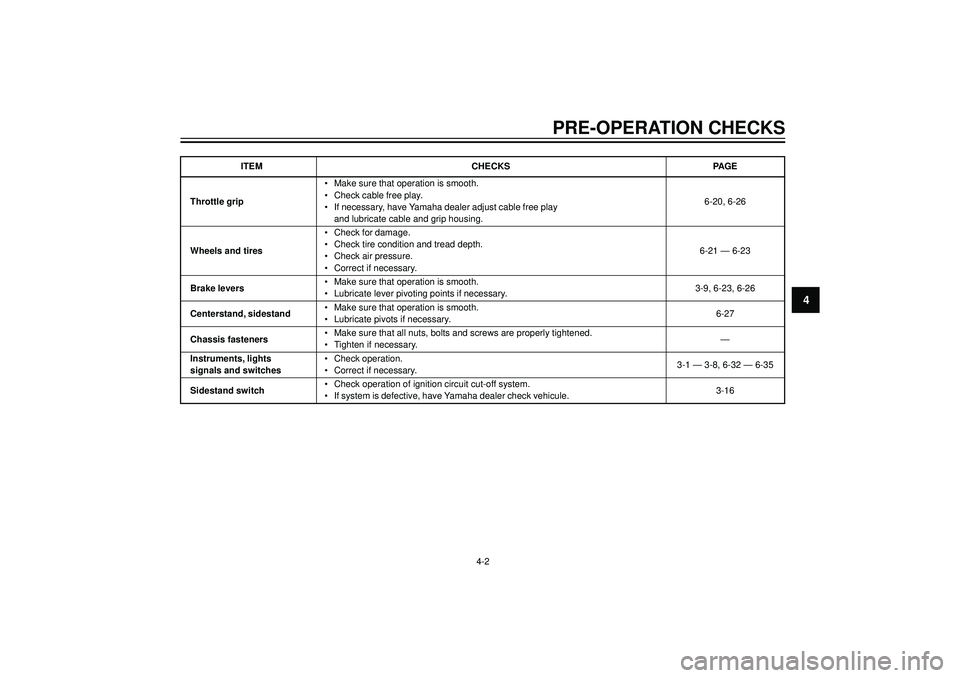
4
PRE-OPERATION CHECKS
ITEM CHECKS PAGE
•Make sure that operation is smooth.
Throttle grip•Check cable free play.
6-20, 6-26
•If necessary, have Yamaha dealer adjust cable free play
and lubricate cable and grip housing.
•Check for damage.
Wheels and tires•Check tire condition and tread depth.
6-21 — 6-23
•Check air pressure.
•Correct if necessary.
Brake levers•Make sure that operation is smooth.
3-9, 6-23, 6-26
•Lubricate lever pivoting points if necessary.
Centerstand, sidestand•Make sure that operation is smooth.
6-27
•Lubricate pivots if necessary.
Chassis fasteners•Make sure that all nuts, bolts and screws are properly tightened.
—
•Tighten if necessary.
Instruments, lights•Check operation.
3-1 — 3-8, 6-32 — 6-35
signals and switches•Correct if necessary.
Sidestand switch•Check operation of ignition circuit cut-off system.
3-16
•If system is defective, have Yamaha dealer check vehicule.
4-2
Page 47 of 104
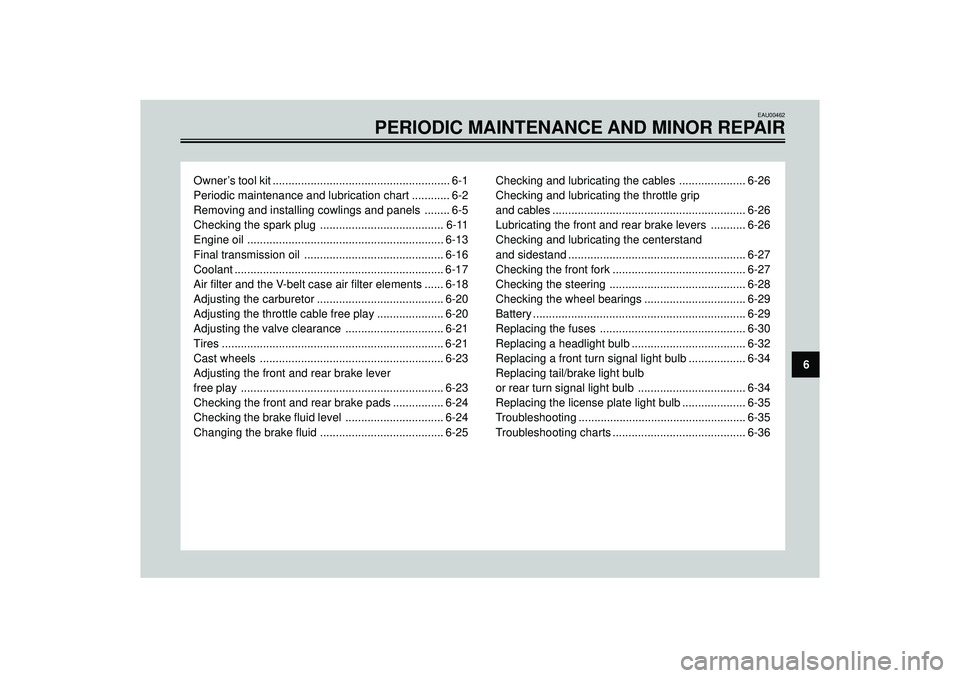
EAU00462
PERIODIC MAINTENANCE AND MINOR REPAIR
Owner’s tool kit ........................................................ 6-1
Periodic maintenance and lubrication chart ............ 6-2
Removing and installing cowlings and panels ........ 6-5
Checking the spark plug ....................................... 6-11
Engine oil .............................................................. 6-13
Final transmission oil ............................................ 6-16
Coolant .................................................................. 6-17
Air filter and the V-belt case air filter elements ...... 6-18
Adjusting the carburetor ........................................ 6-20
Adjusting the throttle cable free play ..................... 6-20
Adjusting the valve clearance ............................... 6-21
Tires ...................................................................... 6-21
Cast wheels .......................................................... 6-23
Adjusting the front and rear brake lever
free play ................................................................ 6-23
Checking the front and rear brake pads ................ 6-24
Checking the brake fluid level ............................... 6-24
Changing the brake fluid ....................................... 6-25Checking and lubricating the cables ..................... 6-26
Checking and lubricating the throttle grip
and cables ............................................................. 6-26
Lubricating the front and rear brake levers ........... 6-26
Checking and lubricating the centerstand
and sidestand ........................................................ 6-27
Checking the front fork .......................................... 6-27
Checking the steering ........................................... 6-28
Checking the wheel bearings ................................ 6-29
Battery ................................................................... 6-29
Replacing the fuses .............................................. 6-30
Replacing a headlight bulb .................................... 6-32
Replacing a front turn signal light bulb .................. 6-34
Replacing tail/brake light bulb
or rear turn signal light bulb .................................. 6-34
Replacing the license plate light bulb .................... 6-35
Troubleshooting ..................................................... 6-35
Troubleshooting charts .......................................... 6-36
6
Page 51 of 104
PERIODIC MAINTENANCE AND MINOR REPAIR
6
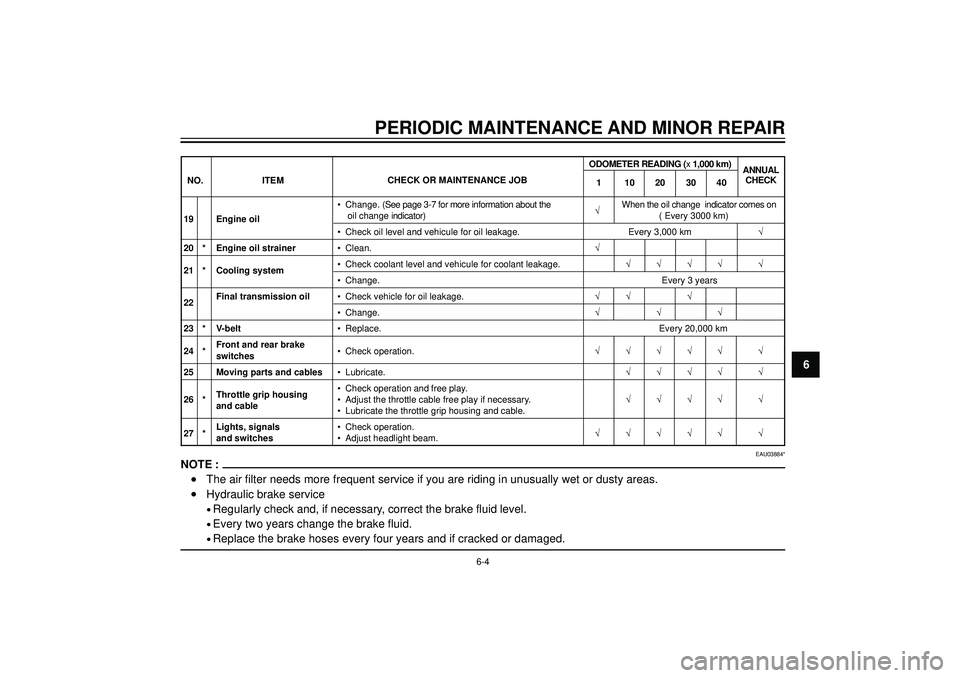
•Change. (See page 3-7 for more information about the√When the oil change indicator comes on19 Engine oil oil change indicator)( Every 3000 km)
•Check oil level and vehicule for oil leakage. Every 3,000 km√
20 * Engine oil strainer•Clean.√
21 * Cooling system•Check coolant level and vehicule for coolant leakage.√√√√ √•Change. Every 3 years
22Final transmission oil•Check vehicle for oil leakage.√√ √•Change.√√√
23 * V-belt•Replace. Every 20,000 km
24 *Front and rear brake
•Check operation.√√√√√ √
switches
25 Moving parts and cables•Lubricate.√√√√ √
Throttle grip housing•Check operation and free play.
26 *
and cable•Adjust the throttle cable free play if necessary.√√√√ √
•Lubricate the throttle grip housing and cable.
27 *Lights, signals•Check operation.
√√√√√ √
and switches•Adjust headlight beam.
ODOMETER READING (x 1,000 km)
NO. ITEMCHECK OR MAINTENANCE JOB
1
ANNUAL
CHECK
10 20 30 40
EAU03884*
NOTE :
•The air filter needs more frequent service if you are riding in unusually wet or dusty areas.
•Hydraulic brake service
•Regularly check and, if necessary, correct the brake fluid level.
•Every two years change the brake fluid.
•Replace the brake hoses every four years and if cracked or damaged.
6-4
Page 81 of 104
PERIODIC MAINTENANCE AND MINOR REPAIR
6
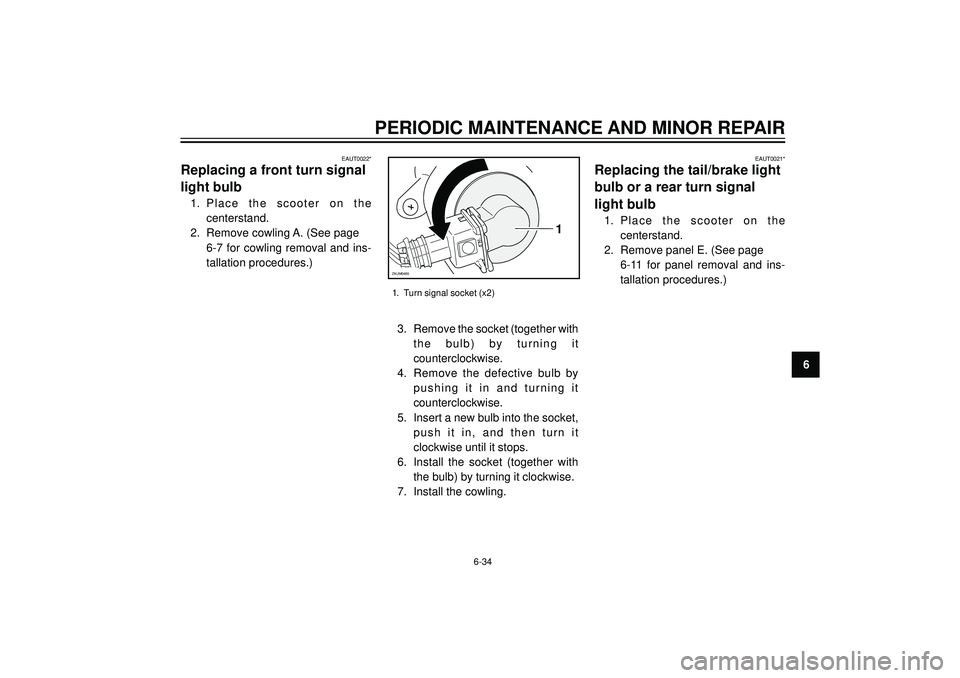
EAUT0022*
Replacing a front turn signal
light bulb
1. Place the scooter on the
centerstand.
2. Remove cowling A. (See page
6-7 for cowling removal and ins-
tallation procedures.)
3. Remove the socket (together with
the bulb) by turning it
counterclockwise.
4. Remove the defective bulb by
pushing it in and turning it
counterclockwise.
5. Insert a new bulb into the socket,
push it in, and then turn it
clockwise until it stops.
6. Install the socket (together with
the bulb) by turning it clockwise.
7. Install the cowling.
1. Turn signal socket (x2)
EAUT0021*
Replacing the tail/brake light
bulb or a rear turn signal
light bulb
1. Place the scooter on the
centerstand.
2. Remove panel E. (See page
6-11 for panel removal and ins-
tallation procedures.)
6-34
1
ZAUM0465
Page 82 of 104
PERIODIC MAINTENANCE AND MINOR REPAIR
6
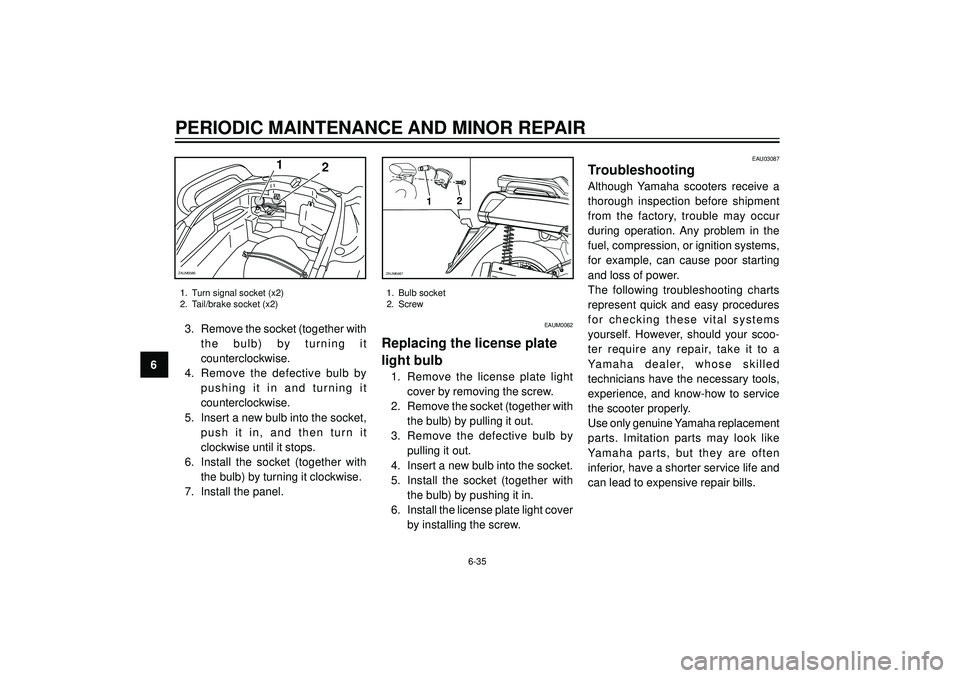
1. Turn signal socket (x2)
2. Tail/brake socket (x2)
3. Remove the socket (together with
the bulb) by turning it
counterclockwise.
4. Remove the defective bulb by
pushing it in and turning it
counterclockwise.
5. Insert a new bulb into the socket,
push it in, and then turn it
clockwise until it stops.
6. Install the socket (together with
the bulb) by turning it clockwise.
7. Install the panel.
1. Bulb socket
2. Screw
EAUM0062
Replacing the license plate
light bulb
1. Remove the license plate light
cover by removing the screw.
2. Remove the socket (together with
the bulb) by pulling it out.
3. Remove the defective bulb by
pulling it out.
4. Insert a new bulb into the socket.
5. Install the socket (together with
the bulb) by pushing it in.
6. Install the license plate light cover
by installing the screw.
EAU03087
Troubleshooting
Although Yamaha scooters receive a
thorough inspection before shipment
from the factory, trouble may occur
during operation. Any problem in the
fuel, compression, or ignition systems,
for example, can cause poor starting
and loss of power.
The following troubleshooting charts
represent quick and easy procedures
for checking these vital systems
yourself. However, should your scoo-
ter require any repair, take it to a
Yamaha dealer, whose skilled
technicians have the necessary tools,
experience, and know-how to service
the scooter properly.
Use only genuine Yamaha replacement
parts. Imitation parts may look like
Yamaha parts, but they are often
inferior, have a shorter service life and
can lead to expensive repair bills.
6-35
21
ZAUM0467
1
2
ZAUM0586
Page 87 of 104
SCOOTER CARE AND STORAGE
7
•Do not use any harsh chemical
products on plastic parts. Be
sure to avoid using cloths or
sponges which have been in
contact with strong or abrasive
cleaning products, solvent or
thinner, fuel (gasoline), rust
removers or inhibitors, brake
fluid, antifreeze or electrolyte.
•Do not use high-pressure
washers or steam-jet cleaners
since they cause water
seepage and deterioration in
the following areas: seals (of
wheel and swingarm bearings,
fork and brakes), electric
components (couplers,
connectors, instruments,
switches and lights), breather
hoses and vents.
•For scooters equipped with a
windshield: Do not use strong
cleaners or hard sponges as
they will cause dulling or
scratching. Some cleaning
compounds for plastic may
leave scratches on the
windshield. Test the product on
a small hidden part of the
windshield to make sure that it
does not leave any marks. If the
windshield is scratched, use a
quality plastic polishing
compound after washing.
After normal use
Remove dirt with warm water, a mild
detergent, and a soft, clean sponge,
and then rinse thoroughly with clean
water. Use a toothbrush or bottlebrush
for hard-to-reach areas. Stubborn dirt
and insects will come off more easily if
the area is covered with a wet cloth for
a few minutes before cleaning.
After riding in the rain, near the sea
or on salt-sprayed roads
Since sea salt or salt sprayed on the
roads during winter are extremely cor-
rosive in combination with water, carry
out the following steps after each ride
in the rain, near the sea or on salt-
sprayed roads.
NOTE :
Salt sprayed on roads in the winter may
remain well into spring.
1. Clean the scooter with cold water
and a mild detergent after the
engine has cooled down.
ECA00012
Do not use warm water since it
increases the corrosive action of the
salt.
2. Apply a corrosion protection spray
on all metal, including chrome-
and nickel-plated, surfaces to
prevent corrosion.
CAUTION:
7-2