fuel YAMAHA VERSITY 300 2004 Owners Manual
[x] Cancel search | Manufacturer: YAMAHA, Model Year: 2004, Model line: VERSITY 300, Model: YAMAHA VERSITY 300 2004Pages: 104, PDF Size: 2.82 MB
Page 15 of 104
2
DESCRIPTION
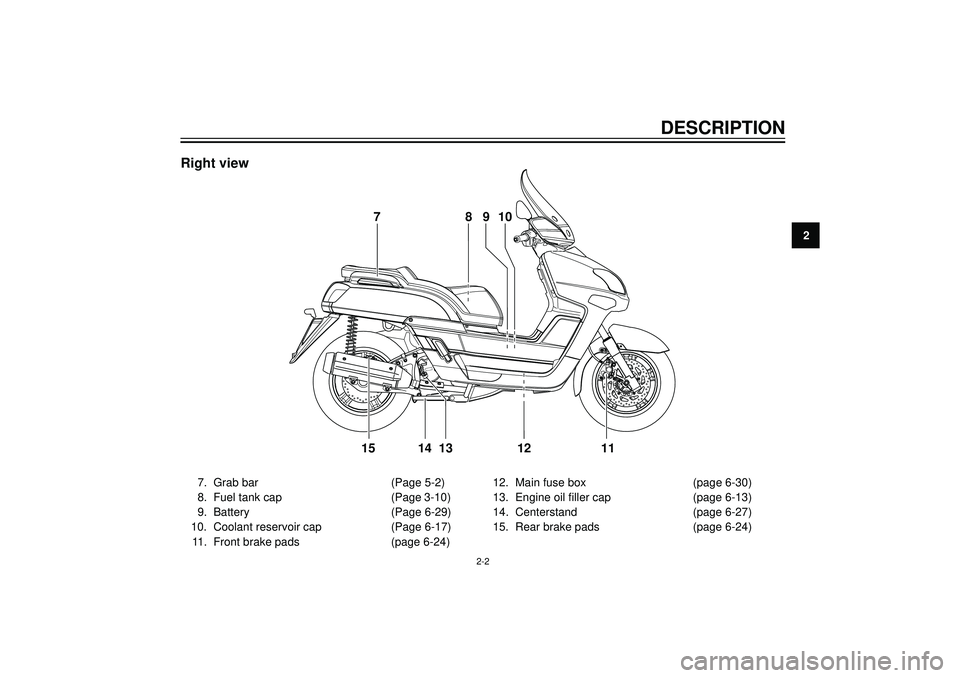
Right view
7. Grab bar (Page 5-2)
8. Fuel tank cap (Page 3-10)
9. Battery (Page 6-29)
10. Coolant reservoir cap (Page 6-17)
11. Front brake pads (page 6-24)12. Main fuse box (page 6-30)
13. Engine oil filler cap (page 6-13)
14. Centerstand (page 6-27)
15. Rear brake pads (page 6-24)
7
15 14 13 12 118910
2-2
Page 17 of 104
EAU00027
INSTRUMENT AND CONTROL FUNCTIONS
Main switch/steering lock .................................................................... 3-1
Indicator lights ..................................................................................... 3-2
Speedometer ...................................................................................... 3-2
Fuel gauge .......................................................................................... 3-3
Battery voltage/coolant temperature gauge ........................................ 3-3
Multi-function display .......................................................................... 3-4
Anti-theft alarm (optional) .................................................................... 3-7
Handlebar switches ............................................................................. 3-8
Front brake lever ................................................................................. 3-9
Rear brake lever .................................................................................. 3-9
Fuel tank cap .................................................................................... 3-10
Fuel ................................................................................................... 3-10
Catalytic converter ............................................................................ 3-11
Seat ................................................................................................... 3-12
Storage compartments ...................................................................... 3-12
Anti-theft device housing ................................................................... 3-14
Adjusting the shock absorber assemblies ......................................... 3-14
Luggage hook ................................................................................... 3-15
Sidestand .......................................................................................... 3-16
Ignition circuit cut-off system ............................................................. 3-16
Auxiliary DC jack ............................................................................... 3-18
3
Page 20 of 104
3
INSTRUMENT AND CONTROL FUNCTIONS
EAUM0098
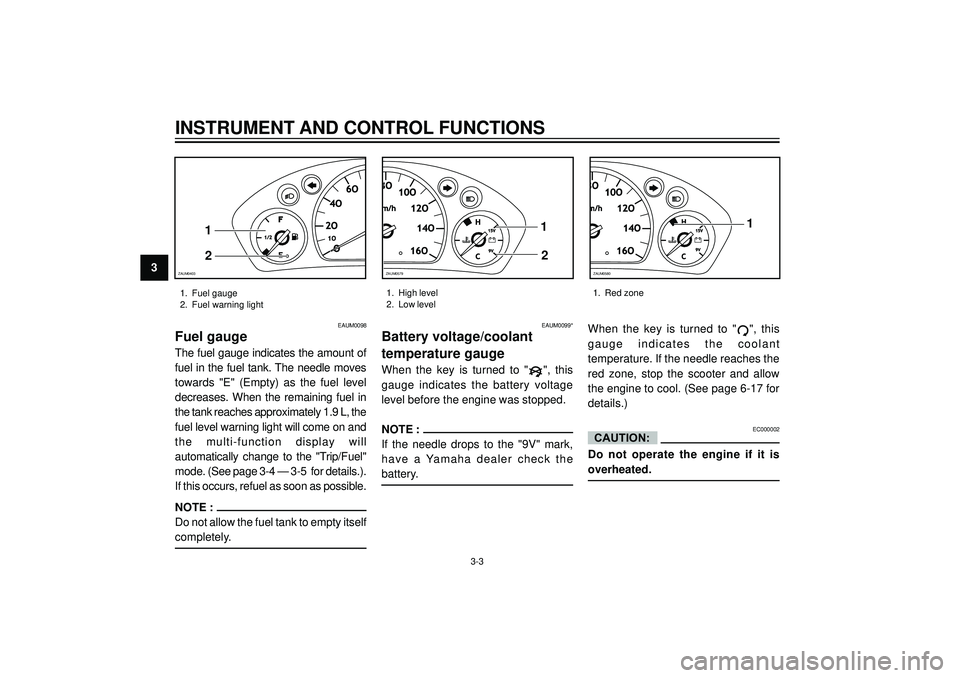
Fuel gauge
The fuel gauge indicates the amount of
fuel in the fuel tank. The needle moves
towards "E" (Empty) as the fuel level
decreases. When the remaining fuel in
the tank reaches approximately 1.9 L, the
fuel level warning light will come on and
the multi-function display will
automatically change to the "Trip/Fuel"
mode. (See page 3-4 — 3-5 for details.).
If this occurs, refuel as soon as possible.
NOTE :
Do not allow the fuel tank to empty itself
completely.
EAUM0099*
Battery voltage/coolant
temperature gauge
When the key is turned to "", this
gauge indicates the battery voltage
level before the engine was stopped.
NOTE :
If the needle drops to the "9V" mark,
have a Yamaha dealer check the
battery.When the key is turned to "
", this
gauge indicates the coolant
temperature. If the needle reaches the
red zone, stop the scooter and allow
the engine to cool. (See page 6-17 for
details.)
EC000002
Do not operate the engine if it is
overheated.
CAUTION:
1. Fuel gauge
2. Fuel warning light1. High level
2. Low level1. Red zone
O1O1O
2O2O
4O4O
6O6O
F
1/21/2
E
1
2
ZAUM0403
3-3
10O10O
12O12O
14O14O
16O16O
H
C15V15V
9V9V
1
2
ZAUM0579
10O
12O
14O
16O
H
C15V 15V
9V 9V1
ZAUM0580
Page 21 of 104
INSTRUMENT AND CONTROL FUNCTIONS
3
"Mode""Mode"
"Mode"
"Mode"
12
3
4
ZAUM0391
1. Mode button
2. Digital display
3. Set button1. Total
2. Trip 1
3. Trip 2
4. Trip/Fuel
3-4
1
23ZAUM0581
EAUM1950
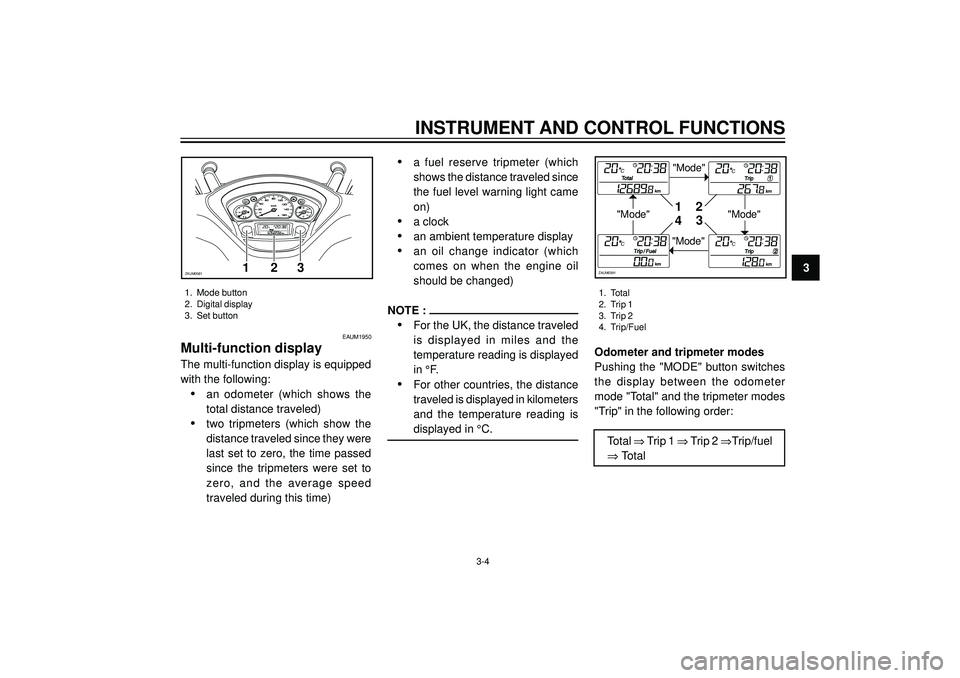
Multi-function display
The multi-function display is equipped
with the following:
•an odometer (which shows the
total distance traveled)
•two tripmeters (which show the
distance traveled since they were
last set to zero, the time passed
since the tripmeters were set to
zero, and the average speed
traveled during this time)
•a fuel reserve tripmeter (which
shows the distance traveled since
the fuel level warning light came
on)
•a clock
•an ambient temperature display
•an oil change indicator (which
comes on when the engine oil
should be changed)
NOTE :
•For the UK, the distance traveled
is displayed in miles and the
temperature reading is displayed
in °F.
•For other countries, the distance
traveled is displayed in kilometers
and the temperature reading is
displayed in °C.Odometer and tripmeter modes
Pushing the "MODE" button switches
the display between the odometer
mode "Total" and the tripmeter modes
"Trip" in the following order:
Total ⇒ Trip 1 ⇒ Trip 2 ⇒Trip/fuel
⇒ Total
Page 22 of 104
3
INSTRUMENT AND CONTROL FUNCTIONS
"Set"
"Set""Set"
1
2
3
ZAUM0392ZAUM0393
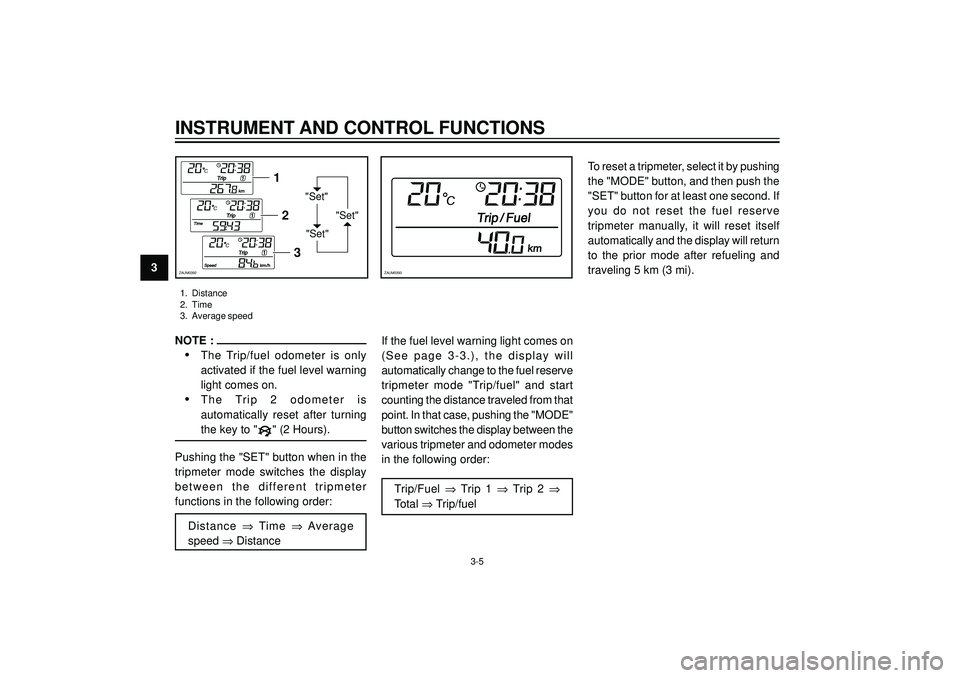
1. Distance
2. Time
3. Average speed
3-5
NOTE :
•The Trip/fuel odometer is only
activated if the fuel level warning
light comes on.
•The Trip 2 odometer is
automatically reset after turning
the key to "" (2 Hours).
Pushing the "SET" button when in the
tripmeter mode switches the display
between the different tripmeter
functions in the following order:
Distance ⇒ Time ⇒ Average
speed ⇒ DistanceIf the fuel level warning light comes on
(See page 3-3.), the display will
automatically change to the fuel reserve
tripmeter mode "Trip/fuel" and start
counting the distance traveled from that
point. In that case, pushing the "MODE"
button switches the display between the
various tripmeter and odometer modes
in the following order:
Trip/Fuel ⇒ Trip 1 ⇒ Trip 2 ⇒
Total ⇒ Trip/fuelTo reset a tripmeter, select it by pushing
the "MODE" button, and then push the
"SET" button for at least one second. If
you do not reset the fuel reserve
tripmeter manually, it will reset itself
automatically and the display will return
to the prior mode after refueling and
traveling 5 km (3 mi).
Page 27 of 104
INSTRUMENT AND CONTROL FUNCTIONS
3
1
ZAUM0409
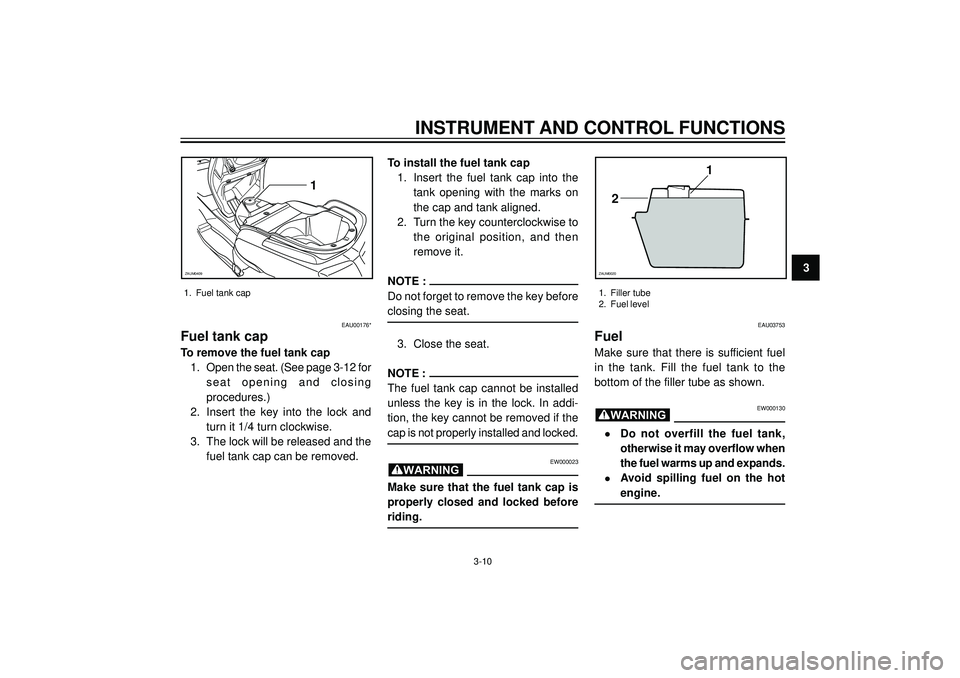
1. Fuel tank cap
EAU00176*
Fuel tank cap
To remove the fuel tank cap
1. Open the seat. (See page 3-12 for
seat opening and closing
procedures.)
2. Insert the key into the lock and
turn it 1/4 turn clockwise.
3. The lock will be released and the
fuel tank cap can be removed.To install the fuel tank cap
1. Insert the fuel tank cap into the
tank opening with the marks on
the cap and tank aligned.
2. Turn the key counterclockwise to
the original position, and then
remove it.
NOTE :
Do not forget to remove the key before
closing the seat.
3. Close the seat.
NOTE :
The fuel tank cap cannot be installed
unless the key is in the lock. In addi-
tion, the key cannot be removed if the
cap is not properly installed and locked.
EW000023
Make sure that the fuel tank cap is
properly closed and locked before
riding.
WARNING
1
2
ZAUM0020
1. Filler tube
2. Fuel level
EAU03753
Fuel
Make sure that there is sufficient fuel
in the tank. Fill the fuel tank to the
bottom of the filler tube as shown.
EW000130
•Do not overfill the fuel tank,
otherwise it may overflow when
the fuel warms up and expands.
•Avoid spilling fuel on the hot
engine.
WARNING
3-10
Page 28 of 104
3
INSTRUMENT AND CONTROL FUNCTIONS
EAU00185
EC000008
Immediately wipe off spilled fuel with
a clean, dry, soft cloth, since fuel may
deteriorate painted surfaces or plas-
tic parts.
CAUTION:
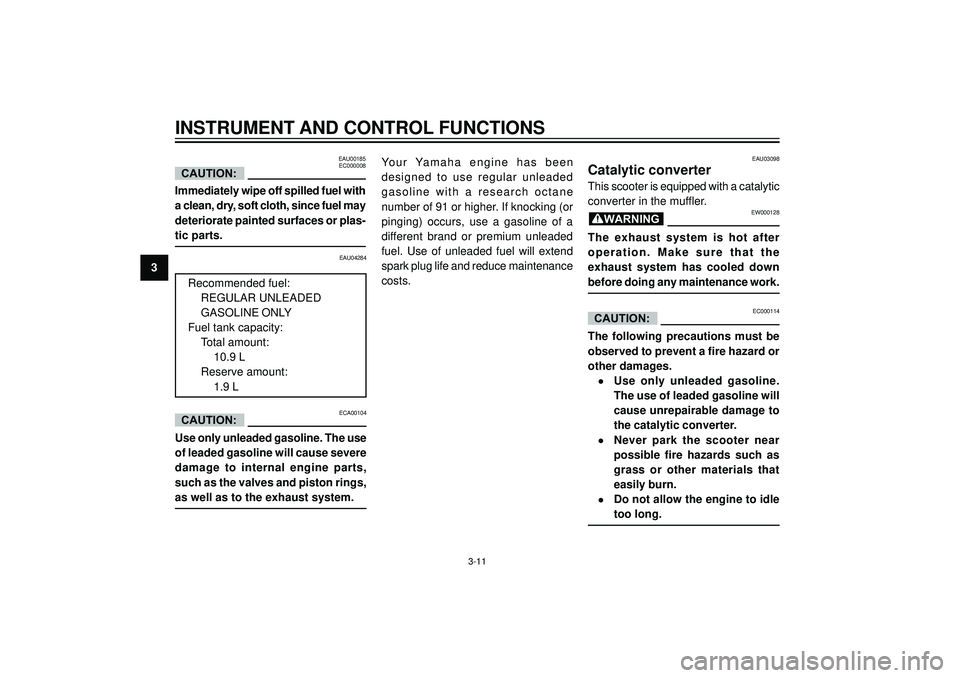
EAU04284
Recommended fuel:
REGULAR UNLEADED
GASOLINE ONLY
Fuel tank capacity:
Total amount:
10.9 L
Reserve amount:
1.9 L
ECA00104
Use only unleaded gasoline. The use
of leaded gasoline will cause severe
damage to internal engine parts,
such as the valves and piston rings,
as well as to the exhaust system.
Your Yamaha engine has been
designed to use regular unleaded
gasoline with a research octane
number of 91 or higher. If knocking (or
pinging) occurs, use a gasoline of a
different brand or premium unleaded
fuel. Use of unleaded fuel will extend
spark plug life and reduce maintenance
costs.
CAUTION:
EAU03098
Catalytic converter
This scooter is equipped with a catalytic
converter in the muffler.
EW000128
The exhaust system is hot after
operation. Make sure that the
exhaust system has cooled down
before doing any maintenance work.
EC000114
The following precautions must be
observed to prevent a fire hazard or
other damages.
•Use only unleaded gasoline.
The use of leaded gasoline will
cause unrepairable damage to
the catalytic converter.
•Never park the scooter near
possible fire hazards such as
grass or other materials that
easily burn.
•Do not allow the engine to idle
too long.
WARNING
CAUTION:
3-11
Page 38 of 104
PRE-OPERATION CHECKS
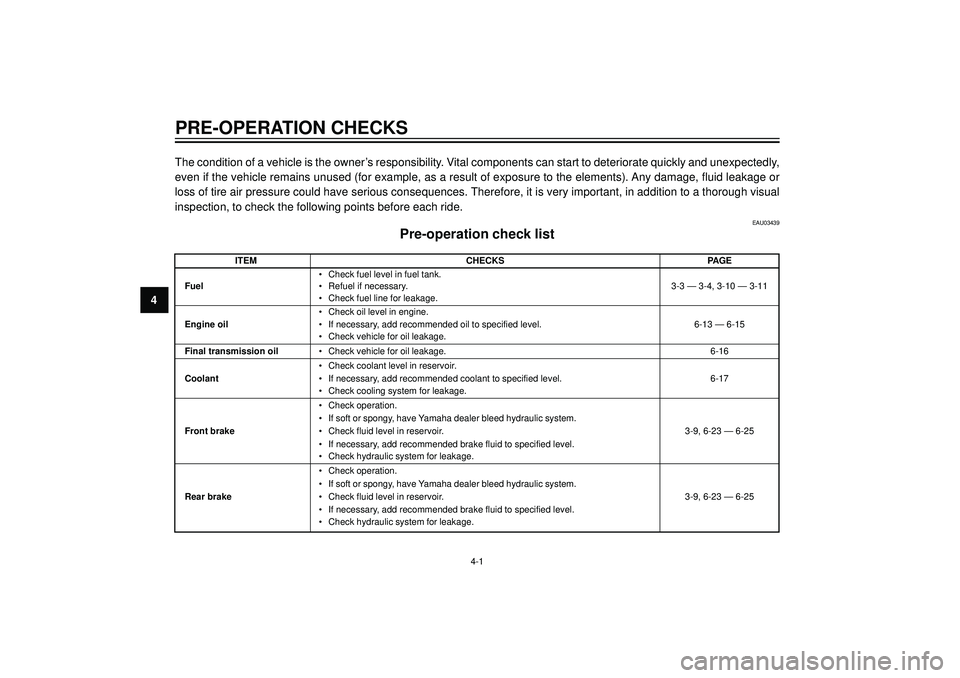
4The condition of a vehicle is the owner’s responsibility. Vital components can start to deteriorate quickly and unexpectedly,
even if the vehicle remains unused (for example, as a result of exposure to the elements). Any damage, fluid leakage or
loss of tire air pressure could have serious consequences. Therefore, it is very important, in addition to a thorough visual
inspection, to check the following points before each ride.
EAU03439
Pre-operation check list
ITEM CHECKS PAGE
•Check fuel level in fuel tank.
Fuel•Refuel if necessary. 3-3 — 3-4, 3-10 — 3-11
•Check fuel line for leakage.
•Check oil level in engine.
Engine oil•If necessary, add recommended oil to specified level. 6-13 — 6-15
•Check vehicle for oil leakage.
Final transmission oil•Check vehicle for oil leakage. 6-16
•Check coolant level in reservoir.
Coolant•If necessary, add recommended coolant to specified level. 6-17
•Check cooling system for leakage.
•Check operation.
•If soft or spongy, have Yamaha dealer bleed hydraulic system.
Front brake•Check fluid level in reservoir. 3-9, 6-23 — 6-25
•If necessary, add recommended brake fluid to specified level.
•Check hydraulic system for leakage.
•Check operation.
•If soft or spongy, have Yamaha dealer bleed hydraulic system.
Rear brake•Check fluid level in reservoir. 3-9, 6-23 — 6-25
•If necessary, add recommended brake fluid to specified level.
•Check hydraulic system for leakage.
4-1
Page 41 of 104
EAU00372
OPERATION AND IMPORTANT RIDING POINTS
Starting the engine .............................................................................. 5-1
Starting off ........................................................................................... 5-2
Acceleration and deceleration ............................................................. 5-3
Braking ................................................................................................ 5-3
Tips for reducing fuel consumption ..................................................... 5-4
Engine break-in ................................................................................... 5-4
Parking ................................................................................................ 5-5
5
Page 45 of 104
OPERATION AND IMPORTANT RIDING POINTS
5
EAU04755
Tips for reducing fuel
consumption
Fuel consumption depends largely on
your riding style. Consider the following
tips to reduce fuel consumption:
•Avoid high engine speeds during
acceleration.
•Avoid high engine speeds with no
load on the engine.
•Turn the engine off instead of
letting it idle for an extended
length of time (e.g., in traffic jams,
at traffic lights or at railroad
crossings).
EAU01128
Engine break-in
There is never a more important period
in the life of your engine than the period
between 0 and 1,600 km. For this
reason, you should read the following
material carefully.
Since the engine is brand new, do not
put an excessive load on it for the first
1,600 km. The various parts in the
engine wear and polish themselves to
the correct operating clearances.
During this period, prolonged full-
throttle operation or any condition that
might result in engine overheating must
be avoided.
EAU03845*
0 — 1,000 km
Avoid prolonged operation above 1/3
throttle.
1,000 — 1,600 km
Avoid prolonged operation above 1/2
throttle.
ECA00138
After 1,000 km of operation, be sure
to replace the engine oil and final
transmission oil.
1,600 km and beyond
The vehicle can now be operated
normally.
EC000049
If any engine trouble should occur
during the engine break-in period,
immediately have a Yamaha dealer
check the vehicle.
CAUTION:
CAUTION:
5-4