oil level YAMAHA VERSITY 300 2004 Owners Manual
[x] Cancel search | Manufacturer: YAMAHA, Model Year: 2004, Model line: VERSITY 300, Model: YAMAHA VERSITY 300 2004Pages: 104, PDF Size: 2.82 MB
Page 21 of 104
INSTRUMENT AND CONTROL FUNCTIONS
3
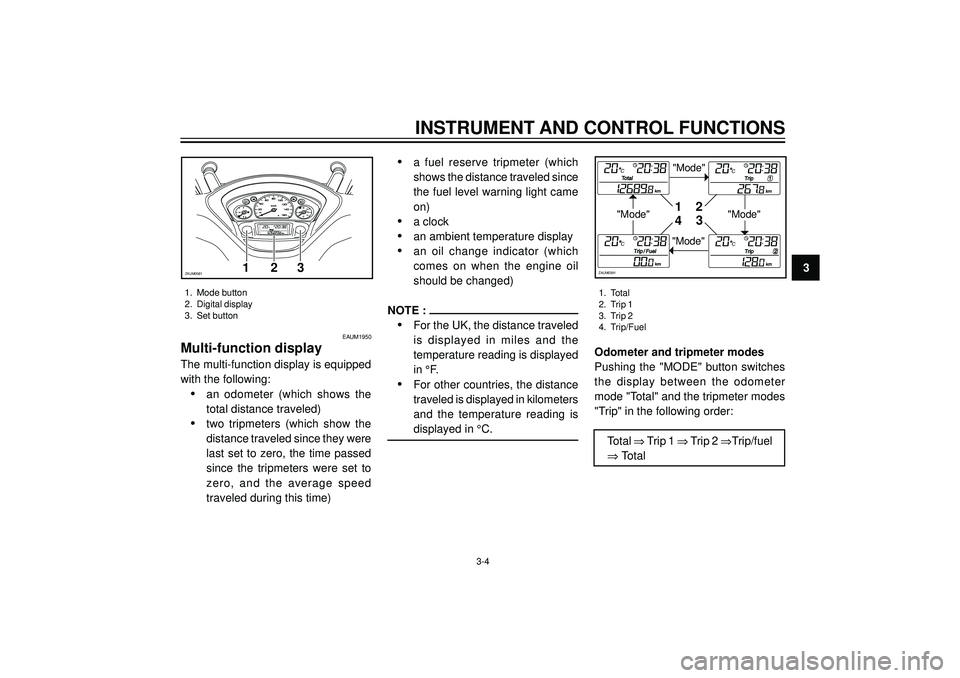
"Mode""Mode"
"Mode"
"Mode"
12
3
4
ZAUM0391
1. Mode button
2. Digital display
3. Set button1. Total
2. Trip 1
3. Trip 2
4. Trip/Fuel
3-4
1
23ZAUM0581
EAUM1950
Multi-function display
The multi-function display is equipped
with the following:
•an odometer (which shows the
total distance traveled)
•two tripmeters (which show the
distance traveled since they were
last set to zero, the time passed
since the tripmeters were set to
zero, and the average speed
traveled during this time)
•a fuel reserve tripmeter (which
shows the distance traveled since
the fuel level warning light came
on)
•a clock
•an ambient temperature display
•an oil change indicator (which
comes on when the engine oil
should be changed)
NOTE :
•For the UK, the distance traveled
is displayed in miles and the
temperature reading is displayed
in °F.
•For other countries, the distance
traveled is displayed in kilometers
and the temperature reading is
displayed in °C.Odometer and tripmeter modes
Pushing the "MODE" button switches
the display between the odometer
mode "Total" and the tripmeter modes
"Trip" in the following order:
Total ⇒ Trip 1 ⇒ Trip 2 ⇒Trip/fuel
⇒ Total
Page 38 of 104
PRE-OPERATION CHECKS
4The condition of a vehicle is the owner’s responsibility. Vital components can start to deteriorate quickly and unexpectedly,
even if the vehicle remains unused (for example, as a result of exposure to the elements). Any damage, fluid leakage or
loss of tire air pressure could have serious consequences. Therefore, it is very important, in addition to a thorough visual
inspection, to check the following points before each ride.
EAU03439
Pre-operation check list
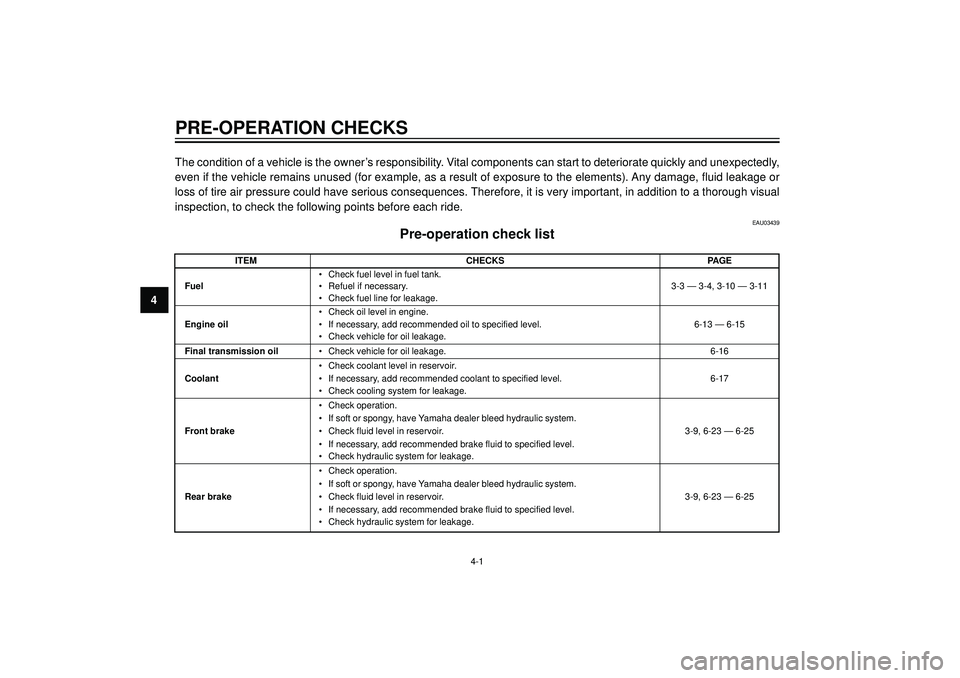
ITEM CHECKS PAGE
•Check fuel level in fuel tank.
Fuel•Refuel if necessary. 3-3 — 3-4, 3-10 — 3-11
•Check fuel line for leakage.
•Check oil level in engine.
Engine oil•If necessary, add recommended oil to specified level. 6-13 — 6-15
•Check vehicle for oil leakage.
Final transmission oil•Check vehicle for oil leakage. 6-16
•Check coolant level in reservoir.
Coolant•If necessary, add recommended coolant to specified level. 6-17
•Check cooling system for leakage.
•Check operation.
•If soft or spongy, have Yamaha dealer bleed hydraulic system.
Front brake•Check fluid level in reservoir. 3-9, 6-23 — 6-25
•If necessary, add recommended brake fluid to specified level.
•Check hydraulic system for leakage.
•Check operation.
•If soft or spongy, have Yamaha dealer bleed hydraulic system.
Rear brake•Check fluid level in reservoir. 3-9, 6-23 — 6-25
•If necessary, add recommended brake fluid to specified level.
•Check hydraulic system for leakage.
4-1
Page 47 of 104
EAU00462
PERIODIC MAINTENANCE AND MINOR REPAIR
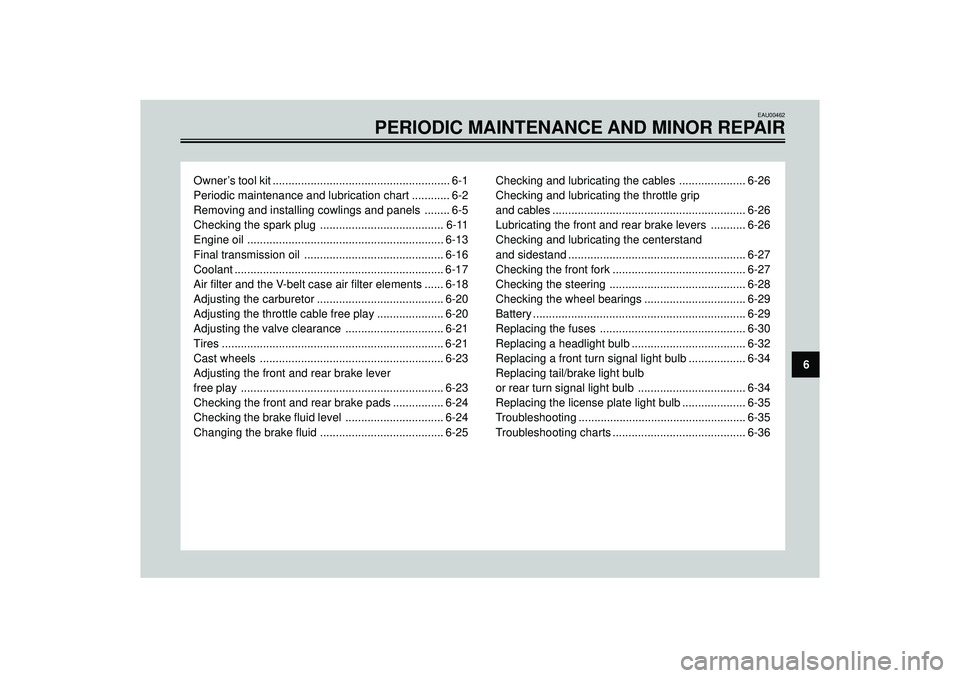
Owner’s tool kit ........................................................ 6-1
Periodic maintenance and lubrication chart ............ 6-2
Removing and installing cowlings and panels ........ 6-5
Checking the spark plug ....................................... 6-11
Engine oil .............................................................. 6-13
Final transmission oil ............................................ 6-16
Coolant .................................................................. 6-17
Air filter and the V-belt case air filter elements ...... 6-18
Adjusting the carburetor ........................................ 6-20
Adjusting the throttle cable free play ..................... 6-20
Adjusting the valve clearance ............................... 6-21
Tires ...................................................................... 6-21
Cast wheels .......................................................... 6-23
Adjusting the front and rear brake lever
free play ................................................................ 6-23
Checking the front and rear brake pads ................ 6-24
Checking the brake fluid level ............................... 6-24
Changing the brake fluid ....................................... 6-25Checking and lubricating the cables ..................... 6-26
Checking and lubricating the throttle grip
and cables ............................................................. 6-26
Lubricating the front and rear brake levers ........... 6-26
Checking and lubricating the centerstand
and sidestand ........................................................ 6-27
Checking the front fork .......................................... 6-27
Checking the steering ........................................... 6-28
Checking the wheel bearings ................................ 6-29
Battery ................................................................... 6-29
Replacing the fuses .............................................. 6-30
Replacing a headlight bulb .................................... 6-32
Replacing a front turn signal light bulb .................. 6-34
Replacing tail/brake light bulb
or rear turn signal light bulb .................................. 6-34
Replacing the license plate light bulb .................... 6-35
Troubleshooting ..................................................... 6-35
Troubleshooting charts .......................................... 6-36
6
Page 50 of 104
PERIODIC MAINTENANCE AND MINOR REPAIR
6
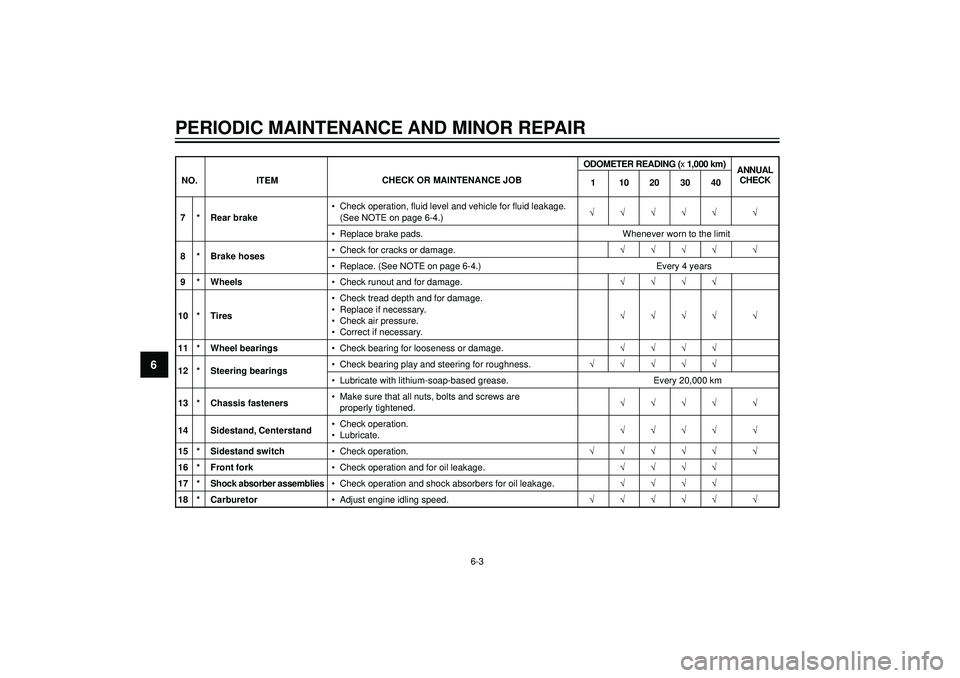
•Check operation, fluid level and vehicle for fluid leakage.
√√√√√ √7 * Rear brake(See NOTE on page 6-4.)
•Replace brake pads. Whenever worn to the limit
8 * Brake hoses•Check for cracks or damage.√√√√ √•Replace. (See NOTE on page 6-4.) Every 4 years
9 * Wheels•Check runout and for damage.√√√√
•Check tread depth and for damage.
10 * Tires•Replace if necessary.
√√√√ √
•Check air pressure.
•Correct if necessary.
11 * Wheel bearings•Check bearing for looseness or damage.√√√√
12 * Steering bearings•Check bearing play and steering for roughness.√√√√√•Lubricate with lithium-soap-based grease. Every 20,000 km
13 * Chassis fasteners•Make sure that all nuts, bolts and screws are
√√√√ √
properly tightened.
14 Sidestand, Centerstand•Check operation.
√√√√ √
•Lubricate.
15 * Sidestand switch•Check operation.√√√√√ √
16 * Front fork•Check operation and for oil leakage.√√√√
17 * Shock absorber assemblies•Check operation and shock absorbers for oil leakage.√√√√
18 * Carburetor•Adjust engine idling speed.√√√√√ √
ODOMETER READING (x 1,000 km)
NO. ITEMCHECK OR MAINTENANCE JOB
1
ANNUAL
CHECK
10 20 30 40
6-3
Page 51 of 104
PERIODIC MAINTENANCE AND MINOR REPAIR
6
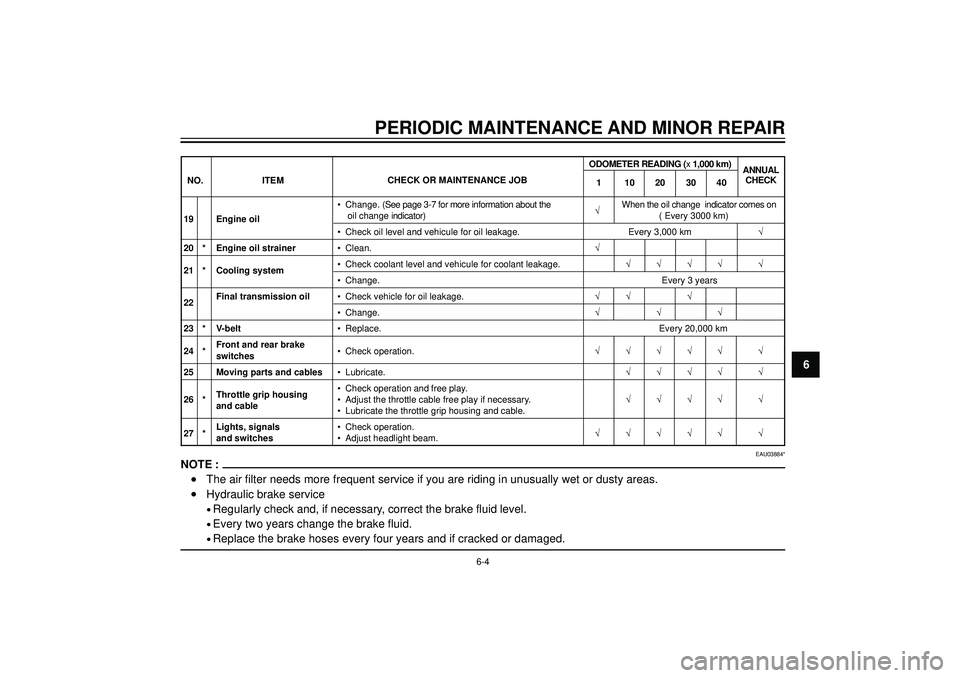
•Change. (See page 3-7 for more information about the√When the oil change indicator comes on19 Engine oil oil change indicator)( Every 3000 km)
•Check oil level and vehicule for oil leakage. Every 3,000 km√
20 * Engine oil strainer•Clean.√
21 * Cooling system•Check coolant level and vehicule for coolant leakage.√√√√ √•Change. Every 3 years
22Final transmission oil•Check vehicle for oil leakage.√√ √•Change.√√√
23 * V-belt•Replace. Every 20,000 km
24 *Front and rear brake
•Check operation.√√√√√ √
switches
25 Moving parts and cables•Lubricate.√√√√ √
Throttle grip housing•Check operation and free play.
26 *
and cable•Adjust the throttle cable free play if necessary.√√√√ √
•Lubricate the throttle grip housing and cable.
27 *Lights, signals•Check operation.
√√√√√ √
and switches•Adjust headlight beam.
ODOMETER READING (x 1,000 km)
NO. ITEMCHECK OR MAINTENANCE JOB
1
ANNUAL
CHECK
10 20 30 40
EAU03884*
NOTE :
•The air filter needs more frequent service if you are riding in unusually wet or dusty areas.
•Hydraulic brake service
•Regularly check and, if necessary, correct the brake fluid level.
•Every two years change the brake fluid.
•Replace the brake hoses every four years and if cracked or damaged.
6-4
Page 60 of 104
PERIODIC MAINTENANCE AND MINOR REPAIR
6Tightening torque:
Spark plug:
17.5 Nm (1.75 m
•kg)
NOTE :
If a torque wrench is not available when
installing a spark plug, a good estimate
of the correct torque is 1/4 – 1/2 turn
past finger tight. However, the spark
plug should be tightened to the
specified torque as soon as possible.
4. Install the spark plug cap.
5. Install the cowling.
6-13
EAUM0103*
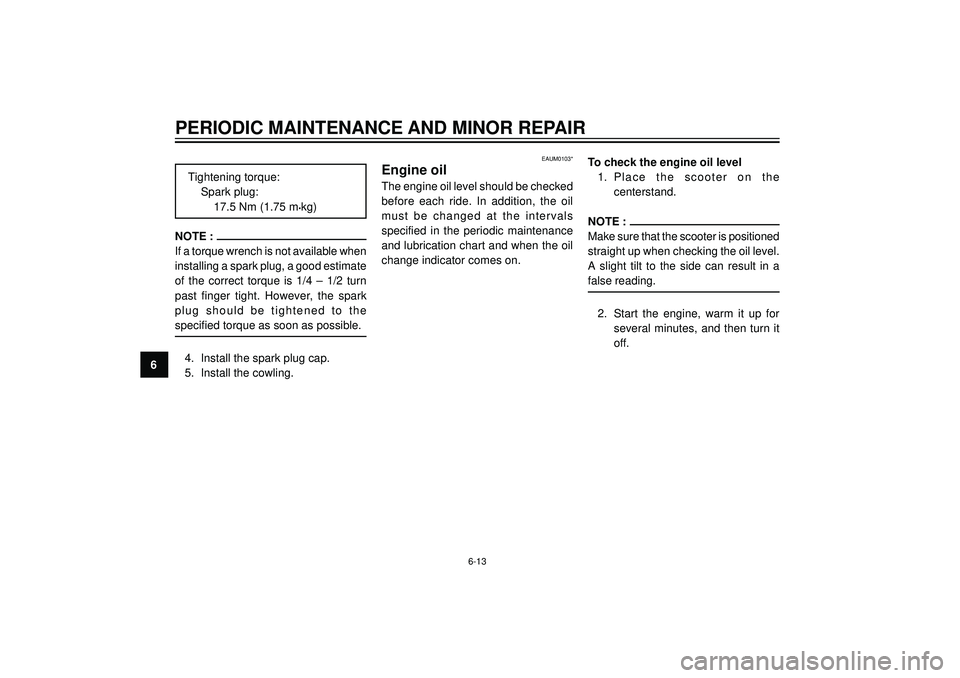
Engine oil
The engine oil level should be checked
before each ride. In addition, the oil
must be changed at the intervals
specified in the periodic maintenance
and lubrication chart and when the oil
change indicator comes on.To check the engine oil level
1. Place the scooter on the
centerstand.
NOTE :
Make sure that the scooter is positioned
straight up when checking the oil level.
A slight tilt to the side can result in a
false reading.
2. Start the engine, warm it up for
several minutes, and then turn it
off.
Page 61 of 104
PERIODIC MAINTENANCE AND MINOR REPAIR
6
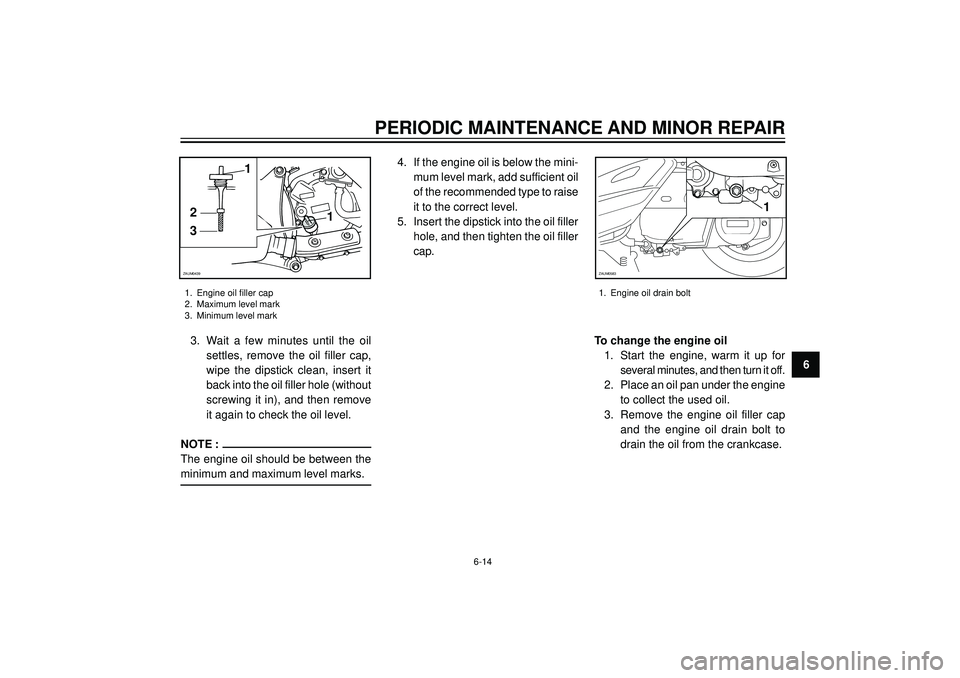
1. Engine oil filler cap
2. Maximum level mark
3. Minimum level mark1. Engine oil drain bolt
6-14
1
3
21
ZAUM0439
3. Wait a few minutes until the oil
settles, remove the oil filler cap,
wipe the dipstick clean, insert it
back into the oil filler hole (without
screwing it in), and then remove
it again to check the oil level.
NOTE :
The engine oil should be between the
minimum and maximum level marks.4. If the engine oil is below the mini-
mum level mark, add sufficient oil
of the recommended type to raise
it to the correct level.
5. Insert the dipstick into the oil filler
hole, and then tighten the oil filler
cap.
To change the engine oil
1. Start the engine, warm it up for
several minutes, and then turn it off.
2. Place an oil pan under the engine
to collect the used oil.
3. Remove the engine oil filler cap
and the engine oil drain bolt to
drain the oil from the crankcase.
11
ZAUM0583
Page 72 of 104
PERIODIC MAINTENANCE AND MINOR REPAIR
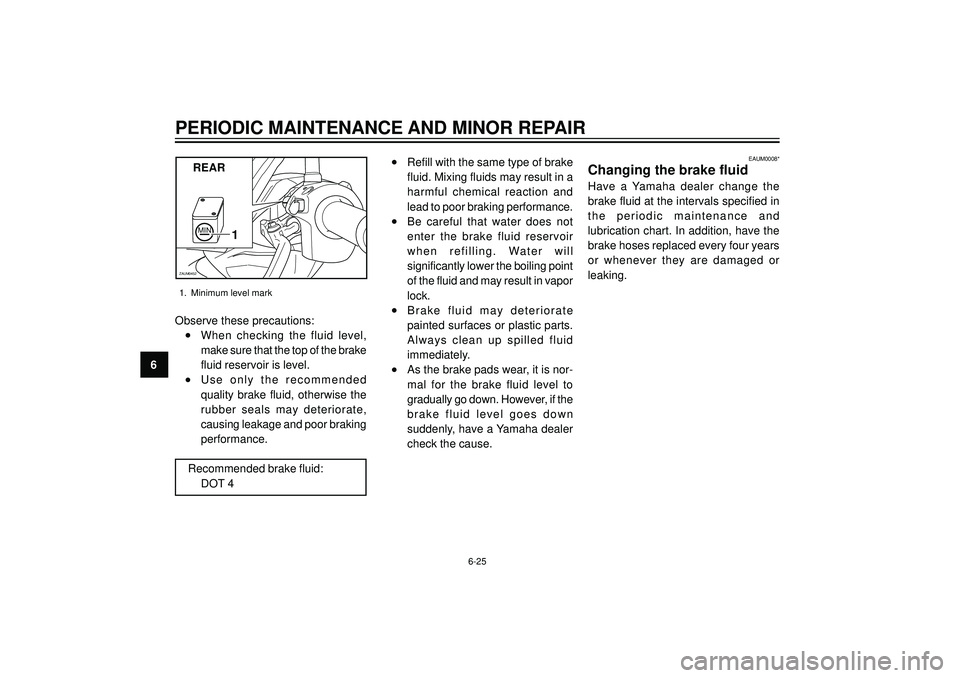
6Observe these precautions:
•When checking the fluid level,
make sure that the top of the brake
fluid reservoir is level.
•Use only the recommended
quality brake fluid, otherwise the
rubber seals may deteriorate,
causing leakage and poor braking
performance.
Recommended brake fluid:
DOT 4
1. Minimum level mark
•Refill with the same type of brake
fluid. Mixing fluids may result in a
harmful chemical reaction and
lead to poor braking performance.
•Be careful that water does not
enter the brake fluid reservoir
when refilling. Water will
significantly lower the boiling point
of the fluid and may result in vapor
lock.
•Brake fluid may deteriorate
painted surfaces or plastic parts.
Always clean up spilled fluid
immediately.
•As the brake pads wear, it is nor-
mal for the brake fluid level to
gradually go down. However, if the
brake fluid level goes down
suddenly, have a Yamaha dealer
check the cause.
EAUM0008*
Changing the brake fluid
Have a Yamaha dealer change the
brake fluid at the intervals specified in
the periodic maintenance and
lubrication chart. In addition, have the
brake hoses replaced every four years
or whenever they are damaged or
leaking.
6-25
MIN1
ZAUM0452
REAR
Page 100 of 104
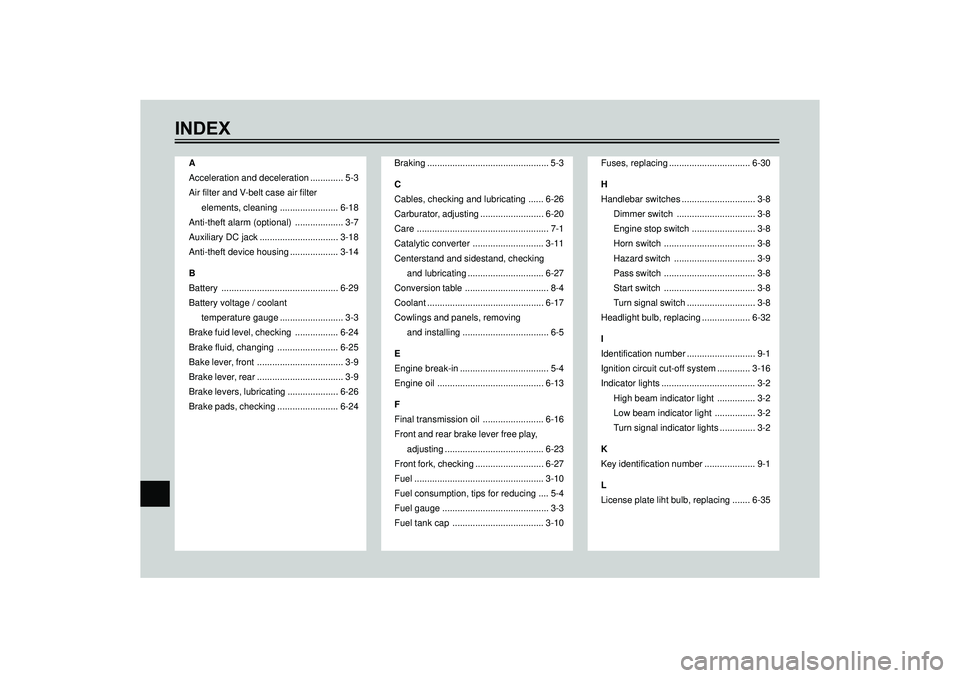
INDEX
A
Acceleration and deceleration ............. 5-3
Air filter and V-belt case air filter
elements, cleaning ....................... 6-18
Anti-theft alarm (optional) ................... 3-7
Auxiliary DC jack ............................... 3-18
Anti-theft device housing ................... 3-14
B
Battery .............................................. 6-29
Battery voltage / coolant
temperature gauge ......................... 3-3
Brake fuid level, checking ................. 6-24
Brake fluid, changing ........................ 6-25
Bake lever, front .................................. 3-9
Brake lever, rear .................................. 3-9
Brake levers, lubricating .................... 6-26
Brake pads, checking ........................ 6-24Braking ................................................ 5-3
C
Cables, checking and lubricating ...... 6-26
Carburator, adjusting ......................... 6-20
Care .................................................... 7-1
Catalytic converter ............................ 3-11
Centerstand and sidestand, checking
and lubricating .............................. 6-27
Conversion table ................................. 8-4
Coolant .............................................. 6-17
Cowlings and panels, removing
and installing .................................. 6-5
E
Engine break-in ................................... 5-4
Engine oil .......................................... 6-13
F
Final transmission oil ........................ 6-16
Front and rear brake lever free play,
adjusting ....................................... 6-23
Front fork, checking ........................... 6-27
Fuel ................................................... 3-10
Fuel consumption, tips for reducing .... 5-4
Fuel gauge .......................................... 3-3
Fuel tank cap .................................... 3-10Fuses, replacing ................................ 6-30
H
Handlebar switches ............................. 3-8
Dimmer switch ............................... 3-8
Engine stop switch ......................... 3-8
Horn switch .................................... 3-8
Hazard switch ................................ 3-9
Pass switch .................................... 3-8
Start switch .................................... 3-8
Turn signal switch ........................... 3-8
Headlight bulb, replacing ................... 6-32
I
Identification number ........................... 9-1
Ignition circuit cut-off system ............. 3-16
Indicator lights ..................................... 3-2
High beam indicator light ............... 3-2
Low beam indicator light ................ 3-2
Turn signal indicator lights .............. 3-2
K
Key identification number .................... 9-1
L
License plate liht bulb, replacing ....... 6-35