brake YAMAHA VIKING 2014 Owner's Manual
[x] Cancel search | Manufacturer: YAMAHA, Model Year: 2014, Model line: VIKING, Model: YAMAHA VIKING 2014Pages: 180, PDF Size: 3.78 MB
Page 104 of 180

7-20
7
8
9
10
11
12
13
14
4. With the brake pedal applied, set the parking brake.
5. Block the front and rear wheels with
rocks or other objects.
Loading
The total weight of operator, passengers, ac-
cessories, cargo, trailer tongue weight, and
the vehicle itself must not exceed 1080 kg
(2381 lb). Vehicle loading can affect handling.
See “Loading” on page 6-8.
Operation on differe nt surfaces and
terrainsGo slowly and proceed with caution when op-
erating on an unfamiliar surface or terrain.
This vehicle may handle differently in certain
types of terrains or on certain surfaces. You
may come upon hidden rocks, bumps, or
holes without enough time to react. To avoid
loss of control or rollover, always be alert to
changing surfaces or terrain when operating
the vehicle.
Your Yamaha Viking has higher ground clear-
ance and other features to handle rugged ter-
rain, and as a result, can overturn in situations
where some vehicles may not. Abrupt maneu-
vers or aggressive driving can cause loss of
control, including rollovers – even on flat,
open areas. These rollovers can result in
crushed limbs and other serious injuries or
death to drivers or passengers.
1XP7B_EE.book Page 20 Tuesday, February 4, 2014 3:40 PM
Page 106 of 180

7-22
7
8
9
10
11
12
13
14
Uphill
Do not attempt to climb hills until you have
mastered basic maneuvers on flat ground.
Drive straight up hills, and avoid crossing the
side of a hill, which increases your risk of roll-
over. Practice first on gentle slopes before at-
tempting steeper hills. Always check the
terrain carefully before attempting any hill.
To climb a hill, you need traction, momentum,
and steady throttle. For more traction and
control for climbing steeper and/or rougher
slopes, shift into low gear and select “4WD” or
“DIFF LOCK”. Travel fast enough to maintain
momentum, but not so fast that you cannot re-
act to changes in the terrain as you climb. Slow down when you reach the crest of the hill
if you cannot see clearly what is on the other
side – there could be another person, an ob-
stacle, or a sharp drop-off.
If you start to lose traction or momentum
when climbing, and decide you will be unable
to continue, use the brakes to stop. Do not at-
tempt to turn the vehicle around. With your
foot on the brake pedal, look behind you and
plan your descent. Shift the drive select lever
into reverse so you can use engine braking to
slow your descent. Release the brake and be-
gin to coast down the hill. Use engine braking
as much as possible, gently applying the
brakes when necessary.1XP7B_EE.book Page 22 Tuesday, February 4, 2014 3:40 PM
Page 107 of 180

7-23
1
2
3
4
5
67
8
9
10
11
12
13
14
Downhill
Check the terrain carefully before going
downhill. When possible, choose a path that
lets you drive your vehicle straight downhill.
Choose your path carefully and drive slowly
enough to be able to react to obstacles that
you encounter.
For more traction and control, before going
down steeper and/or rougher slopes, shift into
low gear and select “4WD” or “DIFF LOCK”.
Engine braking will help you go downhill slow-
ly. Go as slowly as possible. If you begin to go
too fast, apply the brakes gently. Avoid hard
application of the brakes, which could cause
the vehicle to slide.If you are sliding or skidding, try to steer in the
direction the vehicle is sliding, to regain con-
trol. For example, if you feel the back of the
vehicle start to slide to your right, steer to the
right.
If you must turn on the hill to avoid an obsta-
cle, do so slowly and carefully. If the vehicle
starts to tip, immediately steer in the downhill
direction if there are no obstacles in your path.
As you regain proper balance, gradually steer
again in the direction you want to go.1XP7B_EE.book Page 23 Tuesday, February 4, 2014 3:40 PM
Page 108 of 180

7-24
7
8
9
10
11
12
13
14
Rough terrain
Operation over rough terrain should be done
with caution.●
Look for and avoid obstacles that could
cause damage to the vehicle or could lead
to a rollover or accident.
●
Do not drive in a way that will get the vehi-
cle airborne, as injury, loss of control, and
damage to the vehicle could occur.
Pavement
This vehicle is designed for off-road use only.
Avoid paved surfaces. Turn gradually and go
slowly if you must drive on pavement. Water
If you must cross shallow, slow-moving water
up to the depth of the vehicle’s floorboards,
choose your path carefully to avoid sharp
drop-offs, large rocks, or slippery surfaces
that could cause the vehicle to overturn. Nev-
er operate through water deeper than 37 cm
(15 in) or fast-flowing water. Choose a path
where both your entrance into and exit point
from the water is a gradual incline. Determine
the water depth and currents before crossing.
Operating this vehicle through deep or fast-
flowing water can lead to loss of control or
overturn. To reduce your risk of drowning or
other injuries, use care when crossing
through water.
Wet brakes may have reduced effectiveness.
After leaving the water, test your brakes. If
necessary, apply the brakes several times to
let friction dry out the linings.
1XP7B_EE.book Page 24 Tuesday, February 4, 2014 3:40 PM
Page 110 of 180

7-26
7
8
9
10
11
12
13
14
Brush or wooded areas
When operating in areas with brush or trees,
watch carefully on both sides and above the
vehicle for obstacles such as branches that
the vehicle might hit, causing an accident.
Watch for brush that might enter the vehicle
as you pass and strike you or the passengers.
Never hold onto the cage/frame. The passen-
gers should always hold onto the passenger
handhold with both hands.
The muffler and other engine parts become
extremely hot during operation and remain
hot after the engine has stopped. To reduce
the risk of fire during operation or after leaving
the vehicle, do not let brush, grass and other
materials collect under the vehicle, near the
muffler or exhaust pipe, or next to other hot
parts. Check under the vehicle after operating
in areas where combustible materials may
have collected. Do not idle or park the vehicle
in long dry grass or other dry ground cover. Encountering obstacles
If you cannot go around an obstacle, such as
a fallen tree or a ditch, stop the vehicle where
it is safe to do so. Set the parking brake and
get out to inspect the area thoroughly. Look
from both your approach side and exit side. If
you believe you can continue safely, choose
the path that will allow you to get over the ob-
stacle and at as close to a right angle as pos-
sible to minimize vehicle tipping. Go only fast
enough to maintain your momentum but still
give yourself plenty of time to react to chang-
es in conditions.
If there is any question about your ability to
maneuver safely over the obstacle, you
should turn around if the ground is flat and you
have the room or back up until you find a less
difficult path.1XP7B_EE.book Page 26 Tuesday, February 4, 2014 3:40 PM
Page 111 of 180
8-1
1
2
3
4
5
6
78
9
10
11
12
13
14
EVU006501-PERIODIC MAINTENANCE AND ADJUSTMENTPeriodic inspection, adjustment, and lubrica-
tion will keep your vehicle in the safest and
most efficient condition possible.
Safety is an obligation of the vehicle owner/
operator. The most important points of vehicle
inspection, adjustment, and lubrication are ex-
plained on the following pages.
WARNING
Failure to properly maintain the vehicle or
performing maintenance activities incor-
rectly may increase your risk of injury or
death during service or while using the ve-
hicle. If you are not familiar with vehicle
service, have a Yamaha dealer perform
service.
WARNING
Turn off the engine when performing main-
tenance unless otherwise specified.●
A running engine has moving parts
that can catch on body parts or cloth-
ing and electrical parts that can cause
shocks or fires.
●
Running the engine while servicing
can lead to eye injury, burns, fire, or
carbon monoxide poisoning – possi-
bly leading to death. See page 2-7 for
more information about carbon mon-
oxide.WARNING
Brake discs, calipers, drums, and linings
can become very hot during use. To avoid
possible burns, let brake components cool
before touching them.
1XP7B_EE.book Page 1 Tuesday, February 4, 2014 3:40 PM
Page 115 of 180
8-5
1
2
3
4
5
6
78
9
10
11
12
13
14
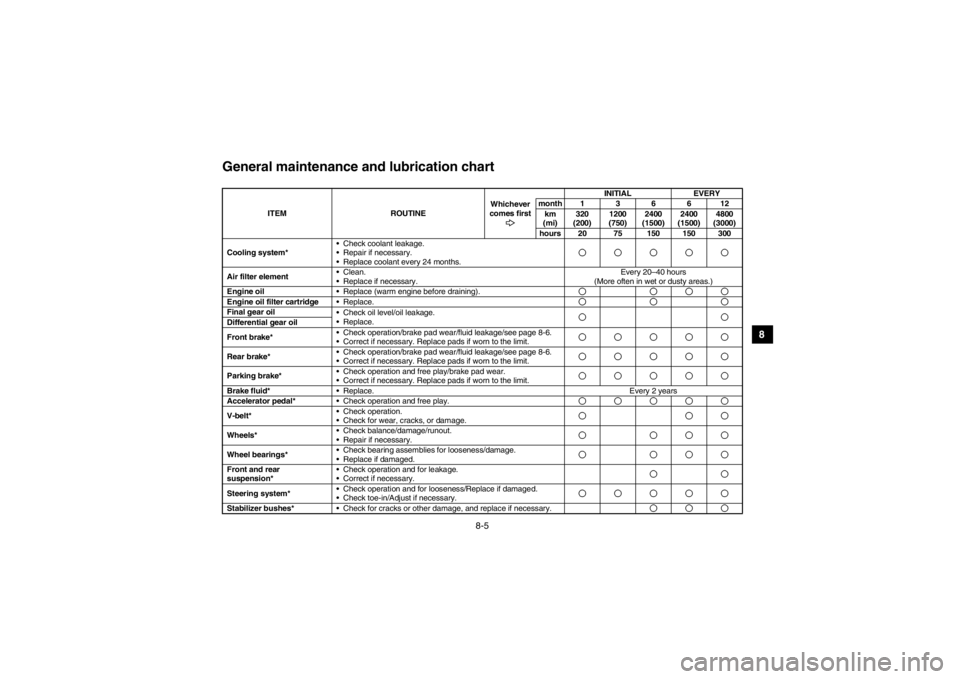
EVU01650General maintenance and lubrication chart
ITEM ROUTINEWhichever
comes first INITIAL
EVERY
month136612 km
(mi) 320
(200) 1200
(750) 2400
(1500) 2400
(1500) 4800
(3000)
hours 20 75 150 150 300
Cooling system* Check coolant leakage.
Repair if necessary.
Replace coolant every 24 months.
Air filter element
Clean.
Replace if necessary. Every 20–40 hours
(More often in wet or dusty areas.)
Engine oil Replace (warm engine before draining).Engine oil filter cartridge Replace.Final gear oil
Check oil level/oil leakage.
Replace.Differential gear oil
Front brake* Check operation/brake pad wear/fluid leakage/see page 8-6.
Correct if necessary. Replace pads if worn to the limit.Rear brake* Check operation/brake pad wear/fluid leakage/see page 8-6.
Correct if necessary. Replace pads if worn to the limit.Parking brake*
Check operation and free play/brake pad wear.
Correct if necessary. Replace pads if worn to the limit.Brake fluid*
Replace. Every 2 years
Accelerator pedal* Check operation and free play.V-belt* Check operation.
Check for wear, cracks, or damage.Wheels* Check balance/damage/runout.
Repair if necessary.Wheel bearings*
Check bearing assemblies for looseness/damage.
Replace if damaged.Front and rear
suspension* Check operation and for leakage.
Correct if necessary.Steering system*
Check operation and for looseness/Replace if damaged.
Check toe-in/Adjust if necessary.Stabilizer bushes*
Check for cracks or other damage, and replace if necessary.
1XP7B_EE.book Page 5 Tuesday, February 4, 2014 4:19 PM
Page 116 of 180
8-6
8
9
10
11
12
13
14
TIP●
Some maintenance items need more frequent service if you are riding in unusually wet, dusty,
sandy or muddy areas, or at full throttle.
●
Hydraulic brake service
Regularly check and, if necessary, correct the brake fluid level.
Every two years replace the internal components of the brake master cylinder and calipers, and change the brake fluid.
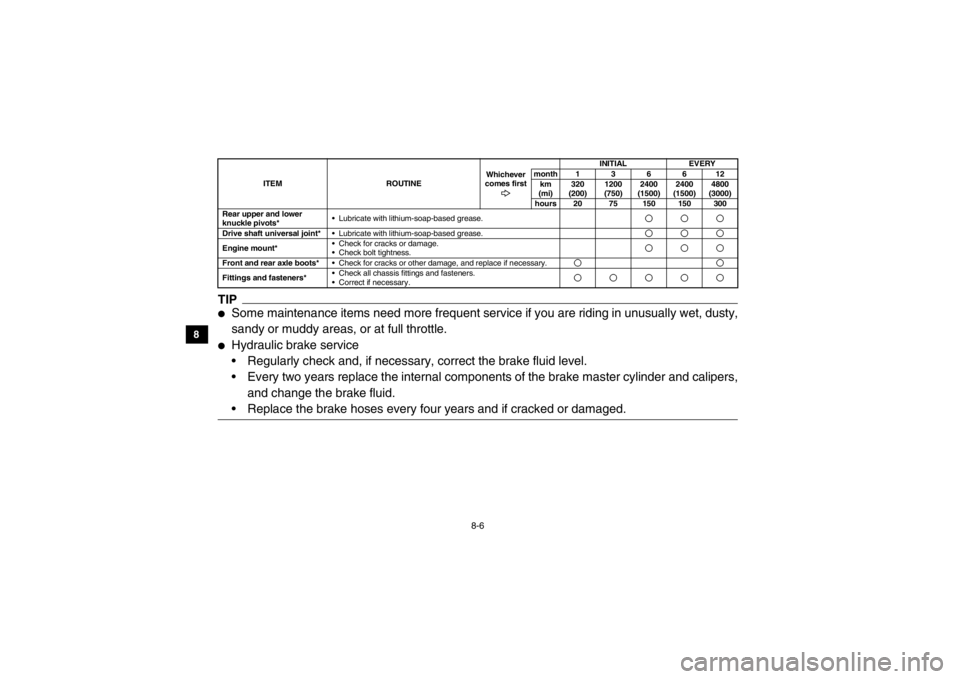
Replace the brake hoses every four years and if cracked or damaged.Rear upper and lower
knuckle pivots* Lubricate with lithium-soap-based grease.Drive shaft universal joint*
Lubricate with lithium-soap-based grease.Engine mount* Check for cracks or damage.
Check bolt tightness.Front and rear axle boots*
Check for cracks or other damage, and replace if necessary.Fittings and fasteners* Check all chassis fittings and fasteners.
Correct if necessary.
ITEM
ROUTINEWhichever
comes first INITIAL
EVERY
month136612 km
(mi) 320
(200) 1200
(750) 2400
(1500) 2400
(1500) 4800
(3000)
hours 20 75 150 150 300
1XP7B_EE.book Page 6 Tuesday, February 4, 2014 4:19 PM
Page 142 of 180
8-32
8
9
10
11
12
13
14
BrakesReplacement of brake components requires
professional knowledge. Brake service should
be performed by a Yamaha dealer.
WARNING
Operating with improperly serviced or ad-
justed brakes could lead to a loss in brak-
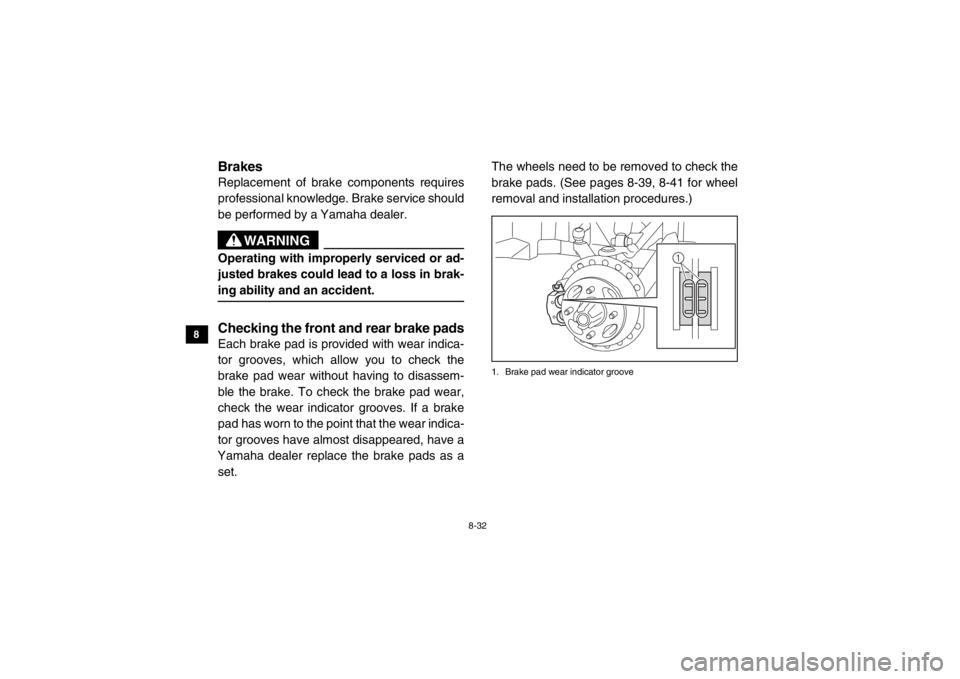
ing ability and an accident.5B410019Checking the front and rear brake padsEach brake pad is provided with wear indica-
tor grooves, which allow you to check the
brake pad wear without having to disassem-
ble the brake. To check the brake pad wear,
check the wear indicator grooves. If a brake
pad has worn to the point that the wear indica-
tor grooves have almost disappeared, have a
Yamaha dealer replace the brake pads as a
set. The wheels need to be removed to check the
brake pads. (See pages 8-39, 8-41 for wheel
removal and installation procedures.)
1. Brake pad wear indicator groove
1
1XP7B_EE.book Page 32 Tuesday, February 4, 2014 3:40 PM
Page 143 of 180
8-33
1
2
3
4
5
6
78
9
10
11
12
13
14
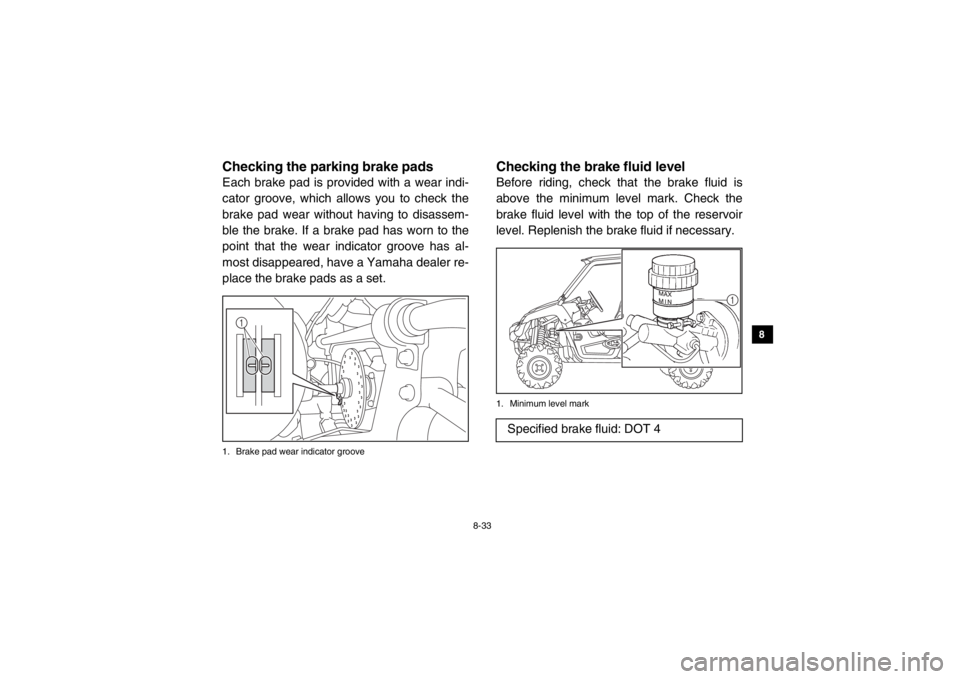
5B410020Checking the parking brake padsEach brake pad is provided with a wear indi-
cator groove, which allows you to check the
brake pad wear without having to disassem-
ble the brake. If a brake pad has worn to the
point that the wear indicator groove has al-
most disappeared, have a Yamaha dealer re-
place the brake pads as a set.1. Brake pad wear indicator groove
EVU00850Checking the brake fluid levelBefore riding, check that the brake fluid is
above the minimum level mark. Check the
brake fluid level with the top of the reservoir
level. Replenish the brake fluid if necessary.1. Minimum level mark
1
Specified brake fluid: DOT 4
1
1XP7B_EE.book Page 33 Tuesday, February 4, 2014 3:40 PM