steering YAMAHA VIKING 2016 User Guide
[x] Cancel search | Manufacturer: YAMAHA, Model Year: 2016, Model line: VIKING, Model: YAMAHA VIKING 2016Pages: 172, PDF Size: 3.94 MB
Page 35 of 172
3-3
3
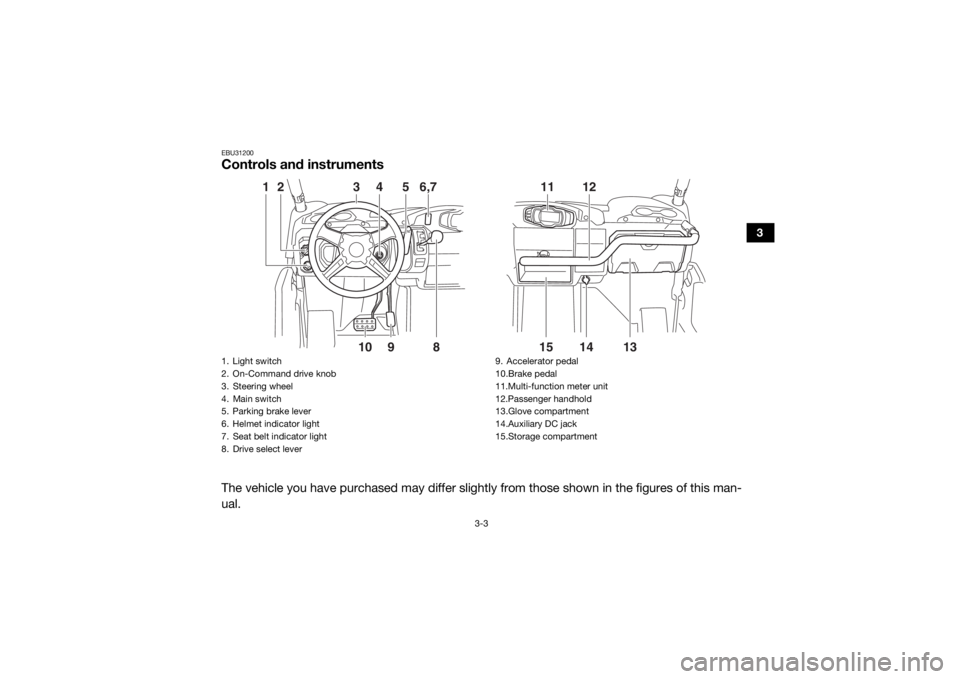
EBU31200Controls and instrumentsThe vehicle you have purchased may differ slightly from those shown in the figures of this man-
ual.
10
9
2
3
4
5
6,7
8
1
15
13
11
1214
1. Light switch
2. On-Command drive knob
3. Steering wheel
4. Main switch
5. Parking brake lever
6. Helmet indicator light
7. Seat belt indicator light
8. Drive select lever
9. Accelerator pedal
10.Brake pedal
11.Multi-function meter unit
12.Passenger handhold
13.Glove compartment
14.Auxiliary DC jack
15.Storage compartmentUB427AE0.book Page 3 Monday, May 18, 2015 9:17 AM
Page 37 of 172
4-2
4
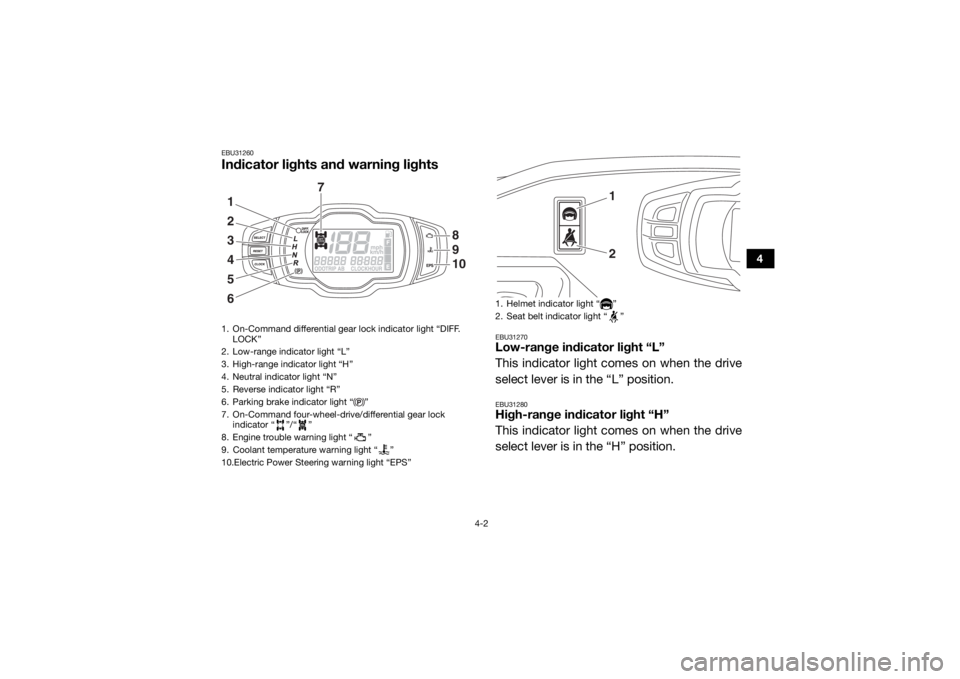
EBU31260Indicator lights and warning lights
EBU31270Low-range indicator light “L”
This indicator light comes on when the drive
select lever is in the “L” position.EBU31280High-range indicator light “H”
This indicator light co mes on when the drive
select lever is in the “H” position.
1. On-Command differential gear lock indicator light “DIFF.
LOCK”
2. Low-range indicator light “L”
3. High-range indicator light “H”
4. Neutral indicator light “N”
5. Reverse indicator light “R”
6. Parking brake indicator light “ ”
7. On-Command four-wheel-drive/differential gear lock indicator “ ”/“ ”
8. Engine trouble warning light “ ”
9. Coolant temperature warning light “ ”
10.Electric Power Steering warning light “EPS”356421
7
8109
1. Helmet indicator light “ ”
2. Seat belt indicator light “ ”
21
UB427AE0.book Page 2 Monday, May 18, 2015 9:17 AM
Page 40 of 172

4-5
4
EBU33040Electric Power Steering warning light
“EPS”
This warning light comes on when the key is
turned to “ ” (on), and then goes off once
the engine is started. If the warning light re-
mains on or comes on after the engine is
started, the EPS system may not be working
correctly. When this occurs, have a Yamaha
dealer check the EPS system.
The electrical circuit of the warning light can
be checked by turning the key to “ ” (on). If
the warning light does not come on, have a
Yamaha dealer check the electrical circuit.TIPIf the steering load is too heavy (i.e., exces-
sive steering use when the Viking is traveling
at a slow speed), the power assist is reduced
to protect the EPS motor from overheating.
EBU31360Helmet indicator light “ ”
The indicator light comes on and stays on
while the key is turned to “ ” (on) to remind
the occupants to always wear a helmet. If the
indicator light does not come on when the key
is turned to “ ” (on), have a Yamaha dealer
check the electrical circuit.EBU31370Seat belt indicator light “ ”
The indicator light comes on when the key is
turned to “ ” (on) to remind the occupants
to fasten their seat belt. The indicator light
stays on until the driver seat belt is properly
latched. If the indicator light does not come
on when the key is turned to “ ” (on), or if
the indicator light remains on after the driver
seat belt is properly latched, have a Yamaha
dealer check the electrical circuit.
UB427AE0.book Page 5 Monday, May 18, 2015 9:17 AM
Page 48 of 172
4-13
4
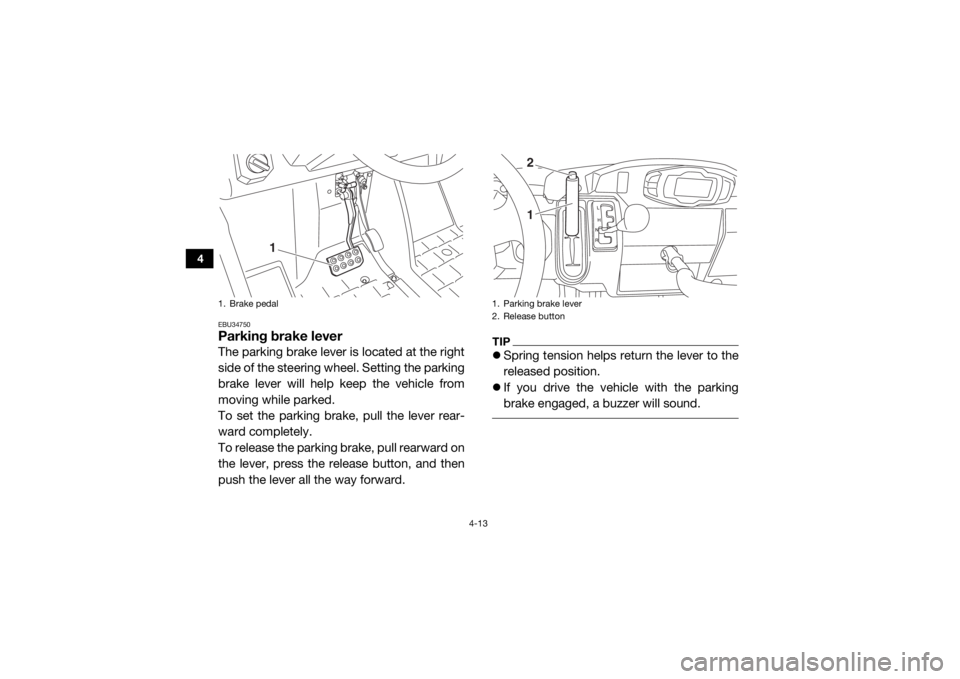
EBU34750Parking brake leverThe parking brake lever is located at the right
side of the steering wheel. Setting the parking
brake lever will help keep the vehicle from
moving while parked.
To set the parking brake, pull the lever rear-
ward completely.
To release the parking brake, pull rearward on
the lever, press the release button, and then
push the lever all the way forward.
TIPSpring tension helps return the lever to the
released position.
If you drive the vehicle with the parking
brake engaged, a buzzer will sound.
1. Brake pedal
1
1. Parking brake lever
2. Release button
12
UB427AE0.book Page 13 Monday, May 18, 2015 9:17 AM
Page 62 of 172

5-2
5
Coolant• Check coolant level in reservoir.
• Fill with coolant if necessary.
5-6, 8-20
Final gear oil/Differen-
tial gear oil • Check for leakage. 5-6, 5-6, 8-16, 8-18
Accelerator pedal • Check for proper accelerator pedal operation. 5-7
Seat belts • Check for proper operation and belt wear. 5-7
Passenger handhold • Check for stability and proper fastening. 5-7, 7-8
Steering • Check for proper operation. 5-7
Fittings and fasteners • Check all fittings and fasteners. 5-8
Instruments, lights and
switches • Check operation, and correct if necessary. 5-8, 8-49, 8-51, 8-52
Wheels and tires • Check tire pressure and for wear and damage. 5-8, 8-39, 8-41
Axle boots • Check for damage. 8-21
ITEM ROUTINE PAGEUB427AE0.book Page 2 Monday, May 18, 2015 9:17 AM
Page 67 of 172

5-7
5
EBU31790Accelerator pedalCheck to see that the accelerator pedal oper-
ates correctly. It must operate smoothly and
spring back to the idle position fully when re-
leased. Have a Yamaha dealer repair as nec-
essary for proper operation.EBU31800Seat beltsMake sure that the seat belts are not frayed,
torn, stretched, or damaged. The seat belts
must move smoothly when pulled out and re-
tract on its own when released. The seat belts
must also lock up when quickly pulled out.
The latch plate should click securely into the
buckle and release when the release button is
pushed firmly. Wash off any dirt or mud that
could affect operation. Have a Yamaha dealer
repair as necessary for proper operation.
A crash can damage the restraint systems in
your vehicle. A damaged restraint system
may not properly protect the person using it,
resulting in serious injury or death in a crash.To help make sure your restraint systems are
working properly after a crash, have them in-
spected and any necessary replacements
made as soon as possible.
EBU31810Passenger handholdCheck that the handhold bar and its supports
are in good condition. Confirm that the lock-
ing pins are securely fastened, and then push
and pull on the handhold to make sure that it
is not loose.EBU31820SteeringPark on level ground. Turn the steering wheel
right and left. Check for excessive free play,
abnormal noises, or a rough feeling. Have a
Yamaha dealer repair as necessary for proper operation.
UB427AE0.book Page 7 Monday, May 18, 2015 9:17 AM
Page 76 of 172

6-6
6
TIPWhen the knob is set to “DIFF LOCK” or “4WD”, the differential gear lock indicator and indica-
tor light will flash until the differential gear is completely locked or unlocked.
When the indicator and indicator light are flas hing, turning the steering wheel back and forth
will help the differential gear lock to engage or disengage.
Riding before the differential gear is properly engaged or disengaged (e.g., when the indicator
and indicator light are flashing) will cause the vehicle speed to be limited until the differential
gear is completely engaged or disengaged. UB427AE0.book Page 6 Monday, May 18, 2015 9:17 AM
Page 89 of 172
7-10
7
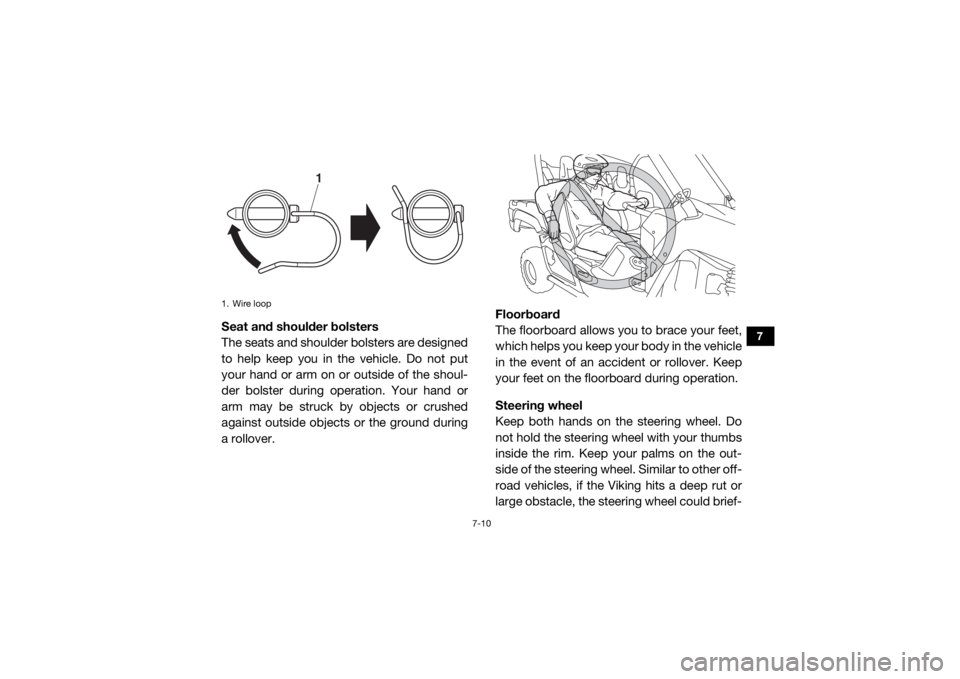
Seat and shoulder bolsters
The seats and shoulder bolsters are designed
to help keep you in the vehicle. Do not put
your hand or arm on or outside of the shoul-
der bolster during operation. Your hand or
arm may be struck by objects or crushed
against outside objects or the ground during
a rollover.Floorboard
The floorboard allows you to brace your feet,
which helps you keep your body in the vehicle
in the event of an accident or rollover. Keep
your feet on the floorboard during operation.
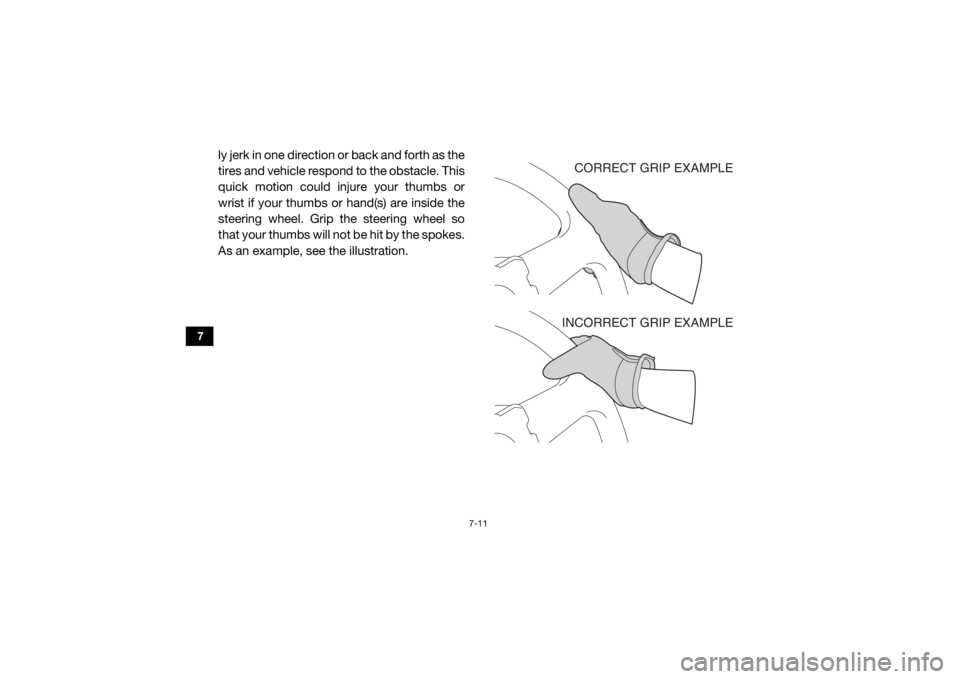
Steering wheel
Keep both hands on the steering wheel. Do
not hold the steering wheel with your thumbs
inside the rim. Keep your palms on the out-
side of the steering wheel. Similar to other off-
road vehicles, if the Viking hits a deep rut or
large obstacle, the steering wheel could brief-1. Wire loop
1
UB427AE0.book Page 10 Monday, May 18, 2015 9:17 AM
Page 90 of 172
7-11
7
ly jerk in one direction or back and forth as the
tires and vehicle respond to the obstacle. This
quick motion could injure your thumbs or
wrist if your thumbs or hand(s) are inside the
steering wheel. Grip the steering wheel so
that your thumbs will not be hit by the spokes.
As an example, see the illustration.
CORRECT GRIP EXAMPLE
INCORRECT GRIP EXAMPLE
UB427AE0.book Page 11 Monday, May 18, 2015 9:17 AM
Page 92 of 172
7-13
7
Practice for new Yamaha Viking users
You should become familiar with the perfor-
mance characteristics of the vehicle in a
large, flat area that is free of obstacles and
other vehicles. Practice controlling the accel-
erator pedal, brakes, steering, and drive se-
lect lever. Drive at slow speeds with gradual
acceleration and turning. Practice smooth
throttle application. Practice slowing down
before turning. Practice maintaining a steady
throttle through the turn. Avoid higher speeds
until you are thoroughly familiar with the oper-
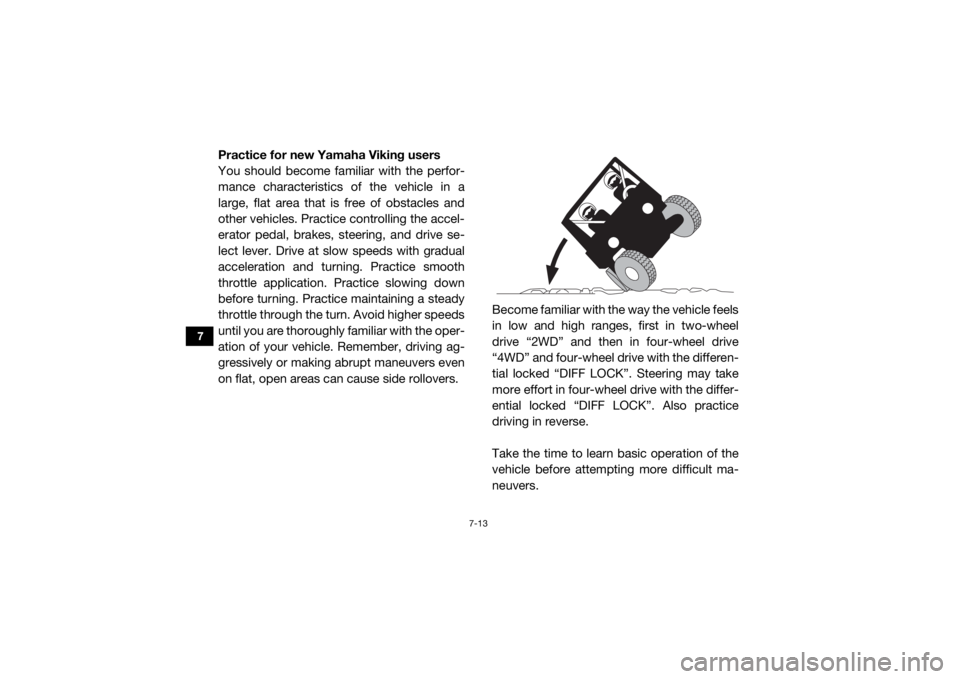
ation of your vehicle. Remember, driving ag-
gressively or making abrupt maneuvers even
on flat, open areas can cause side rollovers.Become familiar with the way the vehicle feels
in low and high ranges, first in two-wheel
drive “2WD” and then in four-wheel drive
“4WD” and four-wheel drive with the differen-
tial locked “DIFF LOCK”. Steering may take
more effort in four-wheel drive with the differ-
ential locked “DIFF LOCK”. Also practice
driving in reverse.
Take the time to learn basic operation of the
vehicle before attempting more difficult ma-
neuvers.UB427AE0.book Page 13 Monday, May 18, 2015 9:17 AM