wheel YAMAHA VIKING 2016 Owner's Manual
[x] Cancel search | Manufacturer: YAMAHA, Model Year: 2016, Model line: VIKING, Model: YAMAHA VIKING 2016Pages: 172, PDF Size: 3.94 MB
Page 89 of 172
7-10
7
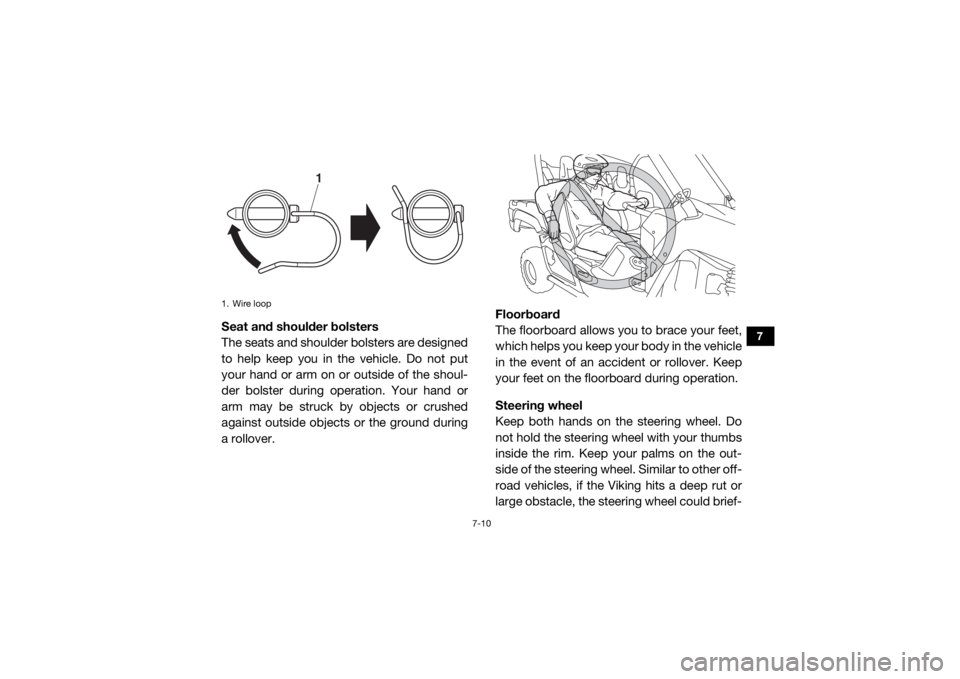
Seat and shoulder bolsters
The seats and shoulder bolsters are designed
to help keep you in the vehicle. Do not put
your hand or arm on or outside of the shoul-
der bolster during operation. Your hand or
arm may be struck by objects or crushed
against outside objects or the ground during
a rollover.Floorboard
The floorboard allows you to brace your feet,
which helps you keep your body in the vehicle
in the event of an accident or rollover. Keep
your feet on the floorboard during operation.
Steering wheel
Keep both hands on the steering wheel. Do
not hold the steering wheel with your thumbs
inside the rim. Keep your palms on the out-
side of the steering wheel. Similar to other off-
road vehicles, if the Viking hits a deep rut or
large obstacle, the steering wheel could brief-1. Wire loop
1
UB427AE0.book Page 10 Monday, May 18, 2015 9:17 AM
Page 90 of 172
7-11
7
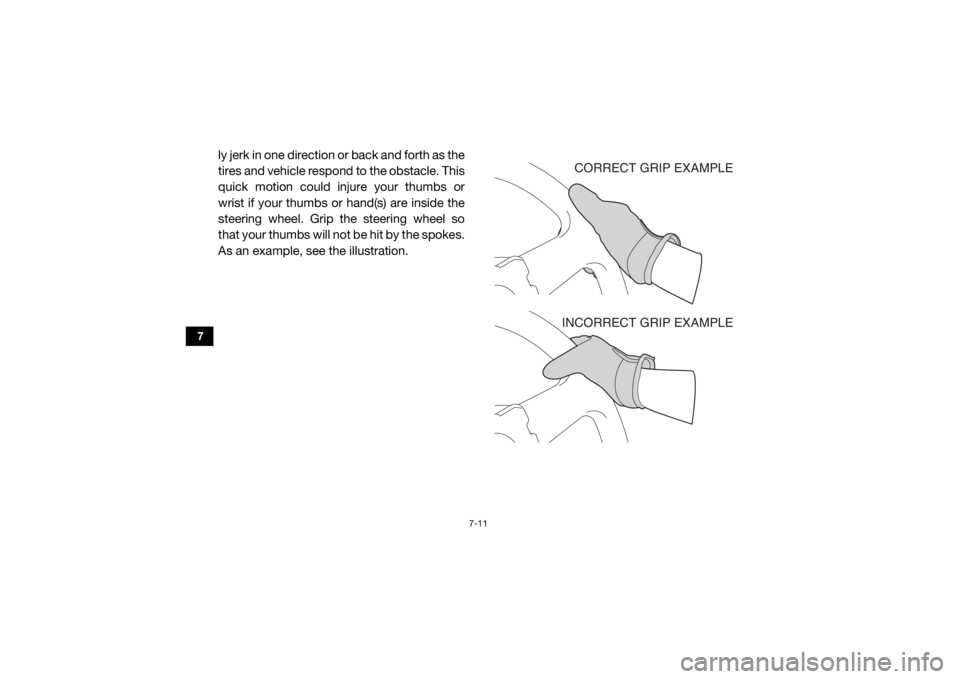
ly jerk in one direction or back and forth as the
tires and vehicle respond to the obstacle. This
quick motion could injure your thumbs or
wrist if your thumbs or hand(s) are inside the
steering wheel. Grip the steering wheel so
that your thumbs will not be hit by the spokes.
As an example, see the illustration.
CORRECT GRIP EXAMPLE
INCORRECT GRIP EXAMPLE
UB427AE0.book Page 11 Monday, May 18, 2015 9:17 AM
Page 92 of 172
7-13
7
Practice for new Yamaha Viking users
You should become familiar with the perfor-
mance characteristics of the vehicle in a
large, flat area that is free of obstacles and
other vehicles. Practice controlling the accel-
erator pedal, brakes, steering, and drive se-
lect lever. Drive at slow speeds with gradual
acceleration and turning. Practice smooth
throttle application. Practice slowing down
before turning. Practice maintaining a steady
throttle through the turn. Avoid higher speeds
until you are thoroughly familiar with the oper-
ation of your vehicle. Remember, driving ag-
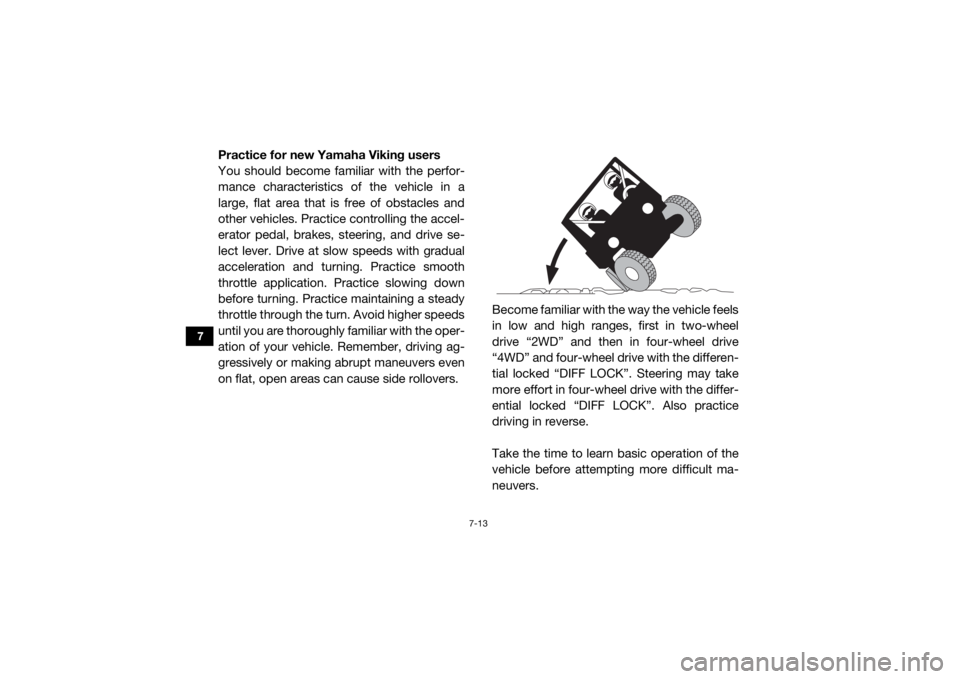
gressively or making abrupt maneuvers even
on flat, open areas can cause side rollovers.Become familiar with the way the vehicle feels
in low and high ranges, first in two-wheel
drive “2WD” and then in four-wheel drive
“4WD” and four-wheel drive with the differen-
tial locked “DIFF LOCK”. Steering may take
more effort in four-wheel drive with the differ-
ential locked “DIFF LOCK”. Also practice
driving in reverse.
Take the time to learn basic operation of the
vehicle before attempting more difficult ma-
neuvers.UB427AE0.book Page 13 Monday, May 18, 2015 9:17 AM
Page 93 of 172

7-14
7
Getting ready to ride
Perform the Pre-Operation Checks on page
5-1. Follow the instructions starting on page
6-2 to start the engine.
Turning
Use care in turns – turning the steering wheel
too far or too fast can result in loss of control
or a rollover. Slow down before entering
turns. When making tight turns from a stand-
still or at slow speeds, avoid sudden or hard
acceleration. Driving aggressively or making
abrupt maneuvers even on flat, open areas
can cause side rollovers. Avoid sideways slid-
ing, skidding, or back-wheel sliding, and nev-
er do donuts. If you feel the Viking begin to
slide sideways or the back wheels slide dur-
ing a turn, steer into the direction of the slide,
if possible, and gradually let off the accelera-
tor pedal to regain directional control and
avoid rollover. For example, if you feel the
back of the vehicle start to slide to your right,
steer to the right.If you think or feel that the vehicle may tip or
roll, keep your body completely inside the
protective structure of the vehicle:
Brace yourself by pressing your feet firmly
on the floorboard and keep a firm grip on
the steering wheel or passenger handhold.
Do not put your hands or feet outside of the
vehicle for any reason. Do not try to stop a
tipover using your arm or leg.
Accelerating
With the engine idling in neutral and your foot
on the brake, shift the drive select lever into
low or high. NOTICE: Do not shift from low
to high or vice versa without coming to a
complete stop and waiting for the engine
to return to normal idle speed – damage to
the engine or drive train may occur. Then
release the parking brake.
[ECB02160]
Press the
accelerator pedal slowly and smoothly. The
centrifugal clutch will engage and the vehicle
will begin to accelerate.
UB427AE0.book Page 14 Monday, May 18, 2015 9:17 AM
Page 94 of 172

7-15
7
Avoid higher speeds and sudden or hard ac-
celeration until you are thoroughly familiar
with the operation of your vehicle. Avoid sud-
den or hard acceleration in any turn.
Braking
When slowing down or stopping, take your
foot off the accelerator pedal and press the
brake pedal smoothly. Improper use of the
brakes can cause the tires to lose traction, re-
ducing control of the vehicle and increasing
the possibility of an accident.
Braking ability is affected by type of terrain. In
most cases, gradual application of the brakes
is more effective than abrupt braking, partic-
ularly on loose surfaces, such as gravel. Al-
ways allow for greater braking distance on
rough, loose, or slippery surfaces.
Engine braking
Engine compression braking is designed to
assist you when operating your Viking off-
road. With this feature, the engine helps slow the vehicle down after you take your foot off
the accelerator. Engine braking is more no-
ticeable in four-wheel drive. Application of ve-
hicle brakes provides additional stopping
power.
Leaving the vehicle
Do not get out of the vehicle while the engine
is running and the drive select lever is in any
gear. There is a risk
of injury because:
Children or others may accidentally press
the accelerator pedal.
Objects tossed into the vehicle may strike
the accelerator pedal.
The parking brake may not keep the vehicle
from accelerating.
Unwanted vehicle movement can cause seri-
ous injury or death, and it may be dangerous
to try to stop the vehicle.UB427AE0.book Page 15 Monday, May 18, 2015 9:17 AM
Page 95 of 172

7-16
7
Parking on a flat area
When parking on a flat area, stop the engine
and shift the drive select lever into the neutral
position. Apply the parking brake to help pre-
vent the vehicle from rolling.
Parking on a slope
The parking brake acts only on the rear
wheels when in “2WD”. For the parking brake
to take effect on all four wheels, shift to “DIFF
LOCK” before stopping the engine.
If you park on a hill that is too steep the vehi-
cle may roll out of control. Never park on hills
that are so steep you cannot walk up them
easily. If you must park on an incline follow
these instructions:1. Bring the vehicle to a stop by applying the brake pedal.
2. Put the vehicle in “DIFF LOCK”.
3. Turn the key to “ ” (off).
4. With the brake pedal applied, set the parking brake. 5. Block the front and rear wheels with
rocks or other objects.
Loading
The total weight of operator, passengers, ac-
cessories, cargo, trailer tongue weight, and
the vehicle itself must not exceed 1080 kg
(2381 lb). Vehicle loading can affect handling.
See “Loading” on page 6-7.
EBU33360Operation on different surfaces and
terrainsGo slowly and proceed with caution when op-
erating on an unfamiliar surface or terrain.
This vehicle may handle differently in certain
types of terrains or on certain surfaces. You
may come upon hidden rocks, bumps, or
holes without enough time to react. To avoid
loss of control or rollover, always be alert to
changing surfaces or terrain when operating
the vehicle.
UB427AE0.book Page 16 Monday, May 18, 2015 9:17 AM
Page 96 of 172
7-17
7
Your Yamaha Viking has higher ground clear-
ance and other features to handle rugged ter-
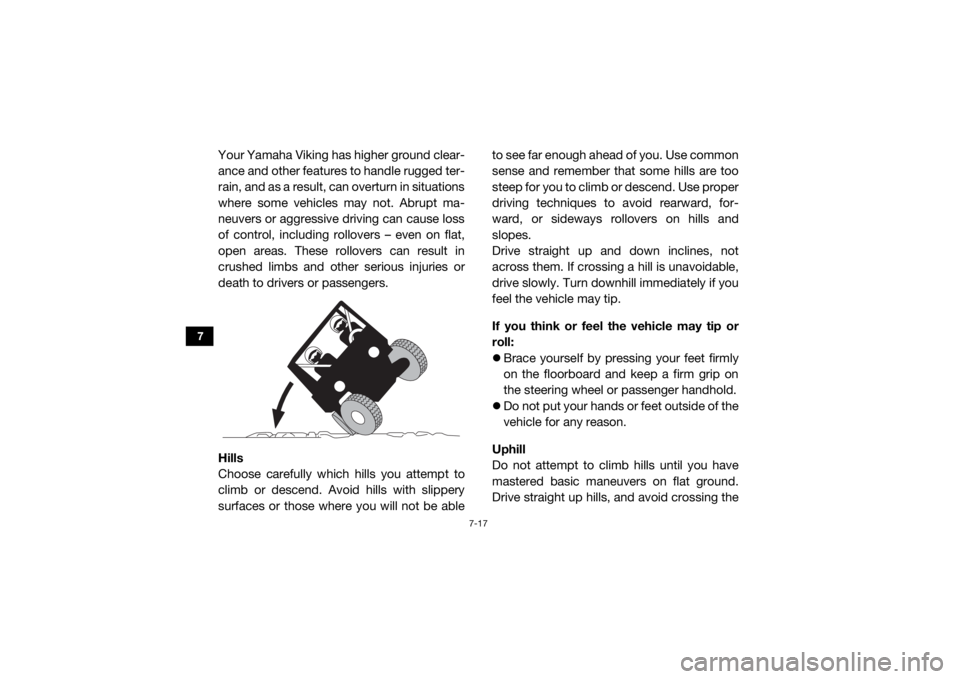
rain, and as a result, can overturn in situations
where some vehicles may not. Abrupt ma-
neuvers or aggressive driving can cause loss
of control, including rollovers – even on flat,
open areas. These rollovers can result in
crushed limbs and other serious injuries or
death to drivers or passengers.
Hills
Choose carefully which hills you attempt to
climb or descend. Avoid hills with slippery
surfaces or those where you will not be ableto see far enough ahead of you. Use common
sense and remember that some hills are too
steep for you to climb or descend. Use proper
driving techniques to avoid rearward, for-
ward, or sideways rollovers on hills and
slopes.
Drive straight up and down inclines, not
across them. If crossing a hill is unavoidable,
drive slowly. Turn downhill immediately if you
feel the vehicle may tip.
If you think or feel the vehicle may tip or
roll:
Brace yourself by pressing your feet firmly
on the floorboard and keep a firm grip on
the steering wheel or passenger handhold.
Do not put your hands or feet outside of the
vehicle for any reason.
Uphill
Do not attempt to climb hills until you have
mastered basic maneuvers on flat ground.
Drive straight up hills, and avoid crossing theUB427AE0.book Page 17 Monday, May 18, 2015 9:17 AM
Page 99 of 172

7-20
7
Wet brakes may have reduced effectiveness.
After leaving the water, test your brakes. If
necessary, apply the brakes several times to
let friction dry out the linings.NOTICEECB02170After driving your vehicle in water, be sure
to drain the trapped water by removing the
check hoses at the bottom of the air filter
case and air duct and the V-belt case drain
plug. Wash the vehicle in fresh water if it
has been operated in salt water or muddy
conditions. Loose terrain/slippery terrain
When driving on slippery terrain, including
wet, muddy, or icy conditions, as well as
loose gravel, be aware that you could begin
skidding or sliding. To avoid loss of control,
slow down and put the vehicle in four-wheel
drive before driving on a slippery surface and
plan your path to avoid making abrupt ma-
neuvers. If you feel the vehicle begin to slide sideways
or the back wheels slide during a turn, steer
into the direction of the slide if possible, to re-
gain directional control. For example, if you
feel the back of the vehicle start to slide to
your right, steer to the right.
Brush or wooded areas
When operating in areas with brush or trees,
watch carefully on both sides and above the
vehicle for obstacles such as branches that
the vehicle might hit, causing an accident.
Watch for brush that might enter the vehicle
as you pass and strike you or the passengers.
Never hold onto the cage/frame. The passen-
gers should always hold onto the passenger
handhold with both hands.
The muffler and other engine parts become
extremely hot during operation and remain
hot after the engine has stopped. To reduce
the risk of fire during operation or after leaving
the vehicle, do not let
brush, grass and other
materials collect under the vehicle, near theUB427AE0.book Page 20 Monday, May 18, 2015 9:17 AM
Page 107 of 172

8-7
8
8*Parking brake • Check operation and free play/brake pad
wear.
• Correct if necessary. Replace pads if worn to the limit. √√√√√
9 *Brake fluid • Change. Every 2 years
10 *Accelerator pedal • Check operation and free play. √√√√√
11 *V-b e l t • Check operation.
• Check for wear, cracks, or damage. √√
√
12 *Wheels • Check balance/damage/runout.
• Repair if necessary. √√√√
13 *Wheel bearings • Check bearing assemblies for loose-
ness/damage.
• Replace if damaged. √√√√
14 *Front and rear
suspension • Check operation and for leakage.
• Correct if necessary.
√√
15 *Steering system • Check operation and for looseness/Replace
if damaged.
• Check toe-in/Adjust if necessary. √√√√√
16 *Stabilizer bushes • Check for cracks or other damage, and re-
place if necessary. √√√
NO. ITEM
ROUTINE INITIAL
EVERY
Whichev- er comes first month 1 3 6 6 12
km
(mi) 320
(200) 1200
(750) 2400
(1500) 2400
(1500) 4800
(3000)
hours 20 75 150 150 300
UB427AE0.book Page 7 Monday, May 18, 2015 9:17 AM
Page 132 of 172

8-32
8
EBU32460Valve clearanceThe correct valve clearance changes with
use, resulting in improper fuel/air supply or
engine noise. To prevent this, the valve clear-
ance must be adjusted regularly. This adjust-
ment however, should be left to a
professional Yamaha service technician.EBU32470BrakesReplacement of brake components requires
professional knowledge. Brake service
should be performed by a Yamaha dealer.
WARNING
EWB02572Operating with improperly serviced or ad-
justed brakes could lead to a loss in brak-
ing ability and an accident.
EBU32480Checking the front and rear brake padsEach brake pad is provided with wear indica-
tor grooves, which allow you to check the
brake pad wear without having to disassem-
ble the brake. To check the brake pad wear,
check the wear indicator grooves. If a brake
pad has worn to the point that the wear indi-
cator grooves have almost disappeared, have
a Yamaha dealer replace the brake pads as a
set.
The wheels need to be removed to check the
brake pads. (See pages 8-39, 8-41 for wheel
removal and installation procedures.)
UB427AE0.book Page 32 Monday, May 18, 2015 9:17 AM