engine oil YAMAHA VMAX 2001 User Guide
[x] Cancel search | Manufacturer: YAMAHA, Model Year: 2001, Model line: VMAX, Model: YAMAHA VMAX 2001Pages: 110, PDF Size: 11.88 MB
Page 54 of 110
PERIODIC MAINTENANCE AND MINOR REPAIR
6-11
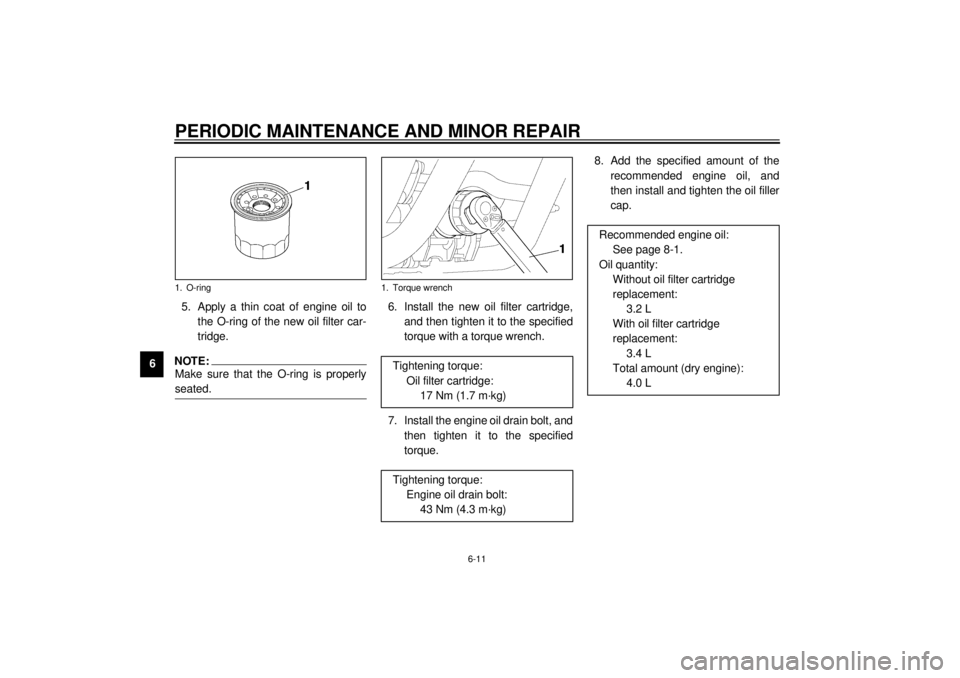
65. Apply a thin coat of engine oil to
the O-ring of the new oil filter car-
tridge.
NOTE:@ Make sure that the O-ring is properly
seated. @
6. Install the new oil filter cartridge,
and then tighten it to the specified
torque with a torque wrench.
7. Install the engine oil drain bolt, and
then tighten it to the specified
torque.8. Add the specified amount of the
recommended engine oil, and
then install and tighten the oil filler
cap.
1. O-ring
1. Torque wrench
Tightening torque:
Oil filter cartridge:
17 Nm (1.7 m·kg)
Tightening torque:
Engine oil drain bolt:
43 Nm (4.3 m·kg)
Recommended engine oil:
See page 8-1.
Oil quantity:
Without oil filter cartridge
replacement:
3.2 L
With oil filter cartridge
replacement:
3.4 L
Total amount (dry engine):
4.0 L
E_3lr.book Page 11 Wednesday, November 22, 2000 4:10 PM
Page 55 of 110
PERIODIC MAINTENANCE AND MINOR REPAIR
6-12
6
EC000072
CAUTION:@ l
In order to prevent clutch slip-
page (since the engine oil also
lubricates the clutch), do not
mix any chemical additives with
the oil or use oils of a higher
grade than “CD”. In addition, do
not use oils labeled “ENERGY
CONSERVING II” or higher.
l
Make sure that no foreign mate-
rial enters the crankcase.
@9. Start the engine, and then let it idle
for several minutes while checking
it for oil leakage. If oil is leaking,
immediately turn the engine off
and check for the cause.NOTE:@ After the engine is started, the engine
oil level warning light should go off if the
oil level is sufficient. @
EC000067
CAUTION:@ If the oil level warning light flickers
or remains on, immediately turn the
engine off and have a Yamaha deal-
er check the vehicle. @10. Turn the engine off, and then
check the oil level and correct it if
necessary.
E_3lr.book Page 12 Wednesday, November 22, 2000 4:10 PM
Page 71 of 110
PERIODIC MAINTENANCE AND MINOR REPAIR
6-28
6
l
Brake fluid may deteriorate paint-
ed surfaces or plastic parts. Al-
ways clean up spilled fluid
immediately.
l
As the brake pads wear, it is nor-
mal for the brake fluid level to
gradually go down. However, if the
brake fluid level goes down sud-
denly, have a Yamaha dealer
check the cause.
EAU03238
Changing the brake fluid Have a Yamaha dealer change the
brake fluid at the intervals specified in
the periodic maintenance and lubrica-
tion chart. In addition, have the oil seals
of the brake master cylinder and caliper
as well as the brake hose replaced at
the intervals listed below or whenever
they are damaged or leaking.l
Oil seals: Replace every two
years.
l
Brake hose: Replace every four
years.
EAU02962
Checking and lubricating the
cables The operation of all control cables and
the condition of the cables should be
checked before each ride, and the ca-
bles and cable ends should be lubricat-
ed if necessary. If a cable is damaged
or does not move smoothly, have a
Yamaha dealer check or replace it.
EW000112
WARNING
@ Damage to the outer sheath may in-
terfere with proper cable operation
and will cause the inner cable to
rust. Replace a damaged cable as
soon as possible to prevent unsafe
conditions. @Recommended lubricant:
Engine oil
E_3lr.book Page 28 Wednesday, November 22, 2000 4:10 PM
Page 72 of 110
PERIODIC MAINTENANCE AND MINOR REPAIR
6-29
6
EAU03209
Checking and lubricating the
throttle grip and cable The operation of the throttle grip and
the condition of the throttle cable
should be checked before each ride,
and the cable should be lubricated or
replaced if necessary.NOTE:@ Since the throttle grip must be removed
to access the throttle cable end, the
throttle grip and the cable should al-
ways be lubricated at the same time. @1. Remove the throttle grip by remov-
ing the screws.
2. Disconnect the throttle cable, hold
it up, and then apply several drops
of oil to the cable end, allowing it to
trickle into the sheath.
3. Connect the throttle cable, and
then grease the inside of the throt-
tle grip housing.
4. Grease the metal-to-metal contact
surface of the throttle grip, and
then install the grip by installing
the screws.
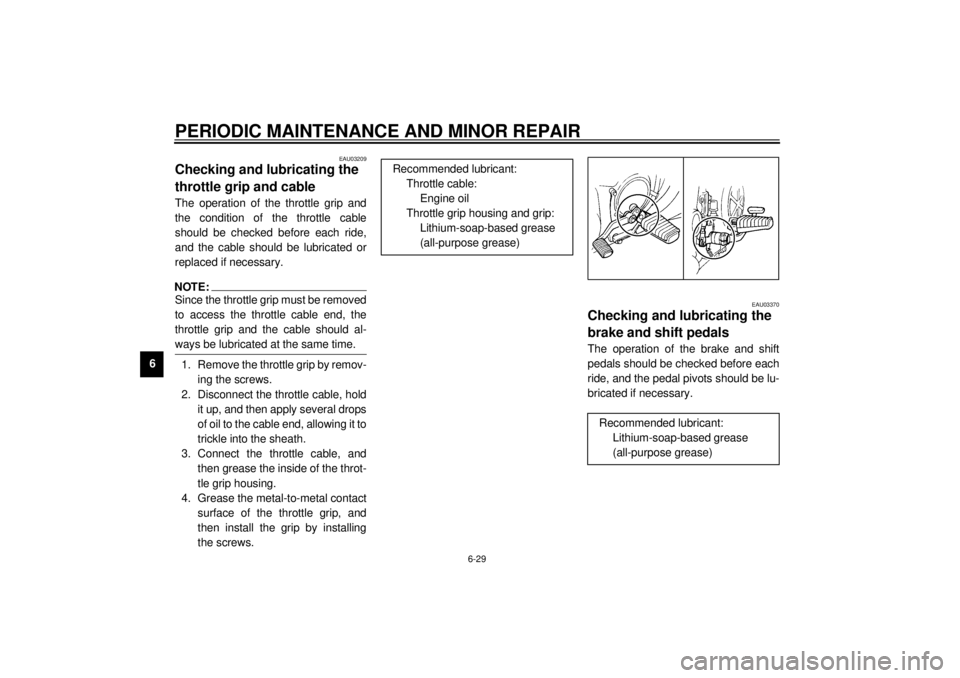
EAU03370
Checking and lubricating the
brake and shift pedals The operation of the brake and shift
pedals should be checked before each
ride, and the pedal pivots should be lu-
bricated if necessary. Recommended lubricant:
Throttle cable:
Engine oil
Throttle grip housing and grip:
Lithium-soap-based grease
(all-purpose grease)
Recommended lubricant:
Lithium-soap-based grease
(all-purpose grease)
E_3lr.book Page 29 Wednesday, November 22, 2000 4:10 PM
Page 79 of 110
PERIODIC MAINTENANCE AND MINOR REPAIR
6-36
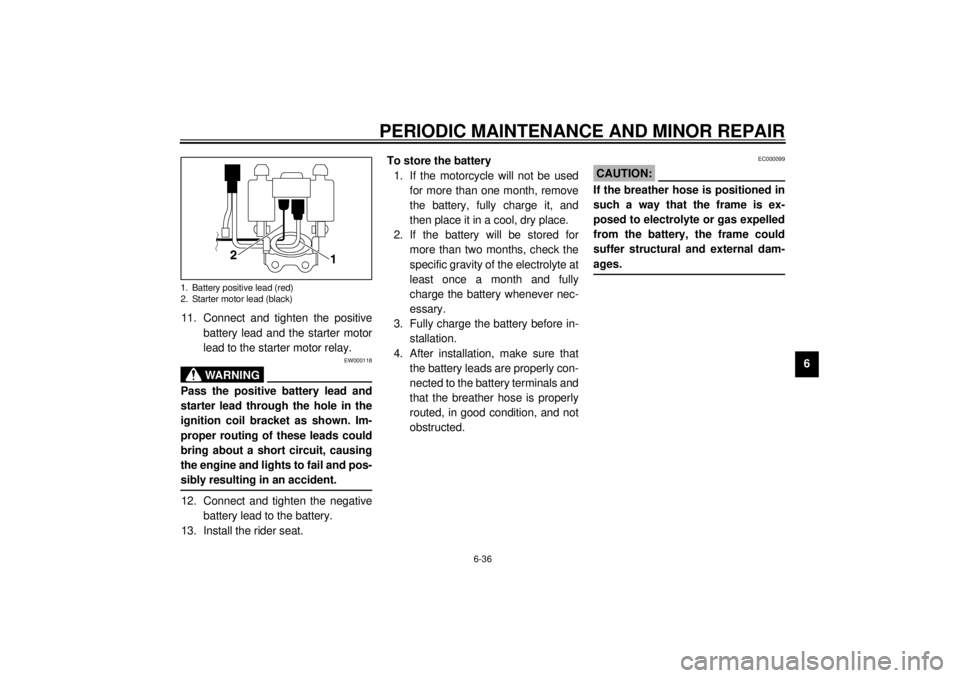
6 11. Connect and tighten the positive
battery lead and the starter motor
lead to the starter motor relay.
EW000118
WARNING
@ Pass the positive battery lead and
starter lead through the hole in the
ignition coil bracket as shown. Im-
proper routing of these leads could
bring about a short circuit, causing
the engine and lights to fail and pos-
sibly resulting in an accident. @12. Connect and tighten the negative
battery lead to the battery.
13. Install the rider seat.To store the battery
1. If the motorcycle will not be used
for more than one month, remove
the battery, fully charge it, and
then place it in a cool, dry place.
2. If the battery will be stored for
more than two months, check the
specific gravity of the electrolyte at
least once a month and fully
charge the battery whenever nec-
essary.
3. Fully charge the battery before in-
stallation.
4. After installation, make sure that
the battery leads are properly con-
nected to the battery terminals and
that the breather hose is properly
routed, in good condition, and not
obstructed.
EC000099
CAUTION:@ If the breather hose is positioned in
such a way that the frame is ex-
posed to electrolyte or gas expelled
from the battery, the frame could
suffer structural and external dam-
ages. @
1. Battery positive lead (red)
2. Starter motor lead (black)
E_3lr.book Page 36 Wednesday, November 22, 2000 4:10 PM
Page 92 of 110
7-1
7
EAU03412
7-MOTORCYCLE CARE AND STORAGECare While the open design of a motorcycle
reveals the attractiveness of the tech-
nology, it also makes it more vulnera-
ble. Rust and corrosion can develop
even if high-quality components are
used. A rusty exhaust pipe may go un-
noticed on a car, however, it detracts
from the overall appearance of a
motorcycle. Frequent and proper care
does not only comply with the terms of
the warranty, but it will also keep your
motorcycle looking good, extend its life
and optimize its performance.Before cleaning
1. Cover the muffler outlets with plas-
tic bags after the engine has
cooled down.
2. Make sure that all caps and covers
as well as all electrical couplers
and connectors, including the
spark plug caps, are tightly in-
stalled.
3. Remove extremely stubborn dirt,
like oil burnt onto the crankcase,
with a degreasing agent and a
brush, but never apply such prod-
ucts onto seals, gaskets and
wheel axles. Always rinse the dirt
and degreaser off with water.Cleaning
ECA00010
CAUTION:@ l
Avoid using strong acidic wheel
cleaners, especially on spoked
wheels. If such products are
used on hard-to-remove dirt, do
not leave the cleaner on the af-
fected area any longer than in-
structed. Also, thoroughly rinse
the area off with water, immedi-
ately dry it, and then apply a
corrosion protection spray.
l
Improper cleaning can damage
windshields, cowlings, panels
and other plastic parts. Use
only a soft, clean cloth or
sponge with mild detergent and
water to clean plastic.
l
Do not use any harsh chemical
products on plastic parts. Be
sure to avoid using cloths or
sponges which have been in
contact with strong or abrasive
cleaning products, solvent or
E_3lr.book Page 1 Wednesday, November 22, 2000 4:10 PM
Page 95 of 110
MOTORCYCLE CARE AND STORAGE
7-4
7
Storage Short-term
Always store your motorcycle in a cool,
dry place and, if necessary, protect it
against dust with a porous cover.
ECA00014
CAUTION:@ l
Storing the motorcycle in a
poorly ventilated room or cover-
ing it with a tarp, while it is still
wet, will allow water and humid-
ity to seep in and cause rust.
l
To prevent corrosion, avoid
damp cellars, stables (because
of the presence of ammonia)
and areas where strong chemi-
cals are stored.
@
Long-term
Before storing your motorcycle for sev-
eral months:
1. Follow all the instructions in the
“Care” section of this chapter.
2. For motorcycles equipped with a
fuel cock that has an “OFF” posi-
tion: Turn the fuel cock lever to
“OFF”.
3. Drain the carburetor float cham-
bers by loosening the drain bolts;
this will prevent fuel deposits from
building up. Pour the drained fuel
into the fuel tank.
4. Fill up the fuel tank and add fuel
stabilizer (if available) to prevent
the fuel tank from rusting and the
fuel from deteriorating.
5. Perform the following steps to pro-
tect the cylinders, piston rings, etc.
from corrosion.
a. Remove the spark plug caps and
spark plugs.
b. Pour a teaspoonful of engine oil
into each spark plug bore.c. Install the spark plug caps onto the
spark plugs, and then place the
spark plugs on the cylinder head
so that the electrodes are ground-
ed. (This will limit sparking during
the next step.)
d. Turn the engine over several times
with the starter. (This will coat the
cylinder walls with oil.)
e. Remove the spark plug caps from
the spark plugs, and then install
the spark plugs and the spark plug
caps.
EWA00003
WARNING
@ To prevent damage or injury from
sparking, make sure to ground the
spark plug electrodes while turning
the engine over. @
E_3lr.book Page 4 Wednesday, November 22, 2000 4:10 PM
Page 98 of 110
8-1
8
EAU01038
8-SPECIFICATIONSSpecifications CS-01E
Model VMX12
Dimensions
Overall length 2,300 mm
Overall width 795 mm
Overall height 1,160 mm
Seat height 765 mm
Wheelbase 1,590 mm
Ground clearance 145 mm
Minimum turning radius 2,900 mm
Basic weight (with oil and full
fuel tank)
281 kg
Engine
Engine type Liquid-cooled 4-stroke, DOHC
Cylinder arrangement V type, 4-cylinder
Displacement 1,198 cm
3
Bore ´ stroke 76 ´ 66 mm
Compression ratio 10.5:1
Starting system Electric starter
Lubrication system Wet sumpEngine oil
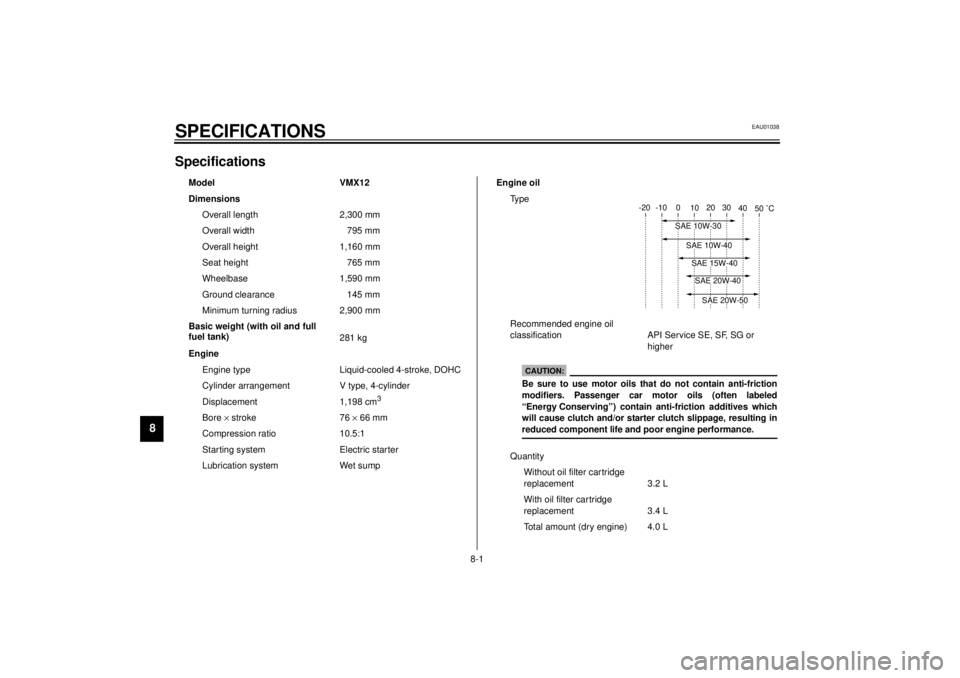
Ty p e
Recommended engine oil
classification API Service SE, SF, SG or
higher
Quantity
Without oil filter cartridge
replacement 3.2 L
With oil filter car tridge
replacement 3.4 L
Total amount (dry engine) 4.0 L
-20 -10 0
10 20 30
40
50 ˚C
SAE 10W-30
SAE 15W-40SAE 20W-40SAE 20W-50
SAE 10W-40
CAUTION:Be sure to use motor oils that do not contain anti-friction
modifiers. Passenger car motor oils (often labeled
“Energy Conserving”) contain anti-friction additives which
will cause clutch and/or starter clutch slippage, resulting in
reduced component life and poor engine performance.
E_3lr.book Page 1 Wednesday, November 22, 2000 4:10 PM
Page 106 of 110
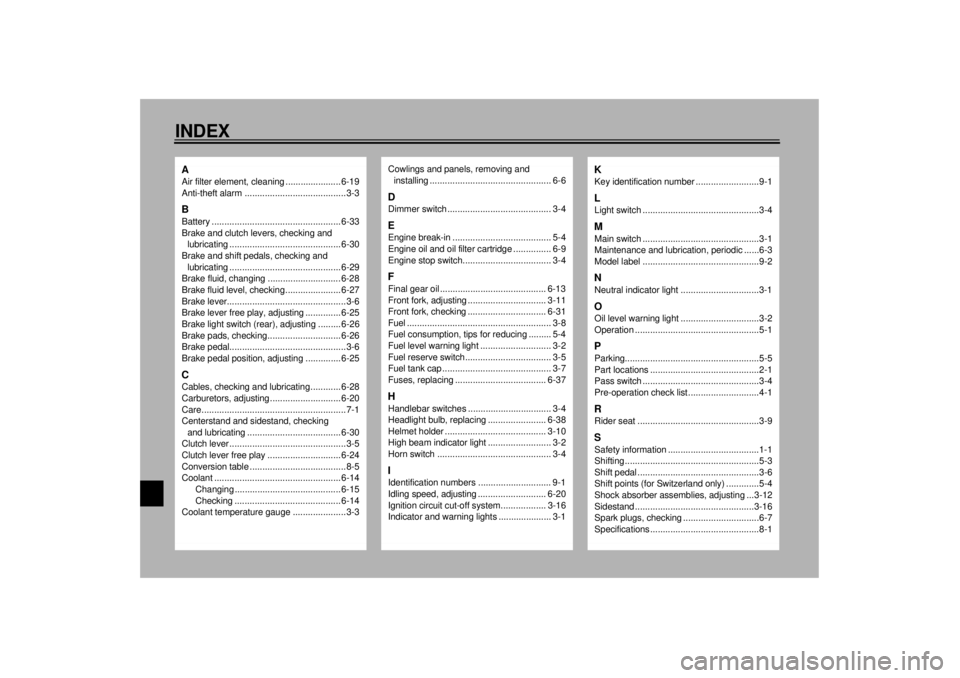
10-INDEXAAir filter element, cleaning ...................... 6-19
Anti-theft alarm ........................................3-3BBattery ................................................... 6-33
Brake and clutch levers, checking and
lubricating ............................................ 6-30
Brake and shift pedals, checking and
lubricating ............................................ 6-29
Brake fluid, changing ............................. 6-28
Brake fluid level, checking...................... 6-27
Brake lever...............................................3-6
Brake lever free play, adjusting .............. 6-25
Brake light switch (rear), adjusting ......... 6-26
Brake pads, checking............................. 6-26
Brake pedal..............................................3-6
Brake pedal position, adjusting .............. 6-25CCables, checking and lubricating............ 6-28
Carburetors, adjusting............................ 6-20
Care.........................................................7-1
Centerstand and sidestand, checking
and lubricating ..................................... 6-30
Clutch lever ..............................................3-5
Clutch lever free play ............................. 6-24
Conversion table ......................................8-5
Coolant .................................................. 6-14
Changing .......................................... 6-15
Checking .......................................... 6-14
Coolant temperature gauge .....................3-3
Cowlings and panels, removing and
installing................................................ 6-6DDimmer switch ......................................... 3-4EEngine break-in ....................................... 5-4
Engine oil and oil filter cartridge ............... 6-9
Engine stop switch................................... 3-4FFinal gear oil .......................................... 6-13
Front fork, adjusting ............................... 3-11
Front fork, checking ............................... 6-31
Fuel ......................................................... 3-8
Fuel consumption, tips for reducing ......... 5-4
Fuel level warning light ............................ 3-2
Fuel reserve switch.................................. 3-5
Fuel tank cap ........................................... 3-7
Fuses, replacing .................................... 6-37HHandlebar switches ................................. 3-4
Headlight bulb, replacing ....................... 6-38
Helmet holder ........................................ 3-10
High beam indicator light ......................... 3-2
Horn switch ............................................. 3-4IIdentification numbers ............................. 9-1
Idling speed, adjusting ........................... 6-20
Ignition circuit cut-off system.................. 3-16
Indicator and warning lights ..................... 3-1
KKey identification number .........................9-1LLight switch ..............................................3-4MMain switch ..............................................3-1
Maintenance and lubrication, periodic ......6-3
Model label ..............................................9-2NNeutral indicator light ...............................3-1OOil level warning light ...............................3-2
Operation .................................................5-1PParking.....................................................5-5
Part locations ...........................................2-1
Pass switch ..............................................3-4
Pre-operation check list ............................4-1RRider seat ................................................3-9SSafety information ....................................1-1
Shifting .....................................................5-3
Shift pedal ................................................3-6
Shift points (for Switzerland only) .............5-4
Shock absorber assemblies, adjusting ...3-12
Sidestand ...............................................3-16
Spark plugs, checking ..............................6-7
Specifications ...........................................8-1
E_3lr.book Page 1 Wednesday, November 22, 2000 4:10 PM