light YAMAHA VMAX 2001 User Guide
[x] Cancel search | Manufacturer: YAMAHA, Model Year: 2001, Model line: VMAX, Model: YAMAHA VMAX 2001Pages: 110, PDF Size: 11.88 MB
Page 41 of 110

OPERATION AND IMPORTANT RIDING POINTS
5-4
5
EAU02941
Recommended shift points
(for Switzerland only) The recommended shift points during
acceleration are shown in the table be-
low.CF-01ENOTE:@ When shifting down two gears at a
time, reduce the speed accordingly
(e.g., down to 35 km/h when shifting
from 4th to 2nd gear). @
EAU00424
Tips for reducing fuel
consumption Fuel consumption depends largely on
your riding style. Consider the following
tips to reduce fuel consumption:l
Thoroughly warm up the engine.
l
Turn the starter (choke) off as
soon as possible.
l
Shift up swiftly, and avoid high en-
gine speeds during acceleration.
l
Do not rev the engine while shift-
ing down, and avoid high engine
speeds with no load on the engine.
l
Turn the engine off instead of let-
ting it idle for an extended length
of time (e.g., in traffic jams, at traf-
fic lights or at railroad crossings).
EAU00436
Engine break-in There is never a more important period
in the life of your engine than the period
between 0 and 1,000 km. For this rea-
son, you should read the following ma-
terial carefully.
Since the engine is brand new, do not
put an excessive load on it for the first
1,000 km. The various parts in the en-
gine wear and polish themselves to the
correct operating clearances. During
this period, prolonged full-throttle oper-
ation or any condition that might result
in engine overheating must be avoided.
Shift point
(km/h)
1st®2nd
2nd®3rd
3rd®4th
4th®5th23
36
50
60
E_3lr.book Page 4 Wednesday, November 22, 2000 4:10 PM
Page 43 of 110
6
PERIODIC MAINTENANCE AND MINOR REPAIR
Owner’s tool kit .................................................... 6-1
Periodic maintenance and lubrication chart ......... 6-3
Removing and installing cowlings and panels ..... 6-6
Checking the spark plugs .................................... 6-7
Engine oil and oil filter cartridge .......................... 6-9
Final gear oil ...................................................... 6-13
Coolant .............................................................. 6-14
Cleaning the air filter element ............................ 6-19
Adjusting the carburetors ................................... 6-20
Adjusting the engine idling speed ...................... 6-20
Adjusting the throttle cable free play .................. 6-21
Adjusting the valve clearance ............................ 6-21
Tires ................................................................... 6-21
Cast wheels ....................................................... 6-24
Clutch lever free play ......................................... 6-24
Adjusting the brake lever free play ..................... 6-25
Adjusting the brake pedal position ..................... 6-25
Adjusting the rear brake light switch .................. 6-26
Checking the front and rear brake pads ............. 6-26
Checking the brake fluid level ............................ 6-27
Changing the brake fluid .................................... 6-28
Checking and lubricating the cables .................. 6-28Checking and lubricating the throttle
grip and cable ................................................. 6-29
Checking and lubricating the brake and
shift pedals ...................................................... 6-29
Checking and lubricating the brake and
clutch levers .................................................... 6-30
Checking and lubricating the centerstand and
sidestand......................................................... 6-30
Lubricating the rear suspension ........................ 6-31
Checking the front fork ...................................... 6-31
Checking the steering ....................................... 6-32
Checking the wheel bearings ............................ 6-33
Battery ............................................................... 6-33
Replacing the fuses .......................................... 6-37
Replacing the headlight bulb ............................. 6-38
Replacing a turn signal light bulb or the tail/
brake light bulb ................................................ 6-39
Front wheel ....................................................... 6-40
Rear wheel ........................................................ 6-41
Troubleshooting ................................................. 6-44
Troubleshooting charts ...................................... 6-45
E_3lr.book Page 1 Wednesday, November 22, 2000 4:10 PM
Page 48 of 110
PERIODIC MAINTENANCE AND MINOR REPAIR
6-5
6
EAU03310*
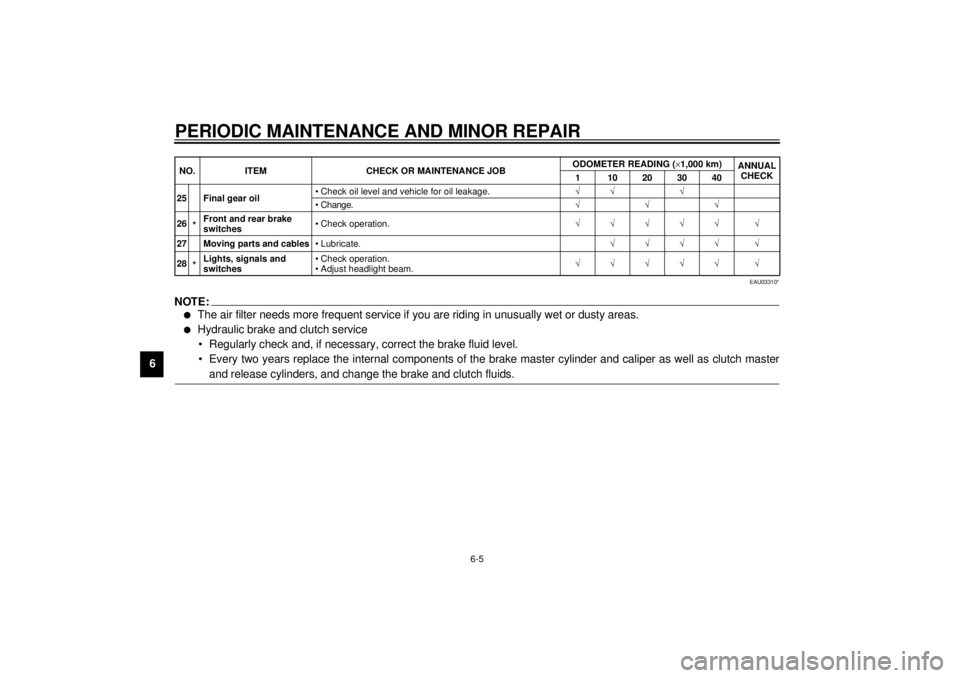
NOTE:@ l
The air filter needs more frequent service if you are riding in unusually wet or dusty areas.
l
Hydraulic brake and clutch service
• Regularly check and, if necessary, correct the brake fluid level.
• Every two years replace the internal components of the brake master cylinder and caliper as well as clutch master
and release cylinders, and change the brake and clutch fluids.
@25 Final gear oil• Check oil level and vehicle for oil leakage.ÖÖ Ö
• Change.ÖÖÖ
26
*Front and rear brake
switches• Check operation.ÖÖÖÖÖ Ö
27 Moving parts and cables• Lubricate.ÖÖÖÖ Ö
28*Lights, signals and
switches• Check operation.
• Adjust headlight beam.ÖÖÖÖÖ Ö NO. ITEM CHECK OR MAINTENANCE JOBODOMETER READING (´1,000 km)
ANNUAL
CHECK
1 10203040
E_3lr.book Page 5 Wednesday, November 22, 2000 4:10 PM
Page 51 of 110
PERIODIC MAINTENANCE AND MINOR REPAIR
6-8
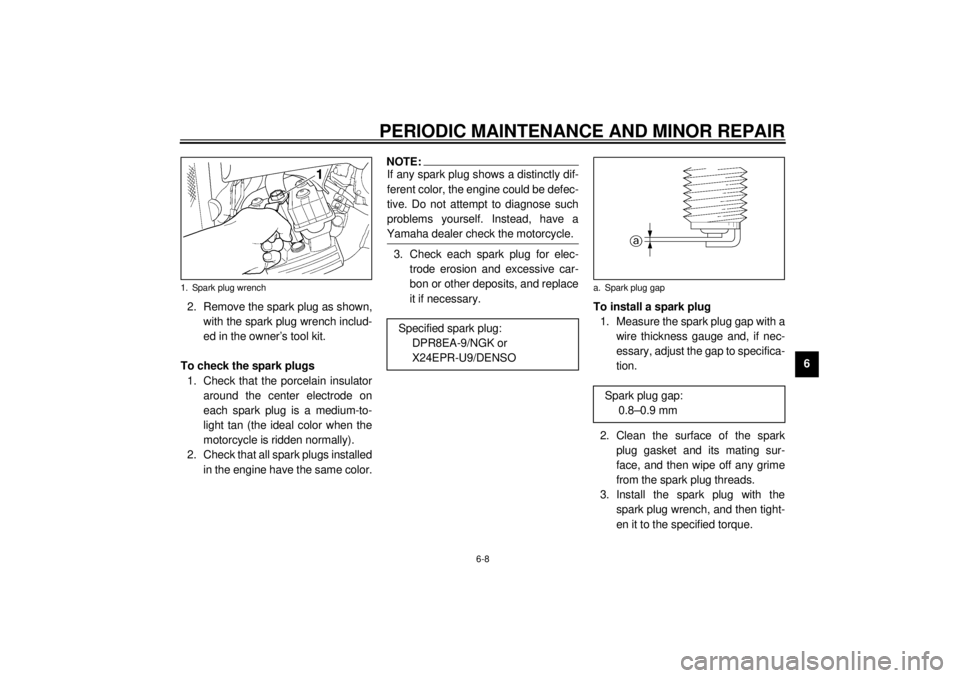
6 2. Remove the spark plug as shown,
with the spark plug wrench includ-
ed in the owner’s tool kit.
To check the spark plugs
1. Check that the porcelain insulator
around the center electrode on
each spark plug is a medium-to-
light tan (the ideal color when the
motorcycle is ridden normally).
2. Check that all spark plugs installed
in the engine have the same color.
NOTE:@ If any spark plug shows a distinctly dif-
ferent color, the engine could be defec-
tive. Do not attempt to diagnose such
problems yourself. Instead, have a
Yamaha dealer check the motorcycle. @3. Check each spark plug for elec-
trode erosion and excessive car-
bon or other deposits, and replace
it if necessary.
To install a spark plug
1. Measure the spark plug gap with a
wire thickness gauge and, if nec-
essary, adjust the gap to specifica-
tion.
2. Clean the surface of the spark
plug gasket and its mating sur-
face, and then wipe off any grime
from the spark plug threads.
3. Install the spark plug with the
spark plug wrench, and then tight-
en it to the specified torque.
1. Spark plug wrench
Specified spark plug:
DPR8EA-9/NGK or
X24EPR-U9/DENSO
a. Spark plug gapSpark plug gap:
0.8–0.9 mm
E_3lr.book Page 8 Wednesday, November 22, 2000 4:10 PM
Page 52 of 110
PERIODIC MAINTENANCE AND MINOR REPAIR
6-9
6
NOTE:@ If a torque wrench is not available when
installing a spark plug, a good estimate
of the correct torque is 1/4–1/2 turn
past finger tight. However, the spark
plug should be tightened to the speci-
fied torque as soon as possible. @4. Install the spark plug cap.
EAU02938
Engine oil and oil filter
cartridge The engine oil level should be checked
before each ride. In addition, the oil
must be changed and the oil filter car-
tridge replaced at the intervals speci-
fied in the periodic maintenance and
lubrication chart.
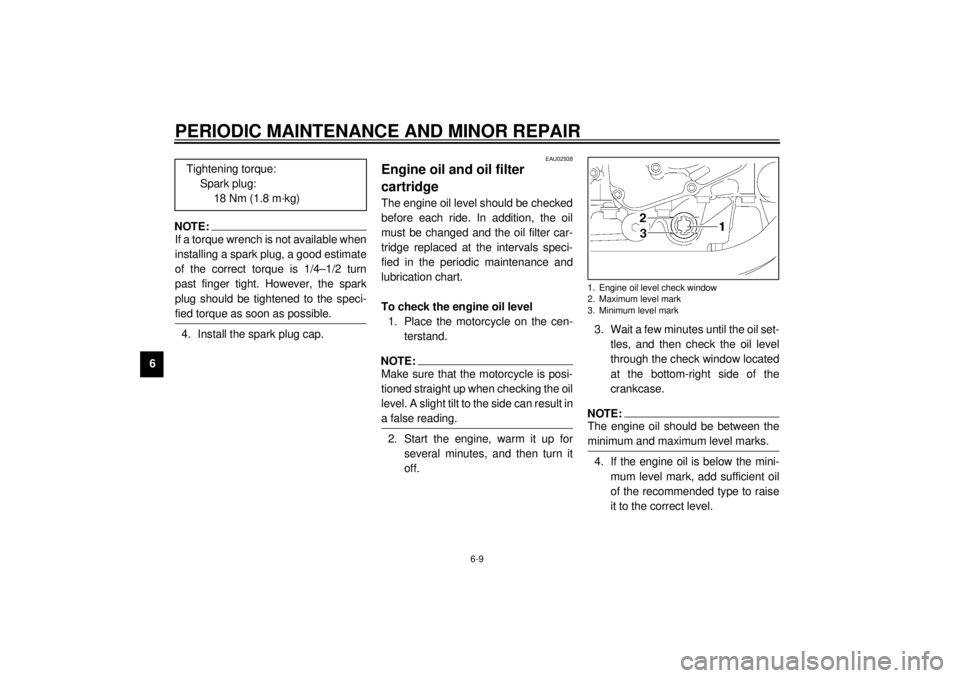
To check the engine oil level
1. Place the motorcycle on the cen-
terstand.NOTE:@ Make sure that the motorcycle is posi-
tioned straight up when checking the oil
level. A slight tilt to the side can result in
a false reading. @2. Start the engine, warm it up for
several minutes, and then turn it
off.3. Wait a few minutes until the oil set-
tles, and then check the oil level
through the check window located
at the bottom-right side of the
crankcase.
NOTE:@ The engine oil should be between the
minimum and maximum level marks. @4. If the engine oil is below the mini-
mum level mark, add sufficient oil
of the recommended type to raise
it to the correct level. Tightening torque:
Spark plug:
18 Nm (1.8 m·kg)1. Engine oil level check window
2. Maximum level mark
3. Minimum level mark
E_3lr.book Page 9 Wednesday, November 22, 2000 4:10 PM
Page 55 of 110
PERIODIC MAINTENANCE AND MINOR REPAIR
6-12
6
EC000072
CAUTION:@ l
In order to prevent clutch slip-
page (since the engine oil also
lubricates the clutch), do not
mix any chemical additives with
the oil or use oils of a higher
grade than “CD”. In addition, do
not use oils labeled “ENERGY
CONSERVING II” or higher.
l
Make sure that no foreign mate-
rial enters the crankcase.
@9. Start the engine, and then let it idle
for several minutes while checking
it for oil leakage. If oil is leaking,
immediately turn the engine off
and check for the cause.NOTE:@ After the engine is started, the engine
oil level warning light should go off if the
oil level is sufficient. @
EC000067
CAUTION:@ If the oil level warning light flickers
or remains on, immediately turn the
engine off and have a Yamaha deal-
er check the vehicle. @10. Turn the engine off, and then
check the oil level and correct it if
necessary.
E_3lr.book Page 12 Wednesday, November 22, 2000 4:10 PM
Page 57 of 110
PERIODIC MAINTENANCE AND MINOR REPAIR
6-14
6
EAU03416
Coolant The coolant level should be checked
before each ride. In addition, the cool-
ant must be changed at the intervals
specified in the periodic maintenance
and lubrication chart.
If the engine overheats, see page 6-46
for further instructions.
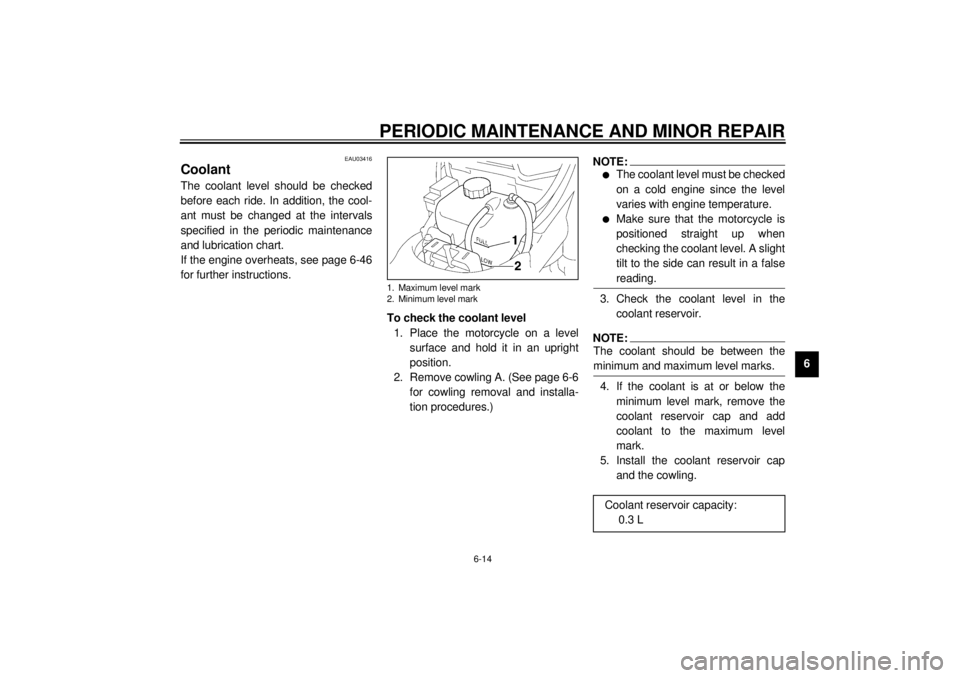
To check the coolant level
1. Place the motorcycle on a level
surface and hold it in an upright
position.
2. Remove cowling A. (See page 6-6
for cowling removal and installa-
tion procedures.)
NOTE:@ l
The coolant level must be checked
on a cold engine since the level
varies with engine temperature.
l
Make sure that the motorcycle is
positioned straight up when
checking the coolant level. A slight
tilt to the side can result in a false
reading.
@3. Check the coolant level in the
coolant reservoir.NOTE:@ The coolant should be between the
minimum and maximum level marks. @4. If the coolant is at or below the
minimum level mark, remove the
coolant reservoir cap and add
coolant to the maximum level
mark.
5. Install the coolant reservoir cap
and the cowling.
1. Maximum level mark
2. Minimum level mark
Coolant reservoir capacity:
0.3 L
E_3lr.book Page 14 Wednesday, November 22, 2000 4:10 PM
Page 62 of 110
PERIODIC MAINTENANCE AND MINOR REPAIR
6-19
6
EAU01662
Cleaning the air filter element The air filter element should be cleaned
at the intervals specified in the periodic
maintenance and lubrication chart.
Clean the air filter element more fre-
quently if you are riding in unusually
wet or dusty areas.
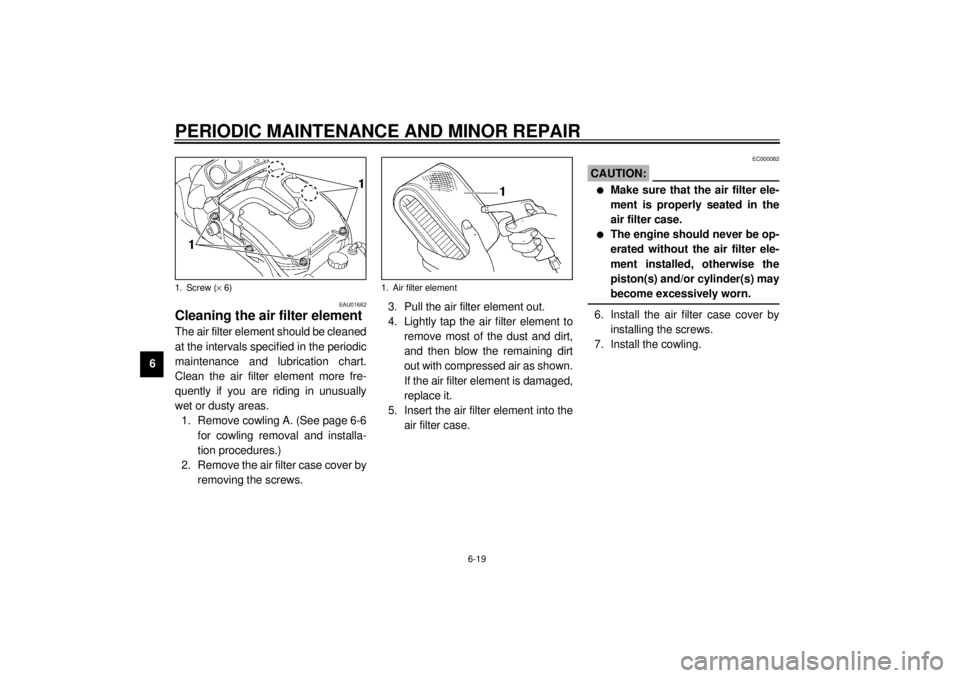
1. Remove cowling A. (See page 6-6
for cowling removal and installa-
tion procedures.)
2. Remove the air filter case cover by
removing the screws.3. Pull the air filter element out.
4. Lightly tap the air filter element to
remove most of the dust and dirt,
and then blow the remaining dirt
out with compressed air as shown.
If the air filter element is damaged,
replace it.
5. Insert the air filter element into the
air filter case.
EC000082
CAUTION:@ l
Make sure that the air filter ele-
ment is properly seated in the
air filter case.
l
The engine should never be op-
erated without the air filter ele-
ment installed, otherwise the
piston(s) and/or cylinder(s) may
become excessively worn.
@6. Install the air filter case cover by
installing the screws.
7. Install the cowling.
1. Screw (´ 6)
1. Air filter element
E_3lr.book Page 19 Wednesday, November 22, 2000 4:10 PM
Page 69 of 110
PERIODIC MAINTENANCE AND MINOR REPAIR
6-26
6
EW000109
WARNING
@ A soft or spongy feeling in the brake
pedal can indicate the presence of
air in the hydraulic system. If there
is air in the hydraulic system, have a
Yamaha dealer bleed the system be-
fore operating the motorcycle. Air in
the hydraulic system will diminish
the braking performance, which
may result in loss of control and an
accident. @
EAU00713
Adjusting the rear brake light
switch The rear brake light switch, which is ac-
tivated by the brake pedal, is properly
adjusted when the brake light comes
on just before braking takes effect. If
necessary, adjust the brake light switch
as follows.
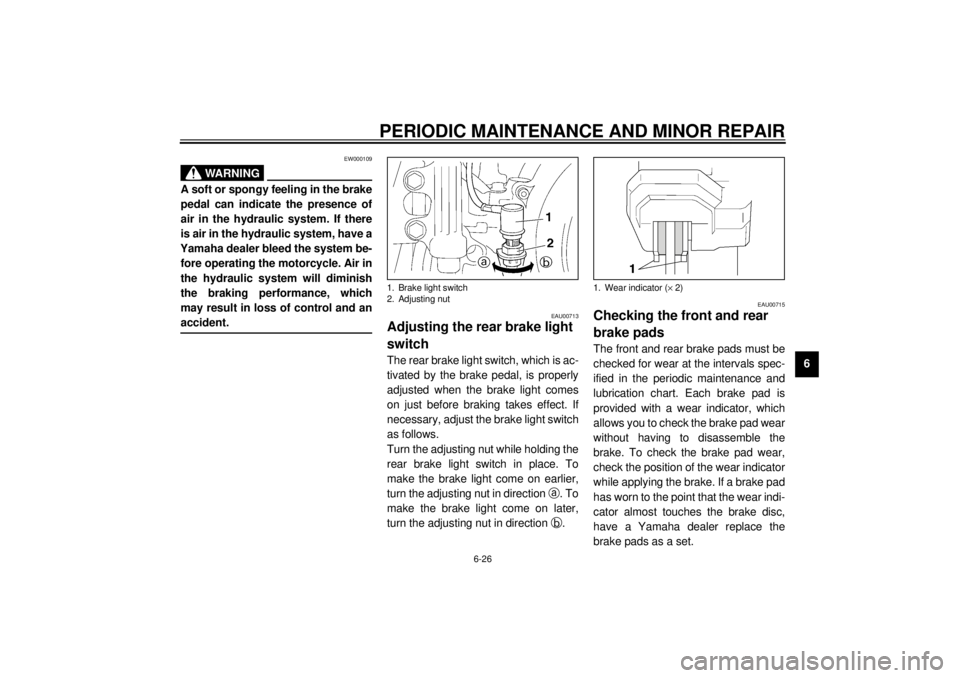
Turn the adjusting nut while holding the
rear brake light switch in place. To
make the brake light come on earlier,
turn the adjusting nut in direction
a. To
make the brake light come on later,
turn the adjusting nut in direction
b.
EAU00715
Checking the front and rear
brake pads The front and rear brake pads must be
checked for wear at the intervals spec-
ified in the periodic maintenance and
lubrication chart. Each brake pad is
provided with a wear indicator, which
allows you to check the brake pad wear
without having to disassemble the
brake. To check the brake pad wear,
check the position of the wear indicator
while applying the brake. If a brake pad
has worn to the point that the wear indi-
cator almost touches the brake disc,
have a Yamaha dealer replace the
brake pads as a set.
1. Brake light switch
2. Adjusting nut
1. Wear indicator (´ 2)
E_3lr.book Page 26 Wednesday, November 22, 2000 4:10 PM
Page 79 of 110
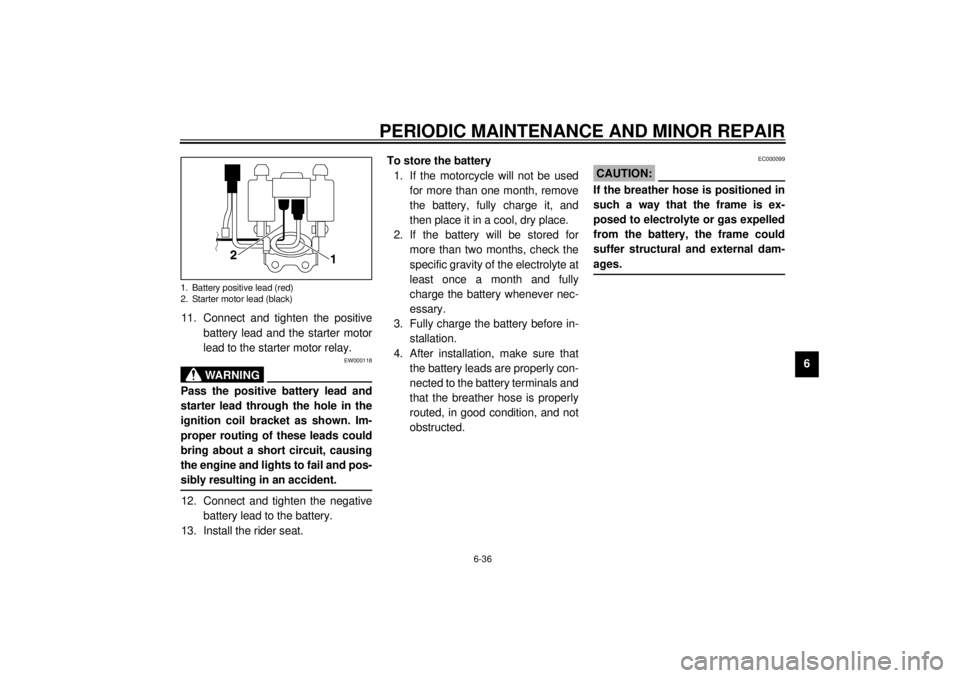
PERIODIC MAINTENANCE AND MINOR REPAIR
6-36
6 11. Connect and tighten the positive
battery lead and the starter motor
lead to the starter motor relay.
EW000118
WARNING
@ Pass the positive battery lead and
starter lead through the hole in the
ignition coil bracket as shown. Im-
proper routing of these leads could
bring about a short circuit, causing
the engine and lights to fail and pos-
sibly resulting in an accident. @12. Connect and tighten the negative
battery lead to the battery.
13. Install the rider seat.To store the battery
1. If the motorcycle will not be used
for more than one month, remove
the battery, fully charge it, and
then place it in a cool, dry place.
2. If the battery will be stored for
more than two months, check the
specific gravity of the electrolyte at
least once a month and fully
charge the battery whenever nec-
essary.
3. Fully charge the battery before in-
stallation.
4. After installation, make sure that
the battery leads are properly con-
nected to the battery terminals and
that the breather hose is properly
routed, in good condition, and not
obstructed.
EC000099
CAUTION:@ If the breather hose is positioned in
such a way that the frame is ex-
posed to electrolyte or gas expelled
from the battery, the frame could
suffer structural and external dam-
ages. @
1. Battery positive lead (red)
2. Starter motor lead (black)
E_3lr.book Page 36 Wednesday, November 22, 2000 4:10 PM