warning YAMAHA VMAX 2016 Owner's Guide
[x] Cancel search | Manufacturer: YAMAHA, Model Year: 2016, Model line: VMAX, Model: YAMAHA VMAX 2016Pages: 112, PDF Size: 3.25 MB
Page 76 of 112

Periodic maintenance an d a djustment
6-21
6
EAU64270
TiresTires are the only contact between the
vehicle and the road. Safety in all con-
ditions of riding depends on a relatively
small area of road contact. Therefore, it
is essential to maintain the tires in good
condition at all times and replace them
at the appropriate time with the speci-
fied tires.
Tire air pressure
The tire air pressure should be
checked and, if necessary, adjusted
before each ride.
WARNING
EWA10504
Operation of this vehicle with im-
proper tire pressure may cause se-
vere injury or death from loss of
control. The tire air pressure must be
checked and a djuste d on col d
tires (i.e., when the temperature
of the tires equals the am bient
temperature).
The tire air pressure must be
a d juste d in accor dance with the
ri din g speed and with the total wei
ght of ri der, passen ger, car-
g o, an d accessories approve d
for this mo del.
WARNING
EWA10512
Never overloa d your vehicle. Opera-
tion of an overloa ded vehicle coul d
cause an acci dent.
Tire inspection
The tires must be checked before each
ride. If the center tread depth reaches
the specified limit, if the tire has a nail
or glass fragments in it, or if the side-
wall is cracked, have a Yamaha dealer
replace the tire immediately.TIPThe tire tread depth limits may differ
from country to country. Always com-
ply with the local regulations.
Tire air pressure (measure d on col d
tires): Up to 90 k g (198 l b) loa d:
Front:
250 kPa (2.50 kgf/cm², 36 psi)
Rear: 290 kPa (2.90 kgf/cm², 42 psi)
90 k g (198 l b) to maximum load :
Front: 250 kPa (2.50 kgf/cm², 36 psi)
Rear: 290 kPa (2.90 kgf/cm², 42 psi)
Maximum loa d*:
190 kg (419 lb)
* Total weight of rider, passenger, car- go and accessories
1. Tire sidewall
2. Tire tread depthMinimum tire trea d d epth (front an d
rear): 1.6 mm (0.06 in)
U2CEE1E0.book Page 21 Thursday, November 19, 2015 10:32 AM
Page 77 of 112

Periodic maintenance an d a djustment
6-22
6
WARNING
EWA10472
Have a Yamaha d ealer replace
excessively worn tires. Besid es
b ein g ille gal, operatin g the vehi-
cle with excessively worn tires
d ecreases ri din g sta bility an d
can lead to loss of control.
The replacement of all wheel
and b rake-relate d parts, inclu d-
in g the tires, shoul d b e left to a
Yamaha dealer, who has the
necessary professional knowl-
e dge an d experience to do so.
Ride at mo derate spee ds after
chan gin g a tire since the tire
surface must first be “ broken
in” for it to develop its optimal
characteristics.
Tire information
This model is equipped with tubeless
tires and tire air valves.
Tires age, even if they have not been
used or have only been used occasion-
ally. Cracking of the tread and sidewall
rubber, sometimes accompanied by
carcass deformation, is an evidence of
ageing. Old and aged tires shall be
checked by tire specialists to ascertain
their suitability for further use.
WARNING
EWA10902
The front an d rear tires shoul d
b e of the same make an d d e-
si gn, otherwise the han dlin g characteristics of the motorcy-
cle may b
e different, which
coul d lea d to an acci dent.
Always make sure that the valve
caps are securely installe d to
prevent air pressure leaka ge.
Use only the tire valves an d
valve cores liste d below to
avoi d tire d eflation during a ride.
After extensive tests, only the tires list-
ed below have been approved for this
model by Yamaha.
1. Tire air valve
2. Tire air valve core
3. Tire air valve cap with seal
Front tire:
Size: 120/70R18M/C 59V
Manufacturer/model: BRIDGESTONE/BT028F G
Rear tire:
Size: 200/50R18M/C 76V
Manufacturer/model:
BRIDGESTONE/BT028R G
FRONT and REAR:
Tire air valve:
TR412
Valve core: #9100 (original)
U2CEE1E0.book Page 22 Thursday, November 19, 2015 10:32 AM
Page 78 of 112

Periodic maintenance an d a djustment
6-23
6
WARNING
EWA10601
This motorcycle is fitte d with super-
hi gh-spee d tires. Note the following
points in or der to make the most ef-
ficient use of these tires. Use only the specifie d replace-
ment tires. Other tires may run
the dan ger of bursting at super
hi gh spee ds.
Bran d-new tires can have a rel-
atively poor g rip on certain road
surfaces until they have been
“ b roken in”. Therefore, it is a d-
visa ble before doin g any hi gh-
speed ridin g to ri de conserva-
tively for approximately 100 km
(60 mi) after installin g a new tire.
The tires must b e warmed up
b efore a hi gh-spee d run.
Always a djust the tire air pres-
sure accor din g to the operating
con ditions.
EAU21963
Cast wheelsTo maximize the performance, durabil-
ity, and safe operation of your vehicle,
note the following points regarding the
specified wheels.
The wheel rims should be
checked for cracks, bends, warp-
age or other damage before each
ride. If any damage is found, have
a Yamaha dealer replace the
wheel. Do not attempt even the
smallest repair to the wheel. A de-
formed or cracked wheel must be
replaced.
The wheel should be balanced
whenever either the tire or wheel
has been changed or replaced. An
unbalanced wheel can result in
poor performance, adverse han-
dling characteristics, and a short-
ened tire life.
EAU42851
Clutch leverSince this model is equipped with a hy-
draulic clutch, adjusting the clutch le-
ver free play is not needed. However, it
is necessary to check the hydraulic
system for leakage before each ride. If
the clutch lever free play does become
excessive, and shifting becomes rough
or clutch slippage occurs, causing
poor acceleration, there may be air in
the clutch system. If there is air in the
hydraulic system, have a Yamaha deal-
er bleed the system before operating
the motorcycle.
U2CEE1E0.book Page 23 Thursday, November 19, 2015 10:32 AM
Page 79 of 112

Periodic maintenance an d a djustment
6-24
6
EAU37914
Checkin g the brake lever free
playThere should be no free play at the
brake lever end. If there is free play,
have a Yamaha dealer inspect the
brake system.
WARNING
EWA14212
A soft or spon gy feelin g in the brake
lever can in dicate the presence of
air in the hy draulic system. If there is
air in the hy draulic system, have a
Yamaha dealer blee d the system be-
fore operatin g the vehicle. Air in the
hy draulic system will diminish the b
rakin g performance, which may re-
sult in loss of control an d an acci-
d ent.
EAU36504
Brake li ght switchesThe brake light, which is activated by
the brake pedal and brake lever,
should come on just before braking
takes effect. If necessary, have a
Yamaha dealer adjust the brake light
switches.
1. No brake lever free play
1
U2CEE1E0.book Page 24 Thursday, November 19, 2015 10:32 AM
Page 81 of 112

Periodic maintenance an d a djustment
6-26
6
Rear
brake
TIPThe rear brake fluid reservoir is located
under the passenger seat. (See page
3-25.)
WARNING
EWA16011
Improper maintenance can result in
loss of b raking a bility. O bserve
these precautions: Insufficient brake flui d may al-
low air to enter the brake sys-
tem, re ducin g brakin g
performance.
Clean the filler cap before re-
movin g. Use only DOT 4 b rake
flui d from a seale d container.
Use only the specified b rake flu-
i d ; otherwise, the ru bber seals
may deteriorate, causin g leak-
a g e.
Refill with the same type of
brake flui d. A dding a brake fluid
other than DOT 4 may result in a
harmful chemical reaction.
Be careful that water or d ust
d oes not enter the brake flui d
reservoir when refillin g. Water
will si gnificantly lower the boil-
in g point of the flui d an d may re-
sult in vapor lock, an d d ir t may
cl
o g the ABS hy draulic unit
valves.
NOTICE
ECA17641
Brake flui d may d amage painte d
surfaces or plastic parts. Always
clean up spilled fluid imme diately.As the brake pads wear, it is normal for
the brake fluid level to gradually go
down. A low brake fluid level may indi-
cate worn brake pads and/or brake system leakage; therefore, be sure to
check the brake pads for wear and the
brake system for leakage. If the brake
fluid level goes down suddenly, have a
Yamaha dealer check the cause before
further riding.
1. Minimum level markSpecifie
d b rake flui d:
DOT 41
U2CEE1E0.book Page 26 Thursday, November 19, 2015 10:32 AM
Page 82 of 112

Periodic maintenance an d a djustment
6-27
6
EAU22754
Chan gin g the brake an d
clutch flui dsHave a Yamaha dealer change the
brake and clutch fluids at the intervals
specified in the periodic maintenance
and lubrication chart. In addition, have
the oil seals of the brake and clutch
master cylinders and calipers as well
as the brake and clutch hoses replaced
at the intervals listed below or whenev-
er they are damaged or leaking.
Oil seals: Replace every two
years.
Brake and clutch hoses: Replace
every four years.
EAU23098
Checkin g an d lu bricatin g the
cab lesThe operation of all control cables and
the condition of the cables should be
checked before each ride, and the ca-
bles and cable ends should be lubri-
cated if necessary. If a cable is
damaged or does not move smoothly,
have a Yamaha dealer check or re-
place it. WARNING! Dama ge to the
outer housin g of cab les may result
in internal rustin g an d cause inter-
ference with cab le movement. Re-
place damag ed cab les as soon as
possi ble to prevent unsafe con di-
tions.
[EWA10712] EAU23115
Checkin
g an d lu bricatin g the
throttle grip an d ca bleThe operation of the throttle grip
should be checked before each ride. In
addition, the cable should be lubricat-
ed by a Yamaha dealer at the intervals
specified in the periodic maintenance
chart.
The throttle cable is equipped with a
rubber cover. Make sure that the cover
is securely installed. Even though the
cover is installed correctly, it does not
completely protect the cable from wa-
ter entry. Therefore, use care not to
pour water directly onto the cover or
cable when washing the vehicle. If the
cable or cover becomes dirty, wipe
clean with a moist cloth.
Recommen ded lu bricant:
Yamaha cable lubricant or other
suitable cable lubricant
U2CEE1E0.book Page 27 Thursday, November 19, 2015 10:32 AM
Page 84 of 112

Periodic maintenance an d a djustment
6-29
6
EAU23203
Checkin g an d lu bricatin g the
si destan dThe operation of the sidestand should
be checked before each ride, and the
sidestand pivot and metal-to-metal
contact surfaces should be lubricated
if necessary.
WARNING
EWA10732
If the si destan d d oes not move up
an d d own smoothly, have a Yamaha
d ealer check or repair it. Otherwise,
the si destan d coul d contact the
g roun d an d d istract the operator, re-
sultin g in a possi ble loss of control.
EAUM1653
Lub ricatin g the swin garm piv-
otsThe swingarm pivots must be lubricat-
ed by a Yamaha dealer at the intervals
specified in the periodic maintenance
and lubrication chart.
Recommen ded lu bricant:
Silicone grease
Recommen ded lu bricant:
Lithium-soap-based grease
Recommen ded lu bricant:
Lithium-soap-based grease
U2CEE1E0.book Page 29 Thursday, November 19, 2015 10:32 AM
Page 85 of 112

Periodic maintenance an d a djustment
6-30
6
EAU23273
Checkin g the front forkThe condition and operation of the
front fork must be checked as follows
at the intervals specified in the periodic
maintenance and lubrication chart.
To check the con dition
Check the inner tubes for scratches,
damage and excessive oil leakage.
To check the operation 1. Place the vehicle on a level surfa- ce and hold it in an upright posi-
tion. WARNING! To avoi d injury,
securely support the vehicle so
there is no dan ger of it fallin g
over.
[EWA10752]
2. While applying the front brake, push down hard on the handle-
bars several times to check if the
front fork compresses and re-
bounds smoothly.
NOTICE
ECA10591
If any damag e is foun d or the front
fork does not operate smoothly,
have a Yamaha d ealer check or re-
pair it.
EAU23285
Checkin g the steerin gWorn or loose steering bearings may
cause danger. Therefore, the operation
of the steering must be checked as fol-
lows at the intervals specified in the
periodic maintenance and lubrication
chart.
1. Raise the front wheel off the ground. (See page 6-39.)
WARNING! To avoid injury, se-
curely support the vehicle so
there is no d anger of it fallin g
over.
[EWA10752]
2. Hold the lower ends of the front fork legs and try to move them for-
ward and backward. If any free
play can be felt, have a Yamaha
dealer check or repair the steer-
ing.
U2CEE1E0.book Page 30 Thursday, November 19, 2015 10:32 AM
Page 86 of 112
Periodic maintenance an d a djustment
6-31
6
EAU23292
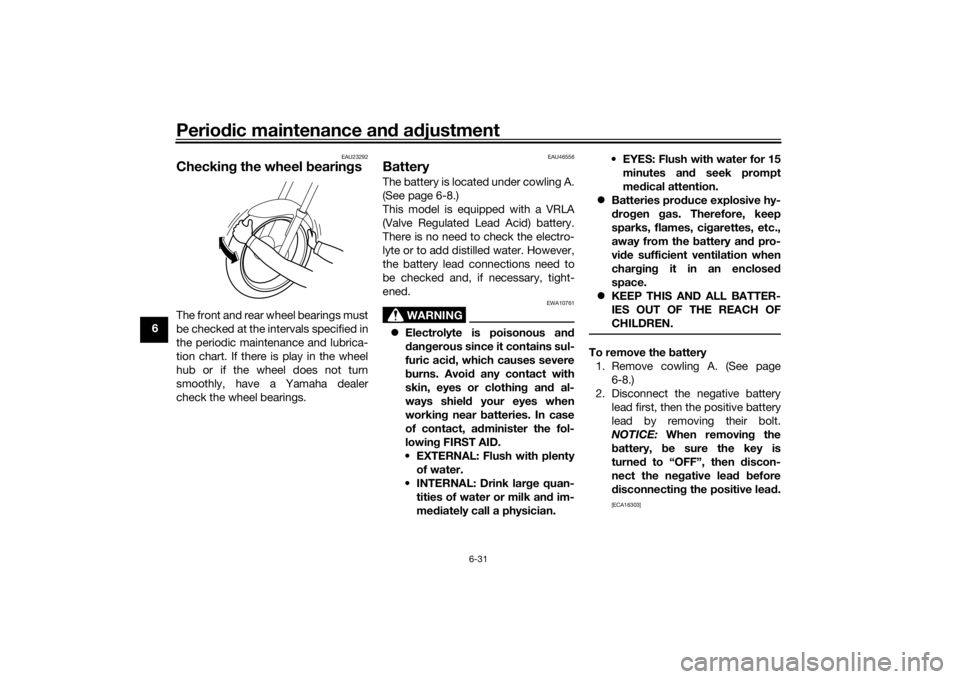
Checkin g the wheel b earingsThe front and rear wheel bearings must
be checked at the intervals specified in
the periodic maintenance and lubrica-
tion chart. If there is play in the wheel
hub or if the wheel does not turn
smoothly, have a Yamaha dealer
check the wheel bearings.
EAU46556
BatteryThe battery is located under cowling A.
(See page 6-8.)
This model is equipped with a VRLA
(Valve Regulated Lead Acid) battery.
There is no need to check the electro-
lyte or to add distilled water. However,
the battery lead connections need to
be checked and, if necessary, tight-
ened.
WARNING
EWA10761
Electrolyte is poisonous an d
d an gerous since it contains sul-
furic aci d, which causes severe
b urns. Avoi d any contact with
skin, eyes or clothin g an d al-
ways shiel d your eyes when
workin g near b atteries. In case
of contact, a dminister the fol-
lowin g FIRST AID.
EXTERNAL: Flush with plenty of water.
INTERNAL: Drink lar ge quan-
tities of water or milk and im-
me diately call a physician. EYES: Flush with water for 15
minutes an d seek prompt
me dical attention.
Batteries pro duce explosive hy-
d ro gen gas. Therefore, keep
sparks, flames, ci garettes, etc.,
away from the battery an d pro-
vi de sufficient ventilation when
char gin g it in an enclose d
space.
KEEP THIS AND ALL BATTER-
IES OUT OF THE REACH OF
CHILDREN.
To remove the battery
1. Remove cowling A. (See page 6-8.)
2. Disconnect the negative battery lead first, then the positive battery
lead by removing their bolt.
NOTICE: When removin g the
b attery, be sure the key is
turne d to “OFF”, then d iscon-
nect the neg ative lead b efore
d isconnectin g the positive lea d.
[ECA16303]
U2CEE1E0.book Page 31 Thursday, November 19, 2015 10:32 AM
Page 89 of 112

Periodic maintenance an d a djustment
6-34
6
EAU46456
Replacin g the fusesThe main fuse and the ABS motor fuse
are located behind cowling A. (See
page 6-8.)
Fuse box 1 is located under the rider
seat. (See page 3-25.) Fuse
box 1
Fuse box 2 is located behind panel B.
(See page 6-8.) Fuse
box 2
If a fuse is blown, replace it as follows. 1. Turn the key to “OFF” and turn off the electrical circuit in question.
2. Remove the blown fuse, and then install a new fuse of the specified
amperage. WARNING! Do not
use a fuse of a hi gher ampera ge
ratin g than recommen ded to1. Main fuse
2. ABS motor fuse
3. ABS motor spare fuse
1
3
2
1. ABS solenoid fuse
2. Fuel injection system fuse
3. Spare fuse
123
1. Ignition fuse
2. ABS control unit fuse
3. Headlight fuse
4. Backup fuse (for clock and immobilizer sys-
tem)
5. Electronic throttle valve fuse
6. Radiator fan motor fuse
7. Spare fuse
8. Signaling system fuse
9. Parking lighting fuse
10.Sub radiator fan motor fuse
1 23456
7
8
10
7
9
U2CEE1E0.book Page 34 Thursday, November 19, 2015 10:32 AM