lock YAMAHA VX CRUISER HO 2022 User Guide
[x] Cancel search | Manufacturer: YAMAHA, Model Year: 2022, Model line: VX CRUISER HO, Model: YAMAHA VX CRUISER HO 2022Pages: 112, PDF Size: 4.8 MB
Page 59 of 112
Equipment operation
51
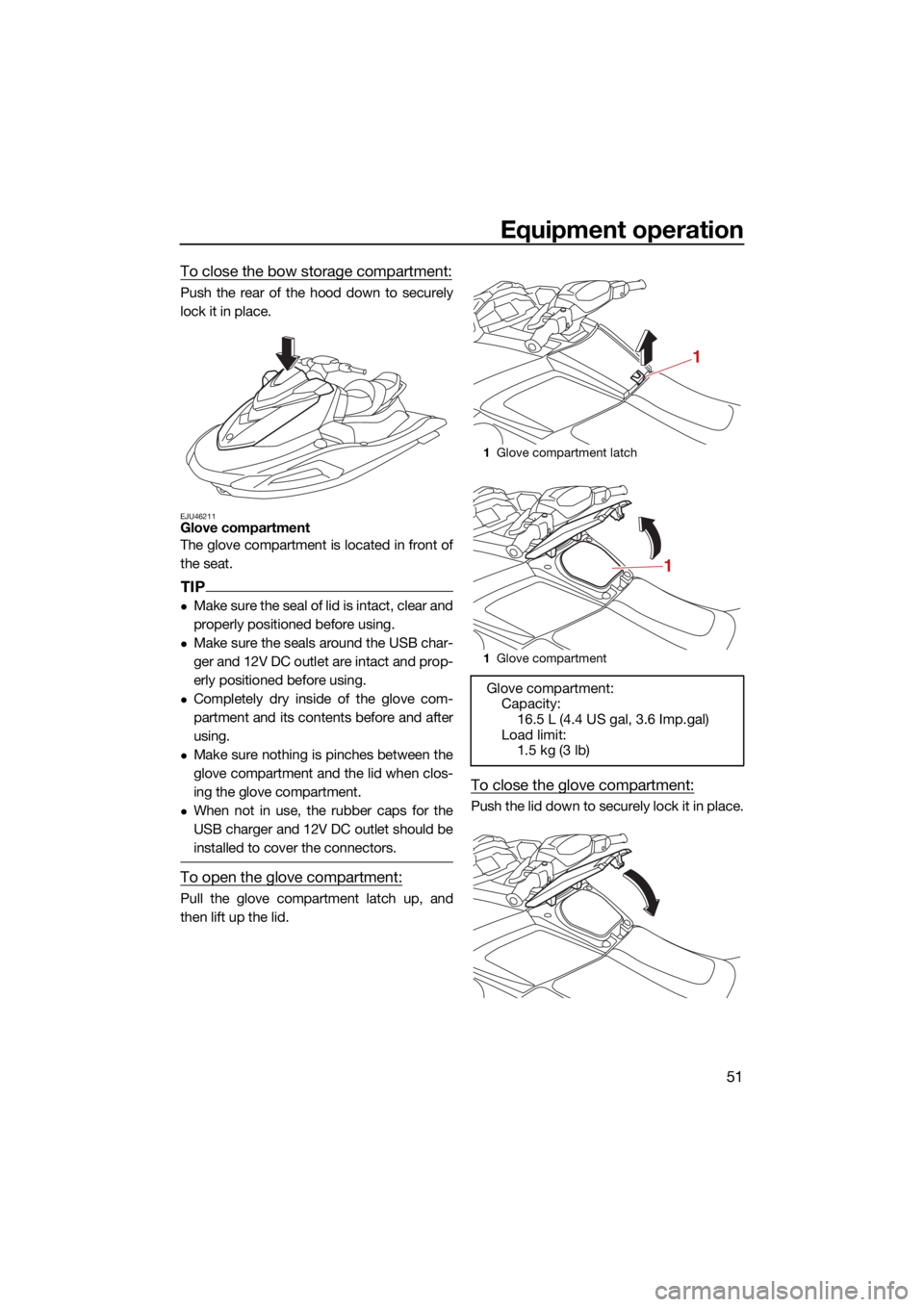
To close the bow storage compartment:
Push the rear of the hood down to securely
lock it in place.
EJU46211Glove compartment
The glove compartment is located in front of
the seat.
TIP
Make sure the seal of lid is intact, clear and
properly positioned before using.
Make sure the seals around the USB char-
ger and 12V DC outlet are intact and prop-
erly positioned before using.
Completely dry inside of the glove com-
partment and its contents before and after
using.
Make sure nothing is pinches between the
glove compartment and the lid when clos-
ing the glove compartment.
When not in use, the rubber caps for the
USB charger and 12V DC outlet should be
installed to cover the connectors.
To open the glove compartment:
Pull the glove compartment latch up, and
then lift up the lid.
To close the glove compartment:
Push the lid down to securely lock it in place.
1Glove compartment latch
1 Glove compartment
Glove compartment:
Capacity: 16.5 L (4.4 US gal, 3.6 Imp.gal)
Load limit: 1.5 kg (3 lb)
1
1
UF4S71E0.book Page 51 Wednesday, August 4, 2021 5:18 PM
Page 61 of 112
Equipment operation
53
(3) Securely install the rear seat in its originalposition.
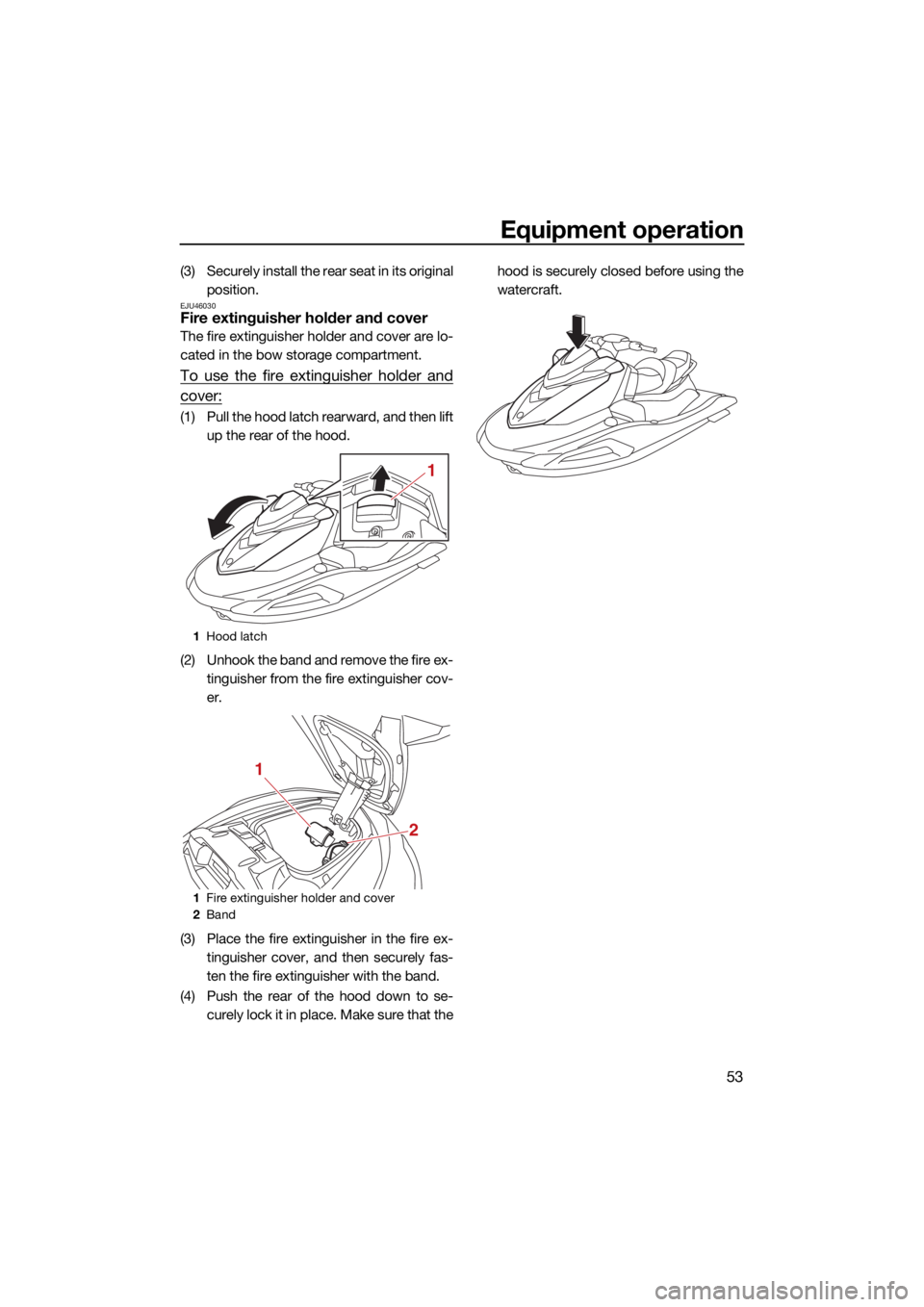
EJU46030Fire extinguisher holder and cover
The fire extinguisher holder and cover are lo-
cated in the bow storage compartment.
To use the fire extinguisher holder and
cover:
(1) Pull the hood latch rearward, and then liftup the rear of the hood.
(2) Unhook the band and remove the fire ex- tinguisher from the fire extinguisher cov-
er.
(3) Place the fire extinguisher in the fire ex- tinguisher cover, and then securely fas-
ten the fire extinguisher with the band.
(4) Push the rear of the hood down to se- curely lock it in place. Make sure that the hood is securely closed before using the
watercraft.
1
Hood latch
1 Fire extinguisher holder and cover
2 Band
1
2
1
UF4S71E0.book Page 53 Wednesday, August 4, 2021 5:18 PM
Page 74 of 112
Pre-operation checks
66
EJU46050Switch checksECJ01311
Do not run the engine over 4000 r/min on
land. Also, do not run the engine for more
than 15 seconds without supplying water,
otherwise the engine could overheat.
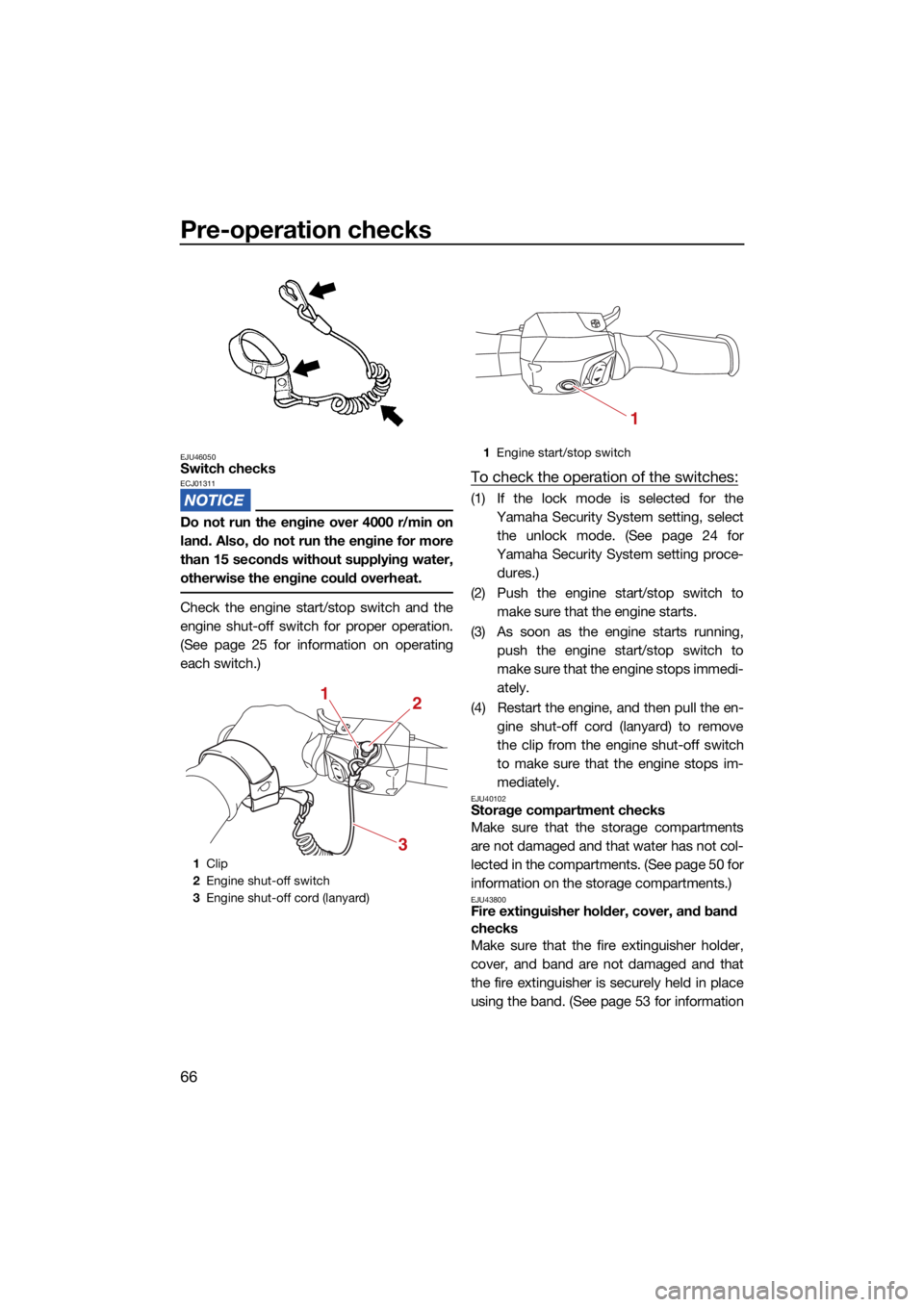
Check the engine start/stop switch and the
engine shut-off switch for proper operation.
(See page 25 for information on operating
each switch.)
To check the operation of the switches:
(1) If the lock mode is selected for theYamaha Security System setting, selectthe unlock mode. (See page 24 for
Yamaha Security System setting proce- dures.)
(2) Push the engine start/stop switch to make sure that the engine starts.
(3) As soon as the engine starts running, push the engine start/stop switch to
make sure that the engine stops immedi-
ately.
(4) Restart the engine, and then pull the en- gine shut-off cord (lanyard) to remove
the clip from the engine shut-off switch
to make sure that the engine stops im-
mediately.
EJU40102Storage compartment checks
Make sure that the storage compartments
are not damaged and that water has not col-
lected in the compartments. (See page 50 for
information on the storage compartments.)
EJU43800Fire extinguisher holder, cover, and band
checks
Make sure that the fire extinguisher holder,
cover, and band are not damaged and that
the fire extinguisher is securely held in place
using the band. (See page 53 for information
1Clip
2 Engine shut-off switch
3 Engine shut-off cord (lanyard)
12
3
1Engine start/stop switch
1
UF4S71E0.book Page 66 Wednesday, August 4, 2021 5:18 PM
Page 78 of 112
Operation
70
EJU32905
Operating your watercraftEWJ00512
Before operating your watercraft, become
familiar with all of the controls. Consult a
Yamaha dealer about any control or func- tion that you do not fully understand. Fail-
ure to understand how the controls work
could cause an accident or prevent you
from avoiding an accident.
EJU32965Getting to know your watercraft
Operating your watercraft requires skills ac-
quired through practice over a period of time.
Take the time to learn the basic techniques
well before attempting more difficult maneu-
vers.
Operating your new watercraft can be a very
enjoyable activity, providing you with hours of
pleasure. However, it is essential to familiar-
ize yourself with the operation of the water-
craft to achieve the skill level necessary to
enjoy riding safely.
Before operating this watercraft, read this
owner’s/operator’s manual, the Riding Prac-
tice Guide, the Riding Instruction card, and all
labels on the watercraft. Pay particular atten-
tion to the safety information beginning on
page 9. These materials should give you an
understanding of the watercraft and its oper-
ation.
Remember: This watercraft is designed to
carry the operator and up to 2 passengers.
Never exceed the maximum load limit or al-
low more than 3 persons (or 2 persons if a
wakeboarder or water-skier is being pulled)
to ride the watercraft at any time.
EJU33006Learning to operate your watercraft
Before operating the watercraft, always per-
form the pre-operation checks listed on page
61. The short time spent checking the water-
craft will reward you with added safety and
reliability.
Check local laws before operating your wa-
tercraft.
Operate defensively at safe speeds and keep
a safe distance away from people, objects,
and other watercraft. Select a wide area to
learn in, where there is good visibility and
light boat traffic.
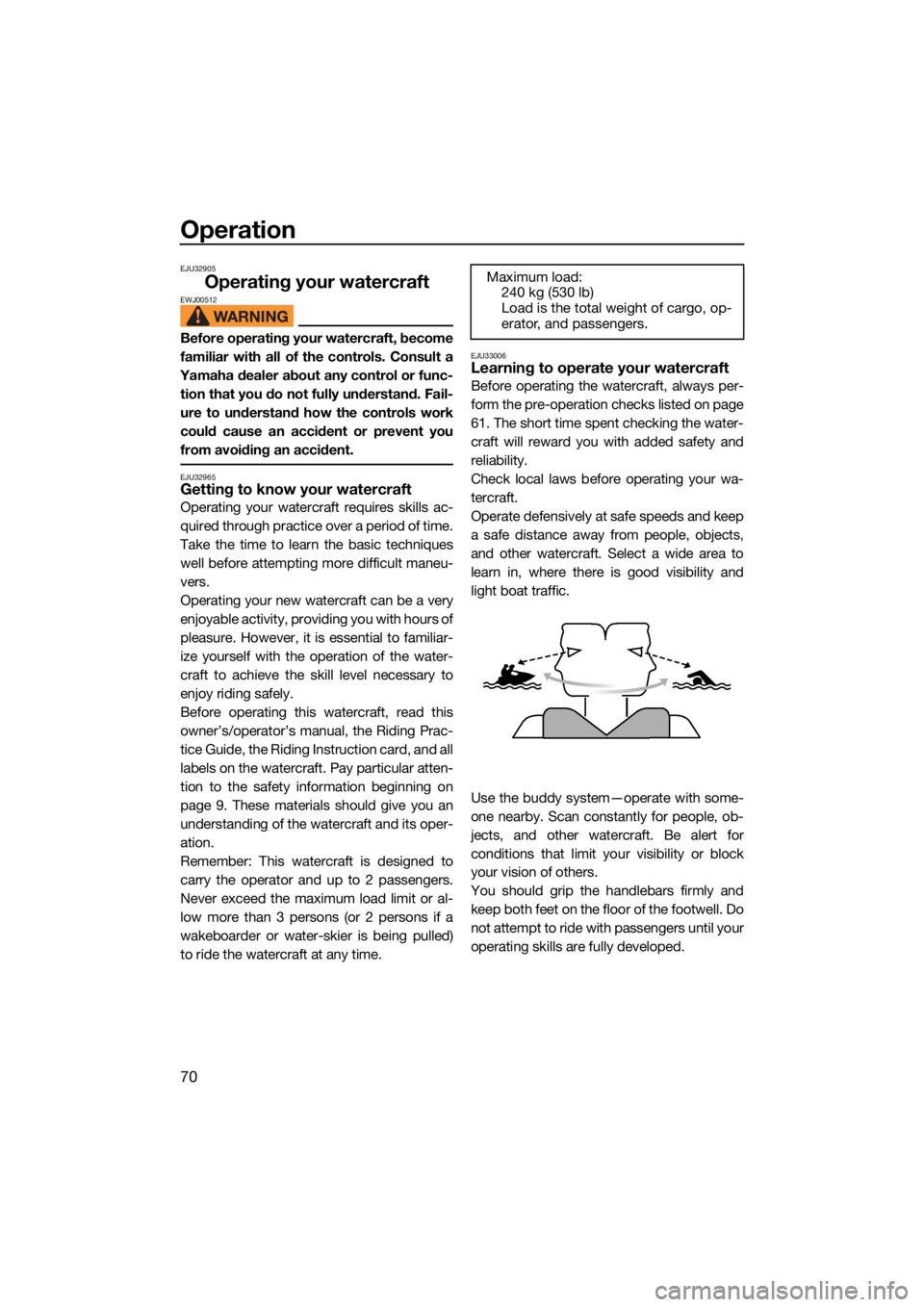
Use the buddy system—operate with some-
one nearby. Scan constantly for people, ob-
jects, and other watercraft. Be alert for
conditions that limit your visibility or block
your vision of others.
You should grip the handlebars firmly and
keep both feet on the floor of the footwell. Do
not attempt to ride with passengers until your
operating skills are fully developed. Maximum load:
240 kg (530 lb)
Load is the total weight of cargo, op-
erator, and passengers.
UF4S71E0.book Page 70 Wednesday, August 4, 2021 5:18 PM
Page 79 of 112
Operation
71
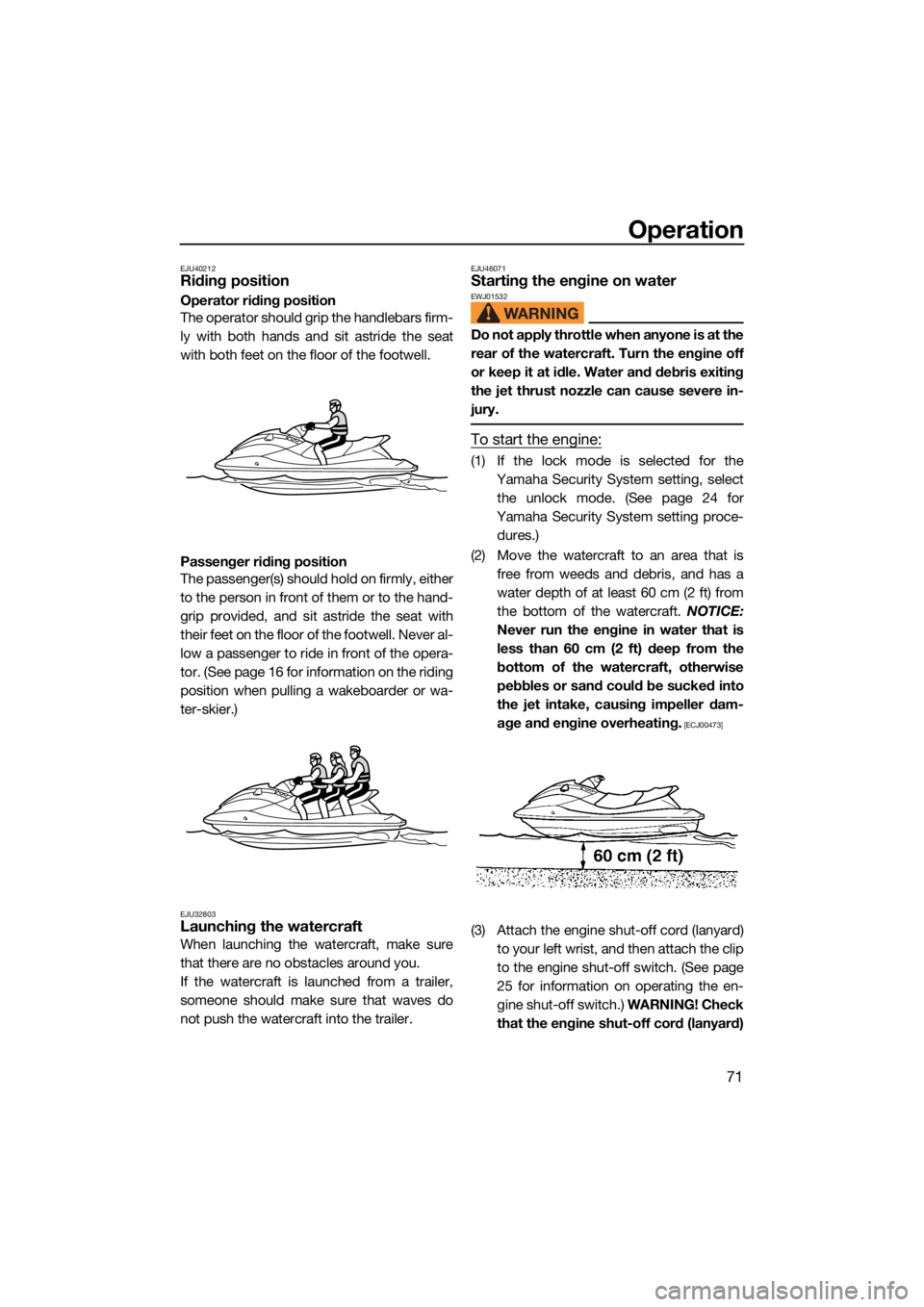
EJU40212Riding position
Operator riding position
The operator should grip the handlebars firm-
ly with both hands and sit astride the seat
with both feet on the floor of the footwell.
Passenger riding position
The passenger(s) should hold on firmly, either
to the person in front of them or to the hand-
grip provided, and sit astride the seat with
their feet on the floor of the footwell. Never al-
low a passenger to ride in front of the opera-
tor. (See page 16 for information on the riding
position when pulling a wakeboarder or wa-
ter-skier.)
EJU32803Launching the watercraft
When launching the watercraft, make sure
that there are no obstacles around you.
If the watercraft is launched from a trailer,
someone should make sure that waves do
not push the watercraft into the trailer.
EJU46071Starting the engine on waterEWJ01532
Do not apply throttle when anyone is at the
rear of the watercraft. Turn the engine off
or keep it at idle. Water and debris exiting
the jet thrust nozzle can cause severe in-
jury.
To start the engine:
(1) If the lock mode is selected for theYamaha Security System setting, selectthe unlock mode. (See page 24 for
Yamaha Security System setting proce- dures.)
(2) Move the watercraft to an area that is free from weeds and debris, and has a
water depth of at least 60 cm (2 ft) from
the bottom of the watercraft. NOTICE:
Never run the engine in water that is
less than 60 cm (2 ft) deep from the
bottom of the watercraft, otherwise
pebbles or sand could be sucked into
the jet intake, causing impeller dam-
age and engine overheating.
[ECJ00473]
(3) Attach the engine shut-off cord (lanyard) to your left wrist, and then attach the clip
to the engine shut-off switch. (See page
25 for information on operating the en-
gine shut-off switch.) WARNING! Check
that the engine shut-off cord (lanyard)
UF4S71E0.book Page 71 Wednesday, August 4, 2021 5:18 PM
Page 86 of 112
Operation
78
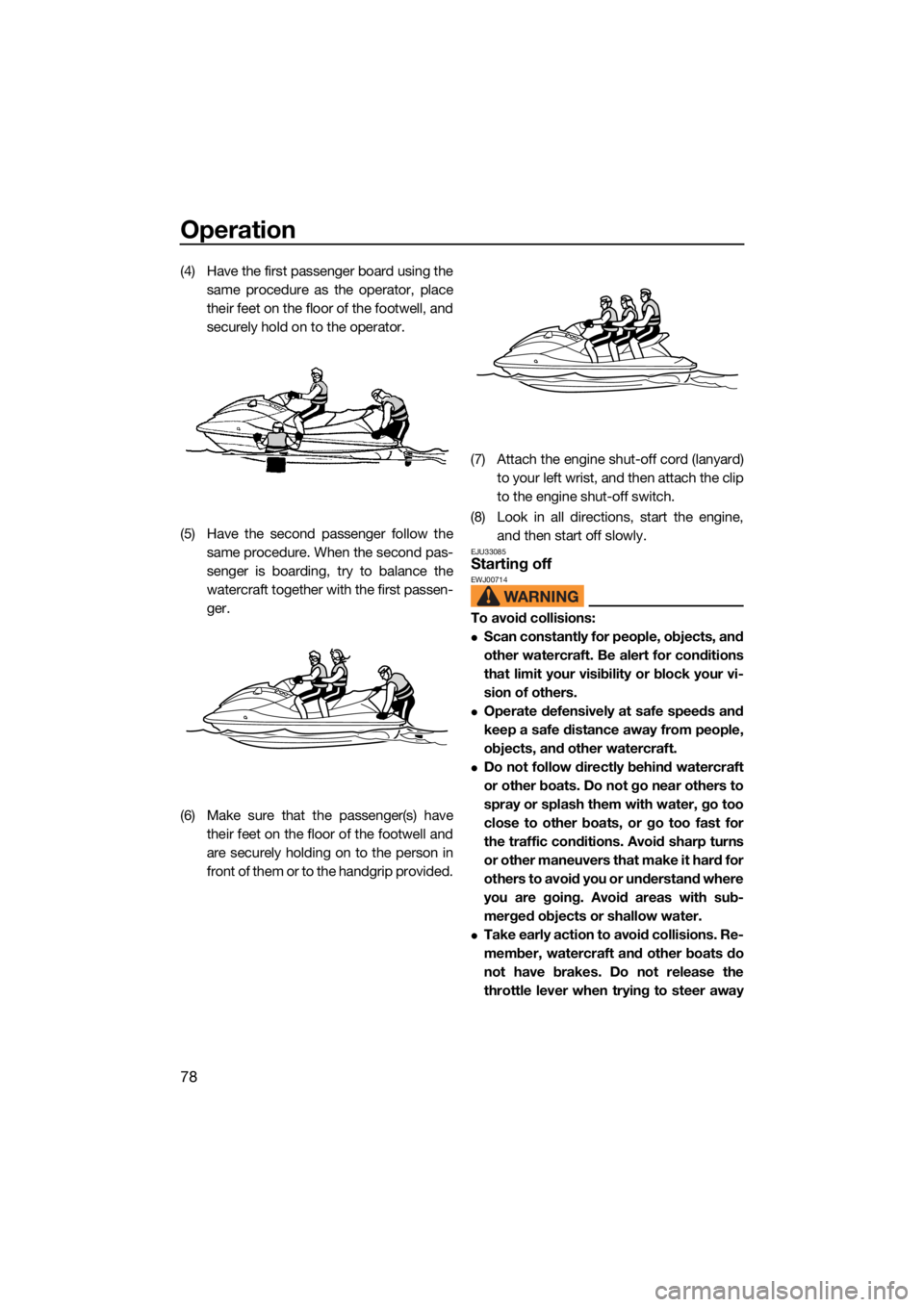
(4) Have the first passenger board using thesame procedure as the operator, place
their feet on the floor of the footwell, and
securely hold on to the operator.
(5) Have the second passenger follow the same procedure. When the second pas-
senger is boarding, try to balance the
watercraft together with the first passen-
ger.
(6) Make sure that the passenger(s) have their feet on the floor of the footwell and
are securely holding on to the person in
front of them or to the handgrip provided. (7) Attach the engine shut-off cord (lanyard)
to your left wrist, and then attach the clip
to the engine shut-off switch.
(8) Look in all directions, start the engine, and then start off slowly.
EJU33085Starting offEWJ00714
To avoid collisions:
Scan constantly for people, objects, and
other watercraft. Be alert for conditions
that limit your visibility or block your vi-
sion of others.
Operate defensively at safe speeds and
keep a safe distance away from people,
objects, and other watercraft.
Do not follow directly behind watercraft
or other boats. Do not go near others to
spray or splash them with water, go too
close to other boats, or go too fast for
the traffic conditions. Avoid sharp turns
or other maneuvers that make it hard for
others to avoid you or understand where
you are going. Avoid areas with sub-
merged objects or shallow water.
Take early action to avoid collisions. Re-
member, watercraft and other boats do
not have brakes. Do not release the
throttle lever when trying to steer away
UF4S71E0.book Page 78 Wednesday, August 4, 2021 5:18 PM
Page 100 of 112

Specifications
92
EJU46451
Specifications
Watercraft capaci-
ty:Maximum people on board: 3 person
Maximum load capacity: 240 kg (530 lb)
Dimensions and
weight: Length: 3.37 m (132.7 in)
Width: 1.24 m (48.8 in)
Height: 1.20 m (47.2 in)
Dry weight: 352 kg (776 lb) (VX CRUISER HO)
360 kg (794 lb) (VX CRUISER HO with
audio, VX LIMITED HO)
Performance: Maximum output (according to ISO
8665/SAE J1228): 125.0 kW at 7600 r/min
Maximum fuel consumption: 49.7 L/h (13.1 US gal/h,
10.9 Imp.gal/h)
Cruising range at full throttle: 1.41 hour
Trolling speed: 1300 ±100 r/min
Engine: Engine type: Liquid cooled 4-stroke, DOHC
Number of cylinders: 4
Engine displacement: 1812 cm³
Bore × stroke: 86.0 × 78.0 mm (3.39 × 3.07 in)
Compression ratio: 11.0 : 1
Valve clearance-intake (cold): 0.14–0.23 mm (0.0055–0.0091 in)
Valve clearance-exhaust (cold): 0.28–0.37 mm (0.0110–0.0146 in)
Lubrication system: Wet sump
Cooling system: Water
Starting system: Electric
Ignition system: T.C.I.
Spark plug (NGK): LFR6A
Spark plug gap: 0.8–0.9 mm (0.031–0.035 in)
Battery capacity: 12 V, 18 Ah
Battery type: YTX20L-BS
Charging system: Flywheel magneto
Drive unit: Propulsion system: Jet pump
Jet pump type: Axial flow, single stage
Impeller rotation: Counterclockwise
Jet thrust nozzle angle: 24+24 °
UF4S71E0.book Page 92 Wednesday, August 4, 2021 5:18 PM
Page 102 of 112

Trouble recovery
94
EJU34562
Troubleshooting
If you have any trouble with your watercraft, use the troubleshooting chart to check for the
possible cause.
If you cannot find the cause, consult a Yamaha dealer.
EJU46132Troubleshooting chart
Confirm the possible cause and remedy, and then refer to the applicable page.
TROUBLEPOSSIBLE CAUSE REMEDYPAGE
Engine does not
start (Starter motor
does not turn over) Ya m a h a S e -
curity System
Lock mode selected Select unlock mode
24
Engine shut-
off switch Clip not in place Install clip
25
Fuse Burned out Have serviced by
Yamaha dealer —
Battery Run down Recharge83
Poor terminal con-
nections Tighten as required
83
Terminal corroded Clean or replace 83
Starter motor Faulty Have serviced by
Yamaha dealer —
Engine does not
start (Starter motor
turns over) Throttle lever Squeezed
Release25
Faulty Have serviced by
Yamaha dealer —
RiDE lever Squeezed Release25
Faulty Have serviced by
Yamaha dealer —
Fuel Fuel tank empty Refill as soon as pos-
sible 54
Stale or contaminat-
ed Have serviced by
Yamaha dealer
—
Fuel tank Water or dirt present Have serviced by Yamaha dealer—
Spark plug Fouled or defective Have serviced by Yamaha dealer—
Fuel injec-
tion system Fuel pump faulty Have serviced by
Yamaha dealer —
UF4S71E0.book Page 94 Wednesday, August 4, 2021 5:18 PM
Page 109 of 112

101
Index
A
Accessory outlet ...................................... 45
After removing the watercraft from the water ..................................................... 81
Audio control............................................ 44
Audio system (equipped models) ............ 44
B
Battery care.............................................. 83
Battery checks ......................................... 64
Battery, jumping....................................... 98
Beaching and docking the watercraft ...... 80
Bilge water check..................................... 64
Bilge water, draining ................................ 58
Bilge water, draining on land ................... 58
Bilge water, draining on water ................. 58
Boarding alone ......................................... 76
Boarding and starting off from a dock ..... 79
Boarding the watercraft ........................... 76
Boarding with passenger(s) ..................... 77
Bow eye ................................................... 49
Bow storage compartment ...................... 50
Builder’s plate ............................................ 3
C
Capsized watercraft ................................. 79
Cleaning ................................................... 85
Cleaning the watercraft ............................ 83
Cleat ......................................................... 49
Cooling water pilot outlet ......................... 26
Cooling water pilot outlet check .............. 68
Craft Identification Number (CIN)............... 1
Cruise assist............................................. 35
Cruising limitations................................... 10
D
Display ..................................................... 37
Drive control mode................................... 33
Drive control mode screen ....................... 40
E
Emergency procedures ............................ 97
Engine break-in ........................................ 60
Engine compartment check ..................... 63
Engine cover, removing and installing ..... 87
Engine idling speed check ....................... 69
Engine lock screen ................................... 41
Engine oil ................................................. 56
Engine oil and oil filter .............................. 91 Engine oil level check ............................... 64
Engine oil requirements ........................... 56
Engine serial number ................................. 1
Engine shut-off cord (lanyard) check ....... 65
Engine shut-off switch ............................. 25
Engine start/stop switch .......................... 25
Engine unit check ..................................... 64
Enjoy your watercraft responsibly ............ 18
Equipment ................................................ 47
F
Fire extinguisher check ............................ 67
Fire extinguisher holder and cover........... 53
Fire extinguisher holder, cover, and
band checks ......................................... 66
Flushing the cooling water passages....... 82
Fuel .......................................................... 54
Fuel level check........................................ 63
Fuel requirements .................................... 54
Fuel system checks ................................. 63
G
Getting to know your watercraft .............. 70
Glossary, watercraft ................................. 19
Glove compartment ................................. 51
H
Handgrip .................................................. 48
Hazard information................................... 14
Home screen ............................................ 39
Hood check .............................................. 68
Hull and deck check ................................ 67
I
Identification numbers ............................... 1
Information screen ................................... 39
J
Jet intake and impeller, cleaning.............. 97
Jet intake checks ..................................... 67
Jet thrust nozzle and reverse gate check .................................................... 67
Jumper cables, connecting ...................... 98
L
Labels, important ....................................... 4
Labels, other .............................................. 8
Labels, warning .......................................... 5
Launching the watercraft ......................... 71
Learning to operate your watercraft......... 70
Leaving the watercraft.............................. 72
UF4S71E0.book Page 101 Wednesday, August 4, 2021 5:18 PM