oil YAMAHA WHY 50 2003 User Guide
[x] Cancel search | Manufacturer: YAMAHA, Model Year: 2003, Model line: WHY 50, Model: YAMAHA WHY 50 2003Pages: 80, PDF Size: 1.18 MB
Page 35 of 80
OPERATION AND IMPORTANT RIDING POINTS
5
EAU00436
Engine break-in
There is never a more important period
in the life of your engine than the period
between 0 and 1,000 km. For this
reason, you should read the following
material carefully.
Since the engine is brand new, do not
put an excessive load on it for the first
1,000 km. The various parts in the
engine wear and polish themselves to
the correct operating clearances.
During this period, prolonged full-
throttle operation or any condition that
might result in engine overheating must
be avoided.
EAUT0003*
0 — 150 km
Avoid operation above 1/3 throttle. Stop
the engine and let it cool for 5 to 10
minutes after every hour of operation.
Vary the speed of the scooter from time
to time. Do not operate it at one set
throttle position.150 — 500 km
Avoid prolonged operation above 1/2
throttle.
500 — 1,000 km
Avoid cruising speeds in excess of 3/
4 throttle.
ECAT0001
After 1,000 km of operation, be sure
to replace the final transmission oil.
1,000 km and beyond
Avoid prolonged full throttle operation.
Vary speeds occasionally.
EC000049
If any engine trouble should occur
during the engine break-in period,
immediately have a Yamaha dealer
check the vehicle.
EAU00461
Parking
When parking, stop the engine, and
then remove the key from the main
switch.
EW000058
•Since the engine and exhaust
system can become very hot,
park in a place where
pedestrians or children are not
likely to touch them.
•Do not park on a slope or on
soft ground, otherwise the
scooter may overturn.
EC000062
Never park in an area where there
are fire hazards such as grass or
other flammable materials.
5-4
Page 37 of 80
EAU00462
PERIODIC MAINTENANCE AND MINOR REPAIR
Periodic maintenance and lubrication chart ............ 6-2
Removing and installing the panel .......................... 6-5
Panel A .................................................................... 6-5
Checking the spark plug ......................................... 6-5
Final transmission oil .............................................. 6-6
Cleaning the air filter element ................................. 6-7
Adjusting the carburetor .......................................... 6-9
Adjusting the throttle cable free play ....................... 6-9
Tires ...................................................................... 6-10
Cast wheels .......................................................... 6-11
Adjusting the front brake lever free play ................ 6-12
Adjusting the front brake lever free play ................ 6-12
Checking the front brake pads .............................. 6-13
and rear brake shoes
Checking the brake fluid level ............................... 6-14
6 Changing the brake fluid ....................................... 6-15
Checking and lubricating the throttle grip .............. 6-15
and cable
Lubricating the front and rear brakes levers .......... 6-15
Checking and lubricating the centerstand ............. 6-16
Checking the front fork .......................................... 6-16
Checking the steering ........................................... 6-17
Checking the wheel bearings ................................ 6-17
Battery ................................................................... 6-18
Replacing the fuse ................................................ 6-19
Replacing a headlight bulb .................................... 6-20
Replacing the brake taillight bulb .......................... 6-21
Replacing a turn signal light bulb .......................... 6-21
Troubleshooting ..................................................... 6-22
Troubleshooting chart ............................................ 6-23
Page 40 of 80
PERIODIC MAINTENANCE AND MINOR REPAIR
6
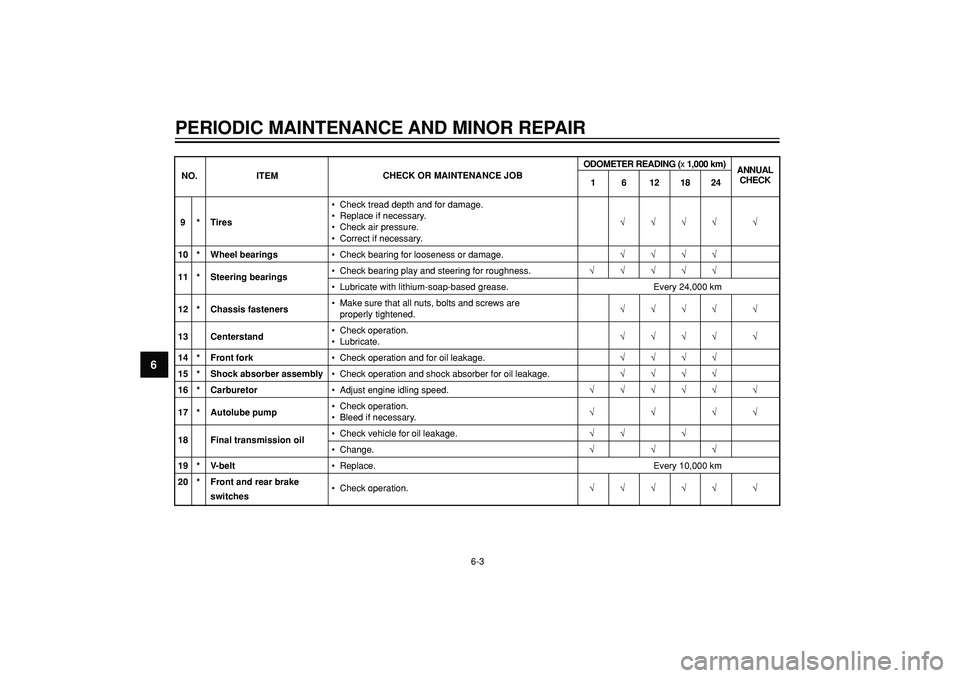
•Check tread depth and for damage.
9 * Tires•Replace if necessary.
√√√√ √
•Check air pressure.
•Correct if necessary.
10 * Wheel bearings•Check bearing for looseness or damage.√√√√
11 * Steering bearings•Check bearing play and steering for roughness.√√√√√•Lubricate with lithium-soap-based grease. Every 24,000 km
12 * Chassis fasteners•Make sure that all nuts, bolts and screws are
√√√√ √
properly tightened.
13 Centerstand•Check operation.
√√√√ √
•Lubricate.
14 * Front fork•Check operation and for oil leakage.√√√√
15 * Shock absorber assembly•Check operation and shock absorber for oil leakage.√√√√
16 * Carburetor•Adjust engine idling speed.√√√√√ √
17 * Autolube pump•Check operation.
√√√√
•Bleed if necessary.
18 Final transmission oil•Check vehicle for oil leakage.√√ √•Change.√√√
19 * V-belt•Replace. Every 10,000 km
20 * Front and rear brake
•Check operation.√√√√√ √
switches
ODOMETER READING (x 1,000 km)
NO. ITEMCHECK OR MAINTENANCE JOB
1
ANNUAL
CHECK
6121824
6-3
Page 43 of 80

PERIODIC MAINTENANCE AND MINOR REPAIR
6 If the spark plug shows signs of
electrode erosion and excessive
carbon or other deposits, it should be
replaced.
Specified spark plug:
BR8HS (NGK)
Before installing a spark plug, the spark
plug gap should be measured with a
wire thickness gauge and, if necessary,
adjusted to specification.
Spark plug gap:
0.6 — 0.7 mmClean the surface of the spark plug
gasket and its mating surface, and then
wipe off any grime from the spark plug
threads.
Tightening torque:
Spark plug:
23 Nm (2.3 m
•kg)
NOTE :
If a torque wrench is not available when
installing a spark plug, a good estimate
of the correct torque is 1/4 — 1/2 turn
past finger tight. However, the spark
plug should be tightened to the
specified torque as soon as possible.
a
ZAUM0037
a Spark plug gap
EAU04228
Final transmission oil
The final transmission case must be
checked for oil leakage before each
ride. If any leakage is found, have a
Yamaha dealer check and repair the
scooter. In addition, the final transmis-
sion oil must be changed as follows at
the intervals specified in the periodic
maintenance and lubrication chart.
1. Start the engine, warm it up by
riding the scooter for several mi-
nutes, and then stop the engine.
2. Place the scooter on the
centerstand.
3. Place an oil pan under the final
transmission case to collect the
used oil.
6-6
Page 44 of 80

PERIODIC MAINTENANCE AND MINOR REPAIR
64. Remove the oil filler cap and drain
bolt to drain the oil from the final
transmission case.
5. Install the final transmission oil
drain bolt, and then tighten it to
the specified torque.
Tightening torque:
Final transmission oil drain bolt:
17 Nm (1.7 m
•kg)
6. Add the specified amount of the
recommended final transmission
oil, and then install and tighten the
oil filler cap.Recommended final transmission oil:
See page 8-1.
Oil quantity:
0.11 L
EWA00062
•Make sure that no foreign
material enters the final trans-
mission case.
•Make sure that no oil gets on
the tire or wheel.
7. Check the final transmission case
for oil leakage. If oil is leaking,
check for the cause.
1
2
ZAUM0371
1. Oil filler cap
2. Oil drain bolt
EAUM0071
Cleaning the air filter element
The air filter element should be cleaned
at the intervals specified in the periodic
maintenance and lubrication chart.
Clean the air filter element more
frequently if you are riding in unusually
wet or dusty areas.
1. Remove the air filter case cover
by removing the screws.
1
ZAUM0372
1. Screws
6-7
Page 45 of 80
PERIODIC MAINTENANCE AND MINOR REPAIR
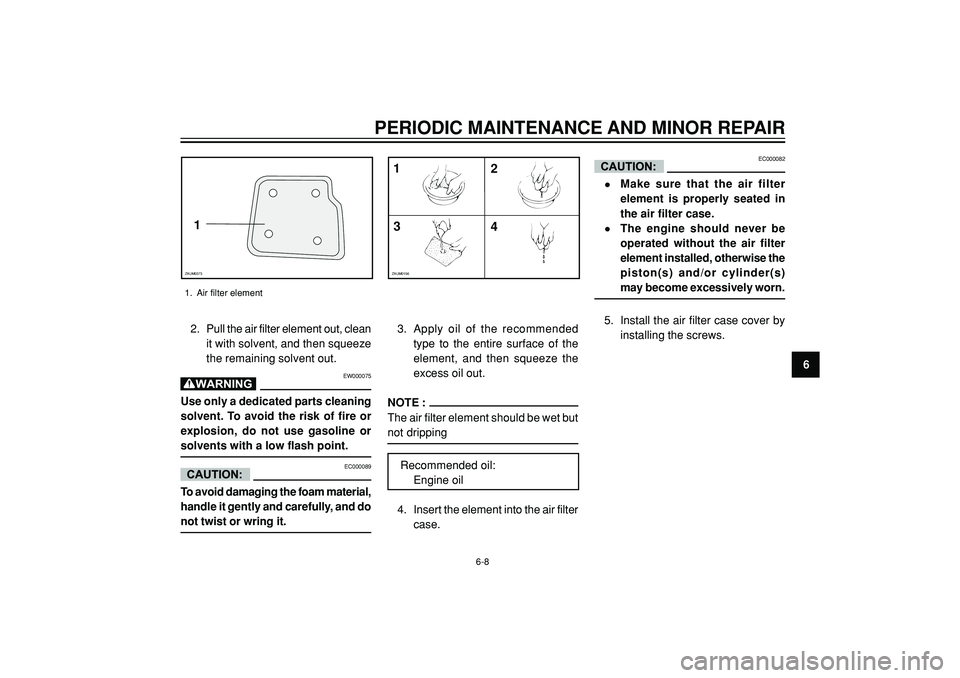
6 2. Pull the air filter element out, clean
it with solvent, and then squeeze
the remaining solvent out.EW000075
Use only a dedicated parts cleaning
solvent. To avoid the risk of fire or
explosion, do not use gasoline or
solvents with a low flash point.
EC000089
To avoid damaging the foam material,
handle it gently and carefully, and do
not twist or wring it.
1
ZAUM0373
1
4 32
ZAUM0156
3. Apply oil of the recommended
type to the entire surface of the
element, and then squeeze the
excess oil out.
NOTE :
The air filter element should be wet but
not dripping
Recommended oil:
Engine oil
4. Insert the element into the air filter
case.
1. Air filter element
EC000082
•Make sure that the air filter
element is properly seated in
the air filter case.
•The engine should never be
operated without the air filter
element installed, otherwise the
piston(s) and/or cylinder(s)
may become excessively worn.
5. Install the air filter case cover by
installing the screws.
6-8
Page 51 of 80
PERIODIC MAINTENANCE AND MINOR REPAIR
6
EAU00732
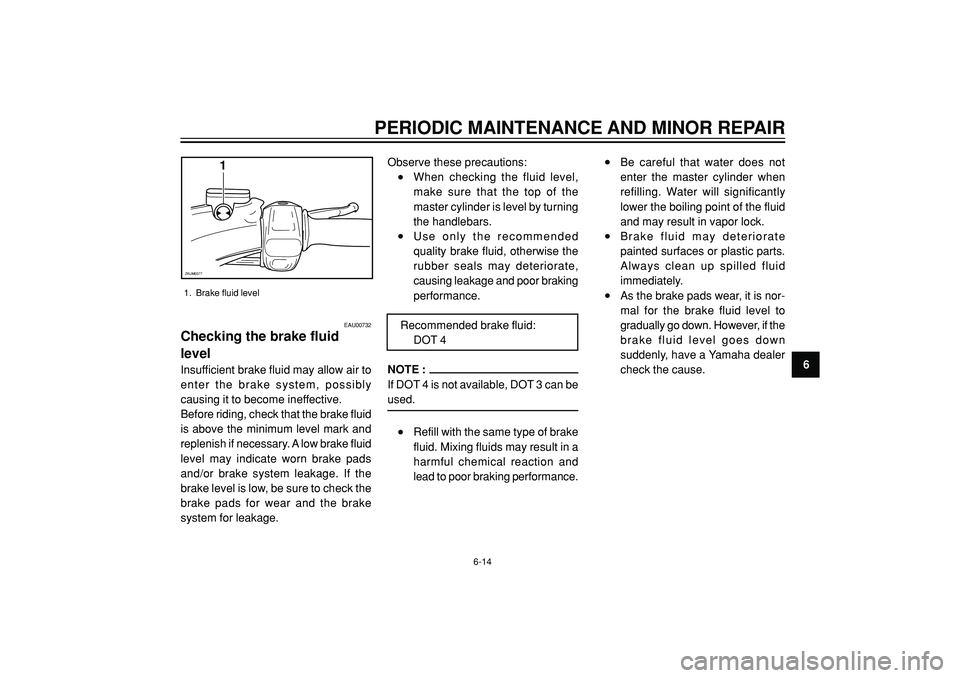
Checking the brake fluid
level
Insufficient brake fluid may allow air to
enter the brake system, possibly
causing it to become ineffective.
Before riding, check that the brake fluid
is above the minimum level mark and
replenish if necessary. A low brake fluid
level may indicate worn brake pads
and/or brake system leakage. If the
brake level is low, be sure to check the
brake pads for wear and the brake
system for leakage.Observe these precautions:
•When checking the fluid level,
make sure that the top of the
master cylinder is level by turning
the handlebars.
•Use only the recommended
quality brake fluid, otherwise the
rubber seals may deteriorate,
causing leakage and poor braking
performance.
Recommended brake fluid:
DOT 4
NOTE :
If DOT 4 is not available, DOT 3 can be
used.
•Refill with the same type of brake
fluid. Mixing fluids may result in a
harmful chemical reaction and
lead to poor braking performance.
•Be careful that water does not
enter the master cylinder when
refilling. Water will significantly
lower the boiling point of the fluid
and may result in vapor lock.
•Brake fluid may deteriorate
painted surfaces or plastic parts.
Always clean up spilled fluid
immediately.
•As the brake pads wear, it is nor-
mal for the brake fluid level to
gradually go down. However, if the
brake fluid level goes down
suddenly, have a Yamaha dealer
check the cause.
1
ZAUM0377
1. Brake fluid level
6-14
Page 53 of 80

PERIODIC MAINTENANCE AND MINOR REPAIR
6 To check the operation
1. Place the scooter on a level sur-
face and hold it in an upright po-
sition.
2. While applying the front brake,
push down hard on the
handlebars several times to check
if the front fork compresses and
rebounds smoothly.
EC000098
If any damage is found or the front
fork does not operate smoothly, have
a Yamaha dealer check or repair it.
6-16
EAU02939
Checking the front fork
The condition and operation of the front
fork must be checked as follows at the
intervals specified in the periodic main-
tenance and lubrication chart.
To check the condition
EW000115
Securely support the scooter so that
there is no danger of it falling over.
Check the inner tubes for scratches,
damage and excessive oil leakage.
ZAUM0378
EAU04123
Checking and lubricating the
centerstand
The operation of the centerstand should
be checked before each ride, and the
pivots and metal-to-metal contact sur-
faces should be lubricated if necessary.
EWA00055
If the centerstand does not move up
and down smoothly, have a Yamaha
dealer check or repair it.
Recommended lubricant:
Lithium-soap-based grease
(all-purpose grease)
ZAUM0062
Page 62 of 80
SCOOTER CARE AND STORAGE
7
Care
While the open design of a scooter
reveals the attractiveness of the
technology, it also makes it more
vulnerable. Rust and corrosion can
develop even if high-quality
components are used. A rusty exhaust
pipe may go unnoticed on a car,
however, it detracts from the overall
appearance of a scooter. Frequent and
proper care does not only comply with
the terms of the warranty, but it will also
keep your scooter looking good, extend
its life and optimize its performance.
Before cleaning
1. Cover the muffler outlet with a
plastic bag after the engine has
cooled down.
2. Make sure that all caps and covers
as well as all electrical couplers
and connectors, including the
spark plug cap, are tightly
installed.3. Remove extremely stubborn dirt,
like oil burnt onto the crankcase,
with a degreasing agent and a
brush, but never apply such
products onto seals, gaskets and
wheel axles. Always rinse the dirt
and degreaser off with water.
Cleaning
ECA00011
•Avoid using strong acidic wheel
cleaners, especially on spoked
wheels. If such products are
used on hard-to-remove dirt, do
not leave the cleaner on the
affected area any longer than
instructed. Also, thoroughly
rinse the area off with water,
immediately dry it, and then
apply a corrosion protection
spray.
•Improper cleaning can damage
windshields, cowlings, panels
and other plastic parts. Use
only a soft, clean cloth or
sponge with mild detergent and
water to clean plastic.
•Do not use any harsh chemical
products on plastic parts. Be
sure to avoid using cloths or
sponges which have been in
contact with strong or abrasive
cleaning products, solvent or
thinner, fuel (gasoline), rust
removers or inhibitors, brake
fluid, antifreeze or electrolyte.
•Do not use high-pressure
washers or steam-jet cleaners
since they cause water seepage
and deterioration in the following
areas: seals (of wheel and
swingarm bearings, fork and
brakes), electric components
(couplers, connectors, instru-
ments, switches and lights),
breather hoses and vents.
7-1
Page 63 of 80

SCOOTER CARE AND STORAGE
7
•For scooters equipped with a
windshield: Do not use strong
cleaners or hard sponges as
they will cause dulling or
scratching. Some cleaning
compounds for plastic may
leave scratches on the
windshield. Test the product on
a small hidden part of the
windshield to make sure that it
does not leave any marks. If the
windshield is scratched, use a
quality plastic polishing
compound after washing.
After normal use
Remove dirt with warm water, a mild
detergent, and a soft, clean sponge,
and then rinse thoroughly with clean
water. Use a toothbrush or bottlebrush
for hard-to-reach areas. Stubborn dirt
and insects will come off more easily if
the area is covered with a wet cloth for
a few minutes before cleaning.
After riding in the rain, near the sea
or on salt-sprayed roads
Since sea salt or salt sprayed on the
roads during winter are extremely cor-
rosive in combination with water, carry
out the following steps after each ride
in the rain, near the sea or on salt-
sprayed roads.
NOTE :
Salt sprayed on roads in the winter may
remain well into spring.
1. Clean the scooter with cold water
and a mild detergent after the
engine has cooled down.
ECA00012
Do not use warm water since it
increases the corrosive action of the
salt.
2. Apply a corrosion protection spray
on all metal, including chrome-
and nickel-plated, surfaces to
prevent corrosion.After cleaning
1. Dry the scooter with a chamois or
an absorbing cloth.
2. Use a chrome polish to shine
chrome, aluminum and stainless-
steel parts, including the exhaust
system. (Even the thermally
induced discoloring of stainless-
steel exhaust systems can be
removed through polishing.)
3. To prevent corrosion, it is
recommended to apply a corro-
sion protection spray on all metal,
including chrome- and nickel-
plated, surfaces.
4. Use spray oil as a universal
cleaner to remove any remaining
dirt.
5. Touch up minor paint damage
caused by stones, etc.
6. Wax all painted surfaces.
7. Let the scooter dry completely
before storing or covering it.
7-2