brake YAMAHA WOLVERINE 2018 User Guide
[x] Cancel search | Manufacturer: YAMAHA, Model Year: 2018, Model line: WOLVERINE, Model: YAMAHA WOLVERINE 2018Pages: 188, PDF Size: 5.4 MB
Page 75 of 188

5-3
5
EBU31731Front and rear brakesBrake pedal
Check that there is no free play in the brake
pedal. If there is free play, have a Yamaha
dealer check the brake system. (See page
8-42.)
Check the operation of the brake pedal. It
should move smoothly and there should be
a firm feeling when the brakes are applied.
If not, have the vehicle inspected by a
Yamaha dealer.
Brake fluid level
Check the brake fluid level. Add fluid if neces-
sary. (See page 8-40.) Brake fluid leakage
Check to see if any brake fluid is leaking out
of the pipe joints or the brake fluid reservoir.
Apply the brakes firmly for one minute. If there
is any leakage, have the vehicle inspected by
a Yamaha dealer.
Brake operation
Check the operation of the brakes at the start
of every drive. Test the brakes at slow speed
after starting out to make sure they are work-
ing properly. If the brakes do not provide
proper braking performance, inspect the
brake system. (See page 8-39.)
EBU33201FuelMake sure there is suffi
cient fuel in the tank.
Specified brake fluid: DOT 4
UB3D7AE0.book Page 3 Tuesday, November 7, 2017 9:38 AM
Page 84 of 188

6-2
6
10–20 hours:
Avoid prolonged operation above three-quar-
ter throttle.
After break-in:
The vehicle may now be operated normally.EBU33081Starting the engine1. Turn the key to “ ” (on).NOTICEECB02291The coolant temperature warning light and
engine trouble warning light should come
on, then go off.
The EPS warning light should come on,
then go off when the engine is started.
To avoid possible damage, do not operate
the vehicle if a warning light does not work
as described above. 2. Apply the brake pedal.
3. Shift the drive select lever into the neutralposition.
When the drive select lever is in the
neutral position, the neutral indicator
light should come on. If the neutral indi-
cator light does not come on, ask a
Yamaha dealer to inspect the electric
circuit.
The engine can be started in any gear if
the brake pedal is applied. However, it
is recommended to shift into neutral
before starting the engine.
4. With your foot off the accelerator pedal,
start the engine by turning the key to “ ”
(start).
If the engine fails to start, release the key, and
then try starting it again. Wait a few seconds
before the next attempt. Each attempt should
be as short as possible, to preserve battery
energy. NOTICE: Do not crank the engine
more than 5 seconds on each attempt, or
starter damage could occur. Wait at least
5 seconds between each operation of the
electric starter to let it cool.
[ECB02140]
UB3D7AE0.book Page 2 Tuesday, November 7, 2017 9:38 AM
Page 85 of 188
6-3
6
Do not turn the key to the “ ” (start) position
with the engine running; otherwise, damage
to the electric starter may result.TIPFor maximum engine life, never accelerate
hard when the engine is cold! EBU31912Drive select lever operation and re-
verse drivingNOTICEECB02150Do not shift without coming to a complete
stop and waiting for the engine to return to
normal idle speed. Damage to the engine
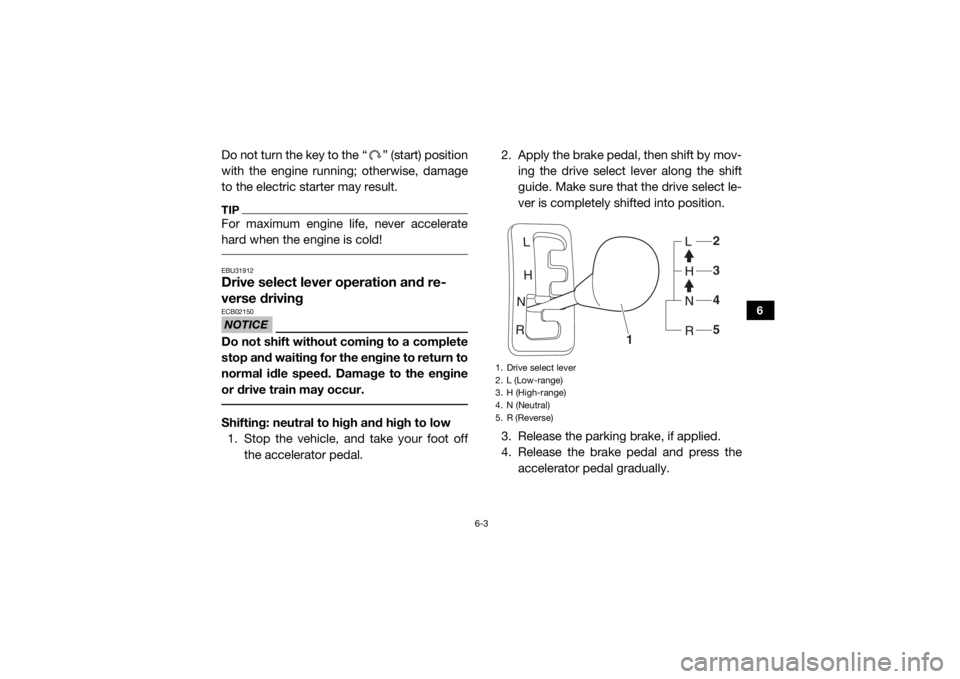
or drive train may occur. Shifting: neutral to high and high to low1. Stop the vehicle, and take your foot off
the accelerator pedal. 2. Apply the brake pedal, then shift by mov-
ing the drive select lever along the shift
guide. Make sure that the drive select le-
ver is completely shifted into position.
3. Release the parking brake, if applied.
4. Release the brake pedal and press the accelerator pedal gradually.
1. Drive select lever
2. L (Low-range)
3. H (High-range)
4. N (Neutral)
5. R (Reverse)
1
2
5 4
3
UB3D7AE0.book Page 3 Tuesday, November 7, 2017 9:38 AM
Page 86 of 188
6-4
6
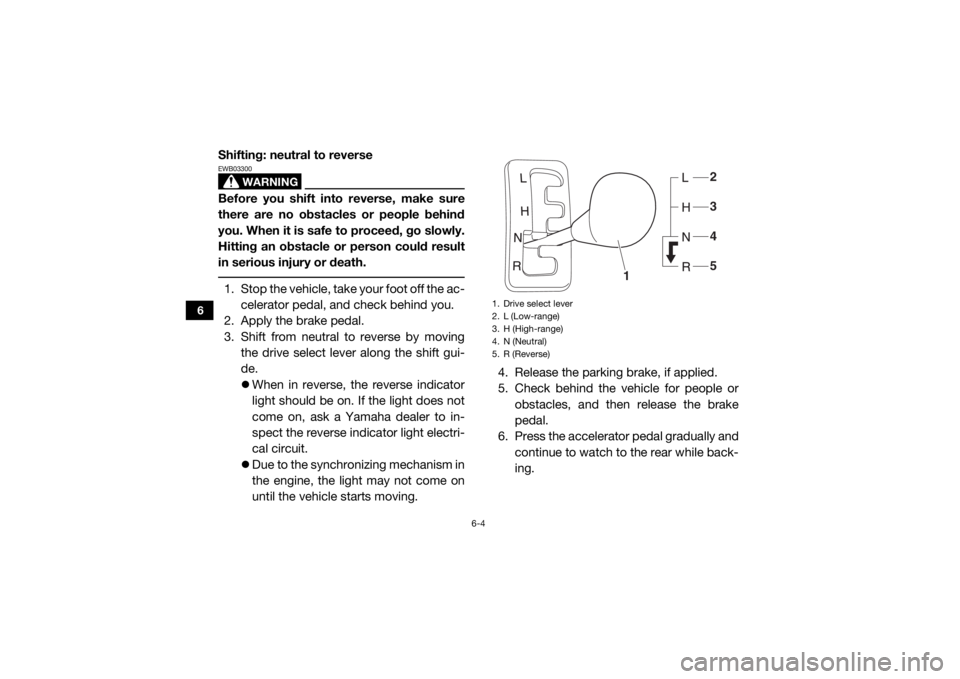
Shifting: neutral to reverse
WARNING
EWB03300Before you shift into reverse, make sure
there are no obstacles or people behind
you. When it is safe to proceed, go slowly.
Hitting an obstacle or person could result
in serious injury or death. 1. Stop the vehicle, take your foot off the ac- celerator pedal, and check behind you.
2. Apply the brake pedal.
3. Shift from neutral to reverse by moving the drive select lever along the shift gui-
de.
When in reverse, the reverse indicator
light should be on. If the light does not
come on, ask a Yamaha dealer to in-
spect the reverse indicator light electri-
cal circuit.
Due to the synchronizing mechanism in
the engine, the light may not come on
until the vehicle starts moving. 4. Release the parking brake, if applied.
5. Check behind the vehicle for people or
obstacles, and then release the brake
pedal.
6. Press the accelerator pedal gradually and
continue to watch to the rear while back-
ing.
1. Drive select lever
2. L (Low-range)
3. H (High-range)
4. N (Neutral)
5. R (Reverse)
1
2
5 4
3
UB3D7AE0.book Page 4 Tuesday, November 7, 2017 9:38 AM
Page 89 of 188

6-7
6
EBU31930ParkingWhen parking, stop the engine and shift the
drive select lever into the neutral position. Ap-
ply the parking brake to help prevent the ve-
hicle from rolling. See page 7-16 for more
information on parking and parking on a
slope.EBU31941LoadingTake extra precautions when driving with a
load or trailer. Follow these instructions and
always use common sense and good judg-
ment when carrying cargo or towing a trailer.
Prepare your load or trailer
Use the hooks equipped on the cargo bed to
tie down loads. (See page 4-20.)
Choose a trailer hitch drawbar designed for
use with a 2" (5 cm) receiver. (See page 4-32.)
WARNING
EWB04260Improper loading or towing can increase
the risk of loss of control, an overturn, or
other accident:
Keep weight in the cargo bed centered
side to side, and as low and as far for-
ward as possible. Top-heavy loads in-
crease the risk of overturn. Be sure
cargo is secured — a loose load could
change handling unexpectedly or strike
occupants.
Be sure to tie down cargo in the trailer
securely — a shifting load can cause an
accident.
Make sure the load does not interfere
with your control or ability to see where
you are going.
Do not exceed the Maximum Load Limits
for each section of the vehicle or the
Maximum Vehicle Load.
UB3D7AE0.book Page 7 Tuesday, November 7, 2017 9:38 AM
Page 104 of 188

7-13
7
Eye protection (goggles, helmet face shield,
or protective eyewear)
Over-the-ankle boots, gloves, long-sleeved
shirt or jacket, and long pants
An approved helmet and other personal pro-
tective equipment can help in a variety of
ways, including:
Reduce the severity of injuries if any part of
you is outside the vehicle cage/frame pro-
tective structure during a rollover.
Help protect you if outside objects intrude
inside the vehicle during operation.
Help protect you in the event of vehicle im-
pact with an obstacle.
Wear eye protection when operating or riding
in the vehicle to reduce the risk of a serious
accident or injury. Eye protection, such as a
face shield or goggles, may reduce the risk of
foreign material getting in your eyes and help
prevent loss of vision. Practice for new Yamaha Wolverine users
You should become familiar with the perfor-
mance characteristics of the vehicle in a lar-
ge, flat area that is free of obstacles and other
vehicles. Practice controlling the accelerator
pedal, brakes, steering, and drive select lever.
Drive at slow speeds with gradual accelera-
tion and turning. Practice smooth throttle ap-
plication. Practice slowing down before
turning. Practice maintaining a steady throttle
through the turn. Avoid higher speeds until
you are thoroughly familiar with the operation
of your vehicle. Remember, driving aggres-
sively or making abrupt maneuvers even on
flat, open areas can cause side rollovers.UB3D7AE0.book Page 13 Tuesday, November 7, 2017 9:38 AM
Page 106 of 188

7-15
7
If you think or feel that the vehicle may tip or
roll, keep your body completely inside the
protective structure of the vehicle:
Brace yourself by pressing your feet firmly
on the floorboard and keep a firm grip on
the steering wheel or passenger handhold.
Do not put your hands or feet outside of the
vehicle for any reason. Do not try to stop a
tipover using your arm or leg.
Accelerating
With the engine idling in neutral and your foot
on the brake, shift the drive select lever into
low or high. NOTICE: Do not shift from low
to high or vice versa without coming to a
complete stop and waiting for the engine
to return to normal idle speed – damage to
the engine or drive train may occur. Then
release the parking brake.
[ECB02160]
Press the
accelerator pedal slowly and smoothly. The
centrifugal clutch will engage and the vehicle
will begin to accelerate. Avoid higher speeds and sudden or hard ac-
celeration until you are thoroughly familiar
with the operation of your vehicle. Avoid sud-
den or hard acceleration in any turn.
Braking
When slowing down or stopping, take your
foot off the accelerator pedal and press the
brake pedal smoothly. Improper use of the
brakes can cause the tires to lose traction, re-
ducing control of the vehicle and increasing
the possibility of an accident.
Braking ability is affected by type of terrain. In
most cases, gradual application of the brakes
is more effective than abrupt braking, partic-
ularly on loose surfaces
, such as gravel. Al-
ways allow for greater braking distance on
rough, loose, or slippery surfaces.
Engine braking
Engine compression braking is designed to
assist you when operating your Wolverine off-
road. With this feature, the engine helps slow
UB3D7AE0.book Page 15 Tuesday, November 7, 2017 9:38 AM
Page 107 of 188

7-16
7
the vehicle down after you take your foot off
the accelerator. Engine braking is more no-
ticeable in four-wheel drive. Application of ve-
hicle brakes provides additional stopping
power.
Leaving the vehicle
Do not get out of the vehicle while the engine
is running and the drive select lever is in any
gear. There is a risk of injury because:
Children or others may accidentally press
the accelerator pedal.
Objects tossed into the vehicle may strike
the accelerator pedal.
The parking brake may not keep the vehicle
from accelerating.
Unwanted vehicle movement can cause seri-
ous injury or death, and it may be dangerous
to try to stop the vehicle. Parking on a flat area
When parking on a flat area, stop the engine
and shift the drive select lever into the neutral
position. Apply the parking brake to help pre-
vent the vehicle from rolling.
Parking on a slope
The parking brake acts only on the rear
wheels when in “2WD”. For the parking brake
to take effect on all four wheels, shift to “DIFF
LOCK” before stopping the engine.
If you park on a hill that is too steep, the vehi-
cle may roll out of control. Never park on hills
that are so steep you cannot walk up them
easily. If you must park
on an incline, follow
these instructions:
1. Bring the vehicle to a stop by applying the brake pedal.
2. Put the vehicle in “DIFF LOCK”.
3. Turn the key to “ ” (off).
4. With the brake pedal applied, set the parking brake.UB3D7AE0.book Page 16 Tuesday, November 7, 2017 9:38 AM
Page 109 of 188

7-18
7
to see far enough ahead of you. Use common
sense and remember that some hills are too
steep for you to climb or descend. Use proper
driving techniques to avoid rearward, for-
ward, or sideways rollovers on hills and
slopes.
Drive straight up and down inclines, not
across them. If crossing a hill is unavoidable,
drive slowly. Turn downhill immediately if you
feel the vehicle may tip.
If you think or feel the vehicle may tip or
roll:
Brace yourself by pressing your feet firmly
on the floorboard and keep a firm grip on
the steering wheel or passenger handhold.
Do not put your hands or feet outside of the
vehicle for any reason.
Uphill
Do not attempt to climb hills until you have
mastered basic maneuv ers on flat ground.
Drive straight up hills, and avoid crossing the side of a hill, which increases your risk of roll-
over. Practice first on gentle slopes before at-
tempting steeper hills. Always check the
terrain carefully before attempting any hill.
To climb a hill, you need traction, momentum,
and steady throttle. For more traction and
control for climbing steeper and/or rougher
slopes, shift into low gear and select “4WD”
or “DIFF LOCK”. Travel fast enough to main-
tain momentum, but not so fast that you can-
not react to changes in the terrain as you
climb.
Slow down when you reach the crest of the
hill if you cannot see clearly what is on the
other side – there could be another person, an
obstacle, or a sharp drop-off.
If you start to lose traction or momentum
when climbing, and decide you will be unable
to continue, use the brakes to stop. Do not at-
tempt to turn the vehicle around. With your
foot on the brake pedal, look behind you and
plan your descent. Shift the drive select lever
into reverse so you can use engine braking toUB3D7AE0.book Page 18 Tuesday, November 7, 2017 9:38 AM
Page 110 of 188

7-19
7
slow your descent. Release the brake and be-
gin to coast down the hill. Use engine braking
as much as possible, gently applying the
brakes when necessary.
Downhill
Check the terrain carefully before going
downhill. When possible, choose a path that
lets you drive your vehicle straight downhill.
Choose your path carefully and drive slowly
enough to be able to react to obstacles that
you encounter.
For more traction and control, before going
down steeper and/or rougher slopes, shift
into low gear and select “4WD” or “DIFF
LOCK”. Engine braking will help you go
downhill slowly. Go as slowly as possible. If
you begin to go too fast, apply the brakes
gently. Avoid hard application of the brakes,
which could cause the vehicle to slide.If you are sliding or skidding, try to steer in the
direction the vehicle is sliding, to regain con-
trol. For example, if you feel the back of the
vehicle start to slide to your right, steer to the
right.
If you must turn on the hill to avoid an obsta-
cle, do so slowly and carefully. If the vehicle
starts to tip, immediately steer in the downhill
direction if there are no obstacles in your
path. As you regain proper balance, gradually
steer again in the direction you want to go.
Rough terrain
Operation over rough terrain should be done
with caution.
Look for and avoid obstacles that could
cause damage to the vehicle or could lead
to a rollover or accident.
Do not drive in a way that will get the vehicle
airborne, as injury, loss of control, and
damage to the vehicle could occur.UB3D7AE0.book Page 19 Tuesday, November 7, 2017 9:38 AM