fuel YAMAHA WR 250F 2007 Owner's Guide
[x] Cancel search | Manufacturer: YAMAHA, Model Year: 2007, Model line: WR 250F, Model: YAMAHA WR 250F 2007Pages: 912, PDF Size: 23.95 MB
Page 370 of 912
4 - 11
TUNSETTING
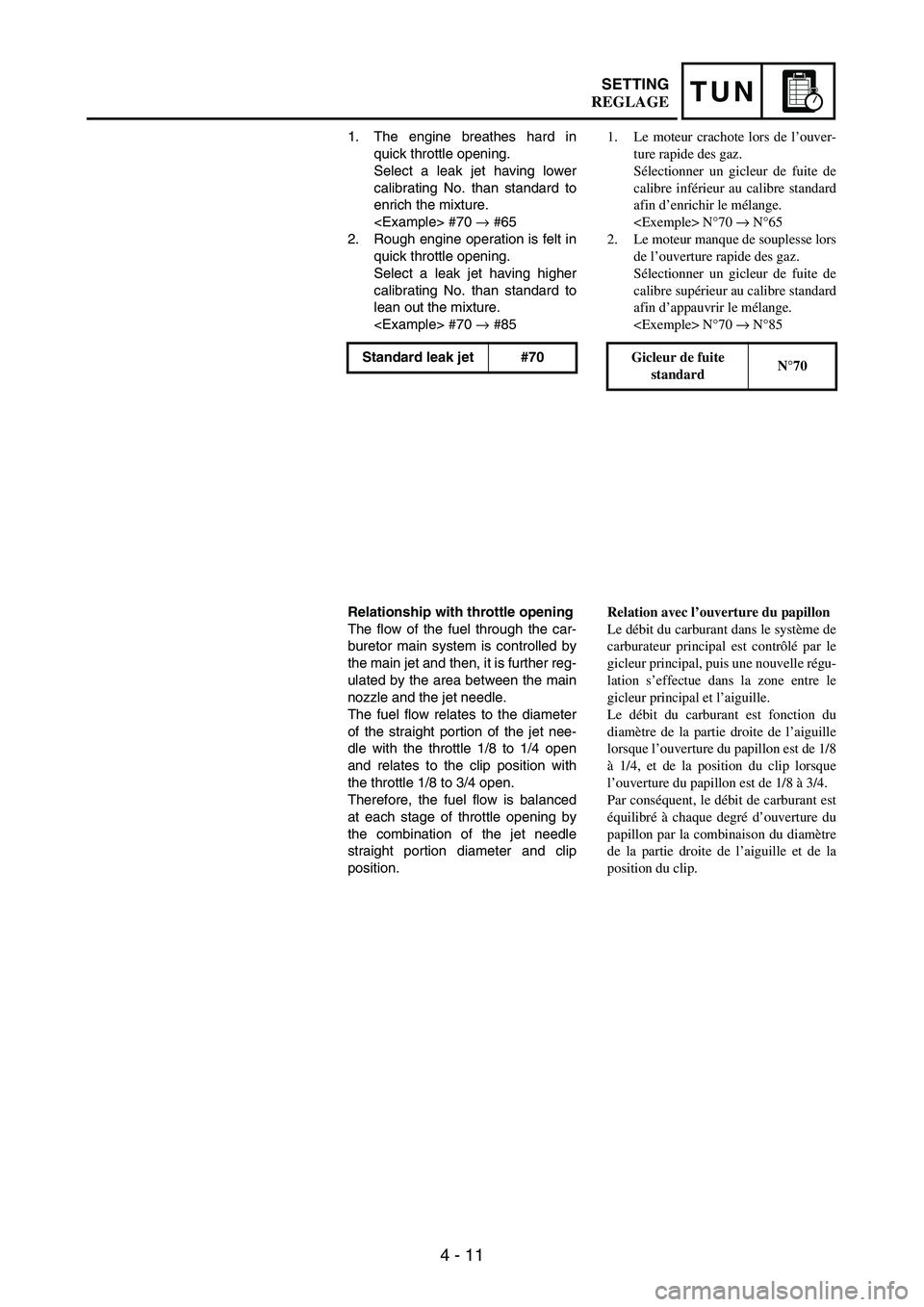
1. The engine breathes hard in
quick throttle opening.
Select a leak jet having lower
calibrating No. than standard to
enrich the mixture.
→ #65
2. Rough engine operation is felt in
quick throttle opening.
Select a leak jet having higher
calibrating No. than standard to
lean out the mixture.
→ #85
Standard leak jet #70
Relationship with throttle opening
The flow of the fuel through the car-
buretor main system is controlled by
the main jet and then, it is further reg-
ulated by the area between the main
nozzle and the jet needle.
The fuel flow relates to the diameter
of the straight portion of the jet nee-
dle with the throttle 1/8 to 1/4 open
and relates to the clip position with
the throttle 1/8 to 3/4 open.
Therefore, the fuel flow is balanced
at each stage of throttle opening by
the combination of the jet needle
straight portion diameter and clip
position.1. Le moteur crachote lors de l’ouver-
ture rapide des gaz.
Sélectionner un gicleur de fuite de
calibre inférieur au calibre standard
afin d’enrichir le mélange.
2. Le moteur manque de souplesse lors
de l’ouverture rapide des gaz.
Sélectionner un gicleur de fuite de
calibre supérieur au calibre standard
afin d’appauvrir le mélange.
Gicleur de fuite
standardN°70Relation avec l’ouverture du papillon
Le débit du carburant dans le système de
carburateur principal est contrôlé par le
gicleur principal, puis une nouvelle régu-
lation s’effectue dans la zone entre le
gicleur principal et l’aiguille.
Le débit du carburant est fonction du
diamètre de la partie droite de l’aiguille
lorsque l’ouverture du papillon est de 1/8
à 1/4, et de la position du clip lorsque
l’ouverture du papillon est de 1/8 à 3/4.
Par conséquent, le débit de carburant est
équilibré à chaque degré d’ouverture du
papillon par la combinaison du diamètre
de la partie droite de l’aiguille et de la
position du clip.
REGLAGE
Page 374 of 912
4 - 15
TUNSETTING
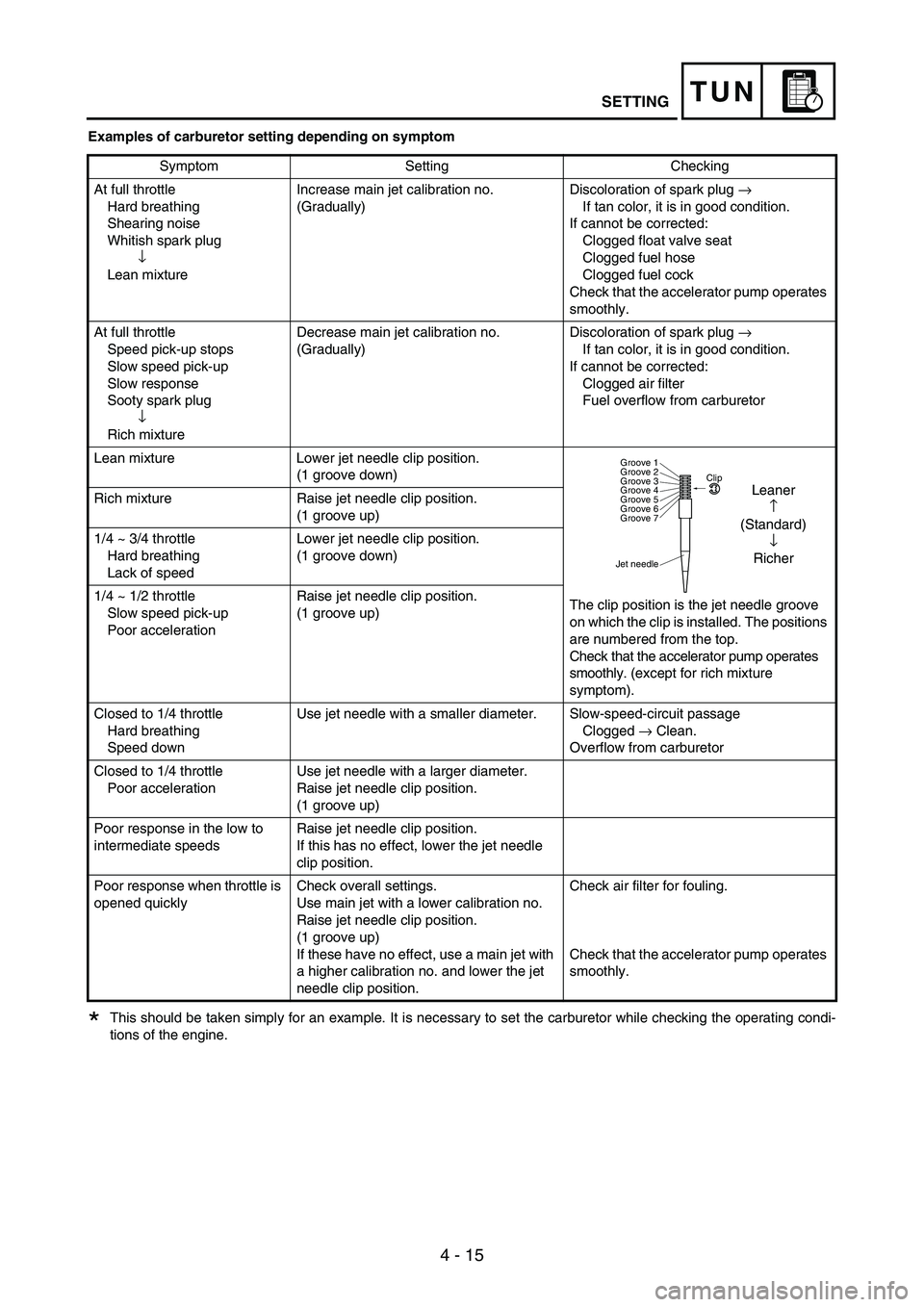
Examples of carburetor setting depending on symptom
This should be taken simply for an example. It is necessary to set the carburetor while checking the operating condi-
tions of the engine.Symptom Setting Checking
At full throttle
Hard breathing
Shearing noise
Whitish spark plug
↓
Lean mixtureIncrease main jet calibration no.
(Gradually)Discoloration of spark plug
→
If tan color, it is in good condition.
If cannot be corrected:
Clogged float valve seat
Clogged fuel hose
Clogged fuel cock
Check that the accelerator pump operates
smoothly.
At full throttle
Speed pick-up stops
Slow speed pick-up
Slow response
Sooty spark plug
↓
Rich mixtureDecrease main jet calibration no.
(Gradually)Discoloration of spark plug
→
If tan color, it is in good condition.
If cannot be corrected:
Clogged air filter
Fuel overflow from carburetor
Lean mixture Lower jet needle clip position.
(1 groove down)
The clip position is the jet needle groove
on which the clip is installed. The positions
are numbered from the top.
Check that the accelerator pump operates
smoothly. (except for rich mixture
symptom). Rich mixture Raise jet needle clip position.
(1 groove up)
1/4 ~ 3/4 throttle
Hard breathing
Lack of speedLower jet needle clip position.
(1 groove down)
1/4 ~ 1/2 throttle
Slow speed pick-up
Poor accelerationRaise jet needle clip position.
(1 groove up)
Closed to 1/4 throttle
Hard breathing
Speed downUse jet needle with a smaller diameter. Slow-speed-circuit passage
Clogged
→ Clean.
Overflow from carburetor
Closed to 1/4 throttle
Poor accelerationUse jet needle with a larger diameter.
Raise jet needle clip position.
(1 groove up)
Poor response in the low to
intermediate speedsRaise jet needle clip position.
If this has no effect, lower the jet needle
clip position.
Poor response when throttle is
opened quicklyCheck overall settings.
Use main jet with a lower calibration no.
Raise jet needle clip position.
(1 groove up)
If these have no effect, use a main jet with
a higher calibration no. and lower the jet
needle clip position.Check air filter for fouling.
Check that the accelerator pump operates
smoothly.
Leaner
↑
(Standard)
↓
Richer
Jet needleClip
Groove 7 Groove 6
Groove 5
Groove 4
Groove 3
Groove 2
Groove 1
*
Page 408 of 912
5 - 1
ENGRADIATOR
ENGINE
EC450001
RADIATOR
NOTE:This section is intended for those who have basic knowledge and skill concerning the
servicing of Yamaha motorcycles (e.g., Yamaha dealers, service engineers, etc.)
Those who have little knowledge and skill concerning servicing are requested not to
undertake inspection, adjustment, disassembly, or reassembly only by reference to
this manual. It may lead to servicing trouble and mechanical damage.
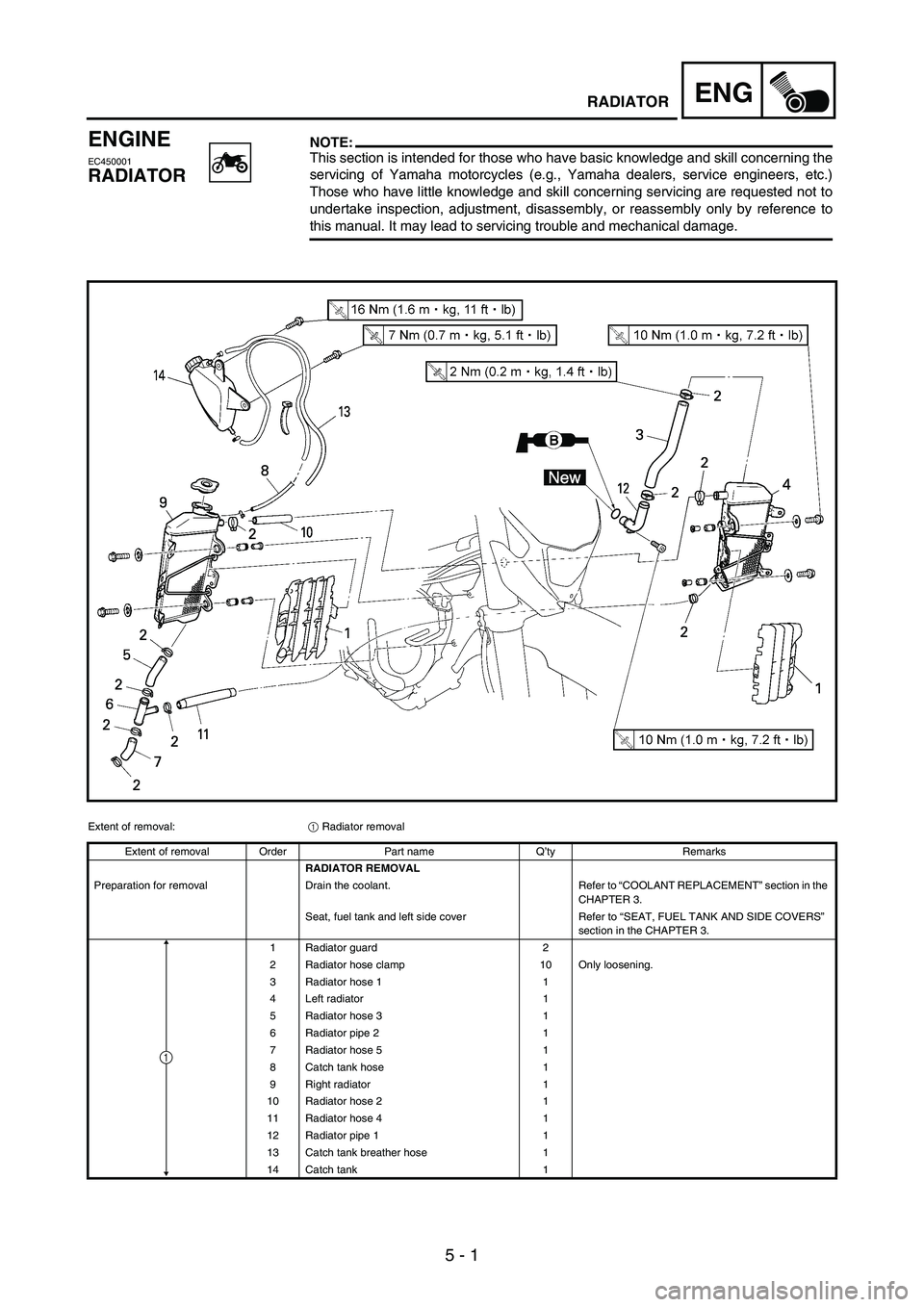
Extent of removal:
1 Radiator removal
Extent of removal Order Part name Q’ty Remarks
RADIATOR REMOVAL
Preparation for removal Drain the coolant. Refer to “COOLANT REPLACEMENT” section in the
CHAPTER 3.
Seat, fuel tank and left side cover Refer to “SEAT, FUEL TANK AND SIDE COVERS”
section in the CHAPTER 3.
1 Radiator guard 2
2 Radiator hose clamp 10 Only loosening.
3 Radiator hose 1 1
4 Left radiator 1
5 Radiator hose 3 1
6 Radiator pipe 2 1
7 Radiator hose 5 1
8 Catch tank hose 1
9 Right radiator 1
10 Radiator hose 2 1
11 Radiator hose 4 1
12 Radiator pipe 1 1
13 Catch tank breather hose 1
14 Catch tank 1
1
Page 416 of 912
5 - 9
ENGCARBURETOR
CARBURETOR
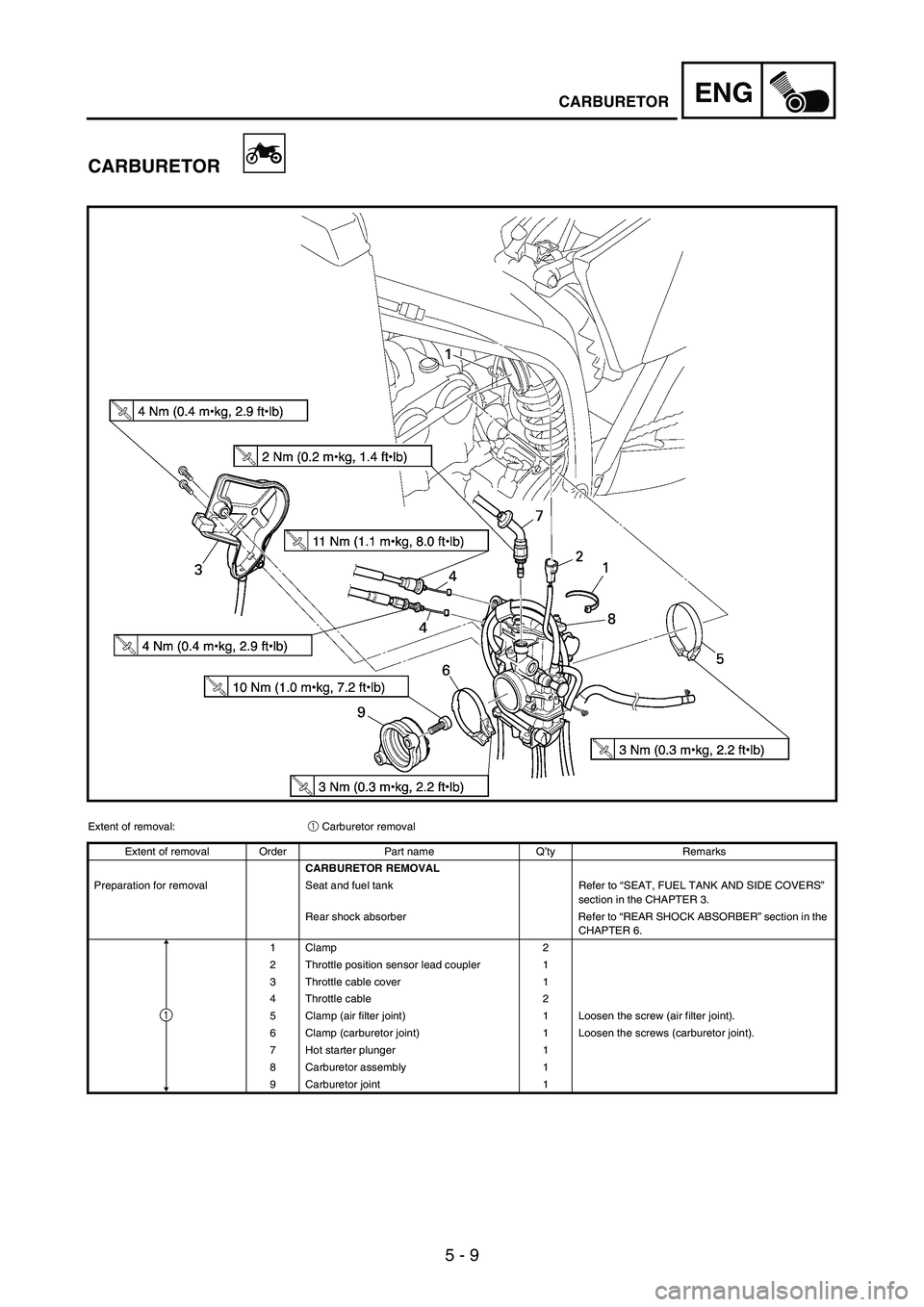
Extent of removal:
1 Carburetor removal
Extent of removal Order Part name Q’ty Remarks
CARBURETOR REMOVAL
Preparation for removal Seat and fuel tank Refer to “SEAT, FUEL TANK AND SIDE COVERS”
section in the CHAPTER 3.
Rear shock absorber Refer to “REAR SHOCK ABSORBER” section in the
CHAPTER 6.
1 Clamp 2
2 Throttle position sensor lead coupler 1
3 Throttle cable cover 1
4 Throttle cable 2
5 Clamp (air filter joint) 1 Loosen the screw (air filter joint).
6 Clamp (carburetor joint) 1 Loosen the screws (carburetor joint).
7 Hot starter plunger 1
8 Carburetor assembly 1
9 Carburetor joint 1
1
Page 452 of 912
5 - 45
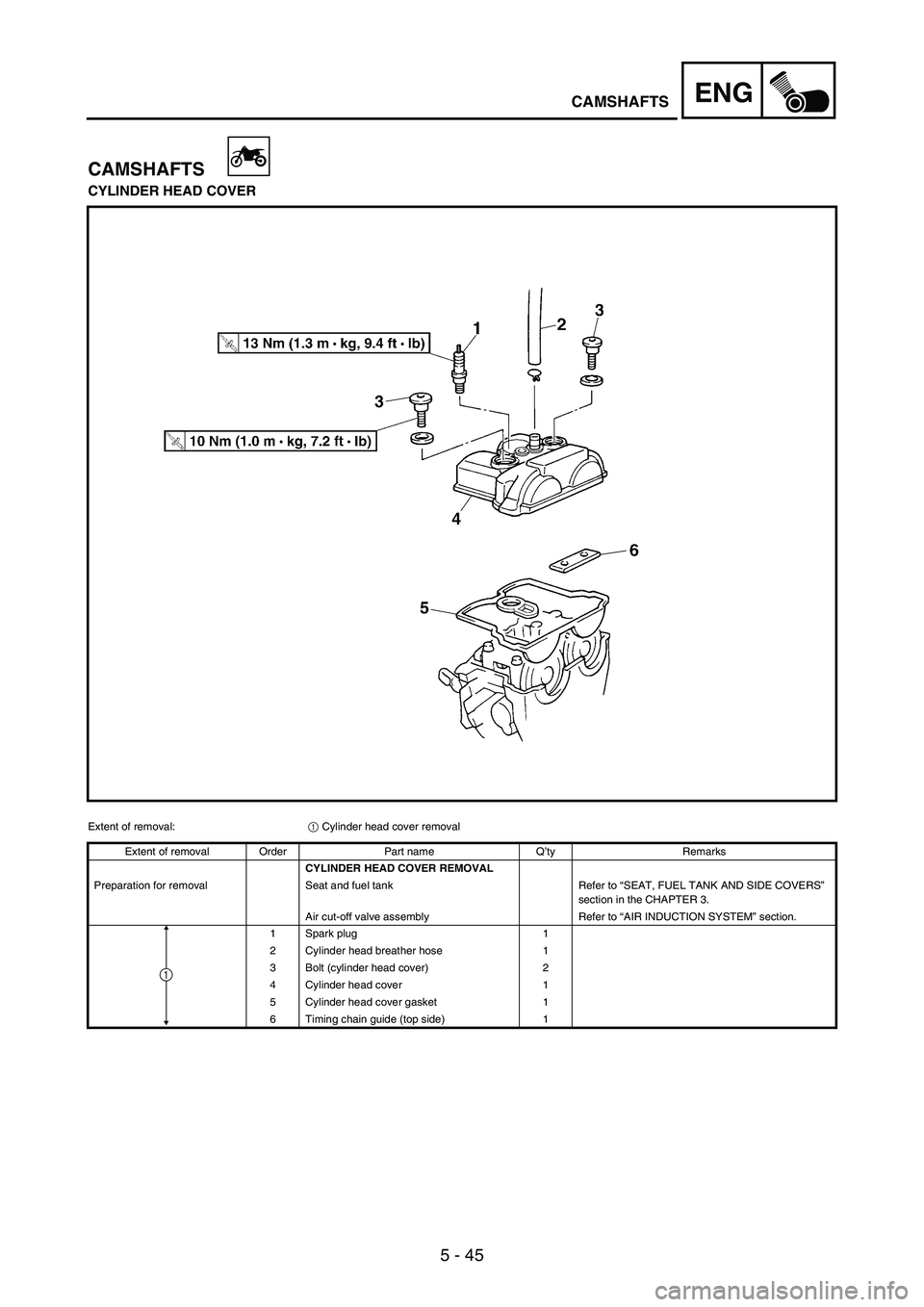
ENGCAMSHAFTS
CAMSHAFTS
CYLINDER HEAD COVER
Extent of removal:
1 Cylinder head cover removal
Extent of removal Order Part name Q’ty Remarks
CYLINDER HEAD COVER REMOVAL
Preparation for removal Seat and fuel tank Refer to “SEAT, FUEL TANK AND SIDE COVERS”
section in the CHAPTER 3.
Air cut-off valve assembly Refer to “AIR INDUCTION SYSTEM” section.
1 Spark plug 1
2 Cylinder head breather hose 1
3 Bolt (cylinder head cover) 2
4 Cylinder head cover 1
5 Cylinder head cover gasket 1
6 Timing chain guide (top side) 1
1
Page 474 of 912
5 - 67
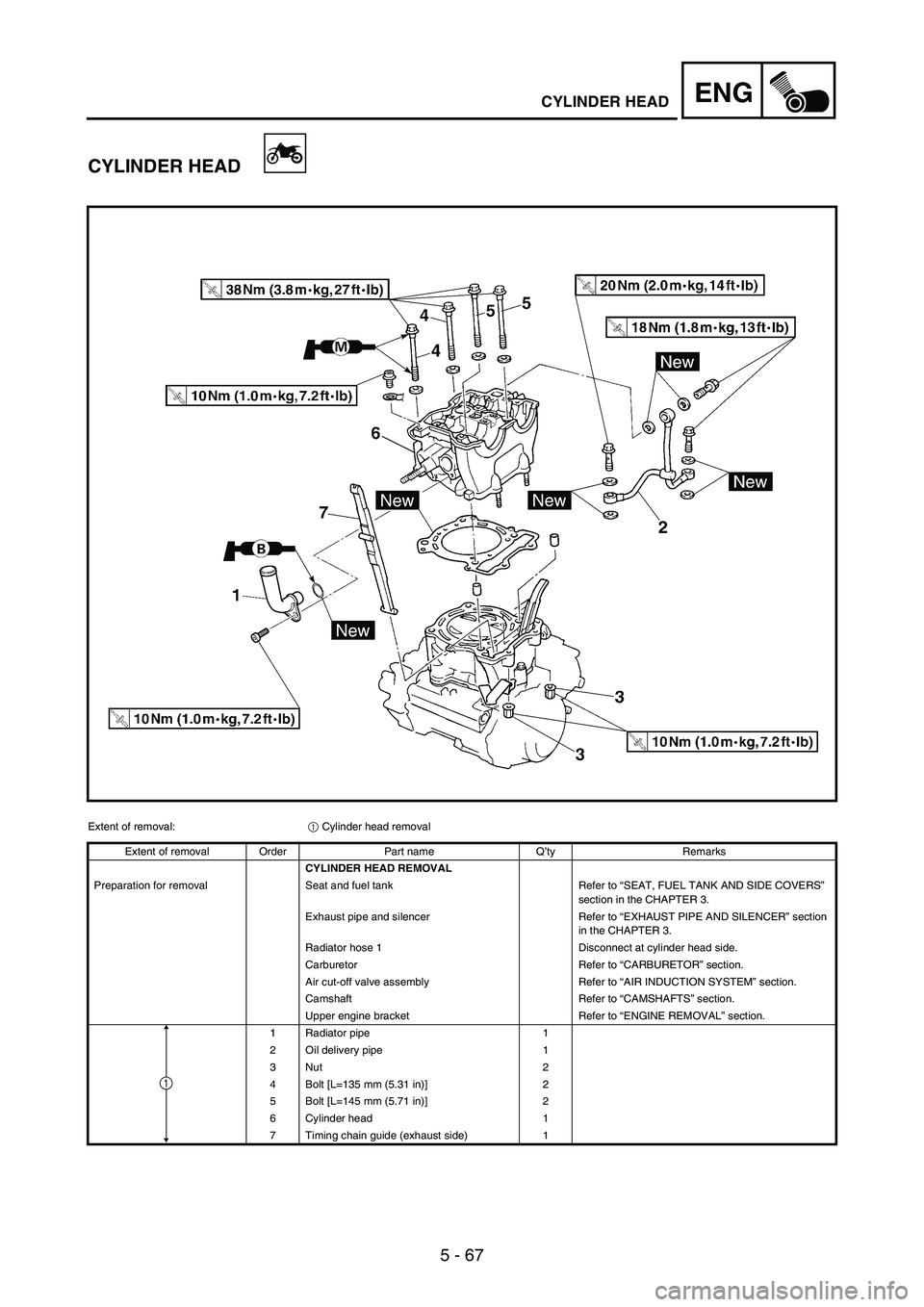
ENGCYLINDER HEAD
CYLINDER HEAD
Extent of removal:
1 Cylinder head removal
Extent of removal Order Part name Q’ty Remarks
CYLINDER HEAD REMOVAL
Preparation for removal Seat and fuel tank Refer to “SEAT, FUEL TANK AND SIDE COVERS”
section in the CHAPTER 3.
Exhaust pipe and silencer Refer to “EXHAUST PIPE AND SILENCER” section
in the CHAPTER 3.
Radiator hose 1 Disconnect at cylinder head side.
Carburetor Refer to “CARBURETOR” section.
Air cut-off valve assembly Refer to “AIR INDUCTION SYSTEM” section.
Camshaft Refer to “CAMSHAFTS” section.
Upper engine bracket Refer to “ENGINE REMOVAL” section.
1 Radiator pipe 1
2 Oil delivery pipe 1
3Nut 2
4 Bolt [L=135 mm (5.31 in)] 2
5 Bolt [L=145 mm (5.71 in)] 2
6 Cylinder head 1
7 Timing chain guide (exhaust side) 1
1
Page 592 of 912
5 - 185
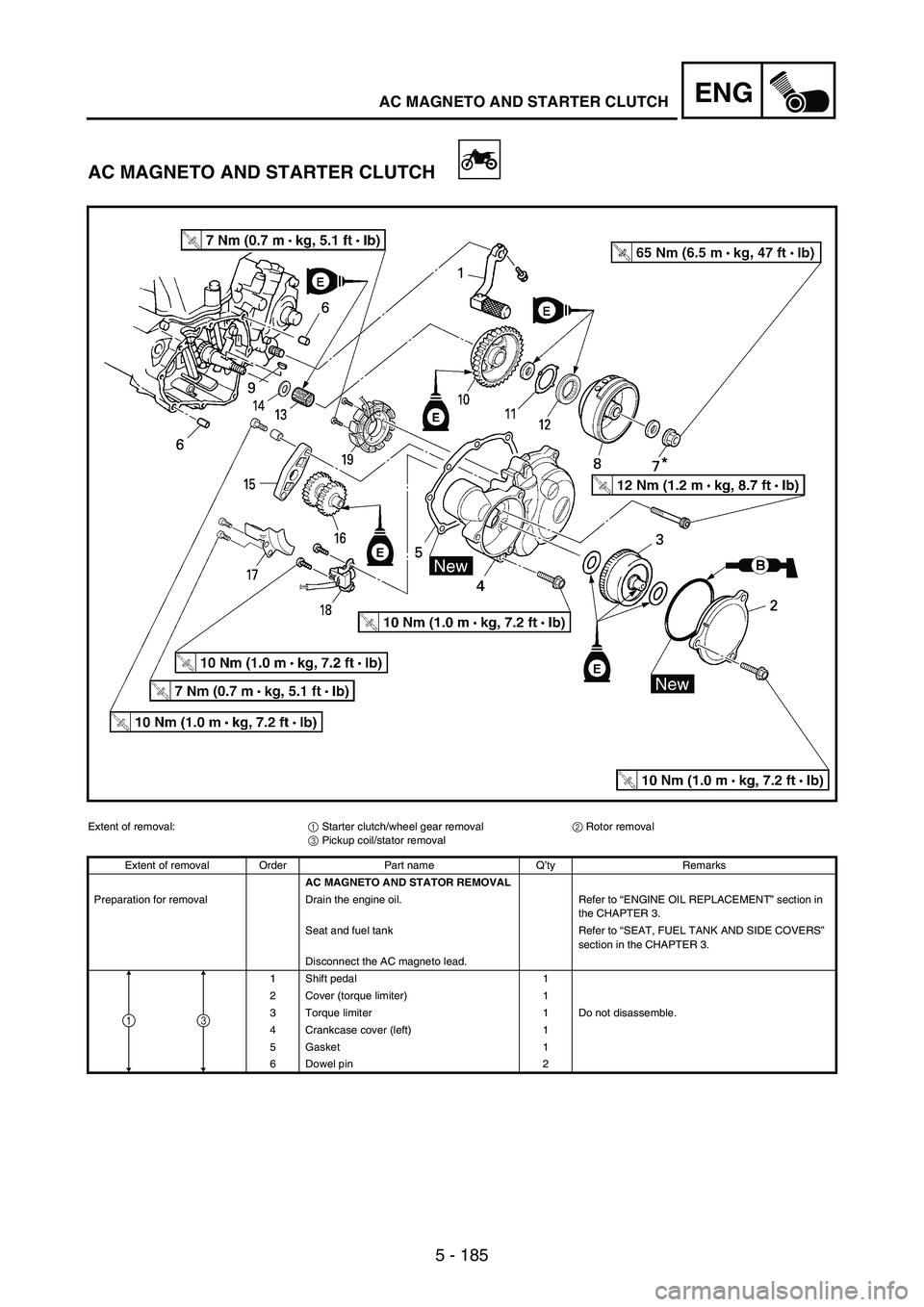
ENGAC MAGNETO AND STARTER CLUTCH
AC MAGNETO AND STARTER CLUTCH
Extent of removal:
1 Starter clutch/wheel gear removal
2 Rotor removal
3 Pickup coil/stator removal
Extent of removal Order Part name Q’ty Remarks
AC MAGNETO AND STATOR REMOVAL
Preparation for removal Drain the engine oil. Refer to “ENGINE OIL REPLACEMENT” section in
the CHAPTER 3.
Seat and fuel tank Refer to “SEAT, FUEL TANK AND SIDE COVERS”
section in the CHAPTER 3.
Disconnect the AC magneto lead.
1 Shift pedal 1
2 Cover (torque limiter) 1
3 Torque limiter 1 Do not disassemble.
4 Crankcase cover (left) 1
5 Gasket 1
6 Dowel pin 2
31
Page 614 of 912
5 - 207
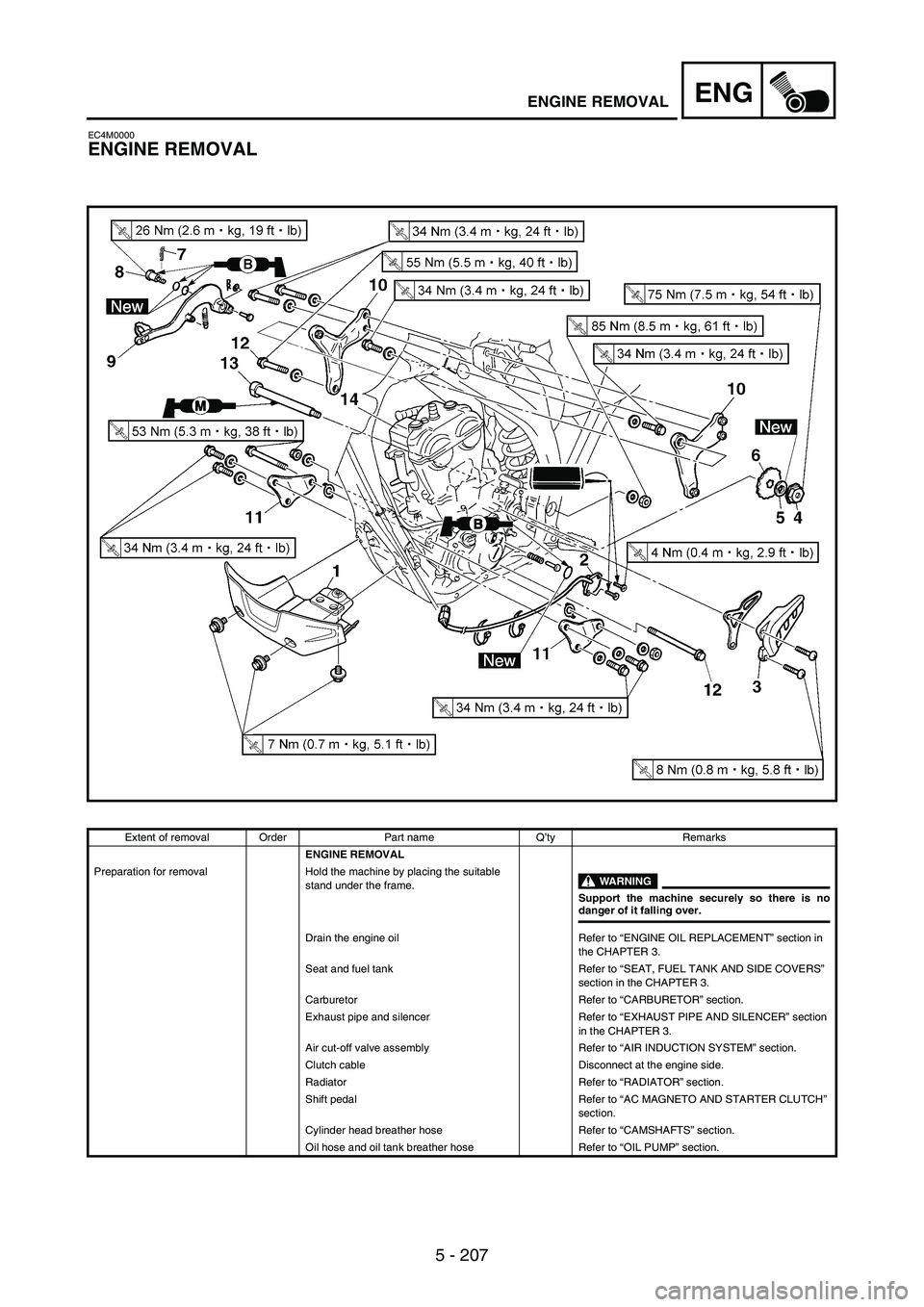
ENGENGINE REMOVAL
EC4M0000
ENGINE REMOVAL
Extent of removal Order Part name Q’ty Remarks
ENGINE REMOVAL
Preparation for removal Hold the machine by placing the suitable
stand under the frame.
WARNING
Support the machine securely so there is nodanger of it falling over.
Drain the engine oil Refer to “ENGINE OIL REPLACEMENT” section in
the CHAPTER 3.
Seat and fuel tank Refer to “SEAT, FUEL TANK AND SIDE COVERS”
section in the CHAPTER 3.
Carburetor Refer to “CARBURETOR” section.
Exhaust pipe and silencer Refer to “EXHAUST PIPE AND SILENCER” section
in the CHAPTER 3.
Air cut-off valve assembly Refer to “AIR INDUCTION SYSTEM” section.
Clutch cable Disconnect at the engine side.
Radiator Refer to “RADIATOR” section.
Shift pedal Refer to “AC MAGNETO AND STARTER CLUTCH”
section.
Cylinder head breather hose Refer to “CAMSHAFTS” section.
Oil hose and oil tank breather hose Refer to “OIL PUMP” section.
Page 804 of 912
6 - 141
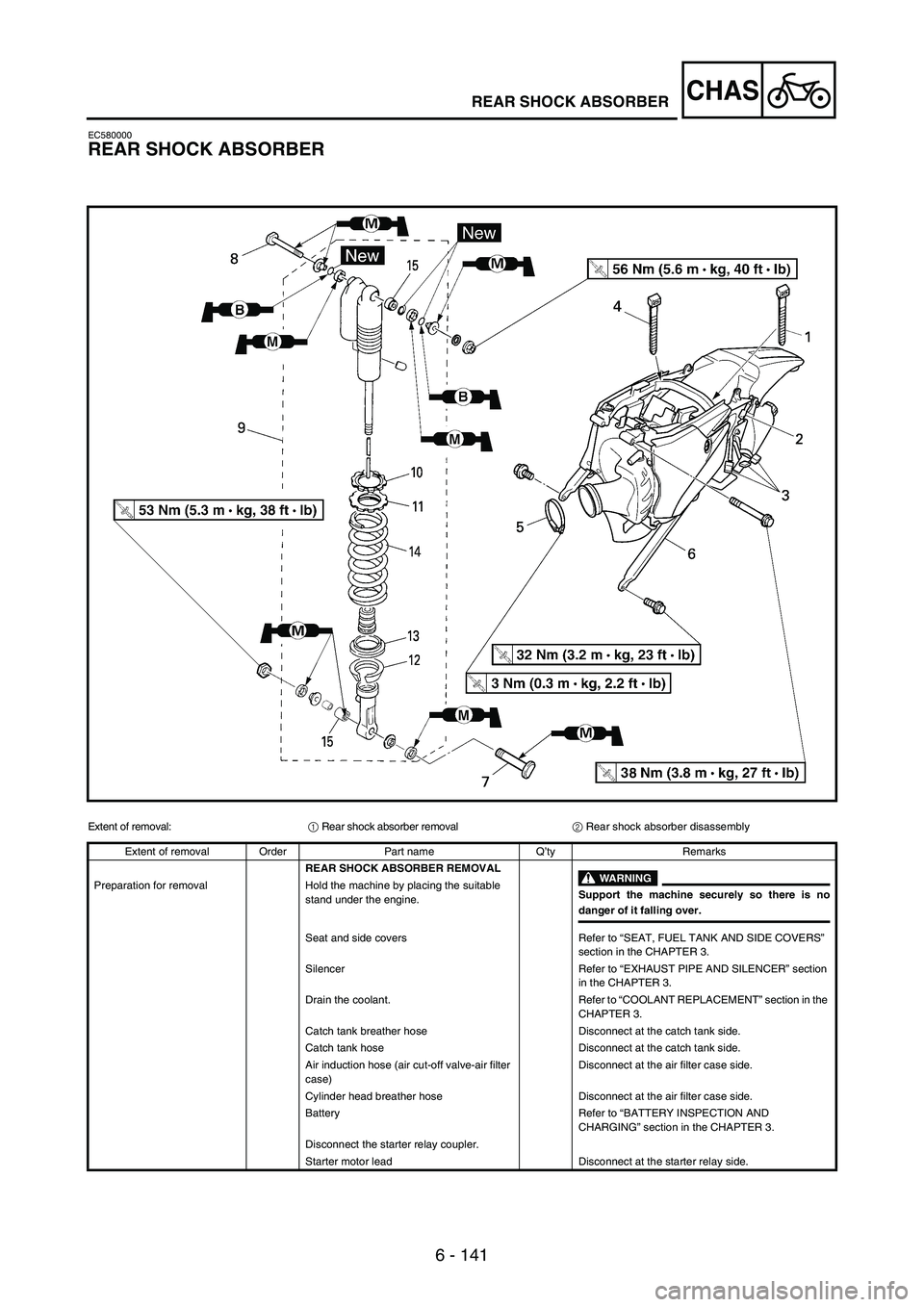
CHASREAR SHOCK ABSORBER
EC580000
REAR SHOCK ABSORBER
Extent of removal:
1 Rear shock absorber removal
2 Rear shock absorber disassembly
Extent of removal Order Part name Q’ty Remarks
REAR SHOCK ABSORBER REMOVAL
WARNING
Support the machine securely so there is nodanger of it falling over. Preparation for removal Hold the machine by placing the suitable
stand under the engine.
Seat and side covers Refer to “SEAT, FUEL TANK AND SIDE COVERS”
section in the CHAPTER 3.
Silencer Refer to “EXHAUST PIPE AND SILENCER” section
in the CHAPTER 3.
Drain the coolant. Refer to “COOLANT REPLACEMENT” section in the
CHAPTER 3.
Catch tank breather hose Disconnect at the catch tank side.
Catch tank hose Disconnect at the catch tank side.
Air induction hose (air cut-off valve-air filter
case)Disconnect at the air filter case side.
Cylinder head breather hose Disconnect at the air filter case side.
Battery Refer to “BATTERY INSPECTION AND
CHARGING” section in the CHAPTER 3.
Disconnect the starter relay coupler.
Starter motor lead Disconnect at the starter relay side.
Page 826 of 912
7 - 5
–+ELECIGNITION SYSTEM
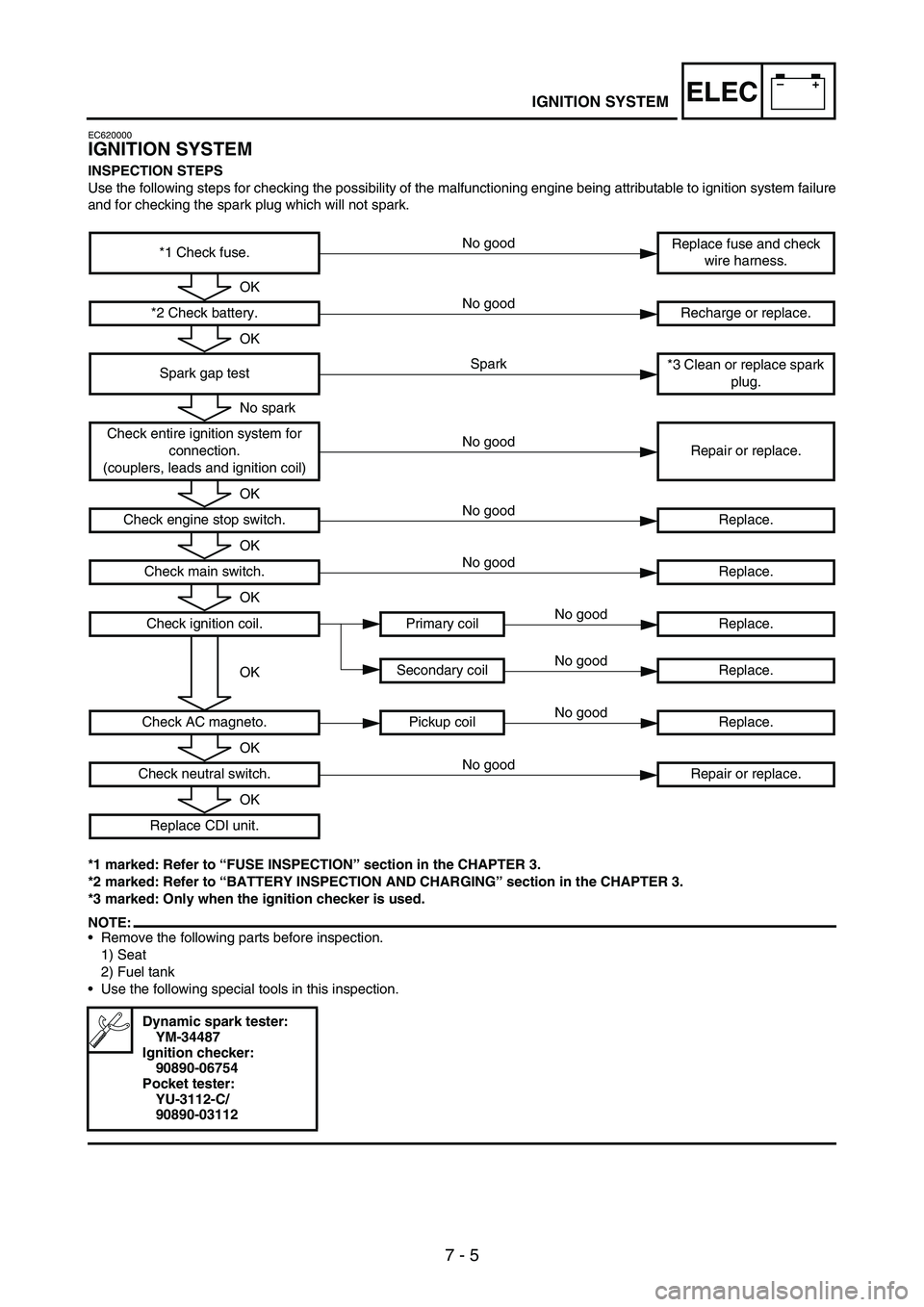
EC620000
IGNITION SYSTEM
INSPECTION STEPS
Use the following steps for checking the possibility of the malfunctioning engine being attributable to ignition system failure
and for checking the spark plug which will not spark.
*1 marked: Refer to “FUSE INSPECTION” section in the CHAPTER 3.
*2 marked: Refer to “BATTERY INSPECTION AND CHARGING” section in the CHAPTER 3.
*3 marked: Only when the ignition checker is used.
NOTE:•Remove the following parts before inspection.
1) Seat
2) Fuel tank
•Use the following special tools in this inspection.
*1 Check fuse.Replace fuse and check
wire harness.
*2 Check battery. Recharge or replace.
Spark gap test*3 Clean or replace spark
plug.
Check entire ignition system for
connection.
(couplers, leads and ignition coil)Repair or replace.
Check engine stop switch. Replace.
Check main switch.Replace.
Check ignition coil. Primary coil Replace.
Secondary coil Replace.
Check AC magneto. Pickup coil Replace.
Check neutral switch. Repair or replace.
Replace CDI unit.
Dynamic spark tester:
YM-34487
Ignition checker:
90890-06754
Pocket tester:
YU-3112-C/
90890-03112
No good
OK
No good
OK
Spark
No spark
No good
OK
No good
OK
No good
OK
No good
OKNo good
No good
OK
No good
OK