fuel YAMAHA WR 250F 2007 User Guide
[x] Cancel search | Manufacturer: YAMAHA, Model Year: 2007, Model line: WR 250F, Model: YAMAHA WR 250F 2007Pages: 912, PDF Size: 23.95 MB
Page 82 of 912

1 - 57
GEN
INFO
BREAK-IN PROCEDURES
1. Before starting the engine, fill the
fuel tank with the fuel.
2. Perform the pre-operation
checks on the machine.
3. Start and warm up the engine.
Check the idle speed, and check
the operation of the controls and
the engine stop switch. Then,
restart the engine and check its
operation within no more than 5
minutes after it is restarted.
4. Operate the machine in the
lower gears at moderate throttle
openings for five to eight min-
utes.
5. Check how the engine runs
when the machine is ridden with
the throttle 1/4 to 1/2 open (low
to medium speed) for about one
hour.
6. Restart the engine and check
the operation of the machine
throughout its entire operating
range. Restart the machine and
operate it for about 10 to 15
more minutes.
CAUTION:
After the break-in or before each
ride, you must check the entire
machine for loose fittings and fas-
teners as per “TORQUE-CHECK
POINTS”.
Tighten all such fasteners as
required.PROCEDURE DE RODAGE
1. Avant de démarrer le moteur, faire
le plein du réservoir de carburant.
2. Effectuer les contrôles avant utilisa-
tion.
3. Mettre le moteur en marche et le
laisser chauffer. Contrôler le régime
de ralenti et le bon fonctionnement
des commandes et du coupe-circuit
du moteur. Redémarrer ensuite le
moteur et contrôler son fonctionne-
ment dans les 5 minutes maximum
qui suivent son redémarrage.
4. Rouler pendant cinq à huit minutes
sur les rapports inférieurs et à
régime modéré.
5. Contrôler le fonctionnement du
moteur lorsque la moto est utilisée
pendant une heure environ aux régi-
mes bas à moyens (ouverture des
gaz 1/4 à 1/2).
6. Remettre le moteur en marche et
vérifier le fonctionnement de la
moto à toutes les vitesses. Redémar-
rer la moto et rouler pendant 10 à 15
minutes environ.
ATTENTION:
Après le rodage ou avant chaque utili-
sation, il est indispensable de contrôler
le bon serrage des raccords et des fixa-
tions conformément aux instructions
de la section “POINTS DE VERIFI-
CATION DES COUPLES DE SER-
RAGE”.
Resserrer toutes les fixations au
besoin.
STARTING AND BREAK-IN
MISE EN MARCHE ET RODAGE
Page 84 of 912

1 - 59
GEN
INFO
TORQUE-CHECK POINTS
Frame construction Frame to rear frame
Combined seat and fuel tank Fuel tank to frame
Exhaust system Silencer to rear frame
Engine mounting Frame to engine
Engine bracket to engine
Engine bracket to frame
Steering Steering stem to handlebar Steering stem to frame
Steering stem to upper bracket
Upper bracket to handlebar
Suspension Front Steering stem to front fork Front fork to upper bracket
Front fork to lower bracket
Rear For link type Assembly of links
Link to frame
Link to rear shock absorber
Link to swingarm
Rear Installation of rear
shock absorberRear shock absorber to frame
Rear Installation of swingarm Tightening of pivot shaft
Wheel Installation of wheel Front Tightening of wheel axle
Tightening of axle holder
Rear Tightening of wheel axle
Wheel to rear wheel sprocket
Brake Front Brake caliper to front fork
Brake disc to wheel
Tightening of union bolt
Brake master cylinder to handlebar
Tightening of bleed screw
Tightening of brake hose holder
Rear Brake pedal to frame
Brake disc to wheel
Tightening of union bolt
Brake master cylinder to frame
Tightening of bleed screw
Tightening of brake hose holder
Fuel system Fuel tank to fuel cock
Lubrication system Tightening of oil hose clamp
NOTE:Concerning the tightening torque, refer to
“MAINTENANCE SPECIFICATIONS” sec-
tion in the CHAPTER 2.
TORQUE-CHECK POINTS
Page 92 of 912
1 - 67
GEN
INFO
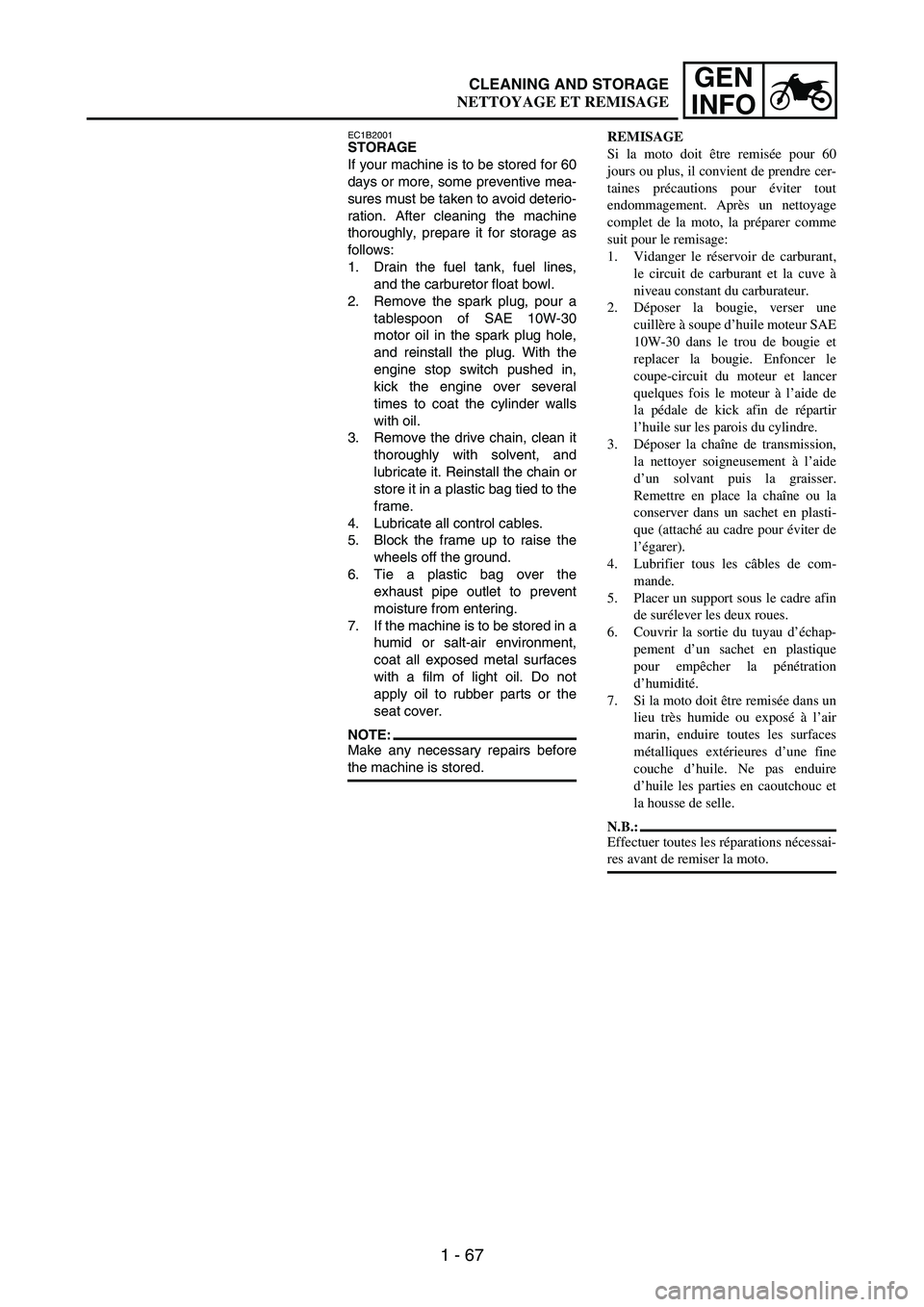
EC1B2001STORAGE
If your machine is to be stored for 60
days or more, some preventive mea-
sures must be taken to avoid deterio-
ration. After cleaning the machine
thoroughly, prepare it for storage as
follows:
1. Drain the fuel tank, fuel lines,
and the carburetor float bowl.
2. Remove the spark plug, pour a
tablespoon of SAE 10W-30
motor oil in the spark plug hole,
and reinstall the plug. With the
engine stop switch pushed in,
kick the engine over several
times to coat the cylinder walls
with oil.
3. Remove the drive chain, clean it
thoroughly with solvent, and
lubricate it. Reinstall the chain or
store it in a plastic bag tied to the
frame.
4. Lubricate all control cables.
5. Block the frame up to raise the
wheels off the ground.
6. Tie a plastic bag over the
exhaust pipe outlet to prevent
moisture from entering.
7. If the machine is to be stored in a
humid or salt-air environment,
coat all exposed metal surfaces
with a film of light oil. Do not
apply oil to rubber parts or the
seat cover.
NOTE:Make any necessary repairs before
the machine is stored.REMISAGE
Si la moto doit être remisée pour 60
jours ou plus, il convient de prendre cer-
taines précautions pour éviter tout
endommagement. Après un nettoyage
complet de la moto, la préparer comme
suit pour le remisage:
1. Vidanger le réservoir de carburant,
le circuit de carburant et la cuve à
niveau constant du carburateur.
2. Déposer la bougie, verser une
cuillère à soupe d’huile moteur SAE
10W-30 dans le trou de bougie et
replacer la bougie. Enfoncer le
coupe-circuit du moteur et lancer
quelques fois le moteur à l’aide de
la pédale de kick afin de répartir
l’huile sur les parois du cylindre.
3. Déposer la chaîne de transmission,
la nettoyer soigneusement à l’aide
d’un solvant puis la graisser.
Remettre en place la chaîne ou la
conserver dans un sachet en plasti-
que (attaché au cadre pour éviter de
l’égarer).
4. Lubrifier tous les câbles de com-
mande.
5. Placer un support sous le cadre afin
de surélever les deux roues.
6. Couvrir la sortie du tuyau d’échap-
pement d’un sachet en plastique
pour empêcher la pénétration
d’humidité.
7. Si la moto doit être remisée dans un
lieu très humide ou exposé à l’air
marin, enduire toutes les surfaces
métalliques extérieures d’une fine
couche d’huile. Ne pas enduire
d’huile les parties en caoutchouc et
la housse de selle.
N.B.:
Effectuer toutes les réparations nécessai-
res avant de remiser la moto.
CLEANING AND STORAGE
NETTOYAGE ET REMISAGE
Page 94 of 912

GENERAL SPECIFICATIONS
2 - 1
SPEC
EC200000
SPECIFICATIONS
EC211000
GENERAL SPECIFICATIONS
Model name: WR250FW (USA, CDN, AUS, NZ)
WR250F (EUROPE, ZA)
Model code number: 5UME (USA)
5UMF (EUROPE)
5UMG (CDN, AUS, NZ, ZA)
Dimensions: USA, ZA, CDN EUROPE, AUS, NZ
Overall length 2,165 mm (85.24 in) 2,180 mm (85.83 in)
Overall width 825 mm (32.48 in)←
Overall height 1,300 mm (51.18 in) 1,305 mm (51.38 in)
Seat height 980 mm (38.58 in) 990 mm (38.98 in)
Wheelbase 1,480 mm (58.27 in)←
Minimum ground clearance 365 mm (14.37 in) 370 mm (14.57 in)
Dry weight:
Without oil and fuel 106.0 kg (233.7 lb)
Engine:
Engine type Liquid cooled 4-stroke, DOHC
Cylinder arrangement Single cylinder, forward inclined
Displacement 249 cm
3 (8.76 Imp oz, 8.42 US oz)
Bore × stroke 77.0 × 53.6 mm (3.03 × 2.11 in)
Compression ratio 12.5 : 1
Kick and electric starter
Starting system
Lubrication system: Dry sump
Oil type or grade:
Engine oil (For USA and CDN)
Yamalube 4, SAE10W30 or SAE20W40
Yamalube 4-R, SAE10W50
API service SG type or higher,
JASO standard MA
(Except for USA and CDN)
SAE10W30, SAE10W40, SAE15W40,
SAE20W40 or SAE20W50
API service SG type or higher,
JASO standard MA
-20 -10 0 10 20 30 40 50
˚C 0 10 30 50 70 90 110 130
˚F
YAMALUBE 4(10W-30) or SAE 10W-30
YAMALUBE 4(20W-40) or SAE 20W-40
YAMALUBE 4-R(10W-50) or SAE 10W-50
-20 -10 0 10 20 30 40 50
˚C
SAE 10W-30
SAE 10W-40
SAE 15W-40
SAE 20W-40
SAE 20W-50
2
Page 95 of 912
GENERAL SPECIFICATIONS
2 - 2
SPEC
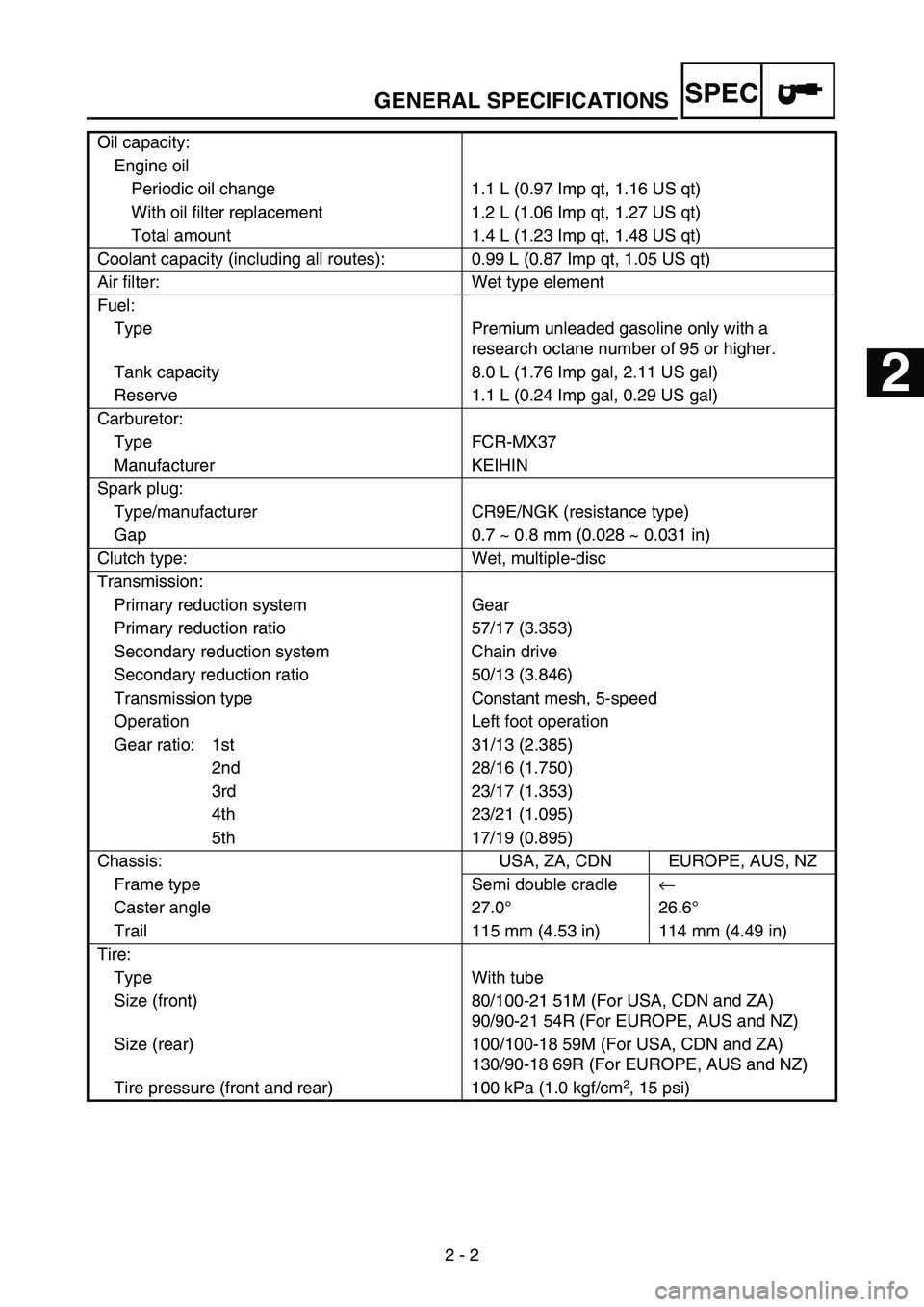
Oil capacity:
Engine oil
Periodic oil change 1.1 L (0.97 Imp qt, 1.16 US qt)
With oil filter replacement 1.2 L (1.06 Imp qt, 1.27 US qt)
Total amount 1.4 L (1.23 Imp qt, 1.48 US qt)
Coolant capacity (including all routes): 0.99 L (0.87 Imp qt, 1.05 US qt)
Air filter: Wet type element
Fuel:
Type Premium unleaded gasoline only with a
research octane number of 95 or higher.
Tank capacity 8.0 L (1.76 Imp gal, 2.11 US gal)
Reserve 1.1 L (0.24 Imp gal, 0.29 US gal)
Carburetor:
Type FCR-MX37
Manufacturer KEIHIN
Spark plug:
Type/manufacturer CR9E/NGK (resistance type)
Gap 0.7 ~ 0.8 mm (0.028 ~ 0.031 in)
Clutch type: Wet, multiple-disc
Transmission:
Primary reduction system Gear
Primary reduction ratio 57/17 (3.353)
Secondary reduction system Chain drive
Secondary reduction ratio 50/13 (3.846)
Transmission type Constant mesh, 5-speed
Operation Left foot operation
Gear ratio: 1st 31/13 (2.385)
2nd 28/16 (1.750)
3rd 23/17 (1.353)
4th 23/21 (1.095)
5th 17/19 (0.895)
Chassis: USA, ZA, CDN EUROPE, AUS, NZ
Frame type Semi double cradle←
Caster angle 27.0°26.6°
Trail 115 mm (4.53 in) 114 mm (4.49 in)
Tire:
Type With tube
Size (front) 80/100-21 51M (For USA, CDN and ZA)
90/90-21 54R (For EUROPE, AUS and NZ)
Size (rear) 100/100-18 59M (For USA, CDN and ZA)
130/90-18 69R (For EUROPE, AUS and NZ)
Tire pressure (front and rear) 100 kPa (1.0 kgf/cm
2, 15 psi)
1
2
3
4
5
6
7
Page 108 of 912

MAINTENANCE SPECIFICATIONS
2 - 15
SPEC
Part to be tightened Thread size Q’tyTightening torque
Nm m·kg ft·lb
Nipple (spoke)—72 3 0.3 2.2
Rear wheel sprocket M8 × 1.25 6 50 5.0 36
Rear brake disc cover M6 × 1.0 2 10 1.0 7.2
Rear brake caliper protector M6 × 1.0 2 7 0.7 5.1
Drive chain puller adjust bolt and locknut M8 × 1.25 2 19 1.9 13
Engine mounting:
Engine and engine bracket (front) M10 × 1.25 1 53 5.3 38
Engine and frame (lower) M10 × 1.25 1 53 5.3 38
Upper engine bracket and frame M8 × 1.25 4 34 3.4 24
Lower engine bracket and frame M8 × 1.25 4 34 3.4 24
Engine and engine bracket (upper) M10 × 1.25 1 55 5.5 40
Engine guard M6 × 1.0 3 7 0.7 5.1
Regulator M6 × 1.0 2 7 0.7 5.1
Pivot shaft and nut M16 × 1.5 1 85 8.5 61
Relay arm and swingarm M14 × 1.5 1 70 7.0 50
Relay arm and connecting rod M14 × 1.5 1 80 8.0 58
Connecting rod and frame M14 × 1.5 1 80 8.0 58
Rear shock absorber and frame M10 × 1.25 1 56 5.6 40
Rear shock absorber and relay arm M10 × 1.25 1 53 5.3 38
Rear frame (upper) M8 × 1.25 1 38 3.8 27
Rear frame (lower) M8 × 1.25 2 32 3.2 23
Swingarm and brake hose holder M5 × 0.8 4 2 0.2 1.4
Swingarm and patch M4 × 0.7 4 2 0.2 1.4
Upper drive chain tensioner M8 × 1.25 1 16 1.6 11
Lower drive chain tensioner M8 × 1.25 1 16 1.6 11
Drive chain support M6 × 1.0 3 7 0.7 5.1
Seal guard and swingarm M5 × 0.8 4 6 0.6 4.3
Fuel tank M6 × 1.0 2 9 0.9 6.5
Fuel cock M6 × 1.0 2 4 0.4 2.9
Seat set bracket and fuel tank M6 × 1.0 1 7 0.7 5.1
Fuel tank bracket and fuel tank M6 × 1.0 4 7 0.7 5.1
Air scoop and fuel tank M6 × 1.0 6 7 0.7 5.1
Air scoop and radiator guard (lower) M6 × 1.0 2 6 0.6 4.3
Front fender M6 × 1.0 4 7 0.7 5.1
Rear fender (front) M6 × 1.0 2 7 0.7 5.1
Rear fender (rear) M6 × 1.0 2 11 1.1 8.0
Side cover M6 × 1.0 2 7 0.7 5.1
Seat M8 × 1.25 2 23 2.3 17
Multi-function display bracket and upper
bracketM6 × 1.0 2 7 0.7 5.1
Multi-function display M5 × 0.8 2 4 0.4 2.9
Plate 1 and front fork protector M5 × 0.8 2 4 0.4 2.9
Plate 2 and front fork protector—2 0.5 0.05 0.36
Page 194 of 912
2 - 101
SPECCABLE ROUTING DIAGRAM
EC240000
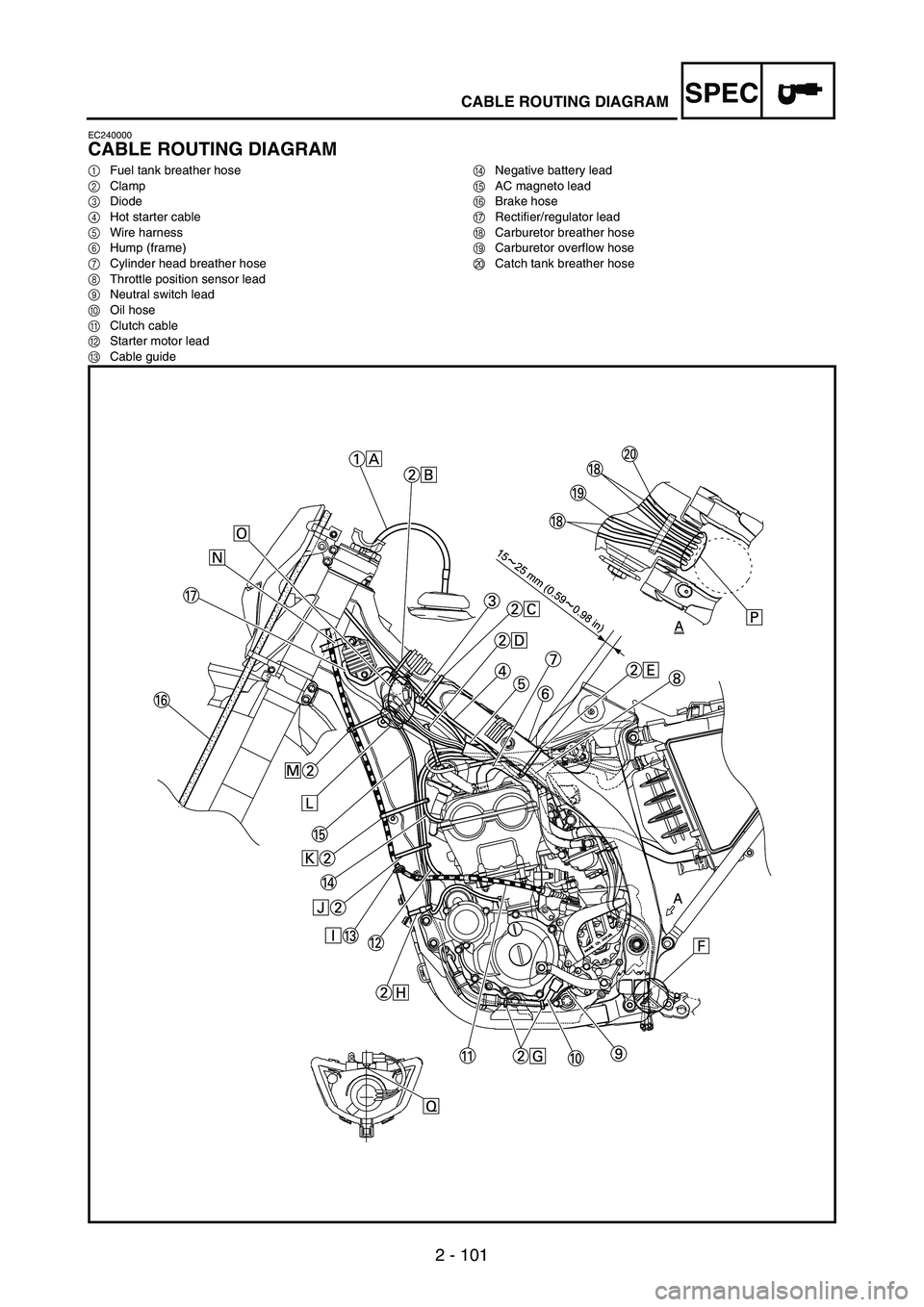
CABLE ROUTING DIAGRAM
1Fuel tank breather hose
2Clamp
3Diode
4Hot starter cable
5Wire harness
6Hump (frame)
7Cylinder head breather hose
8Throttle position sensor lead
9Neutral switch lead
0Oil hose
AClutch cable
BStarter motor lead
CCable guideDNegative battery lead
EAC magneto lead
FBrake hose
GRectifier/regulator lead
HCarburetor breather hose
ICarburetor overflow hose
JCatch tank breather hose
Page 196 of 912

2 - 103
SPECCABLE ROUTING DIAGRAM
ÈInsert the end of the fuel tank breather hose into the hole in the
steering stem.
ÉFasten the throttle cable, hot starter cable and rectifier/regula-
tor lead onto the frame. Locate the clamp end facing the lower
side of the hot starter cable and cut off the tie end.
ÊFasten the diode (at the marking), throttle cable and hot starter
cable onto the frame. Locate the clamp end facing toward the
lower right of the frame and with the tie end facing downward.
ËFasten the wire harness, throttle position sensor lead, starter
motor lead and negative battery lead onto the frame. Pass the
clamp through the hole in the stay (air cut-off valve). Locate the
clamp end facing toward the lower side of the frame and cut off
the tie end.ÌFasten the throttle position sensor lead onto the frame. Locate
the clamp end facing toward the lower side of the frame and
cut off the tie end.
ÍPass the carburetor breather hoses, carburetor overflow hose
and catch tank breather hose between the connecting rod and
cross tube (frame).
ÎFasten the neutral switch lead and oil hose together with the
plastic locking ties and cut off the tie ends.
ÏFasten the neutral switch lead and AC magneto lead onto the
frame. Locate the clamp end facing toward the outside of the
frame and tie end facing toward the rear of the frame.
Page 213 of 912
3 - 2
INSP
ADJ
MAINTENANCE INTERVALS
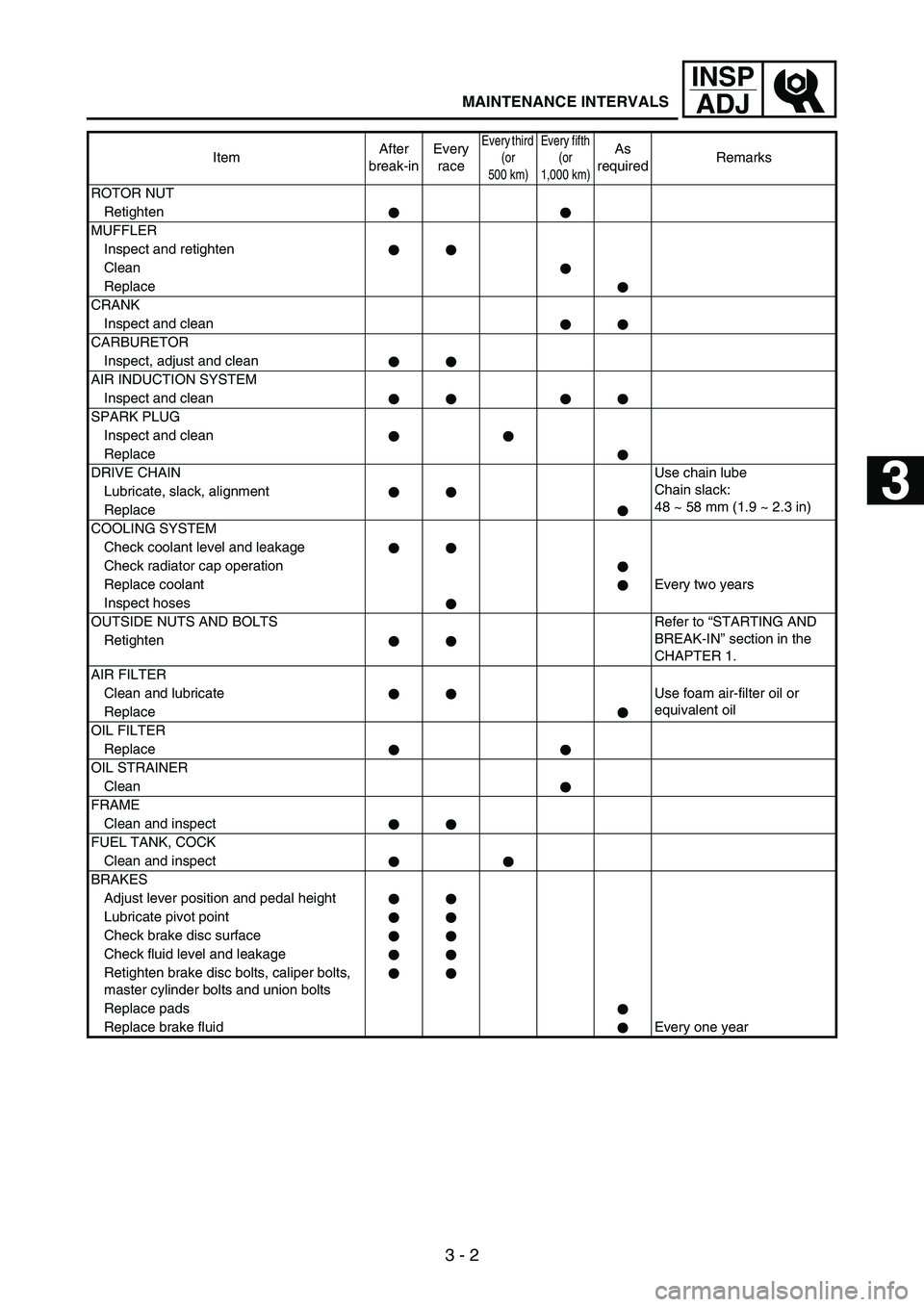
ROTOR NUT
Retighten
MUFFLER
Inspect and retighten
Clean
Replace
CRANK
Inspect and clean
CARBURETOR
Inspect, adjust and clean
AIR INDUCTION SYSTEM
Inspect and clean
SPARK PLUG
Inspect and clean
Replace
DRIVE CHAINUse chain lube
Chain slack:
48 ~ 58 mm (1.9 ~ 2.3 in) Lubricate, slack, alignment
Replace
COOLING SYSTEM
Check coolant level and leakage
Check radiator cap operation
Replace coolantEvery two years
Inspect hoses
OUTSIDE NUTS AND BOLTS Refer to “STARTING AND
BREAK-IN” section in the
CHAPTER 1. Retighten
AIR FILTER
Clean and lubricate Use foam air-filter oil or
equivalent oil
Replace
OIL FILTER
Replace
OIL STRAINER
Clean
FRAME
Clean and inspect
FUEL TANK, COCK
Clean and inspect
BRAKES
Adjust lever position and pedal height
Lubricate pivot point
Check brake disc surface
Check fluid level and leakage
Retighten brake disc bolts, caliper bolts,
master cylinder bolts and union bolts
Replace pads
Replace brake fluid Every one yearItemAfter
break-inEvery
race
Every third
(or
500 km)Every fifth
(or
1,000 km)As
requiredRemarks
1
2
3
4
5
6
7
Page 227 of 912
3 - 16
INSP
ADJ
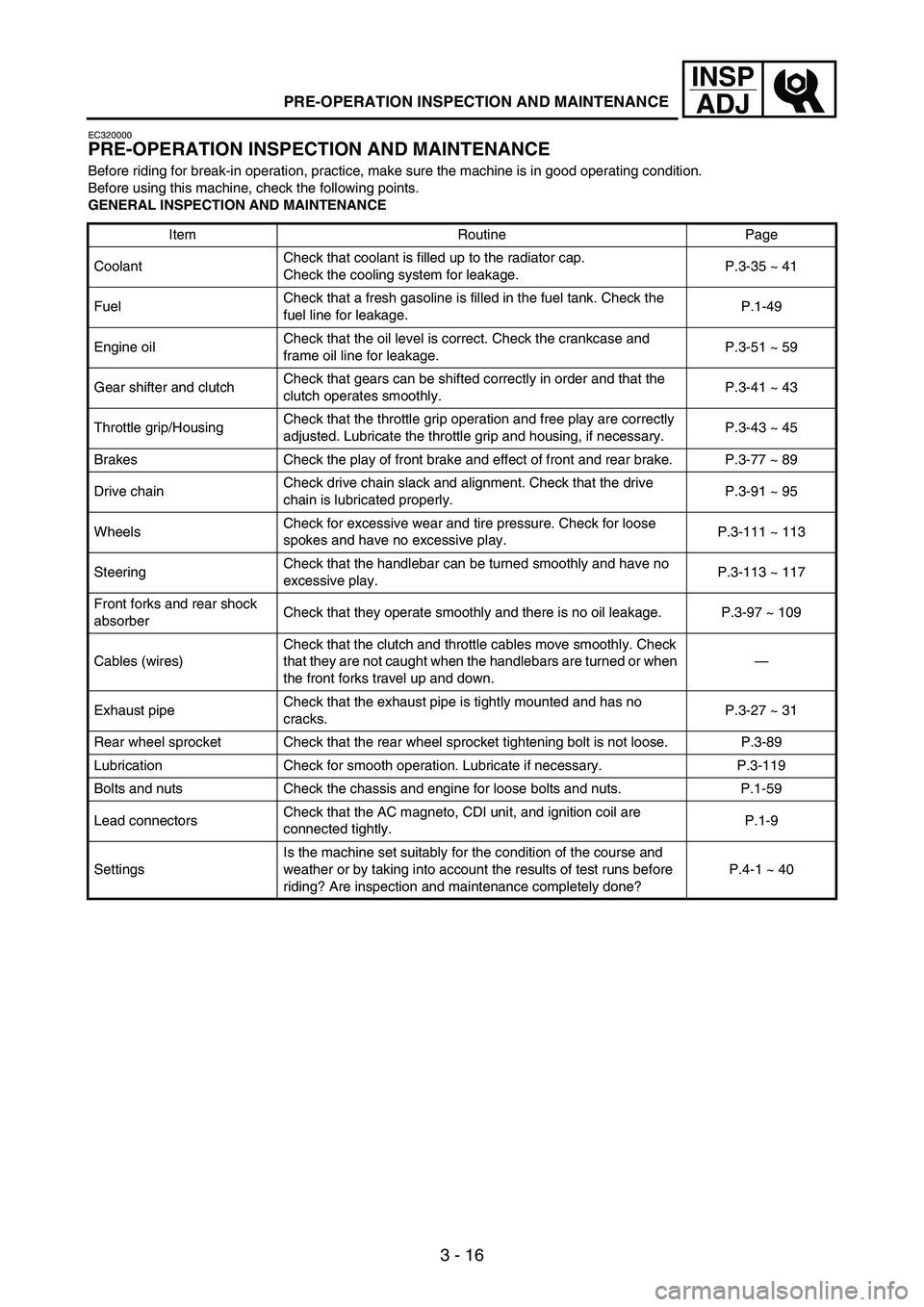
PRE-OPERATION INSPECTION AND MAINTENANCE
EC320000
PRE-OPERATION INSPECTION AND MAINTENANCE
Before riding for break-in operation, practice, make sure the machine is in good operating condition.
Before using this machine, check the following points.
GENERAL INSPECTION AND MAINTENANCE
Item Routine Page
CoolantCheck that coolant is filled up to the radiator cap.
Check the cooling system for leakage.P.3-35 ~ 41
FuelCheck that a fresh gasoline is filled in the fuel tank. Check the
fuel line for leakage.P.1-49
Engine oilCheck that the oil level is correct. Check the crankcase and
frame oil line for leakage.P.3-51 ~ 59
Gear shifter and clutchCheck that gears can be shifted correctly in order and that the
clutch operates smoothly.P.3-41 ~ 43
Throttle grip/HousingCheck that the throttle grip operation and free play are correctly
adjusted. Lubricate the throttle grip and housing, if necessary.P.3-43 ~ 45
Brakes Check the play of front brake and effect of front and rear brake. P.3-77 ~ 89
Drive chainCheck drive chain slack and alignment. Check that the drive
chain is lubricated properly.P.3-91 ~ 95
WheelsCheck for excessive wear and tire pressure. Check for loose
spokes and have no excessive play.P.3-111 ~ 113
SteeringCheck that the handlebar can be turned smoothly and have no
excessive play.P.3-113 ~ 117
Front forks and rear shock
absorberCheck that they operate smoothly and there is no oil leakage. P.3-97 ~ 109
Cables (wires)Check that the clutch and throttle cables move smoothly. Check
that they are not caught when the handlebars are turned or when
the front forks travel up and down.—
Exhaust pipeCheck that the exhaust pipe is tightly mounted and has no
cracks.P.3-27 ~ 31
Rear wheel sprocket Check that the rear wheel sprocket tightening bolt is not loose. P.3-89
Lubrication Check for smooth operation. Lubricate if necessary. P.3-119
Bolts and nuts Check the chassis and engine for loose bolts and nuts. P.1-59
Lead connectorsCheck that the AC magneto, CDI unit, and ignition coil are
connected tightly.P.1-9
SettingsIs the machine set suitably for the condition of the course and
weather or by taking into account the results of test runs before
riding? Are inspection and maintenance completely done?P.4-1 ~ 40