light YAMAHA WR 250F 2008 User Guide
[x] Cancel search | Manufacturer: YAMAHA, Model Year: 2008, Model line: WR 250F, Model: YAMAHA WR 250F 2008Pages: 224, PDF Size: 13.66 MB
Page 42 of 224

2-15
TIGHTENING TORQUES
△Engine and engine bracket (upper) M10 × 1.25 1 55 5.5 40
△ Engine guard M6 × 1.0 3 7 0.7 5.1
Regulator M6 × 1.0 2 7 0.7 5.1
△ Pivot shaft and nut M16 × 1.5 1 85 8.5 61
△ Relay arm and swingarm M14 × 1.5 1 70 7.0 50
△ Relay arm and connecting rod M14 × 1.5 1 80 8.0 58
△ Connecting rod and frame M14 × 1.5 1 80 8.0 58
△ Rear shock absorber and frame M10 × 1.25 1 56 5.6 40
△ Rear shock absorber and relay arm M10 × 1.25 1 53 5.3 38
△ Rear frame (upper) M8 × 1.25 1 38 3.8 27
△ Rear frame (lower) M8 × 1.25 2 32 3.2 23
△ Swingarm and brake hose holder M5 × 0.8 4 2 0.2 1.4
Swingarm and patch M4 × 0.7 4 2 0.2 1.4
Upper drive chain tensioner M8 × 1.25 1 16 1.6 11
Lower drive chain tensioner M8 × 1.25 1 16 1.6 11
Drive chain support M6 × 1.0 3 7 0.7 5.1
Seal guard and swingarm M5 × 0.8 4 6 0.6 4.3
△ Fuel tank M6 × 1.0 2 9 0.9 6.5
△ Fuel cock M6 × 1.0 2 4 0.4 2.9
Seat set bracket and fuel tank M6 × 1.0 1 7 0.7 5.1
Fuel tank bracket and fuel tank M6 × 1.0 4 7 0.7 5.1
△ Air scoop and fuel tank M6 × 1.0 6 7 0.7 5.1
△ Air scoop and radiator guard (lower) M6 × 1.0 2 6 0.6 4.3
△ Front fender M6 × 1.0 4 7 0.7 5.1
△ Rear fender (front) M6 × 1.0 2 7 0.7 5.1
△ Rear fender (rear) M6 × 1.0 2 11 1.1 8.0
△ Side cover M6 × 1.0 2 7 0.7 5.1
△ Seat M8 × 1.25 2 23 2.3 17
Multi-function display bracket and upper bracket M6 × 1.0 2 7 0.7 5.1
Multi-function display M5 × 0.8 2 4 0.4 2.9
Plate 1 and front fork protector M5 × 0.8 2 4 0.4 2.9
Plate 2 and front fork protector —2 0.5 0.05 0.36
Speed sensor lead holder and lower bracket M6 × 1.0 1 13 1.3 9.4
Speed sensor lead holder and clamp M6 × 1.0 1 7 0.7 5.1
Headlight body and headlight unit —2 1 0.1 0.7
△ Headlight M6 × 1.0 2 7 0.7 5.1
Taillight —3 1 0.1 0.7
Taillight lead clamp and rear fender —3 0.5 0.05 0.36
△ Catch tank (upper) M6 × 1.0 1 16 1.6 11
△ Catch tank (lower) M6 × 1.0 1 7 0.7 5.1
Footrest bracket and frame M10 × 1.25 4 55 5.5 40
Sidestand M10 × 1.25 1 25 2.5 18
Part to be tightened
Thread size Q'tyTightening torque
Nm m•kg ft•lb
Page 49 of 224

2-22
CABLE ROUTING DIAGRAM
A. Insert the end of the fuel tank breather hose into the hole in
the steering stem.
B. Fasten the throttle cable, hot
starter cable and rectifier/regula-
tor lead onto the frame. Locate
the clamp end facing the lower
side of the hot starter cable and
cut off the tie end.
C. Fasten the diode (at the mark-
ing), throttle cable and hot start-
er cable onto the frame. Locate
the clamp end facing toward the
lower right of the frame and with
the tie end facing downward.
D. Fasten the wire harness, throttle
position sensor lead, starter mo-
tor lead and negative battery
lead onto the frame. Pass the
clamp through the hole in the
stay (air cut-off valve). Locate
the clamp end facing toward the
lower side of the frame and cut
off the tie end.
E. Fasten the throttle position sen-
sor lead onto the frame. Locate
the clamp end facing toward the
lower side of the frame and cut
off the tie end.
F. Pass the carburetor breather hoses, carburetor overflow hose
and catch tank breather hose
between the connecting rod and
cross tube (frame).
G. Fasten the neutral switch lead and oil hose together with the
plastic locking ties and cut off
the tie ends.
H. Fasten the neutral switch lead
and AC magneto lead onto the
frame. Locate the clamp end
facing toward the outside of the
frame and tie end facing toward
the rear of the frame.
I. Pass the clutch cable through
the cable guide.
J. Fasten the starter motor lead, AC magneto lead and neutral
switch lead onto the frame. Lo-
cate the clamp end facing to-
ward the rear of the frame and
cut off the tie end.
K. Fasten the clutch cable, starter motor lead, negative battery
lead, AC magneto lead and neu-
tral switch lead onto the frame.
Locate the clamp end facing to-
ward the rear of the frame and
cut off the tie end.
L. Pass the neutral switch lead and
AC magneto lead on the inside
of the wire harness. M. Fasten the clutch cable, AC
magneto lead and neutral switch
lead onto the frame. Locate the
clamp end near the clutch cable
and cut off the tie end.
N. Pass the clutch cable and wire harness through the cable
guide.
O. Locate the couplers in the frame recess.
P. Pass the carburetor breather hoses, carburetor overflow hose
and catch tank breather hose so
that the hoses do not contact the
rear shock absorber.
Q. Secure the coupler by pushing it
into the hole in the headlight
unit.
Page 51 of 224
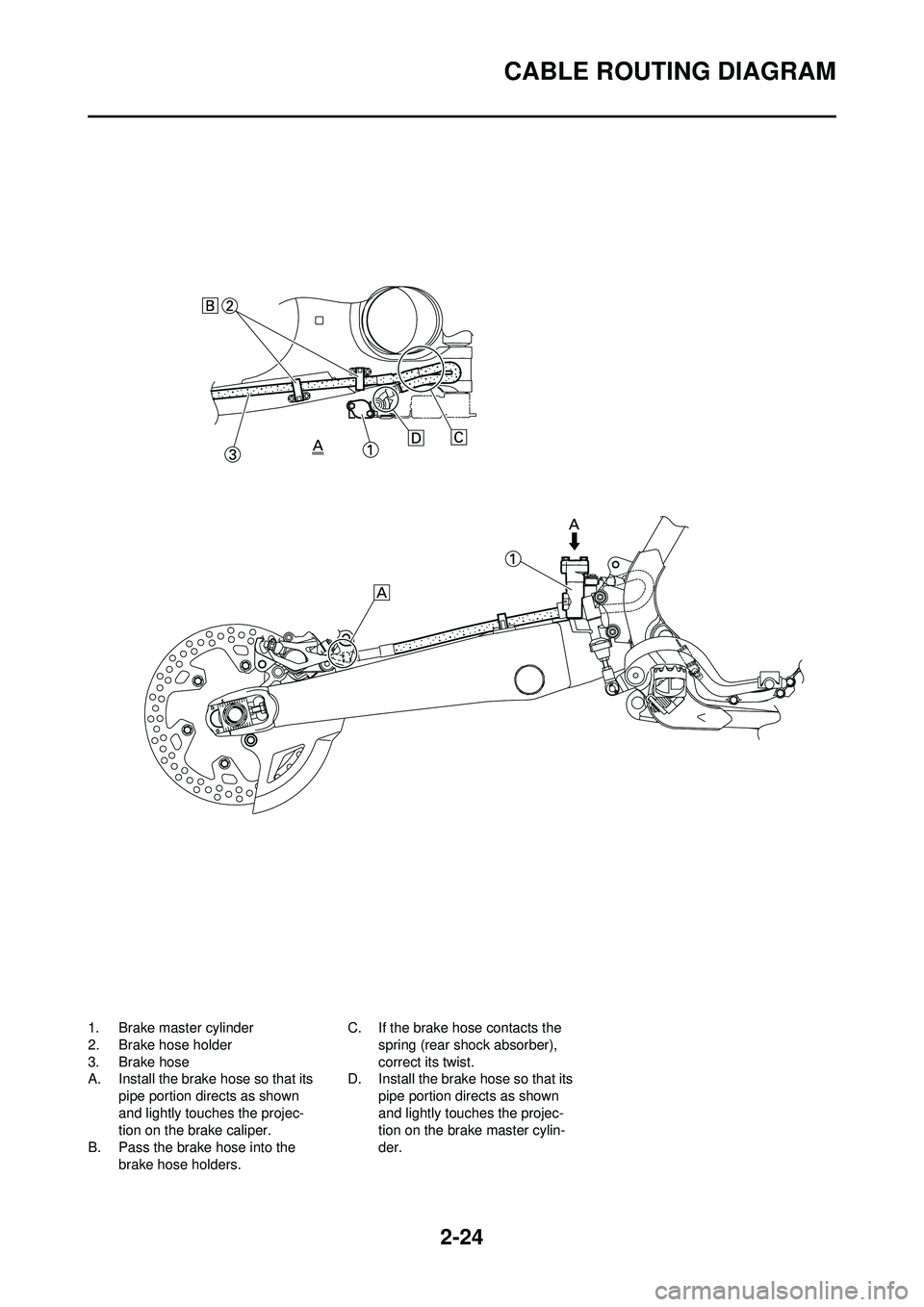
2-24
CABLE ROUTING DIAGRAM
1. Brake master cylinder
2. Brake hose holder
3. Brake hose
A. Install the brake hose so that its
pipe portion directs as shown
and lightly touches the projec-
tion on the brake caliper.
B. Pass the brake hose into the
brake hose holders. C. If the brake hose contacts the
spring (rear shock absorber),
correct its twist.
D. Install the brake hose so that its pipe portion directs as shown
and lightly touches the projec-
tion on the brake master cylin-
der.
Page 52 of 224
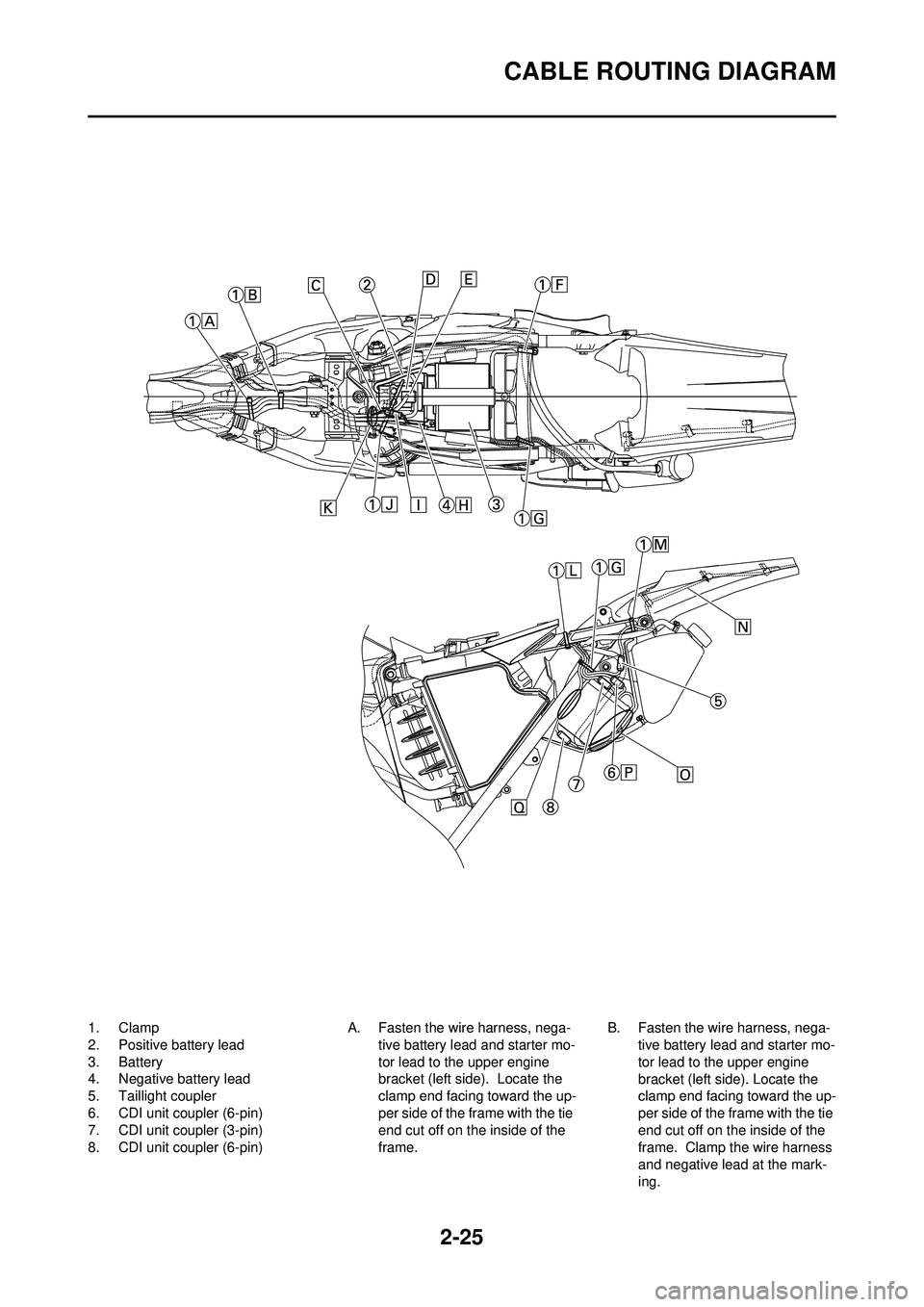
2-25
CABLE ROUTING DIAGRAM
1. Clamp
2. Positive battery lead
3. Battery
4. Negative battery lead
5. Taillight coupler
6. CDI unit coupler (6-pin)
7. CDI unit coupler (3-pin)
8. CDI unit coupler (6-pin)A. Fasten the wire harness, nega-
tive battery lead and starter mo-
tor lead to the upper engine
bracket (left side). Locate the
clamp end facing toward the up-
per side of the frame with the tie
end cut off on the inside of the
frame. B. Fasten the wire harness, nega-
tive battery lead and starter mo-
tor lead to the upper engine
bracket (left side). Locate the
clamp end facing toward the up-
per side of the frame with the tie
end cut off on the inside of the
frame. Clamp the wire harness
and negative lead at the mark-
ing.
Page 53 of 224

2-26
CABLE ROUTING DIAGRAM
C. Pass the starter motor lead through the hole in the relay
holder.
D. Fit the cover securely.
E. Connect the wire harness to the starter relay.
F. Fasten the catch tank breather
hose and catch tank hose to the
rear frame. Clamp them close to
where they are joined to the
frame. Fasten the pipe tightly
enough not to crush it. Locate
the clamp end facing toward the
rear of the frame with the tie end
facing downward.
G. Fasten the (three) CDI unit leads
and taillight lead to the rear
frame. Locate the clamp end
facing toward the upper side of
the frame and cut off the tie end.
H. Connect the negative battery lead to the battery negative ter-
minal.
I. Connect the negative battery lead to the wire harness.
J. Fasten the wire harness to the rear frame. Locate the clamp
end facing toward the upper side
of the frame and the tie end to-
ward the inside of the frame.
Clamp the wire harness at the
marking.
K. Pass the wire harness, starter relay lead, starting circuit cut-off
relay lead and negative battery
lead through the hole in the relay
holder.
L. Fasten the (three) CDI unit leads and taillight lead to the rear
frame. Locate the clamp end
facing toward the lower side of
the frame and cut off the tie end.
M. Fasten the taillight lead to the rear frame. Locate the clamp
end facing toward the upper side
of the frame and cut off the tie
end.
N. Do not allow the taillight lead to
slacken.
O. Locate the CDI unit lead be- tween the CDI unit and rear
fender.
P. Locate the CDI unit coupler in the clearance between the up-
per side of the CDI unit and low-
er side of the catch tank stay.
Q. Locate the CDI unit lead be-
tween the CDI unit and rear
frame.
Page 54 of 224
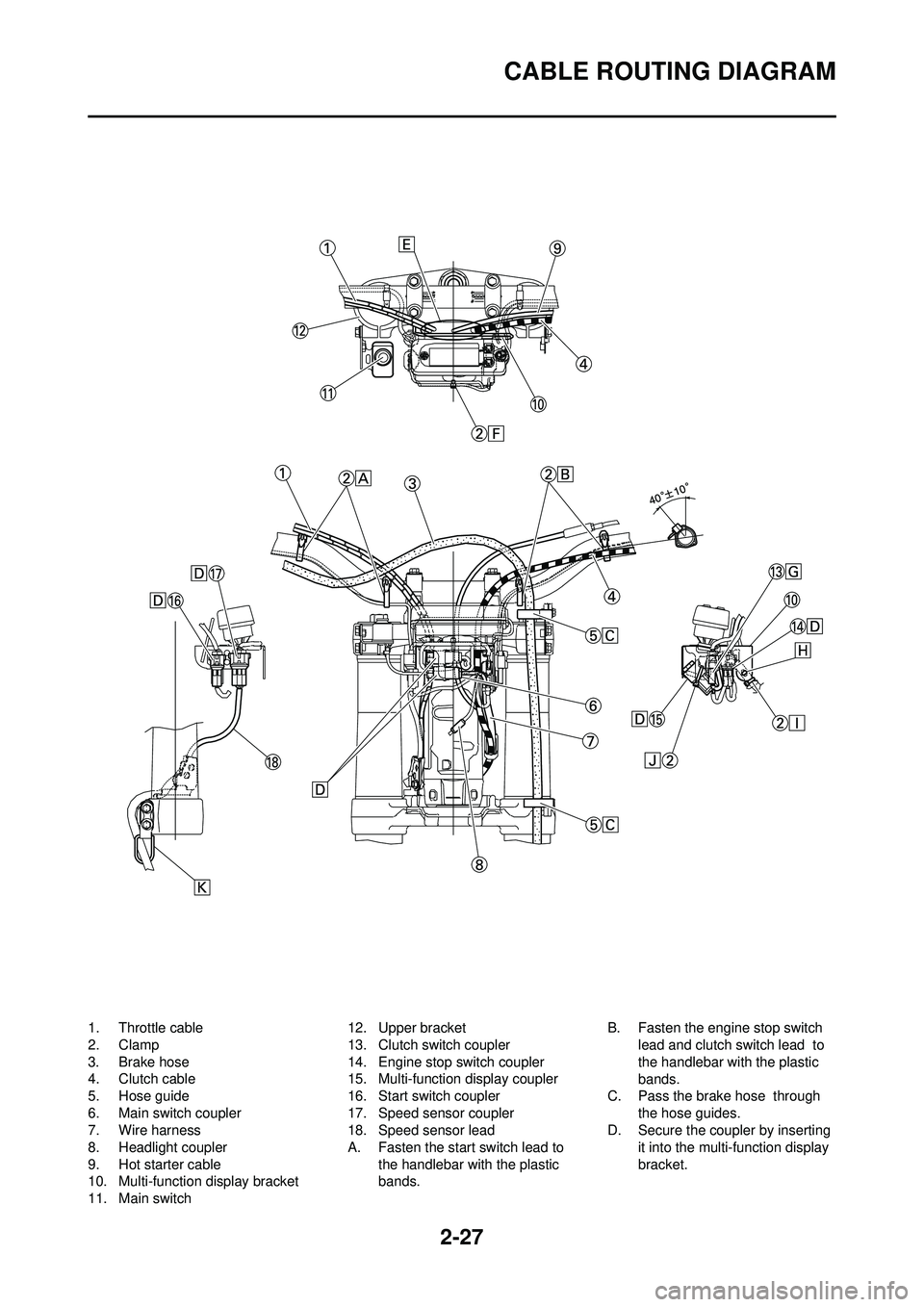
2-27
CABLE ROUTING DIAGRAM
1. Throttle cable
2. Clamp
3. Brake hose
4. Clutch cable
5. Hose guide
6. Main switch coupler
7. Wire harness
8. Headlight coupler
9. Hot starter cable
10. Multi-function display bracket
11. Main switch12. Upper bracket
13. Clutch switch coupler
14. Engine stop switch coupler
15. Multi-function display coupler
16. Start switch coupler
17. Speed sensor coupler
18. Speed sensor lead
A. Fasten the star
t switch lead to
the handlebar with the plastic
bands. B. Fasten the engine stop switch
lead and clutch switch lead to
the handlebar with the plastic
bands.
C. Pass the brake hose through
the hose guides.
D. Secure the coupler by inserting it into the multi-function display
bracket.
Page 61 of 224
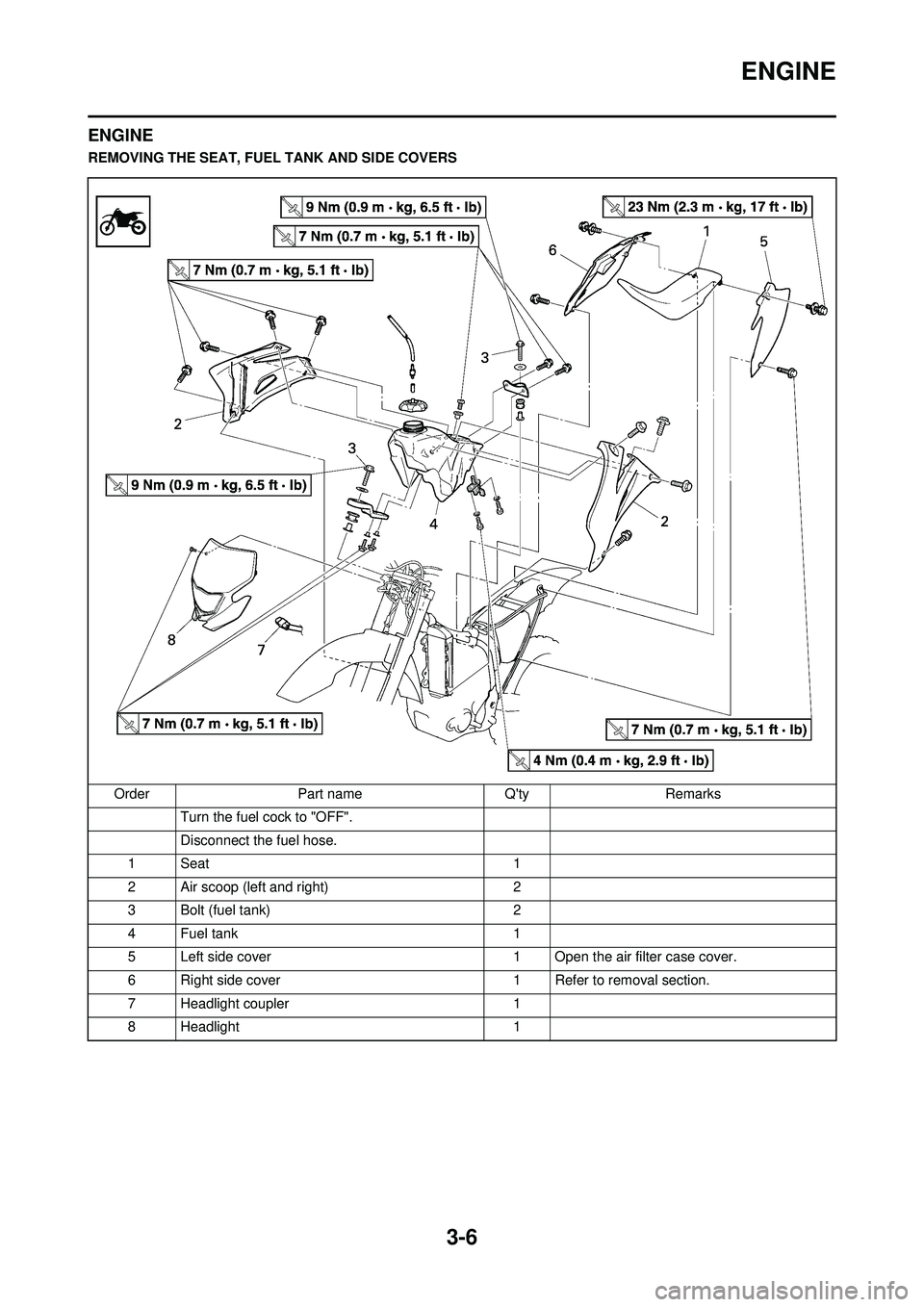
3-6
ENGINE
ENGINE
REMOVING THE SEAT, FUEL TANK AND SIDE COVERS
Order Part name Q'ty Remarks Turn the fuel cock to "OFF".
Disconnect the fuel hose.
1Seat 1
2 Air scoop (left and right) 2
3 Bolt (fuel tank) 2
4 Fuel tank 1
5 Left side cover 1 Open the air filter case cover.
6 Right side cover 1 Refer to removal section.
7 Headlight coupler 1
8 Headlight 1
Page 68 of 224
3-13
ENGINE
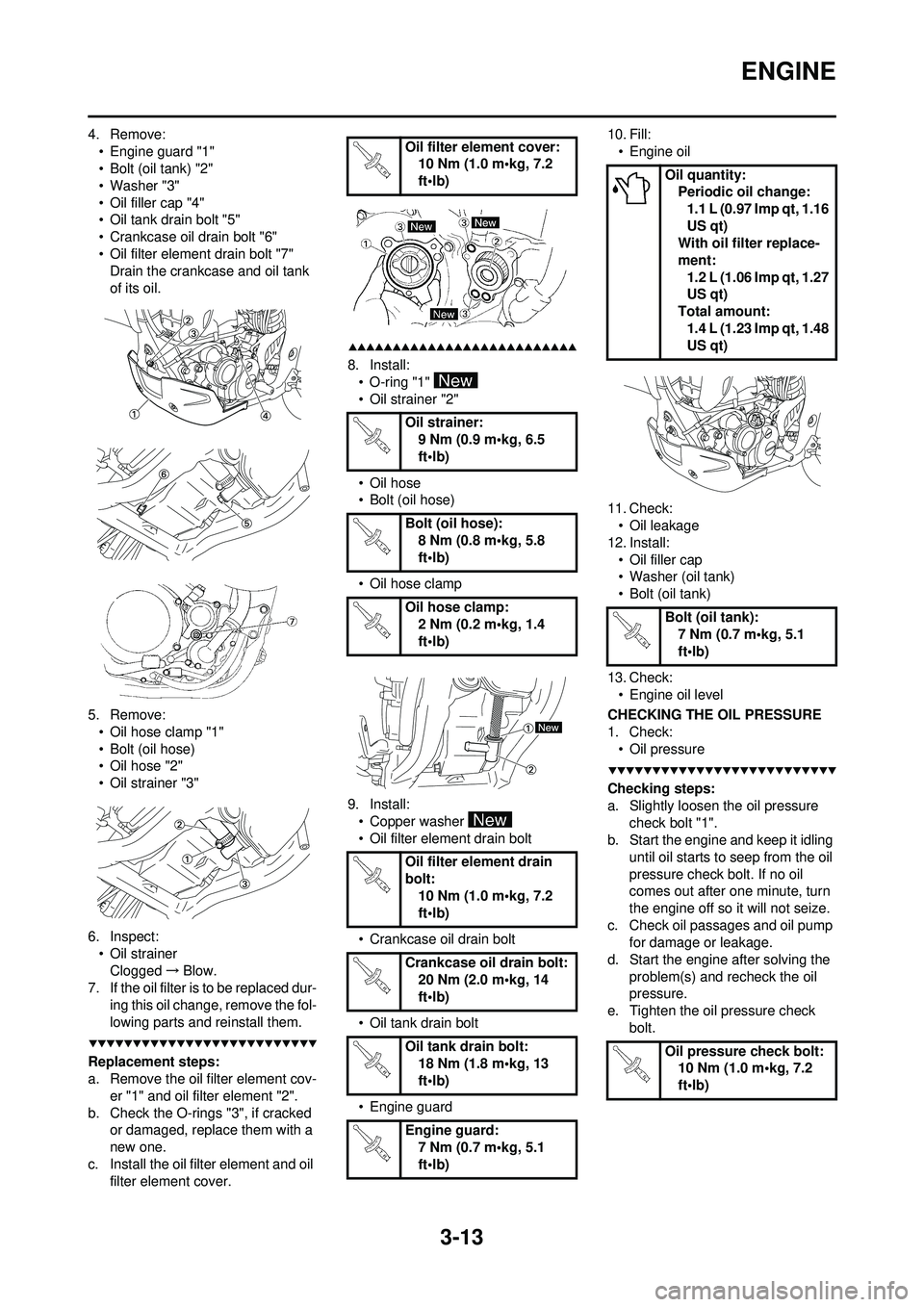
4. Remove:• Engine guard "1"
• Bolt (oil tank) "2"
• Washer "3"
• Oil filler cap "4"
• Oil tank drain bolt "5"
• Crankcase oil drain bolt "6"
• Oil filter element drain bolt "7"Drain the crankcase and oil tank
of its oil.
5. Remove: • Oil hose clamp "1"
• Bolt (oil hose)
• Oil hose "2"
• Oil strainer "3"
6. Inspect: • Oil strainerClogged →Blow.
7. If the oil filter is to be replaced dur-
ing this oil change, remove the fol-
lowing parts and reinstall them.
Replacement steps:
a. Remove the oil filter element cov-er "1" and oil filter element "2".
b. Check the O-rings "3", if cracked or damaged, replace them with a
new one.
c. Install the oil filter element and oil filter element cover.
8. Install:• O-ring "1"
• Oil strainer "2"
• Oil hose
• Bolt (oil hose)
• Oil hose clamp
9. Install: • Copper washer
• Oil filter element drain bolt
• Crankcase oil drain bolt
• Oil tank drain bolt
• Engine guard 10. Fill:
• Engine oil
11. Check: • Oil leakage
12. Install: • Oil filler cap
• Washer (oil tank)
• Bolt (oil tank)
13. Check: • Engine oil level
CHECKING THE OIL PRESSURE
1. Check: • Oil pressure
Checking steps:
a. Slightly loosen the oil pressure check bolt "1".
b. Start the engine and keep it idling
until oil starts to seep from the oil
pressure check bolt. If no oil
comes out after one minute, turn
the engine off so it will not seize.
c. Check oil passages and oil pump for damage or leakage.
d. Start the engine after solving the problem(s) and recheck the oil
pressure.
e. Tighten the oil pressure check bolt.
Oil filter element cover:10 Nm (1.0 m•kg, 7.2
ft•lb)
Oil strainer: 9 Nm (0.9 m•kg, 6.5
ft•lb)
Bolt (oil hose): 8 Nm (0.8 m•kg, 5.8
ft•lb)
Oil hose clamp: 2 Nm (0.2 m•kg, 1.4
ft•lb)
Oil filter element drain
bolt: 10 Nm (1.0 m•kg, 7.2
ft•lb)
Crankcase oil drain bolt: 20 Nm (2.0 m•kg, 14
ft•lb)
Oil tank drain bolt: 18 Nm (1.8 m•kg, 13
ft•lb)
Engine guard: 7 Nm (0.7 m•kg, 5.1
ft•lb)
Oil quantity: Periodic oil change:1.1 L (0.97 Imp qt, 1.16
US qt)
With oil filter replace-
ment:
1.2 L (1.06 Imp qt, 1.27
US qt)
Total amount:
1.4 L (1.23 Imp qt, 1.48
US qt)
Bolt (oil tank): 7 Nm (0.7 m•kg, 5.1
ft•lb)
Oil pressure check bolt: 10 Nm (1.0 m•kg, 7.2
ft•lb)
Page 69 of 224
3-14
ENGINE
ADJUSTING THE PILOT SCREW
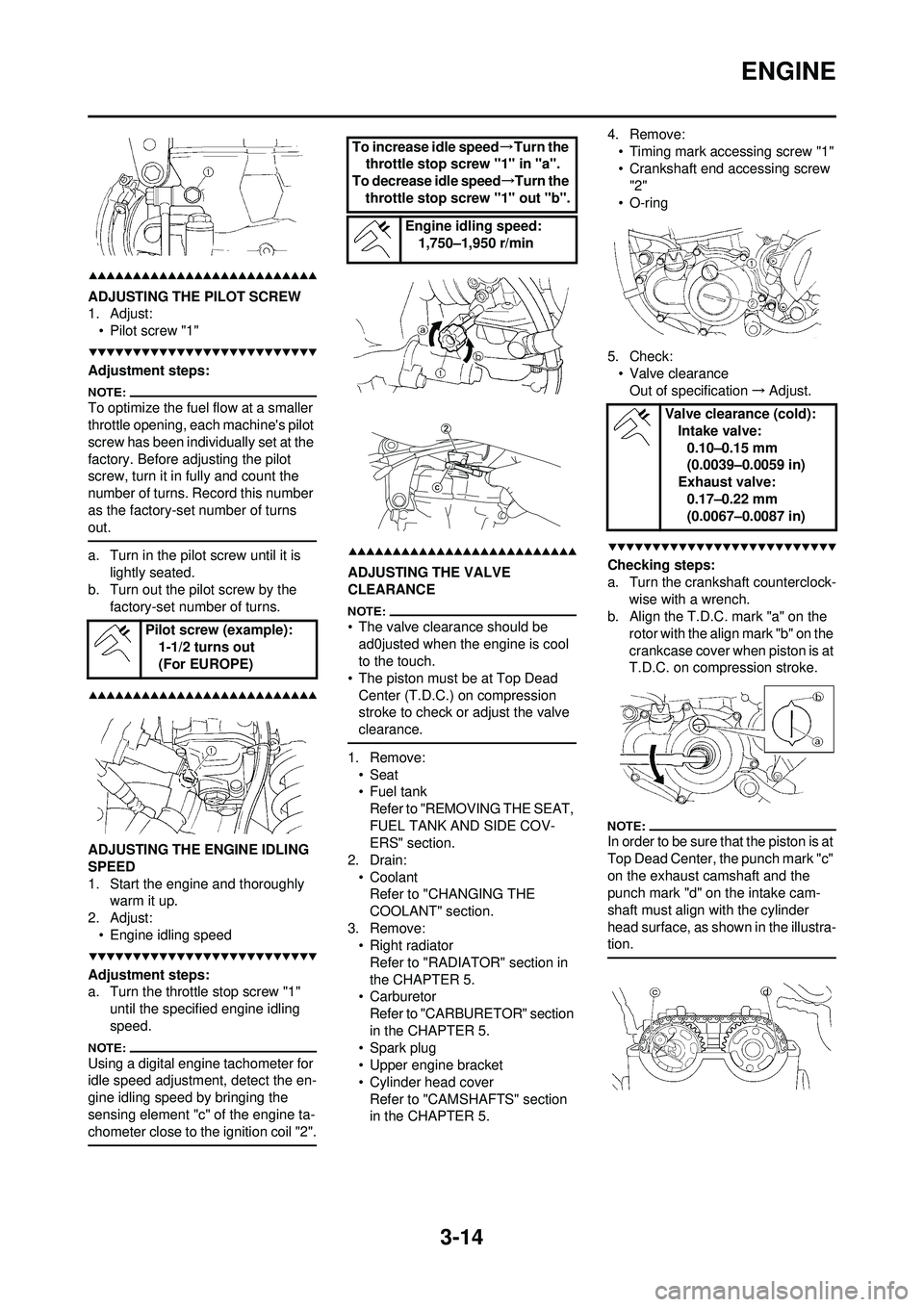
1. Adjust:• Pilot screw "1"
Adjustment steps:
To optimize the fuel flow at a smaller
throttle opening, each machine's pilot
screw has been individually set at the
factory. Before adjusting the pilot
screw, turn it in fully and count the
number of turns. Record this number
as the factory-set number of turns
out.
a. Turn in the pilot screw until it is
lightly seated.
b. Turn out the pilot screw by the factory-set number of turns.
ADJUSTING THE ENGINE IDLING
SPEED
1. Start the engine and thoroughly warm it up.
2. Adjust: • Engine idling speed
Adjustment steps:
a. Turn the throttle stop screw "1"
until the specified engine idling
speed.
Using a digital engine tachometer for
idle speed adjustment, detect the en-
gine idling speed by bringing the
sensing element "c" of the engine ta-
chometer close to the ignition coil "2".
ADJUSTING THE VALVE
CLEARANCE
• The valve clearance should be ad0justed when the engine is cool
to the touch.
• The piston must be at Top Dead Center (T.D.C.) on compression
stroke to check or adjust the valve
clearance.
1. Remove:
•Seat
•Fuel tankRefer to "REMOVING THE SEAT,
FUEL TANK AND SIDE COV-
ERS" section.
2. Drain:
• CoolantRefer to "CHANGING THE
COOLANT" section.
3. Remove: • Right radiatorRefer to "RADIATOR" section in
the CHAPTER 5.
• Carburetor Refer to "CARBU RETOR" section
in the CHAPTER 5.
• Spark plug
• Upper engine bracket
• Cylinder head cover Refer to "CAMSHAFTS" section
in the CHAPTER 5. 4. Remove:
• Timing mark accessing screw "1"
• Crankshaft end accessing screw "2"
• O-ring
5. Check: • Valve clearanceOut of specification →Adjust.
Checking steps:
a. Turn the crankshaft counterclock-
wise with a wrench.
b. Align the T.D.C. mark "a" on the
rotor with the align mark "b" on the
crankcase cover when piston is at
T.D.C. on compression stroke.
In order to be sure t hat the piston is at
Top Dead Center, the punch mark "c"
on the exhaust camshaft and the
punch mark "d" on the intake cam-
shaft must align with the cylinder
head surface, as shown in the illustra-
tion.
Pilot screw (example):
1-1/2 turns out
(For EUROPE)
To increase idle speed →Turn the
throttle stop screw "1" in "a".
To decrease idle speed →Turn the
throttle stop screw "1" out "b".
Engine idling speed:1,750–1,950 r/min
Valve clearance (cold):
Intake valve:0.10–0.15 mm
(0.0039–0.0059 in)
Exhaust valve: 0.17–0.22 mm
(0.0067–0.0087 in)
Page 72 of 224
3-17
CHASSIS
CLEANING THE SPARK
ARRESTER (For USA)
• Be sure the exhaust pipe and si-lencer are cool before cleaning
the spark arrester.
• Do not start the engine when cleaning the exhaust system.
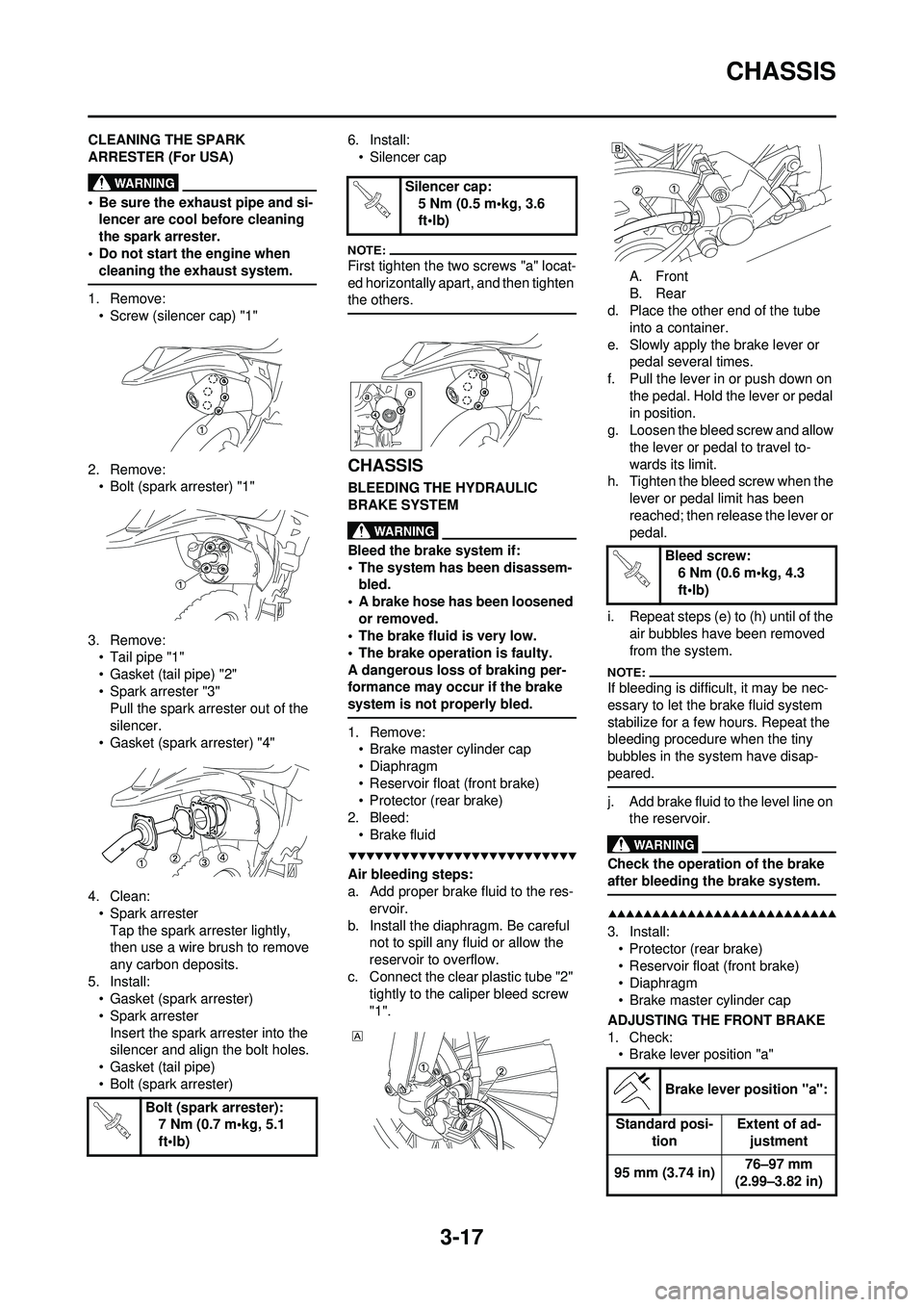
1. Remove:• Screw (silencer cap) "1"
2. Remove: • Bolt (spark arrester) "1"
3. Remove: • Tail pipe "1"
• Gasket (tail pipe) "2"
• Spark arrester "3"Pull the spark arrester out of the
silencer.
• Gasket (spark arrester) "4"
4. Clean: • Spark arrester
Tap the spark arrester lightly,
then use a wire brush to remove
any carbon deposits.
5. Install: • Gasket (spark arrester)
• Spark arresterInsert the spark arrester into the
silencer and align the bolt holes.
• Gasket (tail pipe)
• Bolt (spark arrester) 6. Install:
• Silencer cap
First tighten the two screws "a" locat-
ed horizontally apart, and then tighten
the others.
CHASSIS
BLEEDING THE HYDRAULIC
BRAKE SYSTEM
Bleed the brake system if:
• The system has been disassem-bled.
• A brake hose has been loosened
or removed.
• The brake fluid is very low.
• The brake operation is faulty.
A dangerous loss of braking per-
formance may occur if the brake
system is not properly bled.
1. Remove: • Brake master cylinder cap
• Diaphragm
• Reservoir float (front brake)
• Protector (rear brake)
2. Bleed: •Brake fluid
Air bleeding steps:
a. Add proper brake fluid to the res- ervoir.
b. Install the diaphragm. Be careful not to spill any fluid or allow the
reservoir to overflow.
c. Connect the clear plastic tube "2" tightly to the caliper bleed screw
"1". A. Front
B. Rear
d. Place the other end of the tube
into a container.
e. Slowly apply the brake lever or pedal several times.
f. Pull the lever in or push down on
the pedal. Hold the lever or pedal
in position.
g. Loosen the bleed screw and allow
the lever or pedal to travel to-
wards its limit.
h. Tighten the bleed screw when the
lever or pedal limit has been
reached; then release the lever or
pedal.
i. Repeat steps (e) to (h) until of the air bubbles have been removed
from the system.
If bleeding is difficult, it may be nec-
essary to let the brake fluid system
stabilize for a few hours. Repeat the
bleeding procedure when the tiny
bubbles in the system have disap-
peared.
j. Add brake fluid to the level line on the reservoir.
Check the operation of the brake
after bleeding the brake system.
3. Install:
• Protector (rear brake)
• Reservoir float (front brake)
• Diaphragm
• Brake master cylinder cap
ADJUSTING THE FRONT BRAKE
1. Check: • Brake lever position "a"
Bolt (spark arrester): 7 Nm (0.7 m•kg, 5.1
ft•lb)
Silencer cap:5 Nm (0.5 m•kg, 3.6
ft•lb)
Bleed screw:
6 Nm (0.6 m•kg, 4.3
ft•lb)
Brake lever position "a":
Standard posi- tion Extent of ad-
justment
95 mm (3.74 in) 76–97 mm
(2.99–3.82 in)