torque YAMAHA WR 250F 2008 User Guide
[x] Cancel search | Manufacturer: YAMAHA, Model Year: 2008, Model line: WR 250F, Model: YAMAHA WR 250F 2008Pages: 224, PDF Size: 13.66 MB
Page 79 of 224
3-24
CHASSIS
Do not force the adjuster past the
minimum or maximum extent of
adjustment. The adjuster may be
damaged.
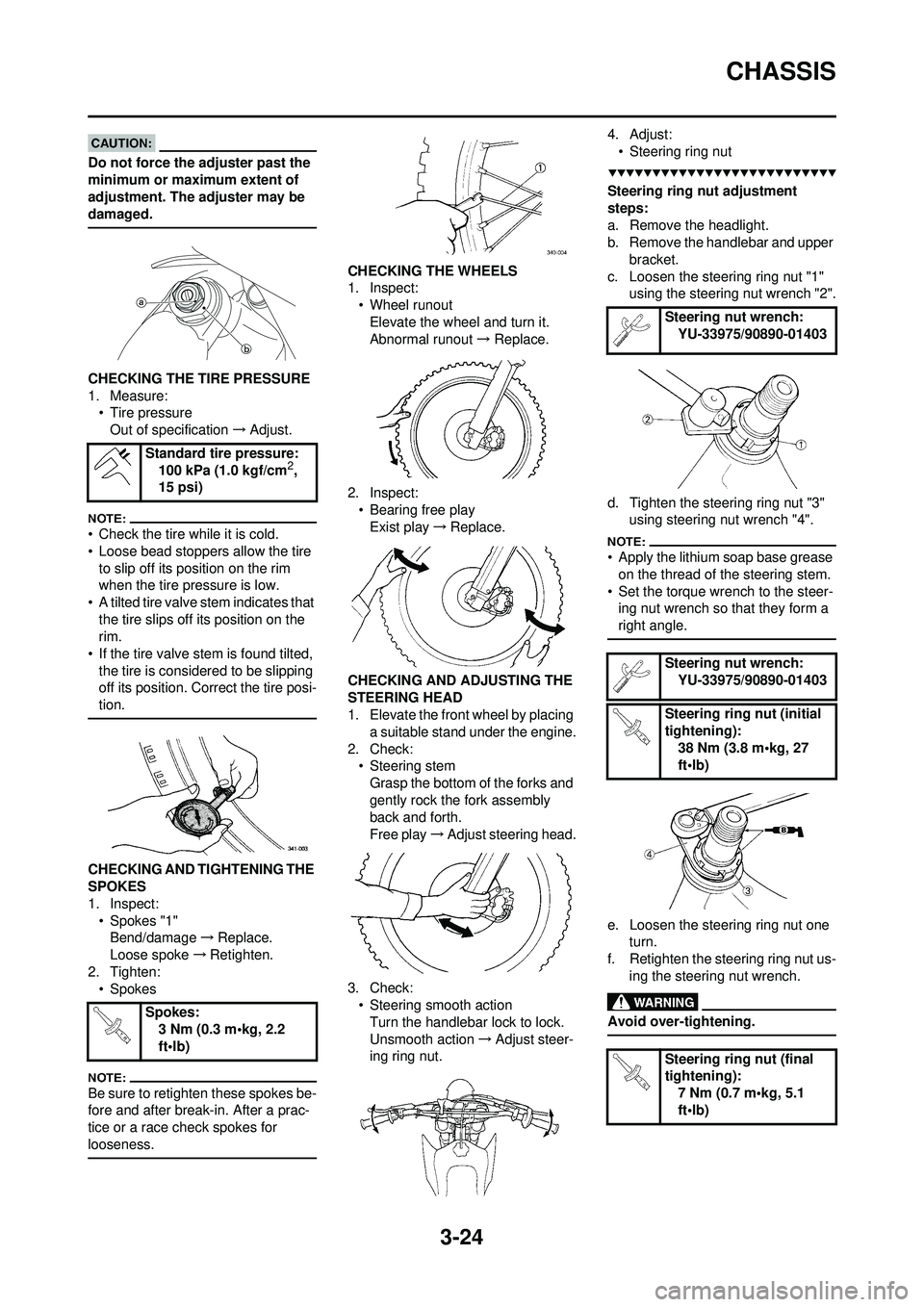
CHECKING THE TIRE PRESSURE
1. Measure:• Tire pressure
Out of specification →Adjust.
• Check the tire while it is cold.
• Loose bead stoppers allow the tire
to slip off its position on the rim
when the tire pressure is low.
• A tilted tire valve stem indicates that
the tire slips off its position on the
rim.
• If the tire valve st em is found tilted,
the tire is considered to be slipping
off its position. Correct the tire posi-
tion.
CHECKING AND TIGHTENING THE
SPOKES
1. Inspect: • Spokes "1"Bend/damage →Replace.
Loose spoke →Retighten.
2. Tighten: • Spokes
Be sure to retighten these spokes be-
fore and after break-in. After a prac-
tice or a race check spokes for
looseness.
CHECKING THE WHEELS
1. Inspect:
• Wheel runoutElevate the wheel and turn it.
Abnormal runout → Replace.
2. Inspect: • Bearing free playExist play →Replace.
CHECKING AND ADJUSTING THE
STEERING HEAD
1. Elevate the front wheel by placing a suitable stand under the engine.
2. Check: • Steering stemGrasp the bottom of the forks and
gently rock the fork assembly
back and forth.
Free play →Adjust steering head.
3. Check: • Steering smooth actionTurn the handlebar lock to lock.
Unsmooth action →Adjust steer-
ing ring nut. 4. Adjust:
• Steering ring nut
Steering ring nut adjustment
steps:
a. Remove the headlight.
b. Remove the handlebar and upper bracket.
c. Loosen the steering ring nut "1" using the steering nut wrench "2".
d. Tighten the steering ring nut "3" using steering nut wrench "4".
• Apply the lithium soap base grease
on the thread of the steering stem.
• Set the torque wrench to the steer- ing nut wrench so that they form a
right angle.
e. Loosen the steering ring nut one turn.
f. Retighten the steering ring nut us- ing the steering nut wrench.
Avoid over-tightening.
Standard tire pressure:100 kPa (1.0 kgf/cm2,
15 psi)
Spokes: 3 Nm (0.3 m•kg, 2.2
ft•lb)
Steering nut wrench:YU-33975/90890-01403
Steering nut wrench: YU-33975/90890-01403
Steering ring nut (initial
tightening): 38 Nm (3.8 m•kg, 27
ft•lb)
Steering ring nut (final
tightening): 7 Nm (0.7 m•kg, 5.1
ft•lb)
Page 95 of 224
4-8
CHASSIS
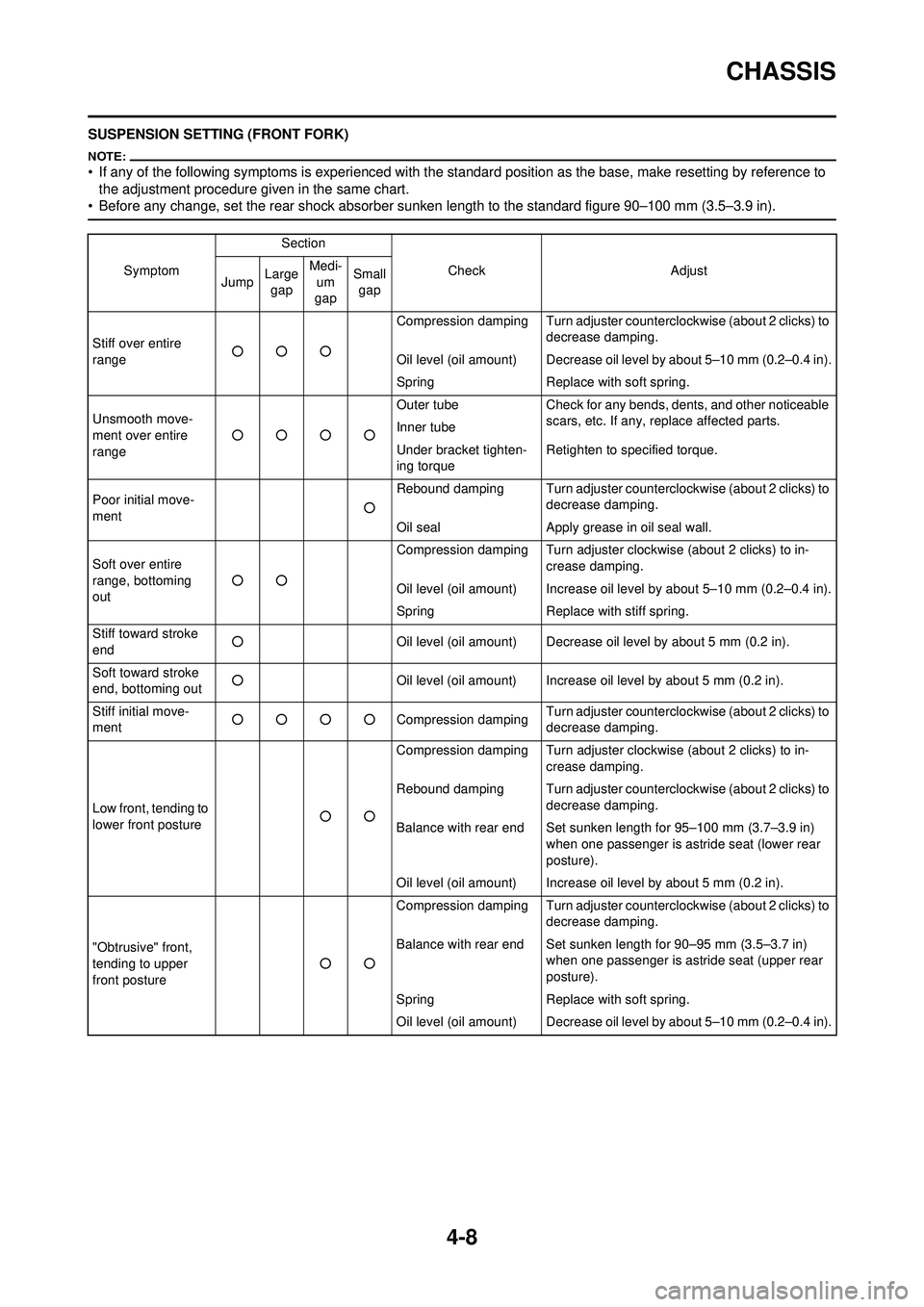
SUSPENSION SETTING (FRONT FORK)
• If any of the following symptoms is experienced with the standard position as the base, make resetting by reference to the adjustment procedure gi ven in the same chart.
• Before any change, set t he rear shock absorber sunken length to the standard figure 90–100 mm (3.5–3.9 in).
SymptomSection
Check Adjust
Jump Large
gap Medi-
um
gap Small
gap
Stiff over entire
range ○○○ Compression damping Turn adjuster counterclockwise (about 2 clicks) to
decrease damping.
Oil level (oil amount) Decrease oil level by about 5–10 mm (0.2–0.4 in).
Spring Replace with soft spring.
Unsmooth move-
ment over entire
range ○○○○ Outer tube
Check for any bends, dents, and other noticeable
scars, etc. If any, replace affected parts.
Inner tube
Under bracket tighten-
ing torque Retighten to specified torque.
Poor initial move-
ment ○Rebound damping Turn adjuster counterclockwise (about 2 clicks) to
decrease damping.
Oil seal Apply grease in oil seal wall.
Soft over entire
range, bottoming
out ○○ Compression damping Turn adjuster clockwise (about 2 clicks) to in-
crease damping.
Oil level (oil amount) Increase oil level by about 5–10 mm (0.2–0.4 in).
Spring Replace with stiff spring.
Stiff toward stroke
end ○
Oil level (oil amount) Decrease oil level by about 5 mm (0.2 in).
Soft toward stroke
end, bottoming out ○
Oil level (oil amount) Increase oil level by about 5 mm (0.2 in).
Stiff initial move-
ment ○○○○
Compression dampingTurn adjuster counterclockwise (about 2 clicks) to
decrease damping.
Low front, tending to
lower front posture ○○Compression damping Turn adjuster clockwise (about 2 clicks) to in-
crease damping.
Rebound damping Turn adjuster counterclockwise (about 2 clicks) to decrease damping.
Balance with rear end Set sunken length for 95–100 mm (3.7–3.9 in) when one passenger is astride seat (lower rear
posture).
Oil level (oil amount) Increase oil level by about 5 mm (0.2 in).
"Obtrusive" front,
tending to upper
front posture ○○Compression damping Turn adjuster counterclockwise (about 2 clicks) to
decrease damping.
Balance with rear end Set sunken length for 90–95 mm (3.5–3.7 in) when one passenger is astride seat (upper rear
posture).
Spring Replace with soft spring.
Oil level (oil amount) Decrease oil level by about 5–10 mm (0.2–0.4 in).
Page 114 of 224
5-18
CAMSHAFTS
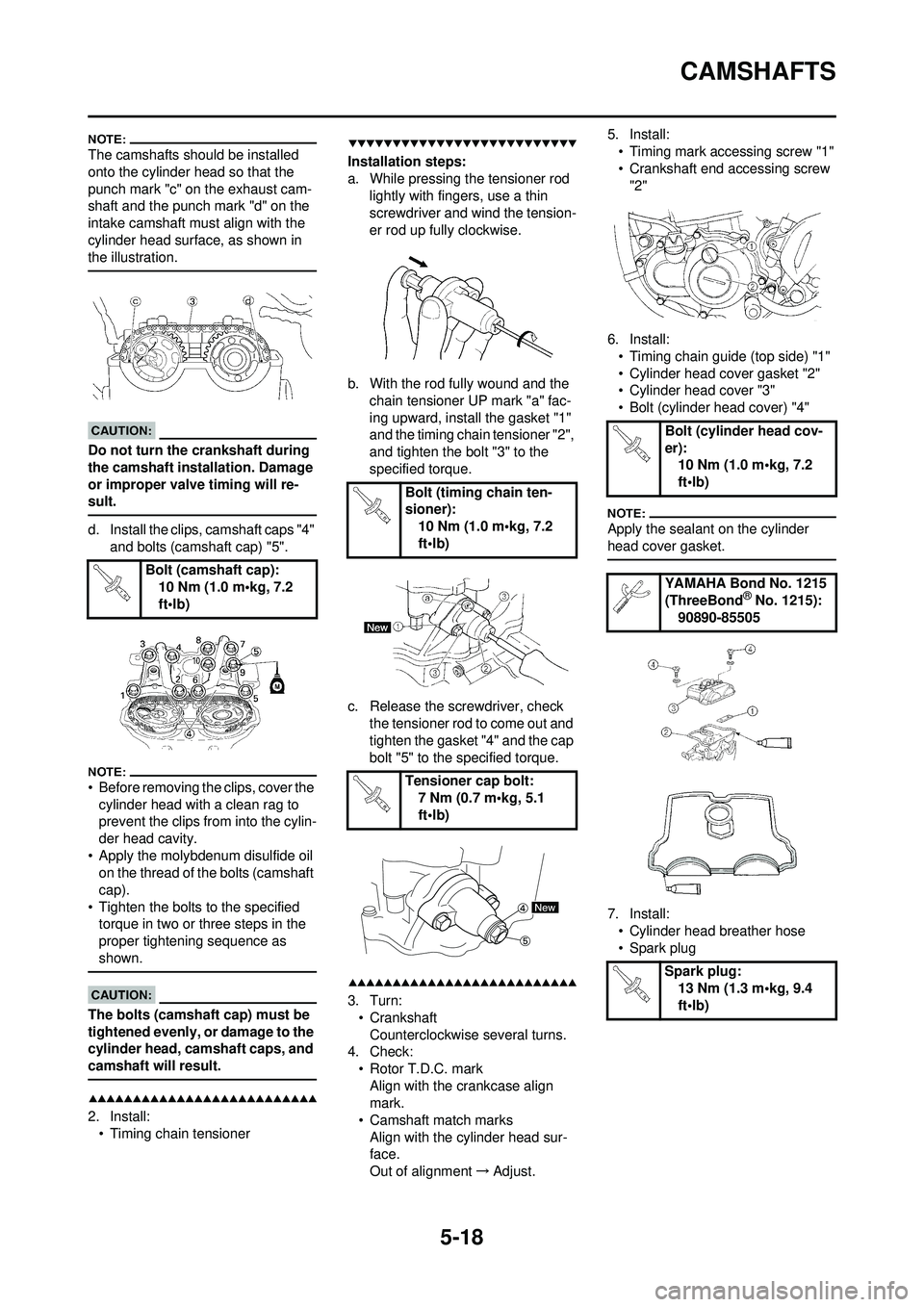
The camshafts should be installed
onto the cylinder head so that the
punch mark "c" on the exhaust cam-
shaft and the punch mark "d" on the
intake camshaft must align with the
cylinder head surface, as shown in
the illustration.
Do not turn the crankshaft during
the camshaft installation. Damage
or improper valve timing will re-
sult.
d. Install the clips, camshaft caps "4"
and bolts (camshaft cap) "5".
• Before removing the clips, cover the cylinder head with a clean rag to
prevent the clips from into the cylin-
der head cavity.
• Apply the molybdenum disulfide oil on the thread of the bolts (camshaft
cap).
• Tighten the bolts to the specified torque in two or three steps in the
proper tightening sequence as
shown.
The bolts (camshaft cap) must be
tightened evenly, or damage to the
cylinder head, camshaft caps, and
camshaft will result.
2. Install:• Timing chain tensioner
Installation steps:
a. While pressing the tensioner rod lightly with fingers, use a thin
screwdriver and wind the tension-
er rod up fully clockwise.
b. With the rod fully wound and the chain tensioner UP mark "a" fac-
ing upward, install the gasket "1"
and the timing chain tensioner "2",
and tighten the bolt "3" to the
specified torque.
c. Release the screwdriver, check the tensioner rod to come out and
tighten the gasket "4" and the cap
bolt "5" to the specified torque.
3. Turn:
• CrankshaftCounterclockwise several turns.
4. Check:
• Rotor T.D.C. markAlign with the crankcase align
mark.
• Camshaft match marks Align with the cylinder head sur-
face.
Out of alignment →Adjust. 5. Install:
• Timing mark accessing screw "1"
• Crankshaft end accessing screw "2"
6. Install: • Timing chain guide (top side) "1"
• Cylinder head cover gasket "2"
• Cylinder head cover "3"
• Bolt (cylinder head cover) "4"
Apply the sealant on the cylinder
head cover gasket.
7. Install:• Cylinder head breather hose
• Spark plug
Bolt (camshaft cap):
10 Nm (1.0 m•kg, 7.2
ft•lb)
Bolt (timing chain ten-
sioner):10 Nm (1.0 m•kg, 7.2
ft•lb)
Tensioner cap bolt: 7 Nm (0.7 m•kg, 5.1
ft•lb)
Bolt (cylinder head cov-
er): 10 Nm (1.0 m•kg, 7.2
ft•lb)
YAMAHA Bond No. 1215
(ThreeBond
® No. 1215):
90890-85505
Spark plug: 13 Nm (1.3 m•kg, 9.4
ft•lb)
Page 144 of 224
5-48
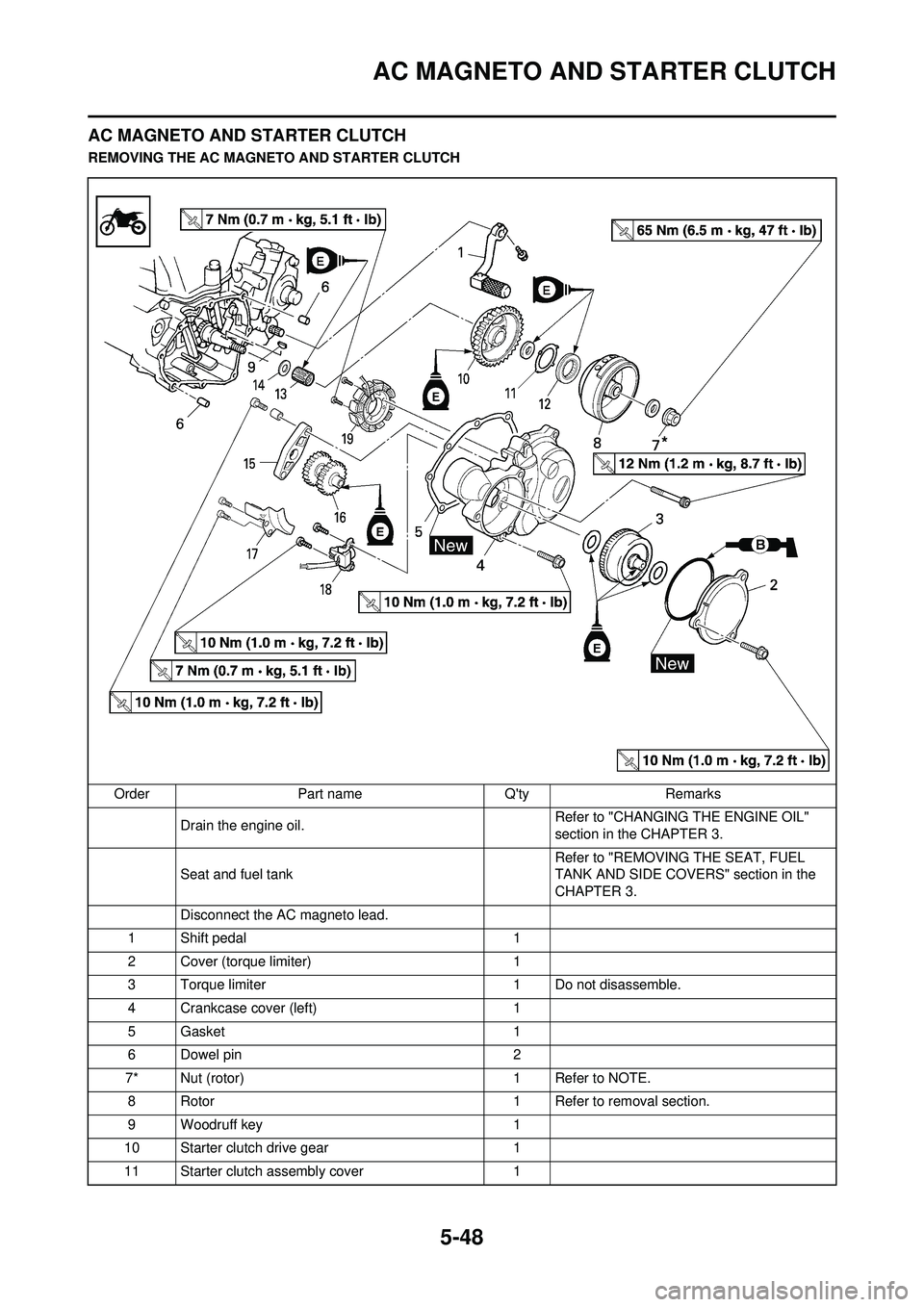
AC MAGNETO AND STARTER CLUTCH
AC MAGNETO AND STARTER CLUTCH
REMOVING THE AC MAGNETO AND STARTER CLUTCHOrder Part name Q'ty Remarks Drain the engine oil. Refer to "CHANGING THE ENGINE OIL"
section in the CHAPTER 3.
Seat and fuel tank Refer to "REMOVING THE SEAT, FUEL
TANK AND SIDE COVERS" section in the
CHAPTER 3.
Disconnect the AC magneto lead.
1 Shift pedal 1
2 Cover (torque limiter) 1
3 Torque limiter 1 Do not disassemble.
4 Crankcase cover (left) 1
5 Gasket 1
6 Dowel pin 2
7* Nut (rotor) 1 Refer to NOTE.
8 Rotor 1 Refer to removal section.
9 Woodruff key 1
10 Starter clutch drive gear 1
11 Starter clutch assembly cover 1
Page 146 of 224
5-50
AC MAGNETO AND STARTER CLUTCH
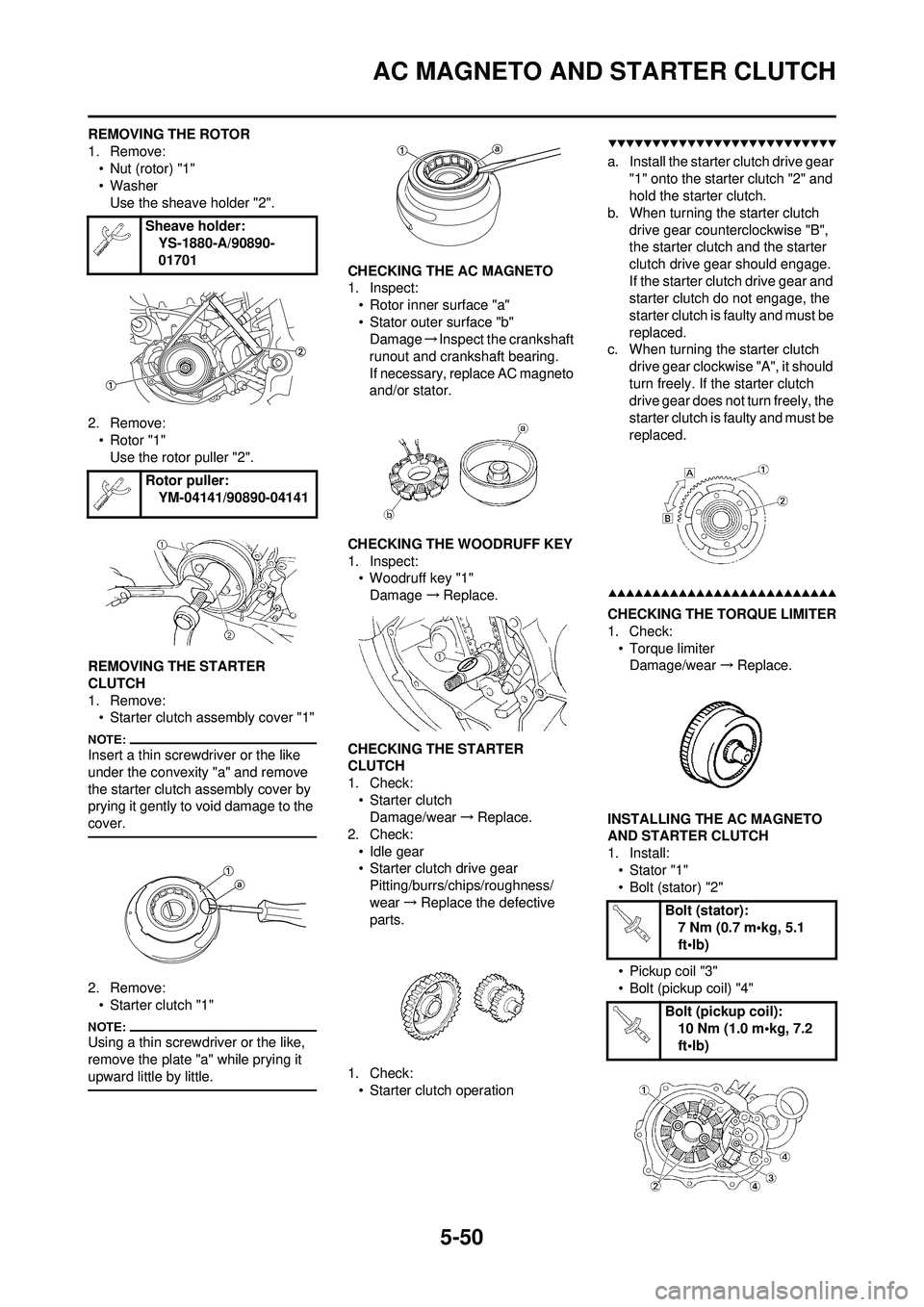
REMOVING THE ROTOR
1. Remove:• Nut (rotor) "1"
• Washer
Use the sheave holder "2".
2. Remove: • Rotor "1"Use the rotor puller "2".
REMOVING THE STARTER
CLUTCH
1. Remove: • Starter clutch a ssembly cover "1"
Insert a thin screwdriver or the like
under the convexity "a" and remove
the starter clutch assembly cover by
prying it gently to void damage to the
cover.
2. Remove:
• Starter clutch "1"
Using a thin screwdriver or the like,
remove the plate "a" while prying it
upward little by little.
CHECKING THE AC MAGNETO
1. Inspect:
• Rotor inner surface "a"
• Stator outer surface "b"Damage →Inspect the crankshaft
runout and crankshaft bearing.
If necessary, replace AC magneto
and/or stator.
CHECKING THE WOODRUFF KEY
1. Inspect: • Woodruff key "1"
Damage →Replace.
CHECKING THE STARTER
CLUTCH
1. Check: • Starter clutchDamage/wear →Replace.
2. Check:
• Idle gear
• Starter clutch drive gearPitting/burrs/chips/roughness/
wear →Replace the defective
parts.
1. Check: • Starter clutch operation
a. Install the starter clutch drive gear "1" onto the starter clutch "2" and
hold the starter clutch.
b. When turning the starter clutch drive gear counterclockwise "B",
the starter clutch and the starter
clutch drive gear should engage.
If the starter clutch drive gear and
starter clutch do not engage, the
starter clutch is faulty and must be
replaced.
c. When turning the starter clutch
drive gear clockwise "A", it should
turn freely. If the starter clutch
drive gear does not turn freely, the
starter clutch is faulty and must be
replaced.
CHECKING THE TORQUE LIMITER
1. Check:• Torque limiterDamage/wear →Replace.
INSTALLING THE AC MAGNETO
AND STARTER CLUTCH
1. Install: • Stator "1"
• Bolt (stator) "2"
• Pickup coil "3"
• Bolt (pickup coil) "4"
Sheave holder:
YS-1880-A/90890-
01701
Rotor puller: YM-04141/90890-04141
Bolt (stator):
7 Nm (0.7 m•kg, 5.1
ft•lb)
Bolt (pickup coil): 10 Nm (1.0 m•kg, 7.2
ft•lb)
Page 148 of 224
![YAMAHA WR 250F 2008 User Guide 5-52
AC MAGNETO AND STARTER CLUTCH
• Bolt [crankcase cover (left)] "3"
Tighten the bolts in stage, using a
crisscross pattern.
11. Install:• Washer "1"
• Torque limiter "2"
• Washer "3"
Apply](/img/51/52328/w960_52328-147.png "YAMAHA WR 250F 2008 User Guide 5-52
AC MAGNETO AND STARTER CLUTCH
• Bolt [crankcase cover (left)] \"3\"
Tighten the bolts in stage, using a
crisscross pattern.
11. Install:• Washer \"1\"
• Torque limiter \"2\"
• Washer \"3\"
Apply")
5-52
AC MAGNETO AND STARTER CLUTCH
• Bolt [crankcase cover (left)] "3"
Tighten the bolts in stage, using a
crisscross pattern.
11. Install:• Washer "1"
• Torque limiter "2"
• Washer "3"
Apply the engine oil to the shaft and
washers.
12. Install:• O-ring
• Cover (idle gear 1) "1"
•Bolt "2"
• Apply the lithium soap base grease on the O-ring.
• Install the cover (idle gear 1) with its
mark "a" facing upward.
13. Connect:• AC magneto leadRefer to "CABLE ROUTING DIA-
GRAM" section in the CHAPTER
2.
14. Install: • Shift pedal "1"
• Bolt (shift pedal)
When installing the shift pedal onto
the shift shaft, be sure that the center
of the shift pedal is about 1.4 mm
(0.06 in) "a" above the top of the foot-
rest.
Bolt [crankcase cover
(left)]: 12 Nm (1.2 m•kg, 8.7
ft•lb)
Bolt: 10 Nm (1.0 m•kg, 7.2
ft•lb)
E
Bolt (shift pedal):
12 Nm (1.2 m•kg, 8.7
ft•lb)
Page 182 of 224
6-21
FRONT FORK
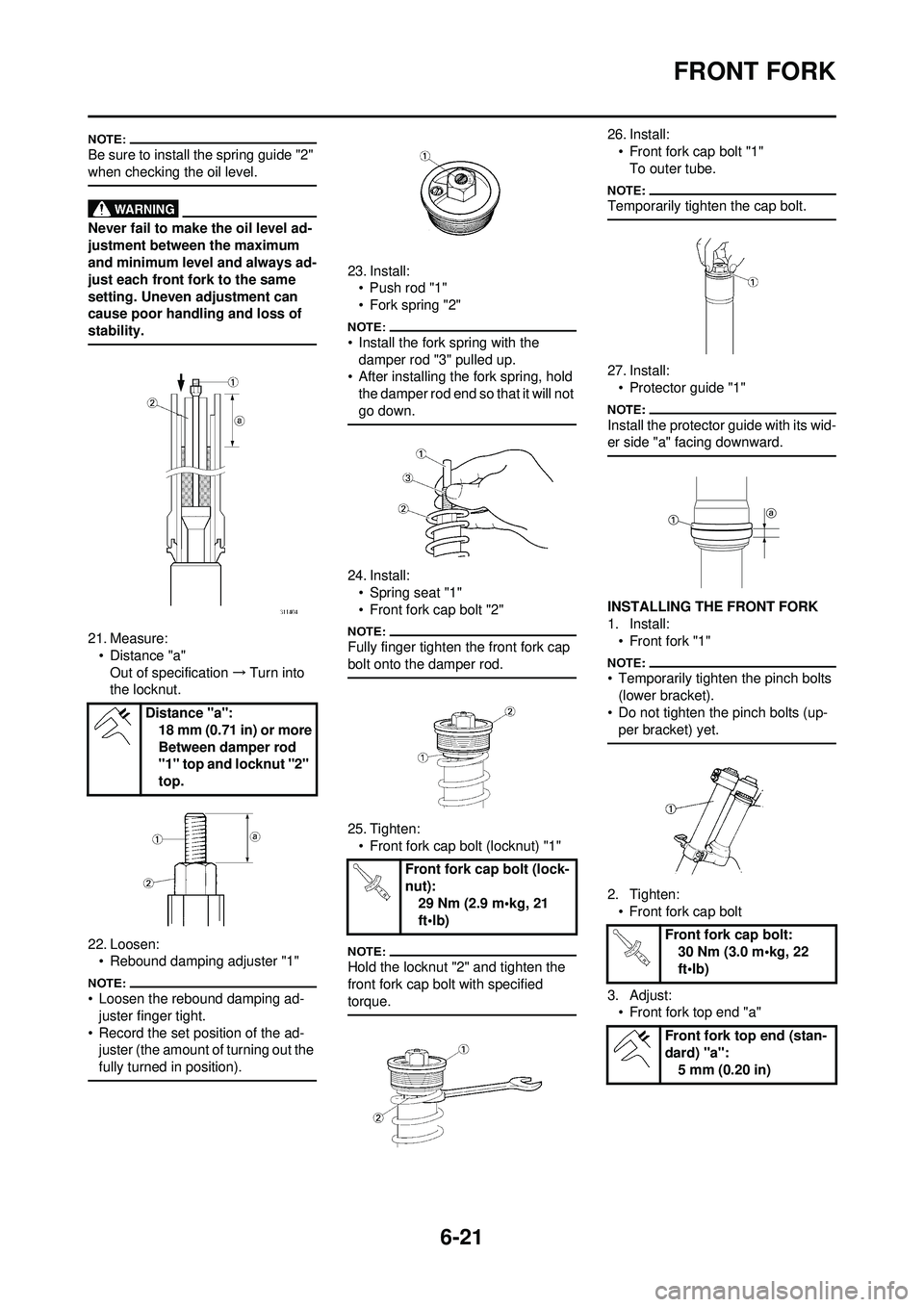
Be sure to install the spring guide "2"
when checking the oil level.
Never fail to make the oil level ad-
justment between the maximum
and minimum level and always ad-
just each front fork to the same
setting. Uneven adjustment can
cause poor handling and loss of
stability.
21. Measure: • Distance "a"
Out of specification →Turn into
the locknut.
22. Loosen: • Rebound damping adjuster "1"
• Loosen the rebound damping ad-juster finger tight.
• Record the set position of the ad- juster (the amount of turning out the
fully turned in position).
23. Install:• Push rod "1"
• Fork spring "2"
• Install the fork spring with the damper rod "3" pulled up.
• After installing the fork spring, hold
the damper rod end so that it will not
go down.
24. Install:• Spring seat "1"
• Front fork cap bolt "2"
Fully finger tighten the front fork cap
bolt onto the damper rod.
25. Tighten:• Front fork cap bolt (locknut) "1"
Hold the locknut "2" and tighten the
front fork cap bolt with specified
torque.
26. Install:
• Front fork cap bolt "1"To outer tube.
Temporarily tighten the cap bolt.
27. Install:
• Protector guide "1"
Install the protector guide with its wid-
er side "a" facing downward.
INSTALLING THE FRONT FORK
1. Install:• Front fork "1"
• Temporarily tighten the pinch bolts
(lower bracket).
• Do not tighten the pinch bolts (up- per bracket) yet.
2. Tighten:• Front fork cap bolt
3. Adjust: • Front fork top end "a"
Distance "a":
18 mm (0.71 in) or more
Between damper rod
"1" top and locknut "2"
top.
Front fork cap bolt (lock-
nut):29 Nm (2.9 m•kg, 21
ft•lb)
Front fork cap bolt: 30 Nm (3.0 m•kg, 22
ft•lb)
Front fork top end (stan-
dard) "a": 5 mm (0.20 in)
Page 183 of 224
6-22
FRONT FORK
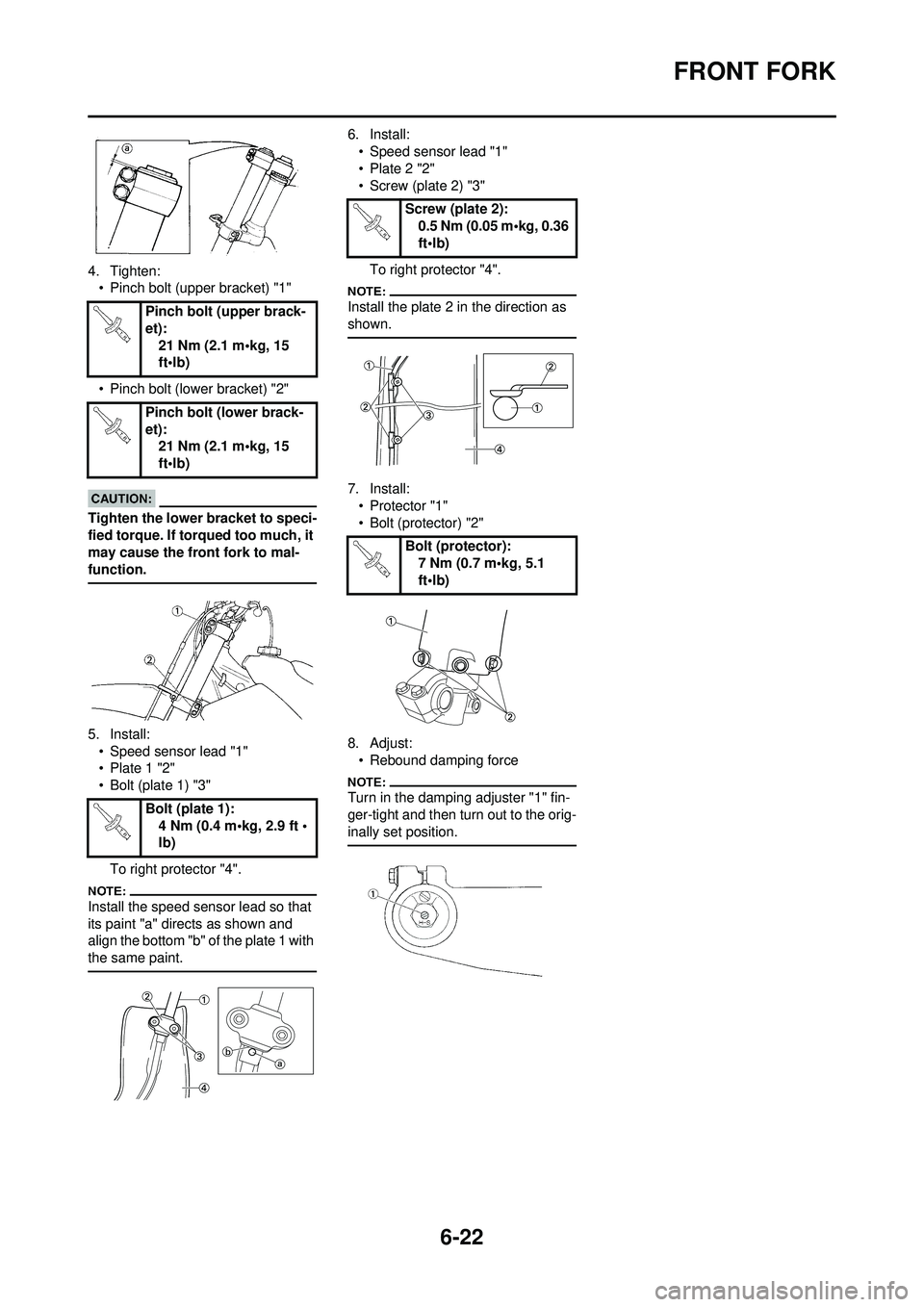
4. Tighten:• Pinch bolt (upper bracket) "1"
• Pinch bolt (lower bracket) "2"
Tighten the lower bracket to speci-
fied torque. If to rqued too much, it
may cause the fron t fork to mal-
function.
5. Install:
• Speed sensor lead "1"
• Plate 1 "2"
• Bolt (plate 1) "3"
To right protector "4".
Install the speed sensor lead so that
its paint "a" directs as shown and
align the bottom "b" of the plate 1 with
the same paint.
6. Install:• Speed sensor lead "1"
•Plate 2 "2"
• Screw (plate 2) "3"
To right protector "4".
Install the plate 2 in the direction as
shown.
7. Install:• Protector "1"
• Bolt (protector) "2"
8. Adjust: • Rebound damping force
Turn in the damping adjuster "1" fin-
ger-tight and then turn out to the orig-
inally set position.
Pinch bolt (upper brack-
et): 21 Nm (2.1 m•kg, 15
ft•lb)
Pinch bolt (lower brack-
et): 21 Nm (2.1 m•kg, 15
ft•lb)
Bolt (plate 1): 4 Nm (0.4 m•kg, 2.9 ft •
lb)
Screw (plate 2):0.5 Nm (0.05 m•kg, 0.36
ft•lb)
Bolt (protector): 7 Nm (0.7 m•kg, 5.1
ft•lb)
Page 191 of 224
6-30
STEERING
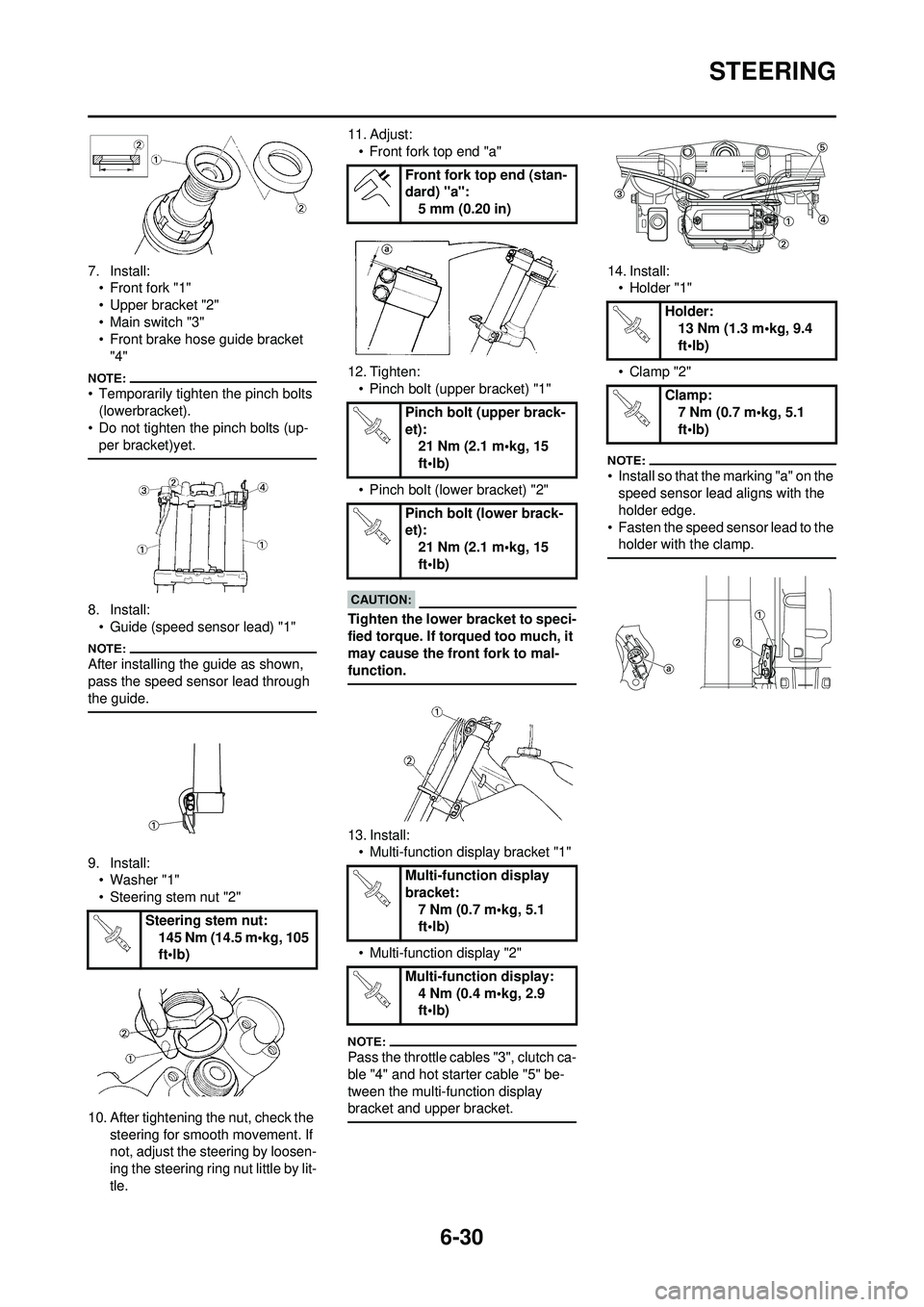
7. Install:• Front fork "1"
• Upper bracket "2"
• Main switch "3"
• Front brake hose guide bracket
"4"
• Temporarily tighten the pinch bolts (lowerbracket).
• Do not tighten the pinch bolts (up-
per bracket)yet.
8. Install:• Guide (speed sensor lead) "1"
After installing the guide as shown,
pass the speed sensor lead through
the guide.
9. Install:• Washer "1"
• Steering stem nut "2"
10. After tightening the nut, check the steering for smooth movement. If
not, adjust the steering by loosen-
ing the steering ring nut little by lit-
tle. 11. Adjust:
• Front fork top end "a"
12. Tighten: • Pinch bolt (upper bracket) "1"
• Pinch bolt (lower bracket) "2"
Tighten the lower bracket to speci-
fied torque. If to rqued too much, it
may cause the front fork to mal-
function.
13. Install: • Multi-function display bracket "1"
• Multi-function display "2"
Pass the throttle cables "3", clutch ca-
ble "4" and hot starter cable "5" be-
tween the multi-function display
bracket and upper bracket.
14. Install: • Holder "1"
• Clamp "2"
• Install so that the marking "a" on the speed sensor lead aligns with the
holder edge.
• Fasten the speed sensor lead to the holder with the clamp.
Steering stem nut:
145 Nm (14.5 m•kg, 105
ft•lb)
Front fork top end (stan-
dard) "a":5 mm (0.20 in)
Pinch bolt (upper brack-
et): 21 Nm (2.1 m•kg, 15
ft•lb)
Pinch bolt (lower brack-
et): 21 Nm (2.1 m•kg, 15
ft•lb)
Multi-function display
bracket: 7 Nm (0.7 m•kg, 5.1
ft•lb)
Multi-function display: 4 Nm (0.4 m•kg, 2.9
ft•lb)
Holder: 13 Nm (1.3 m•kg, 9.4
ft•lb)
Clamp: 7 Nm (0.7 m•kg, 5.1
ft•lb)