wheel YAMAHA WR 250F 2008 User Guide
[x] Cancel search | Manufacturer: YAMAHA, Model Year: 2008, Model line: WR 250F, Model: YAMAHA WR 250F 2008Pages: 224, PDF Size: 13.66 MB
Page 59 of 224

3-4
MAINTENANCE INTERVALS
TIRE, WHEELSInspect air pressure, wheel run-
out, tire wear and spoke loose-
ness ●●
Retighten sprocket bolt ●●
Inspect bearings ●
Replace bearings ●
Lubricate ●Lithium base grease
THROTTLE, CONTROL CABLE Check routing and connection ●●
Lubricate ●● Yamaha cable lube or SAE 10W-30
motor oil
HOT STARTER, CLUTCH LEVER Inspect free play ●
BATTERY Check terminal for looseness
and corrosion ●
Item
After
break- in Every
race
Every third
(or 500 km) Every
fifth (or
1,000 km)
As re-
quired Remarks
Page 60 of 224
3-5
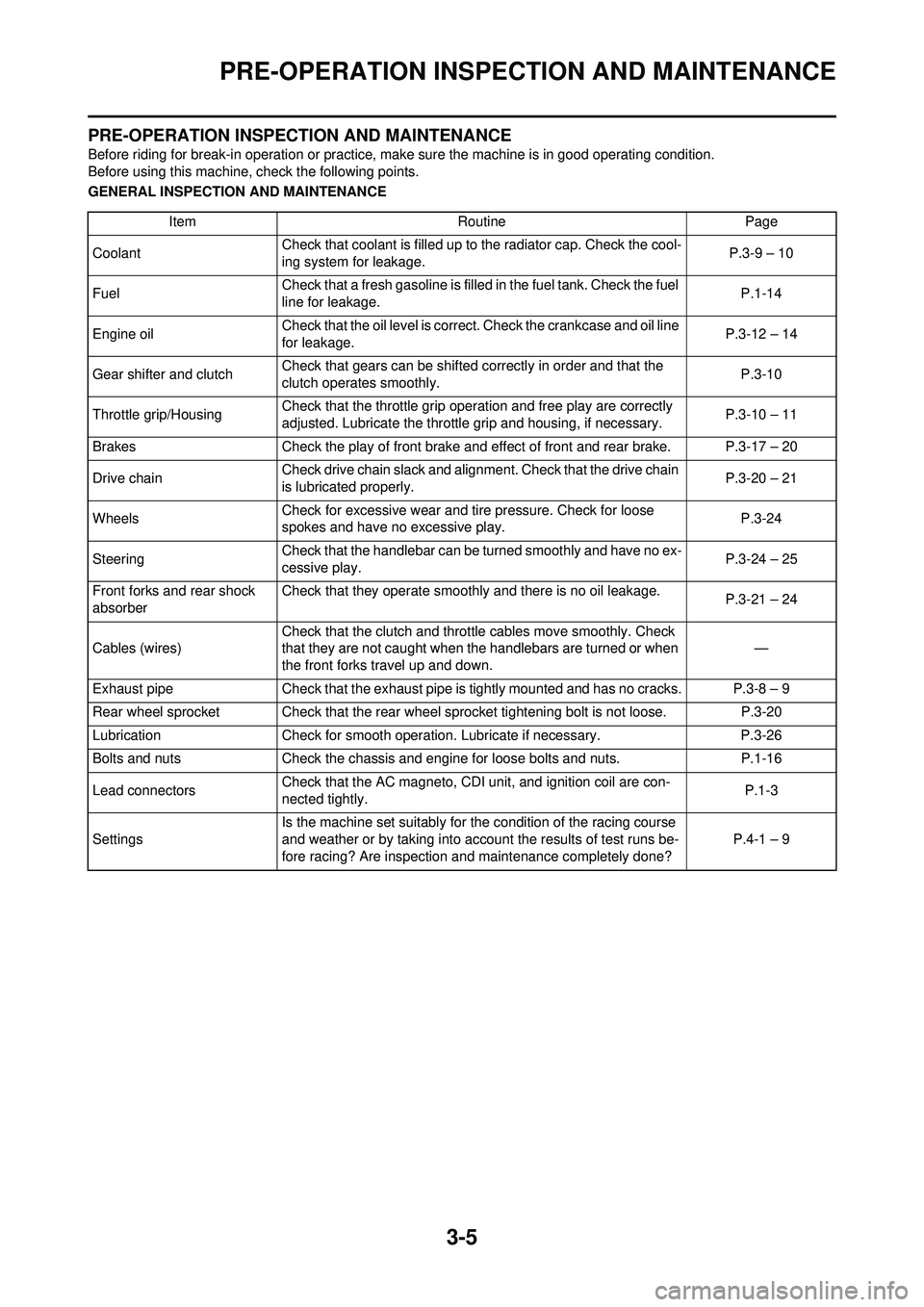
PRE-OPERATION INSPECTION AND MAINTENANCE
PRE-OPERATION INSPECTION AND MAINTENANCE
Before riding for break-in operation or practice, make sure the machine is in good operating condition.
Before using this machine, check the following points.
GENERAL INSPECTION AND MAINTENANCEItem RoutinePage
Coolant Check that coolant is filled up to the radiator cap. Check the cool-
ing system for leakage. P.3-9 – 10
Fuel Check that a fresh gasoline is filled in the fuel tank. Check the fuel
line for leakage.
P.1-14
Engine oil Check that the oil level is correct. Check the crankcase and oil line
for leakage. P.3-12 – 14
Gear shifter and clutch Check that gears can be shifted correctly in order and that the
clutch operates smoothly. P.3-10
Throttle grip/Housing Check that the throttle grip operation and free play are correctly
adjusted. Lubricate the throttle grip and housing, if necessary.
P.3-10 – 11
Brakes Check the play of front brake and ef fect of front and rear brake. P.3-17 – 20
Drive chain Check drive chain slack and alignment. Check that the drive chain
is lubricated properly. P.3-20 – 21
Wheels Check for excessive wear and ti
re pressure. Check for loose
spokes and have no excessive play. P.3-24
Steering Check that the handlebar can be turned smoothly and have no ex-
cessive play.
P.3-24 – 25
Front forks and rear shock
absorber Check that they operate smoothly and there is no oil leakage.
P.3-21 – 24
Cables (wires) Check that the clutch and throttle cables move smoothly. Check
that they are not caught when the handlebars are turned or when
the front forks travel up and down. —
Exhaust pipe Check that the exhaust pipe is tightly mount ed and has no cracks. P.3-8 – 9
Rear wheel sprocket Check that the rear wheel sprocket tightening bolt is not loose. P.3-20
Lubrication Check for smooth operation. Lubricate if necessary. P.3-26
Bolts and nuts Check the chassis and engine for loose bolts and nuts. P.1-16
Lead connectors Check that the AC magneto, CDI unit, and ignition coil are con-
nected tightly. P.1-3
Settings Is the machine set suitably for the
condition of the racing course
and weather or by taking into account the results of test runs be-
fore racing? Are inspection and maintenance completely done? P.4-1 – 9
Page 74 of 224
3-19
CHASSIS
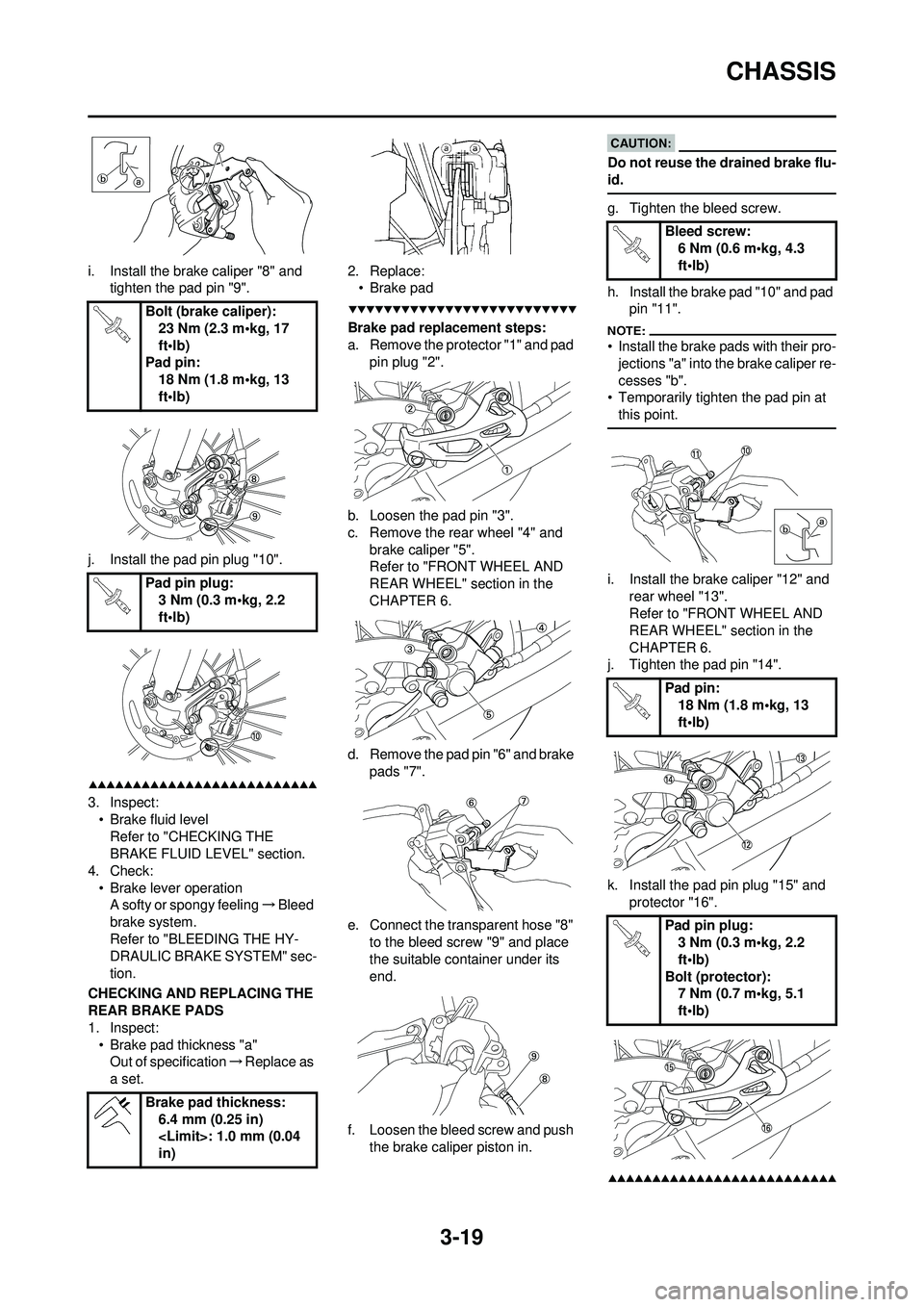
i. Install the brake caliper "8" and tighten the pad pin "9".
j. Install the pad pin plug "10".
3. Inspect: • Brake fluid levelRefer to "CHECKING THE
BRAKE FLUID LEVEL" section.
4. Check: • Brake lever operationA softy or spongy feeling →Bleed
brake system.
Refer to "BLEEDING THE HY-
DRAULIC BRAKE SYSTEM" sec-
tion.
CHECKING AND REPLACING THE
REAR BRAKE PADS
1. Inspect: • Brake pad thickness "a"Out of specification →Replace as
a set. 2. Replace:
•Brake pad
Brake pad replacement steps:
a. Remove the protector "1" and pad
pin plug "2".
b. Loosen the pad pin "3".
c. Remove the rear wheel "4" and brake caliper "5".
Refer to "FRONT WHEEL AND
REAR WHEEL" section in the
CHAPTER 6.
d. Remove the pad pin "6" and brake pads "7".
e. Connect the transparent hose "8" to the bleed screw "9" and place
the suitable container under its
end.
f. Loosen the bleed screw and push the brake caliper piston in.
Do not reuse the drained brake flu-
id.
g. Tighten the bleed screw.
h. Install the brake pad "10" and pad pin "11".
• Install the brake pads with their pro-
jections "a" into the brake caliper re-
cesses "b".
• Temporarily tighten the pad pin at
this point.
i. Install the brake caliper "12" and rear wheel "13".
Refer to "FRONT WHEEL AND
REAR WHEEL" section in the
CHAPTER 6.
j. Tighten the pad pin "14".
k. Install the pad pin plug "15" and protector "16".
Bolt (brake caliper):
23 Nm (2.3 m•kg, 17
ft•lb)
Pad pin:
18 Nm (1.8 m•kg, 13
ft•lb)
Pad pin plug: 3 Nm (0.3 m•kg, 2.2
ft•lb)
Brake pad thickness: 6.4 mm (0.25 in)
in)
Bleed screw:6 Nm (0.6 m•kg, 4.3
ft•lb)
Pad pin: 18 Nm (1.8 m•kg, 13
ft•lb)
Pad pin plug: 3 Nm (0.3 m•kg, 2.2
ft•lb)
Bolt (protector): 7 Nm (0.7 m•kg, 5.1
ft•lb)
Page 75 of 224
3-20
CHASSIS
3. Inspect:• Brake fluid levelRefer to "CHECKING THE
BRAKE FLUID LEVEL" section.
4. Check: • Brake pedal operationA softy or spongy feeling →Bleed
brake system.
Refer to "BLEEDING THE HY-
DRAULIC BRAKE SYSTEM" sec-
tion.
CHECKING THE REAR BRAKE
PAD INSULATOR
1. Remove: • Brake pad
Refer to "CHECKING AND RE-
PLACING THE REAR BRAKE
PADS" section.
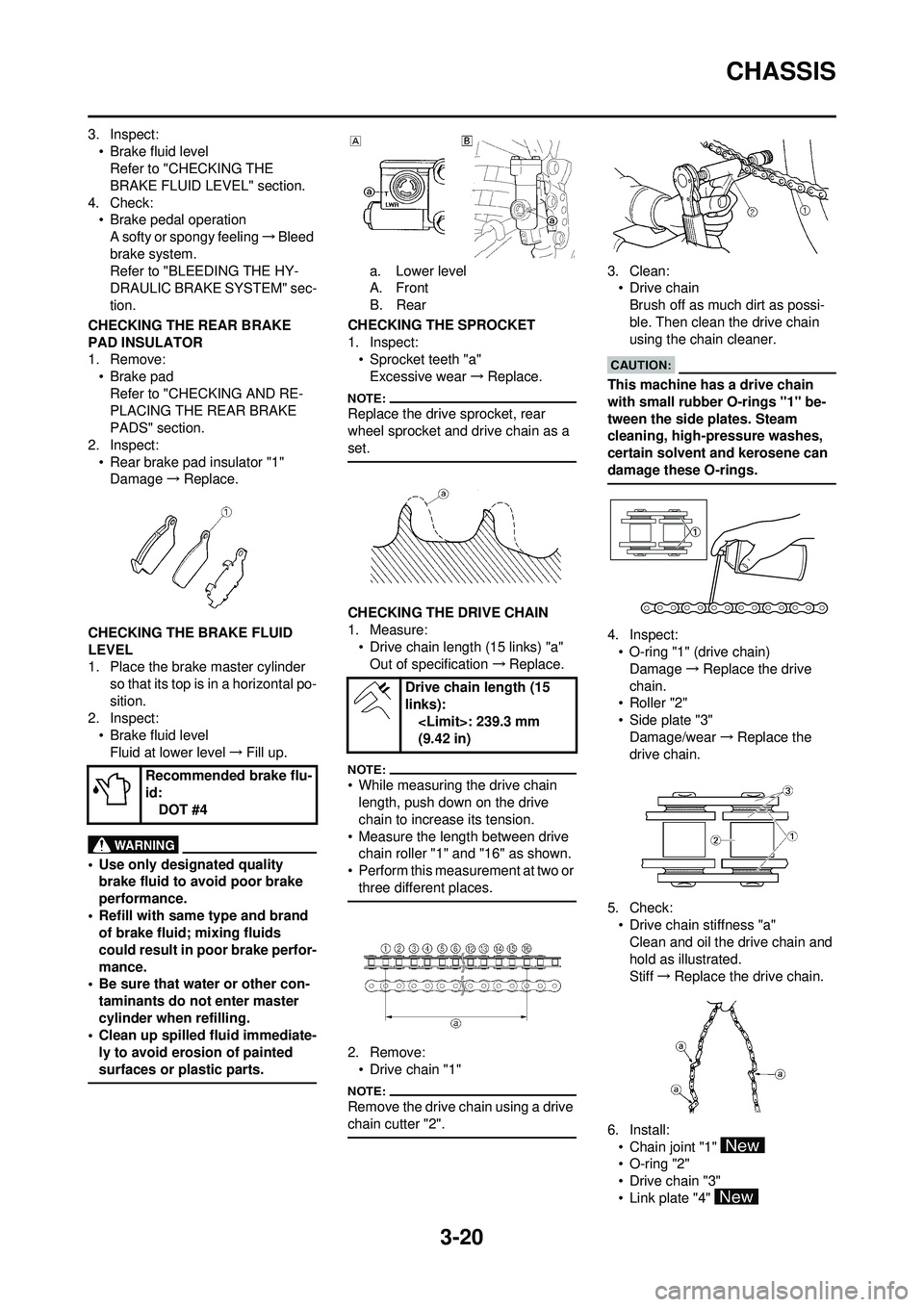
2. Inspect: • Rear brake pad insulator "1"Damage →Replace.
CHECKING THE BRAKE FLUID
LEVEL
1. Place the brake master cylinder so that its top is in a horizontal po-
sition.
2. Inspect:
• Brake fluid levelFluid at lower level →Fill up.
• Use only designated quality
brake fluid to avoid poor brake
performance.
• Refill with same type and brand of brake fluid; mixing fluids
could result in poor brake perfor-
mance.
• Be sure that water or other con- taminants do not enter master
cylinder when refilling.
• Clean up spilled fluid immediate- ly to avoid erosion of painted
surfaces or plastic parts.
a. Lower level
A. Front
B. Rear
CHECKING THE SPROCKET
1. Inspect: • Sprocket teeth "a"Excessive wear →Replace.
Replace the drive sprocket, rear
wheel sprocket and drive chain as a
set.
CHECKING THE DRIVE CHAIN
1. Measure:
• Drive chain length (15 links) "a"
Out of specification →Replace.
• While measuring the drive chain
length, push down on the drive
chain to increase its tension.
• Measure the length between drive chain roller "1" and "16" as shown.
• Perform this measurement at two or
three different places.
2. Remove:• Drive chain "1"
Remove the drive chain using a drive
chain cutter "2".
3. Clean:• Drive chain
Brush off as much dirt as possi-
ble. Then clean the drive chain
using the chain cleaner.
This machine has a drive chain
with small rubber O-rings "1" be-
tween the side plates. Steam
cleaning, high-p ressure washes,
certain solvent and kerosene can
damage these O-rings.
4. Inspect: • O-ring "1" (drive chain)Damage →Replace the drive
chain.
•Roller "2"
• Side plate "3"
Damage/wear →Replace the
drive chain.
5. Check: • Drive chain stiffness "a"Clean and oil the drive chain and
hold as illustrated.
Stiff →Replace the drive chain.
6. Install: • Chain joint "1"
• O-ring "2"
• Drive chain "3"
• Link plate "4"
Recommended brake flu-
id:
DOT #4
Drive chain length (15
links):
(9.42 in)
Page 76 of 224
3-21
CHASSIS
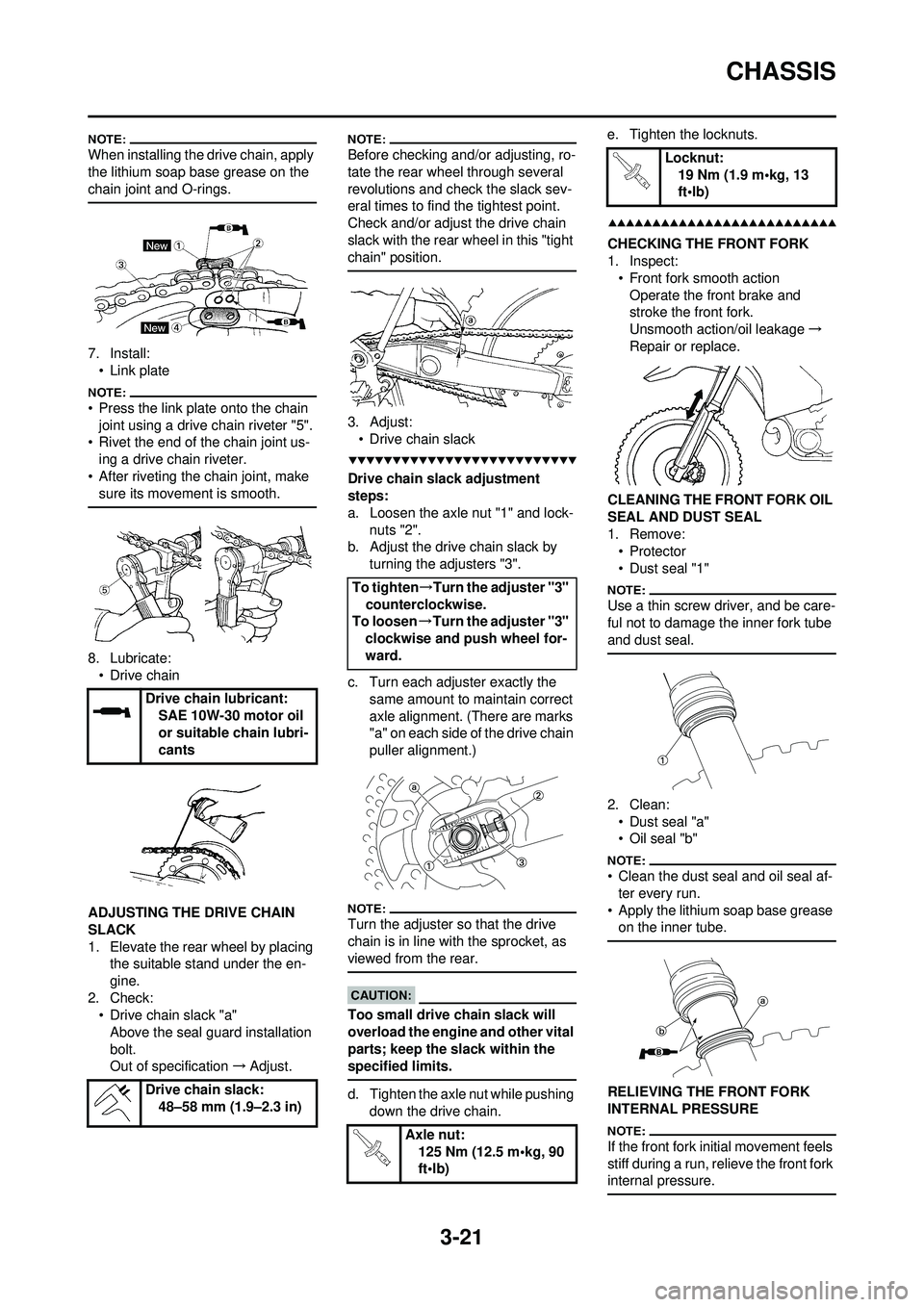
When installing the drive chain, apply
the lithium soap base grease on the
chain joint and O-rings.
7. Install:• Link plate
• Press the link plate onto the chain
joint using a drive chain riveter "5".
• Rivet the end of the chain joint us- ing a drive chain riveter.
• After riveting the chain joint, make sure its movement is smooth.
8. Lubricate:• Drive chain
ADJUSTING THE DRIVE CHAIN
SLACK
1. Elevate the rear wheel by placing the suitable stand under the en-
gine.
2. Check: • Drive chain slack "a"Above the seal guard installation
bolt.
Out of specification →Adjust.
Before checking and/or adjusting, ro-
tate the rear wheel through several
revolutions and check the slack sev-
eral times to find the tightest point.
Check and/or adjust the drive chain
slack with the rear wheel in this "tight
chain" position.
3. Adjust:
• Drive chain slack
Drive chain slack adjustment
steps:
a. Loosen the axle nut "1" and lock- nuts "2".
b. Adjust the drive chain slack by turning the adjusters "3".
c. Turn each adjuster exactly the same amount to maintain correct
axle alignment. (There are marks
"a" on each side of the drive chain
puller alignment.)
Turn the adjuster so that the drive
chain is in line with the sprocket, as
viewed from the rear.
Too small drive chain slack will
overload the engine and other vital
parts; keep the slack within the
specified limits.
d. Tighten the axle nut while pushing down the drive chain. e. Tighten the locknuts.
CHECKING THE FRONT FORK
1. Inspect:
• Front fork smooth actionOperate the front brake and
stroke the front fork.
Unsmooth action/oil leakage →
Repair or replace.
CLEANING THE FRONT FORK OIL
SEAL AND DUST SEAL
1. Remove: •Protector
• Dust seal "1"
Use a thin screw driver, and be care-
ful not to damage the inner fork tube
and dust seal.
2. Clean:• Dust seal "a"
• Oil seal "b"
• Clean the dust seal and oil seal af-
ter every run.
• Apply the lithium soap base grease on the inner tube.
RELIEVING THE FRONT FORK
INTERNAL PRESSURE
If the front fork initial movement feels
stiff during a run, relieve the front fork
internal pressure.
Drive chain lubricant: SAE 10W-30 motor oil
or suitable chain lubri-
cants
Drive chain slack: 48–58 mm (1.9–2.3 in)
To tighten →Turn the adjuster "3"
counterclockwise.
To loosen →Turn the adjuster "3"
clockwise and push wheel for-
ward.
Axle nut:125 Nm (12.5 m•kg, 90
ft•lb)
Locknut: 19 Nm (1.9 m•kg, 13
ft•lb)
Page 77 of 224
3-22
CHASSIS
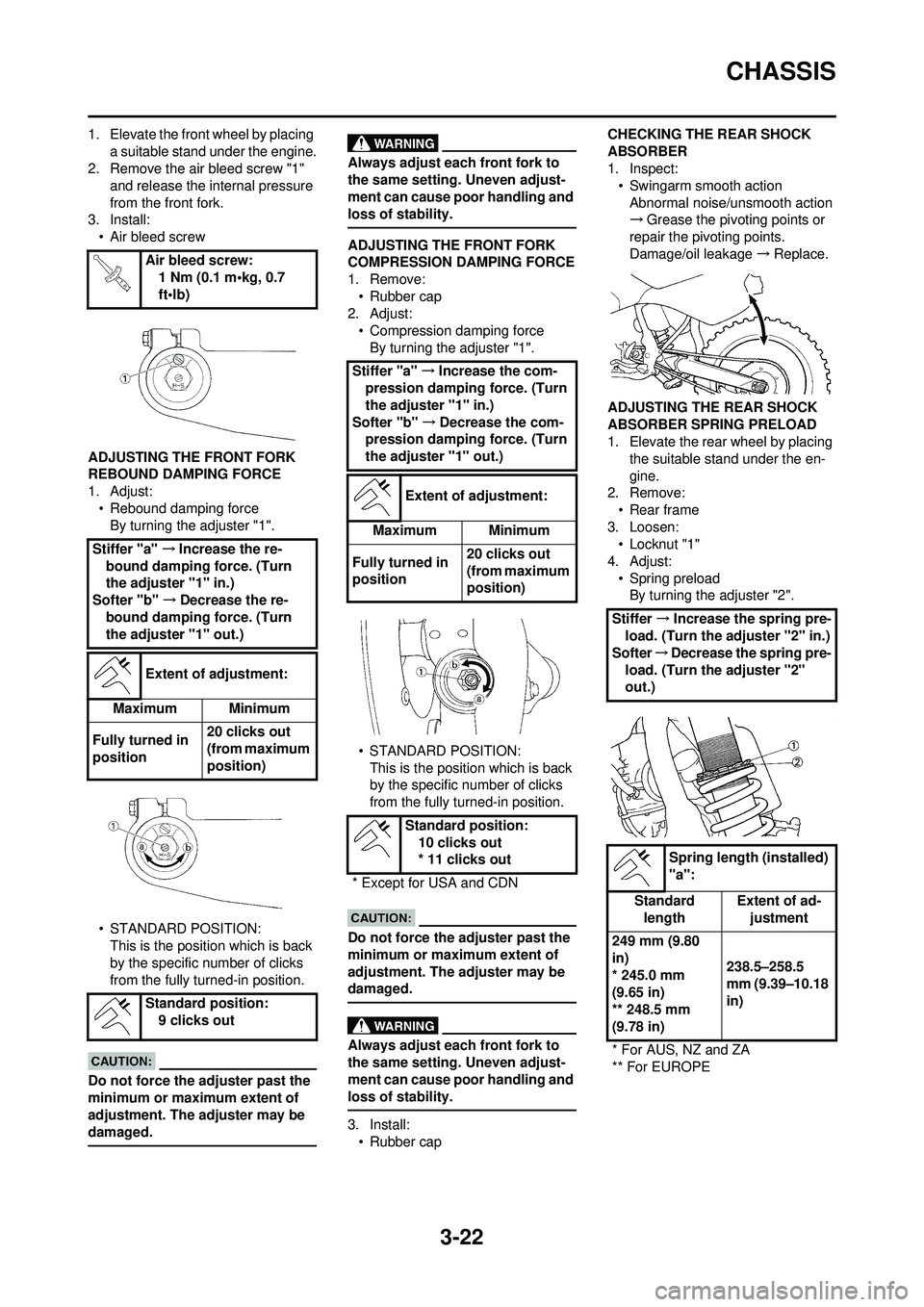
1. Elevate the front wheel by placing a suitable stand under the engine.
2. Remove the air bleed screw "1" and release the internal pressure
from the front fork.
3. Install: • Air bleed screw
ADJUSTING THE FRONT FORK
REBOUND DAMPING FORCE
1. Adjust: • Rebound damping forceBy turning the adjuster "1".
• STANDARD POSITION: This is the position which is back
by the specific number of clicks
from the fully turned-in position.
Do not force the adjuster past the
minimum or maximum extent of
adjustment. The adjuster may be
damaged.
Always adjust each front fork to
the same setting. Uneven adjust-
ment can cause poor handling and
loss of stability.
ADJUSTING THE FRONT FORK
COMPRESSION DAMPING FORCE
1. Remove:• Rubber cap
2. Adjust:
• Compression damping forceBy turning the adjuster "1".
• STANDARD POSITION: This is the position which is back
by the specific number of clicks
from the fully turned-in position.
Do not force the adjuster past the
minimum or maximum extent of
adjustment. The adjuster may be
damaged.
Always adjust each front fork to
the same setting. Uneven adjust-
ment can cause poor handling and
loss of stability.
3. Install:• Rubber cap CHECKING THE REAR SHOCK
ABSORBER
1. Inspect:
• Swingarm smooth action
Abnormal noise/unsmooth action
→ Grease the pivoting points or
repair the pivoting points.
Damage/oil leakage →Replace.
ADJUSTING THE REAR SHOCK
ABSORBER SPRING PRELOAD
1. Elevate the rear wheel by placing the suitable stand under the en-
gine.
2. Remove:
• Rear frame
3. Loosen: • Locknut "1"
4. Adjust: • Spring preloadBy turning the adjuster "2".
Air bleed screw:
1 Nm (0.1 m•kg, 0.7
ft•lb)
Stiffer "a" →Increase the re-
bound damping force. (Turn
the adjuster "1" in.)
Softer "b" →Decrease the re-
bound damping force. (Turn
the adjuster "1" out.)
Extent of adjustment:
Maximum Minimum
Fully turned in
position 20 clicks out
(from maximum
position)
Standard position: 9 clicks out
Stiffer "a" →Increase the com-
pression damping force. (Turn
the adjuster "1" in.)
Softer "b" →Decrease the com-
pression damping force. (Turn
the adjuster "1" out.)
Extent of adjustment:
Maximum Minimum
Fully turned in
position 20 clicks out
(from maximum
position)
Standard position: 10 clicks out
* 11 clicks out
* Except for USA and CDN
Stiffer →Increase the spring pre-
load. (Turn the adjuster "2" in.)
Softer →Decrease the spring pre-
load. (Turn the adjuster "2"
out.)
Spring length (installed)
"a":
Standard length Extent of ad-
justment
249 mm (9.80
in)
* 245.0 mm
(9.65 in)
** 248.5 mm
(9.78 in) 238.5–258.5
mm (9.39–10.18
in)
* For AUS, NZ and ZA
** For EUROPE
Page 79 of 224
3-24
CHASSIS
Do not force the adjuster past the
minimum or maximum extent of
adjustment. The adjuster may be
damaged.
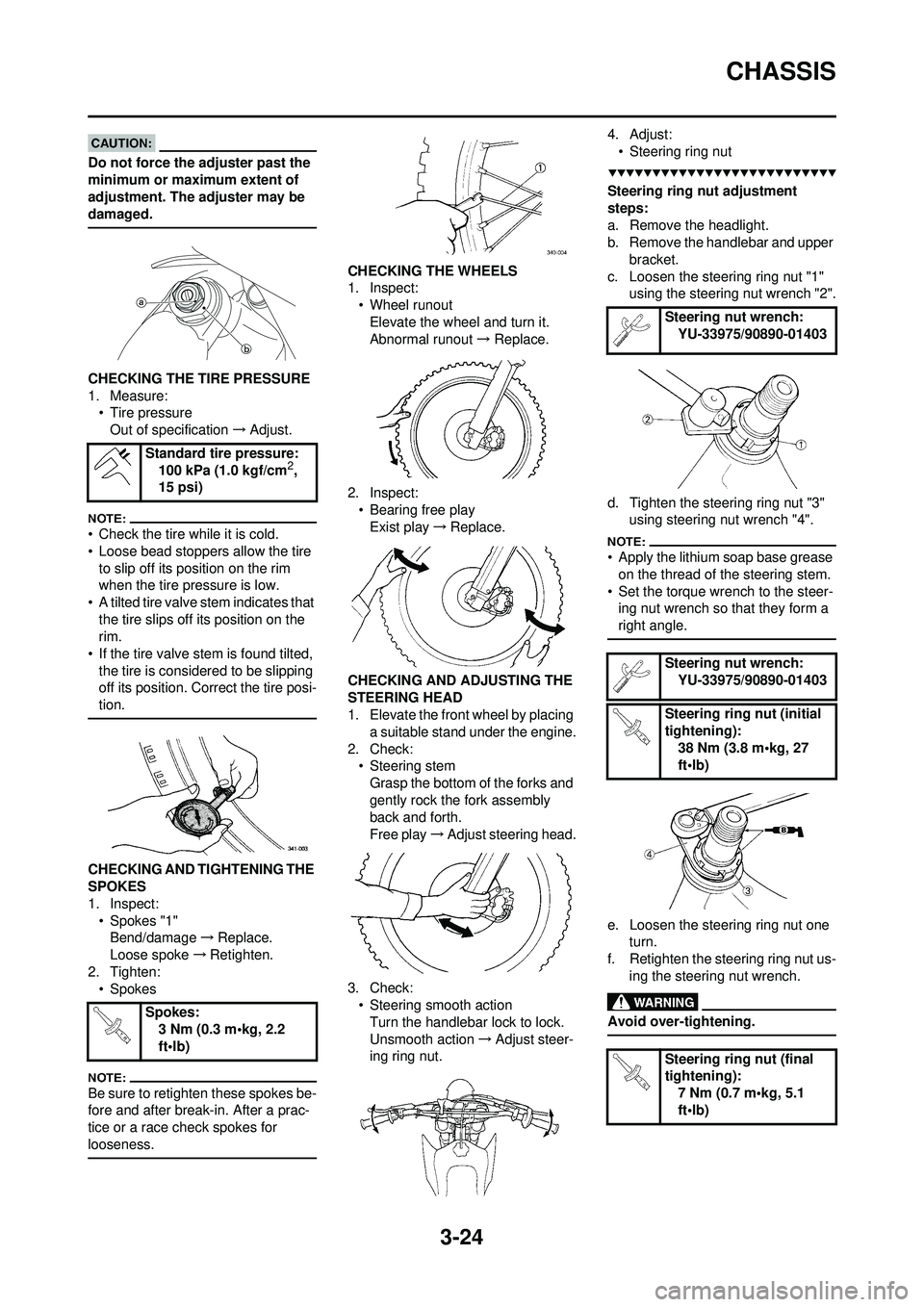
CHECKING THE TIRE PRESSURE
1. Measure:• Tire pressure
Out of specification →Adjust.
• Check the tire while it is cold.
• Loose bead stoppers allow the tire
to slip off its position on the rim
when the tire pressure is low.
• A tilted tire valve stem indicates that
the tire slips off its position on the
rim.
• If the tire valve st em is found tilted,
the tire is considered to be slipping
off its position. Correct the tire posi-
tion.
CHECKING AND TIGHTENING THE
SPOKES
1. Inspect: • Spokes "1"Bend/damage →Replace.
Loose spoke →Retighten.
2. Tighten: • Spokes
Be sure to retighten these spokes be-
fore and after break-in. After a prac-
tice or a race check spokes for
looseness.
CHECKING THE WHEELS
1. Inspect:
• Wheel runoutElevate the wheel and turn it.
Abnormal runout → Replace.
2. Inspect: • Bearing free playExist play →Replace.
CHECKING AND ADJUSTING THE
STEERING HEAD
1. Elevate the front wheel by placing a suitable stand under the engine.
2. Check: • Steering stemGrasp the bottom of the forks and
gently rock the fork assembly
back and forth.
Free play →Adjust steering head.
3. Check: • Steering smooth actionTurn the handlebar lock to lock.
Unsmooth action →Adjust steer-
ing ring nut. 4. Adjust:
• Steering ring nut
Steering ring nut adjustment
steps:
a. Remove the headlight.
b. Remove the handlebar and upper bracket.
c. Loosen the steering ring nut "1" using the steering nut wrench "2".
d. Tighten the steering ring nut "3" using steering nut wrench "4".
• Apply the lithium soap base grease
on the thread of the steering stem.
• Set the torque wrench to the steer- ing nut wrench so that they form a
right angle.
e. Loosen the steering ring nut one turn.
f. Retighten the steering ring nut us- ing the steering nut wrench.
Avoid over-tightening.
Standard tire pressure:100 kPa (1.0 kgf/cm2,
15 psi)
Spokes: 3 Nm (0.3 m•kg, 2.2
ft•lb)
Steering nut wrench:YU-33975/90890-01403
Steering nut wrench: YU-33975/90890-01403
Steering ring nut (initial
tightening): 38 Nm (3.8 m•kg, 27
ft•lb)
Steering ring nut (final
tightening): 7 Nm (0.7 m•kg, 5.1
ft•lb)
Page 92 of 224

4-5
CHASSIS
CHASSIS
SELECTION OF THE SECONDARY
REDUCTION RATIO (SPROCKET)
• It is generally said that the second-ary gear ratio should be reduced for
a longer straight portion of a speed
course and should be increased for
a course with many corners. Actual-
ly, however, as the speed depends
on the ground condition of the day
of the race, be sure to run through
the circuit to set the machine suit-
able for the entire course.
• In actuality, it is very difficult to
achieve settings suitable for the en-
tire course and some settings may
be sacrificed. Thus, the settings
should be matched to the portion of
the course that has the greatest ef-
fect on the race result. In such a
case, run through the entire course
while making notes of lap times to
find the best balance; then, deter-
mine the secondary reduction ratio.
• If a course has a long straight por-
tion where a machine can run at
maximum speed, the machine is
generally set such that it can devel-
op its maximum revolutions toward
the end of the straight line, with care
taken to avoid the engine over-rev-
ving.
Riding technique varies from rider to
rider and the performance of a ma-
chine also vary fr om machine to ma-
chine. Therefore, do not imitate other
rider's settings from the beginning but
choose your own setting according to
the level of your riding technique.
DRIVE AND REAR WHEEL
SPROCKETS SETTING PARTS
TIRE PRESSURE
Tire pressure should be adjust to suit
the road surface condition of the cir-
cuit.
• Under a rainy, muddy, sandy, or slippery condition, the tire pressure
should be lower for a larger area of
contact with the road surface. • Under a stony or hard road condi-
tion, the tire pressure should be
higher to prevent a flat tire.
FRONT FORK SETTING
The front fork setting should be made
depending on the rider's feeling of an
actual run and the circuit conditions.
The front fork setting includes the fol-
lowing three factors:
1. Setting of air spring characteris- tics
• Change the fork oil level.
2. Setting of spring preload • Change the spring.
• Install the adjustment washer.
3. Setting of damping force • Change the compression damp-
ing.
• Change the rebound damping. The spring acts on the load and
the damping force acts on the
cushion travel speed.
CHANGE IN LEVEL AND
CHARACTERISTICS OF FORK OIL
Damping characteristic near the final
stroke can be changed by changing
the fork oil amount.
Adjust the oil level in 5 mm (0.2 in)
increments or decrements. Too
low oil level caus es the front fork
to produce a noise at full rebound
or the rider to feel some pressure
on his hands or body. Alternative-
ly, too high oil level will develop
unexpectedly early oil lock with
the consequent shorter front fork
travel and deteriorated perfor-
mance and characteristics. There-
fore, adjust the front fork within
the specified range.
Secondary reduction ratio =
Number of rear wheel sprocket
teeth/Number of drive sprocket
teeth
Standard secondary
reduction ratio 50/13
(3.846)
* 47/14
(3.357)
* For EUROPE
Part
name Size Part number
Drive
sprocket
"1" (STD) 13T 9383B-13218
** (STD) * 14T 9383B-14222
Rear
wheel
sprocket
"2" ** (STD) ** 47T 1C3-25447-00 48T 5GS-25448-50
* 48T 1C3-25448-00
* 49T 1C3-25449-00
(STD) 50T 5TJ-25450-80
* (STD) * 50T 1C3-25450-00 * 51T 1C3-25451-0052T 5TJ-25452-80
* 52T 1C3-25452-00
* For AUS and NZ
** For EUROPE
Standard tire pressure:100 kPa (1.0 kgf/cm
2,
15 psi)
Extent of adjustment: 60–80 kPa (0.6–0.8 kgf/
cm
2, 9.0–12 psi)
Extent of adjustment: 100–120 kPa (1.0–1.2
kgf/cm
2, 15–18 psi)
Standard oil level: 132 mm (5.20 in)
Extent of adjustment: 95–150 mm (3.74–5.91
in)
From top of outer tube
with inner tube and
damper rod fully com-
pressed without
spring.
Page 94 of 224
4-7
CHASSIS
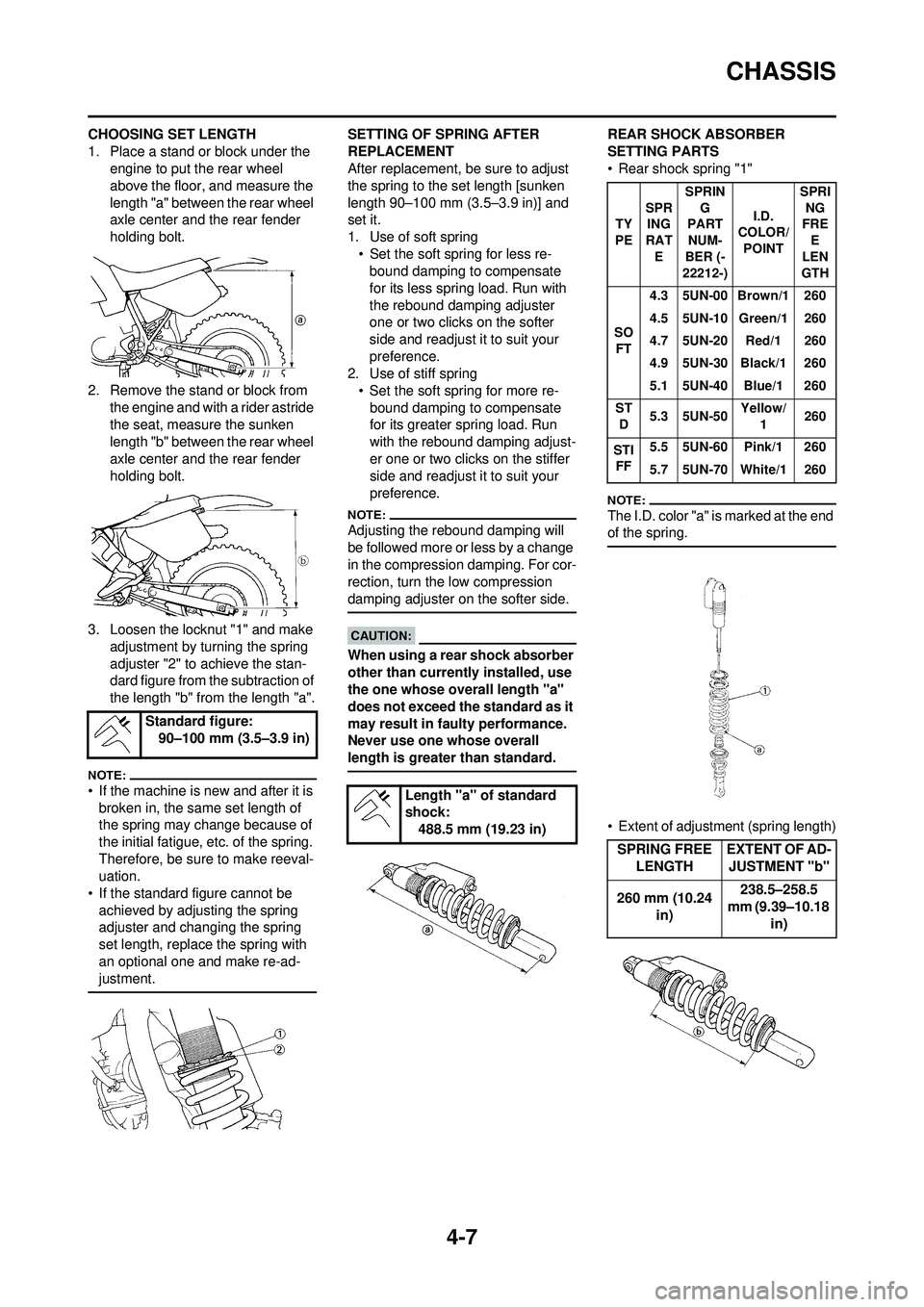
CHOOSING SET LENGTH
1. Place a stand or block under the engine to put the rear wheel
above the floor, and measure the
length "a" between the rear wheel
axle center and the rear fender
holding bolt.
2. Remove the stand or block from the engine and with a rider astride
the seat, measure the sunken
length "b" between the rear wheel
axle center and the rear fender
holding bolt.
3. Loosen the locknut "1" and make adjustment by turning the spring
adjuster "2" to achieve the stan-
dard figure from the subtraction of
the length "b" from the length "a".
• If the machine is new and after it is broken in, the same set length of
the spring may change because of
the initial fatigue, etc. of the spring.
Therefore, be sure to make reeval-
uation.
• If the standard figure cannot be
achieved by adjusting the spring
adjuster and changing the spring
set length, replace the spring with
an optional one and make re-ad-
justment.
SETTING OF SPRING AFTER
REPLACEMENT
After replacement, be sure to adjust
the spring to the set length [sunken
length 90–100 mm (3.5–3.9 in)] and
set it.
1. Use of soft spring• Set the soft sp ring for less re-
bound damping to compensate
for its less spring load. Run with
the rebound damping adjuster
one or two clicks on the softer
side and readjust it to suit your
preference.
2. Use of stiff spring • Set the soft spri ng for more re-
bound damping to compensate
for its greater spring load. Run
with the rebound damping adjust-
er one or two clicks on the stiffer
side and readjust it to suit your
preference.
Adjusting the rebound damping will
be followed more or less by a change
in the compression damping. For cor-
rection, turn th e low compression
damping adjuster on the softer side.
When using a rear shock absorber
other than currently installed, use
the one whose overall length "a"
does not exceed the standard as it
may result in faul ty performance.
Never use one whose overall
length is greater than standard.
REAR SHOCK ABSORBER
SETTING PARTS
• Rear shock spring "1"
The I.D. color "a" is marked at the end
of the spring.
• Extent of adjustment (spring length)
Standard figure:
90–100 mm (3.5–3.9 in)
Length "a" of standard
shock:
488.5 mm (19.23 in)
TY
PE SPR
ING
RAT E SPRIN
G
PART NUM-
BER (-
22212-) I.D.
COLOR/ POINT SPRI
NG
FRE E
LEN
GTH
SO FT 4.3 5UN-00 Brown/1 260
4.5 5UN-10 Green/1 260
4.7 5UN-20 Red/1 260
4.9 5UN-30 Black/1 260
5.1 5UN-40 Blue/1 260
ST D 5.3 5UN-50 Yellow/
1 260
STI FF 5.5 5UN-60 Pink/1 260
5.7 5UN-70 White/1 260
SPRING FREE
LENGTH EXTENT OF AD-
JUSTMENT "b"
260 mm (10.24 in) 238.5–258.5
mm (9.39–10.18 in)
Page 139 of 224
5-43
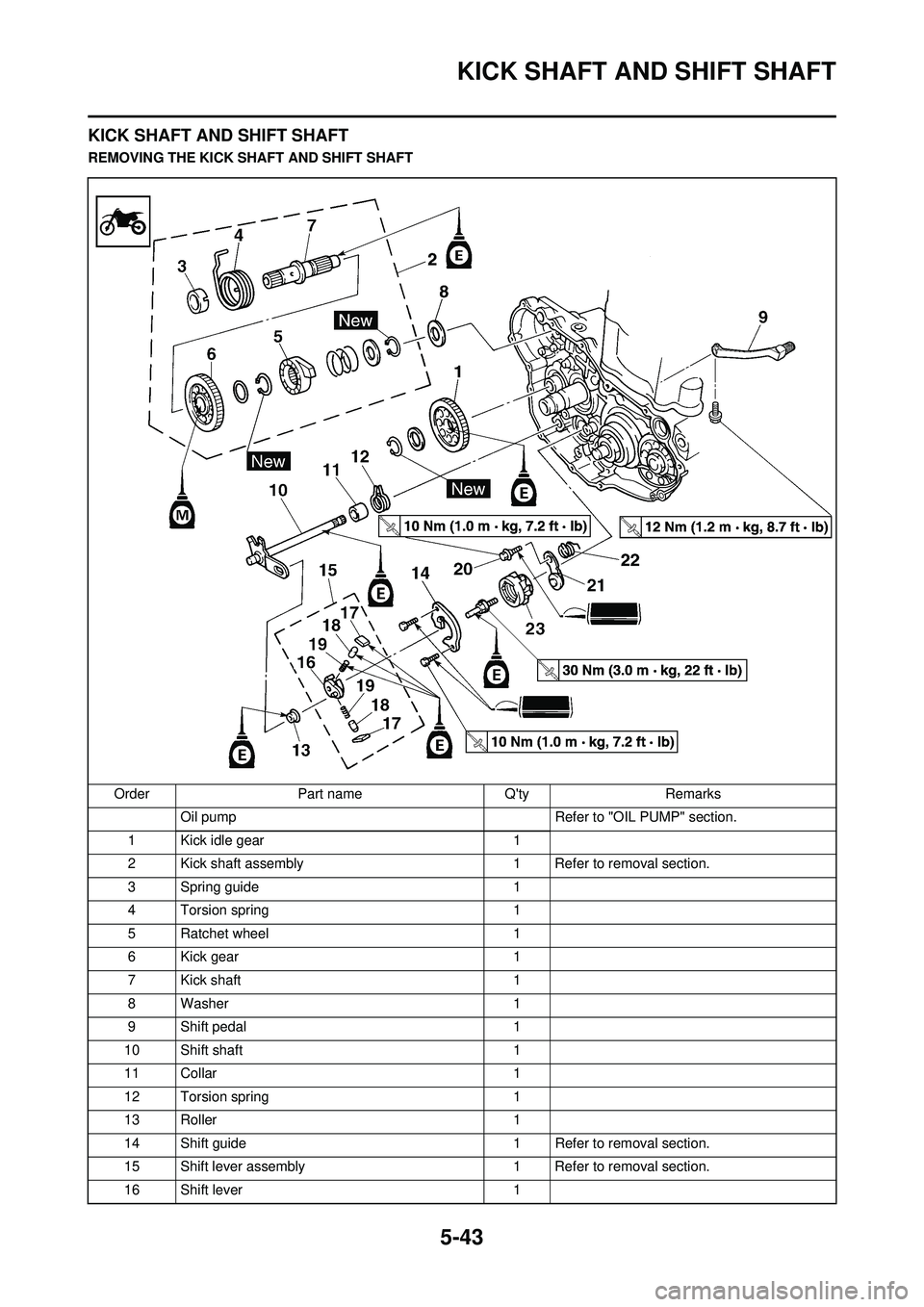
KICK SHAFT AND SHIFT SHAFT
KICK SHAFT AND SHIFT SHAFT
REMOVING THE KICK SHAFT AND SHIFT SHAFTOrder Part name Q'ty Remarks Oil pump Refer to "OIL PUMP" section.
1 Kick idle gear 1
2 Kick shaft assembly 1 Refer to removal section.
3 Spring guide 1
4 Torsion spring 1
5 Ratchet wheel 1
6 Kick gear 1
7 Kick shaft 1
8 Washer 1
9 Shift pedal 1
10 Shift shaft 1
11 Collar 1
12 Torsion spring 1
13 Roller 1
14 Shift guide 1 Refer to removal section.
15 Shift lever assembly 1 Refer to removal section.
16 Shift lever 1