engine YAMAHA WR 250F 2008 Owner's Manual
[x] Cancel search | Manufacturer: YAMAHA, Model Year: 2008, Model line: WR 250F, Model: YAMAHA WR 250F 2008Pages: 224, PDF Size: 13.66 MB
Page 44 of 224
2-17
TIGHTENING TORQUES
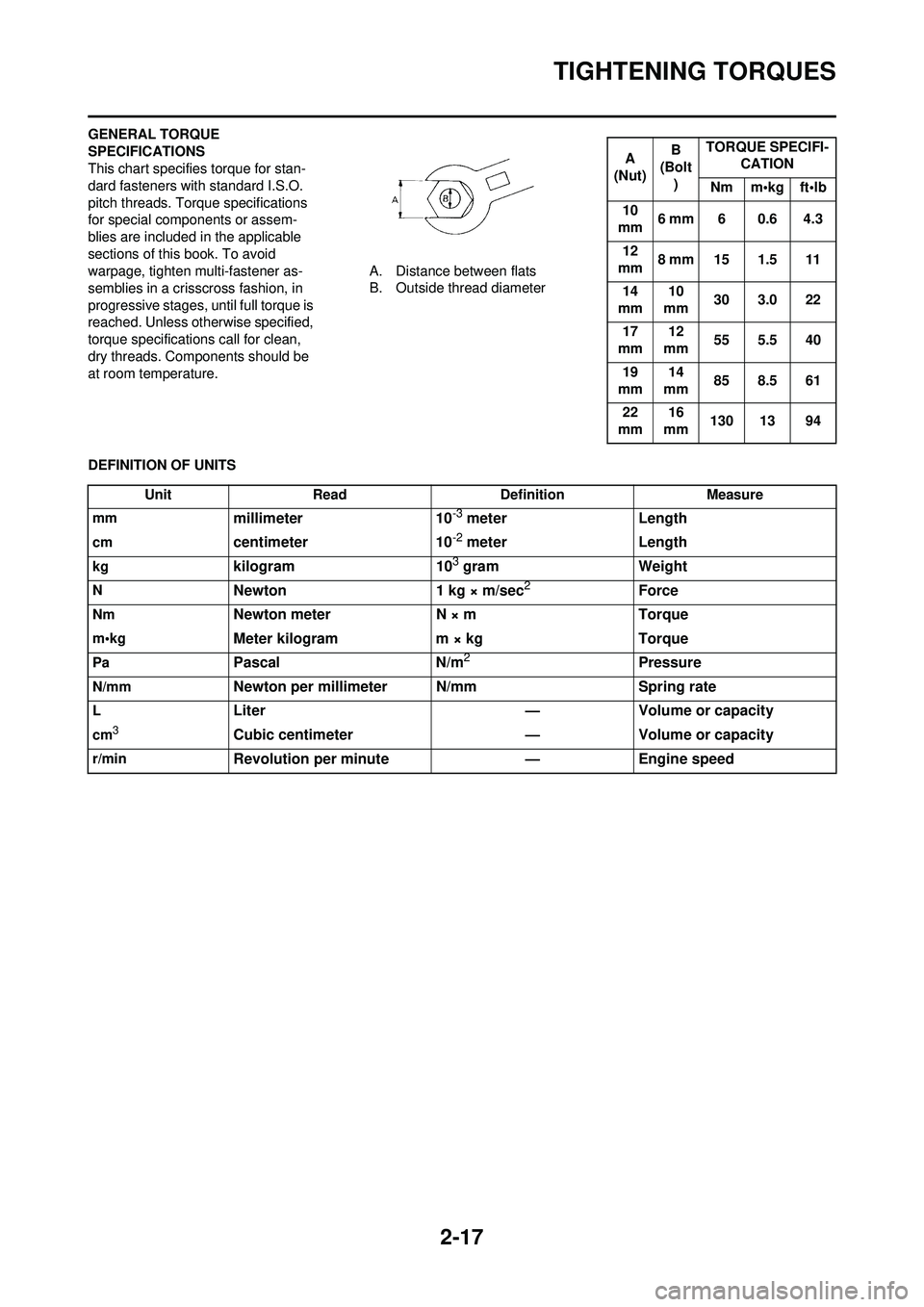
GENERAL TORQUE
SPECIFICATIONS
This chart specifies torque for stan-
dard fasteners with standard I.S.O.
pitch threads. Torque specifications
for special components or assem-
blies are included in the applicable
sections of this book. To avoid
warpage, tighten multi-fastener as-
semblies in a crisscross fashion, in
progressive stages, until full torque is
reached. Unless otherwise specified,
torque specifications call for clean,
dry threads. Components should be
at room temperature. A. Distance between flats
B. Outside thread diameter
DEFINITION OF UNITS
A
(Nut) B
(Bolt
) TORQUE SPECIFI-
CATION
Nm m•kg ft•lb
10
mm 6 mm 6 0.6 4.3
12
mm 8 mm 15 1.5 11
14
mm 10
mm 30 3.0 22
17
mm 12
mm 55 5.5 40
19
mm 14
mm 85 8.5 61
22
mm 16
mm 130 13 94
Unit
Read Definition Measure
mm
millimeter 10-3 meterLength
cmcentimeter 10-2 meterLength
kgkilogram 103 gramWeight
NNewton 1 kg × m/sec2Force
NmNewton meter N × mTorque
m•kgMeter kilogram m × kg Torque
PaPascalN/m2Pressure
N/mmNewton per millimeter N/mm Spring rate
LLiter—Volume or capacity
cm3Cubic centimeter —Volume or capacity
r/minRevolution per minute —Engine speed
Page 52 of 224
2-25
CABLE ROUTING DIAGRAM
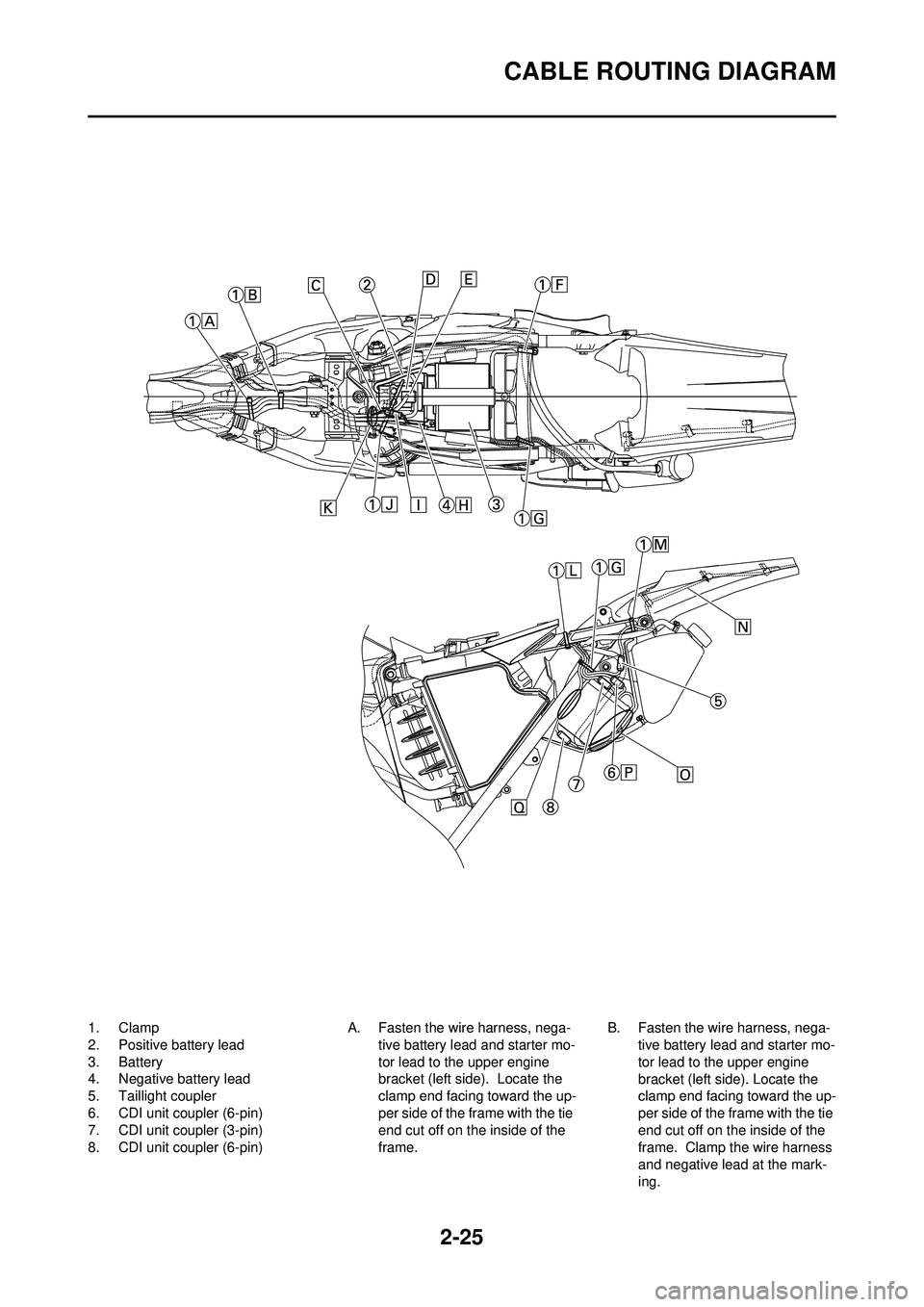
1. Clamp
2. Positive battery lead
3. Battery
4. Negative battery lead
5. Taillight coupler
6. CDI unit coupler (6-pin)
7. CDI unit coupler (3-pin)
8. CDI unit coupler (6-pin)A. Fasten the wire harness, nega-
tive battery lead and starter mo-
tor lead to the upper engine
bracket (left side). Locate the
clamp end facing toward the up-
per side of the frame with the tie
end cut off on the inside of the
frame. B. Fasten the wire harness, nega-
tive battery lead and starter mo-
tor lead to the upper engine
bracket (left side). Locate the
clamp end facing toward the up-
per side of the frame with the tie
end cut off on the inside of the
frame. Clamp the wire harness
and negative lead at the mark-
ing.
Page 54 of 224
2-27
CABLE ROUTING DIAGRAM
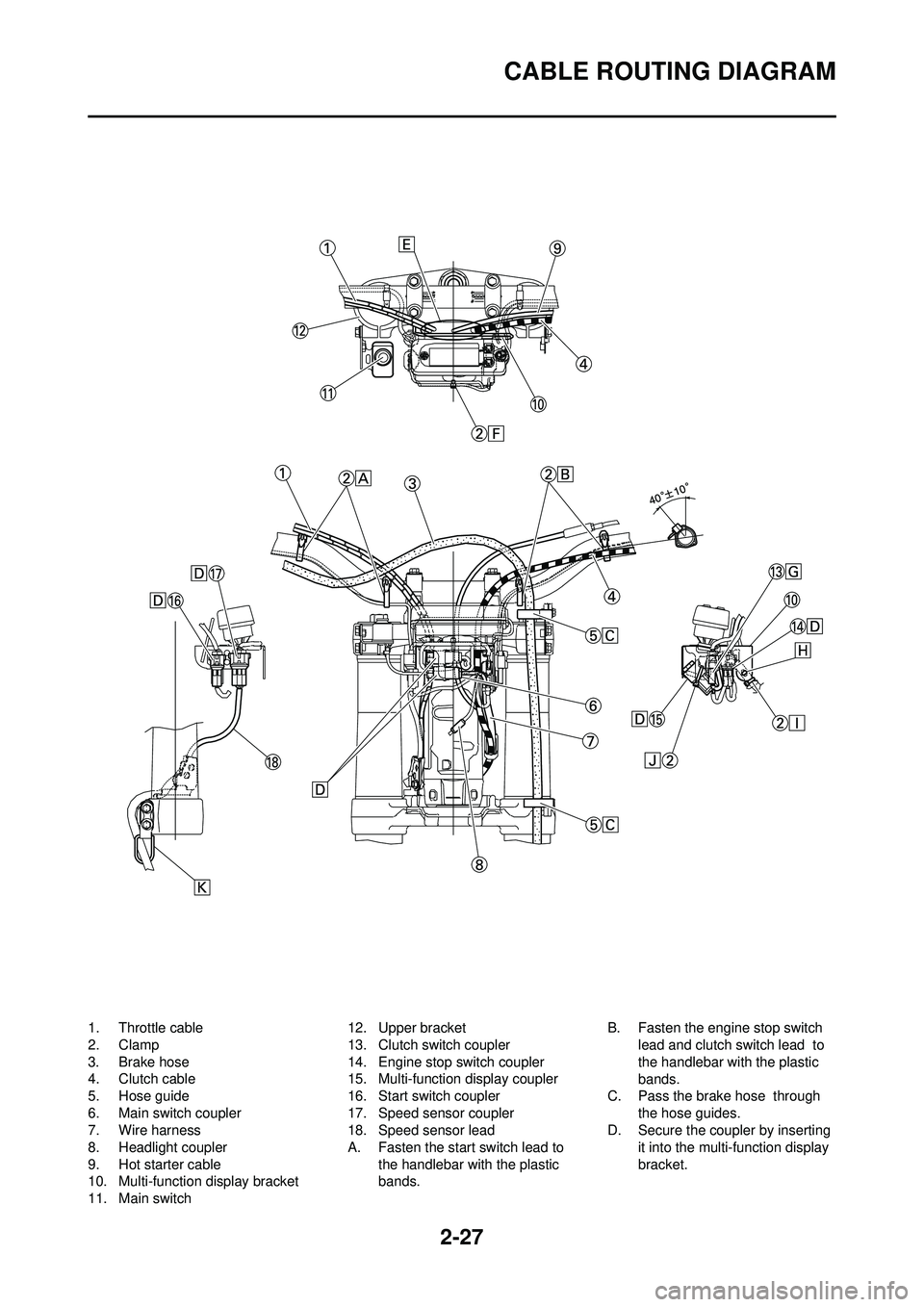
1. Throttle cable
2. Clamp
3. Brake hose
4. Clutch cable
5. Hose guide
6. Main switch coupler
7. Wire harness
8. Headlight coupler
9. Hot starter cable
10. Multi-function display bracket
11. Main switch12. Upper bracket
13. Clutch switch coupler
14. Engine stop switch coupler
15. Multi-function display coupler
16. Start switch coupler
17. Speed sensor coupler
18. Speed sensor lead
A. Fasten the star
t switch lead to
the handlebar with the plastic
bands. B. Fasten the engine stop switch
lead and clutch switch lead to
the handlebar with the plastic
bands.
C. Pass the brake hose through
the hose guides.
D. Secure the coupler by inserting it into the multi-function display
bracket.
Page 56 of 224
3-1
MAINTENANCE INTERVALS
REGULAR INSPECTION AND ADJUSTMENTS
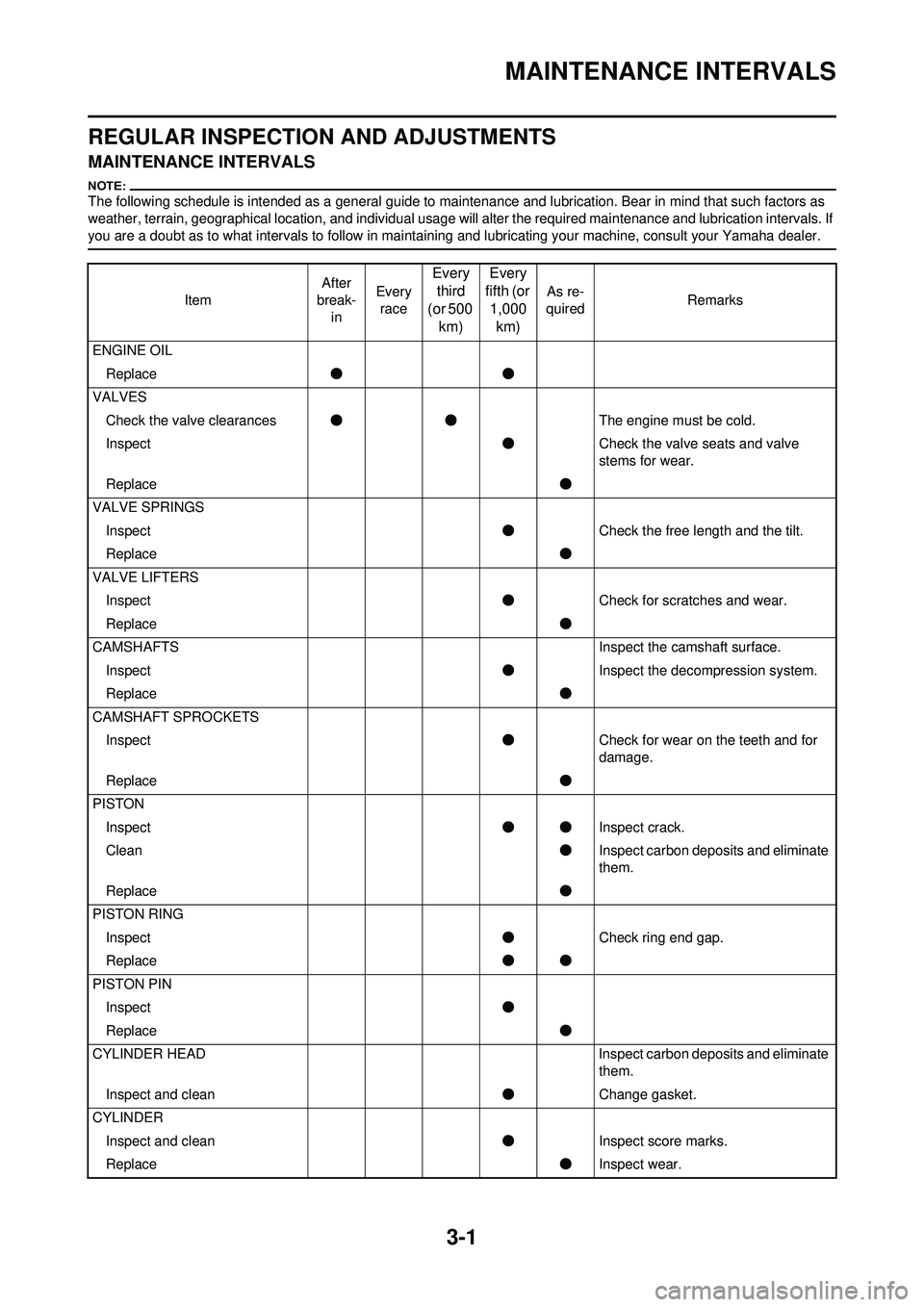
MAINTENANCE INTERVALS
The following schedule is intended as a general guide to maint enance and lubrication. Bear in mind that such factors as
weather, terrain, geographical location, and individual usage will alter the required maintenance and lubrication intervals. If
you are a doubt as to what intervals to follow in maintaini ng and lubricating your machine, consult your Yamaha dealer.
ItemAfter
break- in Every
race
Every third
(or 500
km) Every
fifth (or 1,000
km)
As re-
quired Remarks
ENGINE OIL Replace ●●
VALVES Check the valve clearances ●● The engine must be cold.
Inspect ●Check the valve seats and valve
stems for wear.
Replace ●
VALVE SPRINGS Inspect ●Check the free length and the tilt.
Replace ●
VALVE LIFTERS Inspect ●Check for scratches and wear.
Replace ●
CAMSHAFTS Inspect the camshaft surface.
Inspect ●Inspect the decompression system.
Replace ●
CAMSHAFT SPROCKETS Inspect ●Check for wear on the teeth and for
damage.
Replace ●
PISTON Inspect ●●Inspect crack.
Clean ●Inspect carbon deposits and eliminate
them.
Replace ●
PISTON RING Inspect ●Check ring end gap.
Replace ●●
PISTON PIN Inspect ●
Replace ●
CYLINDER HEAD Inspect carbon deposits and eliminate
them.
Inspect and clean ●Change gasket.
CYLINDER Inspect and clean ●Inspect score marks.
Replace ●Inspect wear.
Page 60 of 224
3-5
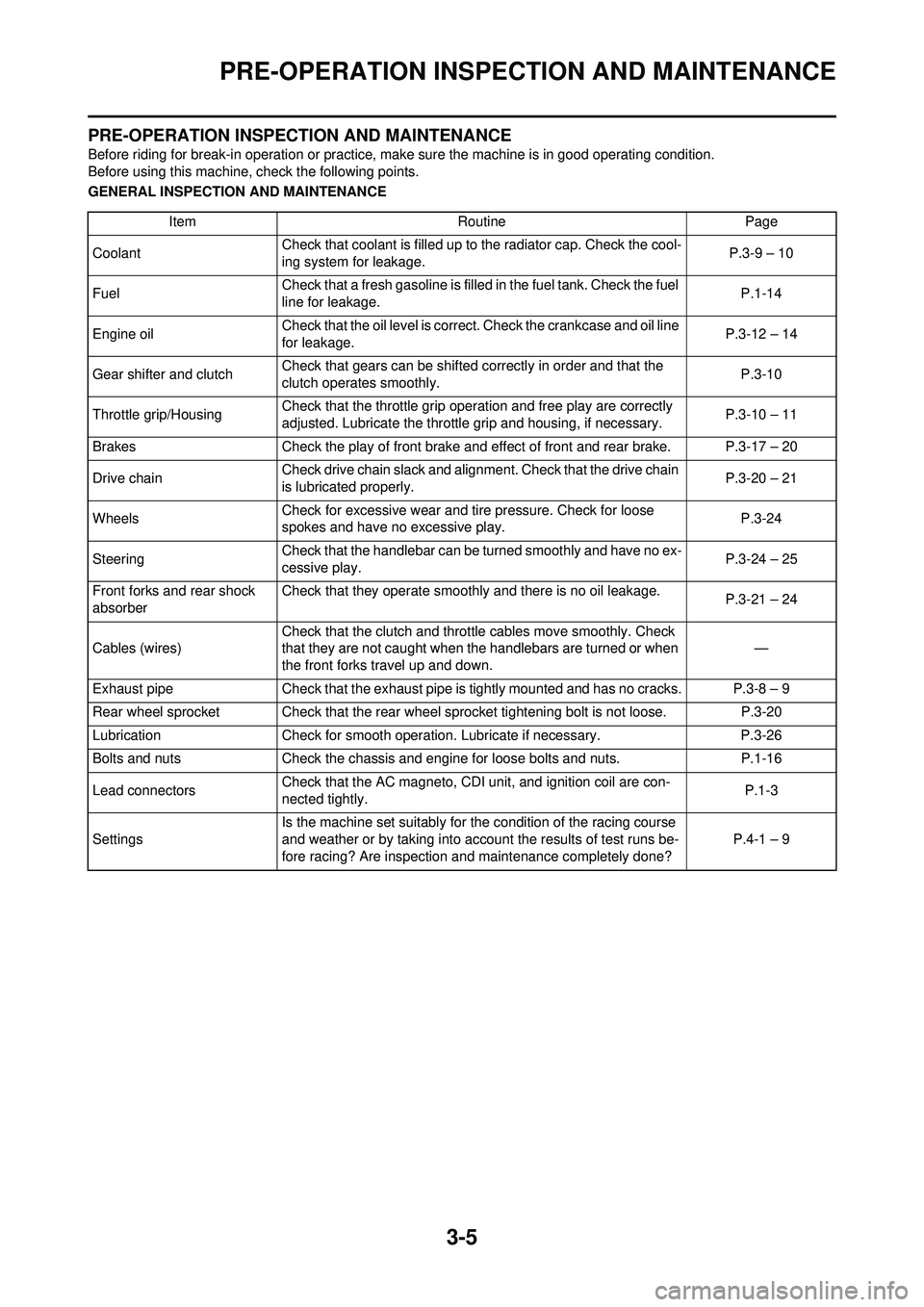
PRE-OPERATION INSPECTION AND MAINTENANCE
PRE-OPERATION INSPECTION AND MAINTENANCE
Before riding for break-in operation or practice, make sure the machine is in good operating condition.
Before using this machine, check the following points.
GENERAL INSPECTION AND MAINTENANCEItem RoutinePage
Coolant Check that coolant is filled up to the radiator cap. Check the cool-
ing system for leakage. P.3-9 – 10
Fuel Check that a fresh gasoline is filled in the fuel tank. Check the fuel
line for leakage.
P.1-14
Engine oil Check that the oil level is correct. Check the crankcase and oil line
for leakage. P.3-12 – 14
Gear shifter and clutch Check that gears can be shifted correctly in order and that the
clutch operates smoothly. P.3-10
Throttle grip/Housing Check that the throttle grip operation and free play are correctly
adjusted. Lubricate the throttle grip and housing, if necessary.
P.3-10 – 11
Brakes Check the play of front brake and ef fect of front and rear brake. P.3-17 – 20
Drive chain Check drive chain slack and alignment. Check that the drive chain
is lubricated properly. P.3-20 – 21
Wheels Check for excessive wear and ti
re pressure. Check for loose
spokes and have no excessive play. P.3-24
Steering Check that the handlebar can be turned smoothly and have no ex-
cessive play.
P.3-24 – 25
Front forks and rear shock
absorber Check that they operate smoothly and there is no oil leakage.
P.3-21 – 24
Cables (wires) Check that the clutch and throttle cables move smoothly. Check
that they are not caught when the handlebars are turned or when
the front forks travel up and down. —
Exhaust pipe Check that the exhaust pipe is tightly mount ed and has no cracks. P.3-8 – 9
Rear wheel sprocket Check that the rear wheel sprocket tightening bolt is not loose. P.3-20
Lubrication Check for smooth operation. Lubricate if necessary. P.3-26
Bolts and nuts Check the chassis and engine for loose bolts and nuts. P.1-16
Lead connectors Check that the AC magneto, CDI unit, and ignition coil are con-
nected tightly. P.1-3
Settings Is the machine set suitably for the
condition of the racing course
and weather or by taking into account the results of test runs be-
fore racing? Are inspection and maintenance completely done? P.4-1 – 9
Page 61 of 224
3-6
ENGINE
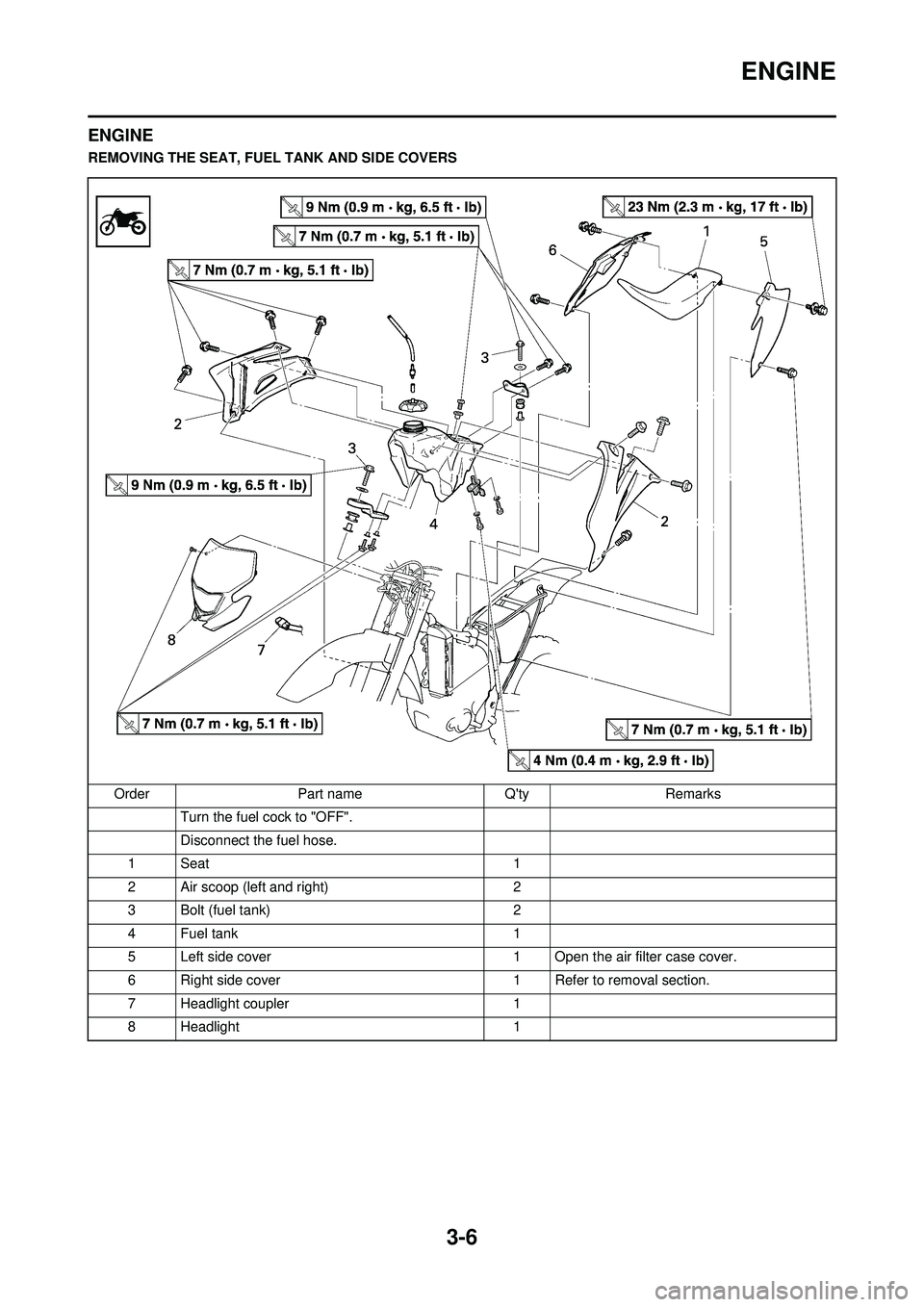
ENGINE
REMOVING THE SEAT, FUEL TANK AND SIDE COVERS
Order Part name Q'ty Remarks Turn the fuel cock to "OFF".
Disconnect the fuel hose.
1Seat 1
2 Air scoop (left and right) 2
3 Bolt (fuel tank) 2
4 Fuel tank 1
5 Left side cover 1 Open the air filter case cover.
6 Right side cover 1 Refer to removal section.
7 Headlight coupler 1
8 Headlight 1
Page 62 of 224
3-7
ENGINE
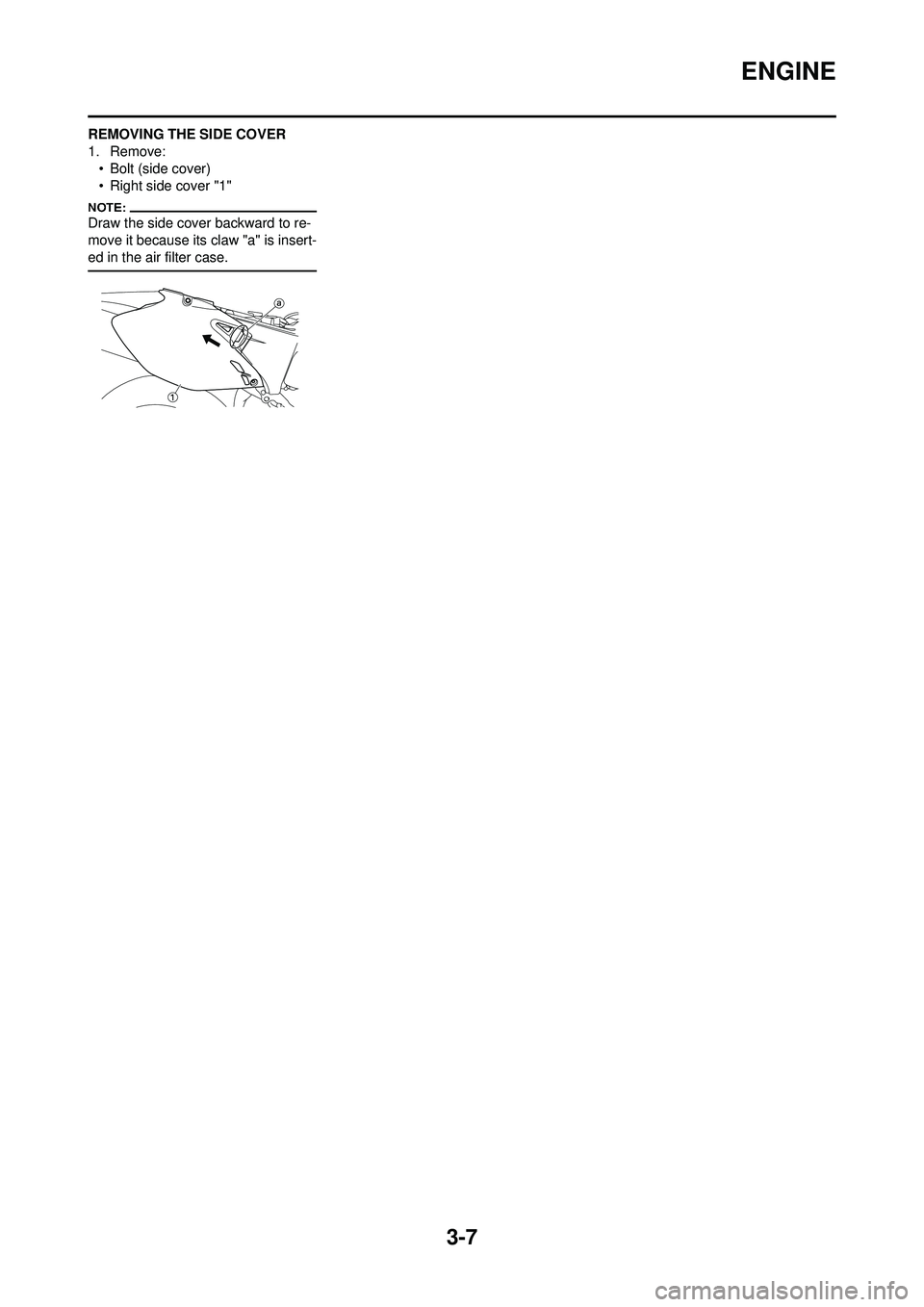
REMOVING THE SIDE COVER
1. Remove:• Bolt (side cover)
• Right side cover "1"
Draw the side cover backward to re-
move it because its claw "a" is insert-
ed in the air filter case.
Page 63 of 224
3-8
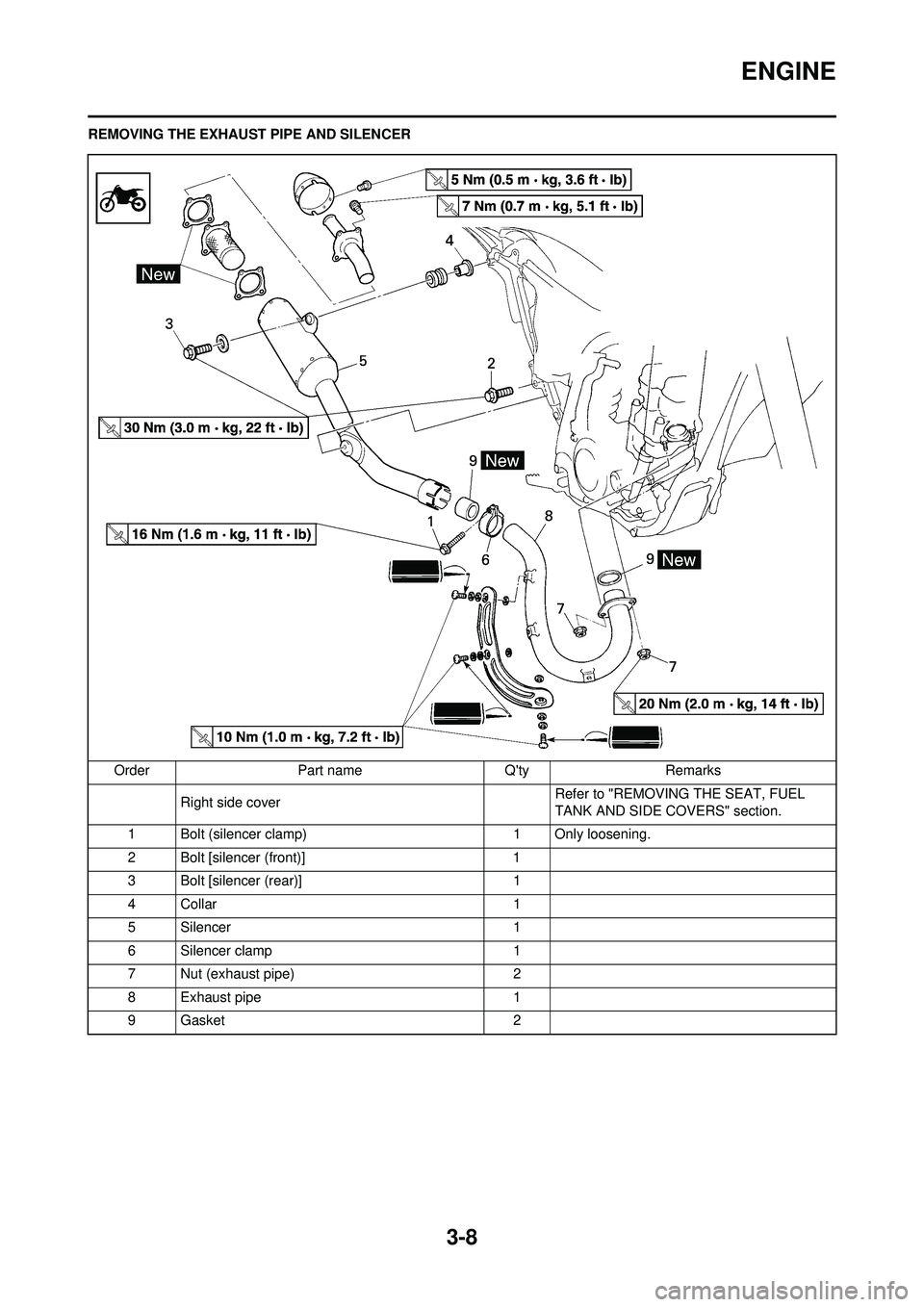
ENGINE
REMOVING THE EXHAUST PIPE AND SILENCEROrder Part name Q'ty Remarks Right side cover Refer to "REMOVING THE SEAT, FUEL
TANK AND SIDE COVERS" section.
1 Bolt (silencer clamp) 1 Only loosening.
2 Bolt [silencer (front)] 1
3 Bolt [silencer (rear)] 1
4 Collar 1
5 Silencer 1
6 Silencer clamp 1
7 Nut (exhaust pipe) 2
8 Exhaust pipe 1
9 Gasket 2
Page 64 of 224
3-9
ENGINE
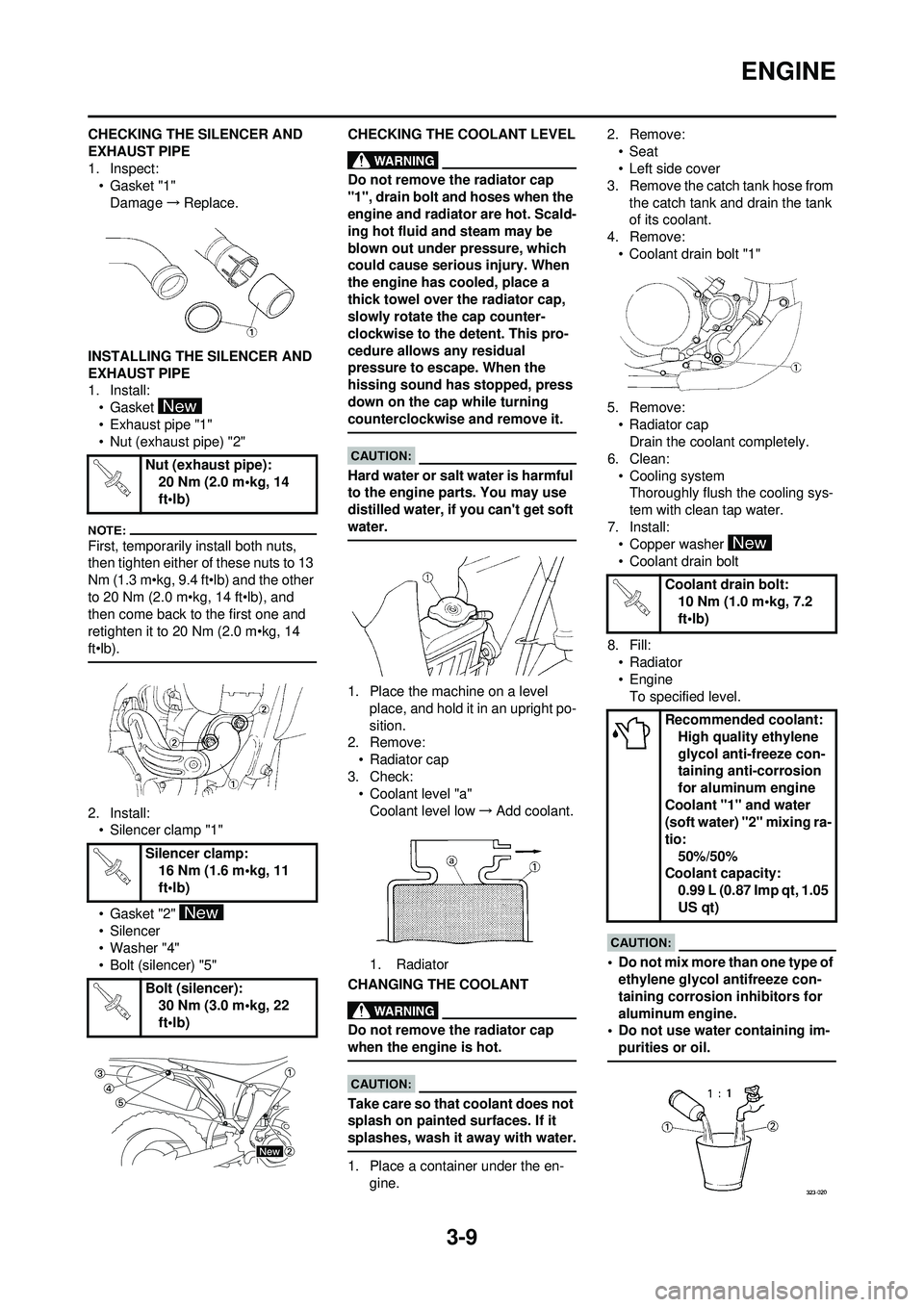
CHECKING THE SILENCER AND
EXHAUST PIPE
1. Inspect:• Gasket "1"
Damage →Replace.
INSTALLING THE SILENCER AND
EXHAUST PIPE
1. Install: • Gasket
• Exhaust pipe "1"
• Nut (exhaust pipe) "2"
First, temporarily install both nuts,
then tighten either of these nuts to 13
Nm (1.3 m•kg, 9.4 ft•lb) and the other
to 20 Nm (2.0 m•kg, 14 ft•lb), and
then come back to the first one and
retighten it to 20 Nm (2.0 m•kg, 14
ft•lb).
2. Install: • Silencer clamp "1"
• Gasket "2"
• Silencer
• Washer "4"
• Bolt (silencer) "5" CHECKING THE COOLANT LEVEL
Do not remove the radiator cap
"1", drain bolt and hoses when the
engine and radiator are hot. Scald-
ing hot fluid and steam may be
blown out under pressure, which
could cause serious injury. When
the engine has cooled, place a
thick towel over the radiator cap,
slowly rotate the cap counter-
clockwise to the detent. This pro-
cedure allows any residual
pressure to escape. When the
hissing sound has stopped, press
down on the cap while turning
counterclockwise and remove it.
Hard water or salt water is harmful
to the engine parts. You may use
distilled water, if you can't get soft
water.
1. Place the machine on a level
place, and hold it in an upright po-
sition.
2. Remove: • Radiator cap
3. Check: • Coolant level "a"Coolant level low →Add coolant.
1. Radiator
CHANGING THE COOLANT
Do not remove the radiator cap
when the engine is hot.
Take care so that coolant does not
splash on painted surfaces. If it
splashes, wash it away with water.
1. Place a container under the en- gine. 2. Remove:
• Seat
• Left side cover
3. Remove the catch tank hose from
the catch tank and drain the tank
of its coolant.
4. Remove:
• Coolant drain bolt "1"
5. Remove: • Radiator capDrain the coolant completely.
6. Clean: • Cooling systemThoroughly flush the cooling sys-
tem with clean tap water.
7. Install: • Copper washer
• Coolant drain bolt
8. Fill: •Radiator
• EngineTo specified level.
• Do not mix more than one type of ethylene glycol antifreeze con-
taining corrosion inhibitors for
aluminum engine.
• Do not use water containing im- purities or oil.
Nut (exhaust pipe):
20 Nm (2.0 m•kg, 14
ft•lb)
Silencer clamp: 16 Nm (1.6 m•kg, 11
ft•lb)
Bolt (silencer): 30 Nm (3.0 m•kg, 22
ft•lb)
Coolant drain bolt:10 Nm (1.0 m•kg, 7.2
ft•lb)
Recommended coolant: High quality ethylene
glycol anti-freeze con-
taining anti-corrosion
for aluminum engine
Coolant "1" and water
(soft water) "2" mixing ra-
tio: 50%/50%
Coolant capacity: 0.99 L (0.87 Imp qt, 1.05
US qt)
Page 65 of 224
3-10
ENGINE
Handling notes of coolant:
The coolant is harmful so it should be
handled with special care.
• When coolant splashes to your eye.
Thoroughly wash your eye with
water and see your doctor.
• When coolant splashes to your clothes.
Quickly wash it away with water
and then with soap.
• When coolant is swallowed. Quickly make him vomit and take
him to a doctor.
9. Install:• Radiator cap
Start the engine and warm it up
for a several minutes.
10. Check:
• Coolant levelCoolant level low →Add coolant.
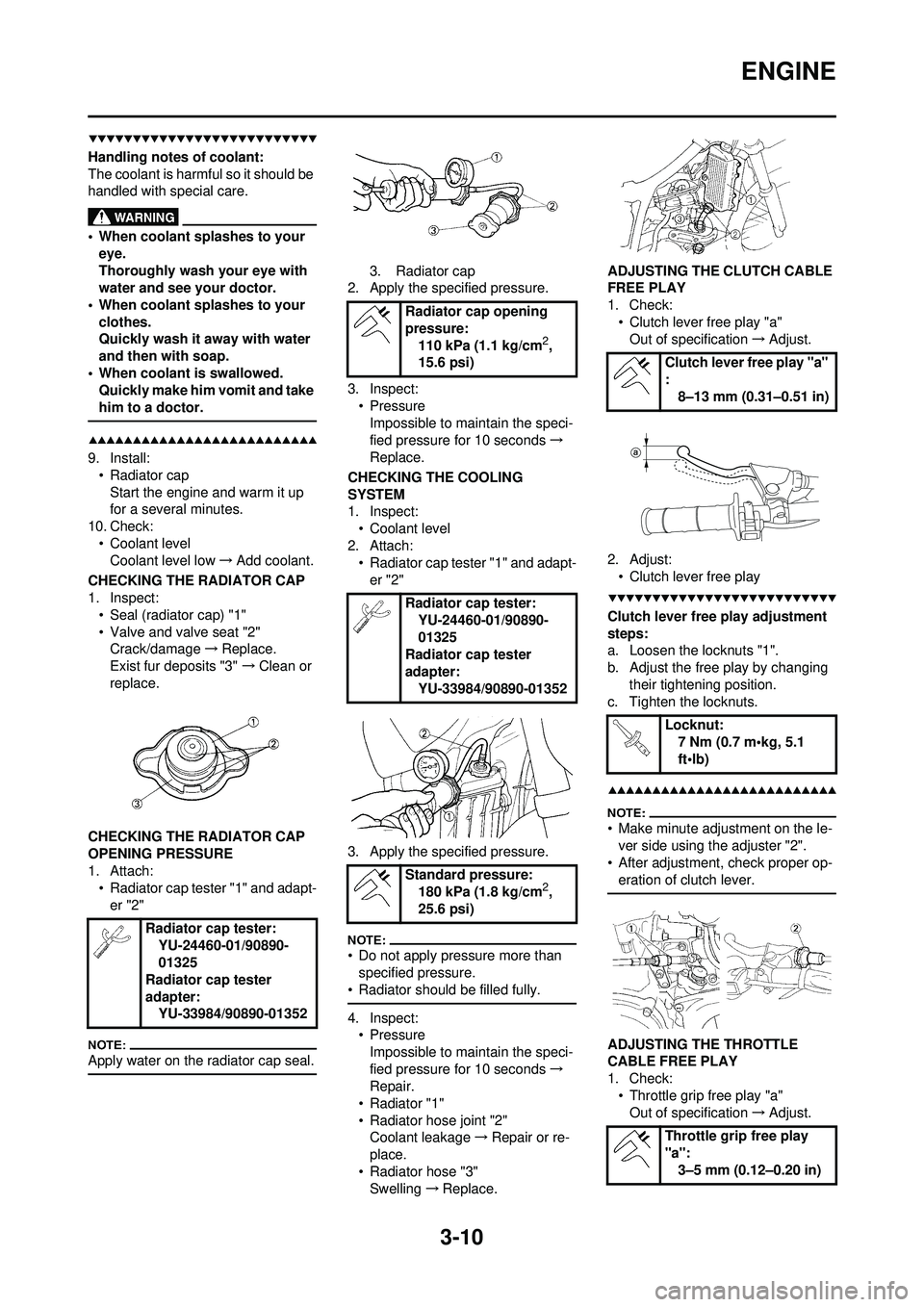
CHECKING THE RADIATOR CAP
1. Inspect: • Seal (radiator cap) "1"
• Valve and valve seat "2"Crack/damage →Replace.
Exist fur deposits "3" →Clean or
replace.
CHECKING THE RADIATOR CAP
OPENING PRESSURE
1. Attach: • Radiator cap tester "1" and adapt-er "2"
Apply water on the radiator cap seal.
3. Radiator cap
2. Apply the specified pressure.
3. Inspect: •PressureImpossible to maintain the speci-
fied pressure for 10 seconds →
Replace.
CHECKING THE COOLING
SYSTEM
1. Inspect: • Coolant level
2. Attach: • Radiator cap tester "1" and adapt-
er "2"
3. Apply the specified pressure.
• Do not apply pressure more than specified pressure.
• Radiator should be filled fully.
4. Inspect: •PressureImpossible to maintain the speci-
fied pressure for 10 seconds →
Repair.
• Radiator "1"
• Radiator hose joint "2" Coolant leakage →Repair or re-
place.
• Radiator hose "3" Swelling →Replace. ADJUSTING THE CLUTCH CABLE
FREE PLAY
1. Check:
• Clutch lever free play "a"Out of specification →Adjust.
2. Adjust: • Clutch lever free play
Clutch lever free play adjustment
steps:
a. Loosen the locknuts "1".
b. Adjust the free play by changing their tightening position.
c. Tighten the locknuts.
• Make minute adjustment on the le- ver side using the adjuster "2".
• After adjustment, check proper op- eration of clutch lever.
ADJUSTING THE THROTTLE
CABLE FREE PLAY
1. Check:
• Throttle grip free play "a"Out of specification →Adjust.
Radiator cap tester:
YU-24460-01/90890-
01325
Radiator cap tester
adapter: YU-33984/90890-01352
Radiator cap opening
pressure:110 kPa (1.1 kg/cm
2,
15.6 psi)
Radiator cap tester: YU-24460-01/90890-
01325
Radiator cap tester
adapter:
YU-33984/90890-01352
Standard pressure: 180 kPa (1.8 kg/cm
2,
25.6 psi)
Clutch lever free play "a"
: 8–13 mm (0.31–0.51 in)
Locknut: 7 Nm (0.7 m•kg, 5.1
ft•lb)
Throttle grip free play
"a": 3–5 mm (0.12–0.20 in)