battery YAMAHA WR 250F 2009 User Guide
[x] Cancel search | Manufacturer: YAMAHA, Model Year: 2009, Model line: WR 250F, Model: YAMAHA WR 250F 2009Pages: 224, PDF Size: 13.93 MB
Page 83 of 224
3-30
ELECTRICAL
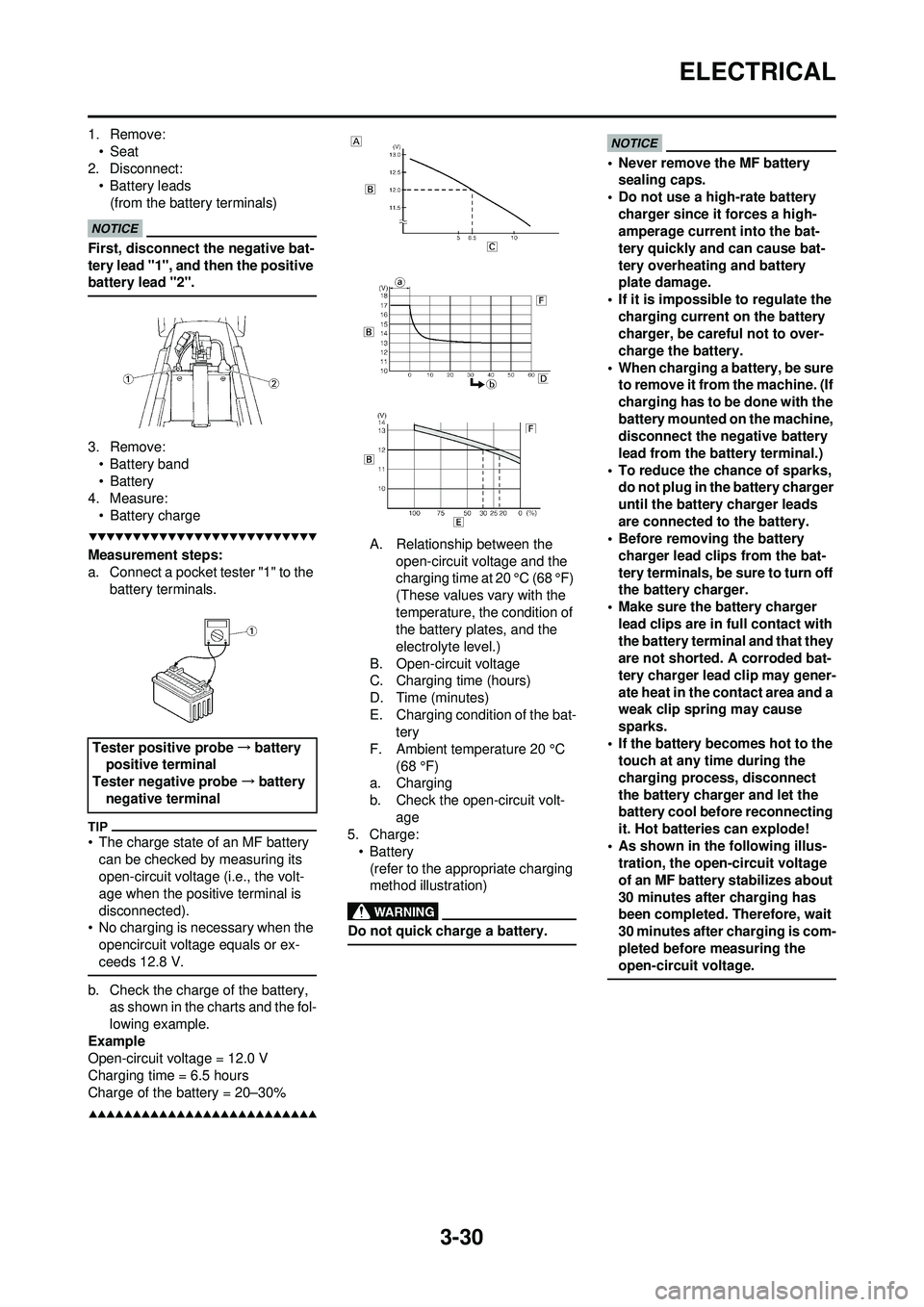
1. Remove:• Seat
2. Disconnect: • Battery leads
(from the battery terminals)
First, disconnect the negative bat-
tery lead "1", and then the positive
battery lead "2".
3. Remove:• Battery band
• Battery
4. Measure:
• Battery charge
Measurement steps:
a. Connect a pocket tester "1" to the battery terminals.
• The charge state of an MF battery can be checked by measuring its
open-circuit voltage (i.e., the volt-
age when the positive terminal is
disconnected).
• No charging is necessary when the
opencircuit voltage equals or ex-
ceeds 12.8 V.
b. Check the charge of the battery, as shown in the charts and the fol-
lowing example.
Example
Open-circuit voltage = 12.0 V
Charging time = 6.5 hours
Charge of the battery = 20–30%
A. Relationship between the open-circuit voltage and the
charging time at 20 °C (68 °F)
(These values vary with the
temperature, the condition of
the battery plates, and the
electrolyte level.)
B. Open-circuit voltage
C. Charging time (hours)
D. Time (minutes)
E. Charging condition of the bat- tery
F. Ambient temperature 20 °C (68 °F)
a. Charging
b. Check the open-circuit volt-
age
5. Charge:
•Battery(refer to the appropriate charging
method illustration)
Do not quick charge a battery.
• Never remove the MF battery sealing caps.
• Do not use a high-rate battery charger since it forces a high-
amperage current into the bat-
tery quickly and can cause bat-
tery overheating and battery
plate damage.
• If it is impossible to regulate the charging current on the battery
charger, be careful not to over-
charge the battery.
• When charging a battery, be sure to remove it from the machine. (If
charging has to be done with the
battery mounted on the machine,
disconnect the negative battery
lead from the battery terminal.)
• To reduce the chance of sparks, do not plug in the battery charger
until the battery charger leads
are connected to the battery.
• Before removing the battery
charger lead clips from the bat-
tery terminals, be sure to turn off
the battery charger.
• Make sure the battery charger lead clips are in full contact with
the battery terminal and that they
are not shorted. A corroded bat-
tery charger lead clip may gener-
ate heat in the contact area and a
weak clip spring may cause
sparks.
• If the battery becomes hot to the touch at any time during the
charging process, disconnect
the battery charger and let the
battery cool before reconnecting
it. Hot batteries can explode!
• As shown in the following illus- tration, the open-circuit voltage
of an MF battery stabilizes about
30 minutes after charging has
been completed. Therefore, wait
30 minutes after charging is com-
pleted before measuring the
open-circuit voltage.
Tester positive probe →battery
positive terminal
Tester negative probe →battery
negative terminal
Page 86 of 224
3-33
ELECTRICAL
6. Install:• Battery
• Battery band
7. Connect: • Battery leads(to the battery terminals)
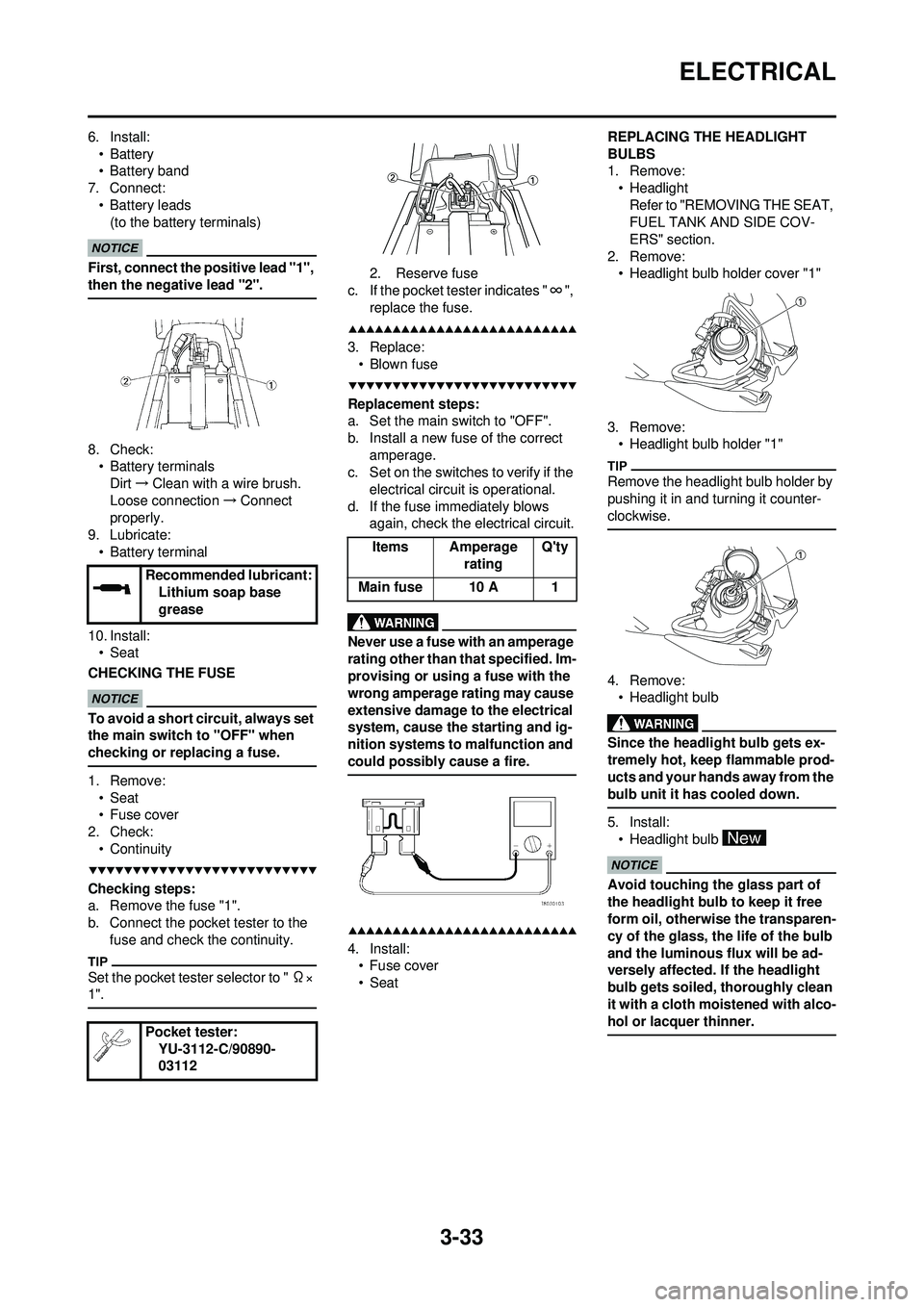
First, connect the positive lead "1",
then the negative lead "2".
8. Check:• Battery terminals
Dirt →Clean with a wire brush.
Loose connection →Connect
properly.
9. Lubricate: • Battery terminal
10. Install: • Seat
CHECKING THE FUSE
To avoid a short circuit, always set
the main switch to "OFF" when
checking or replacing a fuse.
1. Remove: • Seat
• Fuse cover
2. Check: • Continuity
Checking steps:
a. Remove the fuse "1".
b. Connect the pocket tester to the fuse and check the continuity.
Set the pocket tester selector to " Ω×
1".
2. Reserve fuse
c. If the pocket tester indicates " ∞",
replace the fuse.
3. Replace: • Blown fuse
Replacement steps:
a. Set the main switch to "OFF".
b. Install a new fuse of the correct amperage.
c. Set on the switches to verify if the
electrical circuit is operational.
d. If the fuse immediately blows again, check the electrical circuit.
Never use a fuse with an amperage
rating other than that specified. Im-
provising or using a fuse with the
wrong amperage rating may cause
extensive damage to the electrical
system, cause the starting and ig-
nition systems to malfunction and
could possibly cause a fire.
4. Install:• Fuse cover
•Seat REPLACING THE HEADLIGHT
BULBS
1. Remove:
• HeadlightRefer to "REMOVING THE SEAT,
FUEL TANK AND SIDE COV-
ERS" section.
2. Remove: • Headlight bulb holder cover "1"
3. Remove: • Headlight bulb holder "1"
Remove the headlight bulb holder by
pushing it in and turning it counter-
clockwise.
4. Remove:• Headlight bulb
Since the headlight bulb gets ex-
tremely hot, keep flammable prod-
ucts and your hands away from the
bulb unit it has cooled down.
5. Install:
• Headlight bulb
Avoid touching the glass part of
the headlight bulb to keep it free
form oil, otherwise the transparen-
cy of the glass, the life of the bulb
and the luminous flux will be ad-
versely affected. If the headlight
bulb gets soiled, thoroughly clean
it with a cloth moistened with alco-
hol or lacquer thinner.
Recommended lubricant: Lithium soap base
grease
Pocket tester: YU-3112-C/90890-
03112
Items Amperage ratingQ'ty
Main fuse 10 A 1
Page 150 of 224
5-54
ENGINE REMOVAL
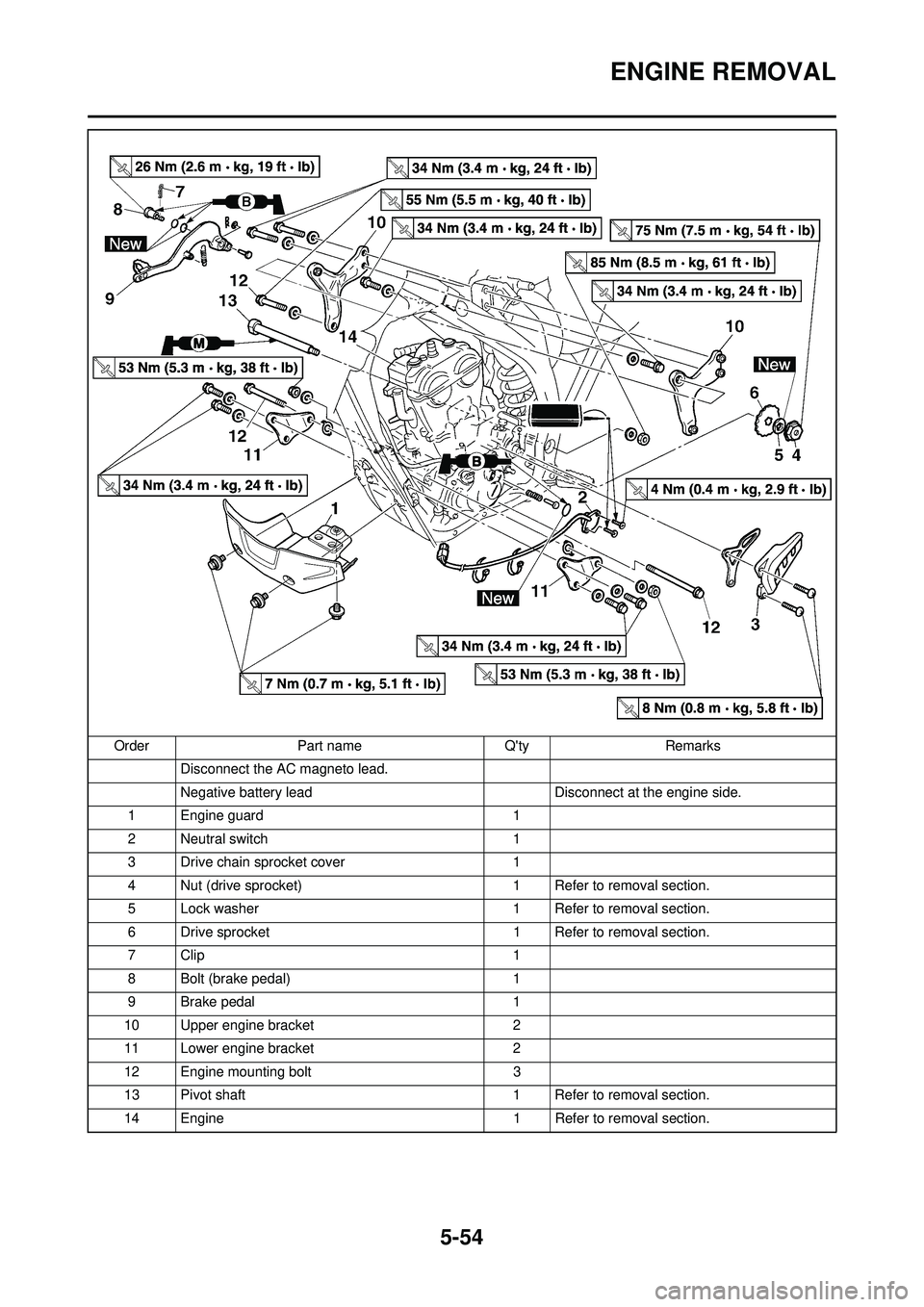
Disconnect the AC magneto lead.
Negative battery lead Disconnect at the engine side.
1 Engine guard 1
2 Neutral switch 1
3 Drive chain sprocket cover 1
4 Nut (drive sprocket) 1 Refer to removal section.
5 Lock washer 1 Refer to removal section.
6 Drive sprocket 1 Refer to removal section.
7 Clip 1
8 Bolt (brake pedal) 1
9 Brake pedal 1
10 Upper engine bracket 2
11 Lower engine bracket 2
12 Engine mounting bolt 3
13 Pivot shaft 1 Refer to removal section.
14 Engine 1 Refer to removal section.
Order
Part name Q'tyRemarks
Page 197 of 224
6-36
REAR SHOCK ABSORBER
REAR SHOCK ABSORBER
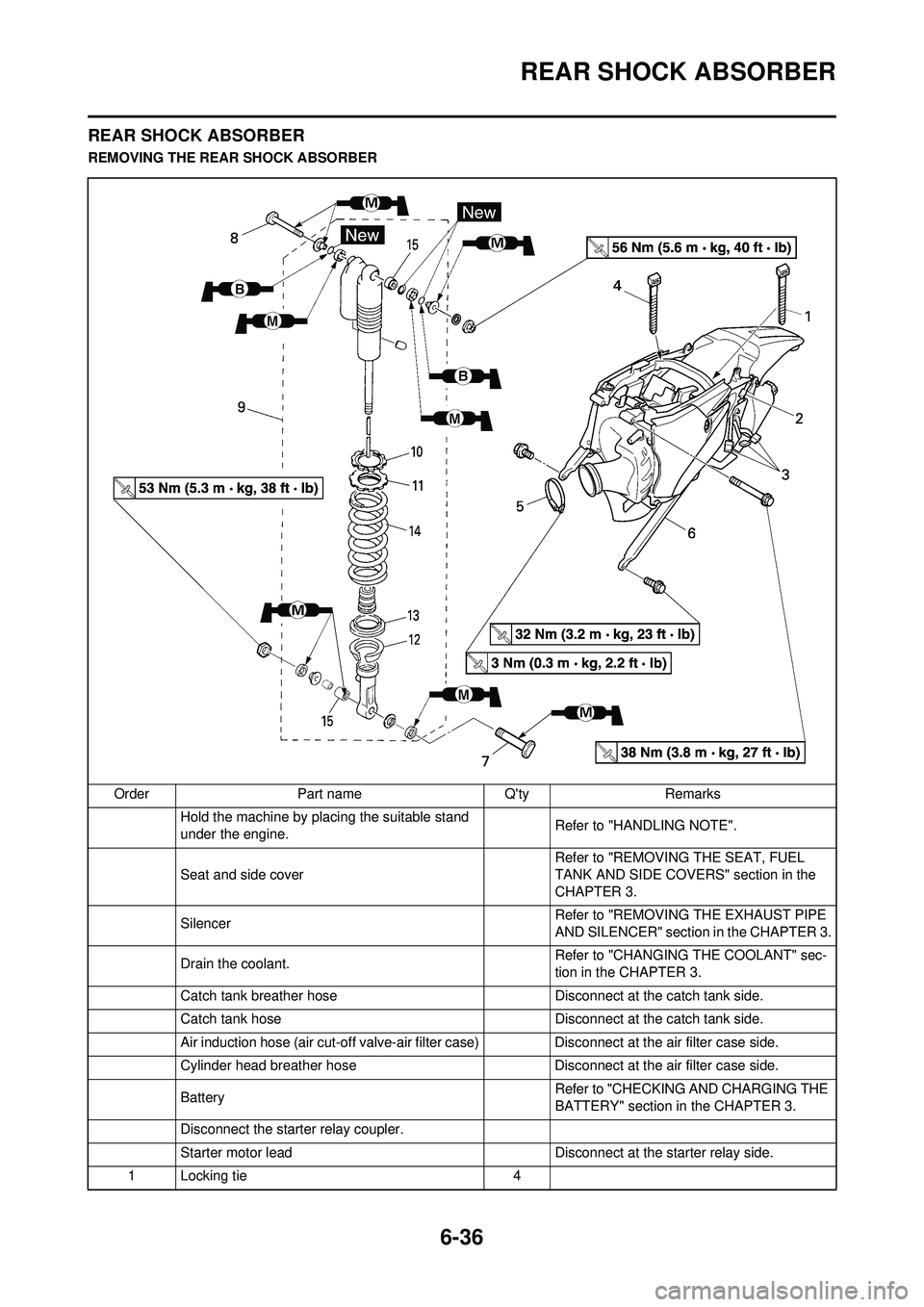
REMOVING THE REAR SHOCK ABSORBEROrder Part name Q'ty Remarks Hold the machine by placing the suitable stand
under the engine. Refer to "HANDLING NOTE".
Seat and side cover Refer to "REMOVING THE SEAT, FUEL
TANK AND SIDE COVERS" section in the
CHAPTER 3.
Silencer Refer to "REMOVING THE EXHAUST PIPE
AND SILENCER" section in the CHAPTER 3.
Drain the coolant. Refer to "CHANGING THE COOLANT" sec-
tion in the CHAPTER 3.
Catch tank breather hose Disconnect at the catch tank side.
Catch tank hose Disconnect at the catch tank side.
Air induction hose (air cut-off valve-air filter case) Disconnect at the air filter case side.
Cylinder head breather hose Disconnect at the air filter case side.
Battery Refer to "CHECKING AND CHARGING THE
BATTERY" section in the CHAPTER 3.
Disconnect the starter relay coupler.
Starter motor lead Disconnect at the starter relay side.
1 Locking tie 4
Page 202 of 224
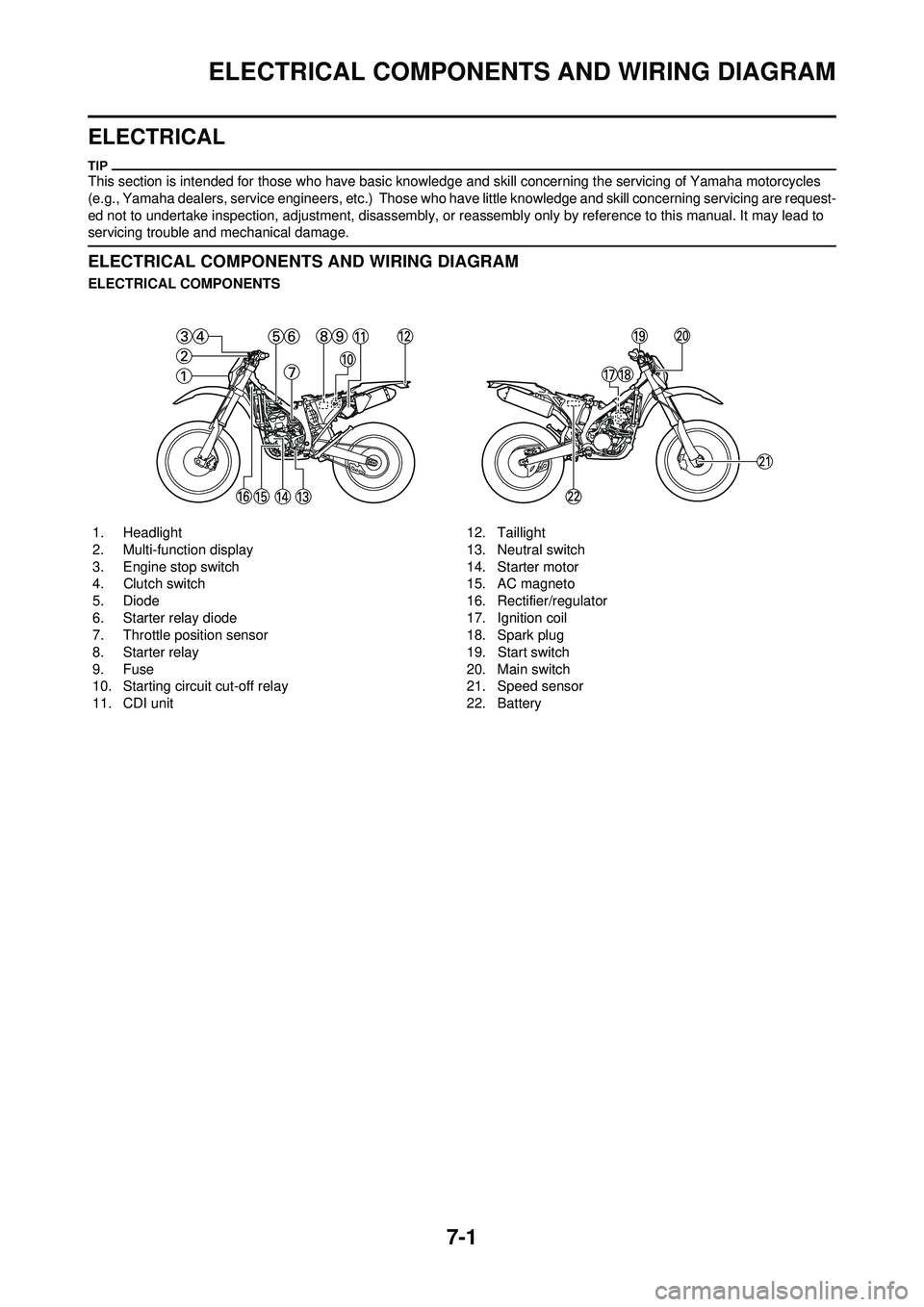
7-1
ELECTRICAL COMPONENTS AND WIRING DIAGRAM
ELECTRICAL
This section is intended for those who have basic knowledge and skill concerning the servicing of Yamaha motorcycles
(e.g., Yamaha dealers, service engineers, etc.) Those who have little knowledge and skill concerning servicing are request-
ed not to undertake inspection, adjustment, disassembly, or reassembly only by reference to this manual. It may lead to
servicing trouble and mechanical damage.
ELECTRICAL COMPONENTS AND WIRING DIAGRAM
ELECTRICAL COMPONENTS1. Headlight
2. Multi-function display
3. Engine stop switch
4. Clutch switch
5. Diode
6. Starter relay diode
7. Throttle position sensor
8. Starter relay
9. Fuse
10. Starting circuit cut-off relay
11. CDI unit 12. Taillight
13. Neutral switch
14. Starter motor
15. AC magneto
16. Rectifier/regulator
17. Ignition coil
18. Spark plug
19. Start switch
20. Main switch
21. Speed sensor
22. Battery
Page 203 of 224
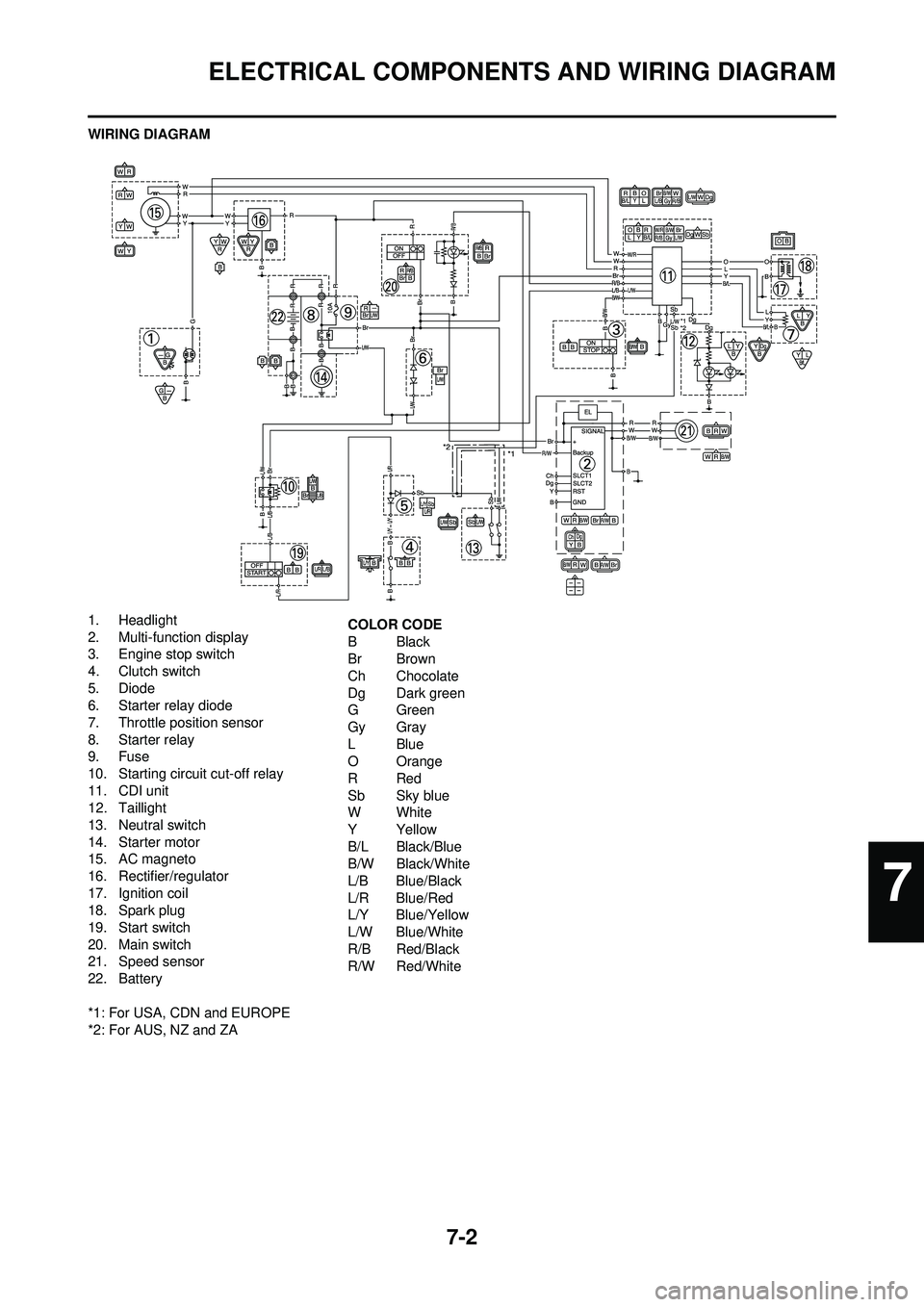
7-2
ELECTRICAL COMPONENTS AND WIRING DIAGRAM
WIRING DIAGRAM
1. Headlight
2. Multi-function display
3. Engine stop switch
4. Clutch switch
5. Diode
6. Starter relay diode
7. Throttle position sensor
8. Starter relay
9. Fuse
10. Starting circuit cut-off relay
11. CDI unit
12. Taillight
13. Neutral switch
14. Starter motor
15. AC magneto
16. Rectifier/regulator
17. Ignition coil
18. Spark plug
19. Start switch
20. Main switch
21. Speed sensor
22. Battery
*1: For USA, CDN and EUROPE
*2: For AUS, NZ and ZACOLOR CODE
BBlack
Br Brown
Ch Chocolate
Dg Dark green
GGreen
Gy Gray
LBlue
OOrange
RRed
Sb Sky blue
WWhite
Y Yellow
B/L Black/Blue
B/W Black/White
L/B Blue/Black
L/R Blue/Red
L/Y Blue/Yellow
L/W Blue/White
R/B Red/Black
R/W Red/White
7
Page 204 of 224
7-3
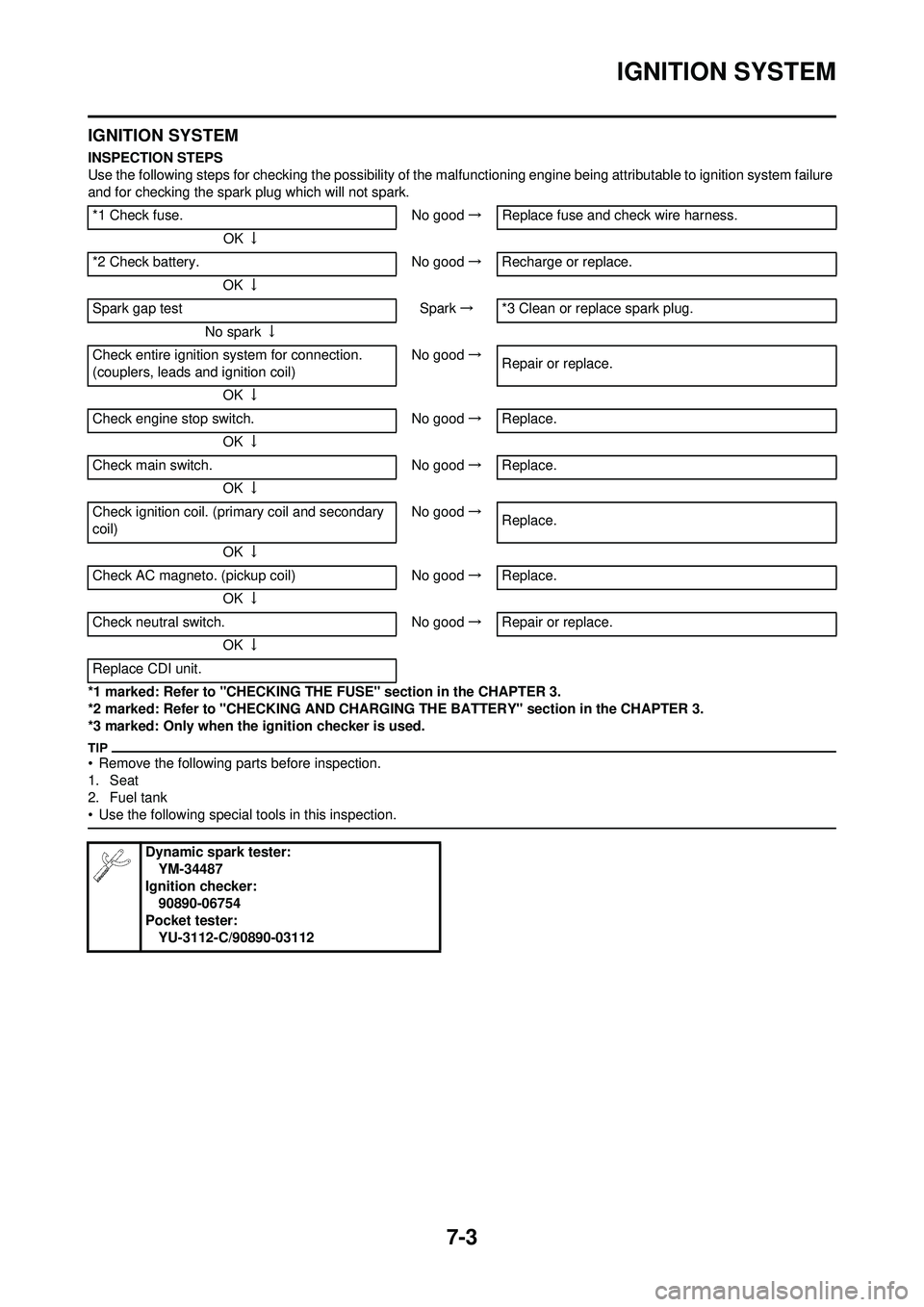
IGNITION SYSTEM
IGNITION SYSTEM
INSPECTION STEPS
Use the following steps for checking the possibility of the malfunctioning engine being attributable to ignition system failure
and for checking the spark plug which will not spark.
*1 marked: Refer to "CHECKING THE FUSE" section in the CHAPTER 3.
*2 marked: Refer to "CHECKING AND CHARGING THE BATTERY" section in the CHAPTER 3.
*3 marked: Only when the ignition checker is used.
• Remove the following parts before inspection.
1. Seat
2. Fuel tank
• Use the following special tools in this inspection.
*1 Check fuse. No good→Replace fuse and check wire harness.
OK ↓
*2 Check battery. No good→Recharge or replace.
OK ↓
Spark gap test Spark→ *3 Clean or replace spark plug.
No spark ↓
Check entire ignition system for connection.
(couplers, leads and ignition coil) No good
→
Repair or replace.
OK ↓
Check engine stop switch. No good→Replace.
OK ↓
Check main switch. No good→Replace.
OK ↓
Check ignition coil. (primary coil and secondary
coil) No good
→
Replace.
OK ↓
Check AC magneto. (pickup coil) No good→Replace.
OK ↓
Check neutral switch. No good→Repair or replace.
OK ↓
Replace CDI unit.
Dynamic spark tester: YM-34487
Ignition checker: 90890-06754
Pocket tester: YU-3112-C/90890-03112
Page 205 of 224
7-4
IGNITION SYSTEM
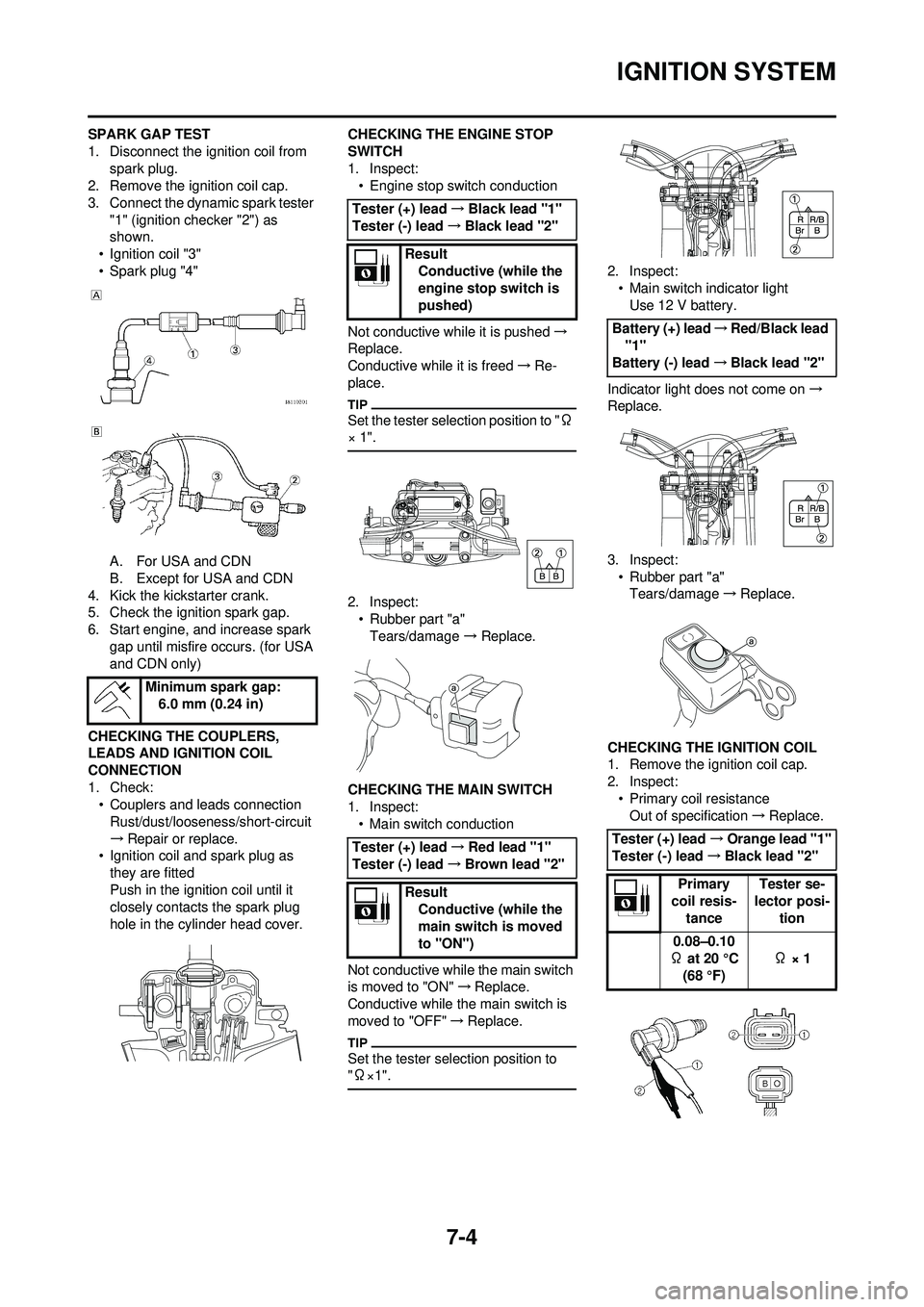
SPARK GAP TEST
1. Disconnect the ignition coil from spark plug.
2. Remove the ignition coil cap.
3. Connect the dynamic spark tester
"1" (ignition checker "2") as
shown.
• Ignition coil "3"
• Spark plug "4"
A. For USA and CDN
B. Except for USA and CDN
4. Kick the kickstarter crank.
5. Check the ignition spark gap.
6. Start engine, and increase spark gap until misfire occurs. (for USA
and CDN only)
CHECKING THE COUPLERS,
LEADS AND IGNITION COIL
CONNECTION
1. Check: • Couplers and leads connection
Rust/dust/looseness/short-circuit
→ Repair or replace.
• Ignition coil and spark plug as
they are fitted
Push in the ignition coil until it
closely contacts the spark plug
hole in the cylinder head cover. CHECKING THE ENGINE STOP
SWITCH
1. Inspect:
• Engine stop switch conduction
Not conductive while it is pushed →
Replace.
Conductive while it is freed →Re-
place.
Set the tester selection position to " Ω
× 1".
2. Inspect:
• Rubber part "a"Tears/damage → Replace.
CHECKING THE MAIN SWITCH
1. Inspect: • Main switch conduction
Not conductive while the main switch
is moved to "ON" →Replace.
Conductive while the main switch is
moved to "OFF" →Replace.
Set the tester selection position to
"Ω×1".
2. Inspect:
• Main switch indicator lightUse 12 V battery.
Indicator light does not come on →
Replace.
3. Inspect:
• Rubber part "a"Tears/damage →Replace.
CHECKING THE IGNITION COIL
1. Remove the ignition coil cap.
2. Inspect: • Primary coil resistanceOut of specification →Replace.
Minimum spark gap:
6.0 mm (0.24 in)
Tester (+) lead →Black lead "1"
Tester (-) lead →Black lead "2"
Result Conductive (while the
engine stop switch is
pushed)
Tester (+) lead →Red lead "1"
Tester (-) lead →Brown lead "2"
Result Conductive (while the
main switch is moved
to "ON")
Battery (+) lead →Red/Black lead
"1"
Battery (-) lead →Black lead "2"
Tester (+) lead →Orange lead "1"
Tester (-) lead →Black lead "2"
Primary
coil resis- tance Tester se-
lector posi- tion
0.08–0.10
Ω at 20 °C (68 °F) Ω × 1
Page 206 of 224
7-5
ELECTRIC STARTING SYSTEM
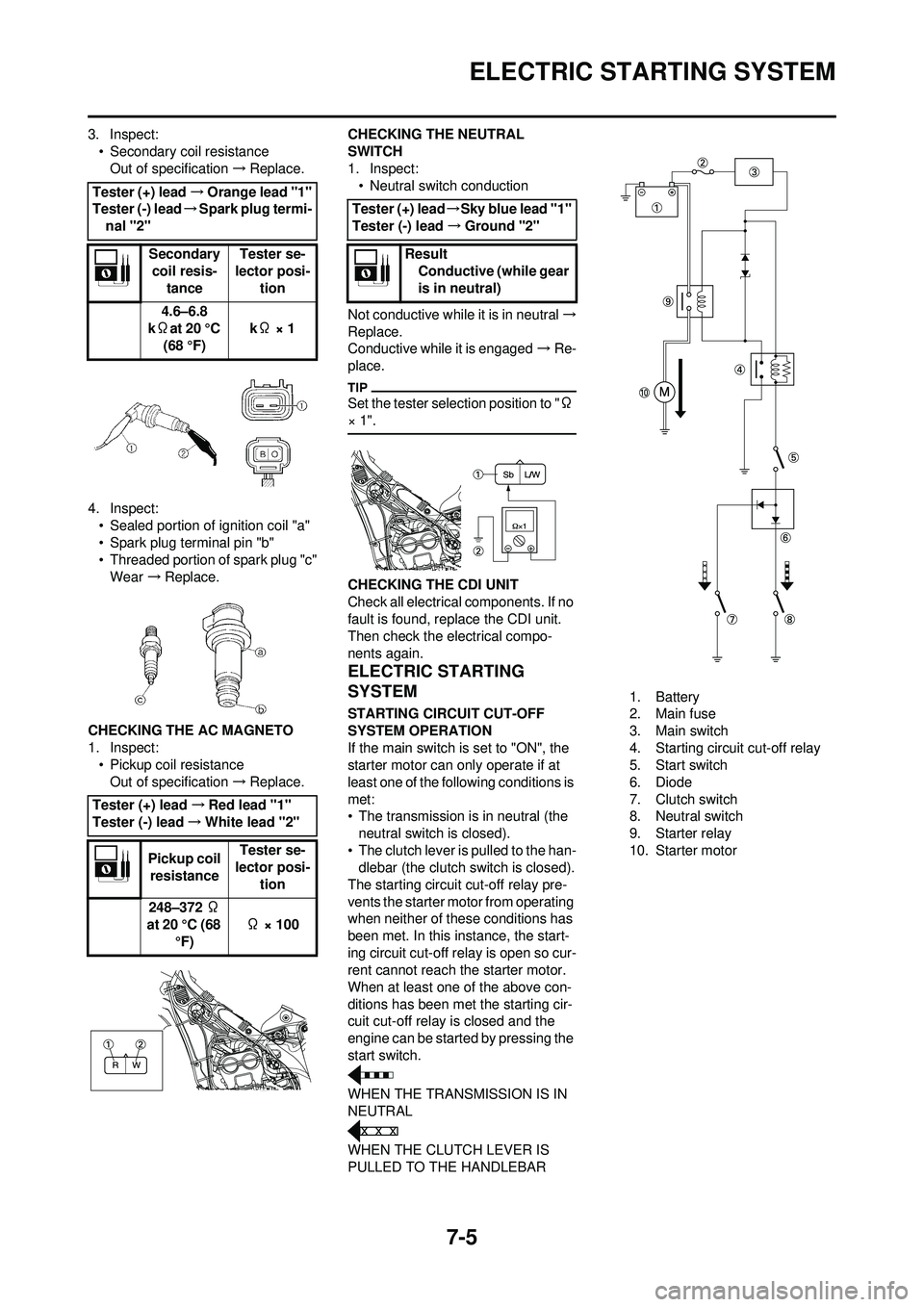
3. Inspect:• Secondary coil resistanceOut of specification →Replace.
4. Inspect: • Sealed portion of ignition coil "a"
• Spark plug terminal pin "b"
• Threaded portion of spark plug "c"Wear →Replace.
CHECKING THE AC MAGNETO
1. Inspect: • Pickup coil resistanceOut of specification →Replace. CHECKING THE NEUTRAL
SWITCH
1. Inspect:
• Neutral switch conduction
Not conductive while it is in neutral →
Replace.
Conductive while it is engaged →Re-
place.
Set the tester selection position to " Ω
× 1".
CHECKING THE CDI UNIT
Check all electrical components. If no
fault is found, replace the CDI unit.
Then check the electrical compo-
nents again.
ELECTRIC STARTING
SYSTEM
STARTING CIRCUIT CUT-OFF
SYSTEM OPERATION
If the main switch is set to "ON", the
starter motor can only operate if at
least one of the following conditions is
met:
• The transmission is in neutral (the neutral switch is closed).
• The clutch lever is pulled to the han- dlebar (the clutch switch is closed).
The starting circuit cut-off relay pre-
vents the starter motor from operating
when neither of these conditions has
been met. In this instance, the start-
ing circuit cut-off relay is open so cur-
rent cannot reach the starter motor.
When at least one of the above con-
ditions has been met the starting cir-
cuit cut-off relay is closed and the
engine can be started by pressing the
start switch.
WHEN THE TRANSMISSION IS IN
NEUTRAL
WHEN THE CLUTCH LEVER IS
PULLED TO THE HANDLEBAR 1. Battery
2. Main fuse
3. Main switch
4. Starting circuit cut-off relay
5. Start switch
6. Diode
7. Clutch switch
8. Neutral switch
9. Starter relay
10. Starter motor
Tester (+) lead
→Orange lead "1"
Tester (-) lead →Spark plug termi-
nal "2"
Secondary coil resis- tance Tester se-
lector posi- tion
4.6–6.8
k Ωat 20 °C
(68 °F) k
Ω × 1
Tester (+) lead →Red lead "1"
Tester (-) lead →White lead "2"
Pickup coil resistance Tester se-
lector posi- tion
248–372 Ω
at 20 °C (68
°F) Ω × 100
Tester (+) lead
→Sky blue lead "1"
Tester (-) lead →Ground "2"
Result Conductive (while gear
is in neutral)
Page 207 of 224
7-6
ELECTRIC STARTING SYSTEM
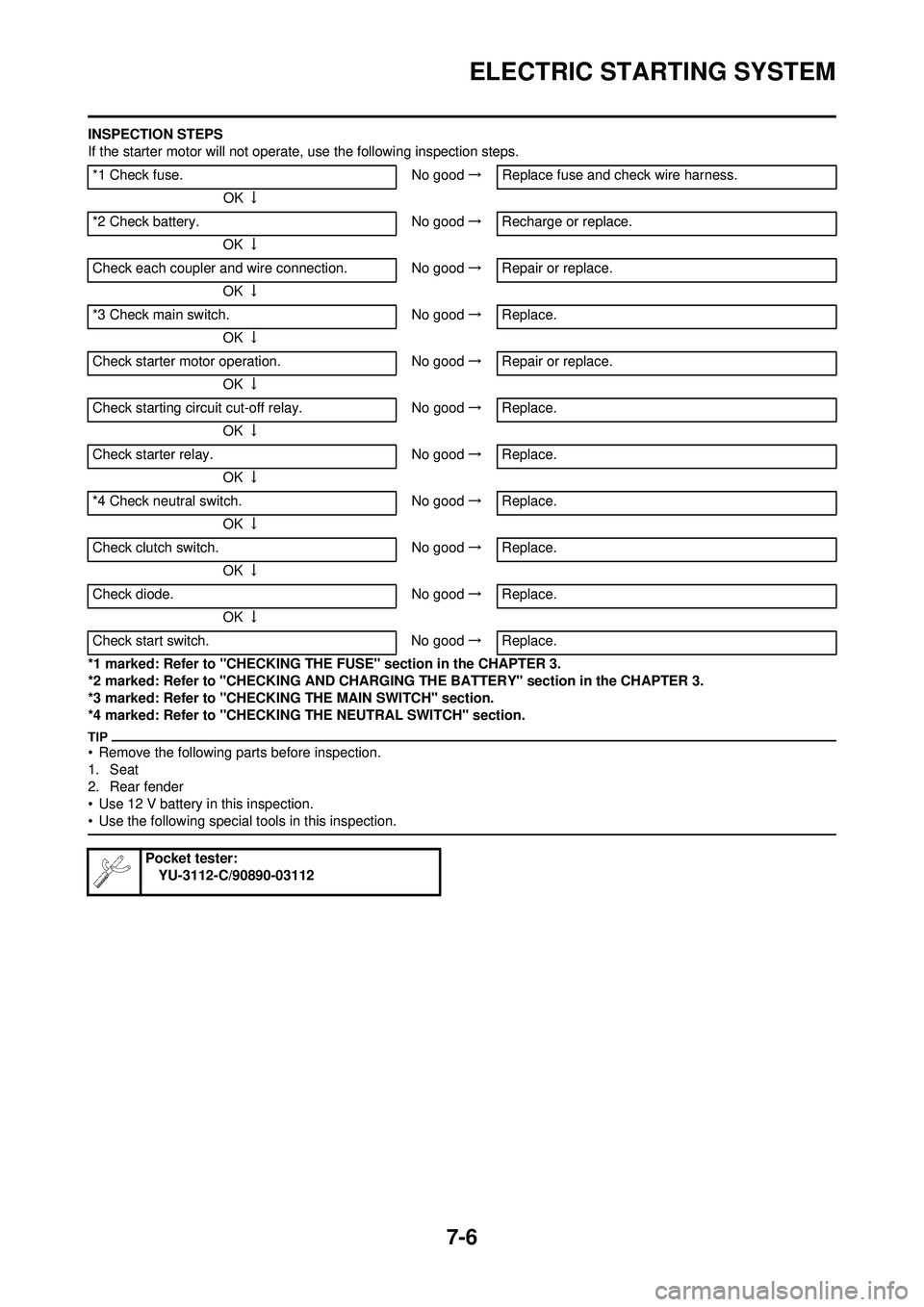
INSPECTION STEPS
If the starter motor will not operate, use the following inspection steps.
*1 marked: Refer to "CHECKING THE FUSE" section in the CHAPTER 3.
*2 marked: Refer to "CHECKING AND CHARGING THE BATTERY" section in the CHAPTER 3.
*3 marked: Refer to "CHECKING THE MAIN SWITCH" section.
*4 marked: Refer to "CHECKING THE NEUTRAL SWITCH" section.
• Remove the following parts before inspection.
1. Seat
2. Rear fender
• Use 12 V battery in this inspection.
• Use the following special tools in this inspection.
*1 Check fuse.No good→Replace fuse and check wire harness.
OK ↓
*2 Check battery. No good→Recharge or replace.
OK ↓
Check each coupler and wire connection. No good →Repair or replace.
OK ↓
*3 Check main switch. No good→Replace.
OK ↓
Check starter motor operation. No good→Repair or replace.
OK ↓
Check starting circuit cut-off relay. No good→Replace.
OK ↓
Check starter relay. No good→Replace.
OK ↓
*4 Check neutral switch. No good→Replace.
OK ↓
Check clutch switch. No good→Replace.
OK ↓
Check diode. No good→Replace.
OK ↓
Check start switch. No good→Replace.
Pocket tester:
YU-3112-C/90890-03112