light YAMAHA WR 250F 2009 User Guide
[x] Cancel search | Manufacturer: YAMAHA, Model Year: 2009, Model line: WR 250F, Model: YAMAHA WR 250F 2009Pages: 224, PDF Size: 13.93 MB
Page 41 of 224
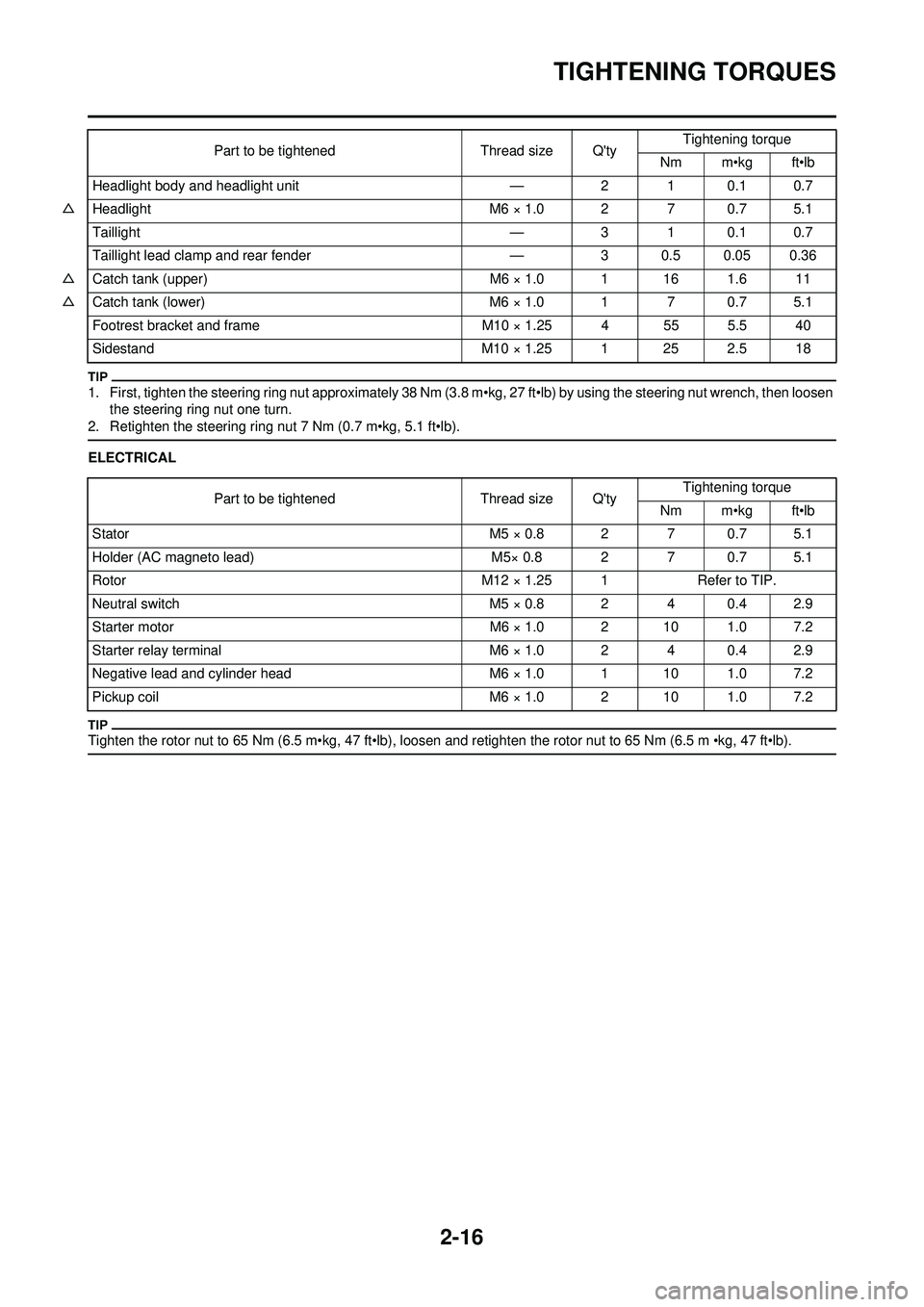
2-16
TIGHTENING TORQUES
1. First, tighten the steering ring nut approximately 38 Nm (3.8 m•kg, 27 ft•lb) by using the steering nut wrench, then loosen the steering ring nut one turn.
2. Retighten the steering ring nut 7 Nm (0.7 m•kg, 5.1 ft•lb).
ELECTRICAL
Tighten the rotor nut to 65 Nm (6.5 m•kg, 47 ft•lb), loosen and retighten the rotor nut to 65 Nm (6.5 m •kg, 47 ft•lb).
Headlight body and headlight unit —2 1 0.1 0.7
△ Headlight M6 × 1.0 2 7 0.7 5.1
Taillight —3 1 0.1 0.7
Taillight lead clamp and rear fender —3 0.5 0.05 0.36
△ Catch tank (upper) M6 × 1.0 1 16 1.6 11
△ Catch tank (lower) M6 × 1.0 1 7 0.7 5.1
Footrest bracket and frame M10 × 1.25 4 55 5.5 40
Sidestand M10 × 1.25 1 25 2.5 18
Part to be tightened
Thread size Q'tyTightening torque
Nm m•kg ft•lb
Part to be tightened Thread size Q'tyTightening torque
Nm m•kg ft•lb
Stator M5 × 0.8 2 7 0.7 5.1
Holder (AC magneto lead) M5× 0.8 2 7 0.7 5.1
Rotor M12 × 1.25 1Refer to TIP.
Neutral switch M5 × 0.8 2 4 0.4 2.9
Starter motor M6 × 1.0 2 10 1.0 7.2
Starter relay terminal M6 × 1.0 2 4 0.4 2.9
Negative lead and cylinder head M6 × 1.0 1 10 1.0 7.2
Pickup coil M6 × 1.0 2 10 1.0 7.2
Page 47 of 224
2-21
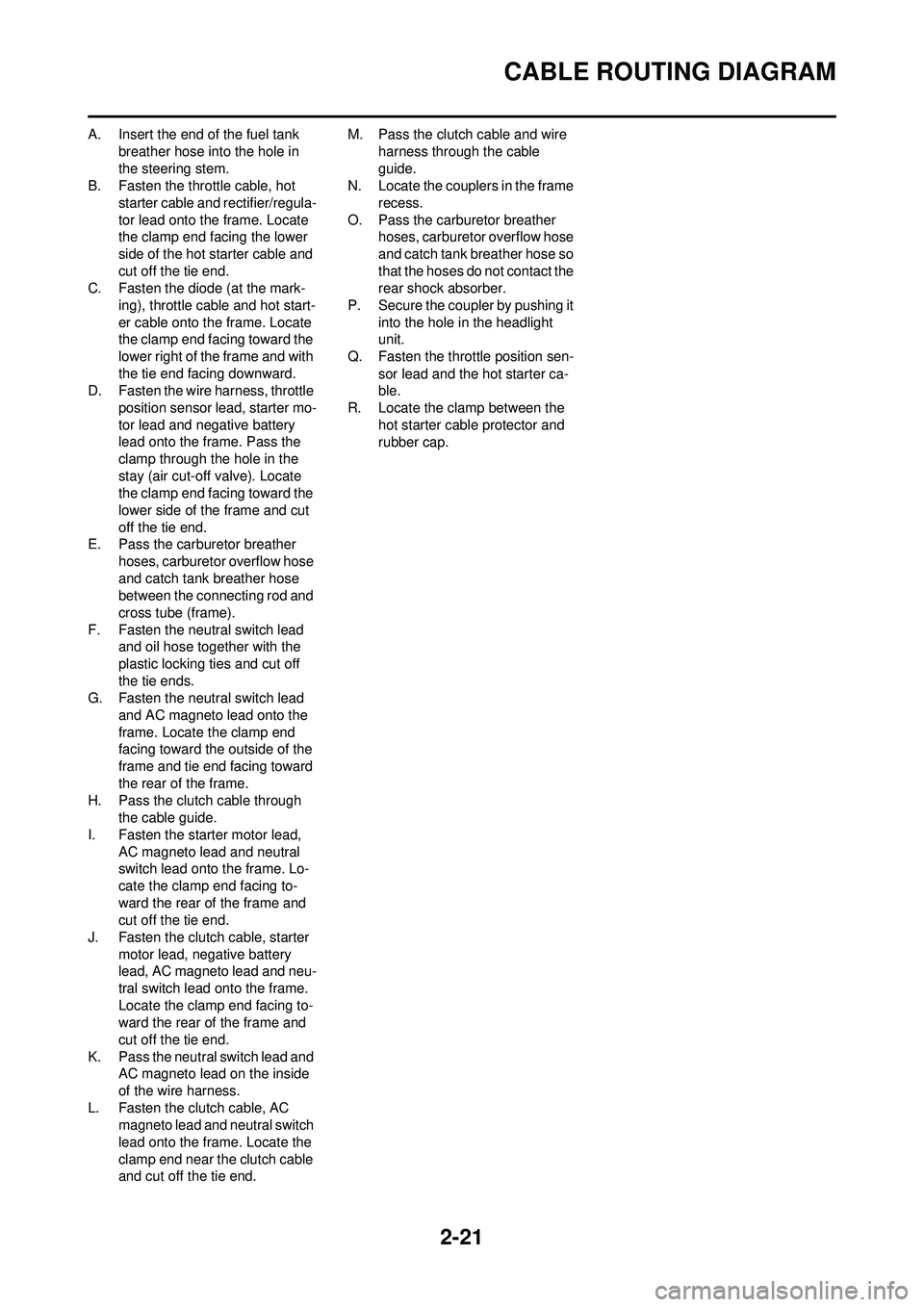
CABLE ROUTING DIAGRAM
A. Insert the end of the fuel tank breather hose into the hole in
the steering stem.
B. Fasten the throttle cable, hot
starter cable and rectifier/regula-
tor lead onto the frame. Locate
the clamp end facing the lower
side of the hot starter cable and
cut off the tie end.
C. Fasten the diode (at the mark-
ing), throttle cable and hot start-
er cable onto the frame. Locate
the clamp end facing toward the
lower right of the frame and with
the tie end facing downward.
D. Fasten the wire harness, throttle
position sensor lead, starter mo-
tor lead and negative battery
lead onto the frame. Pass the
clamp through the hole in the
stay (air cut-off valve). Locate
the clamp end facing toward the
lower side of the frame and cut
off the tie end.
E. Pass the carburetor breather
hoses, carburetor overflow hose
and catch tank breather hose
between the connecting rod and
cross tube (frame).
F. Fasten the neutral switch lead and oil hose together with the
plastic locking ties and cut off
the tie ends.
G. Fasten the neutral switch lead
and AC magneto lead onto the
frame. Locate the clamp end
facing toward the outside of the
frame and tie end facing toward
the rear of the frame.
H. Pass the clutch cable through the cable guide.
I. Fasten the starter motor lead, AC magneto lead and neutral
switch lead onto the frame. Lo-
cate the clamp end facing to-
ward the rear of the frame and
cut off the tie end.
J. Fasten the clutch cable, starter motor lead, negative battery
lead, AC magneto lead and neu-
tral switch lead onto the frame.
Locate the clamp end facing to-
ward the rear of the frame and
cut off the tie end.
K. Pass the neutral switch lead and AC magneto lead on the inside
of the wire harness.
L. Fasten the clutch cable, AC magneto lead and neutral switch
lead onto the frame. Locate the
clamp end near the clutch cable
and cut off the tie end. M. Pass the clutch cable and wire
harness through the cable
guide.
N. Locate the couplers in the frame
recess.
O. Pass the carburetor breather hoses, carburetor overflow hose
and catch tank breather hose so
that the hoses do not contact the
rear shock absorber.
P. Secure the coupler by pushing it into the hole in the headlight
unit.
Q. Fasten the throttle position sen- sor lead and the hot starter ca-
ble.
R. Locate the clamp between the hot starter cable protector and
rubber cap.
Page 49 of 224
2-23
CABLE ROUTING DIAGRAM
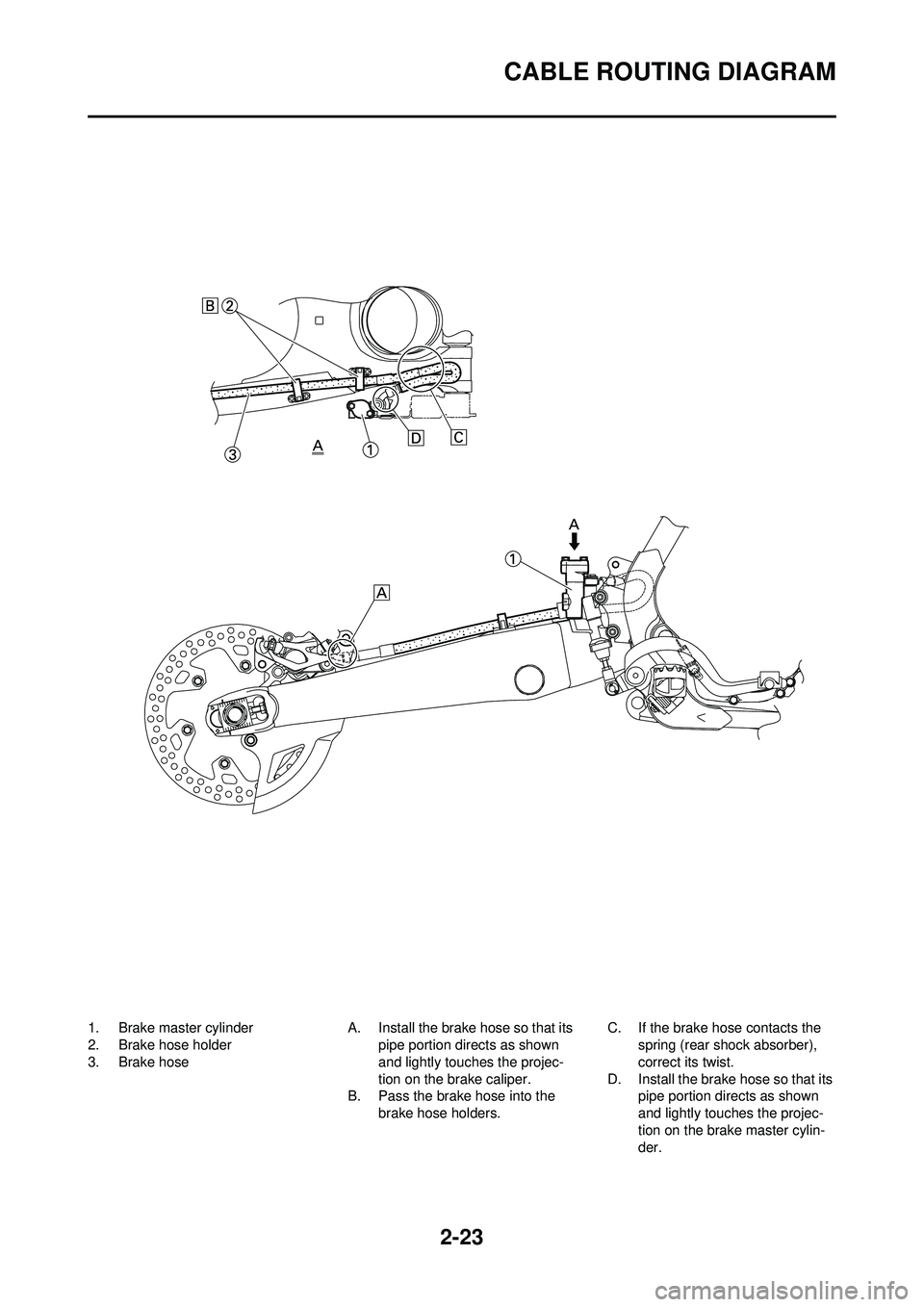
1. Brake master cylinder
2. Brake hose holder
3. Brake hoseA. Install the brake hose so that its
pipe portion directs as shown
and lightly touches the projec-
tion on the brake caliper.
B. Pass the brake hose into the
brake hose holders. C. If the brake hose contacts the
spring (rear shock absorber),
correct its twist.
D. Install the brake hose so that its pipe portion directs as shown
and lightly touches the projec-
tion on the brake master cylin-
der.
Page 50 of 224
2-24
CABLE ROUTING DIAGRAM
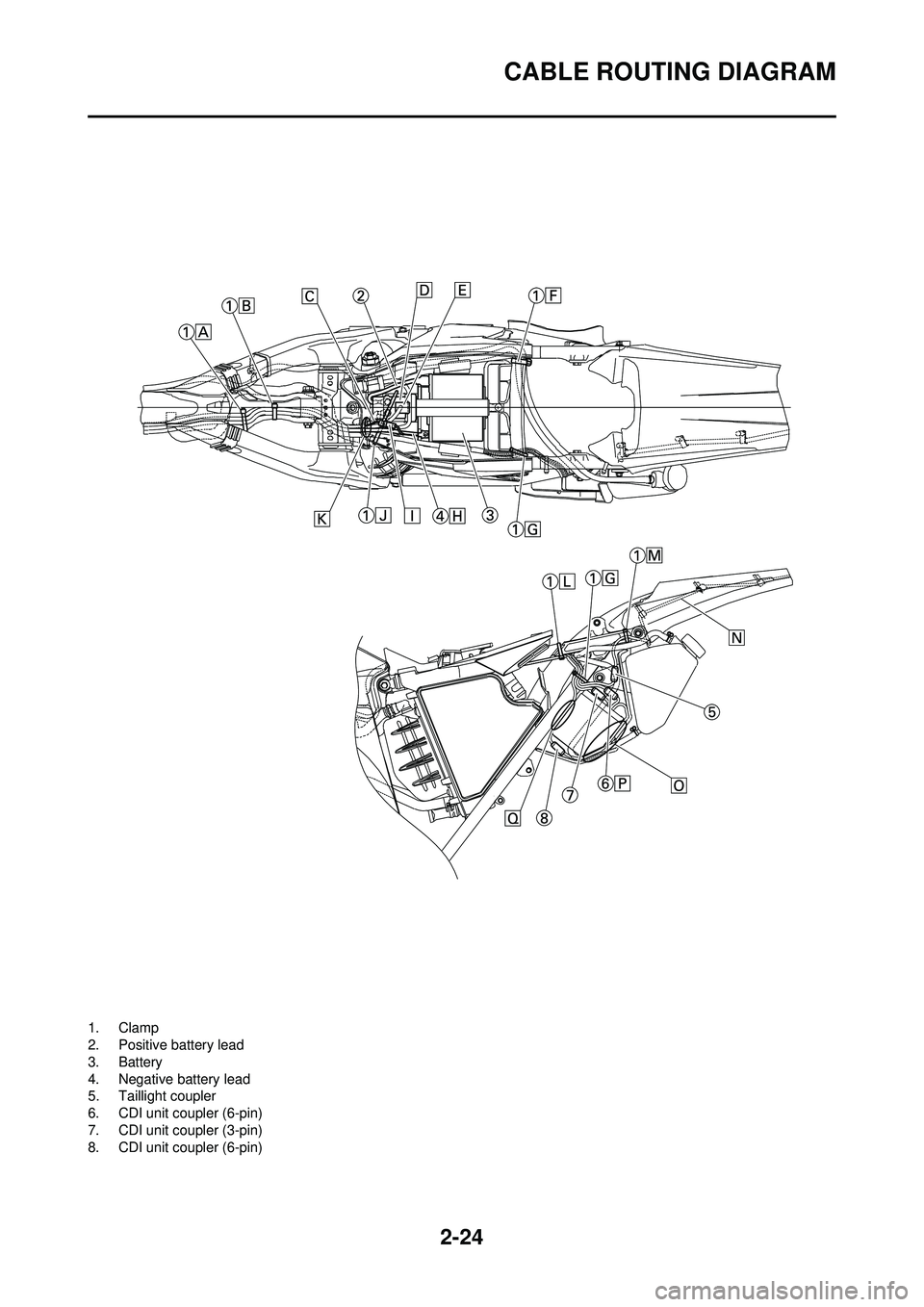
1. Clamp
2. Positive battery lead
3. Battery
4. Negative battery lead
5. Taillight coupler
6. CDI unit coupler (6-pin)
7. CDI unit coupler (3-pin)
8. CDI unit coupler (6-pin)
Page 51 of 224
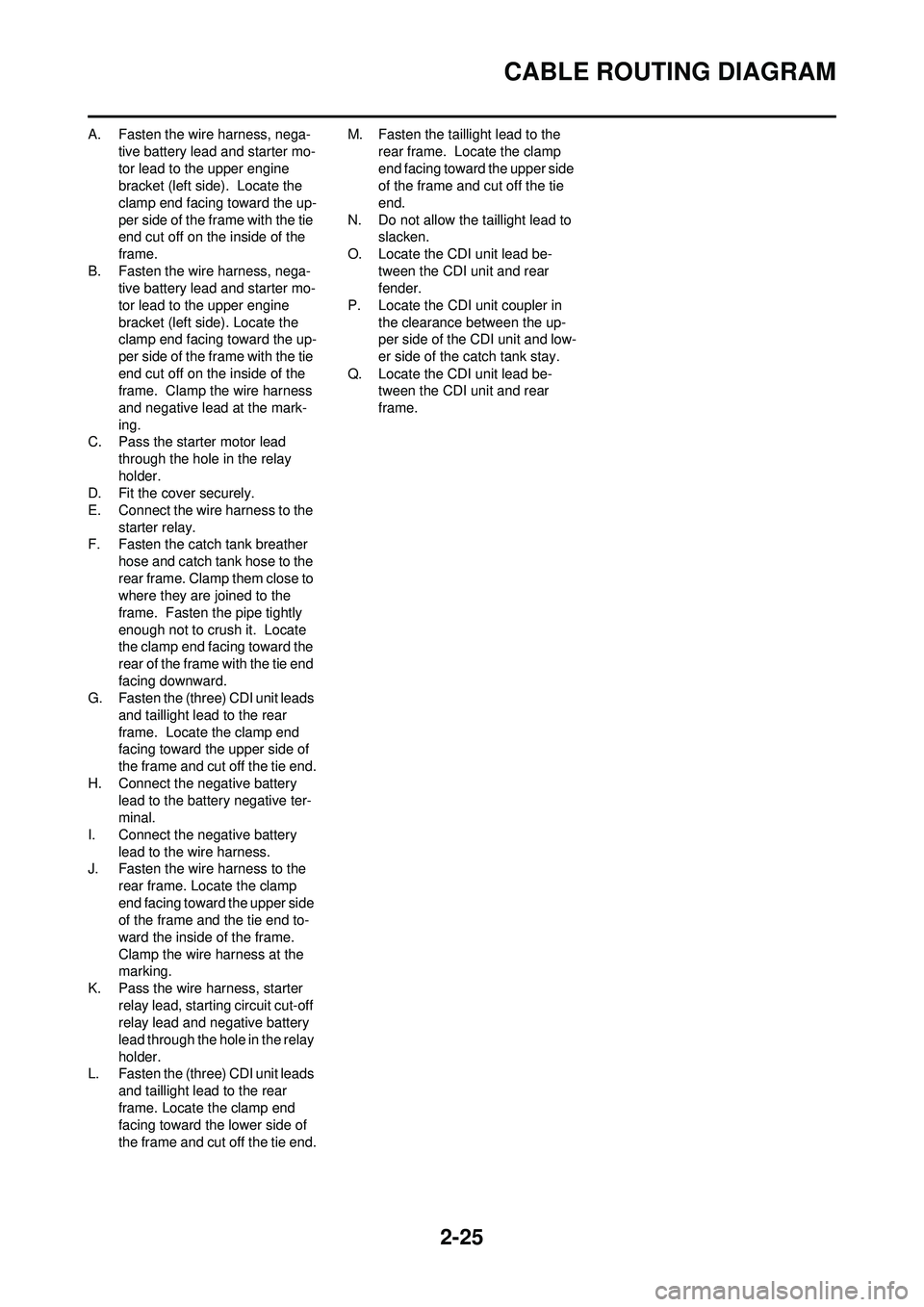
2-25
CABLE ROUTING DIAGRAM
A. Fasten the wire harness, nega-tive battery lead and starter mo-
tor lead to the upper engine
bracket (left side). Locate the
clamp end facing toward the up-
per side of the frame with the tie
end cut off on the inside of the
frame.
B. Fasten the wire harness, nega- tive battery lead and starter mo-
tor lead to the upper engine
bracket (left side). Locate the
clamp end facing toward the up-
per side of the frame with the tie
end cut off on the inside of the
frame. Clamp the wire harness
and negative lead at the mark-
ing.
C. Pass the starter motor lead
through the hole in the relay
holder.
D. Fit the cover securely.
E. Connect the wire harness to the
starter relay.
F. Fasten the catch tank breather
hose and catch tank hose to the
rear frame. Clamp them close to
where they are joined to the
frame. Fasten the pipe tightly
enough not to crush it. Locate
the clamp end facing toward the
rear of the frame with the tie end
facing downward.
G. Fasten the (three) CDI unit leads
and taillight lead to the rear
frame. Locate the clamp end
facing toward the upper side of
the frame and cut off the tie end.
H. Connect the negative battery lead to the battery negative ter-
minal.
I. Connect the negative battery lead to the wire harness.
J. Fasten the wire harness to the
rear frame. Locate the clamp
end facing toward the upper side
of the frame and the tie end to-
ward the inside of the frame.
Clamp the wire harness at the
marking.
K. Pass the wire harness, starter relay lead, starting circuit cut-off
relay lead and negative battery
lead through the hole in the relay
holder.
L. Fasten the (three) CDI unit leads
and taillight lead to the rear
frame. Locate the clamp end
facing toward the lower side of
the frame and cut off the tie end. M. Fasten the taillight lead to the
rear frame. Locate the clamp
end facing toward the upper side
of the frame and cut off the tie
end.
N. Do not allow the taillight lead to slacken.
O. Locate the CDI unit lead be- tween the CDI unit and rear
fender.
P. Locate the CDI unit coupler in the clearance between the up-
per side of the CDI unit and low-
er side of the catch tank stay.
Q. Locate the CDI unit lead be- tween the CDI unit and rear
frame.
Page 52 of 224
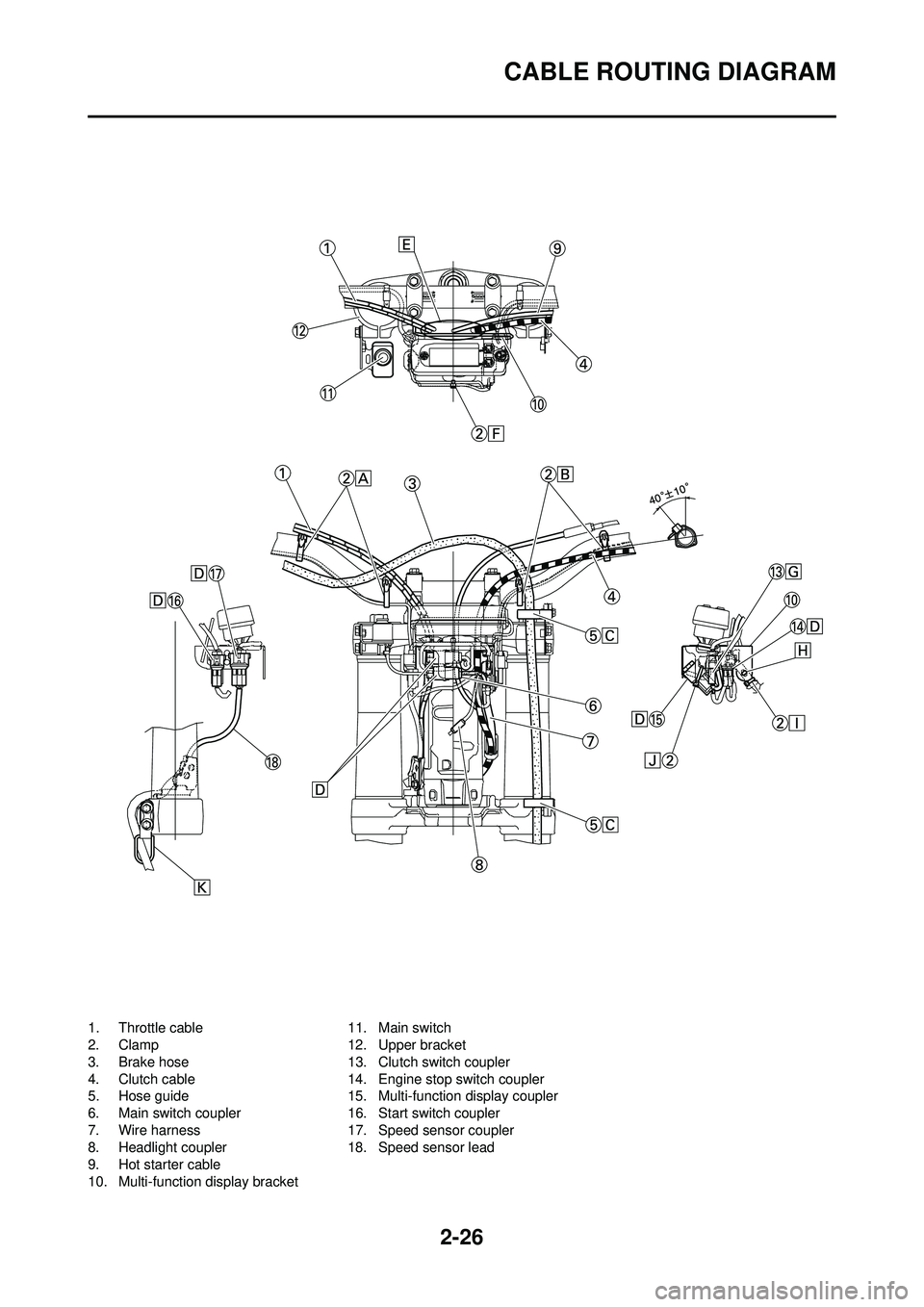
2-26
CABLE ROUTING DIAGRAM
1. Throttle cable
2. Clamp
3. Brake hose
4. Clutch cable
5. Hose guide
6. Main switch coupler
7. Wire harness
8. Headlight coupler
9. Hot starter cable
10. Multi-function display bracket11. Main switch
12. Upper bracket
13. Clutch switch coupler
14. Engine stop switch coupler
15. Multi-function display coupler
16. Start switch coupler
17. Speed sensor coupler
18. Speed sensor lead
Page 55 of 224
3-2
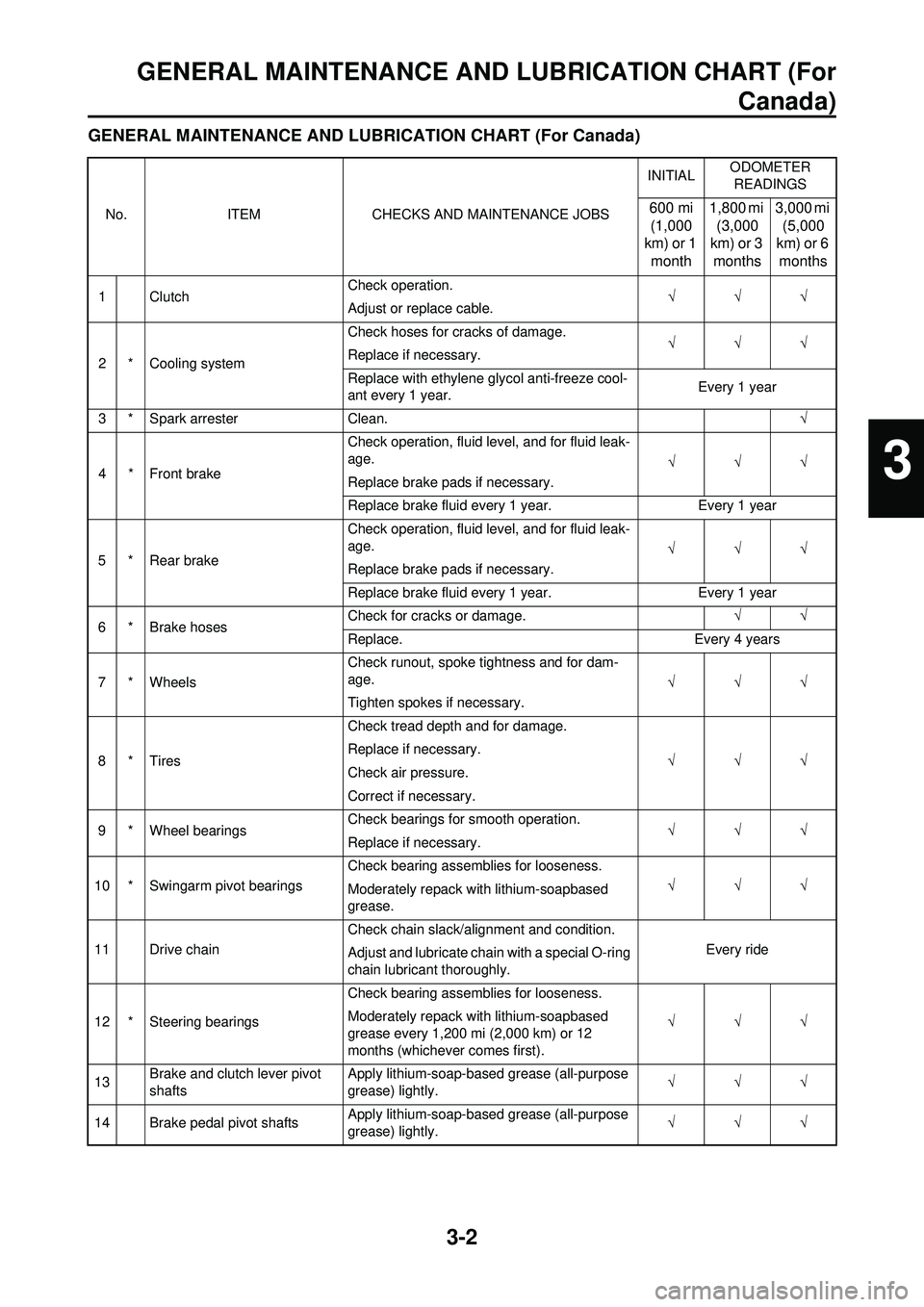
GENERAL MAINTENANCE AND LUBRICATION CHART (ForCanada)
GENERAL MAINTENANCE AND LUBRICATION CHART (For Canada)
No.ITEM CHECKS AND MAINTENANCE JOBS INITIAL
ODOMETER
READINGS600 mi (1,000
km) or 1
month 1,800 mi
(3,000
km) or 3
months 3,000 mi
(5,000
km) or 6
months
1Clutch Check operation.
√√√
Adjust or replace cable.
2 * Cooling system Check hoses for cracks of damage.
√√√
Replace if necessary.
Replace with ethylene glycol anti-freeze cool-
ant every 1 year. Every 1 year
3 * Spark arrester Clean. √
4 * Front brake Check operation, fluid level, and for fluid leak-
age.
√√√
Replace brake pads if necessary.
Replace brake fluid every 1 year. Every 1 year
5 * Rear brake Check operation, fluid level, and for fluid leak-
age.
√√√
Replace brake pads if necessary.
Replace brake fluid every 1 year. Every 1 year
6 * Brake hoses Check for cracks or damage.
√√
Replace. Every 4 years
7*Wheels Check runout, spoke tightness and for dam-
age.
√√√
Tighten spokes if necessary.
8*Tires Check tread depth and for damage.
√√√
Replace if necessary.
Check air pressure.
Correct if necessary.
9 * Wheel bearings Check bearings for smooth operation.
√√√
Replace if necessary.
10 * Swingarm pivot bearings Check bearing assemblies for looseness.
√√√
Moderately repack with lithium-soapbased
grease.
11 Drive chain Check chain slack/alignment and condition.
Every ride
Adjust and lubricate chain with a special O-ring
chain lubricant thoroughly.
12 * Steering bearings Check bearing assemblies for looseness.
√√√
Moderately repack with lithium-soapbased
grease every 1,200 mi (2,000 km) or 12
months (whichever comes first).
13 Brake and clutch lever pivot
shafts Apply lithium-soap-based grease (all-purpose
grease) lightly.
√√√
14 Brake pedal pivot shafts Apply lithium-soap-based grease (all-purpose
grease) lightly. √√√
3
Page 56 of 224
3-3
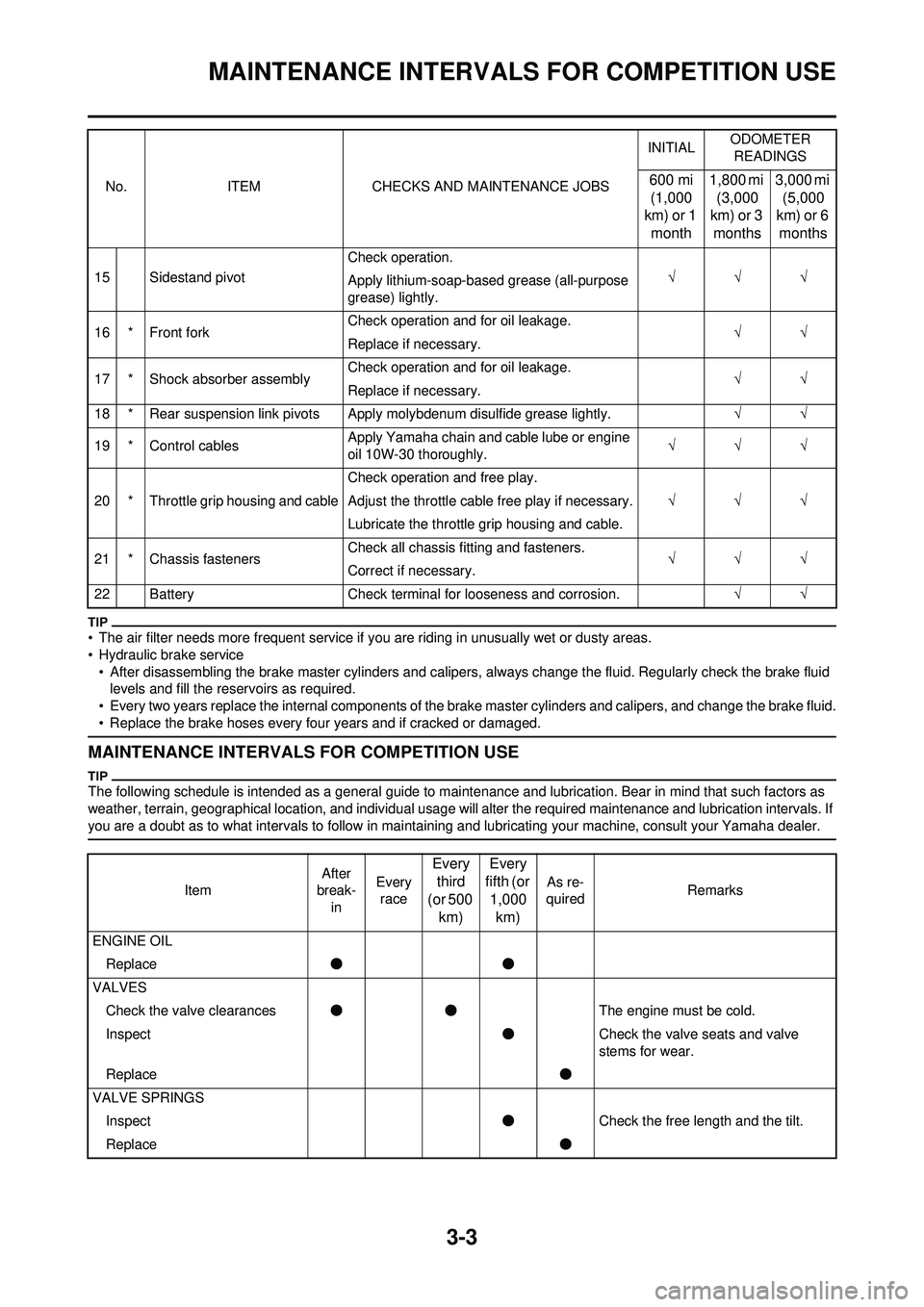
MAINTENANCE INTERVALS FOR COMPETITION USE
• The air filter needs more frequent service if you are riding in unusually wet or dusty areas.
• Hydraulic brake service• After disassembling the brake master cylinders and calipers, always change the fluid. Regularly check the brake fluid levels and fill the reservoirs as required.
• Every two years replace the internal components of the brake master cylinders and calipers, and change the brake fluid.
• Replace the brake hoses every four years and if cracked or damaged.
MAINTENANCE INTERVALS FOR COMPETITION USE
The following schedule is intended as a general guide to maintenance and lubrication. Bear in mind that such factors as
weather, terrain, geographical location, and individual usage will alter the required maintenance and lubrication intervals. If
you are a doubt as to what intervals to follow in maintaining and lubricating your machine, consult your Yamaha dealer.
15 Sidestand pivot Check operation.
√√√
Apply lithium-soap-based grease (all-purpose
grease) lightly.
16 * Front fork Check operation and for oil leakage.
√√
Replace if necessary.
17 * Shock absorber assembly Check operation and for oil leakage.
√√
Replace if necessary.
18 * Rear suspension link pivots Apply molybdenum disulfide grease lightly. √√
19 * Control cables Apply Yamaha chain and cable lube or engine
oil 10W-30 thoroughly. √√√
20 * Throttle grip housing and cable Check operation and free play.
√√√
Adjust the throttle cable free play if necessary.
Lubricate the throttle grip housing and cable.
21 * Chassis fasteners Check all chassis fitting and fasteners.
√√√
Correct if necessary.
22 Battery Check terminal for looseness and corrosion. √√
No.
ITEM CHECKS AND MAINTENANCE JOBS INITIAL
ODOMETER
READINGS
600 mi (1,000
km) or 1
month 1,800 mi
(3,000
km) or 3
months 3,000 mi
(5,000
km) or 6
months
Item After
break-
in Every
race
Every
third
(or 500 km) Every
fifth (or 1,000 km)
As re-
quired Remarks
ENGINE OIL Replace ●●
VALVES Check the valve clearances ●● The engine must be cold.
Inspect ●Check the valve seats and valve
stems for wear.
Replace ●
VALVE SPRINGS Inspect ●Check the free length and the tilt.
Replace ●
Page 61 of 224
3-8
ENGINE
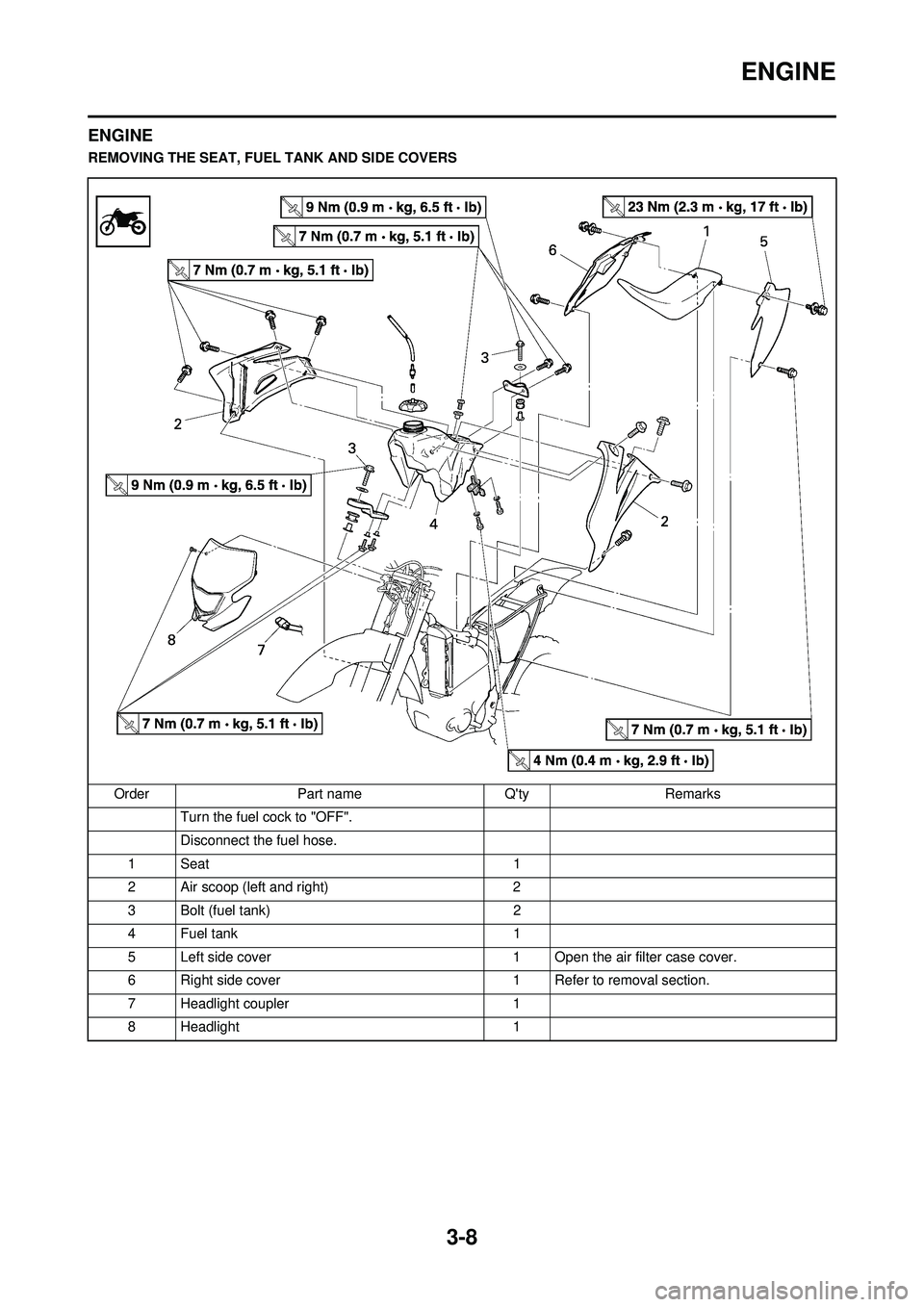
ENGINE
REMOVING THE SEAT, FUEL TANK AND SIDE COVERSOrder Part name Q'ty Remarks Turn the fuel cock to "OFF".
Disconnect the fuel hose.
1 Seat 1
2 Air scoop (left and right) 2
3 Bolt (fuel tank) 2
4 Fuel tank 1
5 Left side cover 1 Open the air filter case cover.
6 Right side cover 1 Refer to removal section.
7 Headlight coupler 1
8 Headlight 1
Page 69 of 224
3-16
ENGINE
CHECKING THE OIL PRESSURE
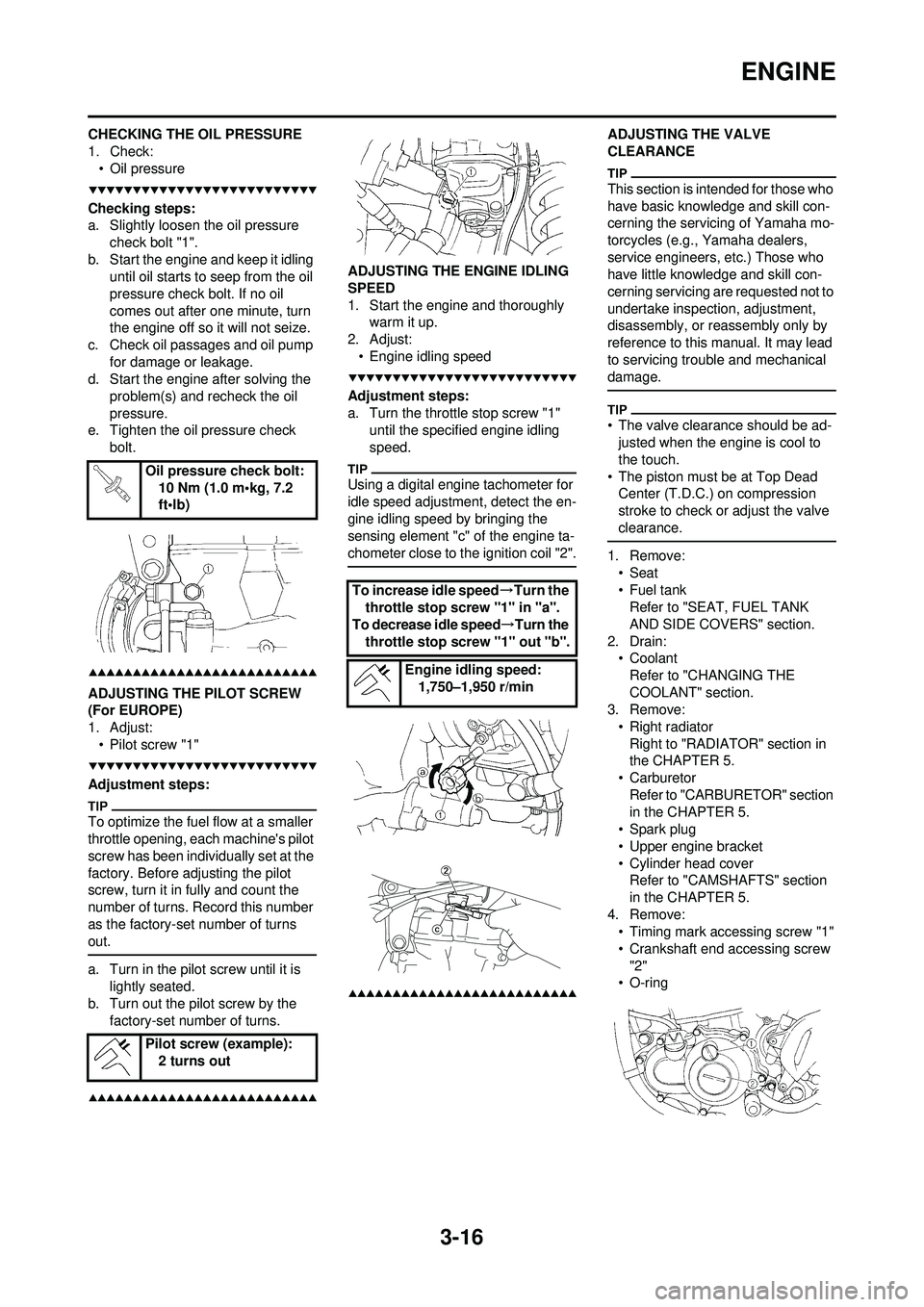
1. Check:•Oil pressure
Checking steps:
a. Slightly loosen the oil pressure check bolt "1".
b. Start the engine and keep it idling until oil starts to seep from the oil
pressure check bolt. If no oil
comes out after one minute, turn
the engine off so it will not seize.
c. Check oil passages and oil pump for damage or leakage.
d. Start the engine after solving the
problem(s) and recheck the oil
pressure.
e. Tighten the oil pressure check
bolt.
ADJUSTING THE PILOT SCREW
(For EUROPE)
1. Adjust:• Pilot screw "1"
Adjustment steps:
To optimize the fuel flow at a smaller
throttle opening, each machine's pilot
screw has been individually set at the
factory. Before adjusting the pilot
screw, turn it in fully and count the
number of turns. Record this number
as the factory-set number of turns
out.
a. Turn in the pilot screw until it is lightly seated.
b. Turn out the pilot screw by the
factory-set number of turns.
ADJUSTING THE ENGINE IDLING
SPEED
1. Start the engine and thoroughly warm it up.
2. Adjust: • Engine idling speed
Adjustment steps:
a. Turn the throttle stop screw "1" until the specified engine idling
speed.
Using a digital engine tachometer for
idle speed adjustment, detect the en-
gine idling speed by bringing the
sensing element "c" of the engine ta-
chometer close to the ignition coil "2".
ADJUSTING THE VALVE
CLEARANCE
This section is intended for those who
have basic knowledge and skill con-
cerning the servicing of Yamaha mo-
torcycles (e.g., Yamaha dealers,
service engineers, etc.) Those who
have little knowledge and skill con-
cerning servicing are requested not to
undertake inspection, adjustment,
disassembly, or reassembly only by
reference to this manual. It may lead
to servicing trouble and mechanical
damage.
• The valve clearance should be ad-justed when the engine is cool to
the touch.
• The piston must be at Top Dead Center (T.D.C.) on compression
stroke to check or adjust the valve
clearance.
1. Remove:
•Seat
• Fuel tankRefer to "SEAT, FUEL TANK
AND SIDE COVERS" section.
2. Drain: • Coolant
Refer to "CHANGING THE
COOLANT" section.
3. Remove:
• Right radiatorRight to "RADIATOR" section in
the CHAPTER 5.
•Carburetor Refer to "CARBURETOR" section
in the CHAPTER 5.
• Spark plug
• Upper engine bracket
• Cylinder head cover Refer to "CAMSHAFTS" section
in the CHAPTER 5.
4. Remove: • Timing mark accessing screw "1"
• Crankshaft end accessing screw
"2"
• O-ring
Oil pressure check bolt:
10 Nm (1.0 m•kg, 7.2
ft•lb)
Pilot screw (example): 2 turns out
To increase idle speed →Turn the
throttle stop screw "1" in "a".
To decrease idle speed→Turn the
throttle stop screw "1" out "b".
Engine idling speed:1,750–1,950 r/min