maintenance YAMAHA WR 250F 2016 User Guide
[x] Cancel search | Manufacturer: YAMAHA, Model Year: 2016, Model line: WR 250F, Model: YAMAHA WR 250F 2016Pages: 428, PDF Size: 14.13 MB
Page 105 of 428
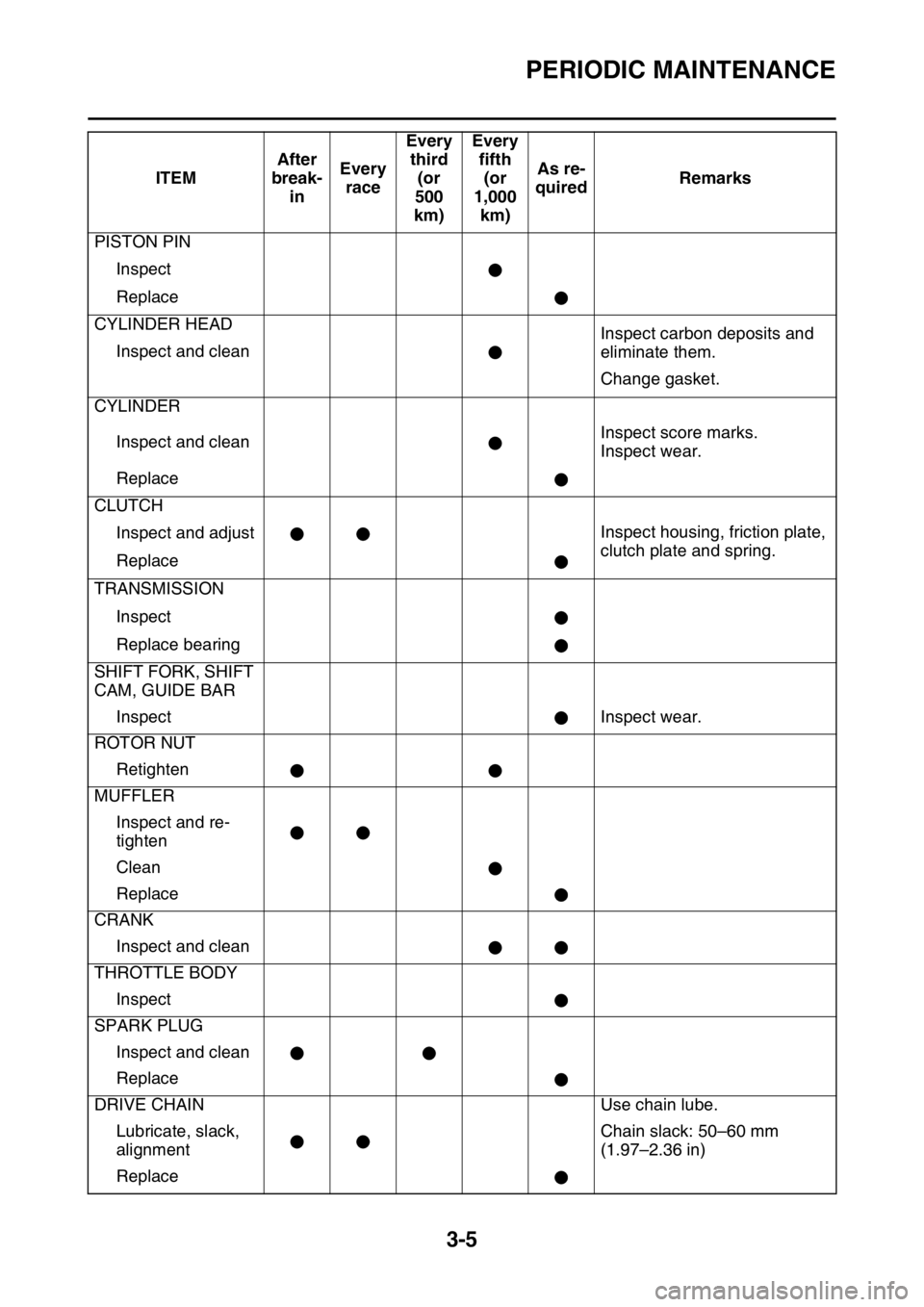
PERIODIC MAINTENANCE
3-5
PISTON PIN
Inspect
Replace
CYLINDER HEAD
Inspect carbon deposits and
eliminate them. Inspect and clean
Change gasket.
CYLINDER
Inspect and cleanInspect score marks.
Inspect wear.
Replace
CLUTCH
Inspect and adjustInspect housing, friction plate,
clutch plate and spring.
Replace
TRANSMISSION
Inspect
Replace bearing
SHIFT FORK, SHIFT
CAM, GUIDE BAR
Inspect Inspect wear.
ROTOR NUT
Retighten
MUFFLER
Inspect and re-
tighten
Clean
Replace
CRANK
Inspect and clean
THROTTLE BODY
Inspect
SPARK PLUG
Inspect and clean
Replace
DRIVE CHAIN Use chain lube.
Lubricate, slack,
alignmentChain slack: 50–60 mm
(1.97–2.36 in)
ReplaceITEMAfter
break-
inEvery
raceEvery
third
(or
500
km)Every
fifth
(or
1,000
km)As re-
quiredRemarks
Page 106 of 428
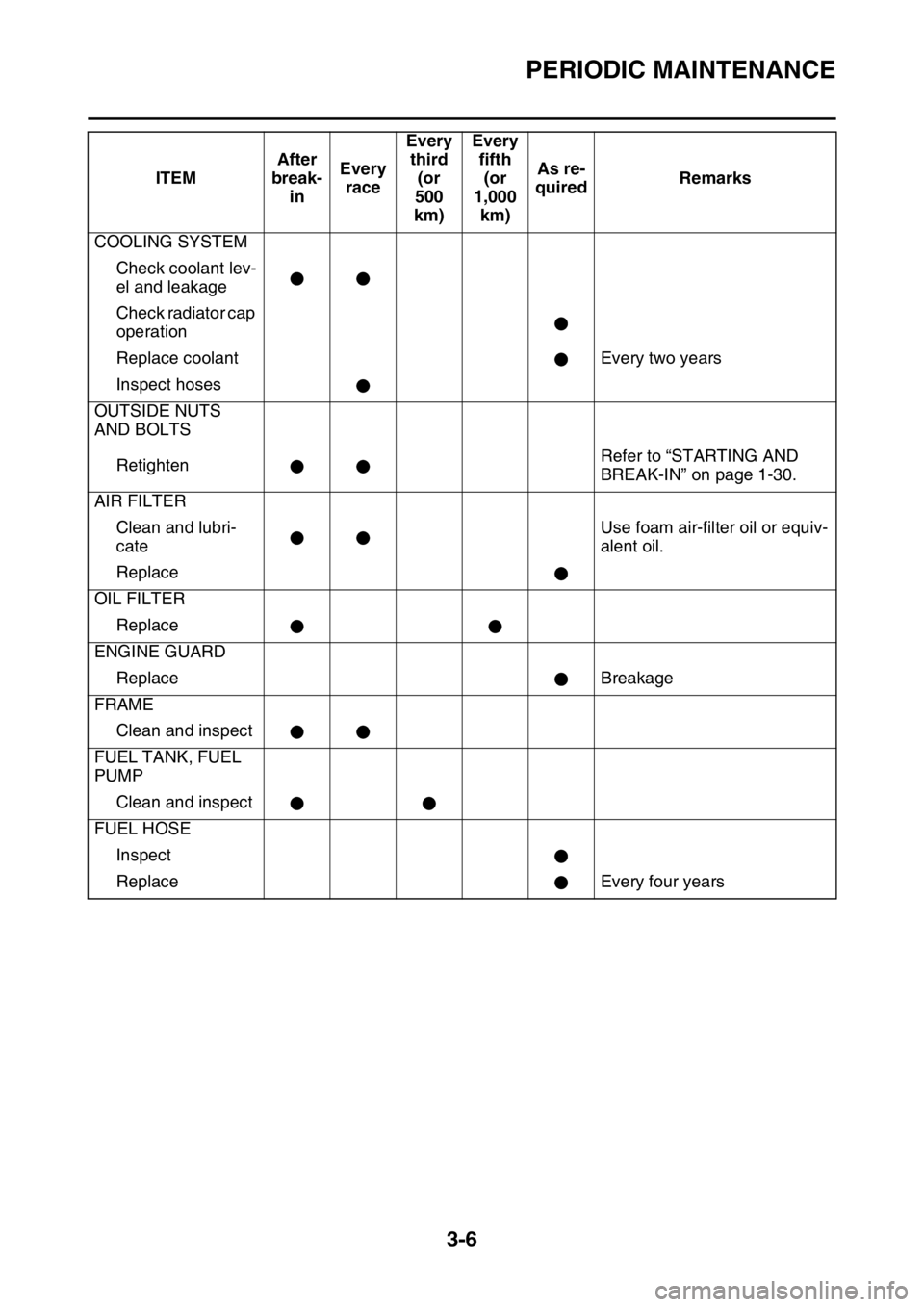
PERIODIC MAINTENANCE
3-6
COOLING SYSTEM
Check coolant lev-
el and leakage
Check radiator cap
operation
Replace coolant Every two years
Inspect hoses
OUTSIDE NUTS
AND BOLTS
RetightenRefer to “STARTING AND
BREAK-IN” on page 1-30.
AIR FILTER
Clean and lubri-
cateUse foam air-filter oil or equiv-
alent oil.
Replace
OIL FILTER
Replace
ENGINE GUARD
Replace Breakage
FRAME
Clean and inspect
FUEL TANK, FUEL
PUMP
Clean and inspect
FUEL HOSE
Inspect
Replace Every four yearsITEMAfter
break-
inEvery
raceEvery
third
(or
500
km)Every
fifth
(or
1,000
km)As re-
quiredRemarks
Page 107 of 428
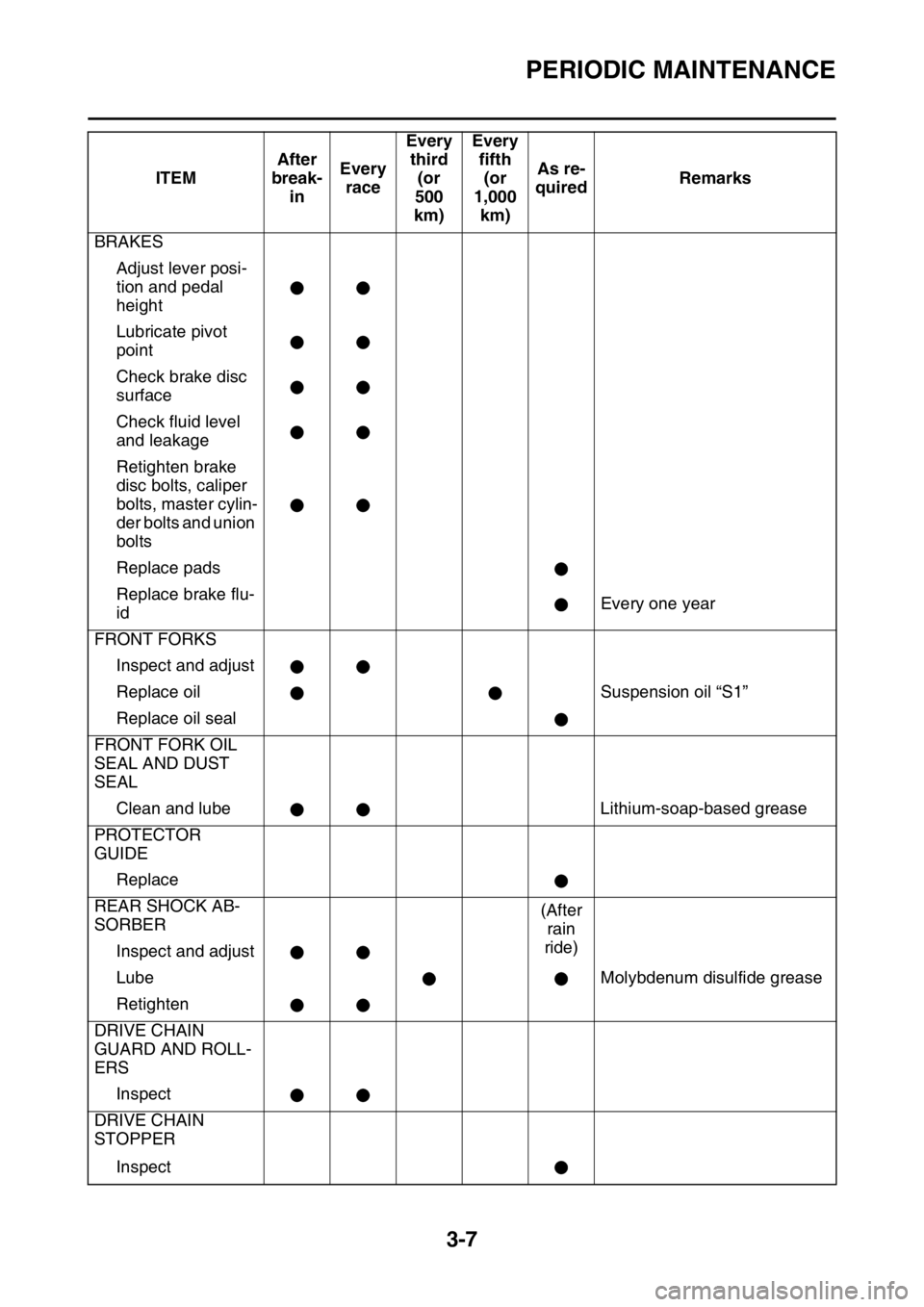
PERIODIC MAINTENANCE
3-7
BRAKES
Adjust lever posi-
tion and pedal
height
Lubricate pivot
point
Check brake disc
surface
Check fluid level
and leakage
Retighten brake
disc bolts, caliper
bolts, master cylin-
der bolts and union
bolts
Replace pads
Replace brake flu-
idEvery one year
FRONT FORKS
Inspect and adjust
Replace oil Suspension oil “S1”
Replace oil seal
FRONT FORK OIL
SEAL AND DUST
SEAL
Clean and lube Lithium-soap-based grease
PROTECTOR
GUIDE
Replace
REAR SHOCK AB-
SORBER(After
rain
ride)
Inspect and adjust
Lube Molybdenum disulfide grease
Retighten
DRIVE CHAIN
GUARD AND ROLL-
ERS
Inspect
DRIVE CHAIN
STOPPER
InspectITEMAfter
break-
inEvery
raceEvery
third
(or
500
km)Every
fifth
(or
1,000
km)As re-
quiredRemarks
Page 108 of 428
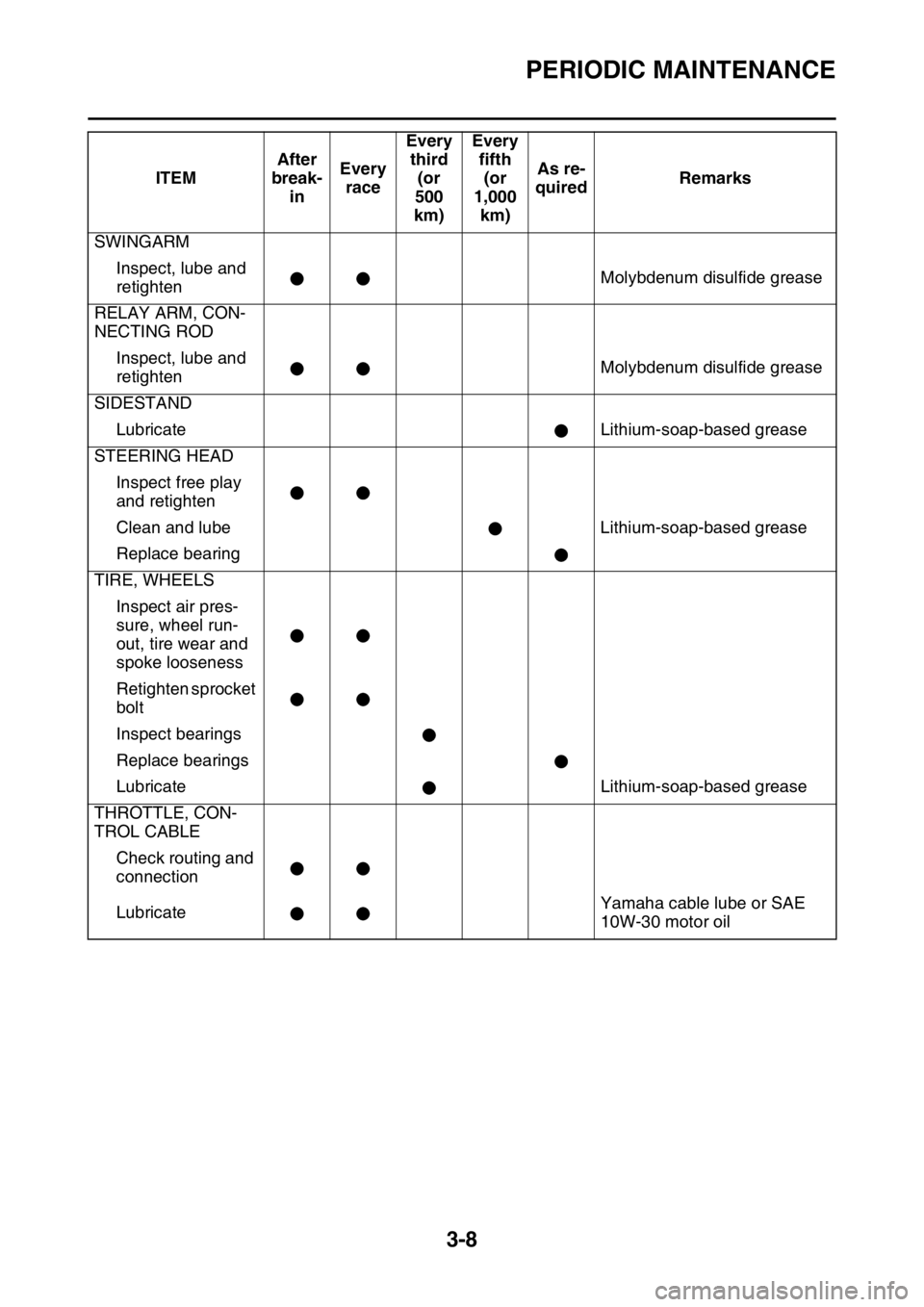
PERIODIC MAINTENANCE
3-8
SWINGARM
Inspect, lube and
retightenMolybdenum disulfide grease
RELAY ARM, CON-
NECTING ROD
Inspect, lube and
retightenMolybdenum disulfide grease
SIDESTAND
Lubricate Lithium-soap-based grease
STEERING HEAD
Inspect free play
and retighten
Clean and lube Lithium-soap-based grease
Replace bearing
TIRE, WHEELS
Inspect air pres-
sure, wheel run-
out, tire wear and
spoke looseness
Retighten sprocket
bolt
Inspect bearings
Replace bearings
Lubricate Lithium-soap-based grease
THROTTLE, CON-
TROL CABLE
Check routing and
connection
LubricateYamaha cable lube or SAE
10W-30 motor oil ITEMAfter
break-
inEvery
raceEvery
third
(or
500
km)Every
fifth
(or
1,000
km)As re-
quiredRemarks
Page 109 of 428
PRE-OPERATION INSPECTION AND MAINTENANCE
3-9
EAS2GB7079
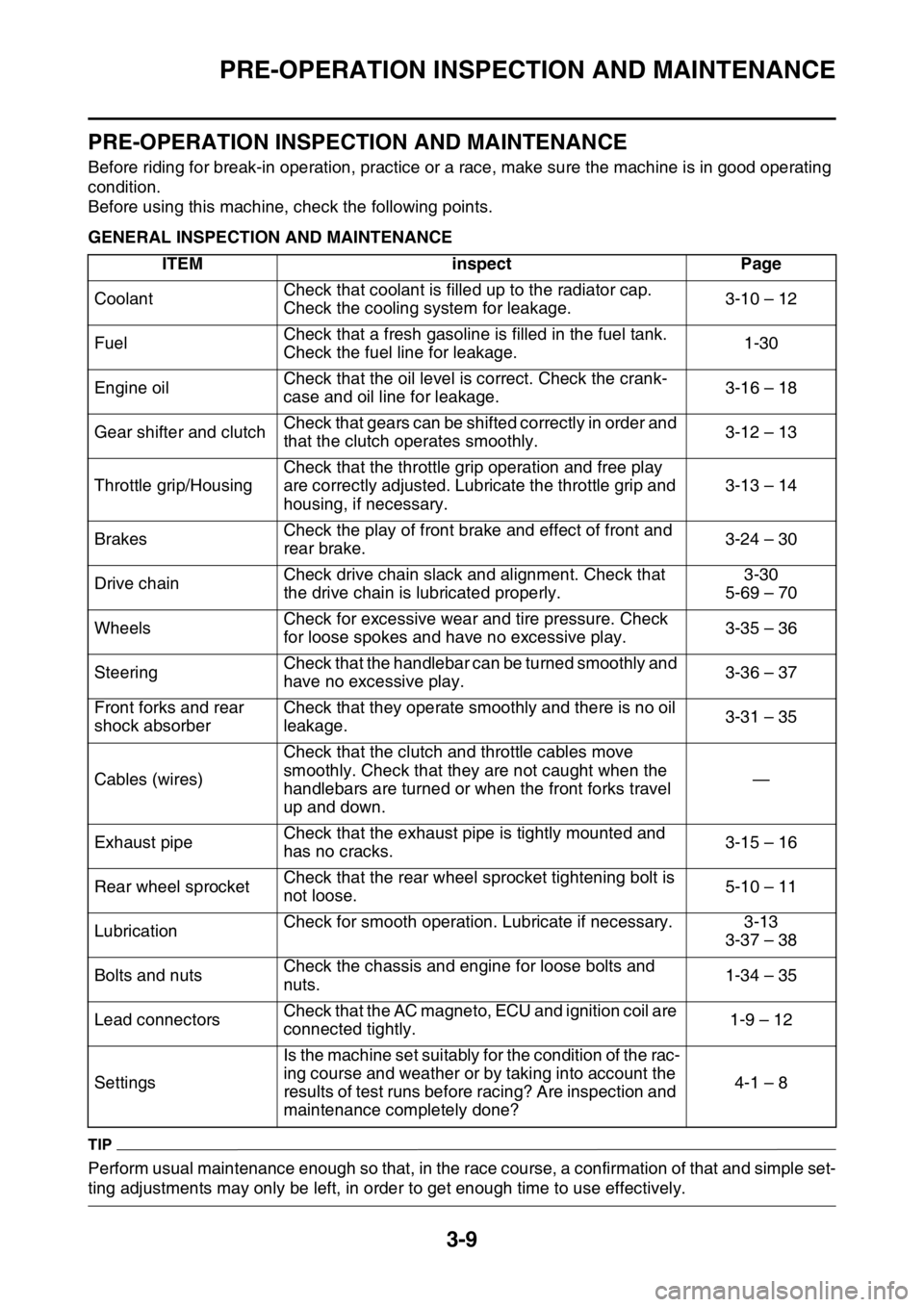
PRE-OPERATION INSPECTION AND MAINTENANCE
Before riding for break-in operation, practice or a race, make sure the machine is in good operating
condition.
Before using this machine, check the following points.
EAS2GB7080GENERAL INSPECTION AND MAINTENANCE
TIP
Perform usual maintenance enough so that, in the race course, a confirmation of that and simple set-
ting adjustments may only be left, in order to get enough time to use effectively.ITEM inspect Page
CoolantCheck that coolant is filled up to the radiator cap.
Check the cooling system for leakage.3-10 – 12
FuelCheck that a fresh gasoline is filled in the fuel tank.
Check the fuel line for leakage.1-30
Engine oilCheck that the oil level is correct. Check the crank-
case and oil line for leakage.3-16 – 18
Gear shifter and clutchCheck that gears can be shifted correctly in order and
that the clutch operates smoothly.3-12 – 13
Throttle grip/HousingCheck that the throttle grip operation and free play
are correctly adjusted. Lubricate the throttle grip and
housing, if necessary.3-13 – 14
BrakesCheck the play of front brake and effect of front and
rear brake.3-24 – 30
Drive chainCheck drive chain slack and alignment. Check that
the drive chain is lubricated properly.3-30
5-69 – 70
WheelsCheck for excessive wear and tire pressure. Check
for loose spokes and have no excessive play.3-35 – 36
SteeringCheck that the handlebar can be turned smoothly and
have no excessive play.3-36 – 37
Front forks and rear
shock absorberCheck that they operate smoothly and there is no oil
leakage.3-31 – 35
Cables (wires)Check that the clutch and throttle cables move
smoothly. Check that they are not caught when the
handlebars are turned or when the front forks travel
up and down.—
Exhaust pipeCheck that the exhaust pipe is tightly mounted and
has no cracks.3-15 – 16
Rear wheel sprocketCheck that the rear wheel sprocket tightening bolt is
not loose.5-10 – 11
LubricationCheck for smooth operation. Lubricate if necessary. 3-13
3-37 – 38
Bolts and nutsCheck the chassis and engine for loose bolts and
nuts.1-34 – 35
Lead connectorsCheck that the AC magneto, ECU and ignition coil are
connected tightly.1-9 – 12
SettingsIs the machine set suitably for the condition of the rac-
ing course and weather or by taking into account the
results of test runs before racing? Are inspection and
maintenance completely done?4-1 – 8
Page 364 of 428
FUEL INJECTION SYSTEM
9-32
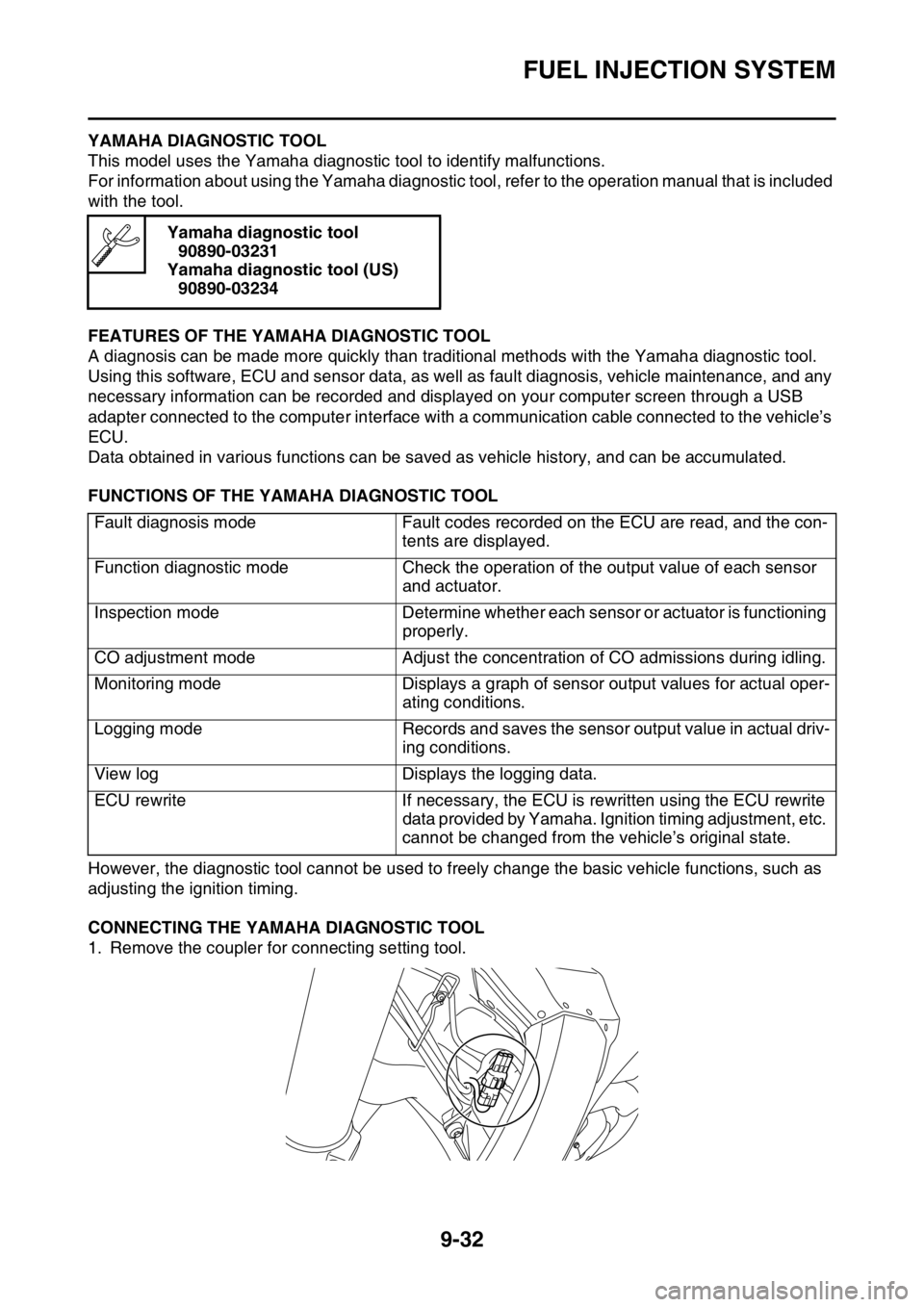
EAS2GB7376YAMAHA DIAGNOSTIC TOOL
This model uses the Yamaha diagnostic tool to identify malfunctions.
For information about using the Yamaha diagnostic tool, refer to the operation manual that is included
with the tool.
FEATURES OF THE YAMAHA DIAGNOSTIC TOOL
A diagnosis can be made more quickly than traditional methods with the Yamaha diagnostic tool.
Using this software, ECU and sensor data, as well as fault diagnosis, vehicle maintenance, and any
necessary information can be recorded and displayed on your computer screen through a USB
adapter connected to the computer interface with a communication cable connected to the vehicle’s
ECU.
Data obtained in various functions can be saved as vehicle history, and can be accumulated.
FUNCTIONS OF THE YAMAHA DIAGNOSTIC TOOL
However, the diagnostic tool cannot be used to freely change the basic vehicle functions, such as
adjusting the ignition timing.
CONNECTING THE YAMAHA DIAGNOSTIC TOOL
1. Remove the coupler for connecting setting tool.Yamaha diagnostic tool
90890-03231
Yamaha diagnostic tool (US)
90890-03234
Fault diagnosis mode Fault codes recorded on the ECU are read, and the con-
tents are displayed.
Function diagnostic mode Check the operation of the output value of each sensor
and actuator.
Inspection mode Determine whether each sensor or actuator is functioning
properly.
CO adjustment mode Adjust the concentration of CO admissions during idling.
Monitoring mode Displays a graph of sensor output values for actual oper-
ating conditions.
Logging mode Records and saves the sensor output value in actual driv-
ing conditions.
View log Displays the logging data.
ECU rewrite If necessary, the ECU is rewritten using the ECU rewrite
data provided by Yamaha. Ignition timing adjustment, etc.
cannot be changed from the vehicle’s original state.
Page 367 of 428

FUEL INJECTION SYSTEM
9-35
6. Condition
The current conditions are displayed. (Detected/Recovered)
7. Symptom
The symptoms of the detected malfunction are displayed.
8. Diagnosis code
The diagnosis codes related to the detected malfunction are displayed.
9. FFD (only for models that can display freeze frame data)
The mark “ ” is displayed when the freeze frame data is available.
10.ECU conduction time (hour: minute: second)
The total ECU conduction time (total hours the vehicle’s start switch was ON) when the malfunc-
tion was detected is displayed.
11.Number of main switch operation after detection
The number of times the meter light comes on by pushing the start switch between the malfunction
detection and code reading is displayed.
12.Number of occurrences
The number of malfunction occurrences between the malfunction detection and code reading is
displayed.
EAS2GB7377TROUBLESHOOTING DETAILS
This section describes the measures per fault code number displayed on the diagnostic tool. Check
and service the items or components that are the probable cause of the malfunction following the or-
der given.
After the check and service of the malfunctioning part have been completed, reset the diagnostic tool
display according to the reinstatement method.
Fault code No.:
Fault code number displayed on the diagnostic tool when the engine failed to work normally.
Diagnostic code No.:
Diagnostic code number to be used when the diagnostic mode is operated.
Fault code No. 12
ItemCrankshaft position sensor: no normal signals are received
from the crankshaft position sensor.
Fail-safe systemUnable to start engine
Unable to drive vehicle
Diagnostic code No.—
Diagnostic tool display—
Procedure—
ItemProbable cause of malfunc-
tion and checkMaintenance jobConfirmation of service
completion
1 Connection of crankshaft po-
sition sensor coupler.
Check the locking condition
of the coupler.
Disconnect the coupler and
check the pins (bent or bro-
ken terminals and locking
condition of the pins).Improperly connected
Connect the coupler securely
or repair/replace the wire har-
ness.Crank the engine.
Fault code number is not dis-
played Service is finished.
Fault code number is dis-
played Go to item 2.
Page 369 of 428
FUEL INJECTION SYSTEM
9-37
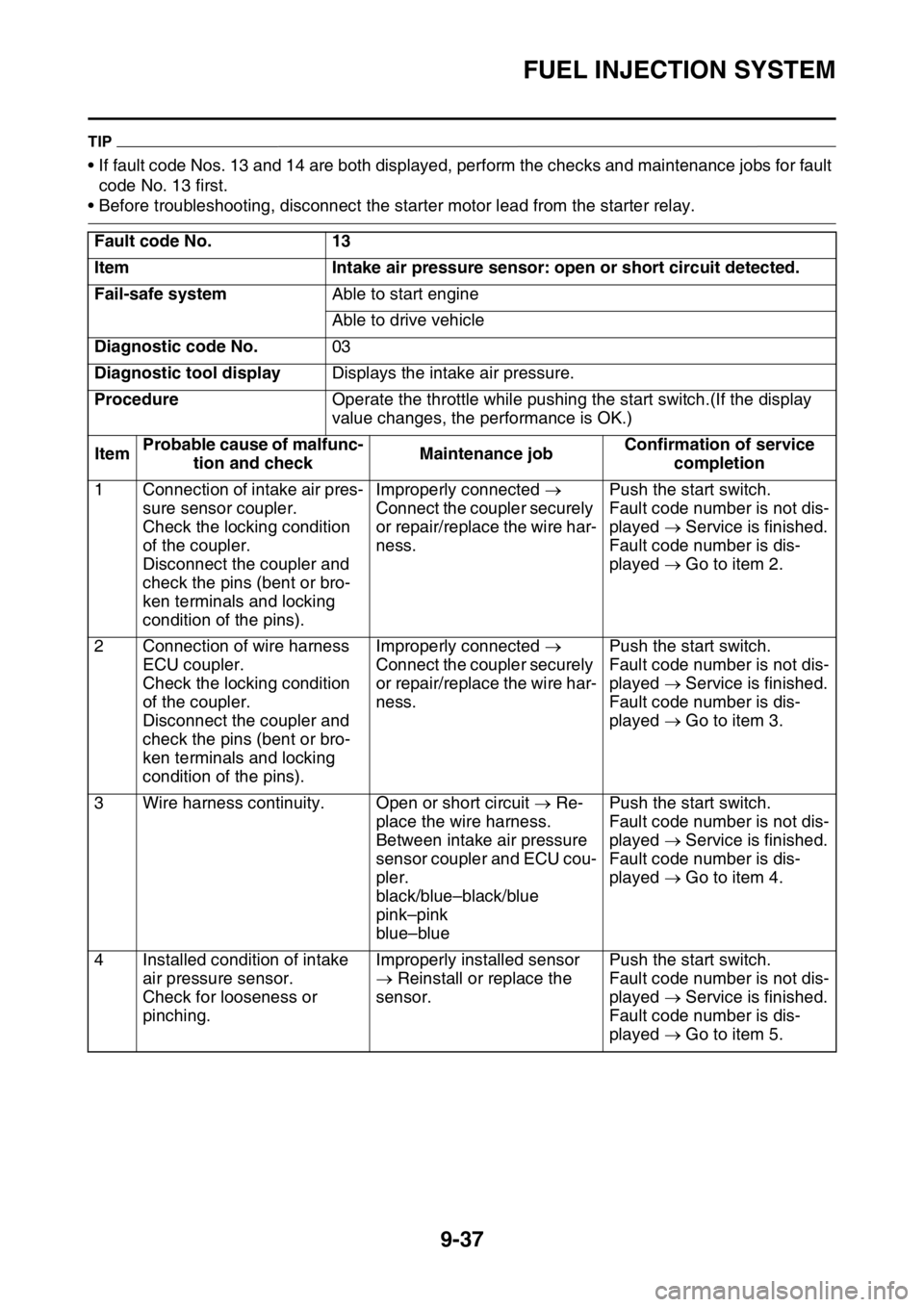
TIP
• If fault code Nos. 13 and 14 are both displayed, perform the checks and maintenance jobs for fault
code No. 13 first.
• Before troubleshooting, disconnect the starter motor lead from the starter relay.
Fault code No. 13
Item Intake air pressure sensor: open or short circuit detected.
Fail-safe systemAble to start engine
Able to drive vehicle
Diagnostic code No.03
Diagnostic tool displayDisplays the intake air pressure.
ProcedureOperate the throttle while pushing the start switch.(If the display
value changes, the performance is OK.)
ItemProbable cause of malfunc-
tion and checkMaintenance jobConfirmation of service
completion
1 Connection of intake air pres-
sure sensor coupler.
Check the locking condition
of the coupler.
Disconnect the coupler and
check the pins (bent or bro-
ken terminals and locking
condition of the pins).Improperly connected
Connect the coupler securely
or repair/replace the wire har-
ness.Push the start switch.
Fault code number is not dis-
played Service is finished.
Fault code number is dis-
played Go to item 2.
2 Connection of wire harness
ECU coupler.
Check the locking condition
of the coupler.
Disconnect the coupler and
check the pins (bent or bro-
ken terminals and locking
condition of the pins).Improperly connected
Connect the coupler securely
or repair/replace the wire har-
ness.Push the start switch.
Fault code number is not dis-
played Service is finished.
Fault code number is dis-
played Go to item 3.
3 Wire harness continuity. Open or short circuit Re-
place the wire harness.
Between intake air pressure
sensor coupler and ECU cou-
pler.
black/blue–black/blue
pink–pink
blue–bluePush the start switch.
Fault code number is not dis-
played Service is finished.
Fault code number is dis-
played Go to item 4.
4 Installed condition of intake
air pressure sensor.
Check for looseness or
pinching.Improperly installed sensor
Reinstall or replace the
sensor.Push the start switch.
Fault code number is not dis-
played Service is finished.
Fault code number is dis-
played Go to item 5.
Page 370 of 428
FUEL INJECTION SYSTEM
9-38
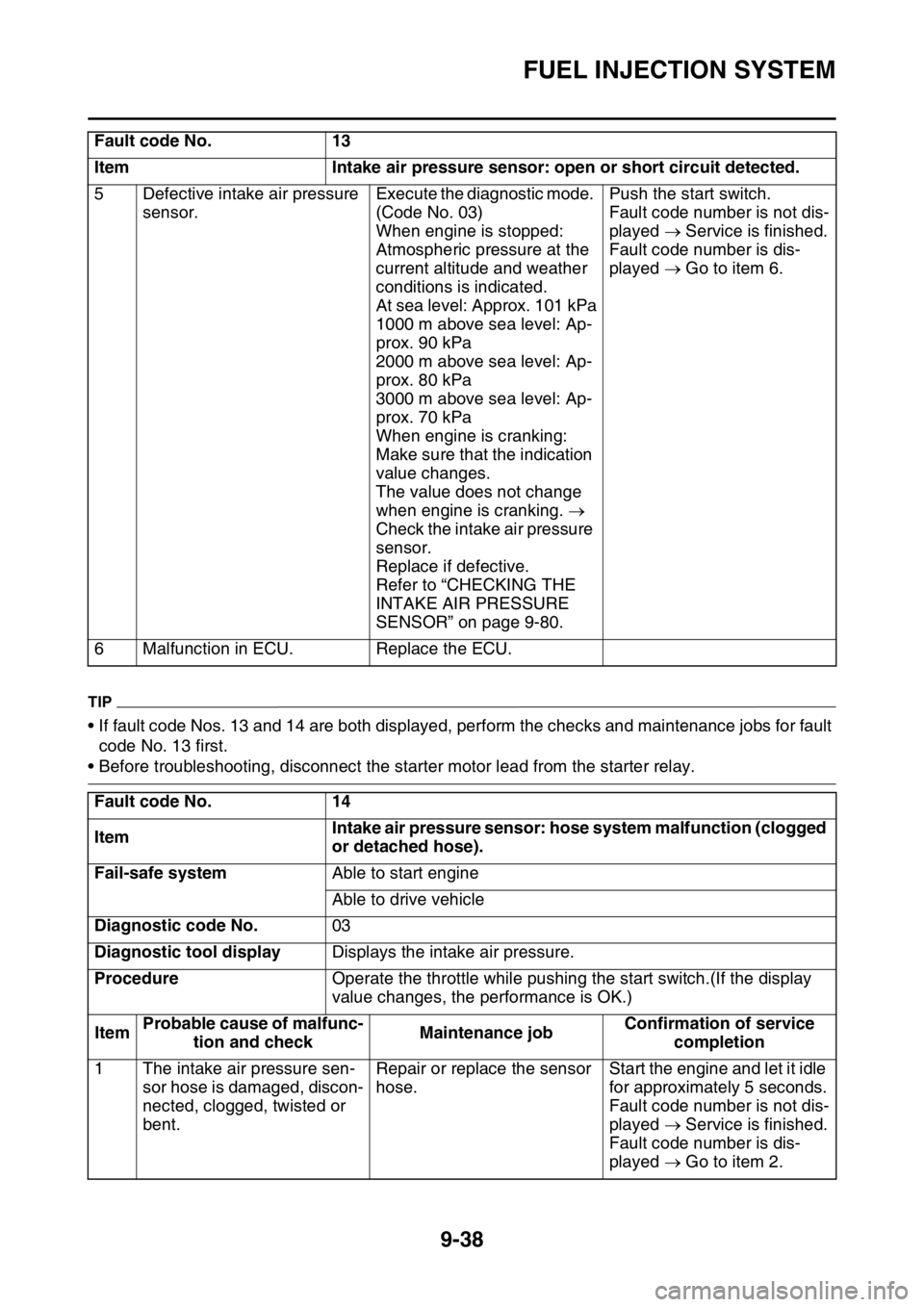
TIP
• If fault code Nos. 13 and 14 are both displayed, perform the checks and maintenance jobs for fault
code No. 13 first.
• Before troubleshooting, disconnect the starter motor lead from the starter relay. 5 Defective intake air pressure
sensor.Execute the diagnostic mode.
(Code No. 03)
When engine is stopped:
Atmospheric pressure at the
current altitude and weather
conditions is indicated.
At sea level: Approx. 101 kPa
1000 m above sea level: Ap-
prox. 90 kPa
2000 m above sea level: Ap-
prox. 80 kPa
3000 m above sea level: Ap-
prox. 70 kPa
When engine is cranking:
Make sure that the indication
value changes.
The value does not change
when engine is cranking.
Check the intake air pressure
sensor.
Replace if defective.
Refer to “CHECKING THE
INTAKE AIR PRESSURE
SENSOR” on page 9-80.Push the start switch.
Fault code number is not dis-
played Service is finished.
Fault code number is dis-
played Go to item 6.
6 Malfunction in ECU. Replace the ECU.
Fault code No. 14
ItemIntake air pressure sensor: hose system malfunction (clogged
or detached hose).
Fail-safe systemAble to start engine
Able to drive vehicle
Diagnostic code No.03
Diagnostic tool displayDisplays the intake air pressure.
ProcedureOperate the throttle while pushing the start switch.(If the display
value changes, the performance is OK.)
ItemProbable cause of malfunc-
tion and checkMaintenance jobConfirmation of service
completion
1 The intake air pressure sen-
sor hose is damaged, discon-
nected, clogged, twisted or
bent.Repair or replace the sensor
hose.Start the engine and let it idle
for approximately 5 seconds.
Fault code number is not dis-
played Service is finished.
Fault code number is dis-
played Go to item 2. Fault code No. 13
Item Intake air pressure sensor: open or short circuit detected.
Page 371 of 428
FUEL INJECTION SYSTEM
9-39
TIP
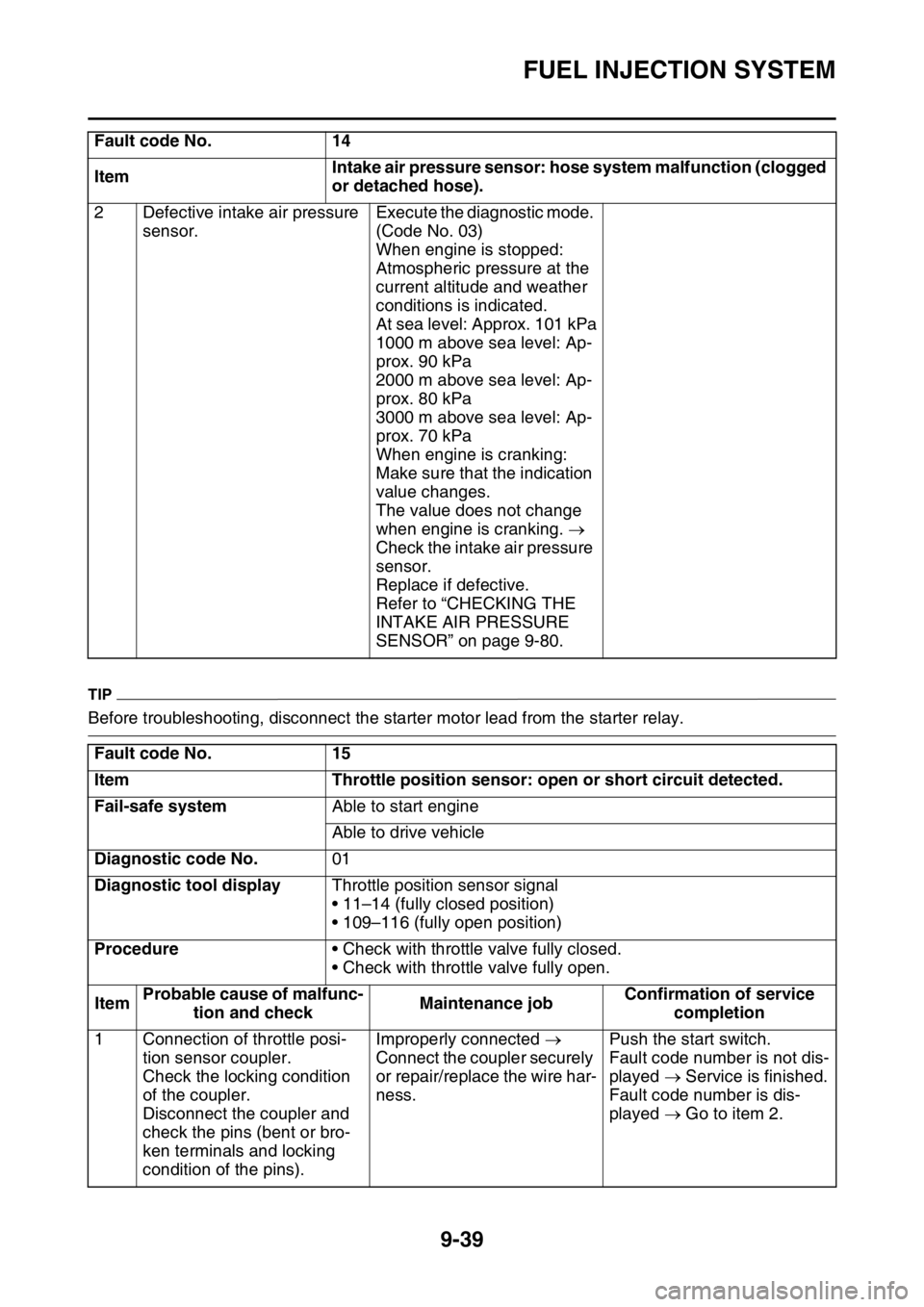
Before troubleshooting, disconnect the starter motor lead from the starter relay. 2 Defective intake air pressure
sensor.Execute the diagnostic mode.
(Code No. 03)
When engine is stopped:
Atmospheric pressure at the
current altitude and weather
conditions is indicated.
At sea level: Approx. 101 kPa
1000 m above sea level: Ap-
prox. 90 kPa
2000 m above sea level: Ap-
prox. 80 kPa
3000 m above sea level: Ap-
prox. 70 kPa
When engine is cranking:
Make sure that the indication
value changes.
The value does not change
when engine is cranking.
Check the intake air pressure
sensor.
Replace if defective.
Refer to “CHECKING THE
INTAKE AIR PRESSURE
SENSOR” on page 9-80.
Fault code No. 15
Item Throttle position sensor: open or short circuit detected.
Fail-safe systemAble to start engine
Able to drive vehicle
Diagnostic code No.01
Diagnostic tool displayThrottle position sensor signal
• 11–14 (fully closed position)
• 109–116 (fully open position)
Procedure• Check with throttle valve fully closed.
• Check with throttle valve fully open.
ItemProbable cause of malfunc-
tion and checkMaintenance jobConfirmation of service
completion
1 Connection of throttle posi-
tion sensor coupler.
Check the locking condition
of the coupler.
Disconnect the coupler and
check the pins (bent or bro-
ken terminals and locking
condition of the pins).Improperly connected
Connect the coupler securely
or repair/replace the wire har-
ness.Push the start switch.
Fault code number is not dis-
played Service is finished.
Fault code number is dis-
played Go to item 2. Fault code No. 14
ItemIntake air pressure sensor: hose system malfunction (clogged
or detached hose).