warning YAMAHA WR 250F 2016 Owner's Manual
[x] Cancel search | Manufacturer: YAMAHA, Model Year: 2016, Model line: WR 250F, Model: YAMAHA WR 250F 2016Pages: 428, PDF Size: 14.13 MB
Page 127 of 428
CHASSIS
3-27
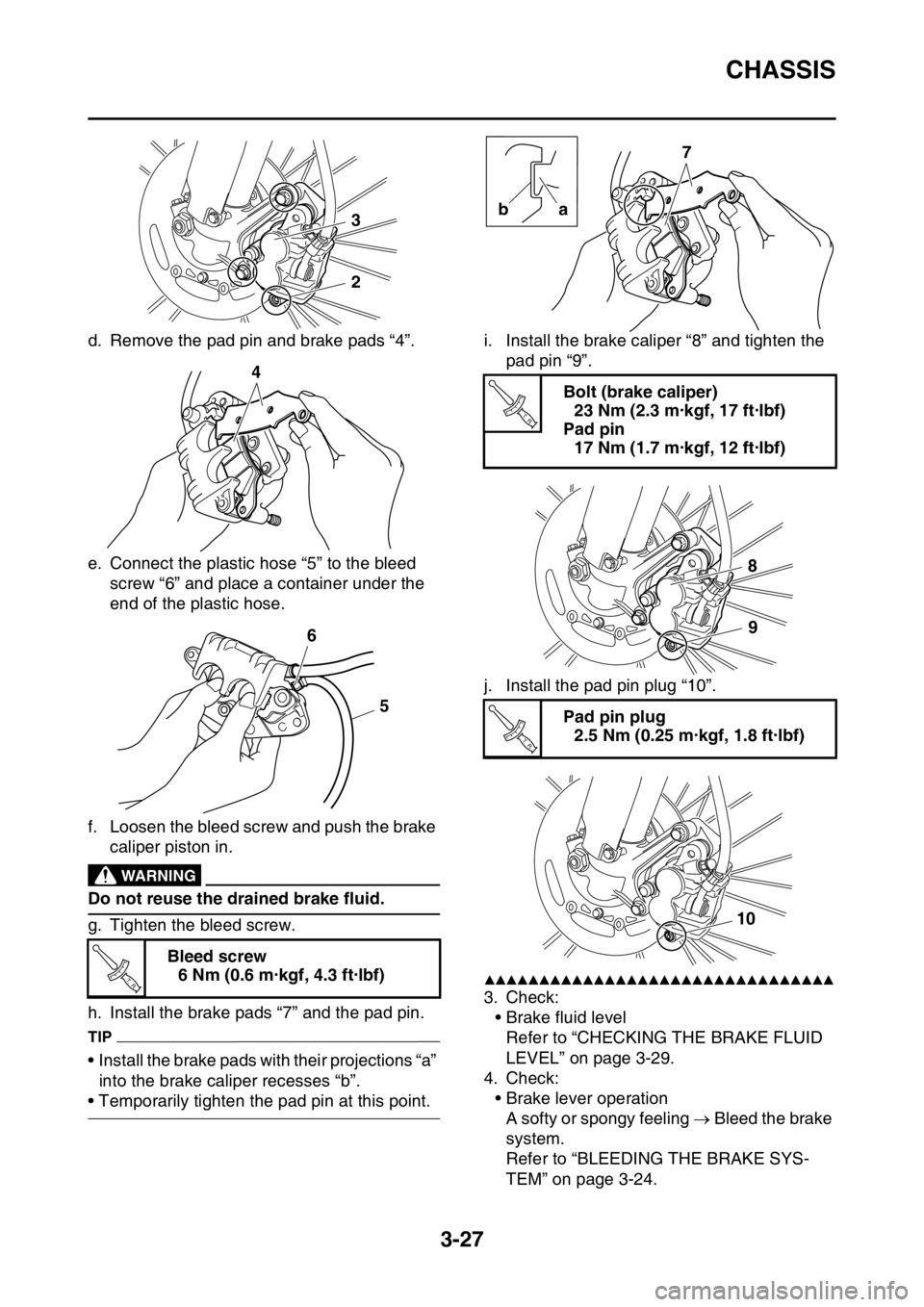
d. Remove the pad pin and brake pads “4”.
e. Connect the plastic hose “5” to the bleed
screw “6” and place a container under the
end of the plastic hose.
f. Loosen the bleed screw and push the brake
caliper piston in.
EWA
WARNING
Do not reuse the drained brake fluid.
g. Tighten the bleed screw.
h. Install the brake pads “7” and the pad pin.
TIP
• Install the brake pads with their projections “a”
into the brake caliper recesses “b”.
• Temporarily tighten the pad pin at this point.i. Install the brake caliper “8” and tighten the
pad pin “9”.
j. Install the pad pin plug “10”.
▲▲▲▲▲▲▲▲▲▲▲▲▲▲▲▲▲▲▲▲▲▲▲▲▲▲▲▲▲▲▲▲
3. Check:
• Brake fluid level
Refer to “CHECKING THE BRAKE FLUID
LEVEL” on page 3-29.
4. Check:
• Brake lever operation
A softy or spongy feeling Bleed the brake
system.
Refer to “BLEEDING THE BRAKE SYS-
TEM” on page 3-24. Bleed screw
6 Nm (0.6 m·kgf, 4.3 ft·lbf)
3
2
4
6
5
T R..
Bolt (brake caliper)
23 Nm (2.3 m·kgf, 17 ft·lbf)
Pad pin
17 Nm (1.7 m·kgf, 12 ft·lbf)
Pad pin plug
2.5 Nm (0.25 m·kgf, 1.8 ft·lbf)
7
a b
T R..
8
9
T R..
10
Page 128 of 428
CHASSIS
3-28
EAS2GB7107CHECKING THE REAR BRAKE PADS
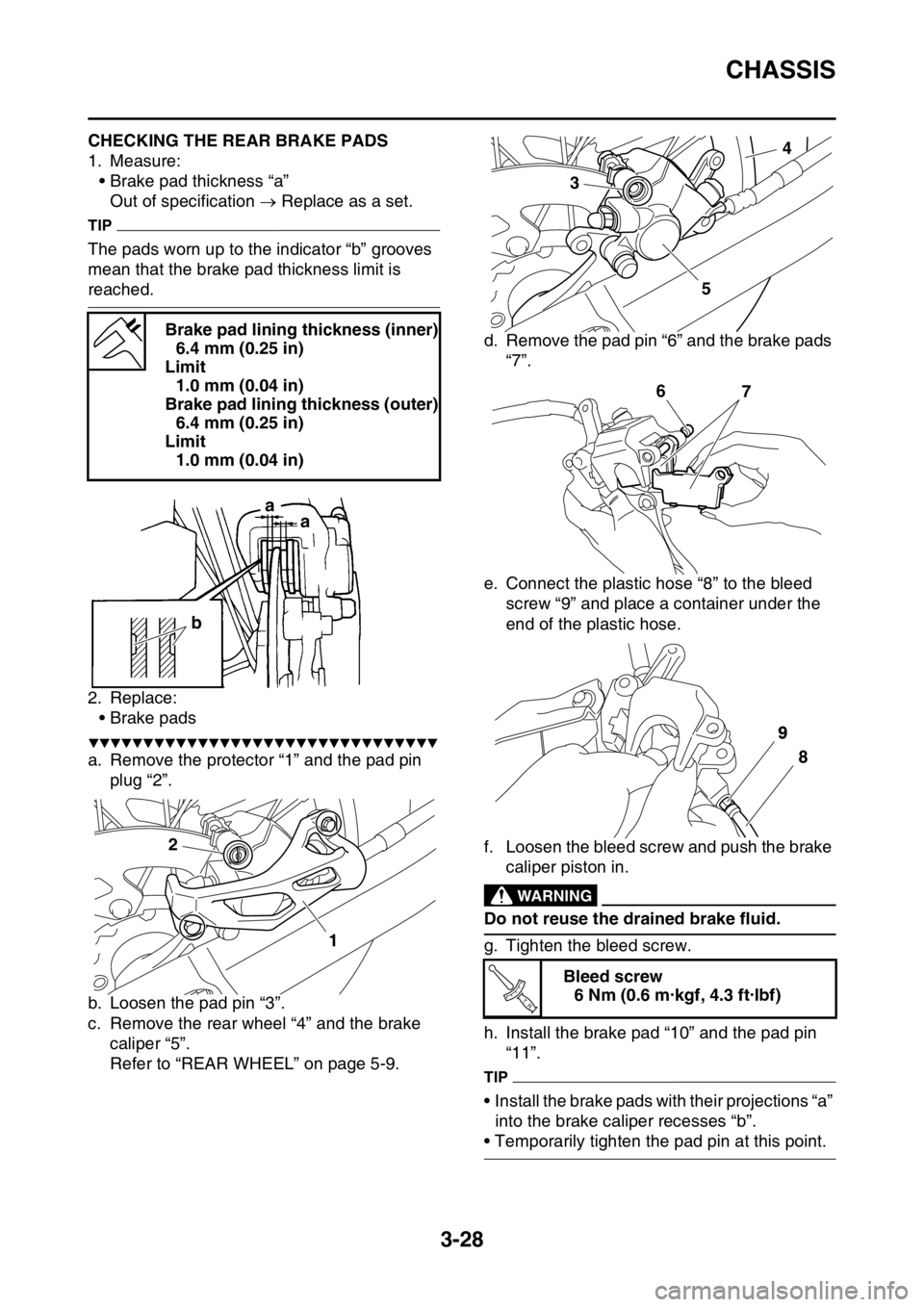
1. Measure:
• Brake pad thickness “a”
Out of specification Replace as a set.
TIP
The pads worn up to the indicator “b” grooves
mean that the brake pad thickness limit is
reached.
2. Replace:
• Brake pads
▼▼▼▼▼▼▼▼▼▼▼▼▼▼▼▼▼▼▼▼▼▼▼▼▼▼▼▼▼▼▼▼
a. Remove the protector “1” and the pad pin
plug “2”.
b. Loosen the pad pin “3”.
c. Remove the rear wheel “4” and the brake
caliper “5”.
Refer to “REAR WHEEL” on page 5-9.d. Remove the pad pin “6” and the brake pads
“7”.
e. Connect the plastic hose “8” to the bleed
screw “9” and place a container under the
end of the plastic hose.
f. Loosen the bleed screw and push the brake
caliper piston in.
EWA
WARNING
Do not reuse the drained brake fluid.
g. Tighten the bleed screw.
h. Install the brake pad “10” and the pad pin
“11”.
TIP
• Install the brake pads with their projections “a”
into the brake caliper recesses “b”.
• Temporarily tighten the pad pin at this point. Brake pad lining thickness (inner)
6.4 mm (0.25 in)
Limit
1.0 mm (0.04 in)
Brake pad lining thickness (outer)
6.4 mm (0.25 in)
Limit
1.0 mm (0.04 in)
ba
a
1 2
Bleed screw
6 Nm (0.6 m·kgf, 4.3 ft·lbf)
34
5
7 6
9
8
T R..
Page 130 of 428
CHASSIS
3-30
WARNING
• Use only the designated brake fluid. Other
brake fluids may cause the rubber seals to
deteriorate, causing leakage and poor
brake performance.
• Refill with the same type of brake fluid that
is already in the system. Mixing brake flu-
ids may result in a harmful chemical reac-
tion, leading to poor brake performance.
• When refilling, be careful that water does
not enter the brake fluid reservoir. Water
will significantly lower the boiling point of
the brake fluid and could cause vapor
lock.
ECA
NOTICE
Brake fluid may damage painted surfaces
and plastic parts. Therefore, always clean
up any spilt brake fluid immediately.
EAS2GB7110ADJUSTING THE DRIVE CHAIN SLACKECA
NOTICE
A drive chain that is too tight will overload
the engine and other vital parts, and one
that is too loose can skip and damage the
swingarm or cause an accident. Therefore,
keep the drive chain slack within the speci-
fied limits.
1. Use a suitable stand to raise the rear wheel
off the ground.
EWA
WARNING
Securely support the vehicle so that there is
no danger of it falling over.
2. Shift the transmission into the neutral posi-
tion.
3. Pull the drive chain up above the drive chain
guide installation bolt with a force of about
50 N (5.0 kgf, 36 lbf).
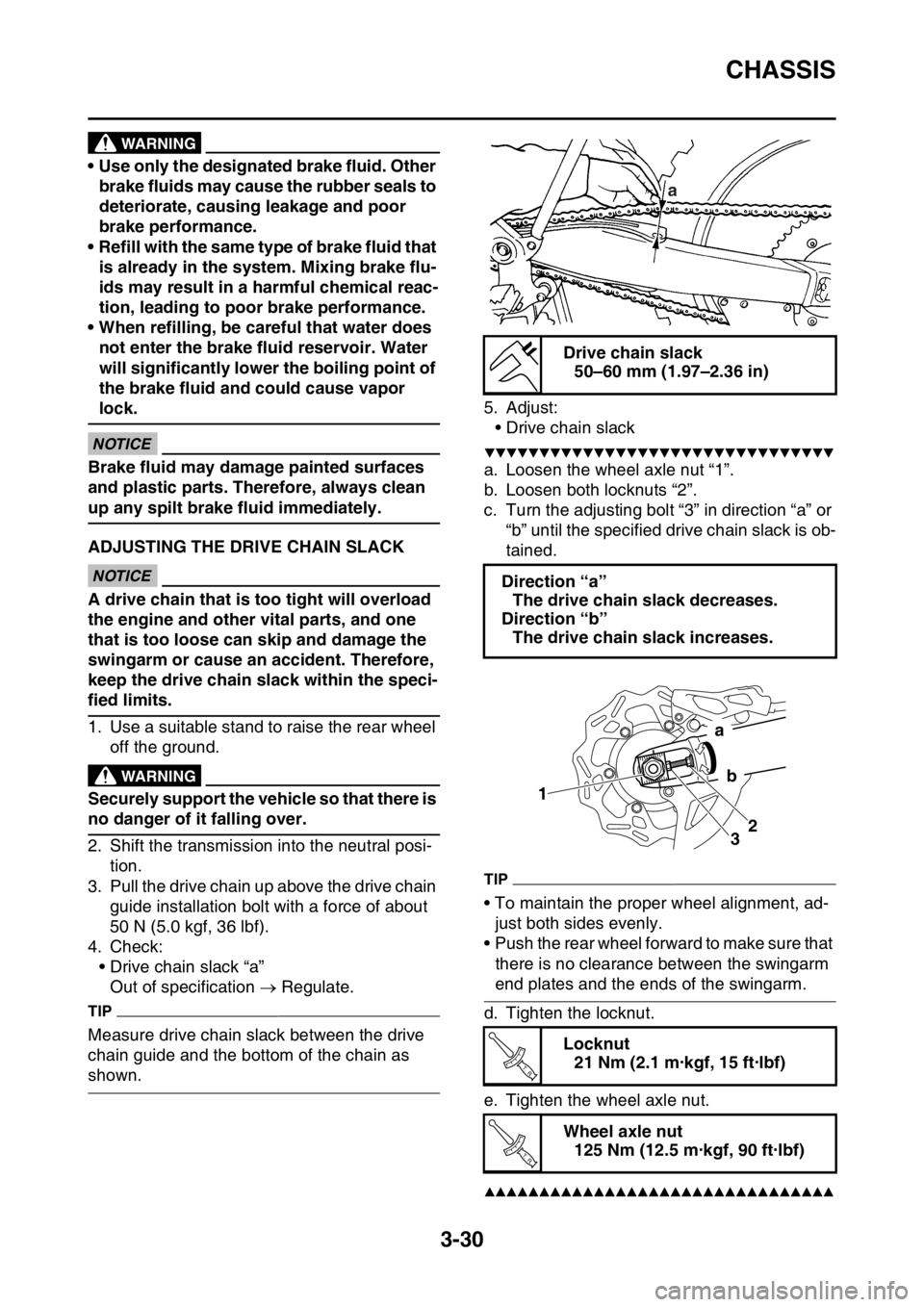
4. Check:
• Drive chain slack “a”
Out of specification Regulate.
TIP
Measure drive chain slack between the drive
chain guide and the bottom of the chain as
shown.5. Adjust:
• Drive chain slack
▼▼▼▼▼▼▼▼▼▼▼▼▼▼▼▼▼▼▼▼▼▼▼▼▼▼▼▼▼▼▼▼
a. Loosen the wheel axle nut “1”.
b. Loosen both locknuts “2”.
c. Turn the adjusting bolt “3” in direction “a” or
“b” until the specified drive chain slack is ob-
tained.
TIP
• To maintain the proper wheel alignment, ad-
just both sides evenly.
• Push the rear wheel forward to make sure that
there is no clearance between the swingarm
end plates and the ends of the swingarm.
d. Tighten the locknut.
e. Tighten the wheel axle nut.
▲▲▲▲▲▲▲▲▲▲▲▲▲▲▲▲▲▲▲▲▲▲▲▲▲▲▲▲▲▲▲▲
Drive chain slack
50–60 mm (1.97–2.36 in)
Direction “a”
The drive chain slack decreases.
Direction “b”
The drive chain slack increases.
Locknut
21 Nm (2.1 m·kgf, 15 ft·lbf)
Wheel axle nut
125 Nm (12.5 m·kgf, 90 ft·lbf)
a
1
32
a
b
T R..
T R..
Page 131 of 428
CHASSIS
3-31
EAS2GB7111CHECKING THE FRONT FORK LEGS
1. Stand the vehicle upright on a level surface.
EWA
WARNING
Securely support the vehicle so that there is
no danger of it falling over.
2. Check:
• Inner tube
Damage/scratches Replace.
• Front fork leg (s)
Oil leaks between inner tube and outer tube
Replace the oil seal.
3. Hold the vehicle upright and apply the front
brake.
4. Check:
• Front fork operation
Push down hard on the handlebar several
times and check if the front fork rebounds
smoothly.
Unsmooth operation Correct or replace.
Refer to “FRONT FORK” on page 5-40.
EAS2GB7112CHECKING THE FRONT FORK PROTEC-
TOR GUIDE
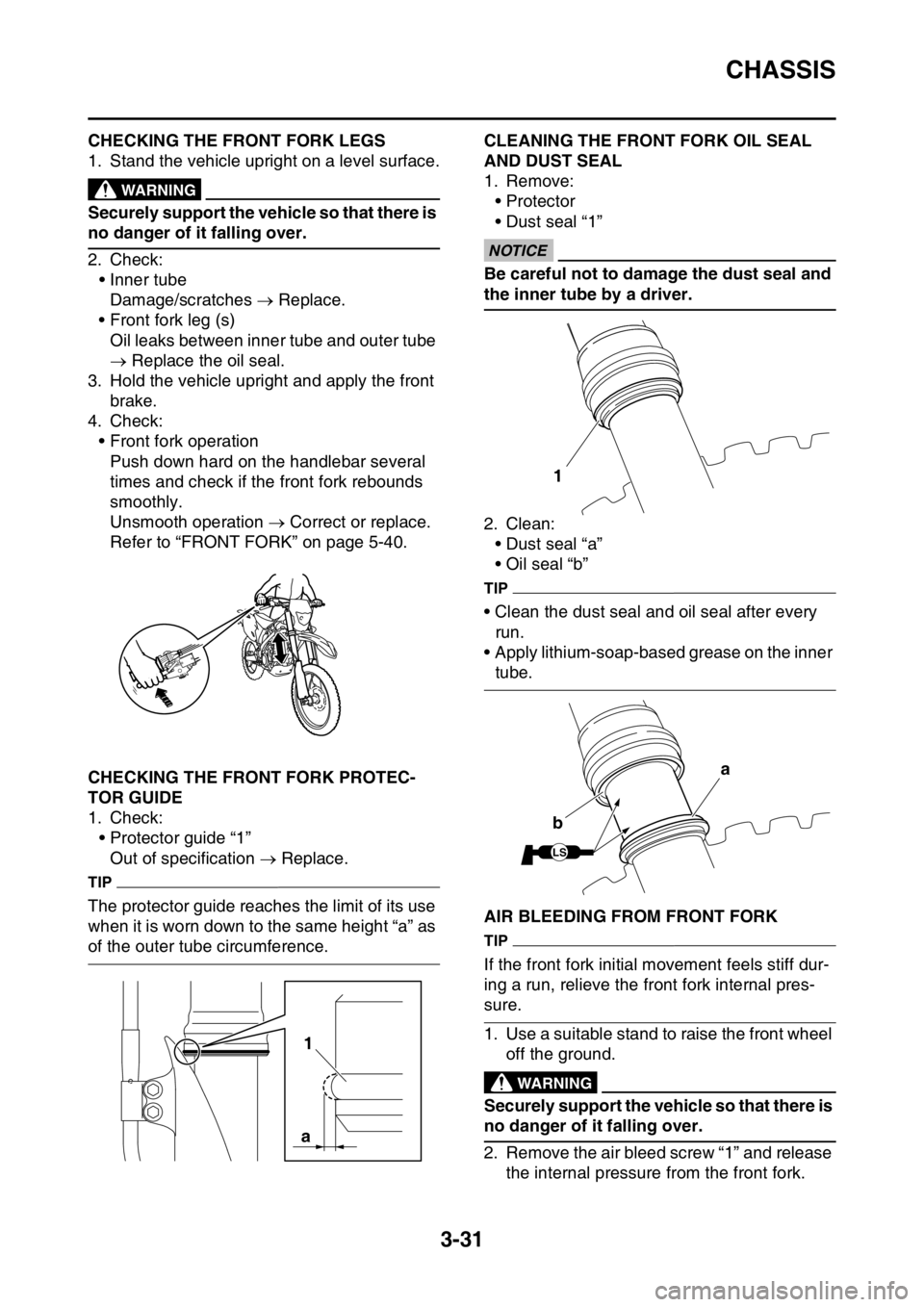
1. Check:
• Protector guide “1”
Out of specification Replace.
TIP
The protector guide reaches the limit of its use
when it is worn down to the same height “a” as
of the outer tube circumference.
EAS2GB7113CLEANING THE FRONT FORK OIL SEAL
AND DUST SEAL
1. Remove:
•Protector
• Dust seal “1”
ECA
NOTICE
Be careful not to damage the dust seal and
the inner tube by a driver.
2. Clean:
• Dust seal “a”
• Oil seal “b”
TIP
• Clean the dust seal and oil seal after every
run.
• Apply lithium-soap-based grease on the inner
tube.
EAS2GB7114AIR BLEEDING FROM FRONT FORK
TIP
If the front fork initial movement feels stiff dur-
ing a run, relieve the front fork internal pres-
sure.
1. Use a suitable stand to raise the front wheel
off the ground.
EWA
WARNING
Securely support the vehicle so that there is
no danger of it falling over.
2. Remove the air bleed screw “1” and release
the internal pressure from the front fork.
1
a
1
LS
a
b
Page 132 of 428
CHASSIS
3-32
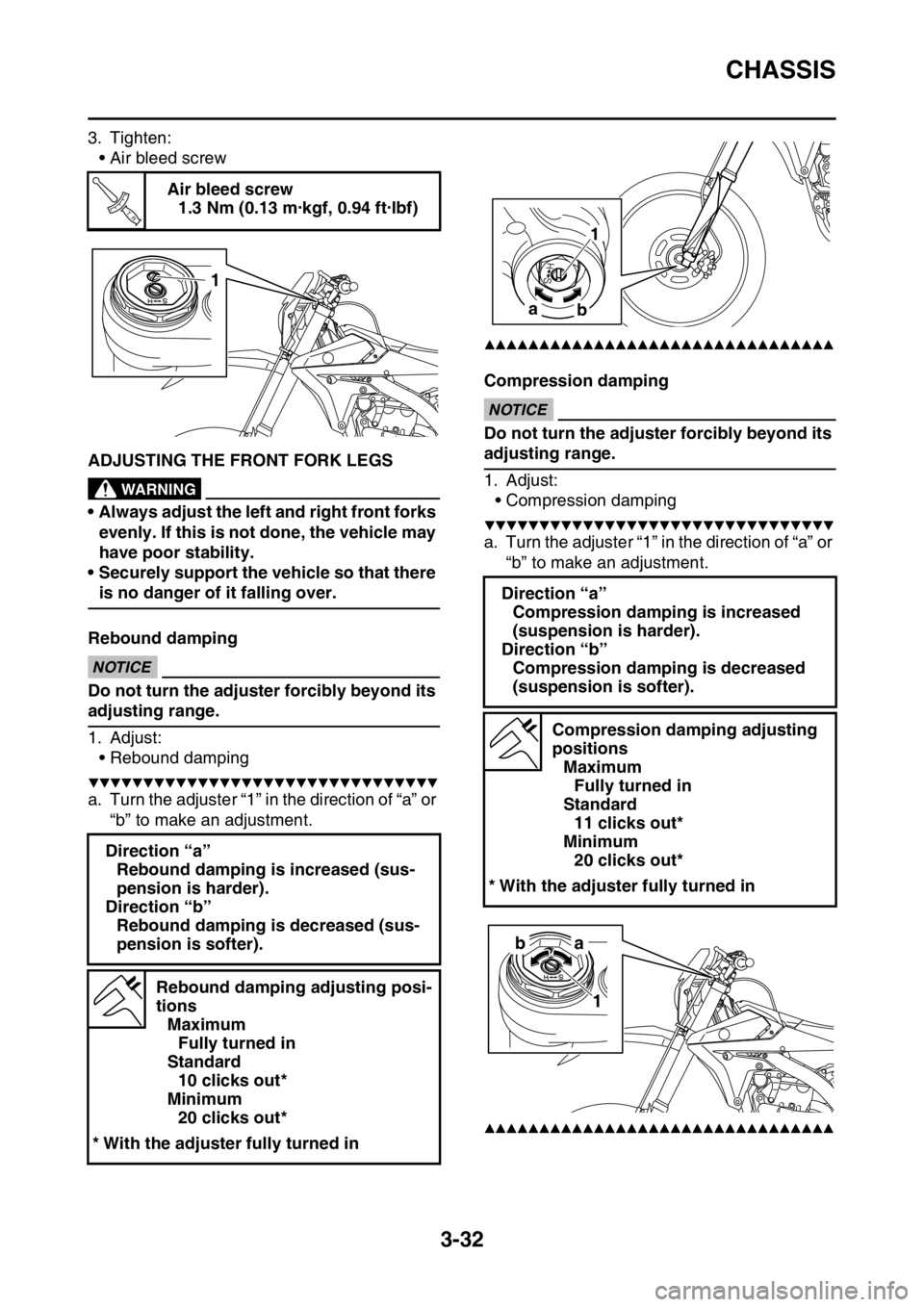
3. Tighten:
• Air bleed screw
EAS2GB7115ADJUSTING THE FRONT FORK LEGSEWA
WARNING
• Always adjust the left and right front forks
evenly. If this is not done, the vehicle may
have poor stability.
• Securely support the vehicle so that there
is no danger of it falling over.
Rebound damping
ECA
NOTICE
Do not turn the adjuster forcibly beyond its
adjusting range.
1. Adjust:
• Rebound damping
▼▼▼▼▼▼▼▼▼▼▼▼▼▼▼▼▼▼▼▼▼▼▼▼▼▼▼▼▼▼▼▼
a. Turn the adjuster “1” in the direction of “a” or
“b” to make an adjustment.
▲▲▲▲▲▲▲▲▲▲▲▲▲▲▲▲▲▲▲▲▲▲▲▲▲▲▲▲▲▲▲▲
Compression dampingECA
NOTICE
Do not turn the adjuster forcibly beyond its
adjusting range.
1. Adjust:
• Compression damping
▼▼▼▼▼▼▼▼▼▼▼▼▼▼▼▼▼▼▼▼▼▼▼▼▼▼▼▼▼▼▼▼
a. Turn the adjuster “1” in the direction of “a” or
“b” to make an adjustment.
▲▲▲▲▲▲▲▲▲▲▲▲▲▲▲▲▲▲▲▲▲▲▲▲▲▲▲▲▲▲▲▲
Air bleed screw
1.3 Nm (0.13 m·kgf, 0.94 ft·lbf)
Direction “a”
Rebound damping is increased (sus-
pension is harder).
Direction “b”
Rebound damping is decreased (sus-
pension is softer).
Rebound damping adjusting posi-
tions
Maximum
Fully turned in
Standard
10 clicks out*
Minimum
20 clicks out*
* With the adjuster fully turned in
T R..
1
Direction “a”
Compression damping is increased
(suspension is harder).
Direction “b”
Compression damping is decreased
(suspension is softer).
Compression damping adjusting
positions
Maximum
Fully turned in
Standard
11 clicks out*
Minimum
20 clicks out*
* With the adjuster fully turned in
1
a
b
a b
1
Page 133 of 428
CHASSIS
3-33
EAS2GB7116CHECKING THE SWINGARM OPERATION
1. Check:
• Swingarm smooth action
• Swingarm free play
Refer to “SWINGARM” on page 5-65.
EAS2GB7117CHECKING THE REAR SUSPENSION
1. Stand the vehicle upright on a level surface.
EWA
WARNING
Securely support the vehicle so that there is
no danger of it falling over.
2. Check:
• Rear shock absorber assembly
Gas leaks/oil leaks Replace the rear
shock absorber assembly.
Refer to “REAR SHOCK ABSORBER AS-
SEMBLY” on page 5-58.
3. Check:
• Rear shock absorber assembly smooth ac-
tion
• Rear suspension link smooth action
Sit astride the seat and shake your body up
and down several times to check whether
the rear shock absorber assembly operates
smoothly.
Unsmooth operation Correct or replace.
Refer to “REAR SHOCK ABSORBER AS-
SEMBLY” on page 5-58.
EAS2GB7118ADJUSTING THE REAR SHOCK ABSORB-
ER ASSEMBLY
Use a suitable stand to raise the rear wheel off
the ground.
EWA
WARNING
Securely support the vehicle so that there is
no danger of it falling over.Spring preload
ECA
NOTICE
Do not turn the adjuster forcibly beyond its
adjusting range.
1. Remove:
• Rear frame
Refer to “REAR SHOCK ABSORBER AS-
SEMBLY” on page 5-58.
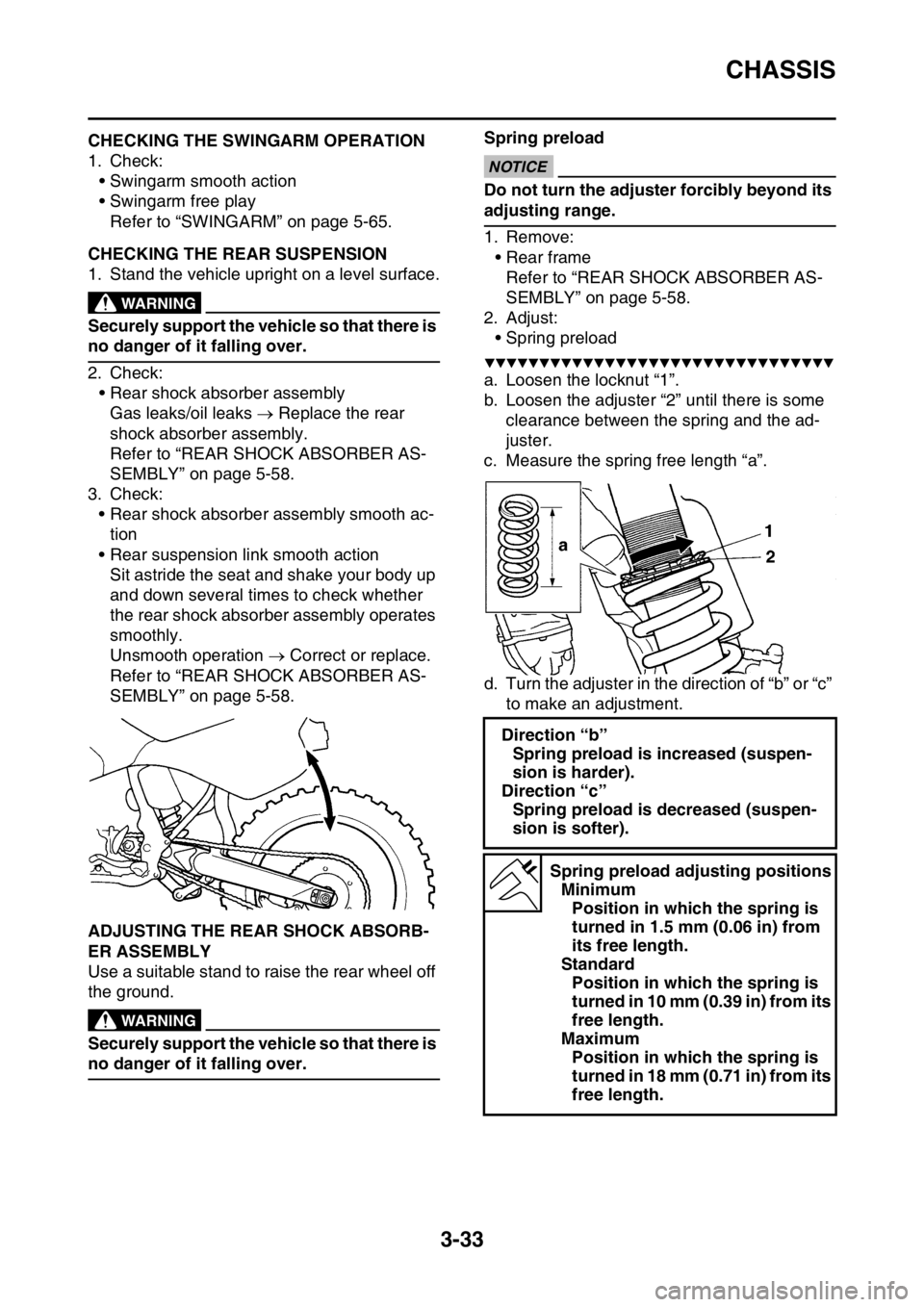
2. Adjust:
• Spring preload
▼▼▼▼▼▼▼▼▼▼▼▼▼▼▼▼▼▼▼▼▼▼▼▼▼▼▼▼▼▼▼▼
a. Loosen the locknut “1”.
b. Loosen the adjuster “2” until there is some
clearance between the spring and the ad-
juster.
c. Measure the spring free length “a”.
d. Turn the adjuster in the direction of “b” or “c”
to make an adjustment.
Direction “b”
Spring preload is increased (suspen-
sion is harder).
Direction “c”
Spring preload is decreased (suspen-
sion is softer).
Spring preload adjusting positions
Minimum
Position in which the spring is
turned in 1.5 mm (0.06 in) from
its free length.
Standard
Position in which the spring is
turned in 10 mm (0.39 in) from its
free length.
Maximum
Position in which the spring is
turned in 18 mm (0.71 in) from its
free length.
Page 136 of 428
CHASSIS
3-36
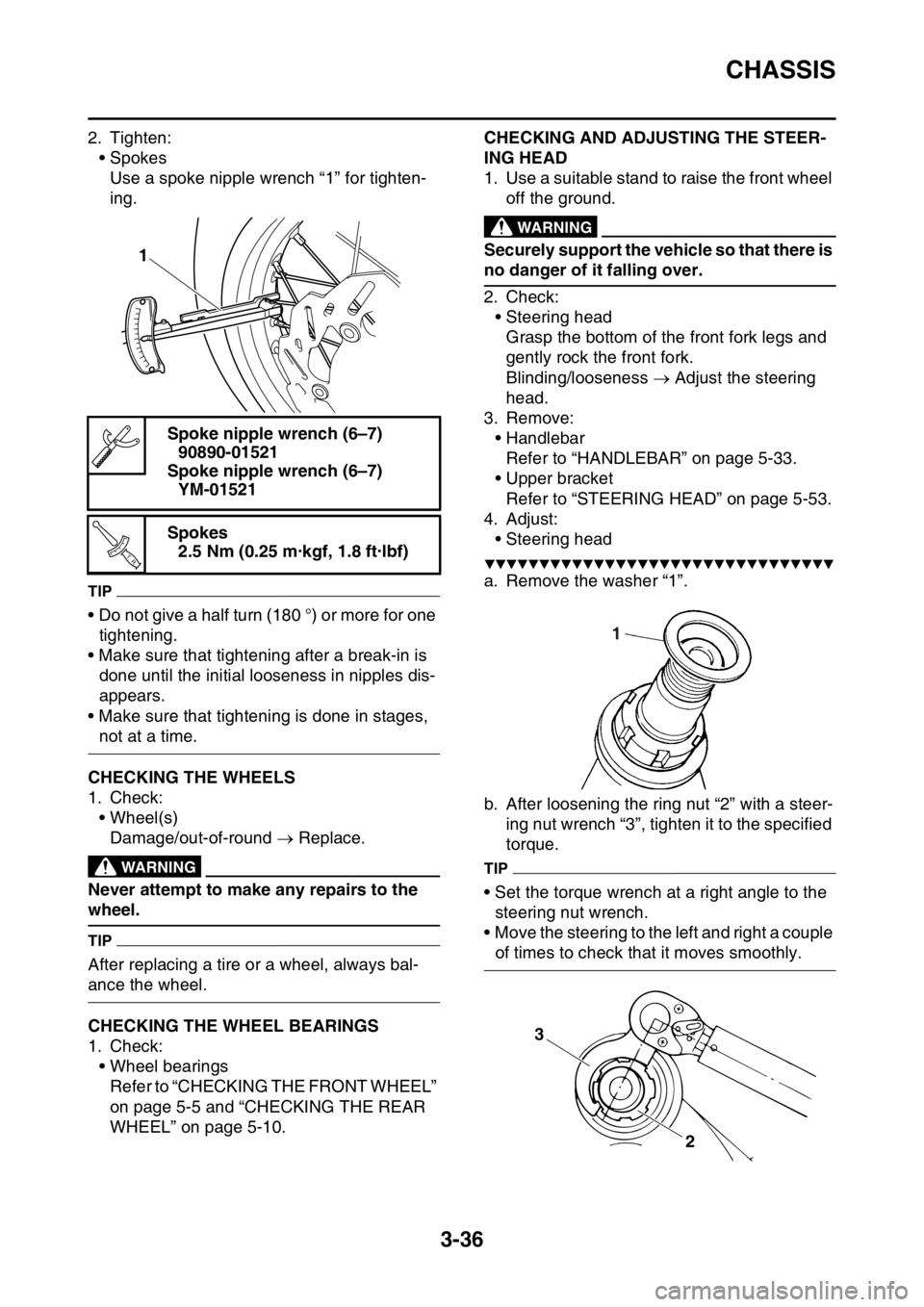
2. Tighten:
• Spokes
Use a spoke nipple wrench “1” for tighten-
ing.
TIP
• Do not give a half turn (180 °) or more for one
tightening.
• Make sure that tightening after a break-in is
done until the initial looseness in nipples dis-
appears.
• Make sure that tightening is done in stages,
not at a time.
EAS2GB7121CHECKING THE WHEELS
1. Check:
• Wheel(s)
Damage/out-of-round Replace.
EWA
WARNING
Never attempt to make any repairs to the
wheel.
TIP
After replacing a tire or a wheel, always bal-
ance the wheel.
EAS2GB7122CHECKING THE WHEEL BEARINGS
1. Check:
• Wheel bearings
Refer to “CHECKING THE FRONT WHEEL”
on page 5-5 and “CHECKING THE REAR
WHEEL” on page 5-10.
EAS2GB7123
CHECKING AND ADJUSTING THE STEER-
ING HEAD
1. Use a suitable stand to raise the front wheel
off the ground.
EWA
WARNING
Securely support the vehicle so that there is
no danger of it falling over.
2. Check:
• Steering head
Grasp the bottom of the front fork legs and
gently rock the front fork.
Blinding/looseness Adjust the steering
head.
3. Remove:
• Handlebar
Refer to “HANDLEBAR” on page 5-33.
• Upper bracket
Refer to “STEERING HEAD” on page 5-53.
4. Adjust:
• Steering head
▼▼▼▼▼▼▼▼▼▼▼▼▼▼▼▼▼▼▼▼▼▼▼▼▼▼▼▼▼▼▼▼
a. Remove the washer “1”.
b. After loosening the ring nut “2” with a steer-
ing nut wrench “3”, tighten it to the specified
torque.
TIP
• Set the torque wrench at a right angle to the
steering nut wrench.
• Move the steering to the left and right a couple
of times to check that it moves smoothly. Spoke nipple wrench (6–7)
90890-01521
Spoke nipple wrench (6–7)
YM-01521
Spokes
2.5 Nm (0.25 m·kgf, 1.8 ft·lbf)
1
T R..
1
3
2
Page 137 of 428
CHASSIS
3-37
c. Turn the front fork to the right and left a few
times, and make sure that the steering ro-
tates smoothly. If it does not turn smoothly,
remove the lower bracket and check the up-
per and lower bearings.
Refer to “STEERING HEAD” on page 5-53.
d. Loosen the ring nut fully turn and then tight-
en it to specification with a steering nut
wrench.
EWA
WARNING
Do not overtighten the lower ring nut.
e. Check the steering head for looseness or
binding by turning the front fork all the way in
both directions. If any binding is felt, remove
the lower bracket and check the upper and
lower bearings.
Refer to “STEERING HEAD” on page 5-53.
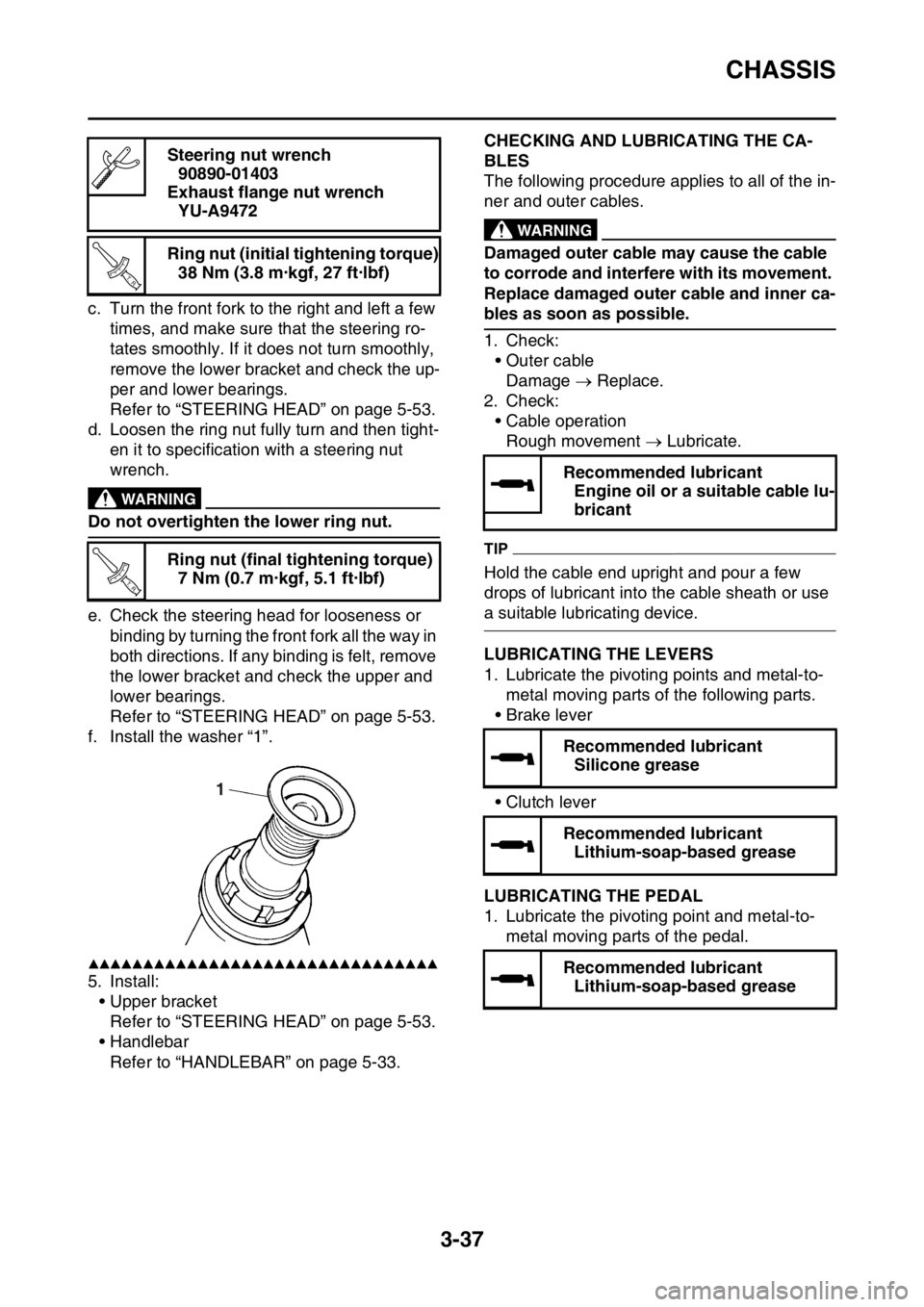
f. Install the washer “1”.
▲▲▲▲▲▲▲▲▲▲▲▲▲▲▲▲▲▲▲▲▲▲▲▲▲▲▲▲▲▲▲▲
5. Install:
• Upper bracket
Refer to “STEERING HEAD” on page 5-53.
• Handlebar
Refer to “HANDLEBAR” on page 5-33.
EAS2GB7124CHECKING AND LUBRICATING THE CA-
BLES
The following procedure applies to all of the in-
ner and outer cables.
EWA
WARNING
Damaged outer cable may cause the cable
to corrode and interfere with its movement.
Replace damaged outer cable and inner ca-
bles as soon as possible.
1. Check:
• Outer cable
Damage Replace.
2. Check:
• Cable operation
Rough movement Lubricate.
TIP
Hold the cable end upright and pour a few
drops of lubricant into the cable sheath or use
a suitable lubricating device.
EAS2GB7125LUBRICATING THE LEVERS
1. Lubricate the pivoting points and metal-to-
metal moving parts of the following parts.
•Brake lever
• Clutch lever
EAS2GB7126LUBRICATING THE PEDAL
1. Lubricate the pivoting point and metal-to-
metal moving parts of the pedal. Steering nut wrench
90890-01403
Exhaust flange nut wrench
YU-A9472
Ring nut (initial tightening torque)
38 Nm (3.8 m·kgf, 27 ft·lbf)
Ring nut (final tightening torque)
7 Nm (0.7 m·kgf, 5.1 ft·lbf)
T R..
T R..
1
Recommended lubricant
Engine oil or a suitable cable lu-
bricant
Recommended lubricant
Silicone grease
Recommended lubricant
Lithium-soap-based grease
Recommended lubricant
Lithium-soap-based grease
Page 140 of 428
ELECTRICAL SYSTEM
3-40
2. Attach:
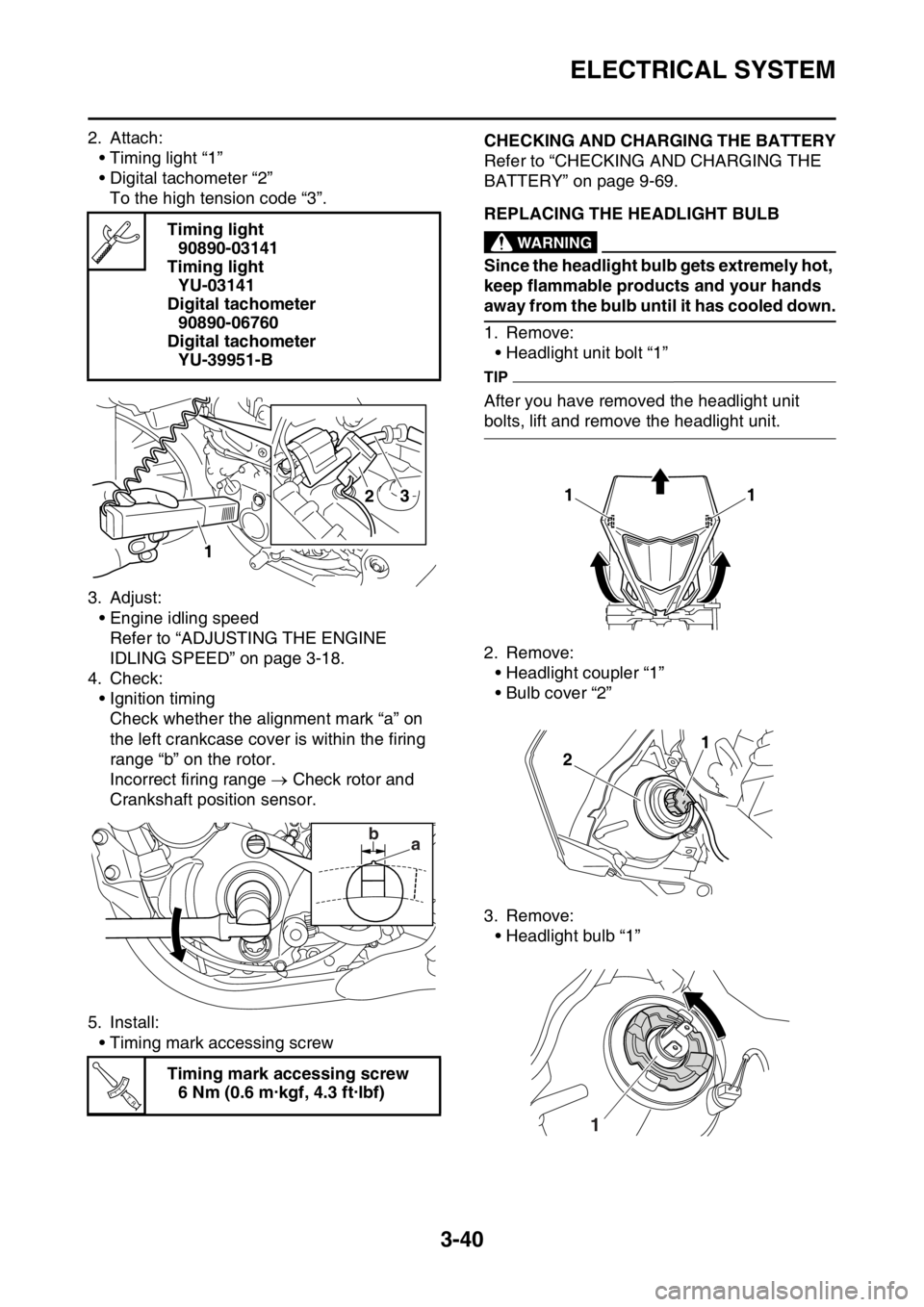
• Timing light “1”
• Digital tachometer “2”
To the high tension code “3”.
3. Adjust:
• Engine idling speed
Refer to “ADJUSTING THE ENGINE
IDLING SPEED” on page 3-18.
4. Check:
• Ignition timing
Check whether the alignment mark “a” on
the left crankcase cover is within the firing
range “b” on the rotor.
Incorrect firing range Check rotor and
Crankshaft position sensor.
5. Install:
• Timing mark accessing screwEAS2GB7133CHECKING AND CHARGING THE BATTERY
Refer to “CHECKING AND CHARGING THE
BATTERY” on page 9-69.
EAS2GB7134REPLACING THE HEADLIGHT BULBEWA
WARNING
Since the headlight bulb gets extremely hot,
keep flammable products and your hands
away from the bulb until it has cooled down.
1. Remove:
• Headlight unit bolt “1”
TIP
After you have removed the headlight unit
bolts, lift and remove the headlight unit.
2. Remove:
• Headlight coupler “1”
• Bulb cover “2”
3. Remove:
• Headlight bulb “1” Timing light
90890-03141
Timing light
YU-03141
Digital tachometer
90890-06760
Digital tachometer
YU-39951-B
Timing mark accessing screw
6 Nm (0.6 m·kgf, 4.3 ft·lbf)
2
1
3
ba
T R..
11
1
2
1
Page 145 of 428
CHASSIS
4-2
• Under a stony or a hard road condition, the
tire pressure should be higher to prevent a flat
tire.
EAS2GB7140FRONT FORK SETTING
The front fork setting should be made depend-
ing on the rider’s feeling of an actual run and
the circuit conditions.
The front fork setting includes the following
three factors:
1. Setting of air spring characteristics
• Change the fork oil amount.
2. Setting of spring preload
• Change the spring.
3. Setting of damping force
• Change the compression damping force.
• Change the rebound damping force.
The spring acts on the load and the damping
force acts on the cushion travel speed.
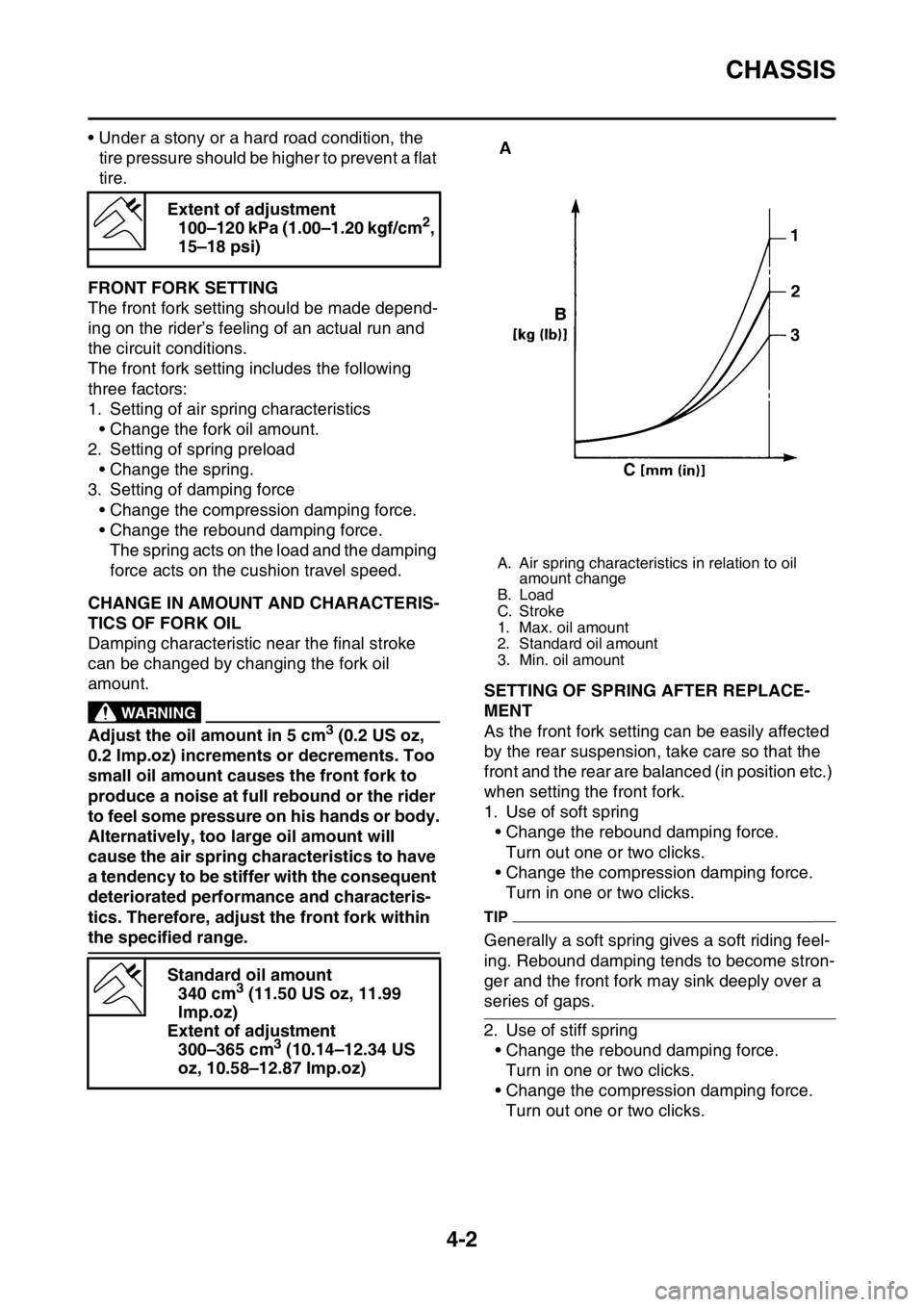
EAS2GB7141CHANGE IN AMOUNT AND CHARACTERIS-
TICS OF FORK OIL
Damping characteristic near the final stroke
can be changed by changing the fork oil
amount.
EWA
WARNING
Adjust the oil amount in 5 cm3 (0.2 US oz,
0.2 Imp.oz) increments or decrements. Too
small oil amount causes the front fork to
produce a noise at full rebound or the rider
to feel some pressure on his hands or body.
Alternatively, too large oil amount will
cause the air spring characteristics to have
a tendency to be stiffer with the consequent
deteriorated performance and characteris-
tics. Therefore, adjust the front fork within
the specified range.
EAS2GB7142SETTING OF SPRING AFTER REPLACE-
MENT
As the front fork setting can be easily affected
by the rear suspension, take care so that the
front and the rear are balanced (in position etc.)
when setting the front fork.
1. Use of soft spring
• Change the rebound damping force.
Turn out one or two clicks.
• Change the compression damping force.
Turn in one or two clicks.
TIP
Generally a soft spring gives a soft riding feel-
ing. Rebound damping tends to become stron-
ger and the front fork may sink deeply over a
series of gaps.
2. Use of stiff spring
• Change the rebound damping force.
Turn in one or two clicks.
• Change the compression damping force.
Turn out one or two clicks. Extent of adjustment
100–120 kPa (1.00–1.20 kgf/cm
2,
15–18 psi)
Standard oil amount
340 cm
3 (11.50 US oz, 11.99
lmp.oz)
Extent of adjustment
300–365 cm
3 (10.14–12.34 US
oz, 10.58–12.87 Imp.oz)
A. Air spring characteristics in relation to oil
amount change
B. Load
C. Stroke
1. Max. oil amount
2. Standard oil amount
3. Min. oil amount