battery YAMAHA WR 250F 2017 User Guide
[x] Cancel search | Manufacturer: YAMAHA, Model Year: 2017, Model line: WR 250F, Model: YAMAHA WR 250F 2017Pages: 432, PDF Size: 14.14 MB
Page 103 of 432
PERIODIC MAINTENANCE
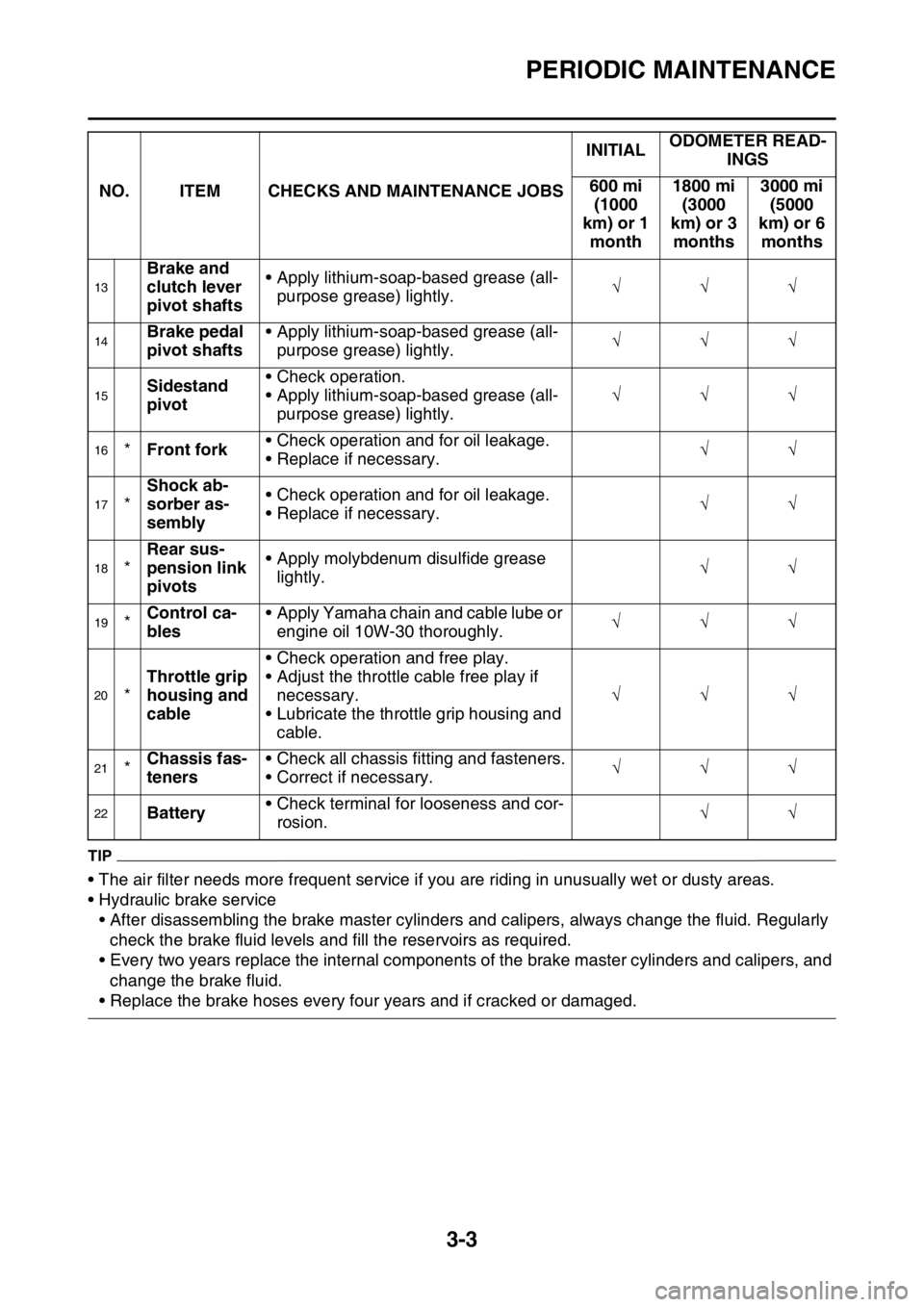
3-3
TIP
• The air filter needs more frequent service if you are riding in unusually wet or dusty areas.
• Hydraulic brake service
• After disassembling the brake master cylinders and calipers, always change the fluid. Regularly
check the brake fluid levels and fill the reservoirs as required.
• Every two years replace the internal components of the brake master cylinders and calipers, and
change the brake fluid.
• Replace the brake hoses every four years and if cracked or damaged.
13
Brake and
clutch lever
pivot shafts• Apply lithium-soap-based grease (all-
purpose grease) lightly.
14Brake pedal
pivot shafts• Apply lithium-soap-based grease (all-
purpose grease) lightly.
15Sidestand
pivot• Check operation.
• Apply lithium-soap-based grease (all-
purpose grease) lightly.
16*Front fork• Check operation and for oil leakage.
• Replace if necessary.
17*Shock ab-
sorber as-
sembly• Check operation and for oil leakage.
• Replace if necessary.
18*Rear sus-
pension link
pivots• Apply molybdenum disulfide grease
lightly.
19*Control ca-
bles• Apply Yamaha chain and cable lube or
engine oil 10W-30 thoroughly.
20*Throttle grip
housing and
cable• Check operation and free play.
• Adjust the throttle cable free play if
necessary.
• Lubricate the throttle grip housing and
cable.
21*Chassis fas-
teners• Check all chassis fitting and fasteners.
• Correct if necessary.
22Battery• Check terminal for looseness and cor-
rosion. NO. ITEM CHECKS AND MAINTENANCE JOBSINITIALODOMETER READ-
INGS
600 mi
(1000
km) or 1
month1800 mi
(3000
km) or 3
months3000 mi
(5000
km) or 6
months
Page 141 of 432
ELECTRICAL SYSTEM
3-41
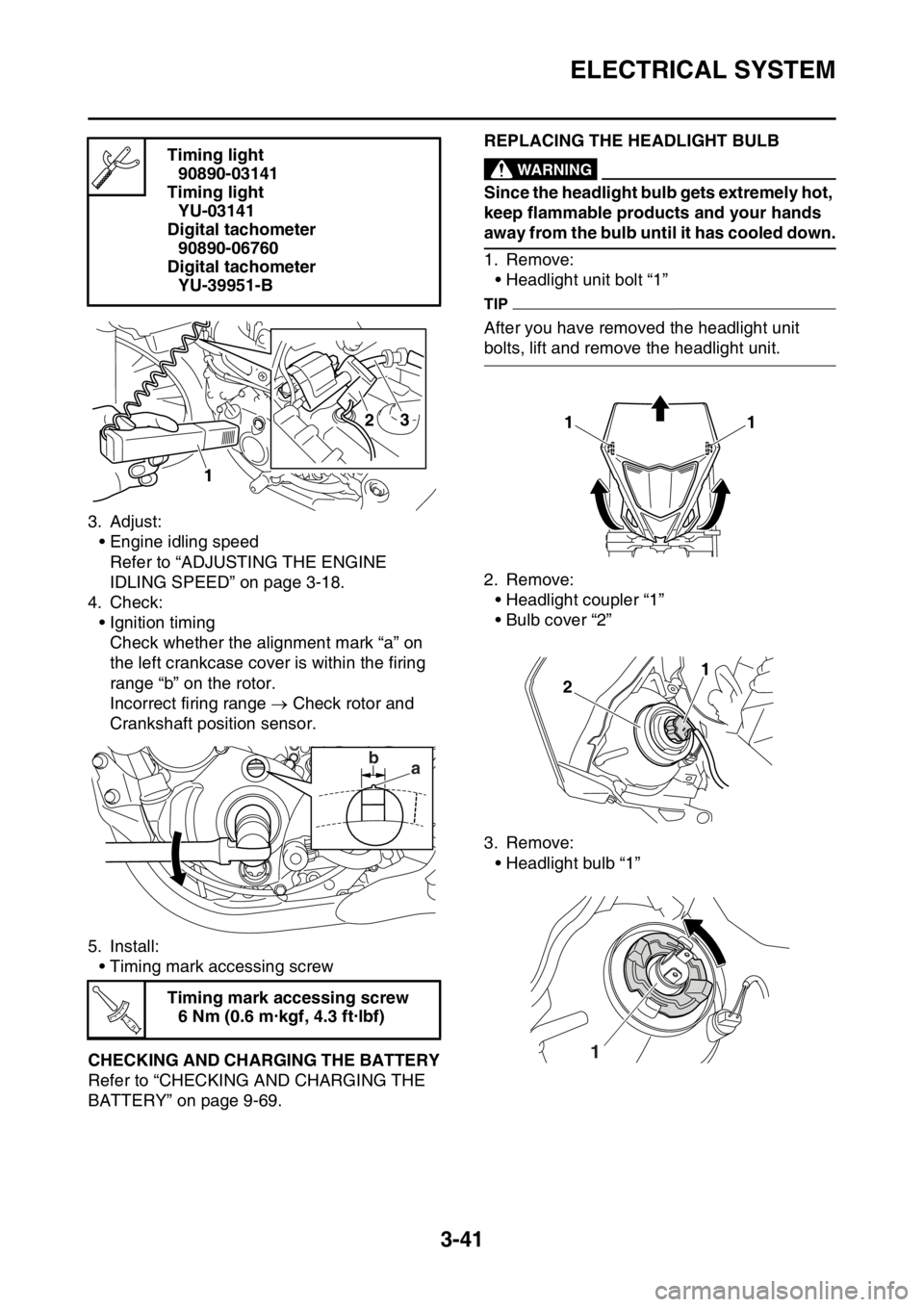
3. Adjust:
• Engine idling speed
Refer to “ADJUSTING THE ENGINE
IDLING SPEED” on page 3-18.
4. Check:
• Ignition timing
Check whether the alignment mark “a” on
the left crankcase cover is within the firing
range “b” on the rotor.
Incorrect firing range Check rotor and
Crankshaft position sensor.
5. Install:
• Timing mark accessing screw
EAS2GBB133CHECKING AND CHARGING THE BATTERY
Refer to “CHECKING AND CHARGING THE
BATTERY” on page 9-69.
EAS2GBB134REPLACING THE HEADLIGHT BULBEWA
WARNING
Since the headlight bulb gets extremely hot,
keep flammable products and your hands
away from the bulb until it has cooled down.
1. Remove:
• Headlight unit bolt “1”
TIP
After you have removed the headlight unit
bolts, lift and remove the headlight unit.
2. Remove:
• Headlight coupler “1”
• Bulb cover “2”
3. Remove:
• Headlight bulb “1” Timing light
90890-03141
Timing light
YU-03141
Digital tachometer
90890-06760
Digital tachometer
YU-39951-B
Timing mark accessing screw
6 Nm (0.6 m·kgf, 4.3 ft·lbf)
2
1
3
ba
T R..
11
1
2
1
Page 336 of 432

ELECTRICAL COMPONENTS....................................................................... 9-60
CHECKING THE SWITCHES .................................................................. 9-64
CHECKING THE BULBS AND BULB SOCKETS .................................... 9-67
CHECKING THE FUSES ......................................................................... 9-68
CHECKING AND CHARGING THE BATTERY ........................................ 9-69
CHECKING THE RELAYS ....................................................................... 9-72
CHECKING THE DIODE .......................................................................... 9-73
CHECKING THE IGNITION SPARK GAP................................................ 9-73
CHECKING THE SPARK PLUG CAP ...................................................... 9-74
CHECKING THE IGNITION COIL ............................................................ 9-74
CHECKING THE CRANKSHAFT POSITION SENSOR........................... 9-75
CHECKING THE LEAN ANGLE SENSOR............................................... 9-75
CHECKING THE STARTER MOTOR OPERATION ................................ 9-76
CHECKING THE STATOR COIL ............................................................. 9-76
CHECKING THE RECTIFIER/REGULATOR ........................................... 9-76
CHECKING THE SPEED SENSOR ......................................................... 9-77
CHECKING THE FUEL SENDER ............................................................ 9-77
CHECKING THE RESISTER ................................................................... 9-78
CHECKING THE RADIATOR FAN MOTOR ............................................ 9-78
CHECKING THE COOLANT TEMPERATURE SENSOR........................ 9-78
CHECKING THE THROTTLE POSITION SENSOR ................................ 9-79
CHECKING THE THROTTLE POSITION SENSOR INPUT VOLTAGE .. 9-80
CHECKING THE INTAKE AIR PRESSURE SENSOR ............................ 9-80
CHECKING THE INTAKE AIR TEMPERATURE SENSOR ..................... 9-80
CHECKING THE FUEL INJECTOR ......................................................... 9-81
Page 339 of 432

IGNITION SYSTEM
9-3
1. Joint connector
2. Joint connector
4. AC magneto
9. Battery
10.Frame ground
11.Starter relay
12.Main fuse
22.ECU (engine control unit)
23.Ignition coil
24.Spark plug
30.Joint connector
35.Lean angle sensor
36.Engine stop switch
48.Frame ground
49.Ignition coil sub-lead
Page 340 of 432

IGNITION SYSTEM
9-4
EAS2GBB359TROUBLESHOOTING
The ignition system fails to operate (no spark or intermittent spark).
TIP
Before troubleshooting, remove the following part (s):
1. Seat
2. Side cover (left/right)
3. Air scoop (left/right)
4. Fuel tank
5. Air filter case cover
1. Check the fuse.
Refer to “CHECKING THE FUSES”
on page 9-68.NG
Replace the fuse(s).
OK
2. Check the battery.
Refer to “CHECKING AND
CHARGING THE BATTERY” on
page 9-69.NG
• Clean the battery terminals.
• Recharge or replace the battery.
OK
3. Check the spark plug.
Refer to “CHECKING THE SPARK
PLUG” on page 3-40.NG
Re-gap or replace the spark plug.
OK
4. Check the ignition spark gap.
Refer to “CHECKING THE IGNI-
TION SPARK GAP” on page 9-73.OK
The ignition system is normal.
NG
5. Check the ignition coil.
Refer to “CHECKING THE IGNI-
TION COIL” on page 9-74.NG
Replace the ignition coil.
OK
6. Check the crankshaft position sen-
sor.
Refer to “CHECKING THE CRANK-
SHAFT POSITION SENSOR” on
page 9-75.NG
Replace the stator assembly.
OK
7. Check the engine stop switch.
Refer to “CHECKING THE
SWITCHES” on page 9-64.NG
Replace the engine stop switch.
OK
Page 343 of 432

ELECTRIC STARTING SYSTEM
9-7
1. Joint connector
2. Joint connector
3. Joint connector
7. Main relay
9. Battery
10.Frame ground
11.Starter relay
12.Main fuse
13.Starter motor
14.Starter relay diode
22.ECU (engine control unit)
30.Joint connector
36.Engine stop switch
37.Neutral switch
38.Diode
39.Starting circuit cut-off relay
40.Clutch switch
41.Start switch
48.Frame ground
Page 345 of 432

ELECTRIC STARTING SYSTEM
9-9
a. WHEN THE TRANSMISSION IS IN NEU-
TRAL
b. WHEN THE CLUTCH LEVER IS PULLED
TO THE HANDLEBAR
1. Battery
2. Main fuse
3. Main relay
4. Starting circuit cut-off relay
5. Start switch
6. Diode
7. Clutch switch
8. Neutral switch
9. Starter relay
10.Starter motor
Page 346 of 432

ELECTRIC STARTING SYSTEM
9-10
EAS2GBB362TROUBLESHOOTING
The starter motor fails to turn.
TIP
Before troubleshooting, remove the following part (s):
1. Seat
2. Side cover (left/right)
3. Air scoop (left/right)
4. Fuel tank
5. Air filter case cover
1. Check the fuse.
Refer to “CHECKING THE FUSES”
on page 9-68.NG
Replace the fuse(s).
OK
2. Check the battery.
Refer to “CHECKING AND
CHARGING THE BATTERY” on
page 9-69.NG
• Clean the battery terminals.
• Recharge or replace the battery.
OK
3. Check the starter motor operation.
Refer to “CHECKING THE START-
ER MOTOR OPERATION” on page
9-76.OK
Starter motor is OK. Perform the electric
starting system troubleshooting, starting
with step 5.
NG
4. Check the starter motor.
Refer to “CHECKING THE START-
ER MOTOR” on page 6-39.NG
Repair or replace the starter motor.
OK
5. Check the relay unit (Starting circuit
cut-off relay).
Refer to “CHECKING THE RE-
LAYS” on page 9-72.NG
Replace the relay unit.
OK
6. Check the diode.
Refer to “CHECKING THE DIODE”
on page 9-73.NG
Replace the diode.
OK
7. Check the starter relay.
Refer to “CHECKING THE RE-
LAYS” on page 9-72.NG
Replace the starter relay.
OK
Page 349 of 432

CHARGING SYSTEM
9-13
4. AC magneto
5. Rectifier/regulator
9. Battery
10.Frame ground
11.Starter relay
12.Main fuse
50.Negative battery lead
Page 350 of 432

CHARGING SYSTEM
9-14
EAS2GBB364TROUBLESHOOTING
The battery is not being charged.
TIP
Before troubleshooting, remove the following part (s):
1. Seat
2. Side cover (left/right)
1. Check the fuse.
Refer to “CHECKING THE FUSES”
on page 9-68.NG
Replace the fuse(s).
OK
2. Check the battery.
Refer to “CHECKING AND
CHARGING THE BATTERY” on
page 9-69.NG
• Clean the battery terminals.
• Recharge or replace the battery.
OK
3. Check the stator coil.
Refer to “CHECKING THE STA-
TOR COIL” on page 9-76.NG
Replace the stator assembly.
OK
4. Check the rectifier/regulator.
Refer to “CHECKING THE RECTI-
FIER/REGULATOR” on page 9-76.NG
Replace the rectifier/regulator.
OK
5. Check the entire charging system’s
wiring.
Refer to “CIRCUIT DIAGRAM” on
page 9-12.NG
Properly connect or repair the charging
system’s wiring.
OK
This circuit is OK.