battery YAMAHA WR 250F 2017 Owner's Guide
[x] Cancel search | Manufacturer: YAMAHA, Model Year: 2017, Model line: WR 250F, Model: YAMAHA WR 250F 2017Pages: 432, PDF Size: 14.14 MB
Page 393 of 432

FUEL PUMP SYSTEM
9-57
1. Joint connector
2. Joint connector
9. Battery
10.Frame ground
11.Starter relay
12.Main fuse
22.ECU (engine control unit)
26.Fuel pump
30.Joint connector
36.Engine stop switch
48.Frame ground
Page 394 of 432

FUEL PUMP SYSTEM
9-58
EAS2GBB380TROUBLESHOOTING
The fuel pump fails to operate.
TIP
Before troubleshooting, remove the following part(s):
1. Seat
2. Side cover (left/right)
3. Air scoop (left/right)
4. Fuel tank
1. Check the fuse.
Refer to “CHECKING THE FUSES”
on page 9-68.NG
Replace the fuse(s).
OK
2. Check the battery.
Refer to “CHECKING AND
CHARGING THE BATTERY” on
page 9-69.NG
• Clean the battery terminals.
• Recharge or replace the battery.
OK
3. Check the engine stop switch.
Refer to “CHECKING THE
SWITCHES” on page 9-64.NG
Replace the engine stop switch.
OK
4. Check fuel pressure.
Refer to “CHECKING THE FUEL
PRESSURE” on page 8-5.NG
Replace the fuel pump.
OK
5. Check the fuel pump system wire
harness connections.
Refer to “CIRCUIT DIAGRAM” on
page 9-56.NG
Properly connect or repair the fuel pump
system’s wiring.
OK
Replace the ECU.
Page 397 of 432

ELECTRICAL COMPONENTS
9-61
1. Rectifier/regulator
2. Clutch switch
3. Ignition coil
4. ECU (engine control unit)
5. Fuel sender
6. Fuel pump
7. Battery
8. Resistor
9. Neutral switch
10.Radiator fan motor
11.Injector
Page 405 of 432
ELECTRICAL COMPONENTS
9-69
4. Install:
• Seat
• Side cover (left/right)
Refer to “GENERAL CHASSIS” on page 5-
1.
EAS2GBB385CHECKING AND CHARGING THE BATTERYEWA
WARNING
Batteries generate explosive hydrogen gas
and contain electrolyte which is made of
poisonous and highly caustic sulfuric acid.
Therefore, always follow these preventive
measures:
• Wear protective eye gear when handling or
working near batteries.
• Charge batteries in a well-ventilated area.
• Keep batteries away from fire, sparks or
open flames (e.g., welding equipment,
lighted cigarettes).
• DO NOT SMOKE when charging or han-
dling batteries.
• KEEP BATTERIES AND ELECTROLYTE
OUT OF REACH OF CHILDREN.
• Avoid bodily contact with electrolyte as it
can cause severe burns or permanent eye
injury.
FIRST AID IN CASE OF BODILY CONTACT:
EXTERNAL
• Skin — Wash with water.
• Eyes — Flush with water for 15 minutes
and get immediate medical attention.
INTERNAL
• Drink large quantities of water or milk fol-
lowed with milk of magnesia, beaten egg
or vegetable oil. Get immediate medical at-
tention.
ECA
NOTICE
• This is a VRLA (Valve Regulated Lead Ac-
id) battery. Never remove the sealing caps
because the balance between cells will not
be maintained and battery performance
will deteriorate.
• Charging time, charging amperage and
charging voltage for a VRLA (Valve Regu-
lated Lead Acid) battery are different from
those of conventional batteries. The VRLA
(Valve Regulated Lead Acid) battery
should be charged according to the appro-
priate charging method. If the battery is
overcharged, the electrolyte level will drop
considerably. Therefore, take special care
when charging the battery.
TIP
Since VRLA (Valve Regulated Lead Acid) bat-
teries are sealed, it is not possible to check the
charge state of the battery by measuring the
specific gravity of the electrolyte. Therefore, the
charge of the battery has to be checked by
measuring the voltage at the battery terminals.
1. Remove:
• Side cover (left/right)
• Seat
Refer to “GENERAL CHASSIS” on page 5-
1.
2. Disconnect:
• Battery leads
(from the battery terminals)
ECA
NOTICE
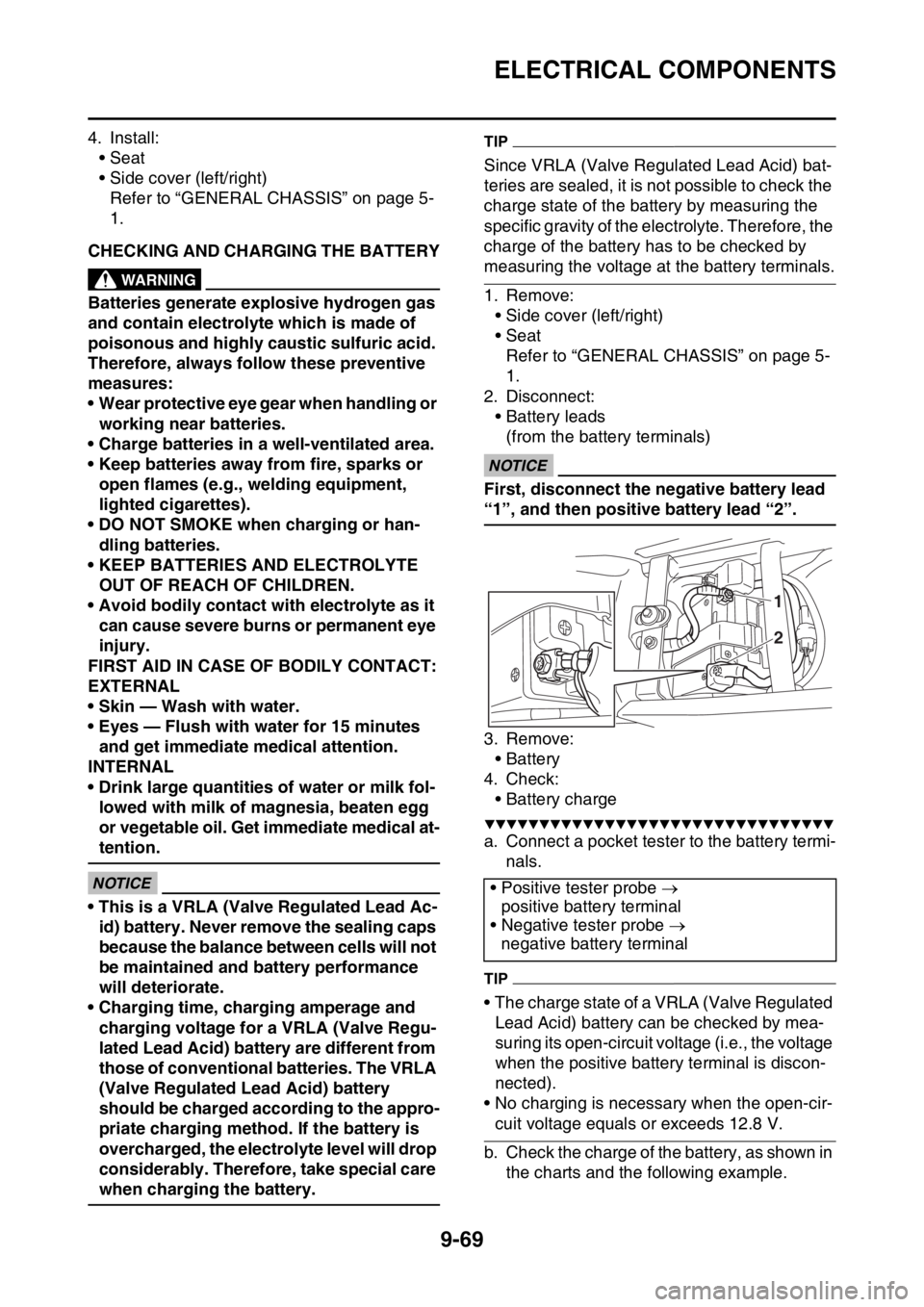
First, disconnect the negative battery lead
“1”, and then positive battery lead “2”.
3. Remove:
• Battery
4. Check:
• Battery charge
▼▼▼▼▼▼▼▼▼▼▼▼▼▼▼▼▼▼▼▼▼▼▼▼▼▼▼▼▼▼▼▼
a. Connect a pocket tester to the battery termi-
nals.
TIP
• The charge state of a VRLA (Valve Regulated
Lead Acid) battery can be checked by mea-
suring its open-circuit voltage (i.e., the voltage
when the positive battery terminal is discon-
nected).
• No charging is necessary when the open-cir-
cuit voltage equals or exceeds 12.8 V.
b. Check the charge of the battery, as shown in
the charts and the following example. • Positive tester probe
positive battery terminal
• Negative tester probe
negative battery terminal
1
2
Page 406 of 432
ELECTRICAL COMPONENTS
9-70
▲▲▲▲▲▲▲▲▲▲▲▲▲▲▲▲▲▲▲▲▲▲▲▲▲▲▲▲▲▲▲▲
5. Charge:
• Battery
(refer to the appropriate charging method)
EWA
WARNING
Do not quick charge a battery.
ECA
NOTICE
• Do not use a high-rate battery charger
since it forces a high-amperage current
into the battery quickly and can cause bat-
tery overheating and battery plate dam-
age.
• If it is impossible to regulate the charging
current on the battery charger, be careful
not to overcharge the battery.• When charging a battery, be sure to re-
move it from the vehicle. (If charging has
to be done with the battery mounted on the
vehicle, disconnect the negative battery
lead from the battery terminal.)
• To reduce the chance of sparks, do not
plug in the battery charger until the battery
charger leads are connected to the bat-
tery.
• Before removing the battery charger lead
clips from the battery terminals, be sure to
turn off the battery charger.
• Make sure the battery charger lead clips
are in full contact with the battery terminal
and that they are not shorted. A corroded
battery charger lead clip may generate
heat in the contact area and a weak clip
spring may cause sparks.
• If the battery becomes hot to the touch at
any time during the charging process, dis-
connect the battery charger and let the
battery cool before reconnecting it. Hot
batteries can explode!
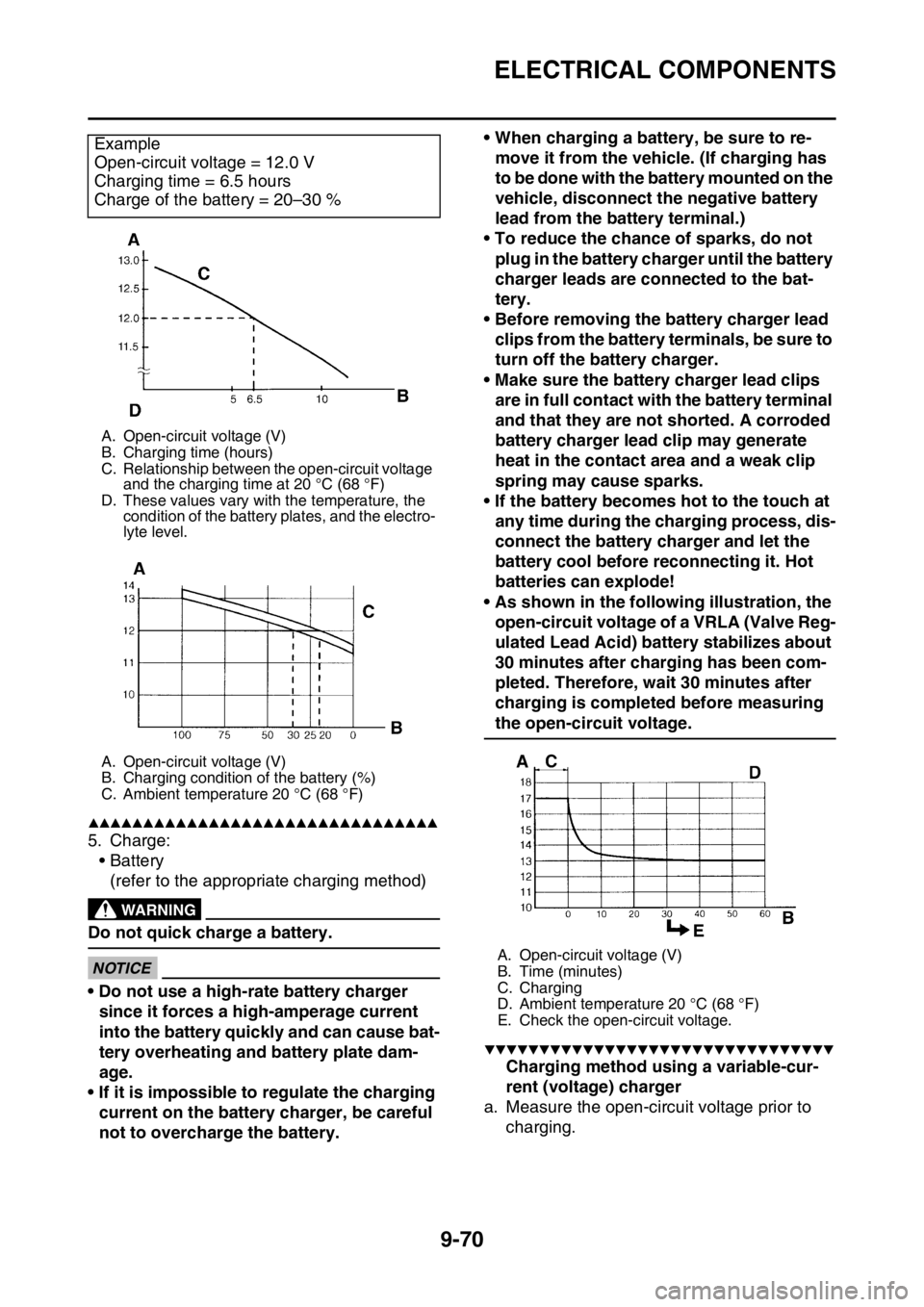
• As shown in the following illustration, the
open-circuit voltage of a VRLA (Valve Reg-
ulated Lead Acid) battery stabilizes about
30 minutes after charging has been com-
pleted. Therefore, wait 30 minutes after
charging is completed before measuring
the open-circuit voltage.
▼▼▼▼▼▼▼▼▼▼▼▼▼▼▼▼▼▼▼▼▼▼▼▼▼▼▼▼▼▼▼▼
Charging method using a variable-cur-
rent (voltage) charger
a. Measure the open-circuit voltage prior to
charging. Example
Open-circuit voltage = 12.0 V
Charging time = 6.5 hours
Charge of the battery = 20–30 %
A. Open-circuit voltage (V)
B. Charging time (hours)
C. Relationship between the open-circuit voltage
and the charging time at 20 °C (68 °F)
D. These values vary with the temperature, the
condition of the battery plates, and the electro-
lyte level.
A. Open-circuit voltage (V)
B. Charging condition of the battery (%)
C. Ambient temperature 20 °C (68 °F)
A. Open-circuit voltage (V)
B. Time (minutes)
C. Charging
D. Ambient temperature 20 °C (68 °F)
E. Check the open-circuit voltage.
Page 407 of 432
ELECTRICAL COMPONENTS
9-71
TIP
Voltage should be measured 30 minutes after
the engine is stopped.
b. Connect a charger and ammeter to the bat-
tery and start charging.
TIP
Set the charging voltage to 16–17 V. If the set-
ting is lower, charging will be insufficient. If too
high, the battery will be over-charged.
c. Make sure that the current is higher than the
standard charging current written on the bat-
tery.
TIP
If the current is lower than the standard charg-
ing current written on the battery, set the charg-
ing voltage adjust dial at 20–24 V and monitor
the amperage for 3–5 minutes to check the bat-
tery.
d. Adjust the voltage so that the current is at
the standard charging level.
e. Set the time according to the charging time
suitable for the open-circuit voltage.
f. If charging requires more than 5 hours, it is
advisable to check the charging current after
a lapse of 5 hours. If there is any change in
the amperage, readjust the voltage to obtain
the standard charging current.
g. Measure the battery open-circuit voltage af-
ter leaving the battery unused for more than
30 minutes.
▲▲▲▲▲▲▲▲▲▲▲▲▲▲▲▲▲▲▲▲▲▲▲▲▲▲▲▲▲▲▲▲
▼▼▼▼▼▼▼▼▼▼▼▼▼▼▼▼▼▼▼▼▼▼▼▼▼▼▼▼▼▼▼▼
Charging method using a constant volt-
age charger
a. Measure the open-circuit voltage prior to
charging.
TIP
Voltage should be measured 30 minutes after
the engine is stopped.
b. Connect a charger and ammeter to the bat-
tery and start charging.c. Make sure that the current is higher than the
standard charging current written on the bat-
tery.
TIP
If the current is lower than the standard charg-
ing current written on the battery, this type of
battery charger cannot charge the VRLA (Valve
Regulated Lead Acid) battery. A variable volt-
age charger is recommended.
d. Charge the battery until the battery’s charg-
ing voltage is 15 V.
TIP
Set the charging time at 20 hours (maximum).
e. Measure the battery open-circuit voltage af-
ter leaving the battery unused for more than
30 minutes.
▲▲▲▲▲▲▲▲▲▲▲▲▲▲▲▲▲▲▲▲▲▲▲▲▲▲▲▲▲▲▲▲
6. Install:
• Battery
7. Connect:
• Battery leads
(to the battery terminals)
ECA
NOTICE
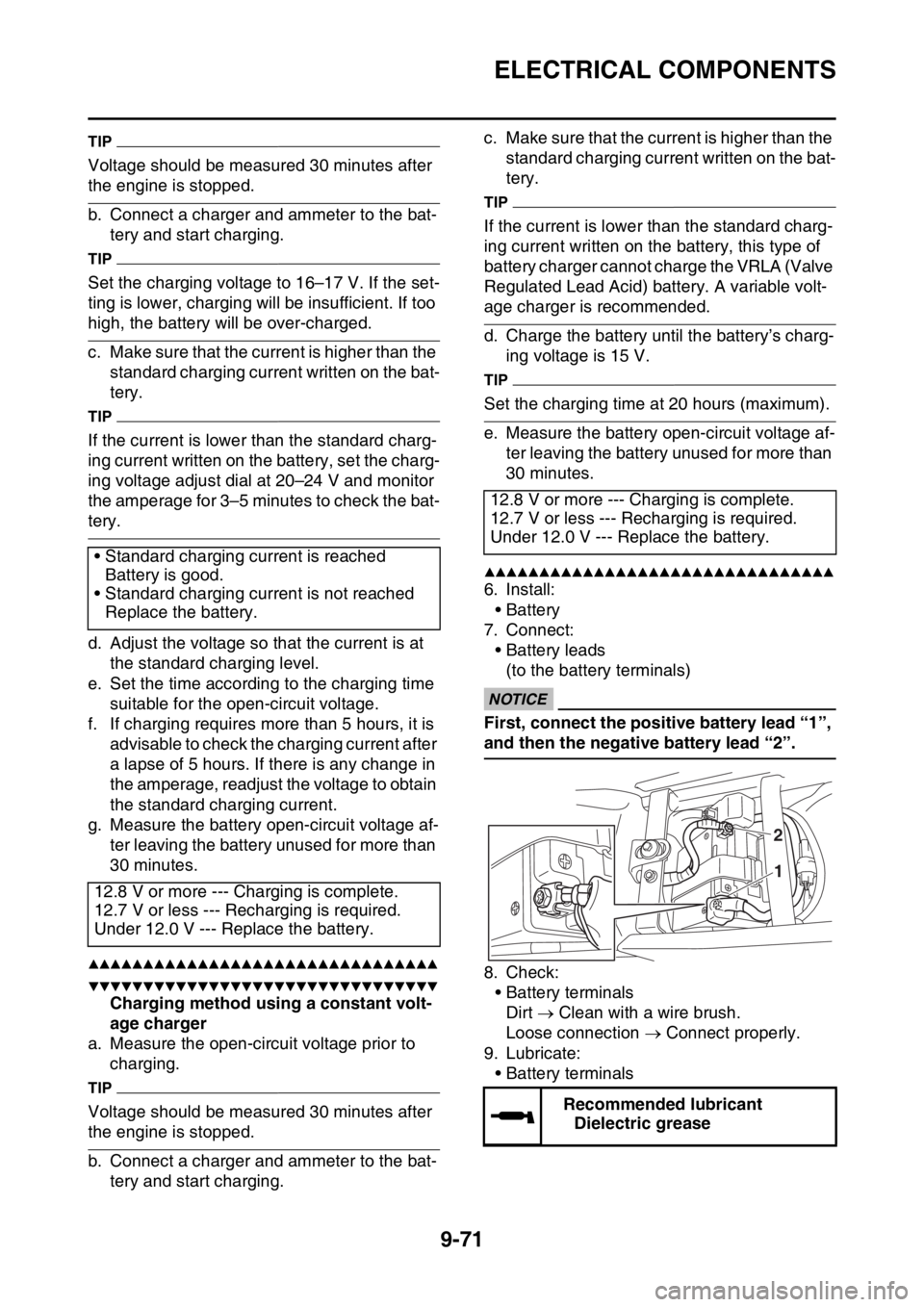
First, connect the positive battery lead “1”,
and then the negative battery lead “2”.
8. Check:
• Battery terminals
Dirt Clean with a wire brush.
Loose connection Connect properly.
9. Lubricate:
• Battery terminals • Standard charging current is reached
Battery is good.
• Standard charging current is not reached
Replace the battery.
12.8 V or more --- Charging is complete.
12.7 V or less --- Recharging is required.
Under 12.0 V --- Replace the battery.
12.8 V or more --- Charging is complete.
12.7 V or less --- Recharging is required.
Under 12.0 V --- Replace the battery.
Recommended lubricant
Dielectric grease
2
1
Page 408 of 432
ELECTRICAL COMPONENTS
9-72
10.Install:
• Seat
• Side cover (left/right)
Refer to “GENERAL CHASSIS” on page 5-
1.
EAS2GBB386CHECKING THE RELAYS
Check each switch for continuity with the pock-
et tester. If the continuity reading is incorrect,
replace the relay.
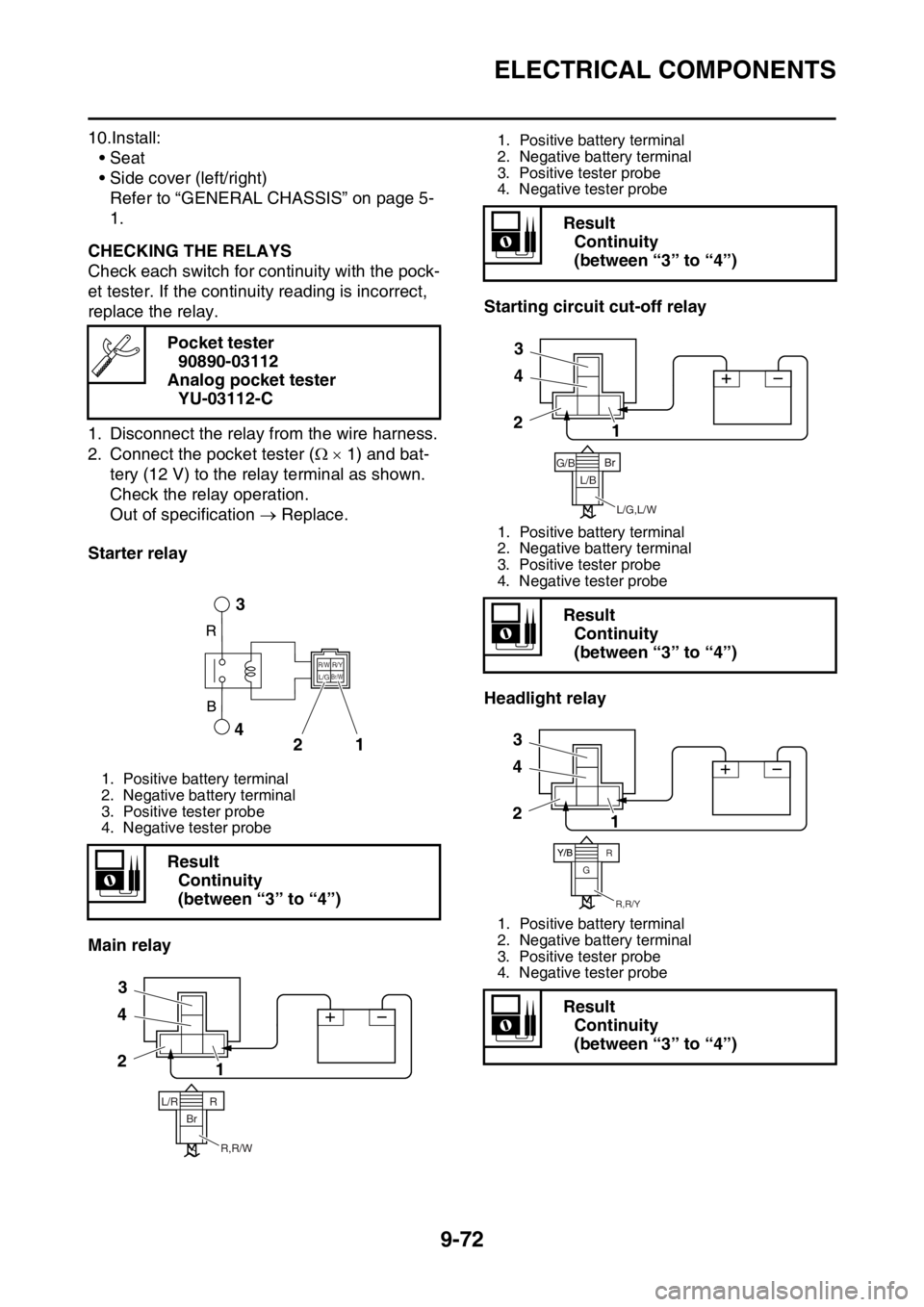
1. Disconnect the relay from the wire harness.
2. Connect the pocket tester ( 1) and bat-
tery (12 V) to the relay terminal as shown.
Check the relay operation.
Out of specification Replace.
Starter relay
Main relayStarting circuit cut-off relay
Headlight relay Pocket tester
90890-03112
Analog pocket tester
YU-03112-C
1. Positive battery terminal
2. Negative battery terminal
3. Positive tester probe
4. Negative tester probe
Result
Continuity
(between “3” to “4”)
21 3
4
R/WBr/WR/YL/G
1 23
4
L/R
BrR
R,R/W
1. Positive battery terminal
2. Negative battery terminal
3. Positive tester probe
4. Negative tester probe
Result
Continuity
(between “3” to “4”)
1. Positive battery terminal
2. Negative battery terminal
3. Positive tester probe
4. Negative tester probe
Result
Continuity
(between “3” to “4”)
1. Positive battery terminal
2. Negative battery terminal
3. Positive tester probe
4. Negative tester probe
Result
Continuity
(between “3” to “4”)
1 23
4
G/B
L/B
L/G,L/W
1 23
4
R,R/Y
GR
Page 409 of 432
ELECTRICAL COMPONENTS
9-73
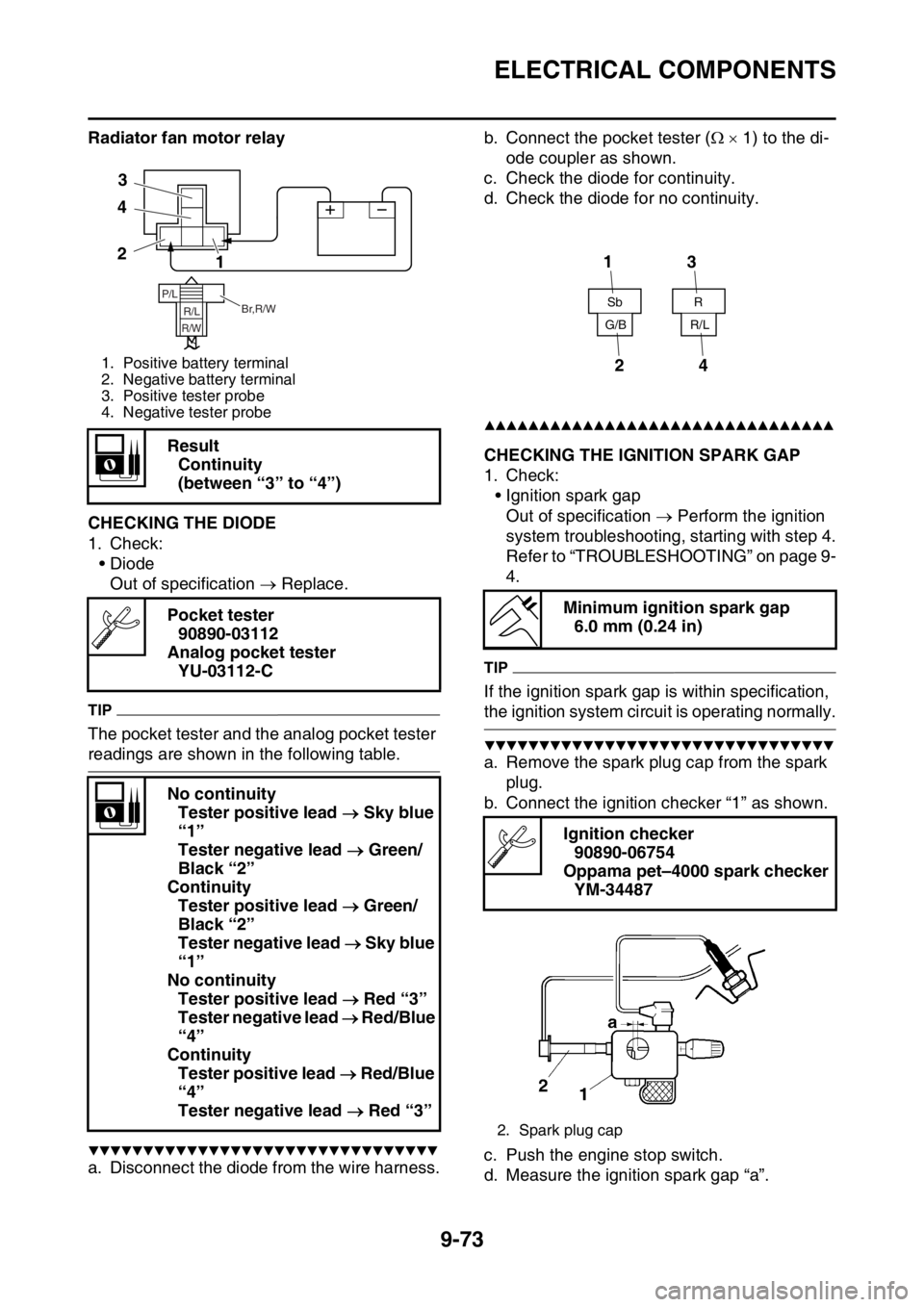
Radiator fan motor relay
EAS2GBB387CHECKING THE DIODE
1. Check:
•Diode
Out of specification Replace.
TIP
The pocket tester and the analog pocket tester
readings are shown in the following table.
▼▼▼▼▼▼▼▼▼▼▼▼▼▼▼▼▼▼▼▼▼▼▼▼▼▼▼▼▼▼▼▼
a. Disconnect the diode from the wire harness.b. Connect the pocket tester ( 1) to the di-
ode coupler as shown.
c. Check the diode for continuity.
d. Check the diode for no continuity.
▲▲▲▲▲▲▲▲▲▲▲▲▲▲▲▲▲▲▲▲▲▲▲▲▲▲▲▲▲▲▲▲
EAS2GBB388CHECKING THE IGNITION SPARK GAP
1. Check:
• Ignition spark gap
Out of specification Perform the ignition
system troubleshooting, starting with step 4.
Refer to “TROUBLESHOOTING” on page 9-
4.
TIP
If the ignition spark gap is within specification,
the ignition system circuit is operating normally.
▼▼▼▼▼▼▼▼▼▼▼▼▼▼▼▼▼▼▼▼▼▼▼▼▼▼▼▼▼▼▼▼
a. Remove the spark plug cap from the spark
plug.
b. Connect the ignition checker “1” as shown.
c. Push the engine stop switch.
d. Measure the ignition spark gap “a”.
1. Positive battery terminal
2. Negative battery terminal
3. Positive tester probe
4. Negative tester probe
Result
Continuity
(between “3” to “4”)
Pocket tester
90890-03112
Analog pocket tester
YU-03112-C
No continuity
Tester positive lead Sky blue
“1”
Tester negative lead Green/
Black “2”
Continuity
Tester positive lead Green/
Black “2”
Tester negative lead Sky blue
“1”
No continuity
Tester positive lead Red “3”
Tester negative lead Red/Blue
“4”
Continuity
Tester positive lead Red/Blue
“4”
Tester negative lead Red “3”
1 23
4
P/L
R/L
R/W
Br,R/W
Minimum ignition spark gap
6.0 mm (0.24 in)
Ignition checker
90890-06754
Oppama pet–4000 spark checker
YM-34487
2. Spark plug cap
2
1
4
3
R Sb
G/B R/L
Page 412 of 432
ELECTRICAL COMPONENTS
9-76
CHECKING THE STARTER MOTOR OPERA-
TION
1. Check:
• Starter motor operation
Does not operate Perform the electric
starting system troubleshooting, starting
with step 4.
Refer to “ELECTRIC STARTING SYSTEM”
on page 9-6.
▼▼▼▼▼▼▼▼▼▼▼▼▼▼▼▼▼▼▼▼▼▼▼▼▼▼▼▼▼▼▼▼
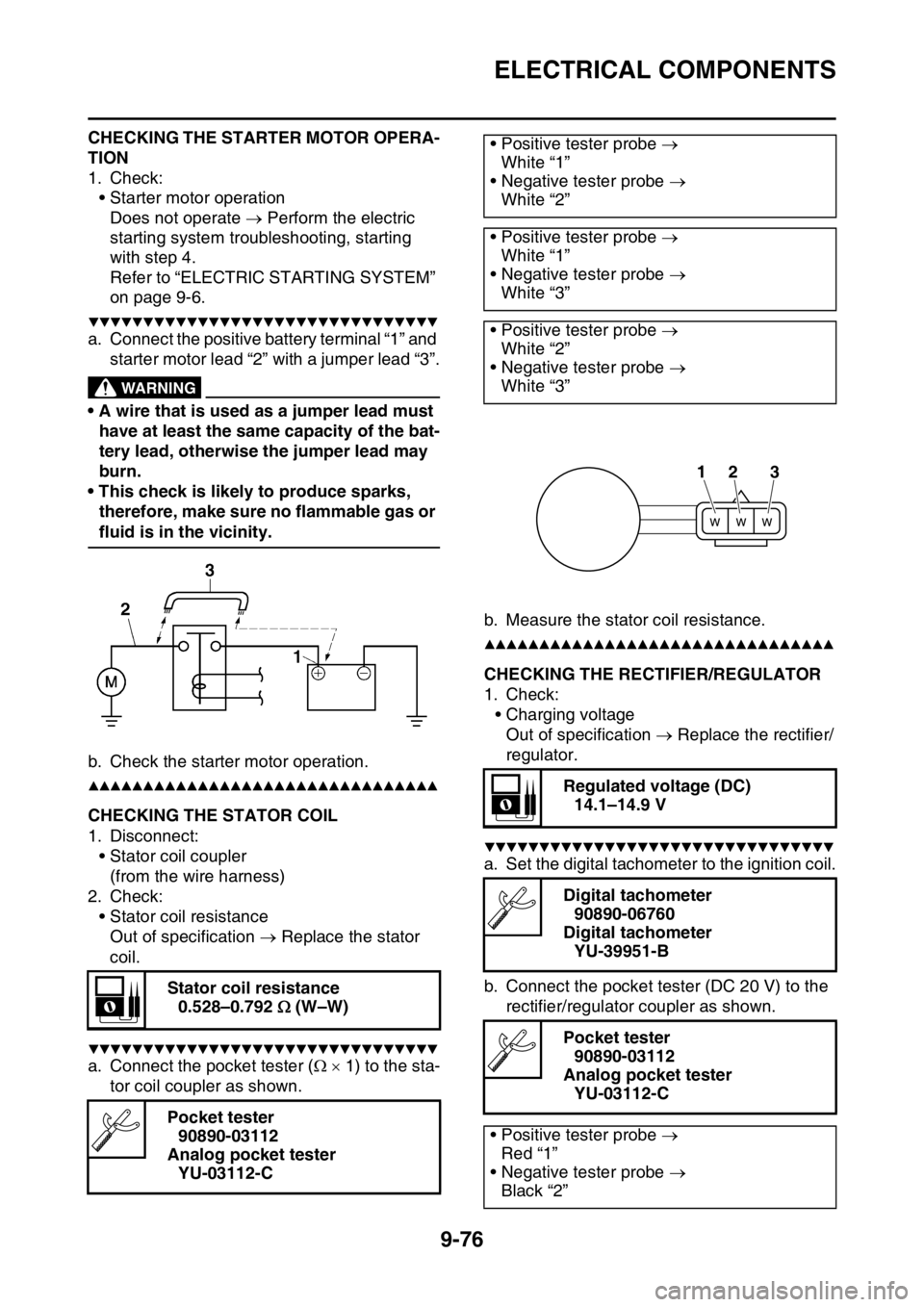
a. Connect the positive battery terminal “1” and
starter motor lead “2” with a jumper lead “3”.
EWA
WARNING
• A wire that is used as a jumper lead must
have at least the same capacity of the bat-
tery lead, otherwise the jumper lead may
burn.
• This check is likely to produce sparks,
therefore, make sure no flammable gas or
fluid is in the vicinity.
b. Check the starter motor operation.
▲▲▲▲▲▲▲▲▲▲▲▲▲▲▲▲▲▲▲▲▲▲▲▲▲▲▲▲▲▲▲▲
EAS28150CHECKING THE STATOR COIL
1. Disconnect:
• Stator coil coupler
(from the wire harness)
2. Check:
• Stator coil resistance
Out of specification Replace the stator
coil.
▼▼▼▼▼▼▼▼▼▼▼▼▼▼▼▼▼▼▼▼▼▼▼▼▼▼▼▼▼▼▼▼
a. Connect the pocket tester ( 1) to the sta-
tor coil coupler as shown.b. Measure the stator coil resistance.
▲▲▲▲▲▲▲▲▲▲▲▲▲▲▲▲▲▲▲▲▲▲▲▲▲▲▲▲▲▲▲▲
EAS2GBB394CHECKING THE RECTIFIER/REGULATOR
1. Check:
• Charging voltage
Out of specification Replace the rectifier/
regulator.
▼▼▼▼▼▼▼▼▼▼▼▼▼▼▼▼▼▼▼▼▼▼▼▼▼▼▼▼▼▼▼▼
a. Set the digital tachometer to the ignition coil.
b. Connect the pocket tester (DC 20 V) to the
rectifier/regulator coupler as shown. Stator coil resistance
0.528–0.792 (W–W)
Pocket tester
90890-03112
Analog pocket tester
YU-03112-C
• Positive tester probe
White “1”
• Negative tester probe
White “2”
• Positive tester probe
White “1”
• Negative tester probe
White “3”
• Positive tester probe
White “2”
• Negative tester probe
White “3”
Regulated voltage (DC)
14.1–14.9 V
Digital tachometer
90890-06760
Digital tachometer
YU-39951-B
Pocket tester
90890-03112
Analog pocket tester
YU-03112-C
• Positive tester probe
Red “1”
• Negative tester probe
Black “2”
123
Page 414 of 432
ELECTRICAL COMPONENTS
9-78
EAS2GBB397CHECKING THE RESISTER
1. Disconnect:
• Resister coupler
(from the wire harness)
2. Check:
• Resister resistance
Out of specification Replace the resister.
▼▼▼▼▼▼▼▼▼▼▼▼▼▼▼▼▼▼▼▼▼▼▼▼▼▼▼▼▼▼▼▼
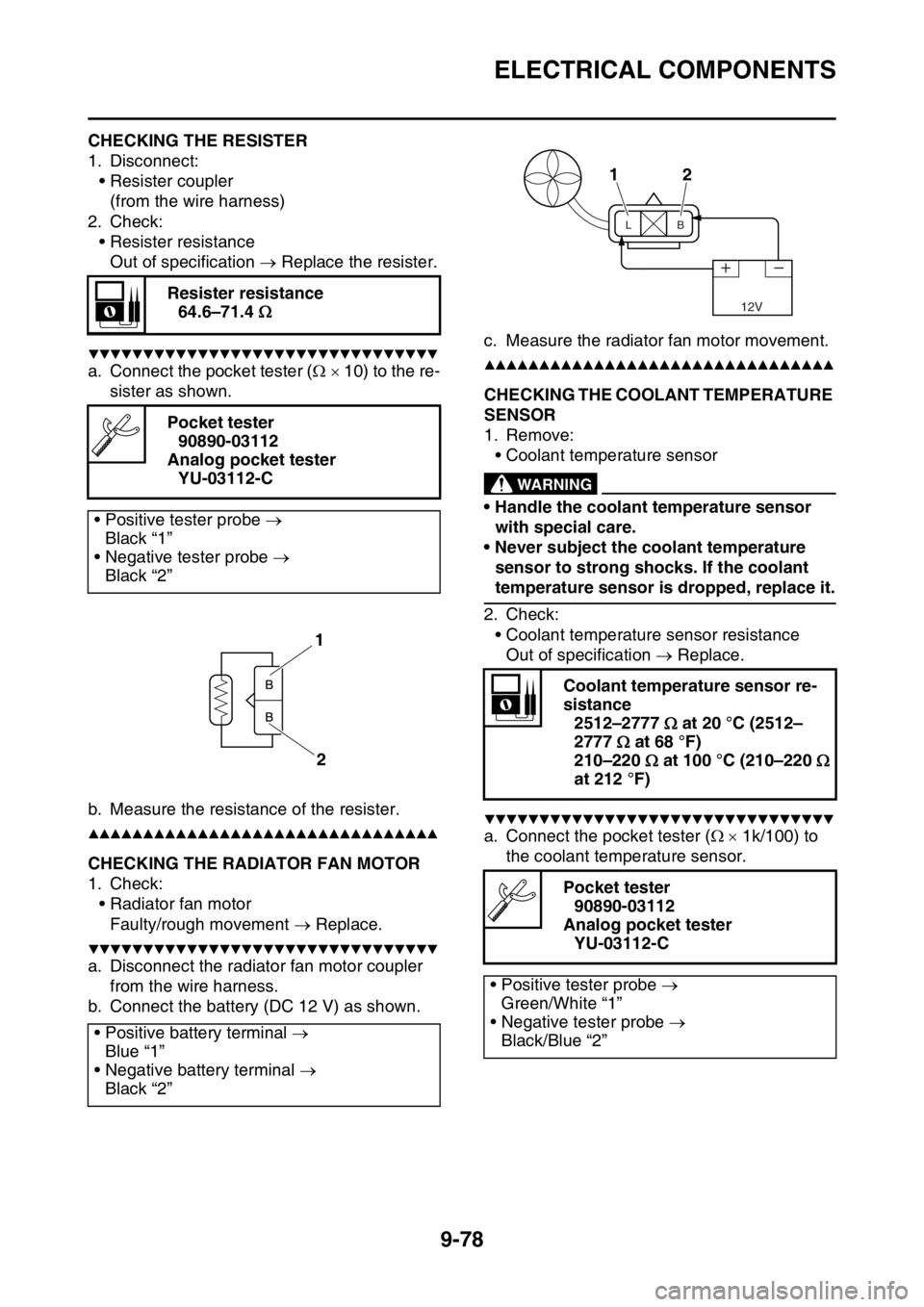
a. Connect the pocket tester ( 10) to the re-
sister as shown.
b. Measure the resistance of the resister.
▲▲▲▲▲▲▲▲▲▲▲▲▲▲▲▲▲▲▲▲▲▲▲▲▲▲▲▲▲▲▲▲
EAS2GBB398CHECKING THE RADIATOR FAN MOTOR
1. Check:
• Radiator fan motor
Faulty/rough movement Replace.
▼▼▼▼▼▼▼▼▼▼▼▼▼▼▼▼▼▼▼▼▼▼▼▼▼▼▼▼▼▼▼▼
a. Disconnect the radiator fan motor coupler
from the wire harness.
b. Connect the battery (DC 12 V) as shown.c. Measure the radiator fan motor movement.
▲▲▲▲▲▲▲▲▲▲▲▲▲▲▲▲▲▲▲▲▲▲▲▲▲▲▲▲▲▲▲▲
EAS2GBB399CHECKING THE COOLANT TEMPERATURE
SENSOR
1. Remove:
• Coolant temperature sensor
EWA
WARNING
• Handle the coolant temperature sensor
with special care.
• Never subject the coolant temperature
sensor to strong shocks. If the coolant
temperature sensor is dropped, replace it.
2. Check:
• Coolant temperature sensor resistance
Out of specification Replace.
▼▼▼▼▼▼▼▼▼▼▼▼▼▼▼▼▼▼▼▼▼▼▼▼▼▼▼▼▼▼▼▼
a. Connect the pocket tester ( 1k/100) to
the coolant temperature sensor. Resister resistance
64.6–71.4
Pocket tester
90890-03112
Analog pocket tester
YU-03112-C
• Positive tester probe
Black “1”
• Negative tester probe
Black “2”
• Positive battery terminal
Blue “1”
• Negative battery terminal
Black “2”
1
2
Coolant temperature sensor re-
sistance
2512–2777 at 20 °C (2512–
2777 at 68 °F)
210–220 at 100 °C (210–220
at 212 °F)
Pocket tester
90890-03112
Analog pocket tester
YU-03112-C
• Positive tester probe
Green/White “1”
• Negative tester probe
Black/Blue “2”
12
12V
LB