checking oil YAMAHA WR 250F 2017 User Guide
[x] Cancel search | Manufacturer: YAMAHA, Model Year: 2017, Model line: WR 250F, Model: YAMAHA WR 250F 2017Pages: 432, PDF Size: 14.14 MB
Page 176 of 432
FRONT BRAKE
5-22
TIP
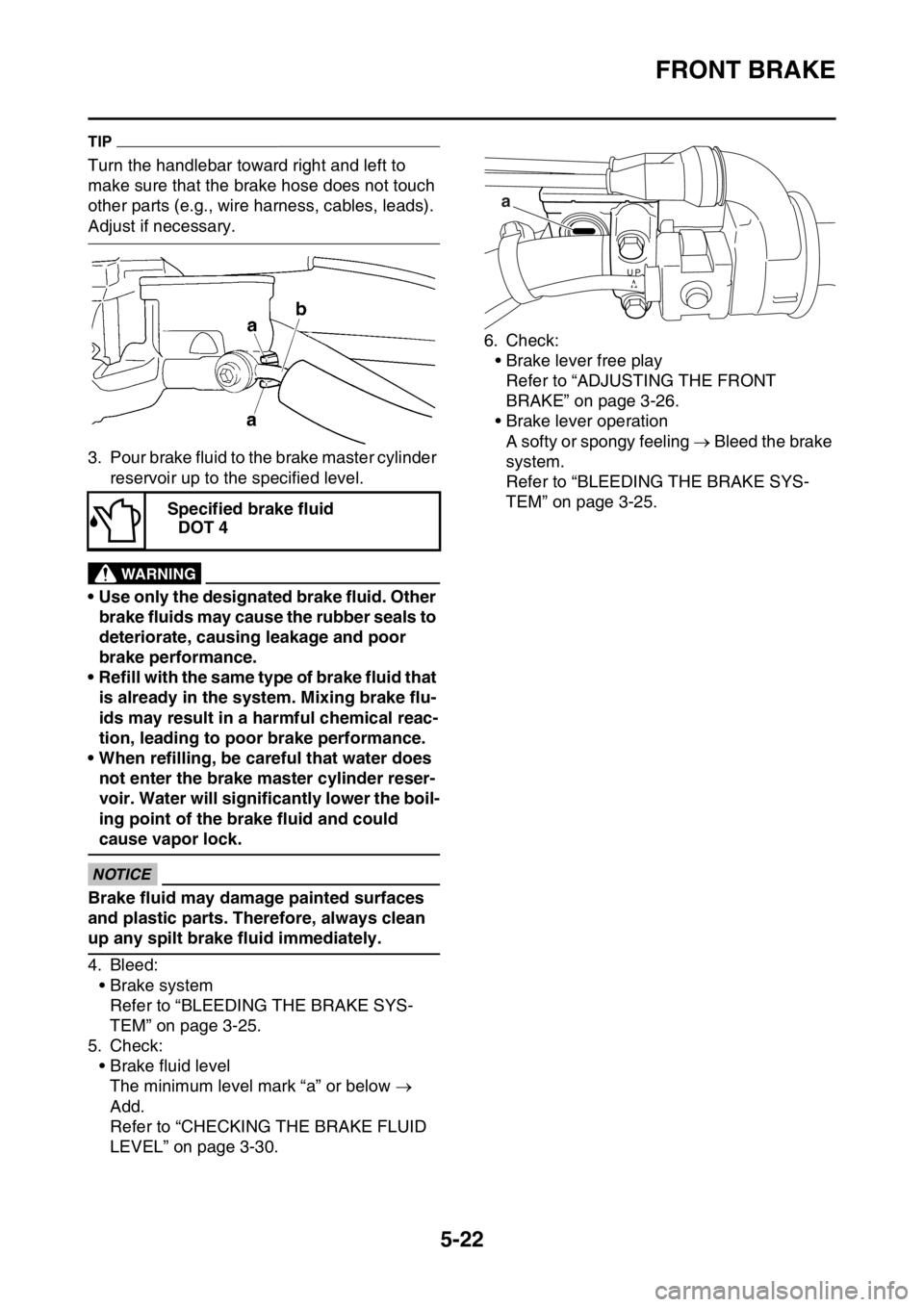
Turn the handlebar toward right and left to
make sure that the brake hose does not touch
other parts (e.g., wire harness, cables, leads).
Adjust if necessary.
3. Pour brake fluid to the brake master cylinder
reservoir up to the specified level.
EWA
WARNING
• Use only the designated brake fluid. Other
brake fluids may cause the rubber seals to
deteriorate, causing leakage and poor
brake performance.
• Refill with the same type of brake fluid that
is already in the system. Mixing brake flu-
ids may result in a harmful chemical reac-
tion, leading to poor brake performance.
• When refilling, be careful that water does
not enter the brake master cylinder reser-
voir. Water will significantly lower the boil-
ing point of the brake fluid and could
cause vapor lock.
ECA
NOTICE
Brake fluid may damage painted surfaces
and plastic parts. Therefore, always clean
up any spilt brake fluid immediately.
4. Bleed:
• Brake system
Refer to “BLEEDING THE BRAKE SYS-
TEM” on page 3-25.
5. Check:
• Brake fluid level
The minimum level mark “a” or below
Add.
Refer to “CHECKING THE BRAKE FLUID
LEVEL” on page 3-30.6. Check:
• Brake lever free play
Refer to “ADJUSTING THE FRONT
BRAKE” on page 3-26.
• Brake lever operation
A softy or spongy feeling Bleed the brake
system.
Refer to “BLEEDING THE BRAKE SYS-
TEM” on page 3-25.
Specified brake fluid
DOT 4
a
Page 184 of 432
REAR BRAKE
5-30
EWA
WARNING
• Use only the designated brake fluid. Other
brake fluids may cause the rubber seals to
deteriorate, causing leakage and poor
brake performance.
• Refill with the same type of brake fluid that
is already in the system. Mixing brake flu-
ids may result in a harmful chemical reac-
tion, leading to poor brake performance.
• When refilling, be careful that water does
not enter the brake fluid reservoir. Water
will significantly lower the boiling point of
the brake fluid and could cause vapor
lock.
ECA
NOTICE
Brake fluid may damage painted surfaces
and plastic parts. Therefore, always clean
up any spilt brake fluid immediately.
5. Bleed:
• Brake system
Refer to “BLEEDING THE BRAKE SYS-
TEM” on page 3-25.
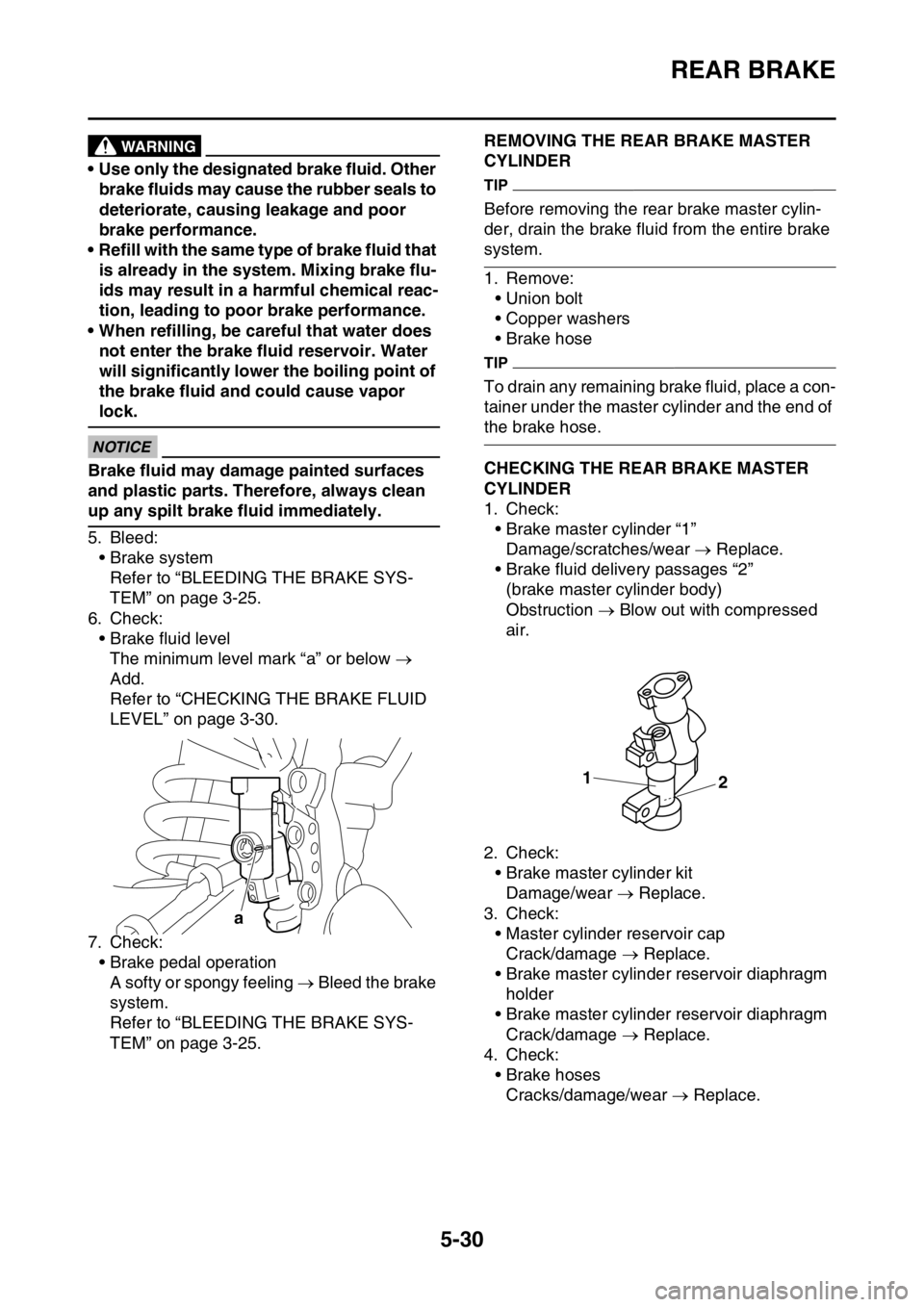
6. Check:
• Brake fluid level
The minimum level mark “a” or below
Add.
Refer to “CHECKING THE BRAKE FLUID
LEVEL” on page 3-30.
7. Check:
• Brake pedal operation
A softy or spongy feeling Bleed the brake
system.
Refer to “BLEEDING THE BRAKE SYS-
TEM” on page 3-25.
EAS2GBB189REMOVING THE REAR BRAKE MASTER
CYLINDER
TIP
Before removing the rear brake master cylin-
der, drain the brake fluid from the entire brake
system.
1. Remove:
• Union bolt
• Copper washers
• Brake hose
TIP
To drain any remaining brake fluid, place a con-
tainer under the master cylinder and the end of
the brake hose.
EAS2GBB190CHECKING THE REAR BRAKE MASTER
CYLINDER
1. Check:
• Brake master cylinder “1”
Damage/scratches/wear Replace.
• Brake fluid delivery passages “2”
(brake master cylinder body)
Obstruction Blow out with compressed
air.
2. Check:
• Brake master cylinder kit
Damage/wear Replace.
3. Check:
• Master cylinder reservoir cap
Crack/damage Replace.
• Brake master cylinder reservoir diaphragm
holder
• Brake master cylinder reservoir diaphragm
Crack/damage Replace.
4. Check:
• Brake hoses
Cracks/damage/wear Replace.
a
1
2
Page 186 of 432
REAR BRAKE
5-32
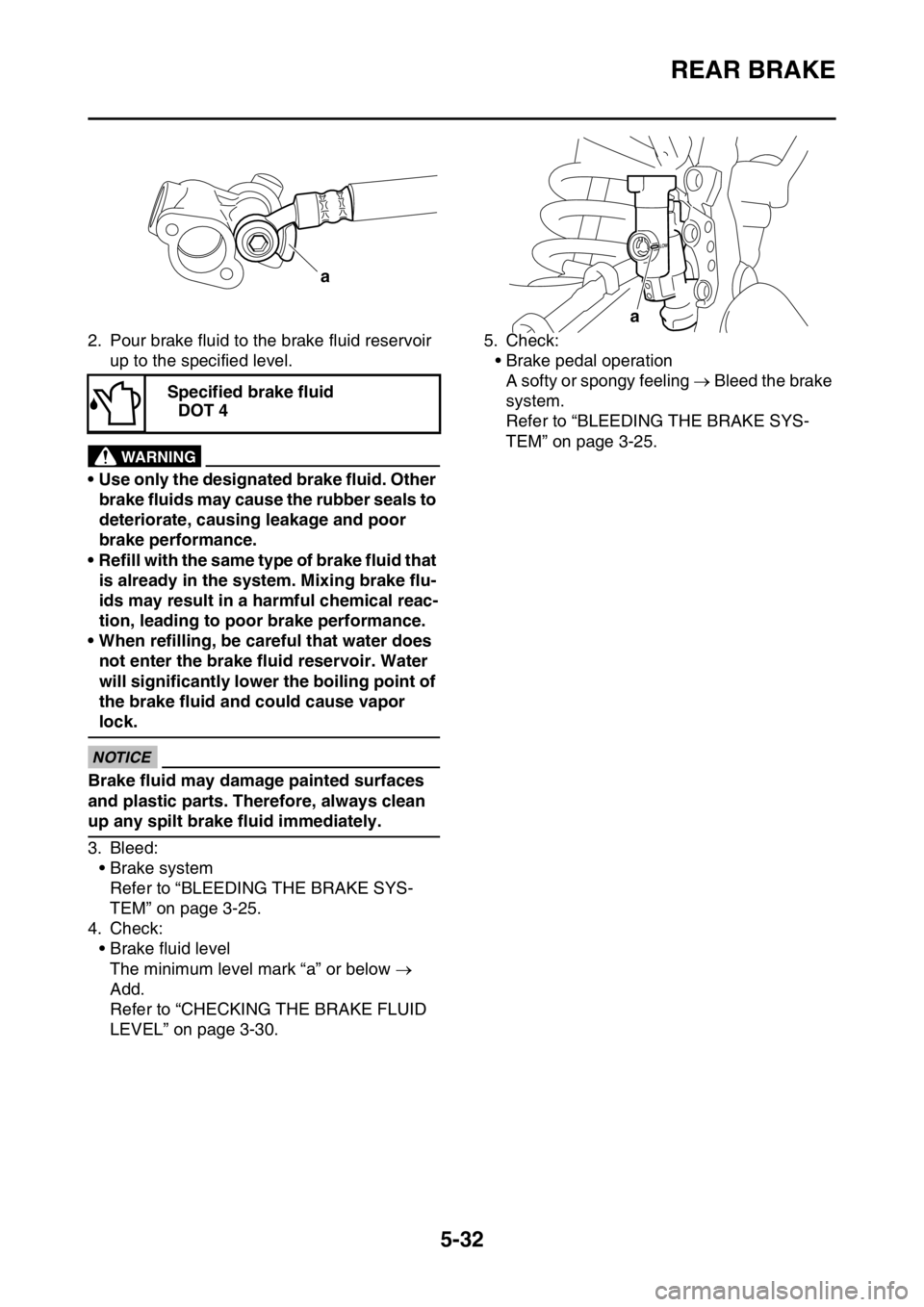
2. Pour brake fluid to the brake fluid reservoir
up to the specified level.
EWA
WARNING
• Use only the designated brake fluid. Other
brake fluids may cause the rubber seals to
deteriorate, causing leakage and poor
brake performance.
• Refill with the same type of brake fluid that
is already in the system. Mixing brake flu-
ids may result in a harmful chemical reac-
tion, leading to poor brake performance.
• When refilling, be careful that water does
not enter the brake fluid reservoir. Water
will significantly lower the boiling point of
the brake fluid and could cause vapor
lock.
ECA
NOTICE
Brake fluid may damage painted surfaces
and plastic parts. Therefore, always clean
up any spilt brake fluid immediately.
3. Bleed:
• Brake system
Refer to “BLEEDING THE BRAKE SYS-
TEM” on page 3-25.
4. Check:
• Brake fluid level
The minimum level mark “a” or below
Add.
Refer to “CHECKING THE BRAKE FLUID
LEVEL” on page 3-30.5. Check:
• Brake pedal operation
A softy or spongy feeling Bleed the brake
system.
Refer to “BLEEDING THE BRAKE SYS-
TEM” on page 3-25. Specified brake fluid
DOT 4
a
a
Page 197 of 432
FRONT FORK
5-43
b. Repeat this step until the inner tube can be
pulled out from the outer tube.
▲▲▲▲▲▲▲▲▲▲▲▲▲▲▲▲▲▲▲▲▲▲▲▲▲▲▲▲▲▲▲▲
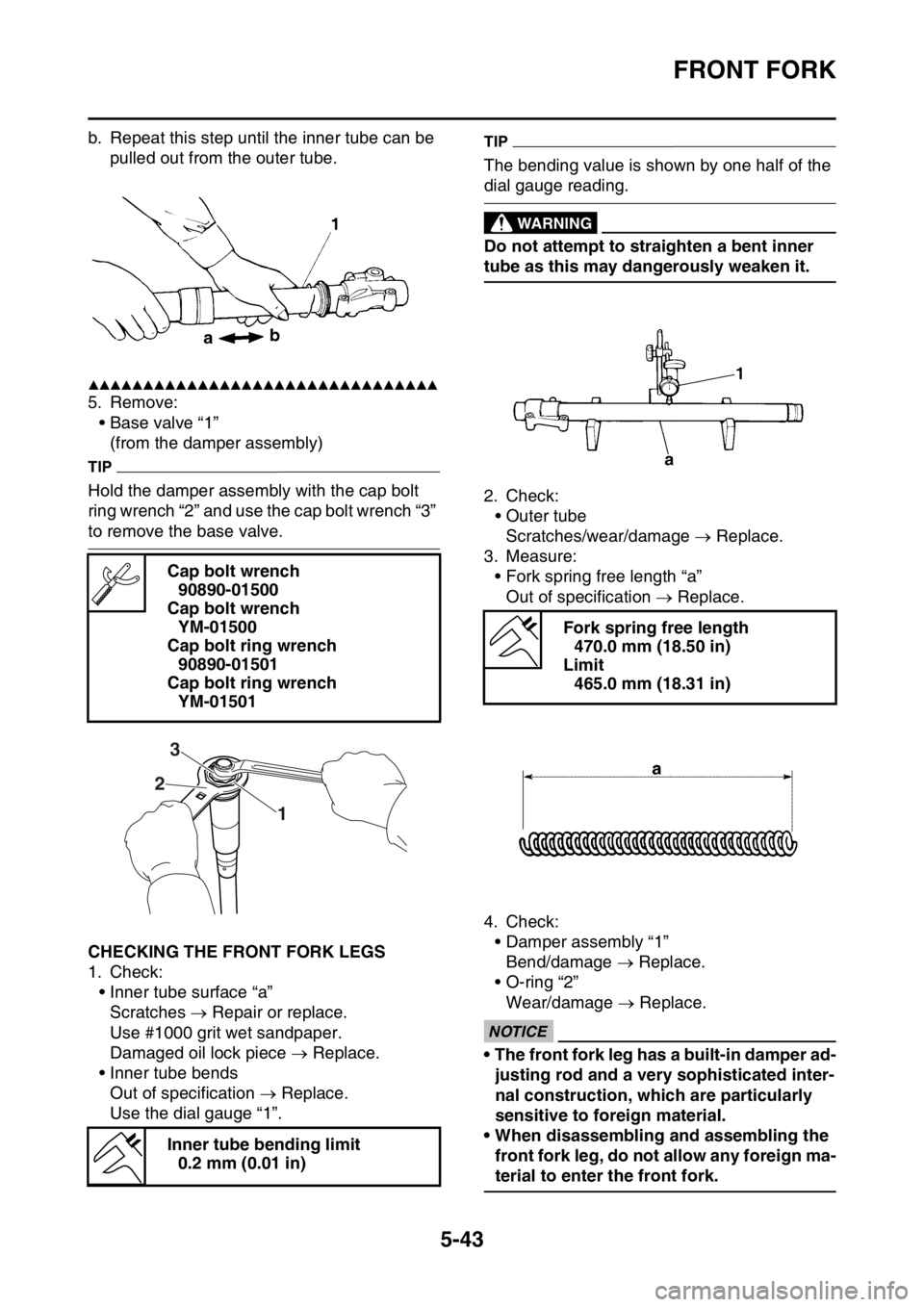
5. Remove:
• Base valve “1”
(from the damper assembly)
TIP
Hold the damper assembly with the cap bolt
ring wrench “2” and use the cap bolt wrench “3”
to remove the base valve.
EAS2GBB200CHECKING THE FRONT FORK LEGS
1. Check:
• Inner tube surface “a”
Scratches Repair or replace.
Use #1000 grit wet sandpaper.
Damaged oil lock piece Replace.
• Inner tube bends
Out of specification Replace.
Use the dial gauge “1”.
TIP
The bending value is shown by one half of the
dial gauge reading.
EWA
WARNING
Do not attempt to straighten a bent inner
tube as this may dangerously weaken it.
2. Check:
• Outer tube
Scratches/wear/damage Replace.
3. Measure:
• Fork spring free length “a”
Out of specification Replace.
4. Check:
• Damper assembly “1”
Bend/damage Replace.
• O-ring “2”
Wear/damage Replace.
ECA
NOTICE
• The front fork leg has a built-in damper ad-
justing rod and a very sophisticated inter-
nal construction, which are particularly
sensitive to foreign material.
• When disassembling and assembling the
front fork leg, do not allow any foreign ma-
terial to enter the front fork. Cap bolt wrench
90890-01500
Cap bolt wrench
YM-01500
Cap bolt ring wrench
90890-01501
Cap bolt ring wrench
YM-01501
Inner tube bending limit
0.2 mm (0.01 in)
1 23
Fork spring free length
470.0 mm (18.50 in)
Limit
465.0 mm (18.31 in)
Page 216 of 432
REAR SHOCK ABSORBER ASSEMBLY
5-62
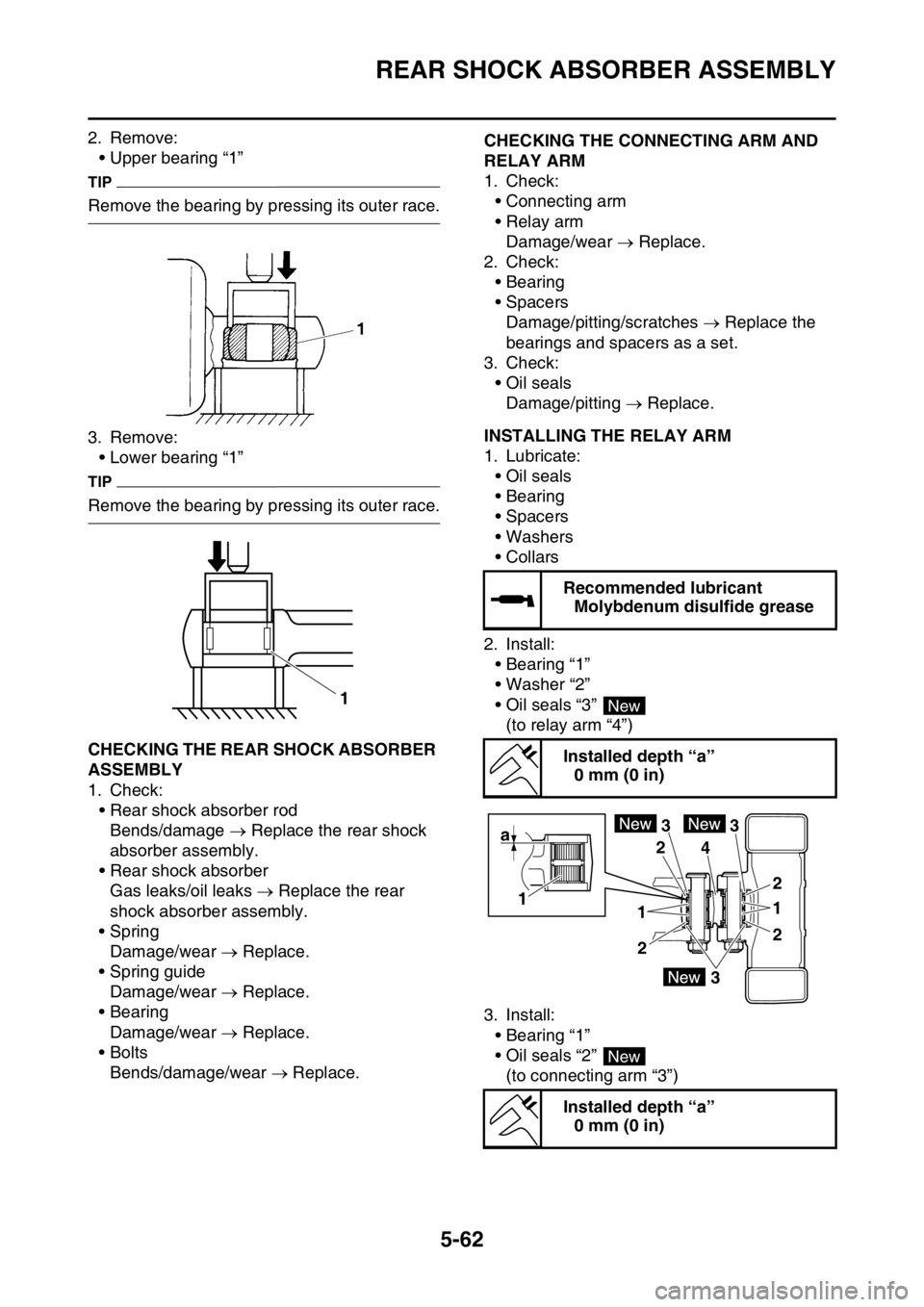
2. Remove:
• Upper bearing “1”
TIP
Remove the bearing by pressing its outer race.
3. Remove:
• Lower bearing “1”
TIP
Remove the bearing by pressing its outer race.
EAS2GBB212CHECKING THE REAR SHOCK ABSORBER
ASSEMBLY
1. Check:
• Rear shock absorber rod
Bends/damage Replace the rear shock
absorber assembly.
• Rear shock absorber
Gas leaks/oil leaks Replace the rear
shock absorber assembly.
•Spring
Damage/wear Replace.
• Spring guide
Damage/wear Replace.
• Bearing
Damage/wear Replace.
•Bolts
Bends/damage/wear Replace.
EAS2GBB213CHECKING THE CONNECTING ARM AND
RELAY ARM
1. Check:
• Connecting arm
• Relay arm
Damage/wear Replace.
2. Check:
• Bearing
• Spacers
Damage/pitting/scratches Replace the
bearings and spacers as a set.
3. Check:
• Oil seals
Damage/pitting Replace.
EAS2GBB214INSTALLING THE RELAY ARM
1. Lubricate:
• Oil seals
• Bearing
• Spacers
• Washers
•Collars
2. Install:
• Bearing “1”
• Washer “2”
• Oil seals “3”
(to relay arm “4”)
3. Install:
• Bearing “1”
• Oil seals “2”
(to connecting arm “3”)
1
Recommended lubricant
Molybdenum disulfide grease
Installed depth “a”
0 mm (0 in)
Installed depth “a”
0 mm (0 in)
New
3 3
43
2 2
22
a
1
11
New
Page 220 of 432
SWINGARM
5-66
EAS2GBB217REMOVING THE SWINGARM
1. Use a suitable stand to raise the rear wheel
off the ground.
EWA
WARNING
Securely support the vehicle so that there is
no danger of it falling over.
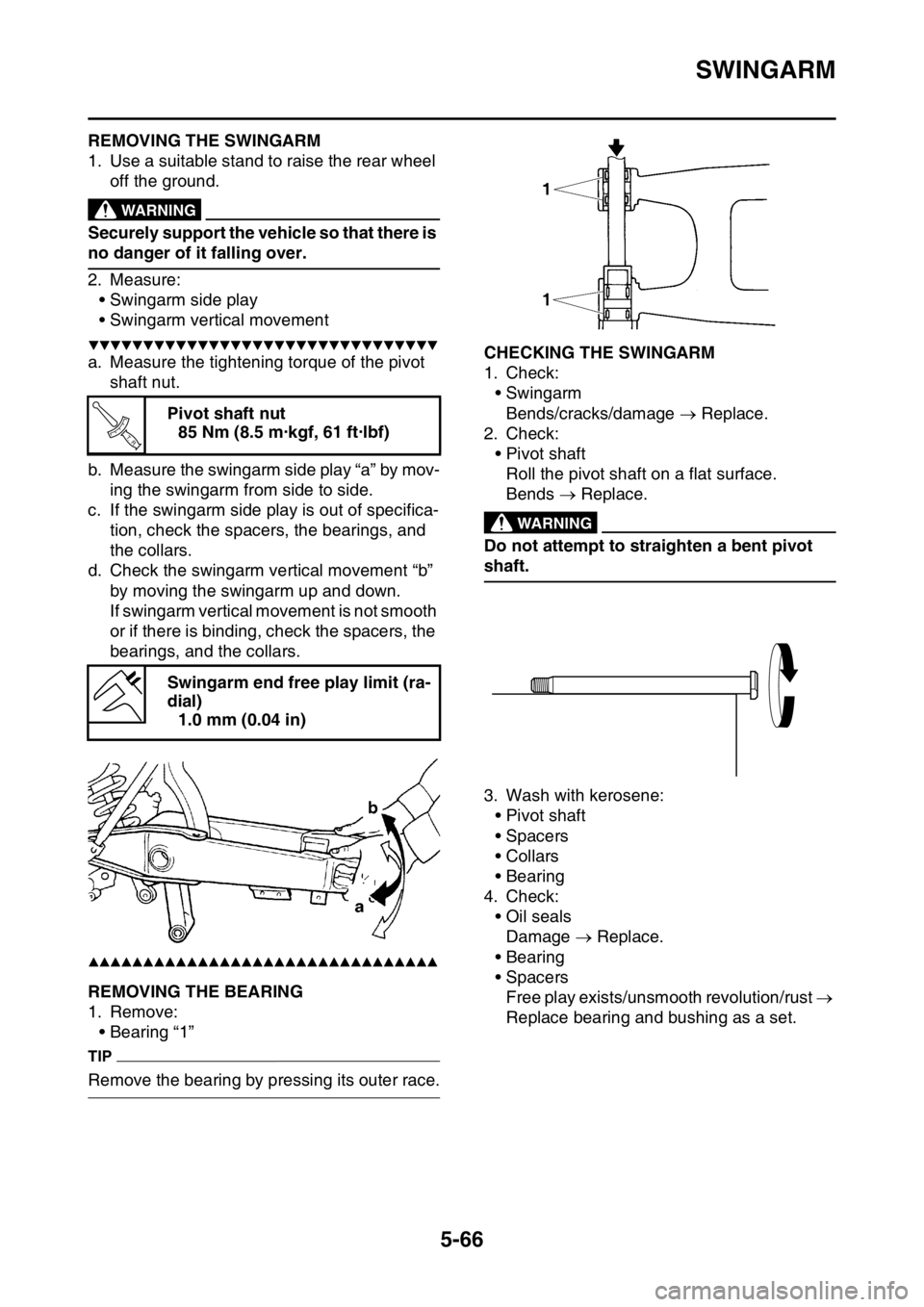
2. Measure:
• Swingarm side play
• Swingarm vertical movement
▼▼▼▼▼▼▼▼▼▼▼▼▼▼▼▼▼▼▼▼▼▼▼▼▼▼▼▼▼▼▼▼
a. Measure the tightening torque of the pivot
shaft nut.
b. Measure the swingarm side play “a” by mov-
ing the swingarm from side to side.
c. If the swingarm side play is out of specifica-
tion, check the spacers, the bearings, and
the collars.
d. Check the swingarm vertical movement “b”
by moving the swingarm up and down.
If swingarm vertical movement is not smooth
or if there is binding, check the spacers, the
bearings, and the collars.
▲▲▲▲▲▲▲▲▲▲▲▲▲▲▲▲▲▲▲▲▲▲▲▲▲▲▲▲▲▲▲▲
EAS2GBB218REMOVING THE BEARING
1. Remove:
• Bearing “1”
TIP
Remove the bearing by pressing its outer race.
EAS2GBB219CHECKING THE SWINGARM
1. Check:
• Swingarm
Bends/cracks/damage Replace.
2. Check:
• Pivot shaft
Roll the pivot shaft on a flat surface.
Bends Replace.
EWA
WARNING
Do not attempt to straighten a bent pivot
shaft.
3. Wash with kerosene:
• Pivot shaft
• Spacers
•Collars
• Bearing
4. Check:
• Oil seals
Damage Replace.
• Bearing
• Spacers
Free play exists/unsmooth revolution/rust
Replace bearing and bushing as a set. Pivot shaft nut
85 Nm (8.5 m·kgf, 61 ft·lbf)
Swingarm end free play limit (ra-
dial)
1.0 mm (0.04 in)
T R..
Page 228 of 432

CLUTCH......................................................................................................... 6-42
REMOVING THE CLUTCH ...................................................................... 6-45
CHECKING THE FRICTION PLATES...................................................... 6-45
CHECKING THE CLUTCH PLATES ........................................................ 6-45
CHECKING THE CLUTCH SPRINGS...................................................... 6-45
CHECKING THE CLUTCH HOUSING ..................................................... 6-46
CHECKING THE CLUTCH BOSS ............................................................ 6-46
CHECKING THE PRESSURE PLATE ..................................................... 6-46
CHECKING THE PUSH LEVER SHAFT .................................................. 6-46
CHECKING THE CLUTCH PUSH RODS ................................................ 6-46
CHECKING THE PRIMARY DRIVE GEAR .............................................. 6-46
CHECKING THE PRIMARY DRIVEN GEAR ........................................... 6-47
INSTALLING THE OIL SEAL................................................................... 6-47
INSTALLING THE RIGHT CRANKCASE COVER ................................... 6-47
INSTALLING THE CLUTCH ..................................................................... 6-47
INSTALLING THE KICKSTARTER LEVER ............................................. 6-50
KICKSTATER................................................................................................. 6-51
REMOVING THE KICK SHAFT ASSEMBLY ........................................... 6-52
CHECKING THE KICK SHAFT AND RATCHET WHEEL ........................ 6-52
CHECKING THE KICK GEAR, KICK IDLE GEAR AND RATCHET
WHEEL .................................................................................................... 6-52
INSTALLING THE KICK SHAFT ASSEMBLY .......................................... 6-52
INSTALLING THE KICK IDLE GEAR ....................................................... 6-53
SHIFT SHAFT................................................................................................. 6-54
REMOVING THE SHIFT GUIDE AND SHIFT LEVER ASSEMBLY ......... 6-56
REMOVING THE SEGMENT ................................................................... 6-56
CHECKING THE SHIFT SHAFT .............................................................. 6-56
CHECKING THE SHIFT GUIDE AND SHIFT LEVER ASSEMBLY ......... 6-56
CHECKING THE STOPPER LEVER ....................................................... 6-56
INSTALLING THE STOPPER LEVER ..................................................... 6-56
INSTALLING THE SEGMENT.................................................................. 6-57
INSTALLING THE SHIFT GUIDE AND SHIFT LEVER ASSEMBLY ....... 6-57
INSTALLING THE SHIFT SHAFT ............................................................ 6-58
INSTALLING THE SHIFT PEDAL ............................................................ 6-58
OIL PUMP AND BALANCER GEAR............................................................. 6-59
REMOVING THE BALANCER ................................................................. 6-62
CHECKING THE PRIMARY DRIVE GEAR, BALANCER DRIVE GEAR,
AND BALANCER WEIGHT GEAR .......................................................... 6-62
CHECKING THE BALANCER .................................................................. 6-62
CHECKING THE OIL PUMP .................................................................... 6-62
ASSEMBLING THE OIL PUMP ................................................................ 6-63
INSTALLING THE OIL PUMP AND BALANCER GEAR .......................... 6-63
Page 229 of 432

GENERATOR AND STARTER CLUTCH....................................................... 6-66
REMOVING THE GENERATOR .............................................................. 6-68
CHECKING THE STARTER CLUTCH ..................................................... 6-68
INSTALLING THE STARTER CLUTCH ................................................... 6-68
INSTALLING THE GENERATOR............................................................. 6-69
CRANKCASE................................................................................................. 6-72
DISASSEMBLING THE CRANKCASE..................................................... 6-75
REMOVING THE CRANKCASE BEARING ............................................. 6-75
CHECKING THE TIMING CHAIN, TIMING CHAIN GUIDE, OIL
STRAINER .............................................................................................. 6-75
CHECKING THE CRANKCASE ............................................................... 6-75
INSTALLING THE OIL SEAL................................................................... 6-76
ASSEMBLING THE CRANKCASE........................................................... 6-76
CRANKSHAFT ASSEMBLY AND BALANCER SHAFT............................... 6-78
REMOVING THE CRANKSHAFT ASSEMBLY ........................................ 6-79
CHECKING THE CRANKSHAFT ASSEMBLY......................................... 6-79
INSTALLING THE CRANKSHAFT ASSEMBLY....................................... 6-80
INSTALLING THE BALANCER SHAFT ................................................... 6-80
TRANSMISSION............................................................................................. 6-81
REMOVING THE TRANSMISSION ......................................................... 6-82
CHECKING THE SHIFT FORKS.............................................................. 6-82
CHECKING THE SHIFT DRUM ASSEMBLY ........................................... 6-82
CHECKING THE TRANSMISSION .......................................................... 6-83
INSTALLING THE TRANSMISSION ........................................................ 6-83
Page 246 of 432
CAMSHAFT
6-17
EAS2GBB242CHECKING THE DECOMPRESSION SYS-
TEM
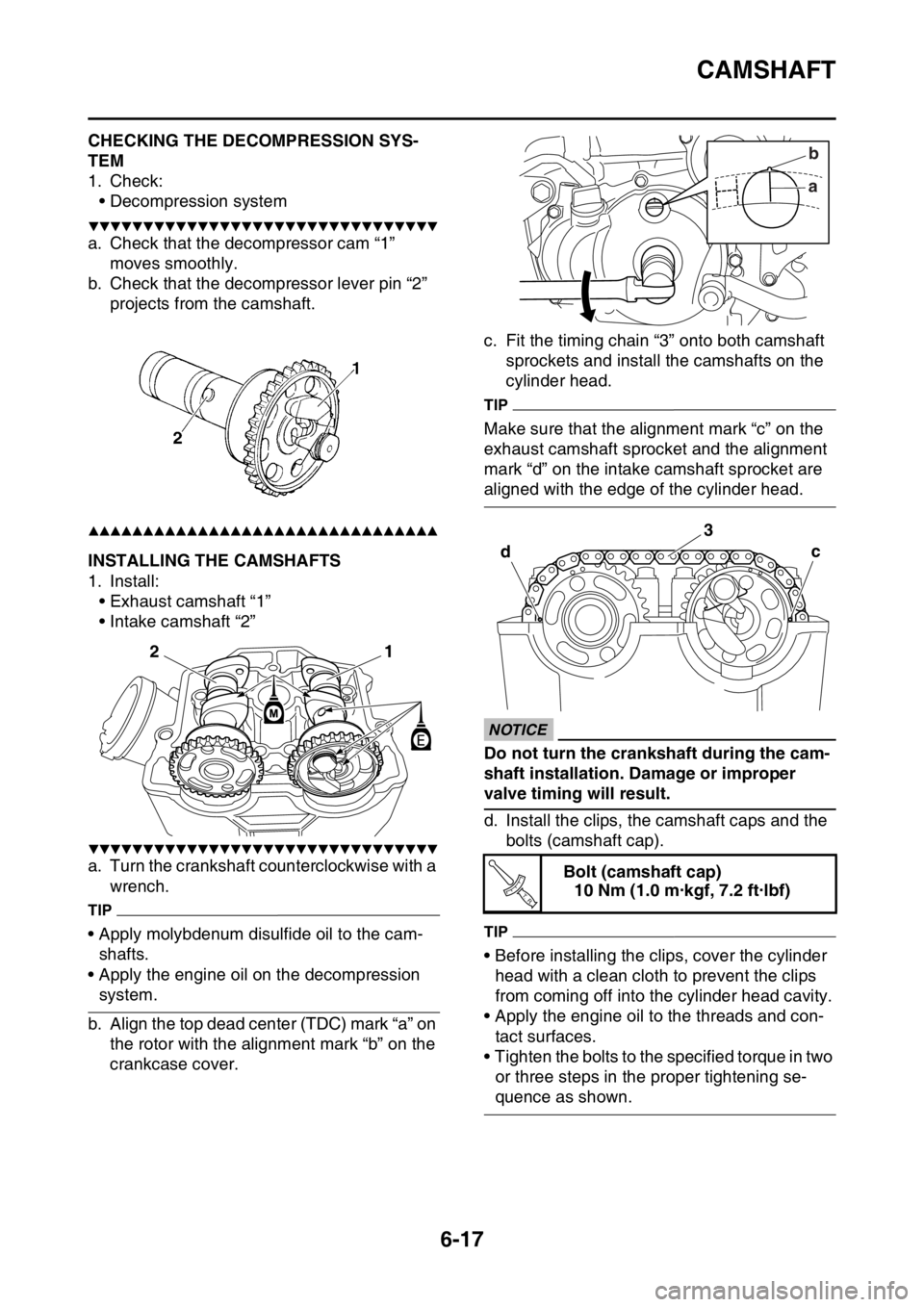
1. Check:
• Decompression system
▼▼▼▼▼▼▼▼▼▼▼▼▼▼▼▼▼▼▼▼▼▼▼▼▼▼▼▼▼▼▼▼
a. Check that the decompressor cam “1”
moves smoothly.
b. Check that the decompressor lever pin “2”
projects from the camshaft.
▲▲▲▲▲▲▲▲▲▲▲▲▲▲▲▲▲▲▲▲▲▲▲▲▲▲▲▲▲▲▲▲
EAS2GBB243INSTALLING THE CAMSHAFTS
1. Install:
• Exhaust camshaft “1”
• Intake camshaft “2”
▼▼▼▼▼▼▼▼▼▼▼▼▼▼▼▼▼▼▼▼▼▼▼▼▼▼▼▼▼▼▼▼
a. Turn the crankshaft counterclockwise with a
wrench.
TIP
• Apply molybdenum disulfide oil to the cam-
shafts.
• Apply the engine oil on the decompression
system.
b. Align the top dead center (TDC) mark “a” on
the rotor with the alignment mark “b” on the
crankcase cover.c. Fit the timing chain “3” onto both camshaft
sprockets and install the camshafts on the
cylinder head.
TIP
Make sure that the alignment mark “c” on the
exhaust camshaft sprocket and the alignment
mark “d” on the intake camshaft sprocket are
aligned with the edge of the cylinder head.
ECA33DD029
NOTICE
Do not turn the crankshaft during the cam-
shaft installation. Damage or improper
valve timing will result.
d. Install the clips, the camshaft caps and the
bolts (camshaft cap).
TIP
• Before installing the clips, cover the cylinder
head with a clean cloth to prevent the clips
from coming off into the cylinder head cavity.
• Apply the engine oil to the threads and con-
tact surfaces.
• Tighten the bolts to the specified torque in two
or three steps in the proper tightening se-
quence as shown.
1
2
Bolt (camshaft cap)
10 Nm (1.0 m·kgf, 7.2 ft·lbf)
ab
dc
3
T R..
Page 262 of 432
CYLINDER AND PISTON
6-33
EAS2GBB257REMOVING THE PISTON
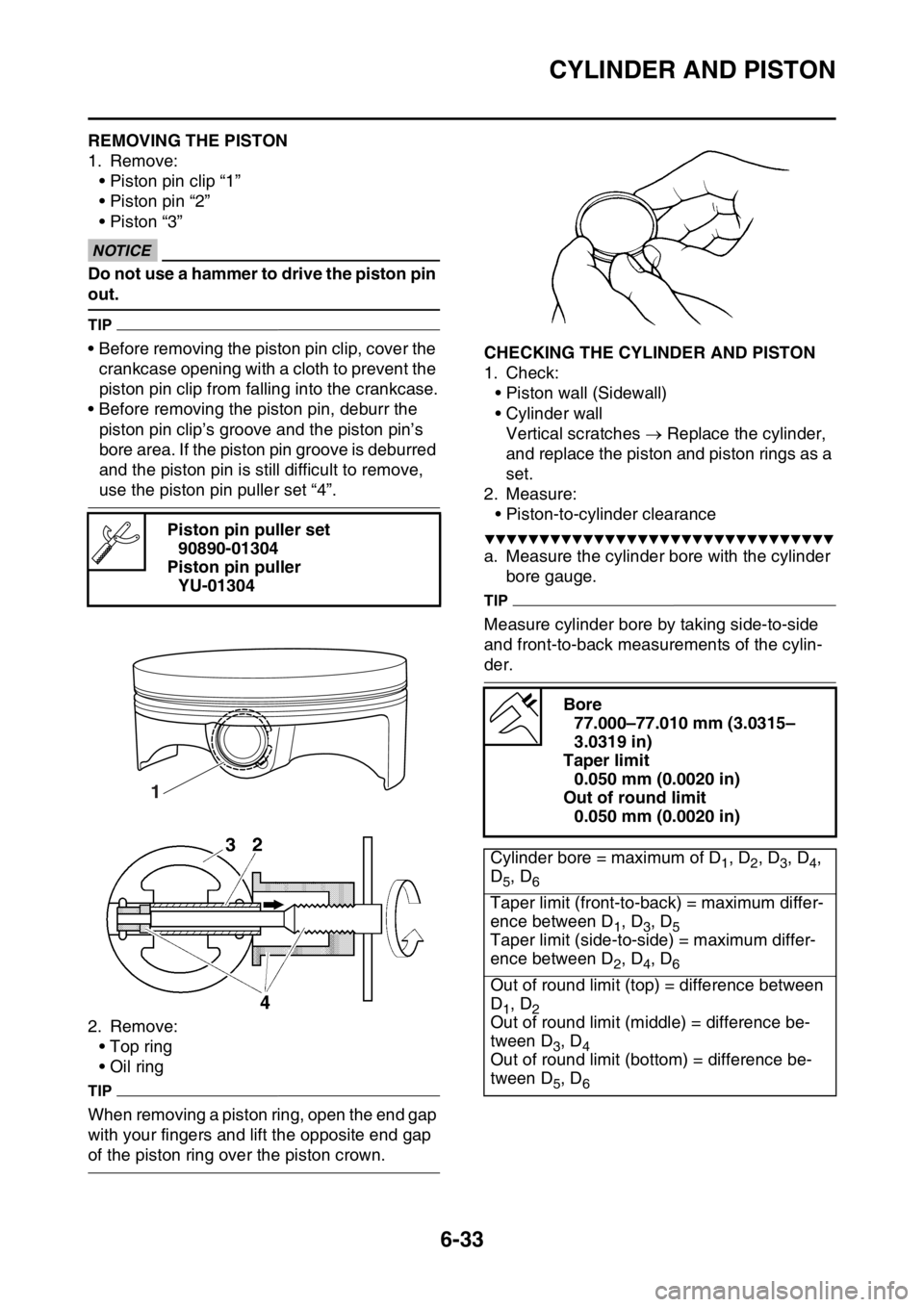
1. Remove:
• Piston pin clip “1”
• Piston pin “2”
• Piston “3”
ECA
NOTICE
Do not use a hammer to drive the piston pin
out.
TIP
• Before removing the piston pin clip, cover the
crankcase opening with a cloth to prevent the
piston pin clip from falling into the crankcase.
• Before removing the piston pin, deburr the
piston pin clip’s groove and the piston pin’s
bore area. If the piston pin groove is deburred
and the piston pin is still difficult to remove,
use the piston pin puller set “4”.
2. Remove:
• Top ring
• Oil ring
TIP
When removing a piston ring, open the end gap
with your fingers and lift the opposite end gap
of the piston ring over the piston crown.
EAS2GBB258CHECKING THE CYLINDER AND PISTON
1. Check:
• Piston wall (Sidewall)
• Cylinder wall
Vertical scratches Replace the cylinder,
and replace the piston and piston rings as a
set.
2. Measure:
• Piston-to-cylinder clearance
▼▼▼▼▼▼▼▼▼▼▼▼▼▼▼▼▼▼▼▼▼▼▼▼▼▼▼▼▼▼▼▼
a. Measure the cylinder bore with the cylinder
bore gauge.
TIP
Measure cylinder bore by taking side-to-side
and front-to-back measurements of the cylin-
der. Piston pin puller set
90890-01304
Piston pin puller
YU-01304
1
Bore
77.000–77.010 mm (3.0315–
3.0319 in)
Taper limit
0.050 mm (0.0020 in)
Out of round limit
0.050 mm (0.0020 in)
Cylinder bore = maximum of D
1, D2, D3, D4,
D
5, D6
Taper limit (front-to-back) = maximum differ-
ence between D
1, D3, D5Taper limit (side-to-side) = maximum differ-
ence between D
2, D4, D6
Out of round limit (top) = difference between
D
1, D2Out of round limit (middle) = difference be-
tween D
3, D4Out of round limit (bottom) = difference be-
tween D
5, D6