steering YAMAHA WR 250F 2017 User Guide
[x] Cancel search | Manufacturer: YAMAHA, Model Year: 2017, Model line: WR 250F, Model: YAMAHA WR 250F 2017Pages: 432, PDF Size: 14.14 MB
Page 137 of 432
CHASSIS
3-37
TIP
• Do not give a half turn (180 °) or more for one
tightening.
• Make sure that tightening after a break-in is
done until the initial looseness in nipples dis-
appears.
• Make sure that tightening is done in stages,
not at a time.
EAS2GBB121CHECKING THE WHEELS
1. Check:
• Wheel(s)
Damage/out-of-round Replace.
EWA
WARNING
Never attempt to make any repairs to the
wheel.
TIP
After replacing a tire or a wheel, always bal-
ance the wheel.
EAS2GBB122CHECKING THE WHEEL BEARINGS
1. Check:
• Wheel bearings
Refer to “CHECKING THE FRONT WHEEL”
on page 5-5 and “CHECKING THE REAR
WHEEL” on page 5-10.
EAS2GBB123CHECKING AND ADJUSTING THE STEER-
ING HEAD
1. Use a suitable stand to raise the front wheel
off the ground.
EWA
WARNING
Securely support the vehicle so that there is
no danger of it falling over.
2. Check:
• Steering head
Grasp the bottom of the front fork legs and
gently rock the front fork.
Blinding/looseness Adjust the steering
head.
3. Remove:
• Handlebar
Refer to “HANDLEBAR” on page 5-33.
• Upper bracket
Refer to “STEERING HEAD” on page 5-53.
4. Adjust:
• Steering head
▼▼▼▼▼▼▼▼▼▼▼▼▼▼▼▼▼▼▼▼▼▼▼▼▼▼▼▼▼▼▼▼
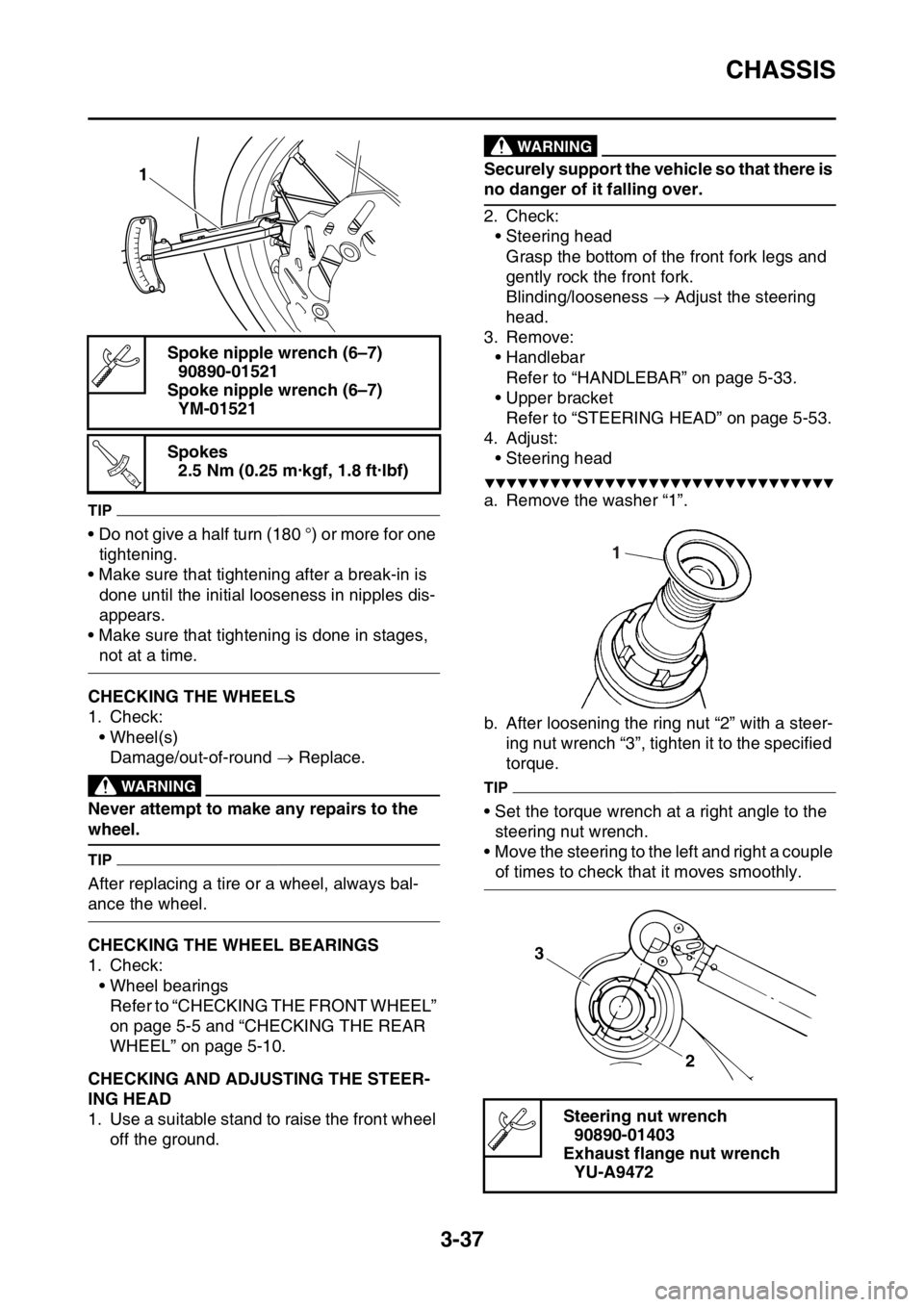
a. Remove the washer “1”.
b. After loosening the ring nut “2” with a steer-
ing nut wrench “3”, tighten it to the specified
torque.
TIP
• Set the torque wrench at a right angle to the
steering nut wrench.
• Move the steering to the left and right a couple
of times to check that it moves smoothly. Spoke nipple wrench (6–7)
90890-01521
Spoke nipple wrench (6–7)
YM-01521
Spokes
2.5 Nm (0.25 m·kgf, 1.8 ft·lbf)
1
T R..
Steering nut wrench
90890-01403
Exhaust flange nut wrench
YU-A9472
1
3
2
Page 138 of 432
CHASSIS
3-38
c. Turn the front fork to the right and left a few
times, and make sure that the steering ro-
tates smoothly. If it does not turn smoothly,
remove the lower bracket and check the up-
per and lower bearings.
Refer to “STEERING HEAD” on page 5-53.
d. Loosen the ring nut fully turn and then tight-
en it to specification with a steering nut
wrench.
EWA
WARNING
Do not overtighten the lower ring nut.
e. Check the steering head for looseness or
binding by turning the front fork all the way in
both directions. If any binding is felt, remove
the lower bracket and check the upper and
lower bearings.
Refer to “STEERING HEAD” on page 5-53.
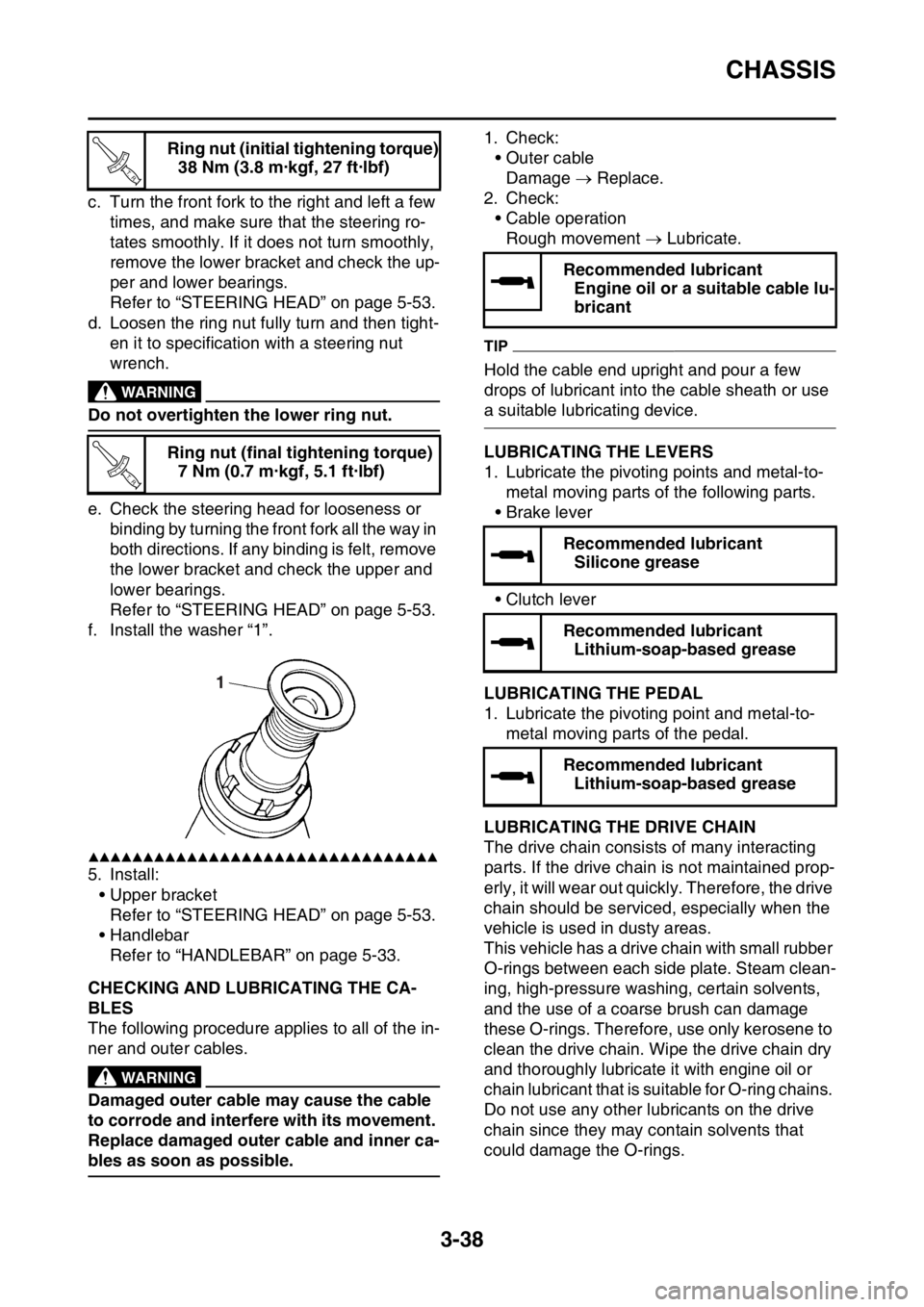
f. Install the washer “1”.
▲▲▲▲▲▲▲▲▲▲▲▲▲▲▲▲▲▲▲▲▲▲▲▲▲▲▲▲▲▲▲▲
5. Install:
• Upper bracket
Refer to “STEERING HEAD” on page 5-53.
• Handlebar
Refer to “HANDLEBAR” on page 5-33.
EAS2GBB124CHECKING AND LUBRICATING THE CA-
BLES
The following procedure applies to all of the in-
ner and outer cables.
EWA
WARNING
Damaged outer cable may cause the cable
to corrode and interfere with its movement.
Replace damaged outer cable and inner ca-
bles as soon as possible.1. Check:
• Outer cable
Damage Replace.
2. Check:
• Cable operation
Rough movement Lubricate.
TIP
Hold the cable end upright and pour a few
drops of lubricant into the cable sheath or use
a suitable lubricating device.
EAS2GBB125LUBRICATING THE LEVERS
1. Lubricate the pivoting points and metal-to-
metal moving parts of the following parts.
•Brake lever
• Clutch lever
EAS2GBB126LUBRICATING THE PEDAL
1. Lubricate the pivoting point and metal-to-
metal moving parts of the pedal.
EAS2GBB127LUBRICATING THE DRIVE CHAIN
The drive chain consists of many interacting
parts. If the drive chain is not maintained prop-
erly, it will wear out quickly. Therefore, the drive
chain should be serviced, especially when the
vehicle is used in dusty areas.
This vehicle has a drive chain with small rubber
O-rings between each side plate. Steam clean-
ing, high-pressure washing, certain solvents,
and the use of a coarse brush can damage
these O-rings. Therefore, use only kerosene to
clean the drive chain. Wipe the drive chain dry
and thoroughly lubricate it with engine oil or
chain lubricant that is suitable for O-ring chains.
Do not use any other lubricants on the drive
chain since they may contain solvents that
could damage the O-rings. Ring nut (initial tightening torque)
38 Nm (3.8 m·kgf, 27 ft·lbf)
Ring nut (final tightening torque)
7 Nm (0.7 m·kgf, 5.1 ft·lbf)
T R..
T R..
1
Recommended lubricant
Engine oil or a suitable cable lu-
bricant
Recommended lubricant
Silicone grease
Recommended lubricant
Lithium-soap-based grease
Recommended lubricant
Lithium-soap-based grease
Page 154 of 432

HANDLEBAR................................................................................................. 5-33
REMOVING THE HANDLEBAR............................................................... 5-35
CHECKING THE HANDLEBAR ............................................................... 5-35
INSTALLING THE HANDLEBAR ............................................................. 5-35
FRONT FORK................................................................................................. 5-40
REMOVING THE FRONT FORK LEGS ................................................... 5-42
DISASSEMBLING THE FRONT FORK LEGS ......................................... 5-42
CHECKING THE FRONT FORK LEGS ................................................... 5-43
ASSEMBLING THE FRONT FORK LEGS ............................................... 5-44
INSTALLING THE FRONT FORK LEGS ................................................. 5-50
STEERING HEAD........................................................................................... 5-53
REMOVING THE LOWER BRACKET...................................................... 5-55
CHECKING THE STEERING HEAD ........................................................ 5-55
INSTALLING THE STEERING HEAD ...................................................... 5-55
REAR SHOCK ABSORBER ASSEMBLY..................................................... 5-58
HANDLING THE REAR SHOCK ABSORBER ......................................... 5-61
DISPOSING OF A REAR SHOCK ABSORBER ...................................... 5-61
REMOVING THE REAR SHOCK ABSORBER ASSEMBLY.................... 5-61
REMOVING THE BEARING..................................................................... 5-61
CHECKING THE REAR SHOCK ABSORBER ASSEMBLY .................... 5-62
CHECKING THE CONNECTING ARM AND RELAY ARM ...................... 5-62
INSTALLING THE RELAY ARM............................................................... 5-62
INSTALLING THE REAR SHOCK ABSORBER ASSEMBLY .................. 5-63
SWINGARM.................................................................................................... 5-65
REMOVING THE SWINGARM................................................................. 5-66
REMOVING THE BEARING..................................................................... 5-66
CHECKING THE SWINGARM ................................................................. 5-66
INSTALLING THE SWINGARM ............................................................... 5-67
CHAIN DRIVE................................................................................................. 5-68
REMOVING THE DRIVE CHAIN.............................................................. 5-69
CHECKING THE DRIVE CHAIN .............................................................. 5-69
CHECKING THE DRIVE SPROCKET...................................................... 5-70
CHECKING THE REAR WHEEL SPROCKET ......................................... 5-70
INSTALLING THE DRIVE CHAIN ............................................................ 5-70
Page 207 of 432
STEERING HEAD
5-53
EAS2GBB203
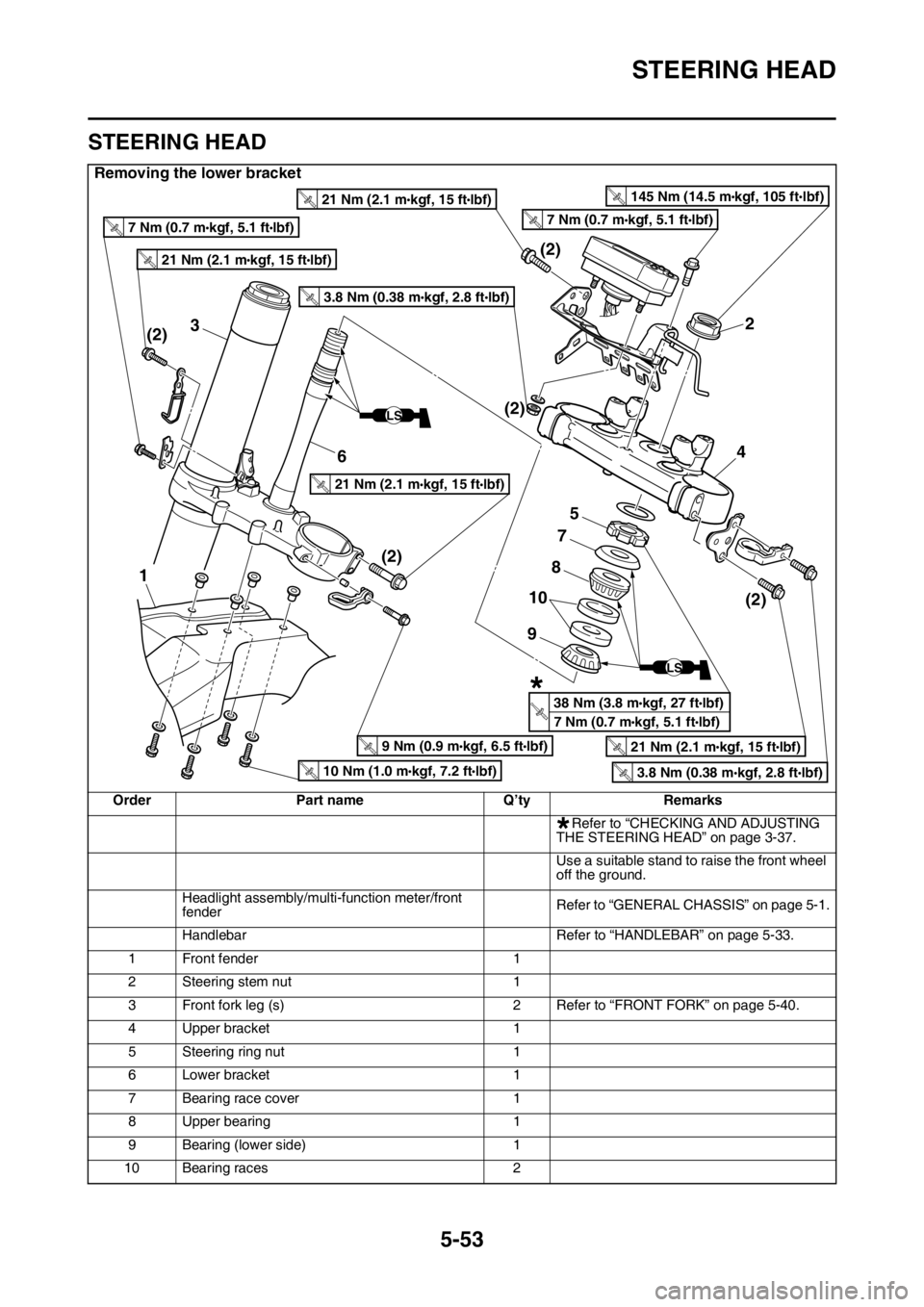
STEERING HEAD
Removing the lower bracket
Order Part name Q’ty Remarks
Refer to “CHECKING AND ADJUSTING
THE STEERING HEAD” on page 3-37.
Use a suitable stand to raise the front wheel
off the ground.
Headlight assembly/multi-function meter/front
fenderRefer to “GENERAL CHASSIS” on page 5-1.
Handlebar Refer to “HANDLEBAR” on page 5-33.
1 Front fender 1
2 Steering stem nut 1
3 Front fork leg (s) 2 Refer to “FRONT FORK” on page 5-40.
4 Upper bracket 1
5 Steering ring nut 1
6 Lower bracket 1
7 Bearing race cover 1
8 Upper bearing 1
9 Bearing (lower side) 1
10 Bearing races 2
2
4
5
7
3
(2)(2)
(2)
(2) (2)
1
6
8
9
10
LS
LS
T
.R.21 Nm (2.1 mlbf) kgf, 15 ft
T
.R.21 Nm (2.1 mlbf) kgf, 15 ft
T
.R.21 Nm (2.1 mlbf) kgf, 15 ft
T
.R.21 Nm (2.1 mlbf) kgf, 15 ft
T
.R.3.8 Nm (0.38 mlbf) kgf, 2.8 ft
T
.R.3.8 Nm (0.38 mlbf) kgf, 2.8 ft
T
.R.9 Nm (0.9 mlbf) kgf, 6.5 ft
T
.R.7 Nm (0.7 mlbf) kgf, 5.1 ftT
.R.7 Nm (0.7 mlbf) kgf, 5.1 ft
T
.R.10 Nm (1.0 mlbf) kgf, 7.2 ft
T
.R.145 Nm (14.5 mlbf) kgf, 105 ft
T
.R.38 Nm (3.8 mlbf) kgf, 27 ft
7 Nm (0.7 m
lbf) kgf, 5.1 ft
*
*
Page 208 of 432
STEERING HEAD
5-54
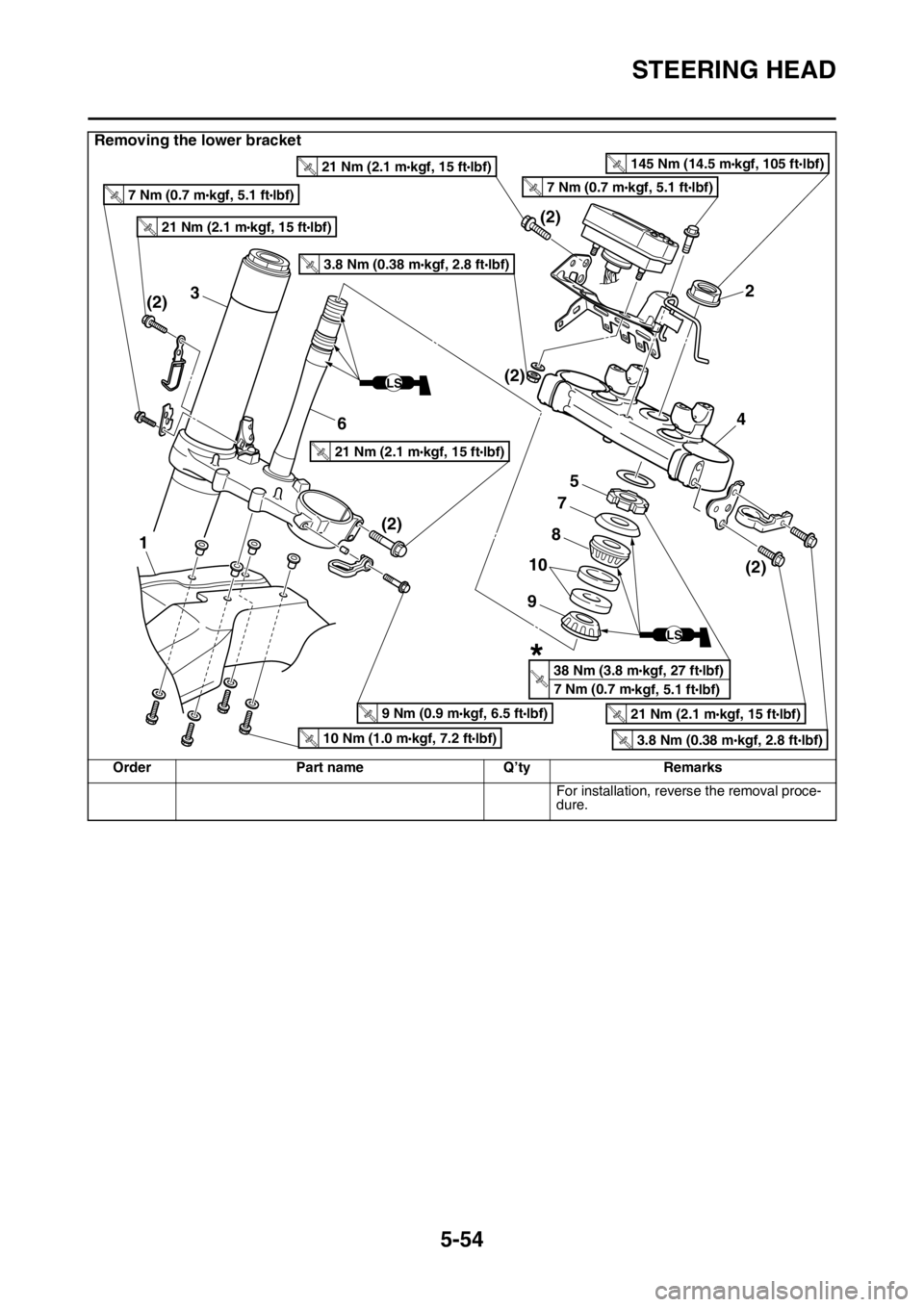
For installation, reverse the removal proce-
dure.
Removing the lower bracket
Order Part name Q’ty Remarks
2
4
5
7
3
(2)(2)
(2)
(2) (2)
1
6
8
9
10
LS
LS
T
.R.21 Nm (2.1 mlbf) kgf, 15 ft
T
.R.21 Nm (2.1 mlbf) kgf, 15 ft
T
.R.21 Nm (2.1 mlbf) kgf, 15 ft
T
.R.21 Nm (2.1 mlbf) kgf, 15 ft
T
.R.3.8 Nm (0.38 mlbf) kgf, 2.8 ft
T
.R.3.8 Nm (0.38 mlbf) kgf, 2.8 ft
T
.R.9 Nm (0.9 mlbf) kgf, 6.5 ft
T
.R.7 Nm (0.7 mlbf) kgf, 5.1 ftT
.R.7 Nm (0.7 mlbf) kgf, 5.1 ft
T
.R.10 Nm (1.0 mlbf) kgf, 7.2 ft
T
.R.145 Nm (14.5 mlbf) kgf, 105 ft
T
.R.38 Nm (3.8 mlbf) kgf, 27 ft
7 Nm (0.7 m
lbf) kgf, 5.1 ft
*
Page 209 of 432
STEERING HEAD
5-55
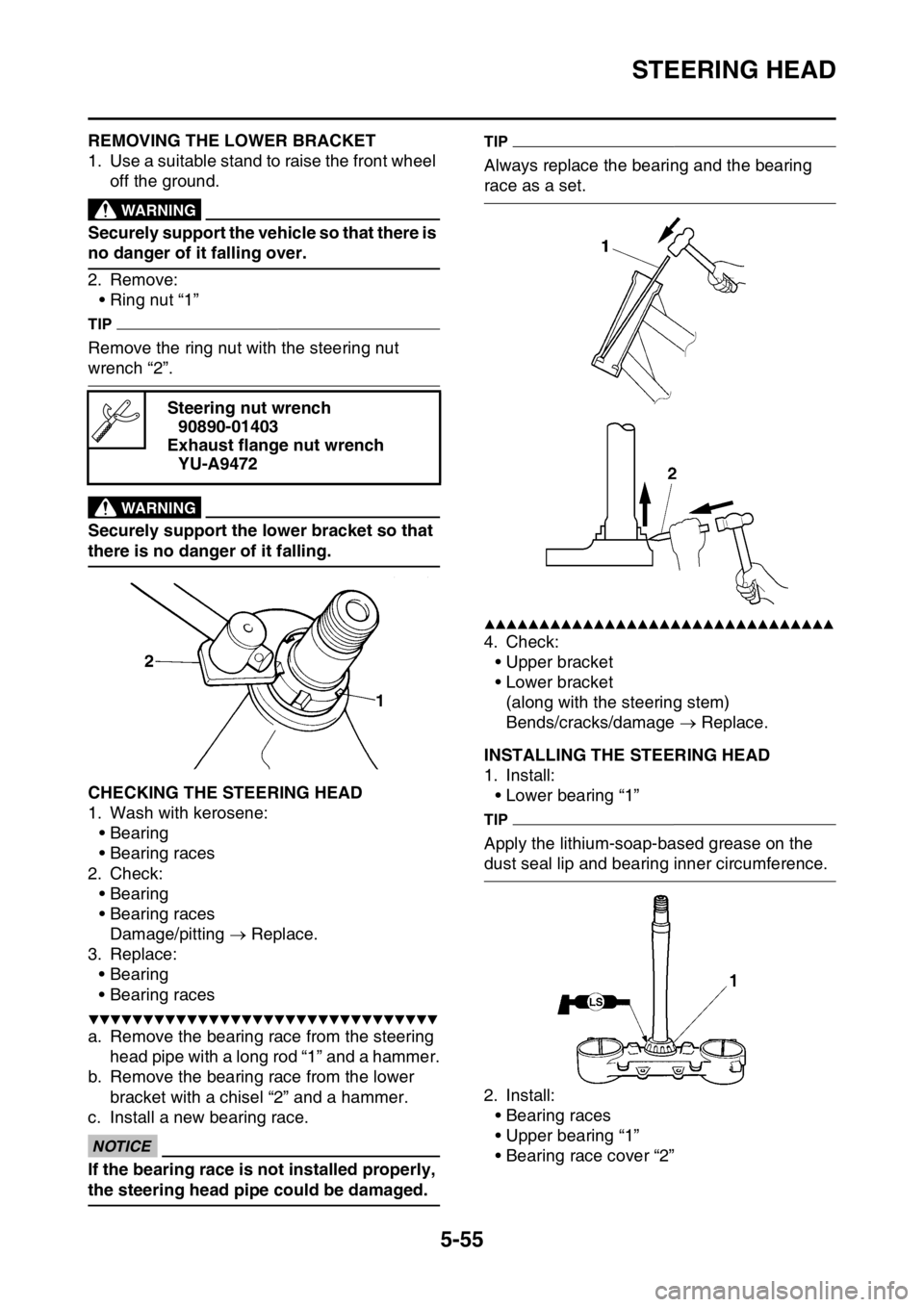
EAS2GBB204REMOVING THE LOWER BRACKET
1. Use a suitable stand to raise the front wheel
off the ground.
EWA
WARNING
Securely support the vehicle so that there is
no danger of it falling over.
2. Remove:
• Ring nut “1”
TIP
Remove the ring nut with the steering nut
wrench “2”.
EWA
WARNING
Securely support the lower bracket so that
there is no danger of it falling.
EAS2GBB205CHECKING THE STEERING HEAD
1. Wash with kerosene:
• Bearing
• Bearing races
2. Check:
• Bearing
• Bearing races
Damage/pitting Replace.
3. Replace:
• Bearing
• Bearing races
▼▼▼▼▼▼▼▼▼▼▼▼▼▼▼▼▼▼▼▼▼▼▼▼▼▼▼▼▼▼▼▼
a. Remove the bearing race from the steering
head pipe with a long rod “1” and a hammer.
b. Remove the bearing race from the lower
bracket with a chisel “2” and a hammer.
c. Install a new bearing race.
ECA
NOTICE
If the bearing race is not installed properly,
the steering head pipe could be damaged.
TIP
Always replace the bearing and the bearing
race as a set.
▲▲▲▲▲▲▲▲▲▲▲▲▲▲▲▲▲▲▲▲▲▲▲▲▲▲▲▲▲▲▲▲
4. Check:
• Upper bracket
• Lower bracket
(along with the steering stem)
Bends/cracks/damage Replace.
EAS2GBB206INSTALLING THE STEERING HEAD
1. Install:
• Lower bearing “1”
TIP
Apply the lithium-soap-based grease on the
dust seal lip and bearing inner circumference.
2. Install:
• Bearing races
• Upper bearing “1”
• Bearing race cover “2” Steering nut wrench
90890-01403
Exhaust flange nut wrench
YU-A9472
Page 210 of 432
STEERING HEAD
5-56
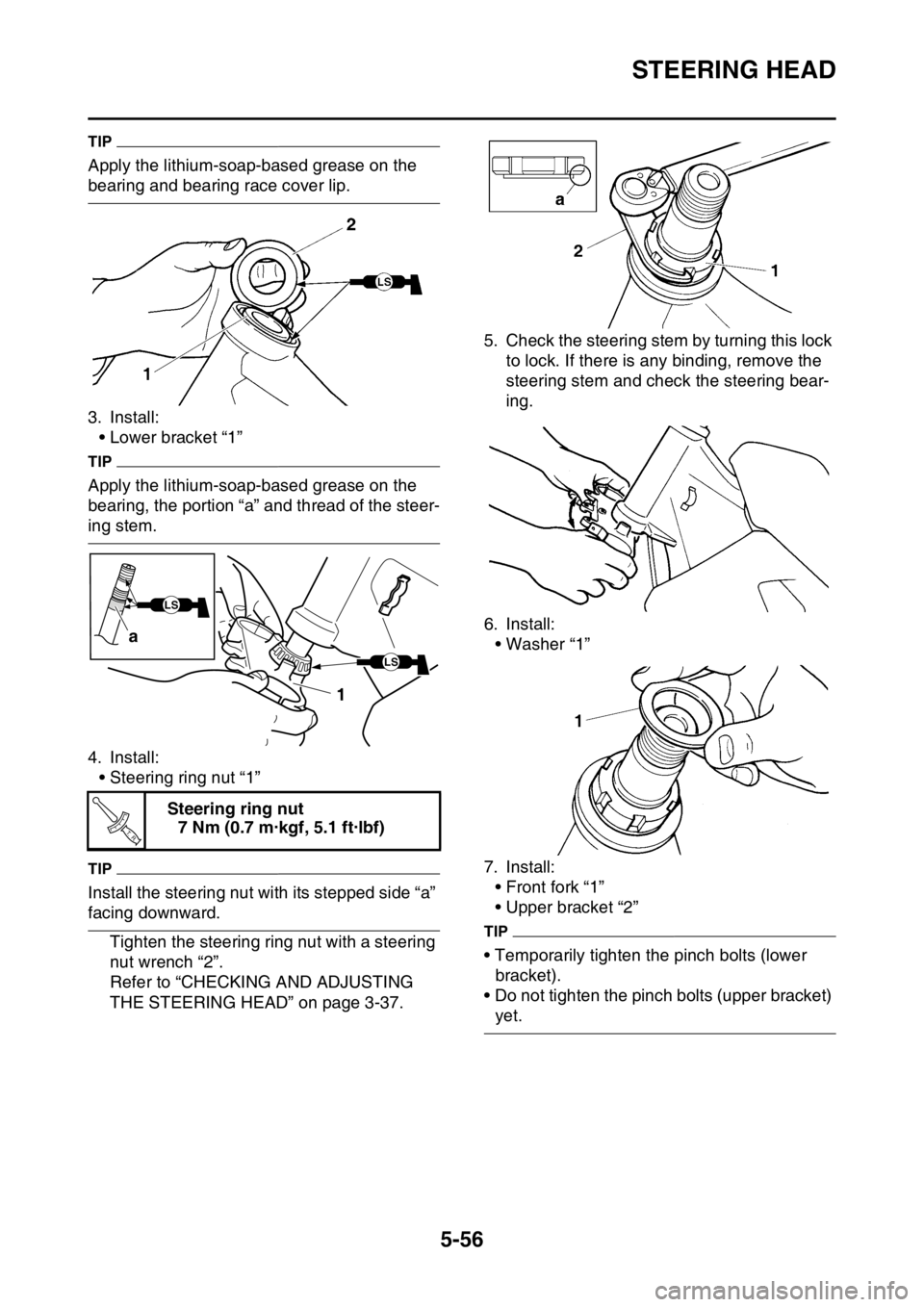
TIP
Apply the lithium-soap-based grease on the
bearing and bearing race cover lip.
3. Install:
• Lower bracket “1”
TIP
Apply the lithium-soap-based grease on the
bearing, the portion “a” and thread of the steer-
ing stem.
4. Install:
• Steering ring nut “1”
TIP
Install the steering nut with its stepped side “a”
facing downward.
Tighten the steering ring nut with a steering
nut wrench “2”.
Refer to “CHECKING AND ADJUSTING
THE STEERING HEAD” on page 3-37.5. Check the steering stem by turning this lock
to lock. If there is any binding, remove the
steering stem and check the steering bear-
ing.
6. Install:
• Washer “1”
7. Install:
• Front fork “1”
• Upper bracket “2”
TIP
• Temporarily tighten the pinch bolts (lower
bracket).
• Do not tighten the pinch bolts (upper bracket)
yet. Steering ring nut
7 Nm (0.7 m·kgf, 5.1 ft·lbf)
LS
1 a
LSLS
T R..
Page 211 of 432
STEERING HEAD
5-57
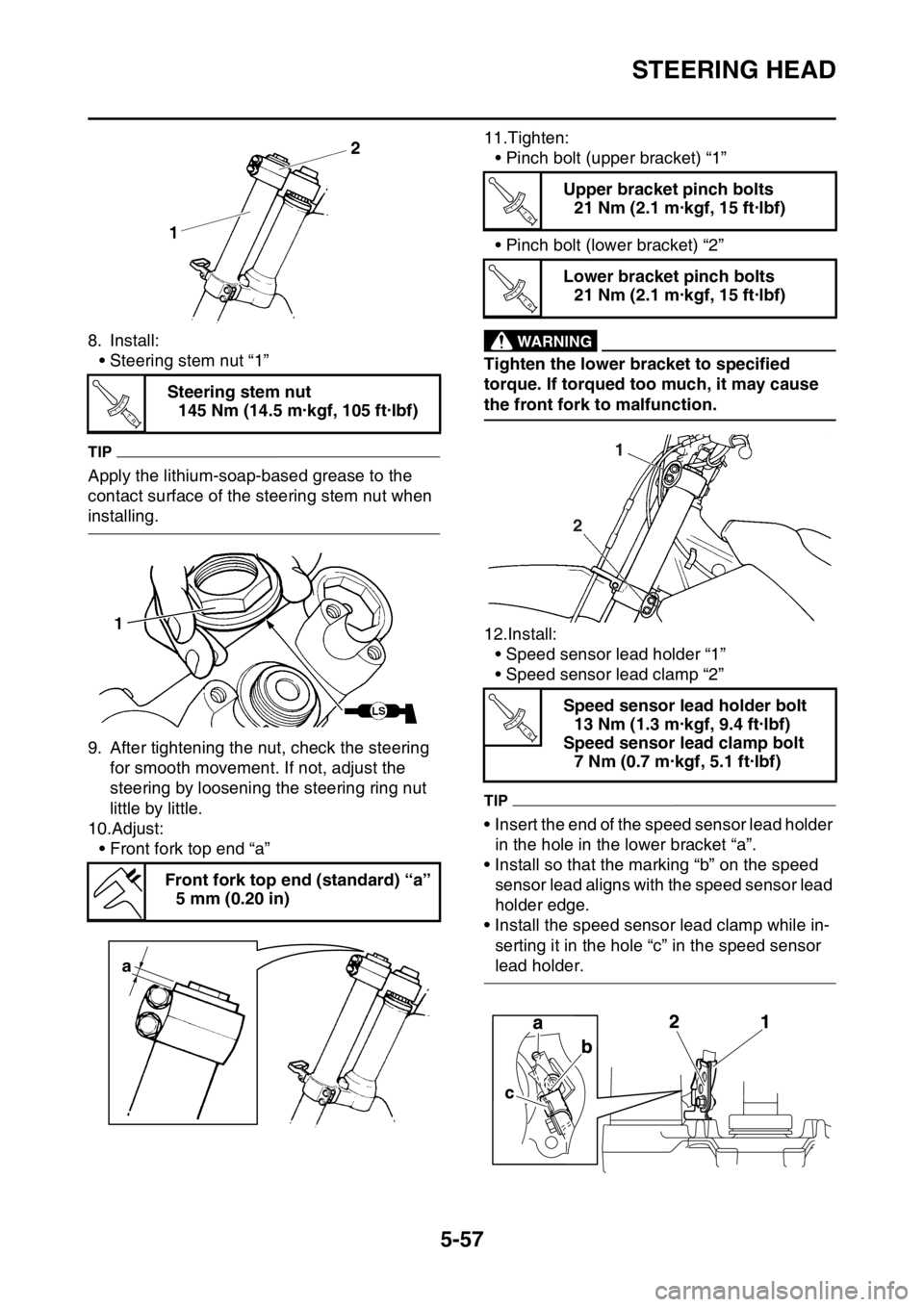
8. Install:
• Steering stem nut “1”
TIP
Apply the lithium-soap-based grease to the
contact surface of the steering stem nut when
installing.
9. After tightening the nut, check the steering
for smooth movement. If not, adjust the
steering by loosening the steering ring nut
little by little.
10.Adjust:
• Front fork top end “a”11.Tighten:
• Pinch bolt (upper bracket) “1”
• Pinch bolt (lower bracket) “2”
EWA
WARNING
Tighten the lower bracket to specified
torque. If torqued too much, it may cause
the front fork to malfunction.
12.Install:
• Speed sensor lead holder “1”
• Speed sensor lead clamp “2”
TIP
• Insert the end of the speed sensor lead holder
in the hole in the lower bracket “a”.
• Install so that the marking “b” on the speed
sensor lead aligns with the speed sensor lead
holder edge.
• Install the speed sensor lead clamp while in-
serting it in the hole “c” in the speed sensor
lead holder. Steering stem nut
145 Nm (14.5 m·kgf, 105 ft·lbf)
Front fork top end (standard) “a”
5 mm (0.20 in)
T R..
a
Upper bracket pinch bolts
21 Nm (2.1 m·kgf, 15 ft·lbf)
Lower bracket pinch bolts
21 Nm (2.1 m·kgf, 15 ft·lbf)
Speed sensor lead holder bolt
13 Nm (1.3 m·kgf, 9.4 ft·lbf)
Speed sensor lead clamp bolt
7 Nm (0.7 m·kgf, 5.1 ft·lbf)
T R..
T R..
21
T R..
Page 422 of 432
TROUBLESHOOTING
10-3
Cooling system
1. Coolant
• Low coolant level
2. Radiator
• Damaged or leaking radiator
• Faulty radiator cap
• Bent or damaged radiator fin
3. Water pump
• Damaged or faulty water pump
• Damaged hose
• Improperly connected hose
• Damaged pipe
• Improperly connected pipe
Fuel system
1. Throttle body
• Damaged or loose throttle body joint
2. Air filter
• Clogged air filter element
Chassis
1. Brake(s)
• Dragging brake
Electrical system
1. Spark plug
• Incorrect spark plug gap
• Incorrect spark plug heat range
2. Ignition system
• Faulty ECU
• Faulty coolant temperature sensor
EAS2GBB416OVERCOOLING
Cooling system
1. Coolant temperature sensor
• Faulty coolant temperature sensor
EAS2GBB417POOR BRAKING PERFORMANCE
Chassis
1. Brake(s)
• Worn brake pad
• Worn brake disc
• Air in hydraulic brake system
• Leaking brake fluid
• Defective master cylinder kit
• Faulty brake caliper kit
• Faulty brake caliper seal
• Loose union bolt
• Damaged brake hose
• Oil or grease on the brake disc
• Oil or grease on the brake pad
• Incorrect brake fluid level
EAS2GBB418FRONT FORK OIL LEAKING
Chassis
1. Front fork
• Bent, damaged, or rusty inner tube
• Cracked or damaged outer tube
• Improperly installed oil seal
• Damaged oil seal lip
• Incorrect oil level (high)
• Loose damper rod assembly bolt
• Damaged damper rod assembly bolt copper
washer
• Cracked or damaged cap bolt O-ring
EAS2GBB419FAULTY FRONT FORK LEGS
Chassis
1. Front fork
• Bent or damaged inner tube
• Bent or damaged outer tube
• Broken fork spring
• Bent or damaged damper rod
• Incorrect oil viscosity
• Incorrect oil level
EAS2GBB420UNSTABLE HANDLING
Chassis
1. Handlebar
• Bent or improperly installed handlebar
2. Steering head components
• Improperly installed upper bracket
• Improperly installed lower bracket
(improperly tightened ring nut)
• Bent steering stem
• Damaged ball bearing or bearing race
3. Front fork leg (s)
• Uneven oil levels (both front fork legs)
• Unevenly tensioned fork spring (both front
fork legs)
• Broken fork spring
• Bent or damaged inner tube
• Bent or damaged outer tube
4. Swingarm
• Worn bearing or bushing
• Bent or damaged swingarm
5. Rear shock absorber assembly (-ies)
• Faulty rear shock absorber spring
• Leaking oil or gas
6. Tire (s)
• Uneven tire pressures (front and rear)
• Incorrect tire pressure
• Uneven tire wear
Page 423 of 432
TROUBLESHOOTING
10-4
7. Wheel (s)
• Incorrect wheel balance
• Broken or loose spoke
• Damaged wheel bearing
• Bent or loose wheel axle
• Excessive wheel runout
8. Frame
• Bent frame
• Damaged steering head pipe
• Improperly installed bearing race
EAS2GBB421HEADLIGHT DOES NOT COME ON
Electrical system
1. Headlight
• Fuse open circuit
• Wrong headlight bulb
• Too many electrical accessories
• Hard charging
• Incorrect connection
• Improperly grounded circuit
• Poor contacts (start switch)
• Burnt-out headlight bulb
EAS2GBB422HEADLIGHT BULB BURNT OUT
Electrical system
1. Headlight
• Wrong headlight bulb
• Faulty battery
• Faulty rectifier/regulator
• Improperly grounded circuit
• Faulty start switch
• Headlight bulb life expired
EAS2GBB423TAILLIGHT DOES NOT COME ON
Electrical system
1. Taillight
• Wrong taillight LED
• Too many electrical accessories
• Incorrect connection
• Faulty battery