light YAMAHA WR 250F 2017 Workshop Manual
[x] Cancel search | Manufacturer: YAMAHA, Model Year: 2017, Model line: WR 250F, Model: YAMAHA WR 250F 2017Pages: 432, PDF Size: 14.14 MB
Page 389 of 432
FUEL INJECTION SYSTEM
9-53
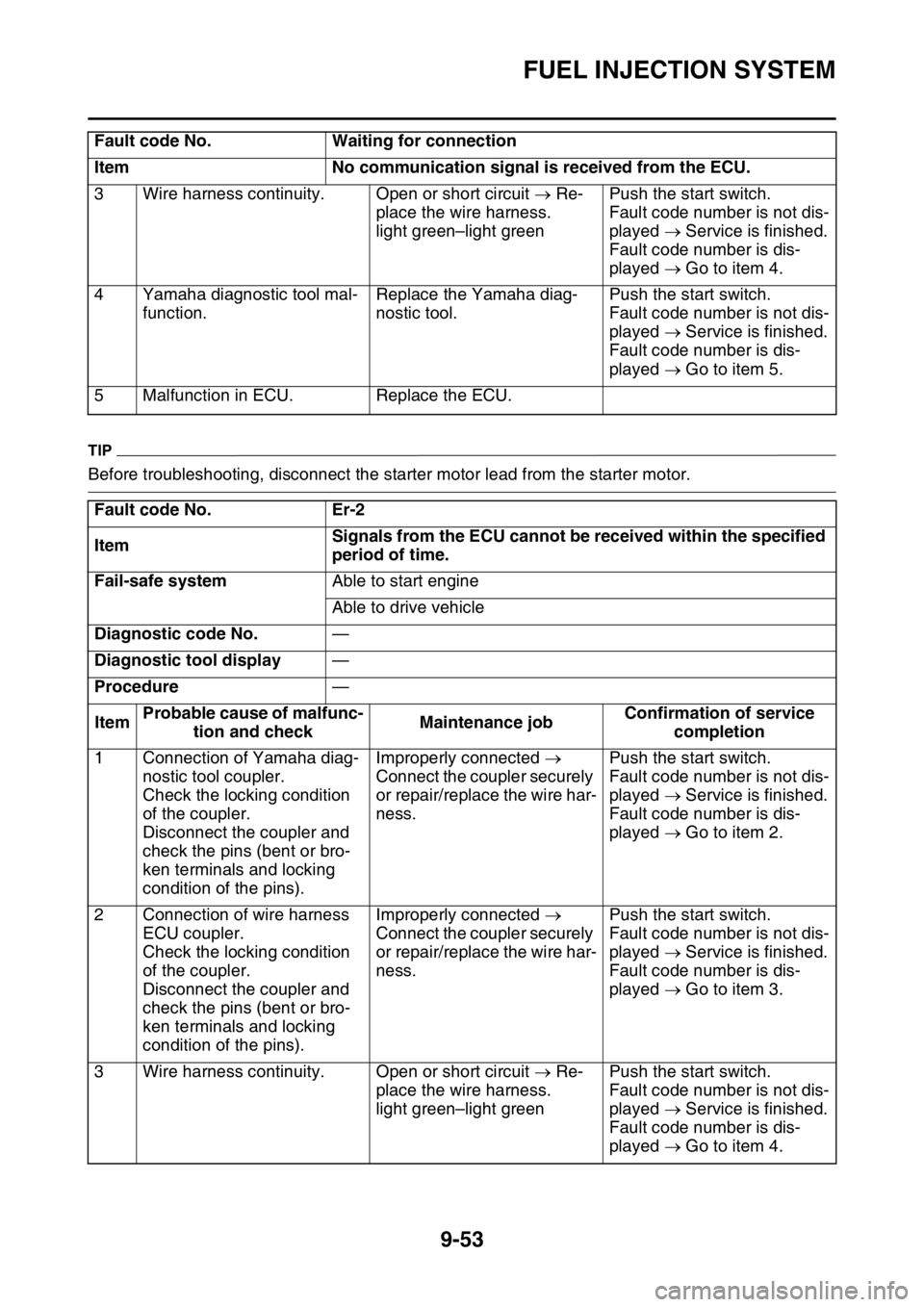
TIP
Before troubleshooting, disconnect the starter motor lead from the starter motor. 3 Wire harness continuity. Open or short circuit Re-
place the wire harness.
light green–light greenPush the start switch.
Fault code number is not dis-
played Service is finished.
Fault code number is dis-
played Go to item 4.
4 Yamaha diagnostic tool mal-
function.Replace the Yamaha diag-
nostic tool.Push the start switch.
Fault code number is not dis-
played Service is finished.
Fault code number is dis-
played Go to item 5.
5 Malfunction in ECU. Replace the ECU.
Fault code No. Er-2
ItemSignals from the ECU cannot be received within the specified
period of time.
Fail-safe systemAble to start engine
Able to drive vehicle
Diagnostic code No.—
Diagnostic tool display—
Procedure—
ItemProbable cause of malfunc-
tion and checkMaintenance jobConfirmation of service
completion
1 Connection of Yamaha diag-
nostic tool coupler.
Check the locking condition
of the coupler.
Disconnect the coupler and
check the pins (bent or bro-
ken terminals and locking
condition of the pins).Improperly connected
Connect the coupler securely
or repair/replace the wire har-
ness.Push the start switch.
Fault code number is not dis-
played Service is finished.
Fault code number is dis-
played Go to item 2.
2 Connection of wire harness
ECU coupler.
Check the locking condition
of the coupler.
Disconnect the coupler and
check the pins (bent or bro-
ken terminals and locking
condition of the pins).Improperly connected
Connect the coupler securely
or repair/replace the wire har-
ness.Push the start switch.
Fault code number is not dis-
played Service is finished.
Fault code number is dis-
played Go to item 3.
3 Wire harness continuity. Open or short circuit Re-
place the wire harness.
light green–light greenPush the start switch.
Fault code number is not dis-
played Service is finished.
Fault code number is dis-
played Go to item 4. Fault code No. Waiting for connection
Item No communication signal is received from the ECU.
Page 390 of 432
FUEL INJECTION SYSTEM
9-54
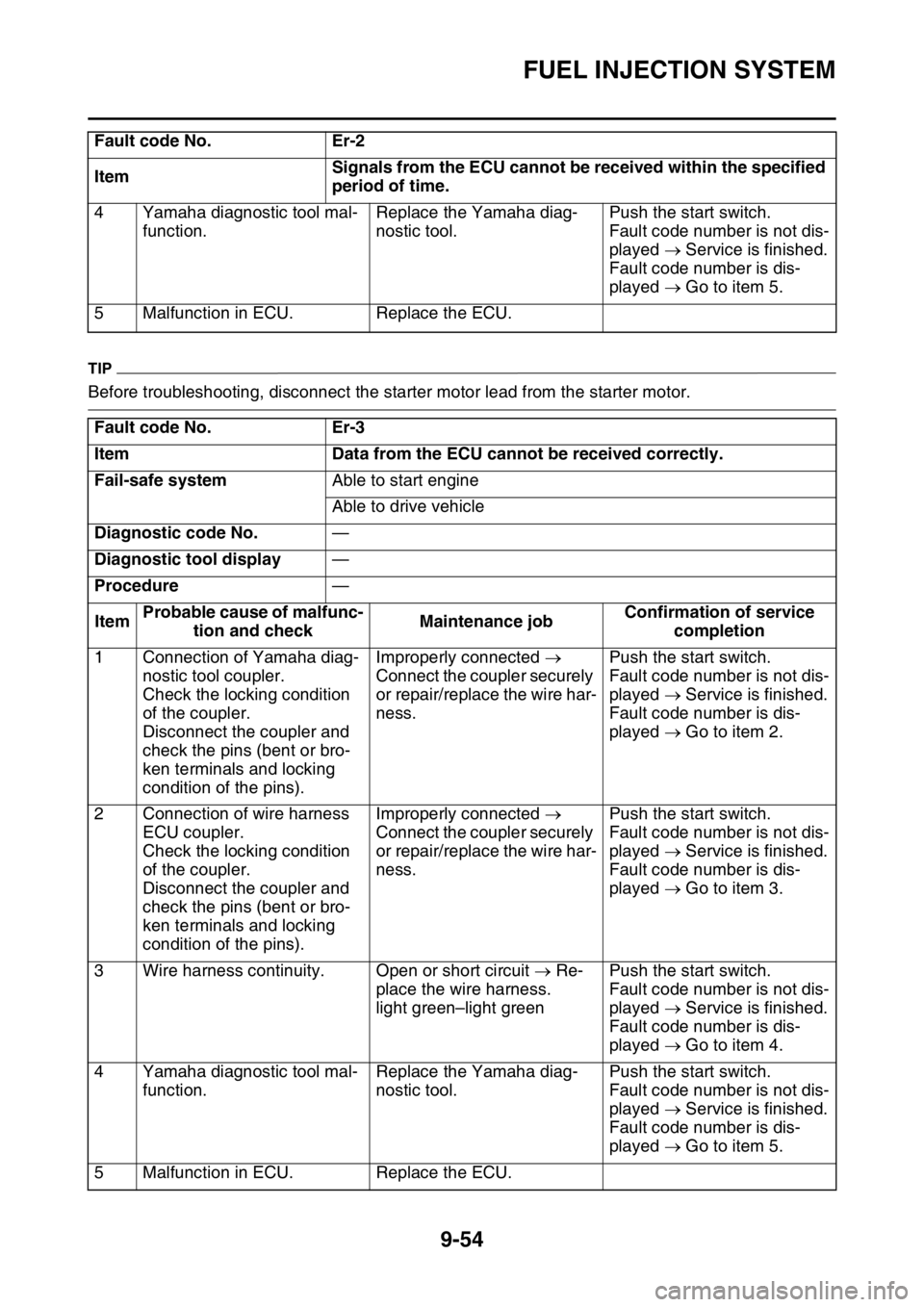
TIP
Before troubleshooting, disconnect the starter motor lead from the starter motor. 4 Yamaha diagnostic tool mal-
function.Replace the Yamaha diag-
nostic tool.Push the start switch.
Fault code number is not dis-
played Service is finished.
Fault code number is dis-
played Go to item 5.
5 Malfunction in ECU. Replace the ECU.
Fault code No. Er-3
Item Data from the ECU cannot be received correctly.
Fail-safe systemAble to start engine
Able to drive vehicle
Diagnostic code No.—
Diagnostic tool display—
Procedure—
ItemProbable cause of malfunc-
tion and checkMaintenance jobConfirmation of service
completion
1 Connection of Yamaha diag-
nostic tool coupler.
Check the locking condition
of the coupler.
Disconnect the coupler and
check the pins (bent or bro-
ken terminals and locking
condition of the pins).Improperly connected
Connect the coupler securely
or repair/replace the wire har-
ness.Push the start switch.
Fault code number is not dis-
played Service is finished.
Fault code number is dis-
played Go to item 2.
2 Connection of wire harness
ECU coupler.
Check the locking condition
of the coupler.
Disconnect the coupler and
check the pins (bent or bro-
ken terminals and locking
condition of the pins).Improperly connected
Connect the coupler securely
or repair/replace the wire har-
ness.Push the start switch.
Fault code number is not dis-
played Service is finished.
Fault code number is dis-
played Go to item 3.
3 Wire harness continuity. Open or short circuit Re-
place the wire harness.
light green–light greenPush the start switch.
Fault code number is not dis-
played Service is finished.
Fault code number is dis-
played Go to item 4.
4 Yamaha diagnostic tool mal-
function.Replace the Yamaha diag-
nostic tool.Push the start switch.
Fault code number is not dis-
played Service is finished.
Fault code number is dis-
played Go to item 5.
5 Malfunction in ECU. Replace the ECU. Fault code No. Er-2
ItemSignals from the ECU cannot be received within the specified
period of time.
Page 391 of 432
FUEL INJECTION SYSTEM
9-55
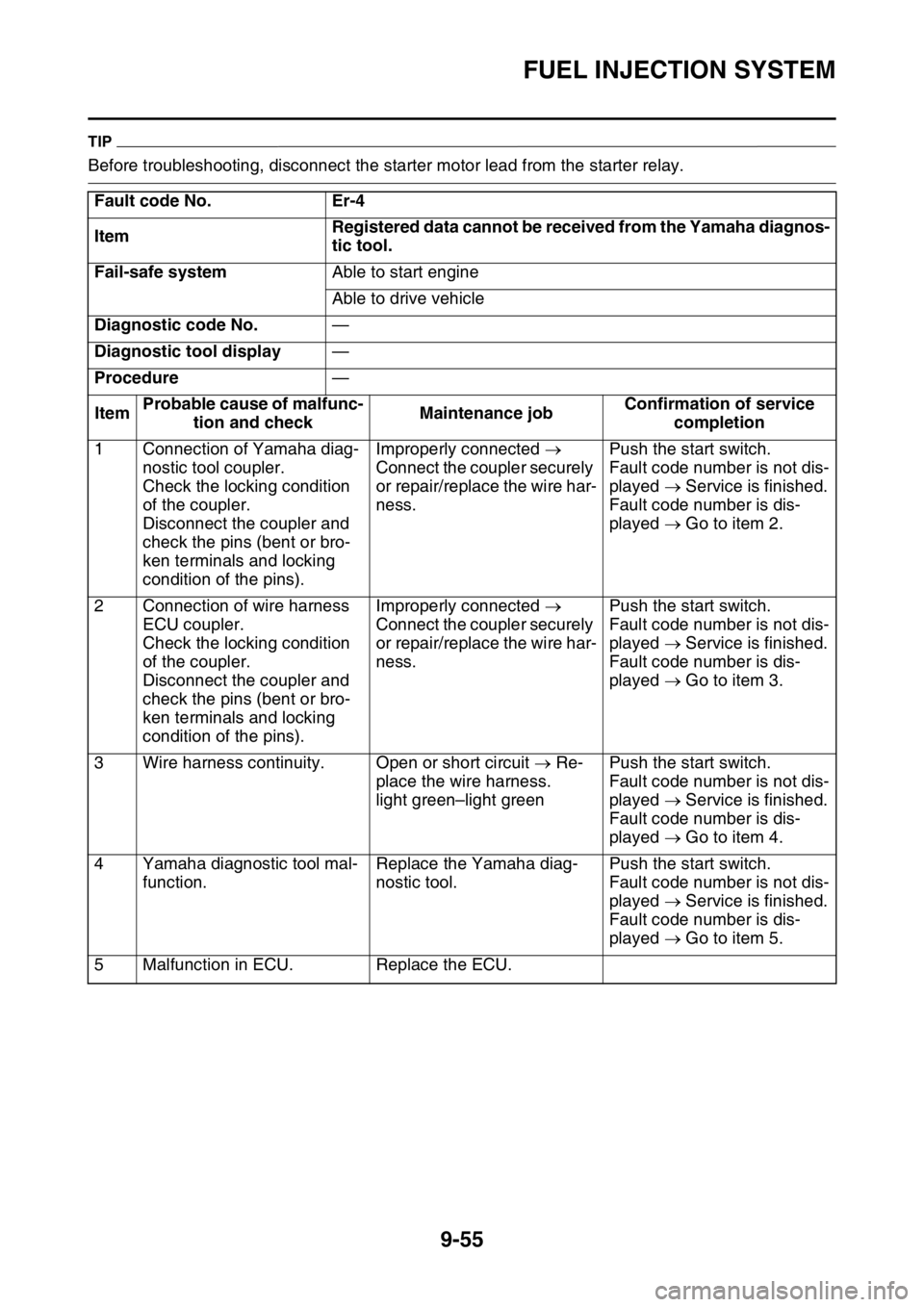
TIP
Before troubleshooting, disconnect the starter motor lead from the starter relay.
Fault code No. Er-4
ItemRegistered data cannot be received from the Yamaha diagnos-
tic tool.
Fail-safe systemAble to start engine
Able to drive vehicle
Diagnostic code No.—
Diagnostic tool display—
Procedure—
ItemProbable cause of malfunc-
tion and checkMaintenance jobConfirmation of service
completion
1 Connection of Yamaha diag-
nostic tool coupler.
Check the locking condition
of the coupler.
Disconnect the coupler and
check the pins (bent or bro-
ken terminals and locking
condition of the pins).Improperly connected
Connect the coupler securely
or repair/replace the wire har-
ness.Push the start switch.
Fault code number is not dis-
played Service is finished.
Fault code number is dis-
played Go to item 2.
2 Connection of wire harness
ECU coupler.
Check the locking condition
of the coupler.
Disconnect the coupler and
check the pins (bent or bro-
ken terminals and locking
condition of the pins).Improperly connected
Connect the coupler securely
or repair/replace the wire har-
ness.Push the start switch.
Fault code number is not dis-
played Service is finished.
Fault code number is dis-
played Go to item 3.
3 Wire harness continuity. Open or short circuit Re-
place the wire harness.
light green–light greenPush the start switch.
Fault code number is not dis-
played Service is finished.
Fault code number is dis-
played Go to item 4.
4 Yamaha diagnostic tool mal-
function.Replace the Yamaha diag-
nostic tool.Push the start switch.
Fault code number is not dis-
played Service is finished.
Fault code number is dis-
played Go to item 5.
5 Malfunction in ECU. Replace the ECU.
Page 399 of 432

ELECTRICAL COMPONENTS
9-63
1. Intake air temperature sensor
2. Intake air pressure sensor
3. Throttle position sensor
4. Starter relay
5. Main fuse
6. Headlight relay
7. Starting circuit cut-off relay
8. Lean angle sensor
9. Radiator fan motor fuse
10.Radiator fan motor relay
11.Main relay
12.Coolant temperature sensor
Page 403 of 432
ELECTRICAL COMPONENTS
9-67
EAS27990CHECKING THE BULBS AND BULB SOCK-
ETS
TIP
Do not check any of the lights that use LEDs.
Check each bulb and bulb socket for damage
or wear, proper connections, and also for con-
tinuity between the terminals.
Damage/wear Repair or replace the bulb,
bulb socket or both.
Improperly connected Properly connect.
No continuity Repair or replace the bulb,
bulb socket or both.
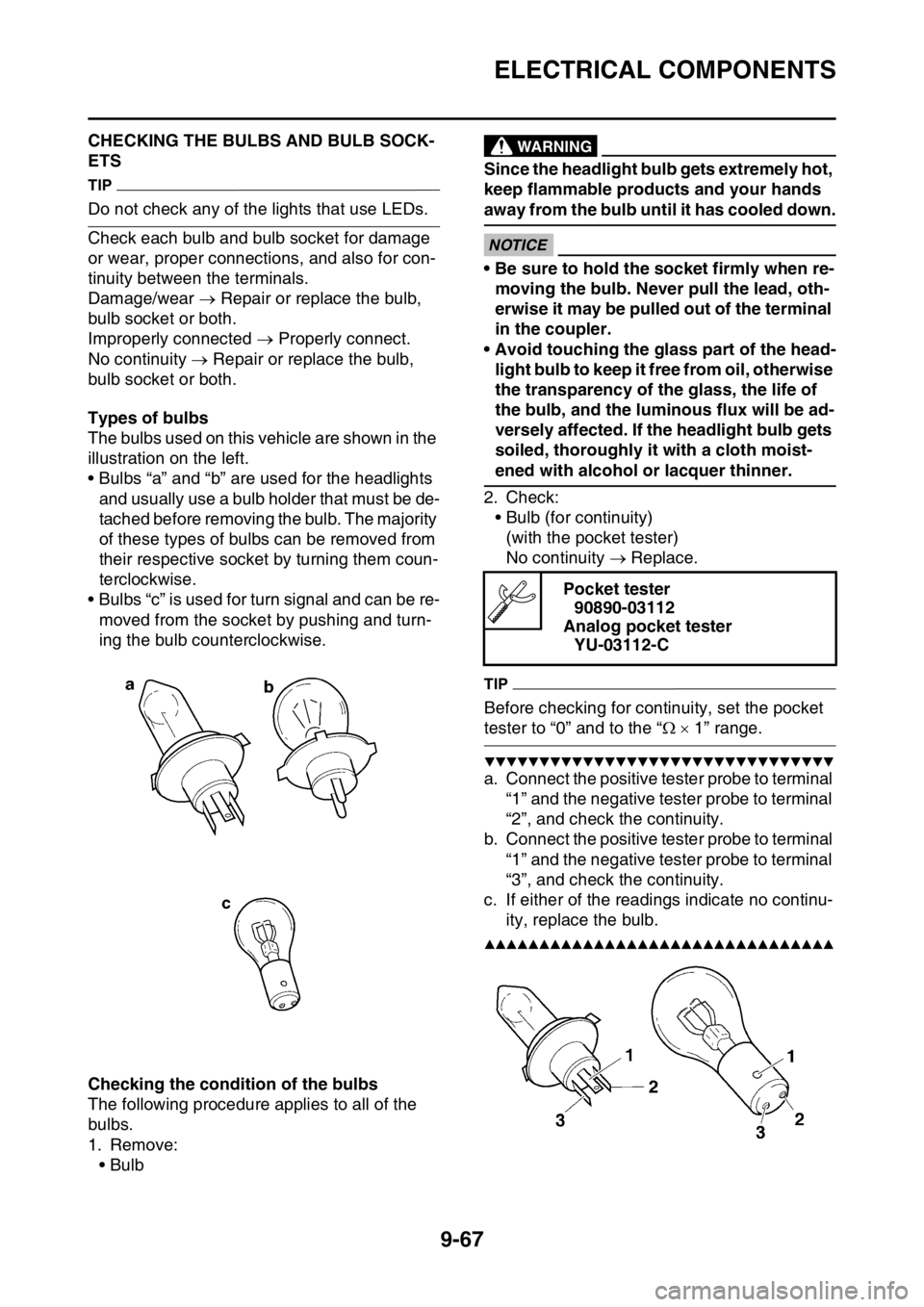
Types of bulbs
The bulbs used on this vehicle are shown in the
illustration on the left.
• Bulbs “a” and “b” are used for the headlights
and usually use a bulb holder that must be de-
tached before removing the bulb. The majority
of these types of bulbs can be removed from
their respective socket by turning them coun-
terclockwise.
• Bulbs “c” is used for turn signal and can be re-
moved from the socket by pushing and turn-
ing the bulb counterclockwise.
Checking the condition of the bulbs
The following procedure applies to all of the
bulbs.
1. Remove:
•Bulb
EWA
WARNING
Since the headlight bulb gets extremely hot,
keep flammable products and your hands
away from the bulb until it has cooled down.
ECA
NOTICE
• Be sure to hold the socket firmly when re-
moving the bulb. Never pull the lead, oth-
erwise it may be pulled out of the terminal
in the coupler.
• Avoid touching the glass part of the head-
light bulb to keep it free from oil, otherwise
the transparency of the glass, the life of
the bulb, and the luminous flux will be ad-
versely affected. If the headlight bulb gets
soiled, thoroughly it with a cloth moist-
ened with alcohol or lacquer thinner.
2. Check:
• Bulb (for continuity)
(with the pocket tester)
No continuity Replace.
TIP
Before checking for continuity, set the pocket
tester to “0” and to the “ 1” range.
▼▼▼▼▼▼▼▼▼▼▼▼▼▼▼▼▼▼▼▼▼▼▼▼▼▼▼▼▼▼▼▼
a. Connect the positive tester probe to terminal
“1” and the negative tester probe to terminal
“2”, and check the continuity.
b. Connect the positive tester probe to terminal
“1” and the negative tester probe to terminal
“3”, and check the continuity.
c. If either of the readings indicate no continu-
ity, replace the bulb.
▲▲▲▲▲▲▲▲▲▲▲▲▲▲▲▲▲▲▲▲▲▲▲▲▲▲▲▲▲▲▲▲
Pocket tester
90890-03112
Analog pocket tester
YU-03112-C
Page 404 of 432
ELECTRICAL COMPONENTS
9-68
Checking the condition of the bulb sockets
The following procedure applies to all of the
bulb sockets.
1. Check:
• Bulb socket (for continuity)
(with the pocket tester)
No continuity Replace.
TIP
Check each bulb socket for continuity in the
same manner as described in the bulb section;
however, note the following.
▼▼▼▼▼▼▼▼▼▼▼▼▼▼▼▼▼▼▼▼▼▼▼▼▼▼▼▼▼▼▼▼
a. Install a good bulb into the bulb socket.
b. Connect the pocket tester probes to the re-
spective leads of the bulb socket.
c. Check the bulb socket for continuity. If any of
the readings indicate no continuity, replace
the bulb socket.
▲▲▲▲▲▲▲▲▲▲▲▲▲▲▲▲▲▲▲▲▲▲▲▲▲▲▲▲▲▲▲▲
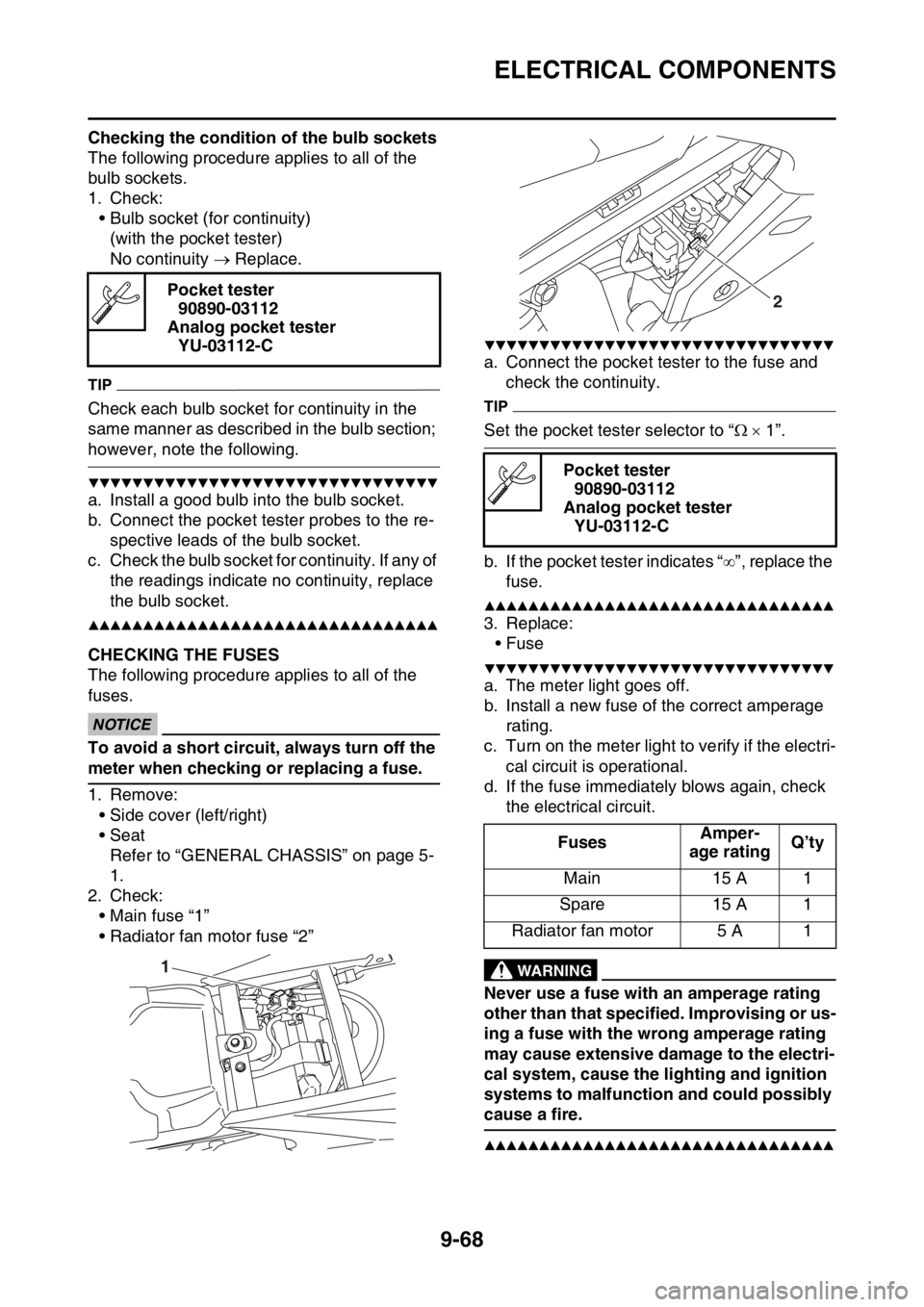
EAS2GBB384CHECKING THE FUSES
The following procedure applies to all of the
fuses.
ECA
NOTICE
To avoid a short circuit, always turn off the
meter when checking or replacing a fuse.
1. Remove:
• Side cover (left/right)
• Seat
Refer to “GENERAL CHASSIS” on page 5-
1.
2. Check:
• Main fuse “1”
• Radiator fan motor fuse “2”
▼▼▼▼▼▼▼▼▼▼▼▼▼▼▼▼▼▼▼▼▼▼▼▼▼▼▼▼▼▼▼▼
a. Connect the pocket tester to the fuse and
check the continuity.
TIP
Set the pocket tester selector to “ 1”.
b. If the pocket tester indicates “”, replace the
fuse.
▲▲▲▲▲▲▲▲▲▲▲▲▲▲▲▲▲▲▲▲▲▲▲▲▲▲▲▲▲▲▲▲
3. Replace:
• Fuse
▼▼▼▼▼▼▼▼▼▼▼▼▼▼▼▼▼▼▼▼▼▼▼▼▼▼▼▼▼▼▼▼
a. The meter light goes off.
b. Install a new fuse of the correct amperage
rating.
c. Turn on the meter light to verify if the electri-
cal circuit is operational.
d. If the fuse immediately blows again, check
the electrical circuit.
EWA
WARNING
Never use a fuse with an amperage rating
other than that specified. Improvising or us-
ing a fuse with the wrong amperage rating
may cause extensive damage to the electri-
cal system, cause the lighting and ignition
systems to malfunction and could possibly
cause a fire.
▲▲▲▲▲▲▲▲▲▲▲▲▲▲▲▲▲▲▲▲▲▲▲▲▲▲▲▲▲▲▲▲
Pocket tester
90890-03112
Analog pocket tester
YU-03112-C
1
Pocket tester
90890-03112
Analog pocket tester
YU-03112-C
FusesAmper-
age ratingQ’ty
Main 15 A 1
Spare 15 A 1
Radiator fan motor 5 A 1
2
Page 405 of 432
ELECTRICAL COMPONENTS
9-69
4. Install:
• Seat
• Side cover (left/right)
Refer to “GENERAL CHASSIS” on page 5-
1.
EAS2GBB385CHECKING AND CHARGING THE BATTERYEWA
WARNING
Batteries generate explosive hydrogen gas
and contain electrolyte which is made of
poisonous and highly caustic sulfuric acid.
Therefore, always follow these preventive
measures:
• Wear protective eye gear when handling or
working near batteries.
• Charge batteries in a well-ventilated area.
• Keep batteries away from fire, sparks or
open flames (e.g., welding equipment,
lighted cigarettes).
• DO NOT SMOKE when charging or han-
dling batteries.
• KEEP BATTERIES AND ELECTROLYTE
OUT OF REACH OF CHILDREN.
• Avoid bodily contact with electrolyte as it
can cause severe burns or permanent eye
injury.
FIRST AID IN CASE OF BODILY CONTACT:
EXTERNAL
• Skin — Wash with water.
• Eyes — Flush with water for 15 minutes
and get immediate medical attention.
INTERNAL
• Drink large quantities of water or milk fol-
lowed with milk of magnesia, beaten egg
or vegetable oil. Get immediate medical at-
tention.
ECA
NOTICE
• This is a VRLA (Valve Regulated Lead Ac-
id) battery. Never remove the sealing caps
because the balance between cells will not
be maintained and battery performance
will deteriorate.
• Charging time, charging amperage and
charging voltage for a VRLA (Valve Regu-
lated Lead Acid) battery are different from
those of conventional batteries. The VRLA
(Valve Regulated Lead Acid) battery
should be charged according to the appro-
priate charging method. If the battery is
overcharged, the electrolyte level will drop
considerably. Therefore, take special care
when charging the battery.
TIP
Since VRLA (Valve Regulated Lead Acid) bat-
teries are sealed, it is not possible to check the
charge state of the battery by measuring the
specific gravity of the electrolyte. Therefore, the
charge of the battery has to be checked by
measuring the voltage at the battery terminals.
1. Remove:
• Side cover (left/right)
• Seat
Refer to “GENERAL CHASSIS” on page 5-
1.
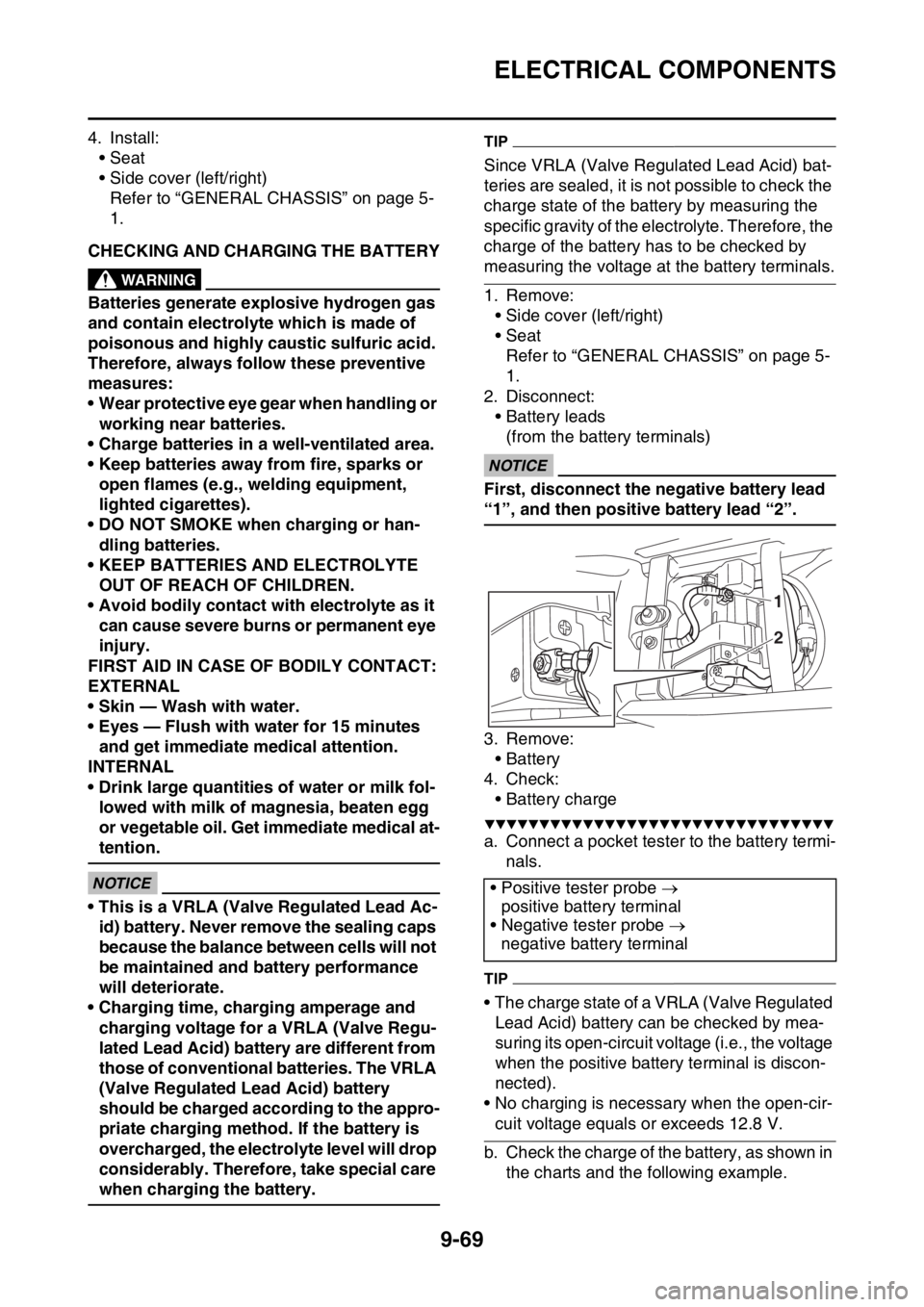
2. Disconnect:
• Battery leads
(from the battery terminals)
ECA
NOTICE
First, disconnect the negative battery lead
“1”, and then positive battery lead “2”.
3. Remove:
• Battery
4. Check:
• Battery charge
▼▼▼▼▼▼▼▼▼▼▼▼▼▼▼▼▼▼▼▼▼▼▼▼▼▼▼▼▼▼▼▼
a. Connect a pocket tester to the battery termi-
nals.
TIP
• The charge state of a VRLA (Valve Regulated
Lead Acid) battery can be checked by mea-
suring its open-circuit voltage (i.e., the voltage
when the positive battery terminal is discon-
nected).
• No charging is necessary when the open-cir-
cuit voltage equals or exceeds 12.8 V.
b. Check the charge of the battery, as shown in
the charts and the following example. • Positive tester probe
positive battery terminal
• Negative tester probe
negative battery terminal
1
2
Page 408 of 432
ELECTRICAL COMPONENTS
9-72
10.Install:
• Seat
• Side cover (left/right)
Refer to “GENERAL CHASSIS” on page 5-
1.
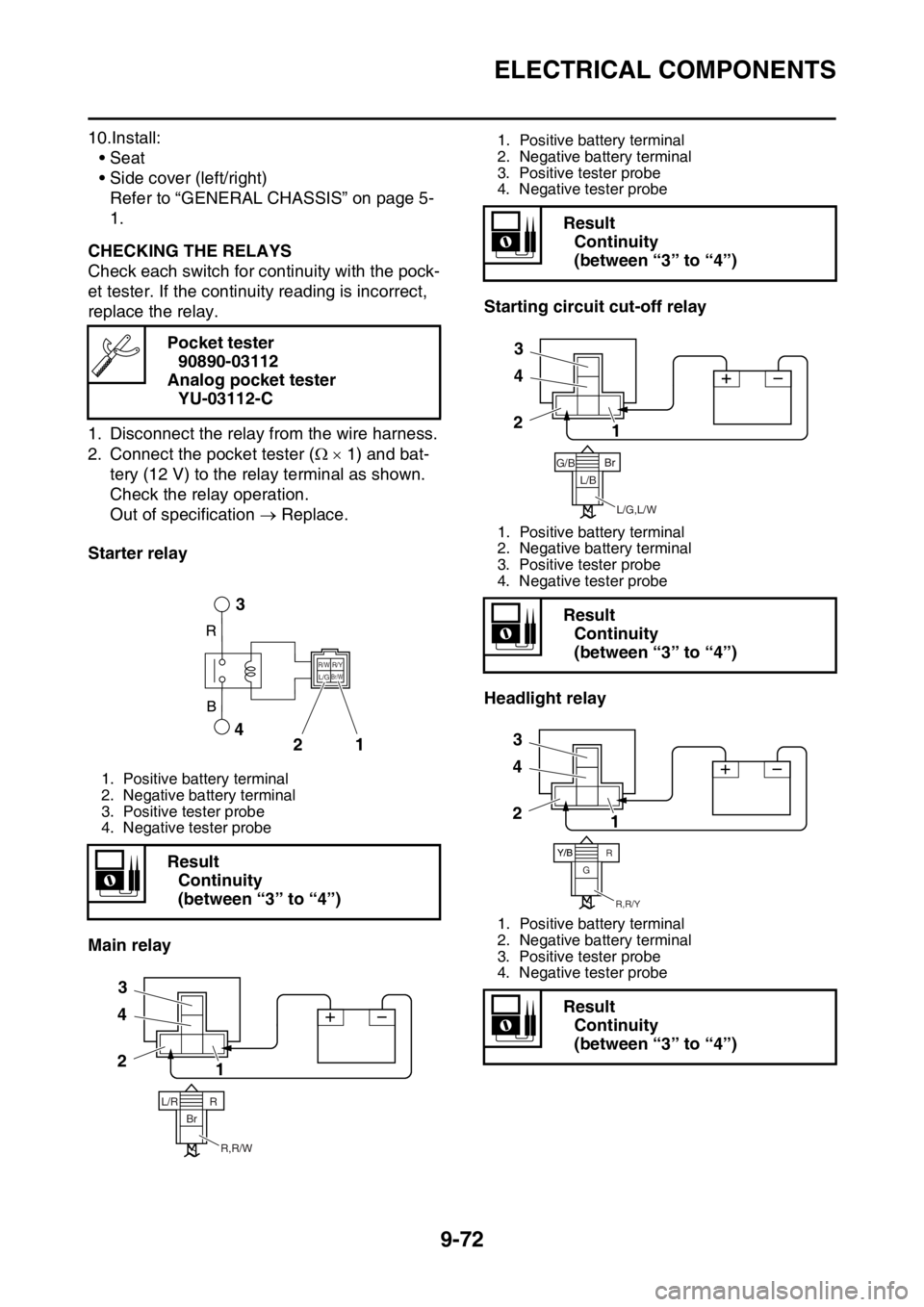
EAS2GBB386CHECKING THE RELAYS
Check each switch for continuity with the pock-
et tester. If the continuity reading is incorrect,
replace the relay.
1. Disconnect the relay from the wire harness.
2. Connect the pocket tester ( 1) and bat-
tery (12 V) to the relay terminal as shown.
Check the relay operation.
Out of specification Replace.
Starter relay
Main relayStarting circuit cut-off relay
Headlight relay Pocket tester
90890-03112
Analog pocket tester
YU-03112-C
1. Positive battery terminal
2. Negative battery terminal
3. Positive tester probe
4. Negative tester probe
Result
Continuity
(between “3” to “4”)
21 3
4
R/WBr/WR/YL/G
1 23
4
L/R
BrR
R,R/W
1. Positive battery terminal
2. Negative battery terminal
3. Positive tester probe
4. Negative tester probe
Result
Continuity
(between “3” to “4”)
1. Positive battery terminal
2. Negative battery terminal
3. Positive tester probe
4. Negative tester probe
Result
Continuity
(between “3” to “4”)
1. Positive battery terminal
2. Negative battery terminal
3. Positive tester probe
4. Negative tester probe
Result
Continuity
(between “3” to “4”)
1 23
4
G/B
L/B
L/G,L/W
1 23
4
R,R/Y
GR
Page 419 of 432
10
TROUBLESHOOTING
TROUBLESHOOTING.................................................................................... 10-1
GENERAL INFORMATION ...................................................................... 10-1
STARTING FAILURES ............................................................................. 10-1
INCORRECT ENGINE IDLING SPEED ................................................... 10-1
POOR MEDIUM-AND-HIGH-SPEED PERFORMANCE .......................... 10-2
SHIFTING IS DIFFICULT ......................................................................... 10-2
SHIFT PEDAL DOES NOT MOVE ........................................................... 10-2
JUMPS OUT OF GEAR............................................................................ 10-2
CLUTCH SLIPS ........................................................................................ 10-2
CLUTCH DRAGS ..................................................................................... 10-2
OVERHEATING ....................................................................................... 10-2
OVERCOOLING ....................................................................................... 10-3
POOR BRAKING PERFORMANCE ......................................................... 10-3
FRONT FORK OIL LEAKING ................................................................... 10-3
FAULTY FRONT FORK LEGS ................................................................. 10-3
UNSTABLE HANDLING ........................................................................... 10-3
HEADLIGHT DOES NOT COME ON ....................................................... 10-4
HEADLIGHT BULB BURNT OUT............................................................. 10-4
TAILLIGHT DOES NOT COME ON ......................................................... 10-4
LIST OF SELF-DIAGNOSTIC AND FAIL-SAFE ACTIONS........................... 10-5
Page 423 of 432
TROUBLESHOOTING
10-4
7. Wheel (s)
• Incorrect wheel balance
• Broken or loose spoke
• Damaged wheel bearing
• Bent or loose wheel axle
• Excessive wheel runout
8. Frame
• Bent frame
• Damaged steering head pipe
• Improperly installed bearing race
EAS2GBB421HEADLIGHT DOES NOT COME ON
Electrical system
1. Headlight
• Fuse open circuit
• Wrong headlight bulb
• Too many electrical accessories
• Hard charging
• Incorrect connection
• Improperly grounded circuit
• Poor contacts (start switch)
• Burnt-out headlight bulb
EAS2GBB422HEADLIGHT BULB BURNT OUT
Electrical system
1. Headlight
• Wrong headlight bulb
• Faulty battery
• Faulty rectifier/regulator
• Improperly grounded circuit
• Faulty start switch
• Headlight bulb life expired
EAS2GBB423TAILLIGHT DOES NOT COME ON
Electrical system
1. Taillight
• Wrong taillight LED
• Too many electrical accessories
• Incorrect connection
• Faulty battery