light YAMAHA WR 250F 2017 User Guide
[x] Cancel search | Manufacturer: YAMAHA, Model Year: 2017, Model line: WR 250F, Model: YAMAHA WR 250F 2017Pages: 432, PDF Size: 14.14 MB
Page 64 of 432

ELECTRICAL SPECIFICATIONS
2-11
Starter motor
Power output 0.35 kW
Armature coil resistance 0.0189–0.0231
Brush overall length 7.0 mm (0.28 in)
Limit 3.50 mm (0.14 in)
Brush spring force 3.92–5.88 N (400–600 gf, 14.11–21.17 oz)
Commutator diameter 17.6 mm (0.69 in)
Limit 16.6 mm (0.65 in)
Mica undercut (depth) 1.50 mm (0.06 in)
Fuel sender unit
Sender unit resistance (thermistor) 1350–1900
Starter relay
Amperage 180.0 A
Coil resistance 4.18–4.62
Starting circuit cut-off relay
Coil resistance 75.6–92.5
Headlight relay
Coil resistance 86.4–105.6
Fuses
Main fuse 15.0 A
Radiator fan motor fuse 5.0 A
Spare fuse 15.0 A
Page 71 of 432
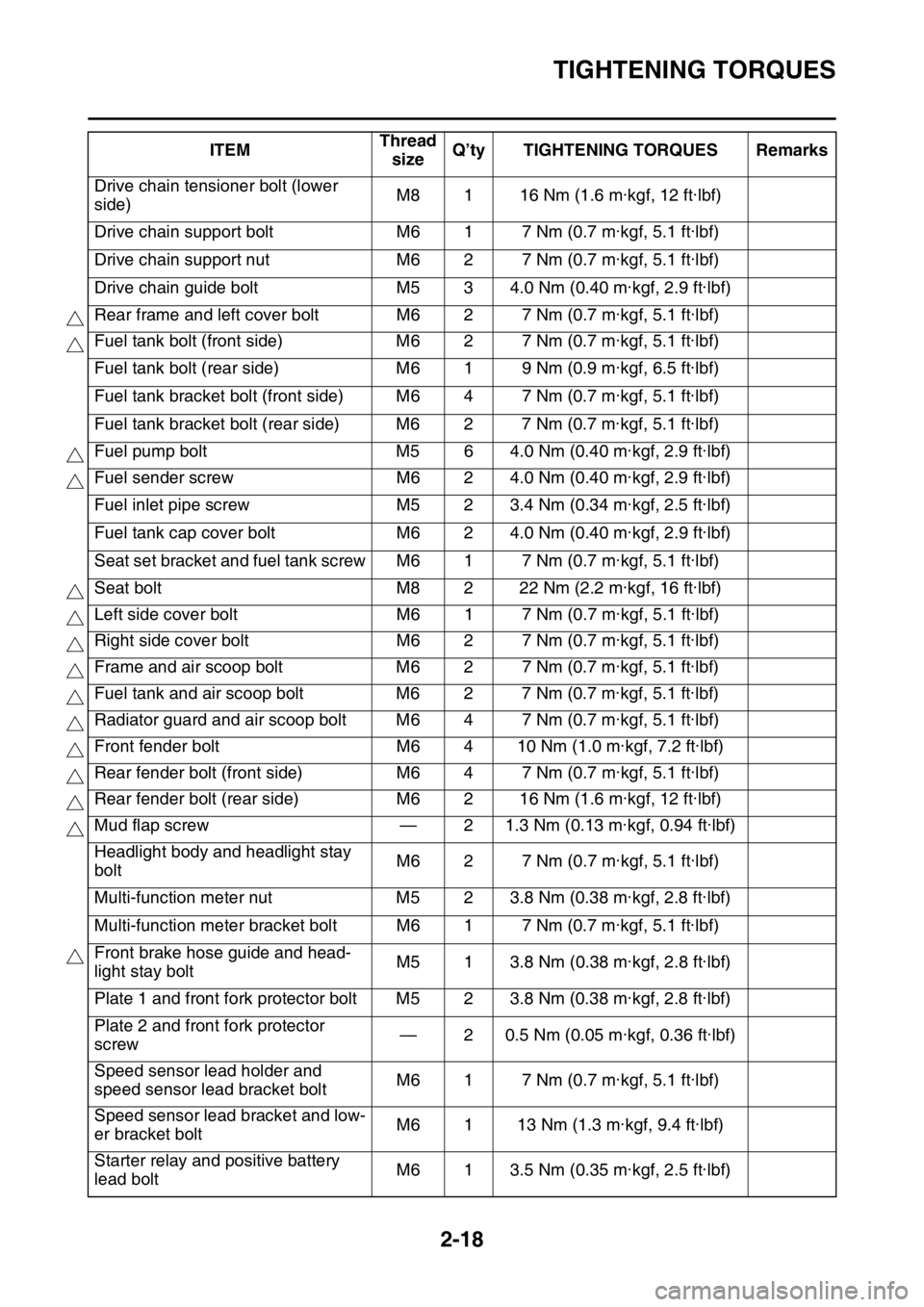
TIGHTENING TORQUES
2-18
Drive chain tensioner bolt (lower
side)M8 1 16 Nm (1.6 m·kgf, 12 ft·lbf)
Drive chain support bolt M6 1 7 Nm (0.7 m·kgf, 5.1 ft·lbf)
Drive chain support nut M6 2 7 Nm (0.7 m·kgf, 5.1 ft·lbf)
Drive chain guide bolt M5 3 4.0 Nm (0.40 m·kgf, 2.9 ft·lbf)
Rear frame and left cover bolt M6 2 7 Nm (0.7 m·kgf, 5.1 ft·lbf)
Fuel tank bolt (front side) M6 2 7 Nm (0.7 m·kgf, 5.1 ft·lbf)
Fuel tank bolt (rear side) M6 1 9 Nm (0.9 m·kgf, 6.5 ft·lbf)
Fuel tank bracket bolt (front side) M6 4 7 Nm (0.7 m·kgf, 5.1 ft·lbf)
Fuel tank bracket bolt (rear side) M6 2 7 Nm (0.7 m·kgf, 5.1 ft·lbf)
Fuel pump bolt M5 6 4.0 Nm (0.40 m·kgf, 2.9 ft·lbf)
Fuel sender screw M6 2 4.0 Nm (0.40 m·kgf, 2.9 ft·lbf)
Fuel inlet pipe screw M5 2 3.4 Nm (0.34 m·kgf, 2.5 ft·lbf)
Fuel tank cap cover bolt M6 2 4.0 Nm (0.40 m·kgf, 2.9 ft·lbf)
Seat set bracket and fuel tank screw M6 1 7 Nm (0.7 m·kgf, 5.1 ft·lbf)
Seat bolt M8 2 22 Nm (2.2 m·kgf, 16 ft·lbf)
Left side cover bolt M6 1 7 Nm (0.7 m·kgf, 5.1 ft·lbf)
Right side cover bolt M6 2 7 Nm (0.7 m·kgf, 5.1 ft·lbf)
Frame and air scoop bolt M6 2 7 Nm (0.7 m·kgf, 5.1 ft·lbf)
Fuel tank and air scoop bolt M6 2 7 Nm (0.7 m·kgf, 5.1 ft·lbf)
Radiator guard and air scoop bolt M6 4 7 Nm (0.7 m·kgf, 5.1 ft·lbf)
Front fender bolt M6 4 10 Nm (1.0 m·kgf, 7.2 ft·lbf)
Rear fender bolt (front side) M6 4 7 Nm (0.7 m·kgf, 5.1 ft·lbf)
Rear fender bolt (rear side) M6 2 16 Nm (1.6 m·kgf, 12 ft·lbf)
Mud flap screw — 2 1.3 Nm (0.13 m·kgf, 0.94 ft·lbf)
Headlight body and headlight stay
boltM6 2 7 Nm (0.7 m·kgf, 5.1 ft·lbf)
Multi-function meter nut M5 2 3.8 Nm (0.38 m·kgf, 2.8 ft·lbf)
Multi-function meter bracket bolt M6 1 7 Nm (0.7 m·kgf, 5.1 ft·lbf)
Front brake hose guide and head-
light stay boltM5 1 3.8 Nm (0.38 m·kgf, 2.8 ft·lbf)
Plate 1 and front fork protector bolt M5 2 3.8 Nm (0.38 m·kgf, 2.8 ft·lbf)
Plate 2 and front fork protector
screw— 2 0.5 Nm (0.05 m·kgf, 0.36 ft·lbf)
Speed sensor lead holder and
speed sensor lead bracket boltM6 1 7 Nm (0.7 m·kgf, 5.1 ft·lbf)
Speed sensor lead bracket and low-
er bracket boltM6 1 13 Nm (1.3 m·kgf, 9.4 ft·lbf)
Starter relay and positive battery
lead boltM6 1 3.5 Nm (0.35 m·kgf, 2.5 ft·lbf) ITEMThread
sizeQ’ty TIGHTENING TORQUES Remarks
Page 72 of 432
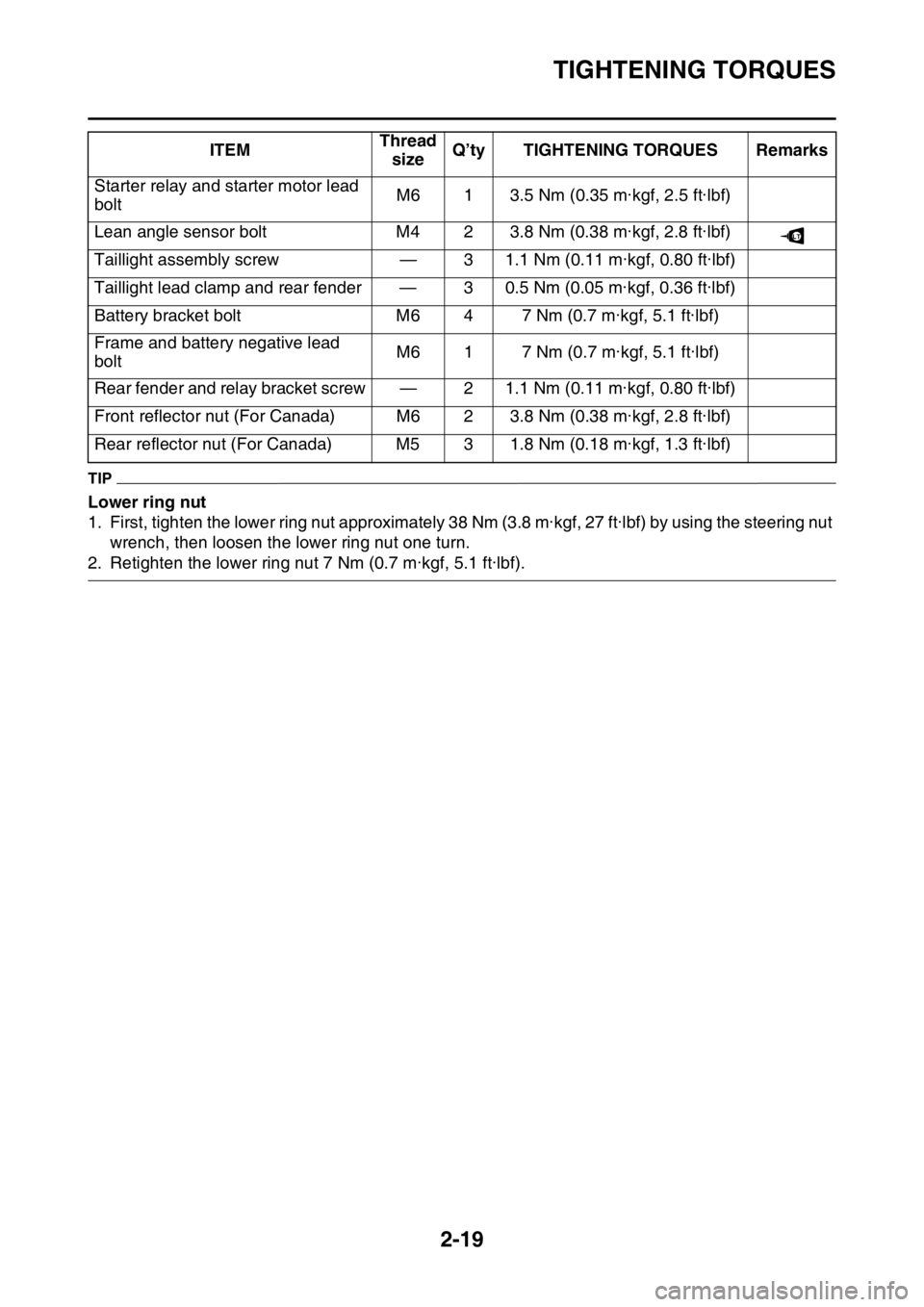
TIGHTENING TORQUES
2-19
TIP
Lower ring nut
1. First, tighten the lower ring nut approximately 38 Nm (3.8 m·kgf, 27 ft·lbf) by using the steering nut
wrench, then loosen the lower ring nut one turn.
2. Retighten the lower ring nut 7 Nm (0.7 m·kgf, 5.1 ft·lbf).Starter relay and starter motor lead
boltM6 1 3.5 Nm (0.35 m·kgf, 2.5 ft·lbf)
Lean angle sensor bolt M4 2 3.8 Nm (0.38 m·kgf, 2.8 ft·lbf)
Taillight assembly screw — 3 1.1 Nm (0.11 m·kgf, 0.80 ft·lbf)
Taillight lead clamp and rear fender — 3 0.5 Nm (0.05 m·kgf, 0.36 ft·lbf)
Battery bracket bolt M6 4 7 Nm (0.7 m·kgf, 5.1 ft·lbf)
Frame and battery negative lead
boltM6 1 7 Nm (0.7 m·kgf, 5.1 ft·lbf)
Rear fender and relay bracket screw — 2 1.1 Nm (0.11 m·kgf, 0.80 ft·lbf)
Front reflector nut (For Canada) M6 2 3.8 Nm (0.38 m·kgf, 2.8 ft·lbf)
Rear reflector nut (For Canada) M5 3 1.8 Nm (0.18 m·kgf, 1.3 ft·lbf)ITEMThread
sizeQ’ty TIGHTENING TORQUES Remarks
LT
Page 85 of 432

CABLE ROUTING DIAGRAM
2-32
1. Clutch cable
2. Throttle cable (return)
3. Throttle cable (pull)
4. Engine stop switch lead
5. Coupler for connecting optional part
6. Engine stop switch coupler
7. Rectifier/regulator coupler
8. AC magneto lead
9. Starter knob/idle screw
10. Starter motor lead
11. Radiator fan fuse
12. Taillight lead
13. Headlight relay (yellow tape)
14. Starting circuit cut-off relay (no identification
tape)
15. Diode
16. Holder plate
17. Left of the vehicle:radiator fan motor relay (blue
tape)
Right of the vehicle:main relay (red tape)
18. Neutral switch lead
19. Engine bracket
20. Front engine bracket
21. Plastic locking tie
22. Radiator hose
23. Neutral switch coupler
24. Crankshaft position sensor coupler
25. Tension arm
26. Wire harness
27. Tank rail
28. Rectifier/regulator
29. Rectifier/regulator bracket
30. Rear frame
31. Side cover 5
32. Crankcase cover
33. Crankcase
34. Lead holder
35. Frame
A. Pass the engine stop switch lead between the
frame and the cable holder.
B. Insert the coupler for connecting optional part into
the connector, and fix it to the bracket.
C. Insert and fix the engine stop switch coupler to
the bracket.
D. Insert and fix the rectifier/regulator coupler to the
bracket.
E. Pass the AC magneto lead to the front of the ve-
hicle beyond the starter knob/idle screw and to
the rear of the vehicle beyond the radiator. No
pinch is allowed between the radiator and the
tension arm.
F. Place the rear grommet of the starter motor lead
matching the rear end of the side cover.
G. Insert the radiator fan motor fuse into the protru-
sion of the holder plate.
H. Place the diode on top of the rear fender on the
inner side of the rear frame.
I. Bring the neutral switch lead into line with the
crankcase cover with no sag allowed.
J. Route the AC magneto lead under the starter
clutch cover.
K. Pass the neutral switch lead to the inside of the
front engine bracket (the side of the vehicle).
L. Insert the plastic locking tie into the bracket hole
and clamp the clutch cable. Clamp it so that the
lock of the plastic locking tie faces downward,
and then cut off the end of the plastic locking tie.
M. Pass the clutch cable with no downward sag al-
lowed.N. Place the grommet of the clutch cable so that it
contacts the radiator hose. Route the clutch cable
outside the neutral switch lead, AC magneto lead
and starter motor lead.
O. Route each lead so that the leads are not pinched
between the radiator hose and the frame.
P. 40 mm (1.57 in)
Q. Clamp the clutch cable, AC magneto lead, neu-
tral switch lead and starter motor lead by the plas-
tic locking tie. Make sure that they are clamped at
the positioning tapes in the clutch cable and the
starter motor lead. Make the lock on the plastic
locking tie face the front of the vehicle, and cut
the end.
R. Clamp the starter motor lead to the inside of the
tension arm with a plastic locking tie. Clamp it so
that the lock of the plastic locking tie faces up-
ward and outward, and do not cut off the end of
the plastic locking tie. Route the lead so that there
is no slack at the bottom from the clamp position
onwards.
S. After connecting the neutral switch coupler, at-
tach the coupler cover.
T. After connecting the crankshaft position sensor
coupler, attach the coupler cover.
U. Pass the rectifier/regulator lead to the inside of
the tension arm (the side of the vehicle).
V. Pass the main harness to the front of the radiator
hose (the front of the vehicle), and to the inside of
the clutch cable (the side of the vehicle).
W. Pass the engine stop switch lead between the
coupler for connecting optional part and the tank
rail, with the lead on the main harness side facing
the top of the vehicle.
X. Insert the starter motor lead completely into the
end of the side cover 5.
Y. Clamp the clutch cable at the front of the lead (the
front of the vehicle).
Z. Insert the clip of the plastic locking tie into the
frame. Face the lock of the plastic locking tie for-
ward, and then cut off the end.
Page 91 of 432

CABLE ROUTING DIAGRAM
2-38
1. Battery negative lead
2. Fuel hose
3. Fuel pump coupler
4. Fuel pump lead
5. Resistor
6. Resistor coupler
7. Battery positive lead
8. Lean angle sensor
9. Starter motor lead
10. Radiator fan motor relay (blue tape)
11. Main relay (red tape)
12. Wire harness
13. Ground lead coupler
14. Starter relay coupler
15. Starter relay
16. Cross member
17. Diode
18. Taillight lead
19. Clamp
20. Fuel tank
21. Damper
22. Rear frame
23. Side cover 6
24. Plastic locking tie
A. After connecting the fuel pump coupler, attach
the coupler cover.
B. Pass the fuel hose to the front of the battery.
C. Route the resistor lead to the outside of the leads.
D. Connect the battery positive lead to the starter re-
lay terminal (in the left side of the vehicle).
E. Insert the protruding end of the wire harness into
the battery bracket hole and holder plate hole.
F. After connecting the negative lead coupler, place
it on the right side of the battery.
G. After installing the plastic cover to the starter re-
lay, connect the starter relay coupler.
H. Route the diode under the cross member and
place it on top of the rear fender.
I. Secure the two ends of the taillight coupler with
the starter motor lead.
J. Route the taillight lead so that it does not slack at
the rear of the vehicle.
K. Clamp the taillight lead and insert the clip into the
rear fender. Clamp it so that the lock faces in-
ward, and then cut off the excess end.
L. Route the battery positive lead under the cross
member.
M. Lower end of the rear frame
N. Clamp it so that the lock of the plastic locking tie
faces downward, insert the end into the rear
frame and side cover 6, and then cut off the ex-
cess end. After cutting off the excess end, make
sure that the plastic locking tie does not protrude
from the lower end of the rear frame.
O. Clamp it so that the lock of the plastic locking tie
faces downward, and then pass the end between
the fuel hose and rear frame.
P. Clamp the wire harness at the position of the
white tape.
Page 93 of 432

CABLE ROUTING DIAGRAM
2-40
1. Clutch switch lead
2. Engine stop switch lead
3. Clutch cable
4. Brake hose guide
5. Headlight lead
6. Speed sensor lead
7. Indicator light coupler
8. Meter assembly optional switch coupler
9. Meter assembly coupler
10. Speed sensor coupler
11. Start switch lead
12. Plastic band
13. Throttle cable
14. Front brake hose
A. Route the throttle cable, clutch cable, clutch
switch lead, engine stop switch lead and start
switch lead between the cable guide of the meter
bracket and handle crown. The cables and leads
may be routed in any order.
B. Clamp the wire harness, clutch switch lead and
start switch lead to the meter bracket. The clamp
shall be located at a position where there is no
slack with the handle turned fully to the left.
C. Connect the headlight lead to the headlight.
D. Clamp the start switch lead to the handlebar by
the plastic band.
E. Clamp the engine stop switch lead and clutch
switch lead to the handlebar by the plastic band.
F. 40°±10°
G. Vertical direction
H. Pass the engine stop switch lead under the han-
dlebar.
Page 100 of 432

ADJUSTING THE REAR SHOCK ABSORBER ASSEMBLY ................... 3-34
CHECKING THE TIRES ........................................................................... 3-36
CHECKING AND TIGHTENING THE SPOKES ....................................... 3-36
CHECKING THE WHEELS ...................................................................... 3-37
CHECKING THE WHEEL BEARINGS ..................................................... 3-37
CHECKING AND ADJUSTING THE STEERING HEAD .......................... 3-37
CHECKING AND LUBRICATING THE CABLES ..................................... 3-38
LUBRICATING THE LEVERS .................................................................. 3-38
LUBRICATING THE PEDAL .................................................................... 3-38
LUBRICATING THE DRIVE CHAIN ......................................................... 3-38
LUBRICATING THE SIDESTAND............................................................ 3-39
CHECKING THE CHASSIS FASTENERS ............................................... 3-39
ELECTRICAL SYSTEM.................................................................................. 3-40
CHECKING THE SPARK PLUG .............................................................. 3-40
CHECKING THE IGNITION TIMING ........................................................ 3-40
CHECKING AND CHARGING THE BATTERY ........................................ 3-41
REPLACING THE HEADLIGHT BULB..................................................... 3-41
Page 103 of 432
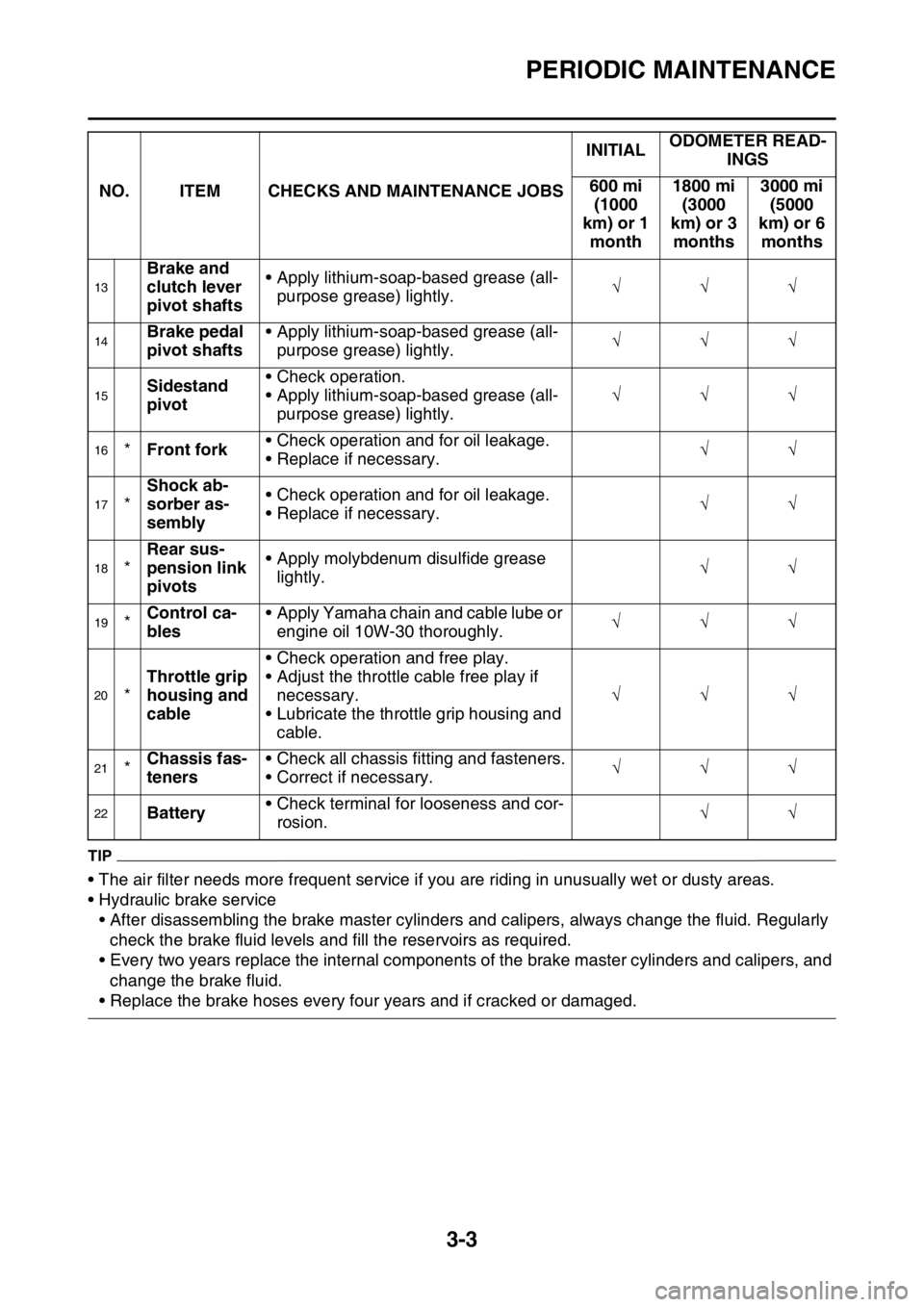
PERIODIC MAINTENANCE
3-3
TIP
• The air filter needs more frequent service if you are riding in unusually wet or dusty areas.
• Hydraulic brake service
• After disassembling the brake master cylinders and calipers, always change the fluid. Regularly
check the brake fluid levels and fill the reservoirs as required.
• Every two years replace the internal components of the brake master cylinders and calipers, and
change the brake fluid.
• Replace the brake hoses every four years and if cracked or damaged.
13
Brake and
clutch lever
pivot shafts• Apply lithium-soap-based grease (all-
purpose grease) lightly.
14Brake pedal
pivot shafts• Apply lithium-soap-based grease (all-
purpose grease) lightly.
15Sidestand
pivot• Check operation.
• Apply lithium-soap-based grease (all-
purpose grease) lightly.
16*Front fork• Check operation and for oil leakage.
• Replace if necessary.
17*Shock ab-
sorber as-
sembly• Check operation and for oil leakage.
• Replace if necessary.
18*Rear sus-
pension link
pivots• Apply molybdenum disulfide grease
lightly.
19*Control ca-
bles• Apply Yamaha chain and cable lube or
engine oil 10W-30 thoroughly.
20*Throttle grip
housing and
cable• Check operation and free play.
• Adjust the throttle cable free play if
necessary.
• Lubricate the throttle grip housing and
cable.
21*Chassis fas-
teners• Check all chassis fitting and fasteners.
• Correct if necessary.
22Battery• Check terminal for looseness and cor-
rosion. NO. ITEM CHECKS AND MAINTENANCE JOBSINITIALODOMETER READ-
INGS
600 mi
(1000
km) or 1
month1800 mi
(3000
km) or 3
months3000 mi
(5000
km) or 6
months
Page 118 of 432
ENGINE
3-18
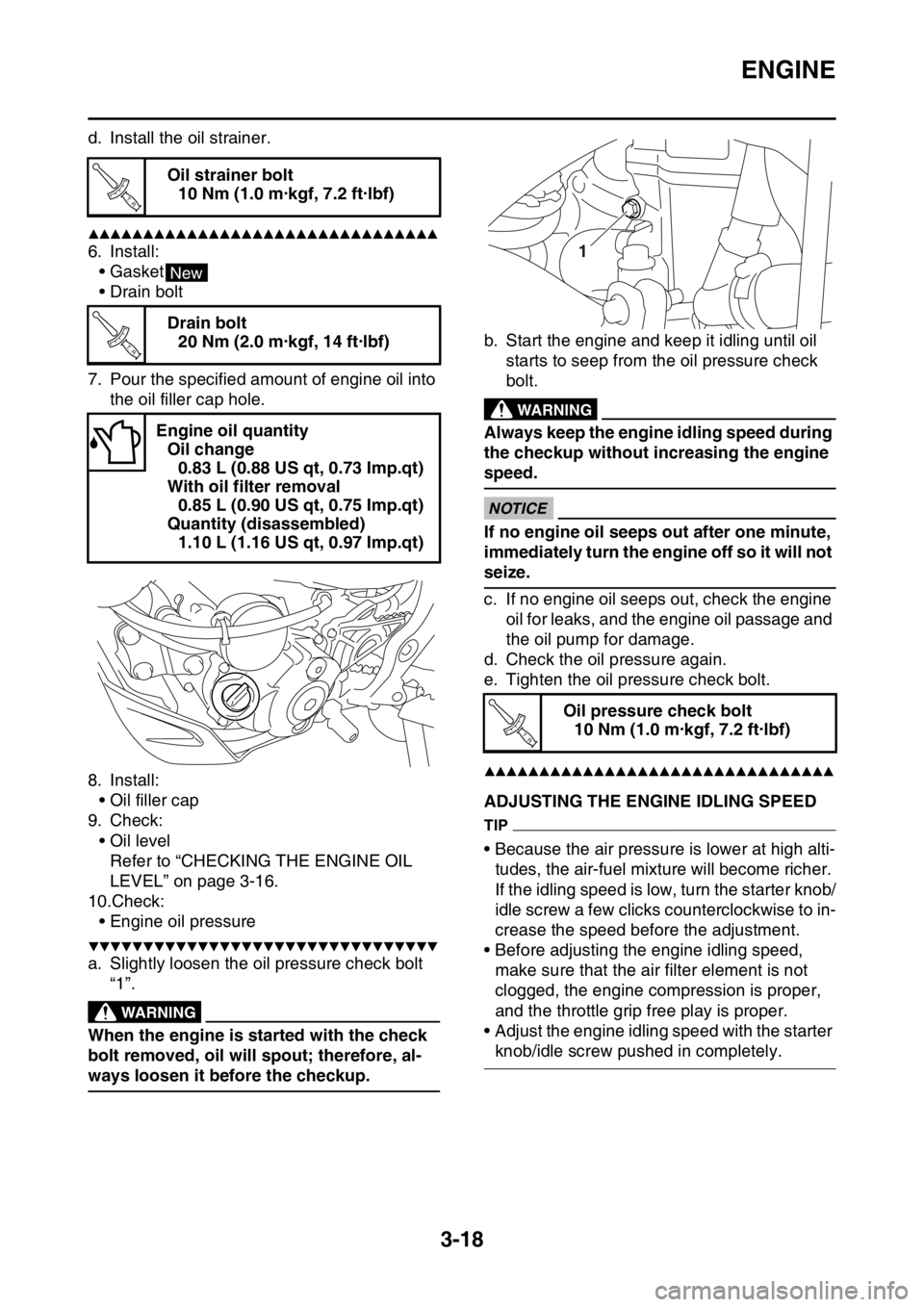
d. Install the oil strainer.
▲▲▲▲▲▲▲▲▲▲▲▲▲▲▲▲▲▲▲▲▲▲▲▲▲▲▲▲▲▲▲▲
6. Install:
•Gasket
• Drain bolt
7. Pour the specified amount of engine oil into
the oil filler cap hole.
8. Install:
• Oil filler cap
9. Check:
• Oil level
Refer to “CHECKING THE ENGINE OIL
LEVEL” on page 3-16.
10.Check:
• Engine oil pressure
▼▼▼▼▼▼▼▼▼▼▼▼▼▼▼▼▼▼▼▼▼▼▼▼▼▼▼▼▼▼▼▼
a. Slightly loosen the oil pressure check bolt
“1”.
EWA
WARNING
When the engine is started with the check
bolt removed, oil will spout; therefore, al-
ways loosen it before the checkup.b. Start the engine and keep it idling until oil
starts to seep from the oil pressure check
bolt.
EWA
WARNING
Always keep the engine idling speed during
the checkup without increasing the engine
speed.
ECA
NOTICE
If no engine oil seeps out after one minute,
immediately turn the engine off so it will not
seize.
c. If no engine oil seeps out, check the engine
oil for leaks, and the engine oil passage and
the oil pump for damage.
d. Check the oil pressure again.
e. Tighten the oil pressure check bolt.
▲▲▲▲▲▲▲▲▲▲▲▲▲▲▲▲▲▲▲▲▲▲▲▲▲▲▲▲▲▲▲▲
EAS2GBB098ADJUSTING THE ENGINE IDLING SPEED
TIP
• Because the air pressure is lower at high alti-
tudes, the air-fuel mixture will become richer.
If the idling speed is low, turn the starter knob/
idle screw a few clicks counterclockwise to in-
crease the speed before the adjustment.
• Before adjusting the engine idling speed,
make sure that the air filter element is not
clogged, the engine compression is proper,
and the throttle grip free play is proper.
• Adjust the engine idling speed with the starter
knob/idle screw pushed in completely. Oil strainer bolt
10 Nm (1.0 m·kgf, 7.2 ft·lbf)
Drain bolt
20 Nm (2.0 m·kgf, 14 ft·lbf)
Engine oil quantity
Oil change
0.83 L (0.88 US qt, 0.73 Imp.qt)
With oil filter removal
0.85 L (0.90 US qt, 0.75 Imp.qt)
Quantity (disassembled)
1.10 L (1.16 US qt, 0.97 Imp.qt)
T R..
New
T R..
Oil pressure check bolt
10 Nm (1.0 m·kgf, 7.2 ft·lbf)
1
T R..
Page 140 of 432
ELECTRICAL SYSTEM
3-40
EAS2GBB130
ELECTRICAL SYSTEM
EAS2GBB131CHECKING THE SPARK PLUG
1. Remove:
• Seat
• Air scoop (left/right)
Refer to “GENERAL CHASSIS” on page 5-
1.
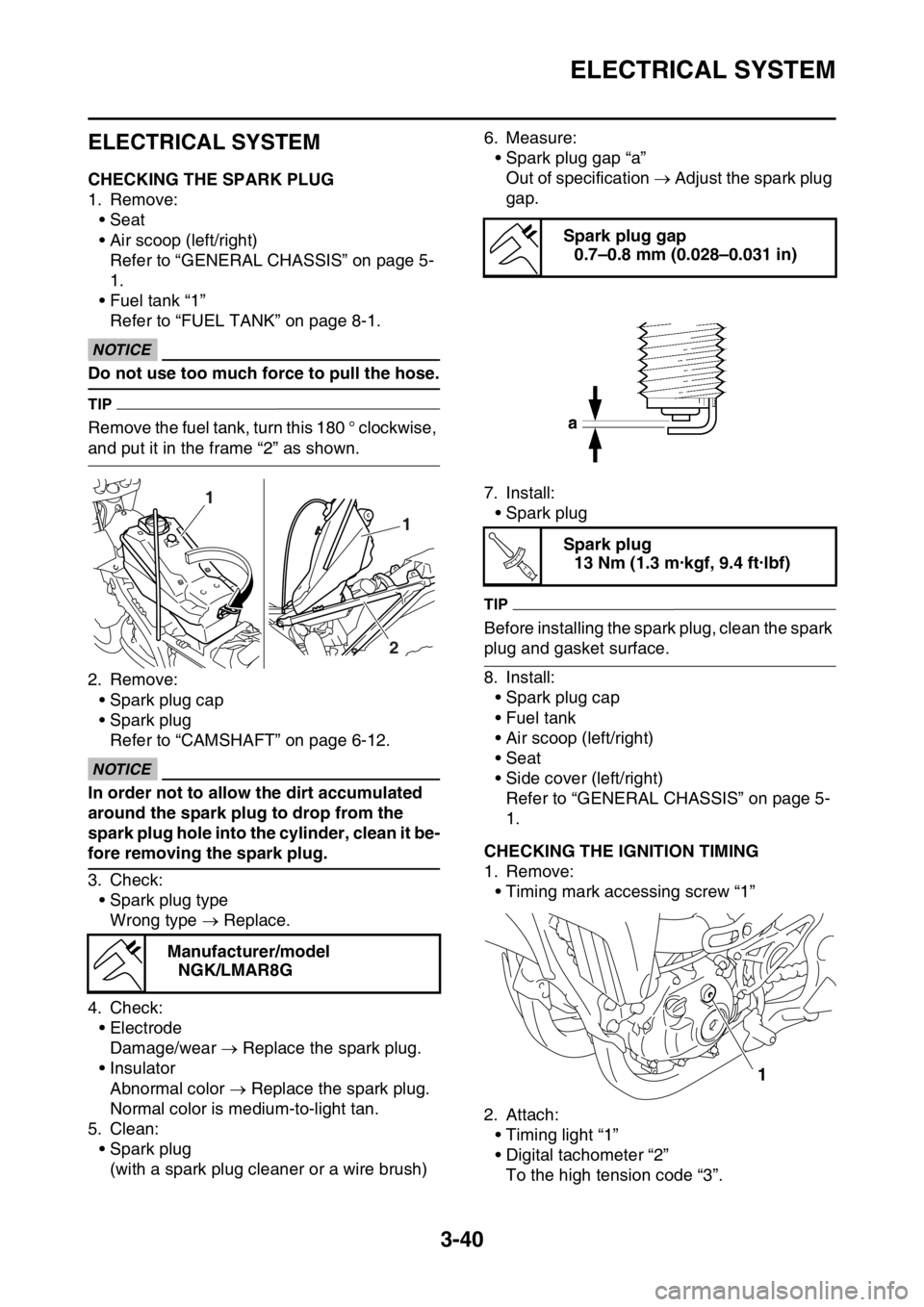
• Fuel tank “1”
Refer to “FUEL TANK” on page 8-1.
ECA
NOTICE
Do not use too much force to pull the hose.
TIP
Remove the fuel tank, turn this 180 ° clockwise,
and put it in the frame “2” as shown.
2. Remove:
• Spark plug cap
• Spark plug
Refer to “CAMSHAFT” on page 6-12.
ECA
NOTICE
In order not to allow the dirt accumulated
around the spark plug to drop from the
spark plug hole into the cylinder, clean it be-
fore removing the spark plug.
3. Check:
• Spark plug type
Wrong type Replace.
4. Check:
• Electrode
Damage/wear Replace the spark plug.
• Insulator
Abnormal color Replace the spark plug.
Normal color is medium-to-light tan.
5. Clean:
• Spark plug
(with a spark plug cleaner or a wire brush)6. Measure:
• Spark plug gap “a”
Out of specification Adjust the spark plug
gap.
7. Install:
• Spark plug
TIP
Before installing the spark plug, clean the spark
plug and gasket surface.
8. Install:
• Spark plug cap
• Fuel tank
• Air scoop (left/right)
• Seat
• Side cover (left/right)
Refer to “GENERAL CHASSIS” on page 5-
1.
EAS2GBB132CHECKING THE IGNITION TIMING
1. Remove:
• Timing mark accessing screw “1”
2. Attach:
• Timing light “1”
• Digital tachometer “2”
To the high tension code “3”. Manufacturer/model
NGK/LMAR8G
1
1
2
Spark plug gap
0.7–0.8 mm (0.028–0.031 in)
Spark plug
13 Nm (1.3 m·kgf, 9.4 ft·lbf)
T R..
1