fuel YAMAHA WR 400F 2000 User Guide
[x] Cancel search | Manufacturer: YAMAHA, Model Year: 2000, Model line: WR 400F, Model: YAMAHA WR 400F 2000Pages: 654, PDF Size: 60.12 MB
Page 64 of 654
1 - 17
GEN
INFO
TORQUE-CHECK POINTS
EC1A0012
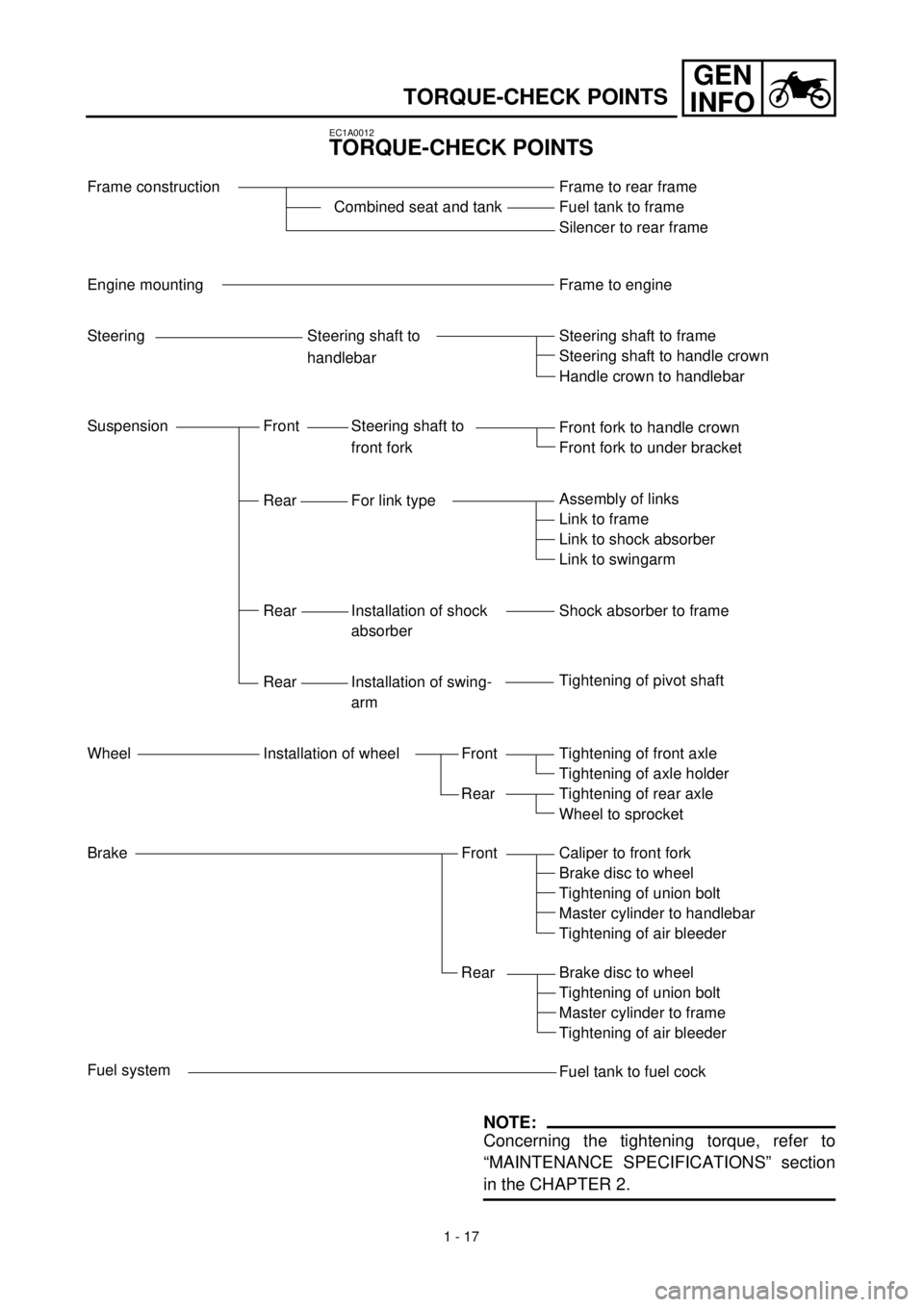
TORQUE-CHECK POINTS
Frame construction
Combined seat and tank
Engine mounting
Steering Steering shaft to
handlebar
Suspension Front Steering shaft to
front fork
Rear For link type
Rear Installation of shock
absorber
Rear Installation of swing-
arm
Wheel Installation of wheel Front
Rear
Brake Front
Rear
Fuel systemFrame to rear frame
Fuel tank to frame
Silencer to rear frame
Frame to engine
Steering shaft to frame
Steering shaft to handle crown
Handle crown to handlebar
Front fork to handle crown
Front fork to under bracket
Assembly of links
Link to frame
Link to shock absorber
Link to swingarm
Shock absorber to frame
Tightening of pivot shaft
Tightening of front axle
Tightening of axle holder
Tightening of rear axle
Wheel to sprocket
Caliper to front fork
Brake disc to wheel
Tightening of union bolt
Master cylinder to handlebar
Tightening of air bleeder
Brake disc to wheel
Tightening of union bolt
Master cylinder to frame
Tightening of air bleeder
Fuel tank to fuel cock
NOTE:
Concerning the tightening torque, refer to
“MAINTENANCE SPECIFICATIONS” section
in the CHAPTER 2.
Page 70 of 654

1 - 19
GEN
INFO
CLEANING AND STORAGE
EC182001
STORAGE
If your machine is to be stored for 60 days or
more, some preventive measures must be
taken to avoid deterioration. After cleaning the
machine thoroughly, prepare it for storage as
follows:
1. Drain the fuel tank, fuel lines, and the car-
buretor float bowl.
2. Remove the spark plug, pour a table-
spoon of SAE 10W-30 motor oil in the
spark plug hole, and reinstall the plug.
With the engine stop switch pushed in,
kick the engine over several times to coat
the cylinder walls with oil.
3. Remove the drive chain, clean it thor-
oughly with solvent, and lubricate it. Rein-
stall the chain or store it in a plastic bag
tied to the frame.
4. Lubricate all control cables.
5. Block the frame up to raise the wheels off
the ground.
6. Tie a plastic bag over the exhaust pipe
outlet to prevent moisture from entering.
7. If the machine is to be stored in a humid
or salt-air environment, coat all exposed
metal surfaces with a film of light oil. Do
not apply oil to rubber parts or the seat
cover.
NOTE:
Make any necessary repairs before the
machine is stored.
Page 72 of 654
2 - 1
SPEC
GENERAL SPECIFICATIONS
EC200000
SPECIFICATIONS
EC211000
GENERAL SPECIFICATIONS
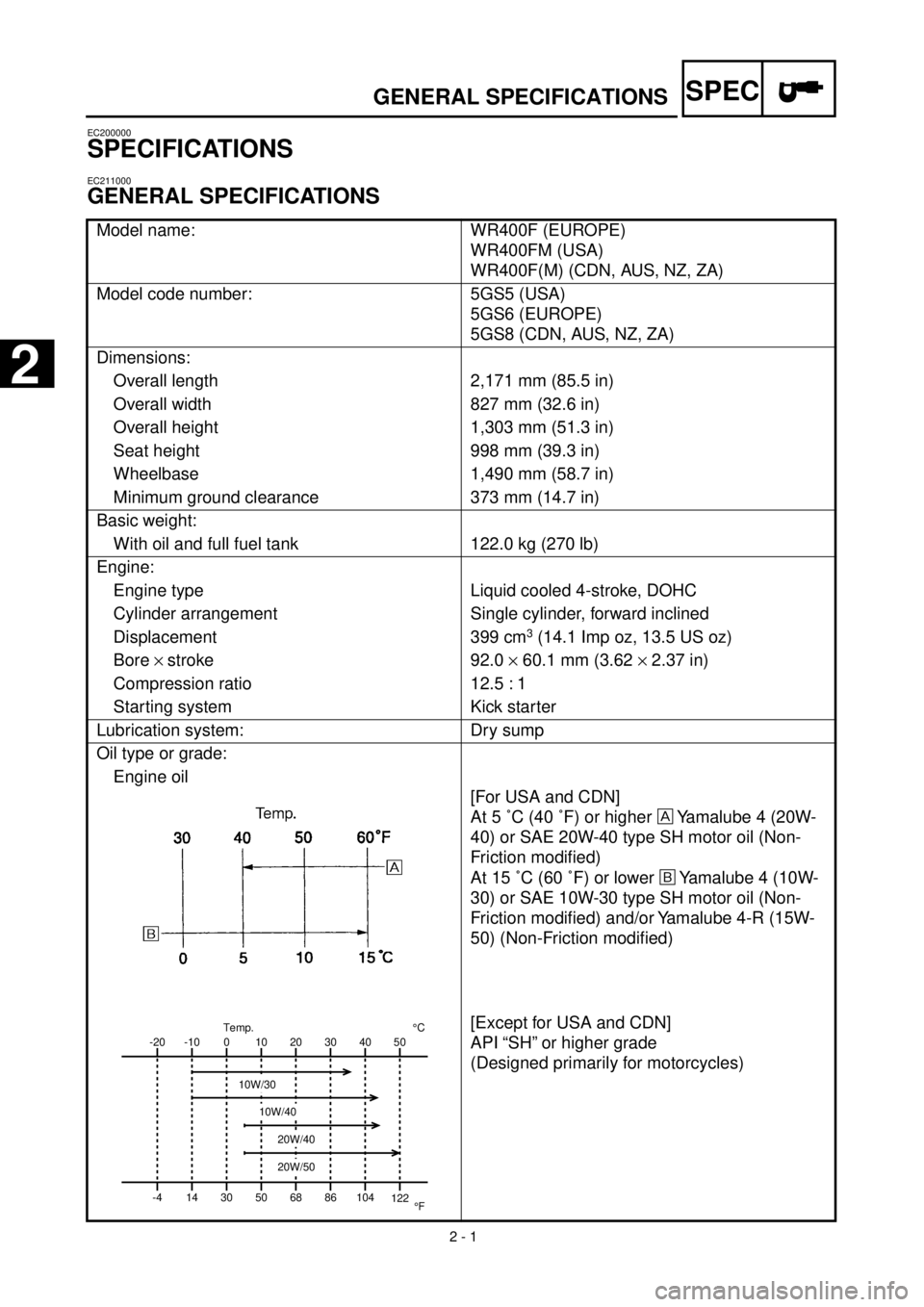
Model name: WR400F (EUROPE)
WR400FM (USA)
WR400F(M) (CDN, AUS, NZ, ZA)
Model code number: 5GS5 (USA)
5GS6 (EUROPE)
5GS8 (CDN, AUS, NZ, ZA)
Dimensions:
Overall length 2,171 mm (85.5 in)
Overall width 827 mm (32.6 in)
Overall height 1,303 mm (51.3 in)
Seat height 998 mm (39.3 in)
Wheelbase 1,490 mm (58.7 in)
Minimum ground clearance 373 mm (14.7 in)
Basic weight:
With oil and full fuel tank 122.0 kg (270 lb)
Engine:
Engine type Liquid cooled 4-stroke, DOHC
Cylinder arrangement Single cylinder, forward inclined
Displacement 399 cm
3
(14.1 Imp oz, 13.5 US oz)
Bore
´
stroke 92.0
´
60.1 mm (3.62
´
2.37 in)
Compression ratio 12.5 : 1
Starting system Kick starter
Lubrication system: Dry sump
Oil type or grade:
Engine oil
[For USA and CDN]
At 5 ˚C (40 ˚F) or higher
Yamalube 4 (20W-
40) or SAE 20W-40 type SH motor oil (Non-
Friction modified)
At 15 ˚C (60 ˚F) or lower
õ
Yamalube 4 (10W-
30) or SAE 10W-30 type SH motor oil (Non-
Friction modified) and/or Yamalube 4-R (15W-
50) (Non-Friction modified)
[Except for USA and CDN]
API “SH” or higher grade
(Designed primarily for motorcycles)
-20
-4-10
140
3010
5020
6830
8640 50
104
122¡CTemp.
¡F
10W/30
10W/40
20W/40
20W/50
2
Page 73 of 654

2 - 2
SPEC
GENERAL SPECIFICATIONS
Oil capacity:
Engine oil
Periodic oil change 1.5 L (1.32 Imp qt, 1.59 US qt)
With oil filter replacement 1.6 L (1.41 Imp qt, 1.69 US qt)
Total amount 1.7 L (1.50 Imp qt, 1.80 US qt)
Coolant capacity (including all routes): 1.2 L (1.06 Imp qt, 1.27 US qt)
Air filter: Wet type element
Fuel:
Type Premium unleaded fuel with a research octane
number of 95 or higher. (Except for AUS)
Unleaded fuel only (For AUS)
Tank capacity 12 L (2.64 Imp gal, 3.17 US gal)
(For USA, CDN)
Reserve 8 L (1.76 Imp gal, 2.11 US gal)
(Except for USA, CDN)
1.6 L (0.35 Imp gal, 0.42 US gal)
(For USA, CDN)
1.4 L (0.31 Imp gal, 0.37 US gal)
(Except for USA, CDN)
Carburetor:
Type FCR-MX39
Manufacturer KEIHIN
Spark plug:
Type/manufacturer CR8E/NGK
U24ESR-N/DENSO
Gap 0.7 ~ 0.8 mm (0.028 ~ 0.031 in)
Clutch type: Wet, multiple-disc
Transmission:
Primary reduction system Gear
Primary reduction ratio 62/21 (2.952)
Secondary reduction system Chain drive
Secondary reduction ratio 50/14 (3.571)
Transmission type Constant mesh, 5-speed
Operation Left foot operation
Gear ratio: 1st 29/12 (2.416)
2nd 26/15 (1.733)
3rd 21/16 (1.312)
4th 21/20 (1.050)
5th 21/25 (0.840)
Chassis:
Frame type Semi double cradle
Caster angle 27.8˚
Trail 123 mm (4.84 in)
2
Page 87 of 654
2 - 16
SPECMAINTENANCE SPECIFICATIONS
HINWEIS:NOTE:
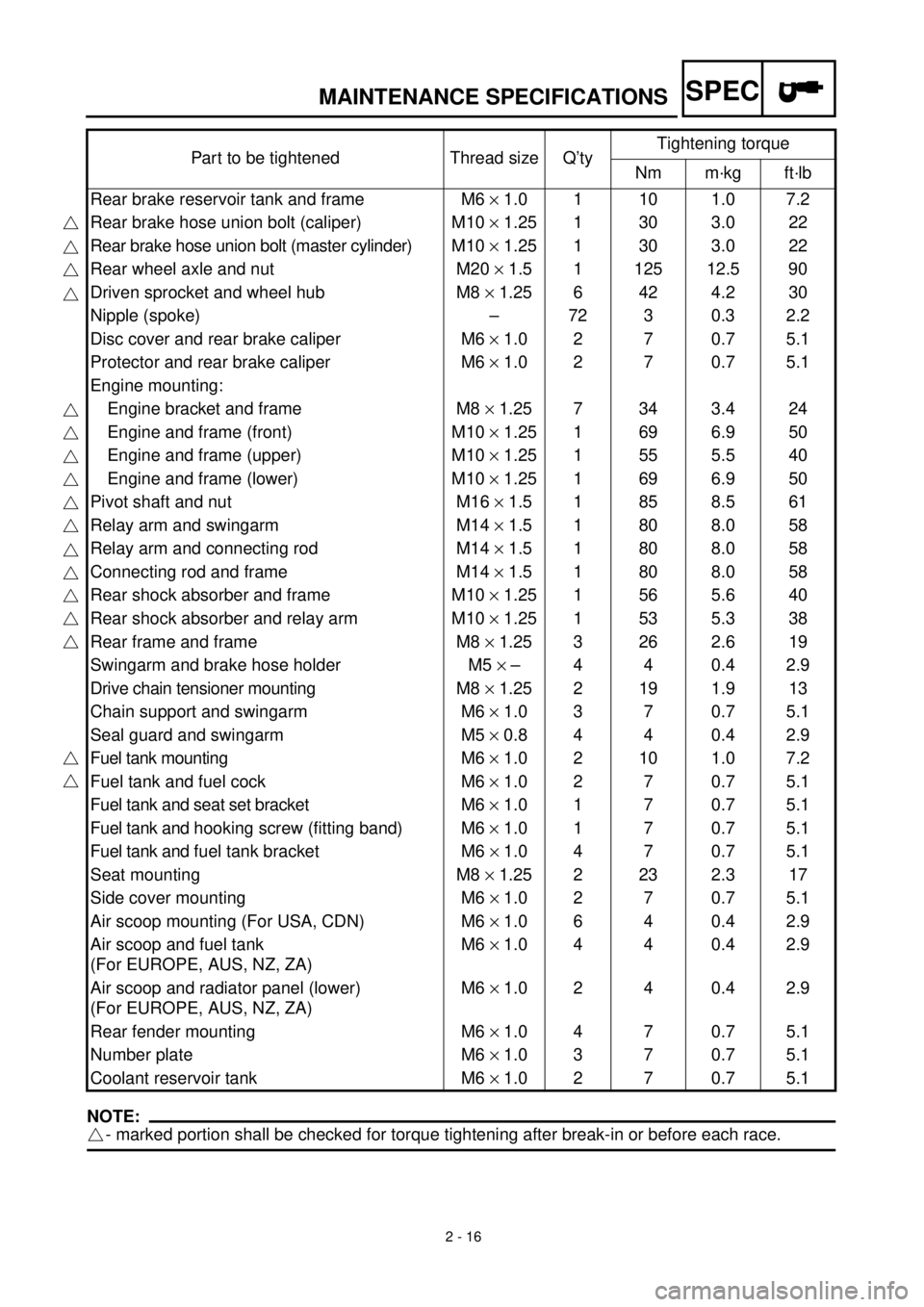
- marked portion shall be checked for torque tightening after break-in or before each race.Part to be tightened Thread size Q’tyTightening torque
Nm m·kg ft·lb
Rear brake reservoir tank and frame M6 ´ 1.0 1 10 1.0 7.2
Rear brake hose union bolt (caliper) M10 ´ 1.25 1 30 3.0 22
Rear brake hose union bolt (master cylinder)M10 ´ 1.25 1 30 3.0 22
Rear wheel axle and nut M20 ´ 1.5 1 125 12.5 90
Driven sprocket and wheel hub M8 ´ 1.25 6 42 4.2 30
Nipple (spoke) – 72 3 0.3 2.2
Disc cover and rear brake caliper M6 ´ 1.0 2 7 0.7 5.1
Protector and rear brake caliper M6 ´ 1.0 2 7 0.7 5.1
Engine mounting:
Engine bracket and frame M8 ´ 1.25 7 34 3.4 24
Engine and frame (front) M10 ´ 1.25 1 69 6.9 50
Engine and frame (upper) M10 ´ 1.25 1 55 5.5 40
Engine and frame (lower) M10 ´ 1.25 1 69 6.9 50
Pivot shaft and nut M16 ´ 1.5 1 85 8.5 61
Relay arm and swingarm M14 ´ 1.5 1 80 8.0 58
Relay arm and connecting rod M14 ´ 1.5 1 80 8.0 58
Connecting rod and frame M14 ´ 1.5 1 80 8.0 58
Rear shock absorber and frame M10 ´ 1.25 1 56 5.6 40
Rear shock absorber and relay arm M10 ´ 1.25 1 53 5.3 38
Rear frame and frame M8 ´ 1.25 3 26 2.6 19
Swingarm and brake hose holder M5 ´ – 4 4 0.4 2.9
Drive chain tensioner mounting M8 ´ 1.25 2 19 1.9 13
Chain support and swingarm M6 ´ 1.0 3 7 0.7 5.1
Seal guard and swingarm M5 ´ 0.8 4 4 0.4 2.9
Fuel tank mounting M6 ´ 1.0 2 10 1.0 7.2
Fuel tank and fuel cock M6 ´ 1.0 2 7 0.7 5.1
Fuel tank and seat set bracket M6 ´ 1.0 1 7 0.7 5.1
Fuel tank and hooking screw (fitting band) M6 ´ 1.0 1 7 0.7 5.1
Fuel tank and fuel tank bracket M6 ´ 1.0 4 7 0.7 5.1
Seat mounting M8 ´ 1.25 2 23 2.3 17
Side cover mounting M6 ´ 1.0 2 7 0.7 5.1
Air scoop mounting (For USA, CDN) M6 ´ 1.0 6 4 0.4 2.9
Air scoop and fuel tank
(For EUROPE, AUS, NZ, ZA)M6 ´ 1.0 4 4 0.4 2.9
Air scoop and radiator panel (lower)
(For EUROPE, AUS, NZ, ZA)M6 ´ 1.0 2 4 0.4 2.9
Rear fender mounting M6 ´ 1.0 4 7 0.7 5.1
Number plate M6 ´ 1.0 3 7 0.7 5.1
Coolant reservoir tank M6 ´ 1.0 2 7 0.7 5.1
Page 148 of 654

2 - 21
SPEC
CABLE ROUTING DIAGRAM
EC240000
CABLE ROUTING DIAGRAM
1
Hose guide
2
Brake hose
3
Regulator
4
Fuel tank breather hose
5
Oil tank breather hose
6
Clamp
7
“ENGINE STOP” button lead
8
Sub wire harness
9
Tail light lead
0
TPS (throttle position sensor) lead
A
Neutral switch lead
B
Oil hose
C
Cylinder head breather hose
D
CDI magneto lead
E
Hose holder
F
Clutch cable
G
Decompression cable
H
Lights switch lead
I
Carburetor breather hose
J
Overflow hose
K
Coolant reservoir tank breather hose
Pass the fuel tank breather
hose behind handlebar, then
insert it into the steering shaft
hole.
õ
Pass the decompression
cable, “ENGINE STOP” but-
ton lead and lights switch lead
under where the oil hose is
attached.
‚
Pass the “ENGINE STOP” but-
ton lead, regulator lead and
lights switch lead along the
inner and side of the decom-
pression cable.
ë
Fasten the CDI magneto lead,
neutral switch lead “ENGINE
STOP” button lead and lights
switch lead to the frame with a
plastic locking tie.äPass the “ENGINE STOP”
button lead and lights switch
lead along the inner side of
the oil tank breather hose.
ìFasten the sub wire harness,
“ENGINE STOP” button lead
and lights switch lead to the
frame with a plastic locking
tie.
íPass the cylinder head
breather hose along the right
side of the oil tank breather
hose.
îFasten the sub wire harness
to the frame with a plastic
locking tie and cut off the tie
end.
éFasten the TPS lead (in the
sub wire harness) under the
frame.
Page 157 of 654

3 - 2
INSP
ADJ
MAINTENANCE INTERVALS
SHIFT FORK, SHIFT CAM, GUIDE BAR
Inspect
c
Inspect wear
ROTOR NUT
Retighten
cc
MUFFLER
Inspect
Clean
Replace
Retighten
cc
ccc
*Whichever comes first
CRANK
Inspect and clean
cc
CARBURETOR
Inspect, adjust and clean
cc
When using a high-pres-
sure washer, make sure
that water does not enter
the accelerator pump.
SPARK PLUG
Inspect and clean
Replace
cc
c
DRIVE CHAIN
Lubricate, slack, alignment
Replace
cc
c
Use chain lube
Chain slack: 40 ~ 50 mm
(1.6 ~ 2.0 in)
COOLING SYSTEM
Check coolant level and leakage
Check radiator cap operation
Replace coolant
Inspect hoses
cc
cc
c
Every two years
OUTSIDE NUTS AND BOLTS
Retighten
cc
Refer to “STARTING AND
BREAK-IN” section in the
CHAPTER 1.
AIR FILTER
Clean and lubricate
Replace
cc
c
Use foam air-filter oil
OIL STRAINER (frame)
Clean
c
FRAME
Clean and inspect
cc
FUEL TANK, COCK
Clean and inspect
cc
BRAKES
Adjust lever position and pedal height
Lubricate pivot point
Check brake disc surface
Check fluid level and leakage
Retighten brake disc bolts, caliper
bolts, master cylinder bolts and union
bolts
Replace pads
Replace brake fluid
c
c
c
c
cc
c
c
c
c
c
c
Every one year
FRONT FORKS
Inspect and adjust
Replace oil
Replace oil seal
c
cc
c
c
Suspension oil “01” ItemAfter
break-inEvery
race
Every
third
(or
500 km)Every
fifth
(or
1,000 km)
As re-
quiredRemarks
3
Page 168 of 654

3 - 4
INSP
ADJ
PRE-OPERATION INSPECTION AND MAINTENANCE
EC320000
PRE-OPERATION INSPECTION AND MAINTENANCE
Before riding for break-in operation, practice or a race, make sure the machine is in good operating
condition.
Before using this machine, check the following points.
GENERAL INSPECTION AND MAINTENANCE
Item Routine Page
CoolantCheck that coolant is filled up to the radiator filler cap.
Check that the coolant level is correct in the coolant reservoir
tank.
Check the cooling system for leakage.P.3-5 ~ 9
FuelCheck that a fresh gasoline is filled in the fuel tank. Check the
fuel line for leakage.P.1-12
Engine oilCheck that the oil level is correct. Check the crankcase and
frame oil line for leakage.P.3-13 ~ 17
Gear shifter and clutchCheck that gears can be shifted correctly in order and that the
clutch operates smoothly.P.3-9
Throttle grip/HousingCheck that the throttle grip operation and free play are correctly
adjusted. Lubricate the throttle grip and housing, if necessary.P.3-10 ~ 11
Brakes Check the play of front brake and effect of front and rear brake. P.3-25 ~ 31
ChainCheck chain slack and alignment. Check that the chain is lubri-
cated properly.P.3-32 ~ 34
WheelsCheck for excessive wear and tire pressure. Check for loose
spokes and have no excessive play.P.3-42 ~ 43
SteeringCheck that the handlebar can be turned smoothly and have no
excessive play.P.3-43 ~ 44
Front forks and rear shock
absorberCheck that they operate smoothly and there is no oil leakage. P.3-34 ~ 41
Cables (wires)Check that the clutch and throttle cables move smoothly. Check
that they are not caught when the handlebars are turned or
when the front forks travel up and down.—
Muffler Check that the muffler is tightly mounted and has no cracks. P.4-2
Sprocket Check that the driven sprocket tightening bolt is not loose. P.3-32
Lubrication Check for smooth operation. Lubricate if necessary. P.3-45
Bolts and nuts Check the chassis and engine for loose bolts and nuts. P.1-17
Lead connectorsCheck that the CDI magneto, CDI unit, and ignition coil are con-
nected tightly.P.1-5
SettingsIs the machine set suitably for the condition of the racing course
and weather or by taking into account the results of test runs
before racing? Are inspection and maintenance completely
done?P.7-1 ~ 21
Page 174 of 654
3 - 6
INSP
ADJ
COOLANT REPLACEMENT
CAUTION:
Take care so that coolant does not splash
on painted surfaces. If it splashes, wash it
away with water.
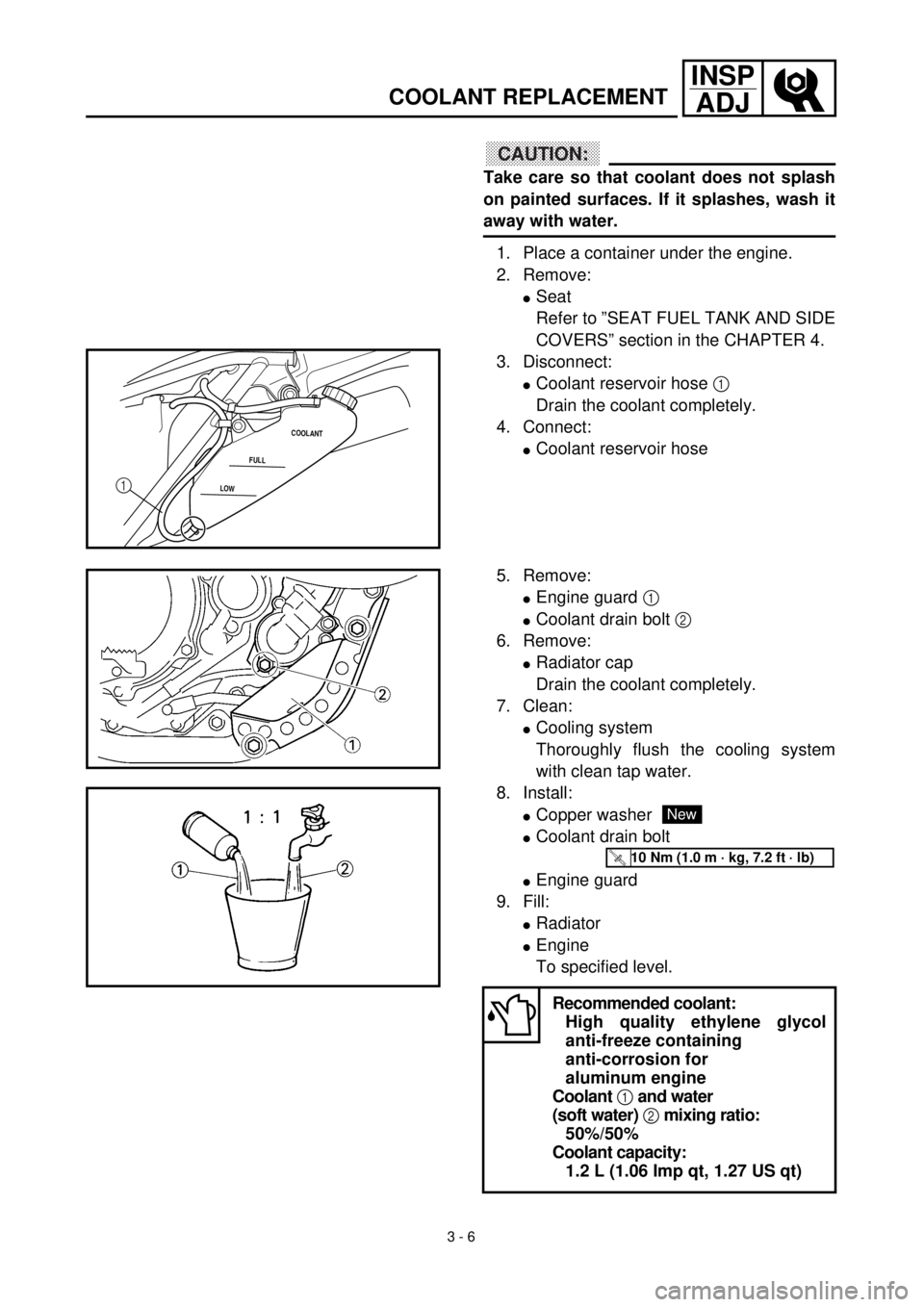
1. Place a container under the engine.
2. Remove:
l
Seat
Refer to ”SEAT FUEL TANK AND SIDE
COVERS” section in the CHAPTER 4.
3. Disconnect:
l
Coolant reservoir hose
1
Drain the coolant completely.
4. Connect:
l
Coolant reservoir hose
LOWFULLCOOLANT1
5. Remove:
l
Engine guard
1
l
Coolant drain bolt
2
6. Remove:
l
Radiator cap
Drain the coolant completely.
7. Clean:
l
Cooling system
Thoroughly flush the cooling system
with clean tap water.
8. Install:
l
Copper washer
l
Coolant drain bolt
l
Engine guard
9. Fill:
l
Radiator
l
Engine
To specified level.
Recommended coolant:
High quality ethylene glycol
anti-freeze containing
anti-corrosion for
aluminum engine
Coolant
1 and water
(soft water) 2 mixing ratio:
50%/50%
Coolant capacity:
1.2 L (1.06 Imp qt, 1.27 US qt)
New
T R..10 Nm (1.0 m · kg, 7.2 ft · lb)
Page 196 of 654
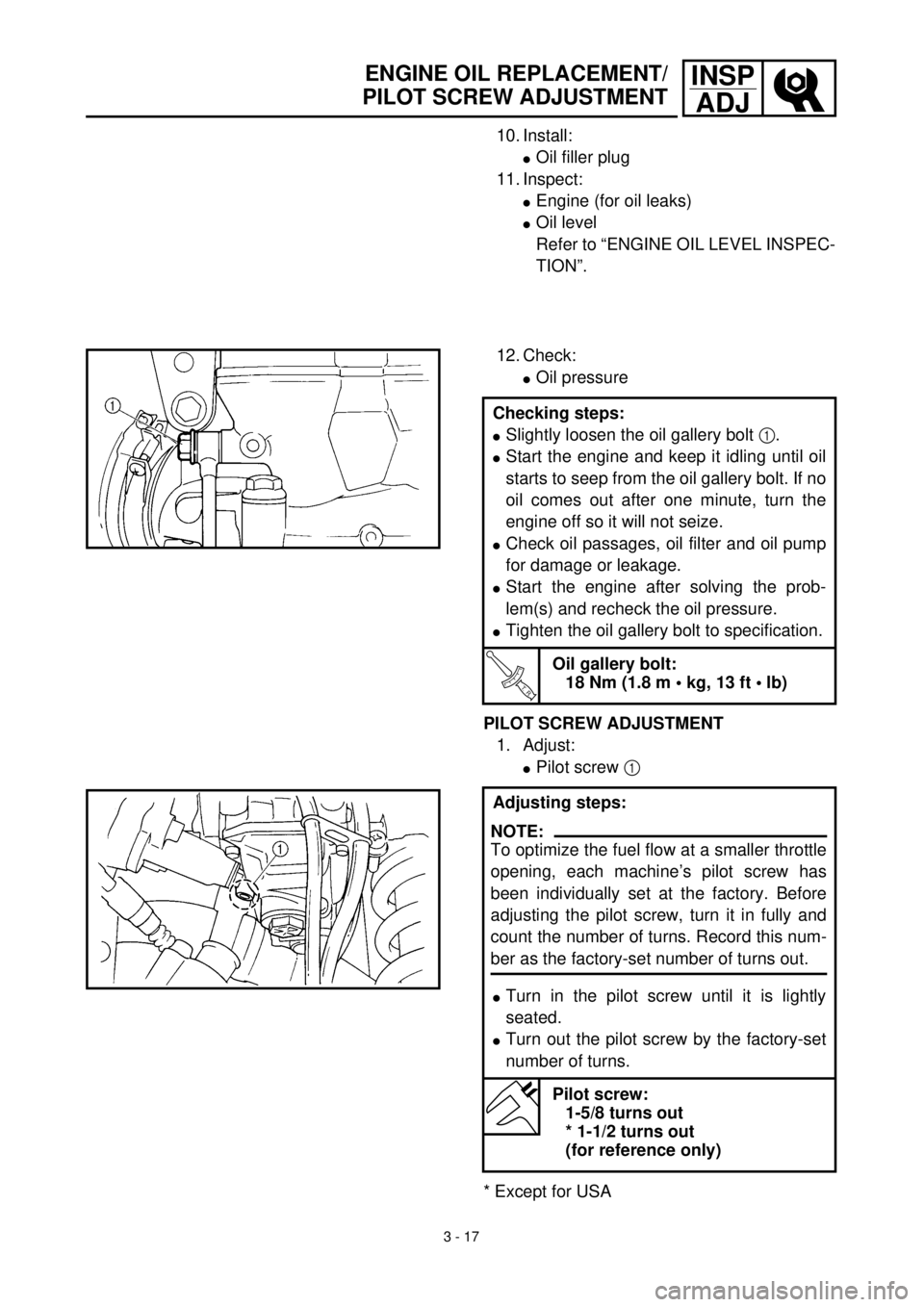
3 - 17
INSP
ADJENGINE OIL REPLACEMENT/
PILOT SCREW ADJUSTMENT
10. Install:
lOil filler plug
11. Inspect:
lEngine (for oil leaks)
lOil level
Refer to “ENGINE OIL LEVEL INSPEC-
TION”.
12. Check:
lOil pressure
PILOT SCREW ADJUSTMENT
1. Adjust:
lPilot screw 1
* Except for USAChecking steps:
lSlightly loosen the oil gallery bolt 1.
lStart the engine and keep it idling until oil
starts to seep from the oil gallery bolt. If no
oil comes out after one minute, turn the
engine off so it will not seize.
lCheck oil passages, oil filter and oil pump
for damage or leakage.
lStart the engine after solving the prob-
lem(s) and recheck the oil pressure.
lTighten the oil gallery bolt to specification.
T R..
Oil gallery bolt:
18 Nm (1.8 m • kg, 13 ft • lb)
Adjusting steps:
lTurn in the pilot screw until it is lightly
seated.
lTurn out the pilot screw by the factory-set
number of turns.
Pilot screw:
1-5/8 turns out
* 1-1/2 turns out
(for reference only)
NOTE:
To optimize the fuel flow at a smaller throttle
opening, each machine’s pilot screw has
been individually set at the factory. Before
adjusting the pilot screw, turn it in fully and
count the number of turns. Record this num-
ber as the factory-set number of turns out.