warning YAMAHA WR 400F 2000 User Guide
[x] Cancel search | Manufacturer: YAMAHA, Model Year: 2000, Model line: WR 400F, Model: YAMAHA WR 400F 2000Pages: 654, PDF Size: 60.12 MB
Page 216 of 654
3 - 26
INSP
ADJ
FRONT BRAKE ADJUSTMENT
3. Install:
lProtector (rear brake)
lDiaphragm
lMaster cylinder cap
NOTE:
If bleeding is difficult, it may be necessary to
let the brake fluid system stabilize for a few
hours. Repeat the bleeding procedure when
the tiny bubbles in the system have disap-
peared.
j. Add brake fluid to the level line on the
reservoir.
WARNING
Check the operation of the brake after
bleeding the brake system.
EC362031
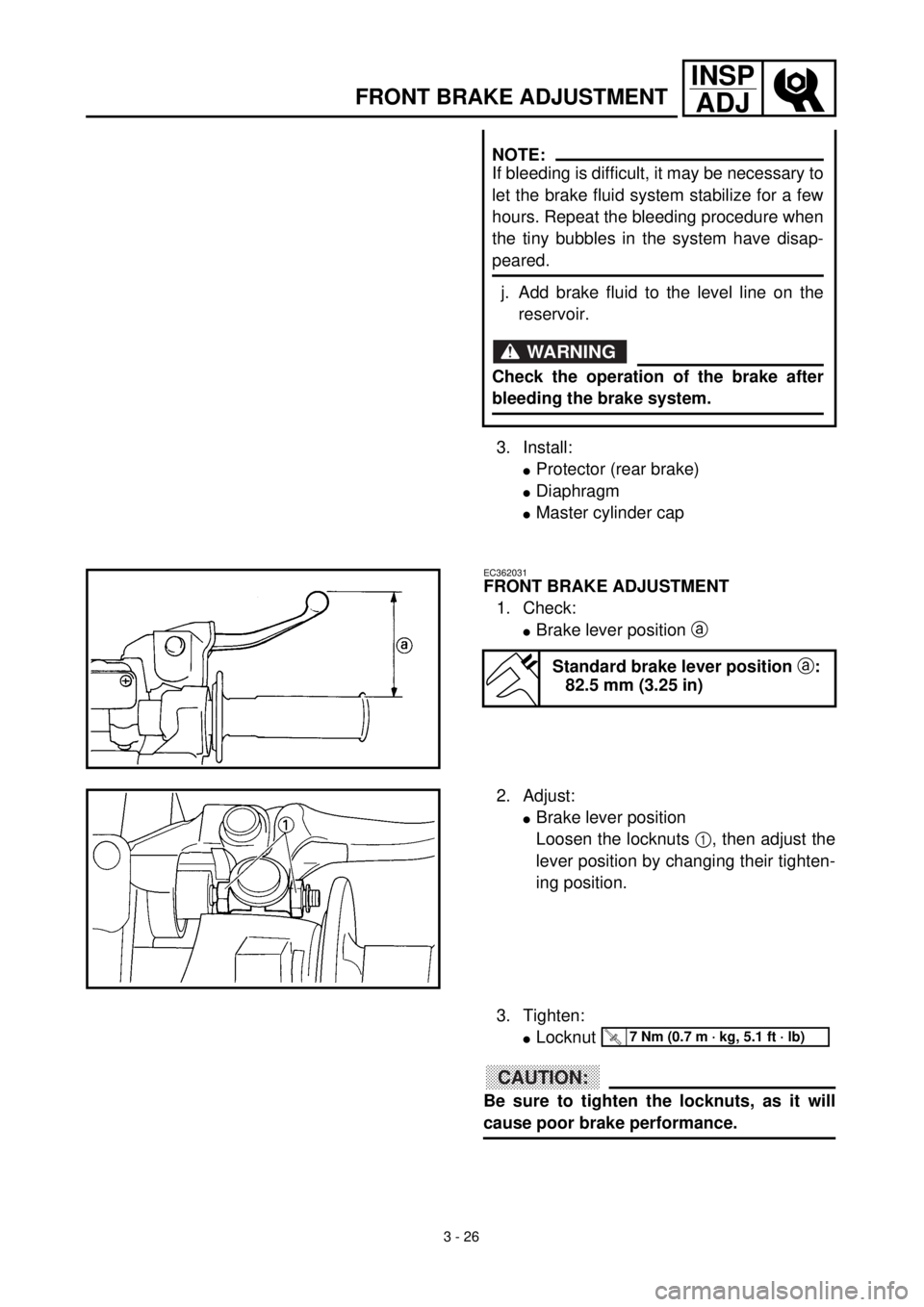
FRONT BRAKE ADJUSTMENT
1. Check:
lBrake lever position a
Standard brake lever position a:
82.5 mm (3.25 in)
2. Adjust:
lBrake lever position
Loosen the locknuts 1, then adjust the
lever position by changing their tighten-
ing position.
3. Tighten:
lLocknut
CAUTION:
Be sure to tighten the locknuts, as it will
cause poor brake performance.
T R..7 Nm (0.7 m · kg, 5.1 ft · lb)
Page 218 of 654
3 - 27
INSP
ADJREAR BRAKE ADJUSTMENT/
FRONT BRAKE PAD INSPECTION AND REPLACEMENT
EC364002
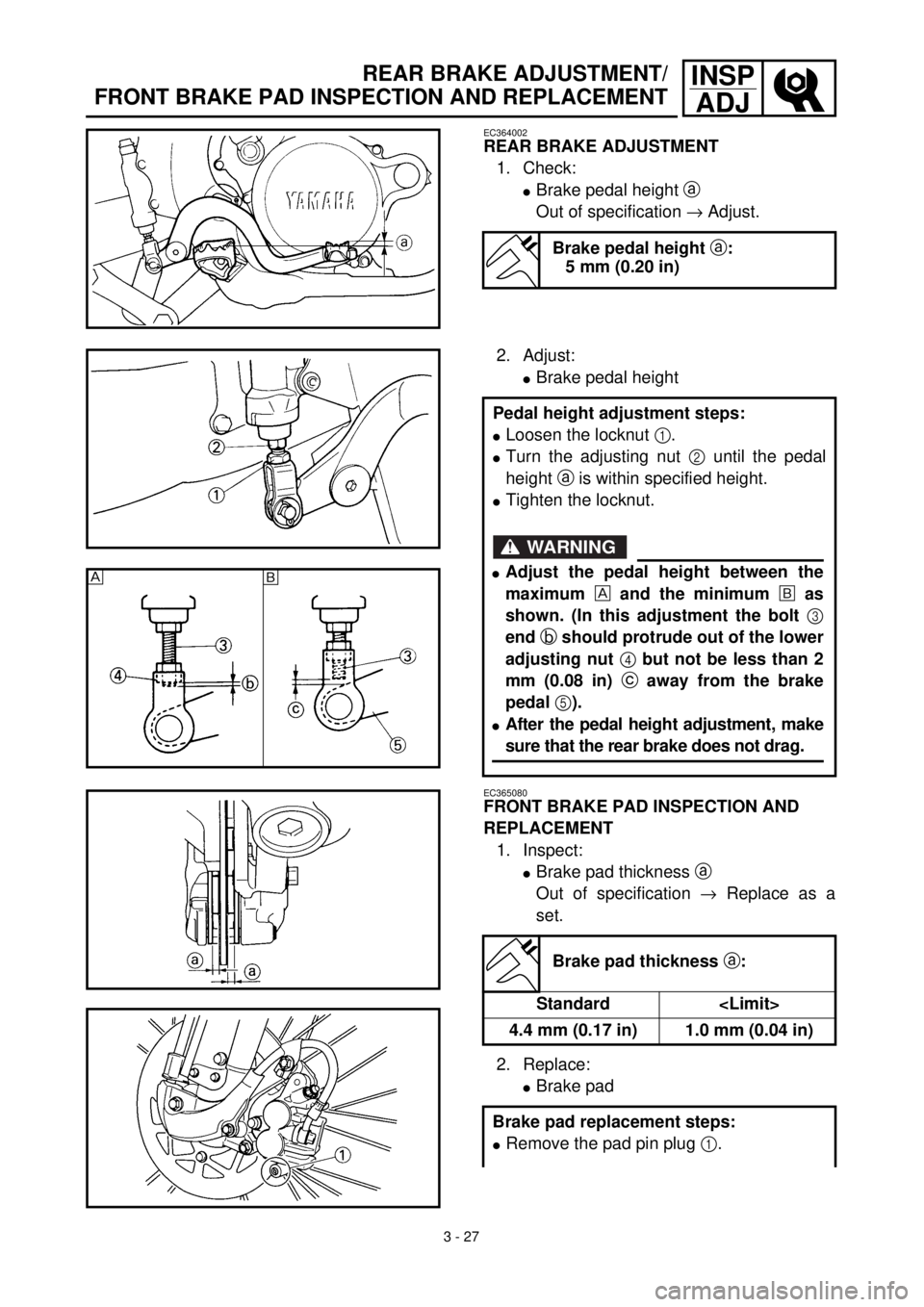
REAR BRAKE ADJUSTMENT
1. Check:
lBrake pedal height a
Out of specification ® Adjust.
Brake pedal height a:
5 mm (0.20 in)
2. Adjust:
lBrake pedal height
EC365080
FRONT BRAKE PAD INSPECTION AND
REPLACEMENT
1. Inspect:
lBrake pad thickness a
Out of specification ® Replace as a
set.
2. Replace:
lBrake pad Pedal height adjustment steps:
lLoosen the locknut 1.
lTurn the adjusting nut 2 until the pedal
height a is within specified height.
lTighten the locknut.
Brake pad thickness a:
Standard
4.4 mm (0.17 in) 1.0 mm (0.04 in)
Brake pad replacement steps:
lRemove the pad pin plug 1.
õ
WARNING
lAdjust the pedal height between the
maximum and the minimum õ as
shown. (In this adjustment the bolt 3
end b should protrude out of the lower
adjusting nut 4 but not be less than 2
mm (0.08 in) c away from the brake
pedal 5).
lAfter the pedal height adjustment, make
sure that the rear brake does not drag.
Page 226 of 654
3 - 31
INSP
ADJREAR BRAKE PAD INSULATOR INSPECTION/
BRAKE FLUID LEVEL INSPECTION
3. Inspect:
lBrake fluid level
Refer to “BRAKE FLUID LEVEL
INSPECTION” section.
4. Check:
lBrake pedal operation
A softy or spongy feeling ® Bleed
brake system.
Refer to “BRAKE SYSTEM AIR
BLEEDING” section.
EC36b000
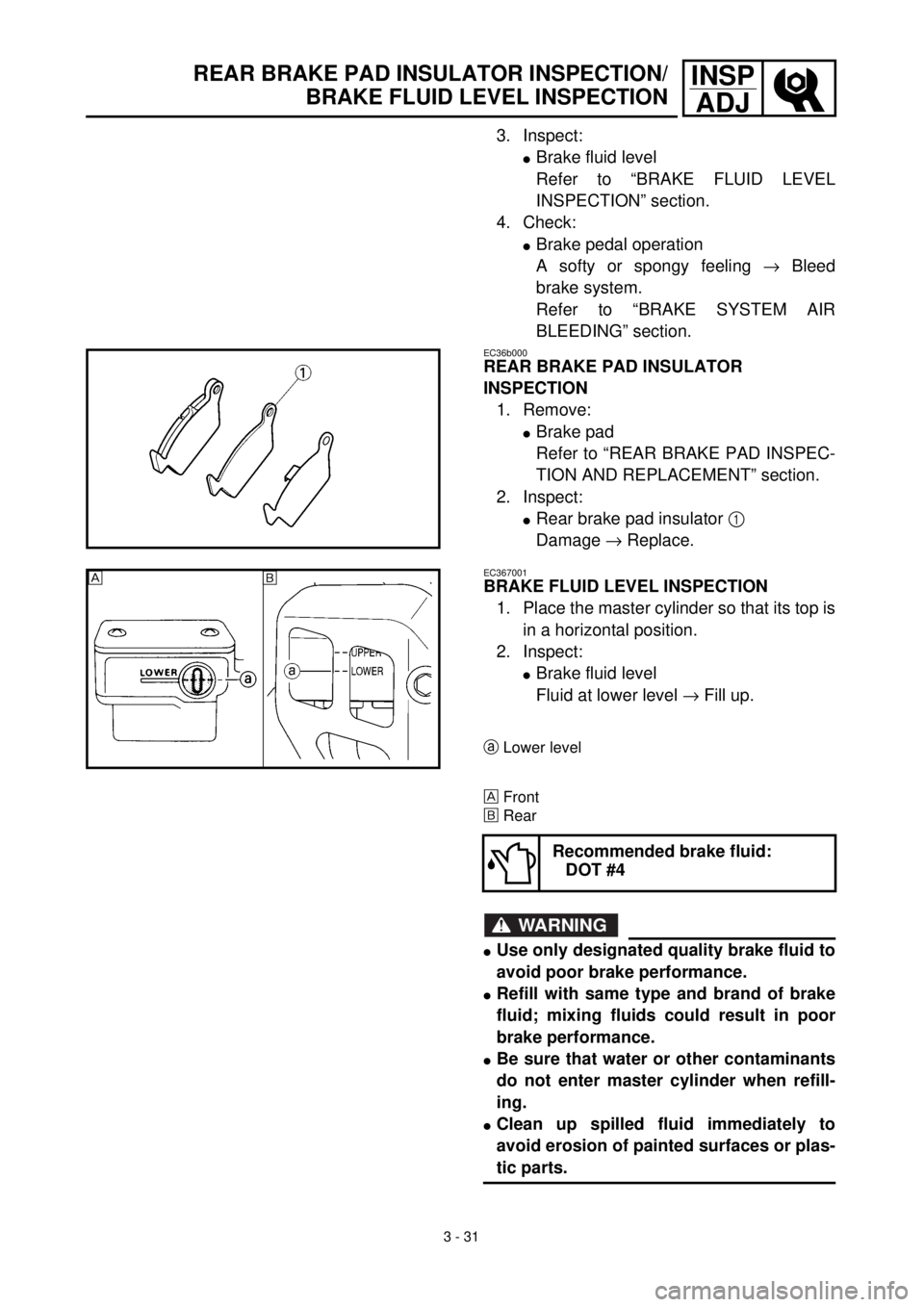
REAR BRAKE PAD INSULATOR
INSPECTION
1. Remove:
lBrake pad
Refer to “REAR BRAKE PAD INSPEC-
TION AND REPLACEMENT” section.
2. Inspect:
lRear brake pad insulator 1
Damage ® Replace.
EC367001
BRAKE FLUID LEVEL INSPECTION
1. Place the master cylinder so that its top is
in a horizontal position.
2. Inspect:
lBrake fluid level
Fluid at lower level ® Fill up.
aLower level
Front
õRear
WARNING
lUse only designated quality brake fluid to
avoid poor brake performance.
lRefill with same type and brand of brake
fluid; mixing fluids could result in poor
brake performance.
lBe sure that water or other contaminants
do not enter master cylinder when refill-
ing.
lClean up spilled fluid immediately to
avoid erosion of painted surfaces or plas-
tic parts.
Recommended brake fluid:
DOT #4
õ
Page 236 of 654
3 - 36
INSP
ADJFRONT FORK COMPRESSION DAMPING FORCE
ADJUSTMENT
lSTANDARD POSITION:
This is the position which is back by the spe-
cific number of clicks from the fully turned-in
position.
* For EUROPE
CAUTION:
Do not force the adjuster past the minimum
or maximum extent of adjustment. The
adjuster may be damaged.
WARNING
Always adjust each front fork to the same
setting. Uneven adjustment can cause poor
handling and loss of stability.
Standard position:
8 clicks out
*14 clicks out
EC36J001
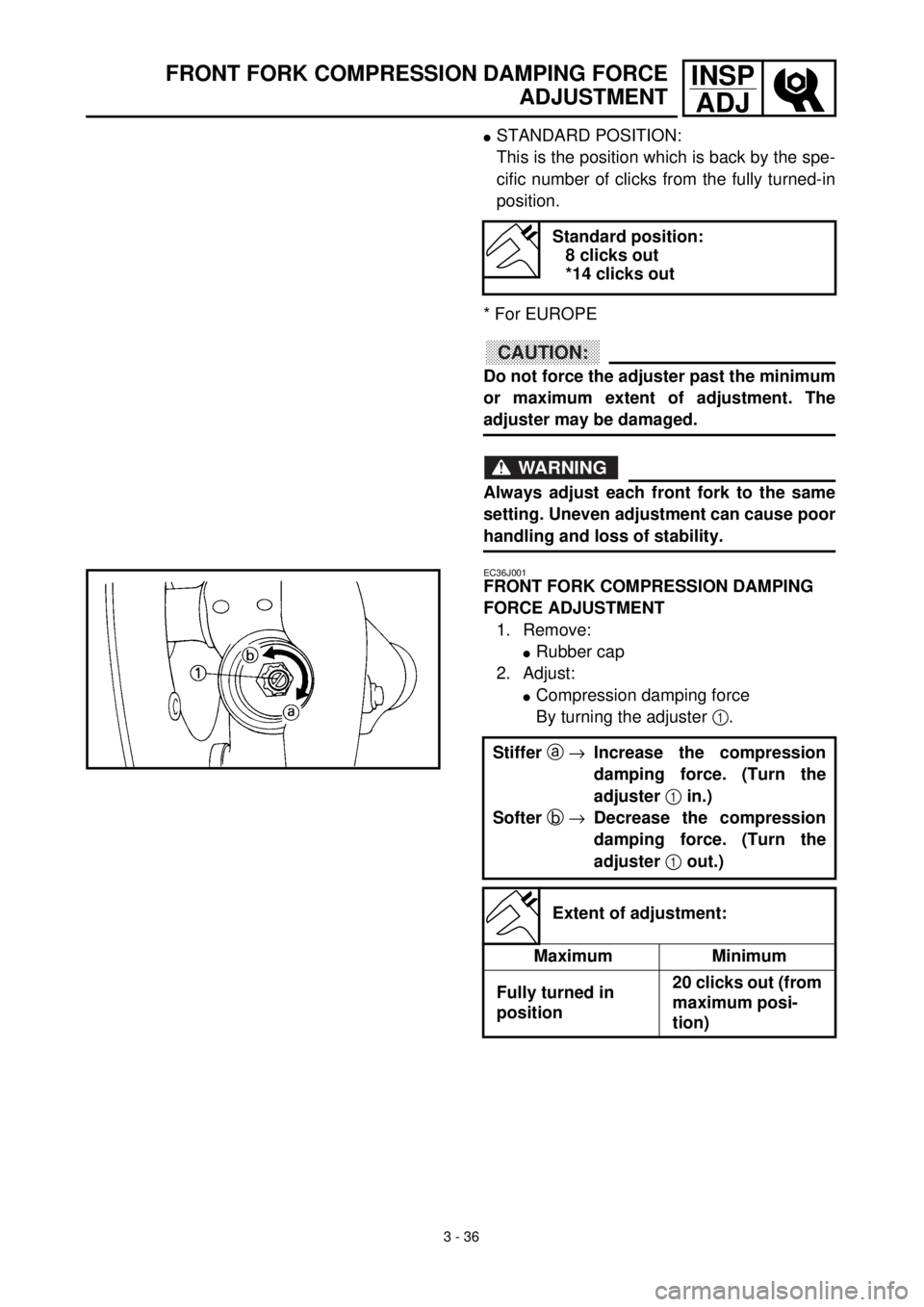
FRONT FORK COMPRESSION DAMPING
FORCE ADJUSTMENT
1. Remove:
lRubber cap
2. Adjust:
lCompression damping force
By turning the adjuster 1.
Stiffer a ®Increase the compression
damping force. (Turn the
adjuster 1 in.)
Softer b ®Decrease the compression
damping force. (Turn the
adjuster 1 out.)
Extent of adjustment:
Maximum Minimum
Fully turned in
position20 clicks out (from
maximum posi-
tion)
Page 238 of 654
3 - 37
INSP
ADJ
REAR SHOCK ABSORBER INSPECTION
lSTANDARD POSITION:
This is the position which is back by the spe-
cific number of clicks from the fully turned-in
position.
* For EUROPE
CAUTION:
Do not force the adjuster past the minimum
or maximum extent of adjustment. The
adjuster may be damaged.
WARNING
Always adjust each front fork to the same
setting. Uneven adjustment can cause poor
handling and loss of stability.
3. Install:
lRubber cap
T R..
Standard position:
7 clicks out
*12 clicks out
EC36K000
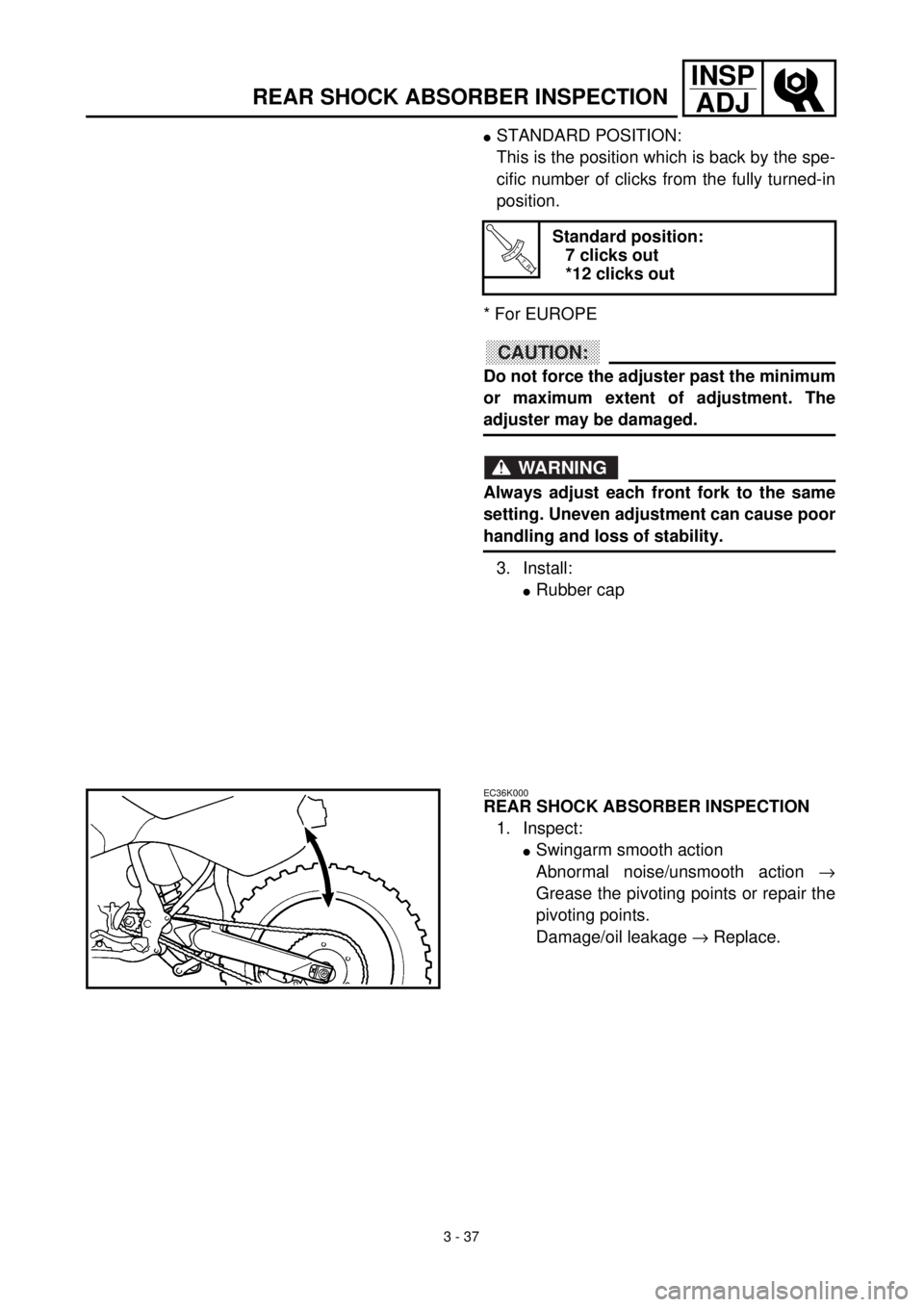
REAR SHOCK ABSORBER INSPECTION
1. Inspect:
lSwingarm smooth action
Abnormal noise/unsmooth action ®
Grease the pivoting points or repair the
pivoting points.
Damage/oil leakage ® Replace.
Page 252 of 654
3 - 44
INSP
ADJ
STEERING HEAD INSPECTION AND ADJUSTMENT
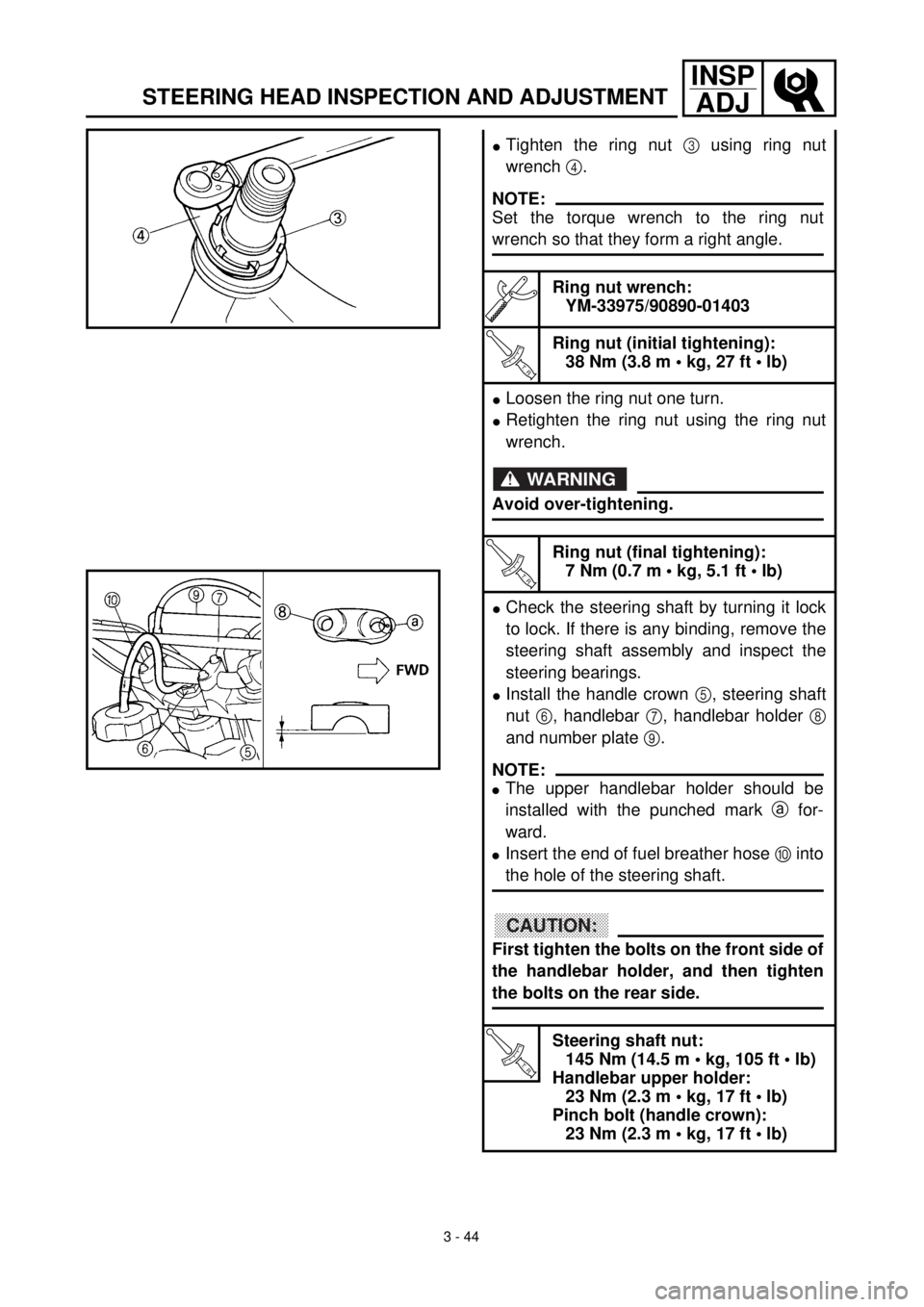
lTighten the ring nut 3 using ring nut
wrench 4.
Ring nut wrench:
YM-33975/90890-01403
T R..
Ring nut (initial tightening):
38 Nm (3.8 m • kg, 27 ft • lb)
lLoosen the ring nut one turn.
lRetighten the ring nut using the ring nut
wrench.
T R..
Ring nut (final tightening):
7 Nm (0.7 m • kg, 5.1 ft • lb)
lCheck the steering shaft by turning it lock
to lock. If there is any binding, remove the
steering shaft assembly and inspect the
steering bearings.
lInstall the handle crown 5, steering shaft
nut 6, handlebar 7, handlebar holder 8
and number plate 9.
T R..
Steering shaft nut:
145 Nm (14.5 m • kg, 105 ft • lb)
Handlebar upper holder:
23 Nm (2.3 m • kg, 17 ft • lb)
Pinch bolt (handle crown):
23 Nm (2.3 m • kg, 17 ft • lb)
NOTE:
Set the torque wrench to the ring nut
wrench so that they form a right angle.
WARNING
Avoid over-tightening.
NOTE:
lThe upper handlebar holder should be
installed with the punched mark a for-
ward.
lInsert the end of fuel breather hose 0 into
the hole of the steering shaft.
CAUTION:
First tighten the bolts on the front side of
the handlebar holder, and then tighten
the bolts on the rear side.
Page 260 of 654
3 - 48
INSP
ADJ
REPLACING THE HEADLIGHT BULBS
REPLACING THE HEADLIGHT BULBS
The following procedure applies to both of the
headlight bulb.
1. Remove:
lNumber plate
Refer to “SEAT, FUEL TANK AND
SIDE COVERS” section in the CHAP-
TER 4.
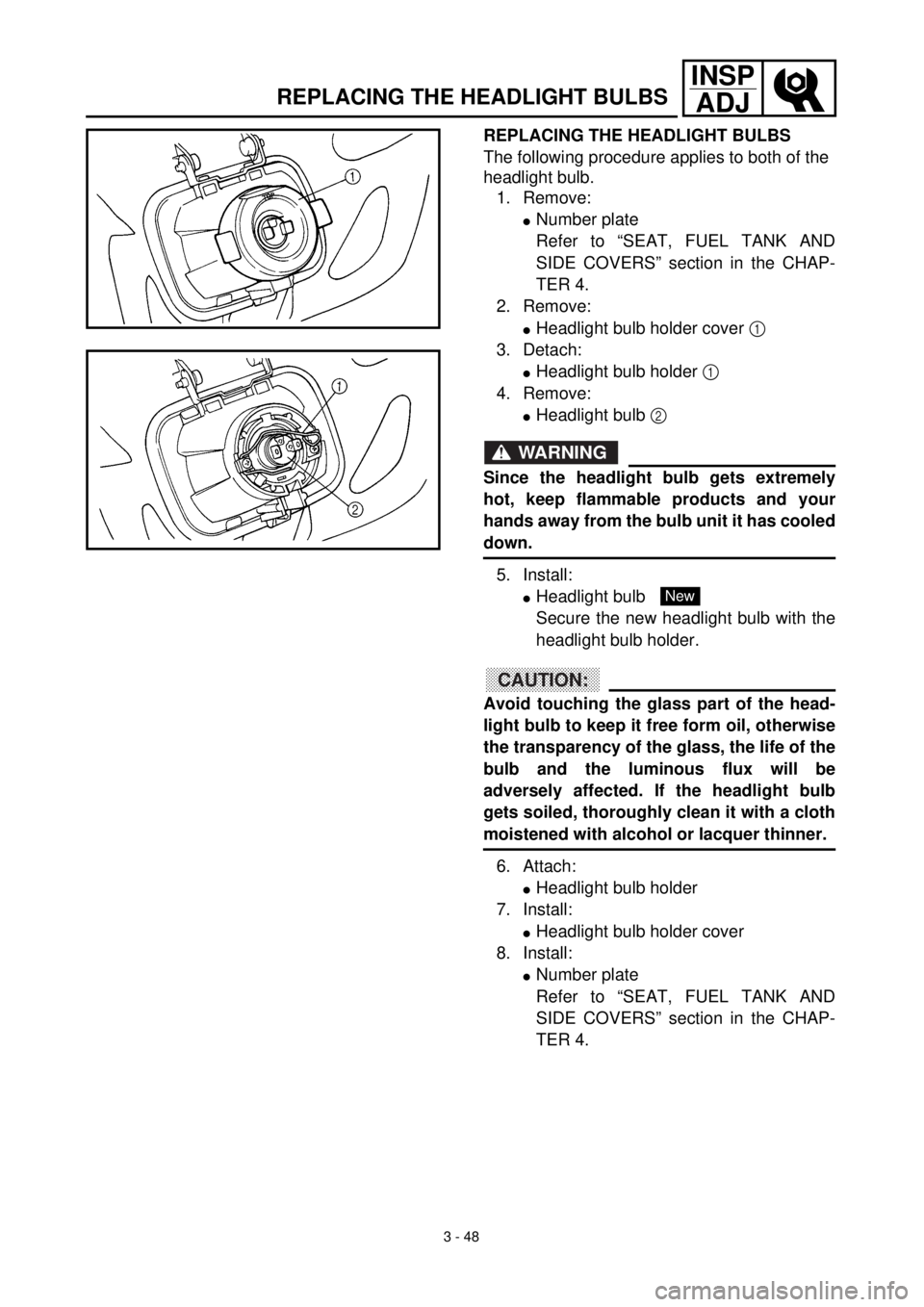
2. Remove:
lHeadlight bulb holder cover 1
3. Detach:
lHeadlight bulb holder 1
4. Remove:
lHeadlight bulb 2
WARNING
Since the headlight bulb gets extremely
hot, keep flammable products and your
hands away from the bulb unit it has cooled
down.
5. Install:
lHeadlight bulb
Secure the new headlight bulb with the
headlight bulb holder.
CAUTION:
Avoid touching the glass part of the head-
light bulb to keep it free form oil, otherwise
the transparency of the glass, the life of the
bulb and the luminous flux will be
adversely affected. If the headlight bulb
gets soiled, thoroughly clean it with a cloth
moistened with alcohol or lacquer thinner.
6. Attach:
lHeadlight bulb holder
7. Install:
lHeadlight bulb holder cover
8. Install:
lNumber plate
Refer to “SEAT, FUEL TANK AND
SIDE COVERS” section in the CHAP-
TER 4.
New
Page 272 of 654
4 - 5
ENG
RADIATOR
EC456000
HANDLING NOTE
WARNING
Do not remove the radiator cap when the
engine and radiator are hot. Scalding hot
fluid and steam may be blown out under
pressure, which could cause serious
injury.
When the engine has cooled, open the radi-
ator cap by the following procedure:
Place a thick rag, like a towel, over the radi-
ator cap, slowly rotate the cap counter-
clockwise to the detent. This procedure
allows any residual pressure to escape.
When the hissing sound has stopped,
press down on the cap while turning coun-
terclockwise and remove it.
EC453000
REMOVAL POINTS
EC453200
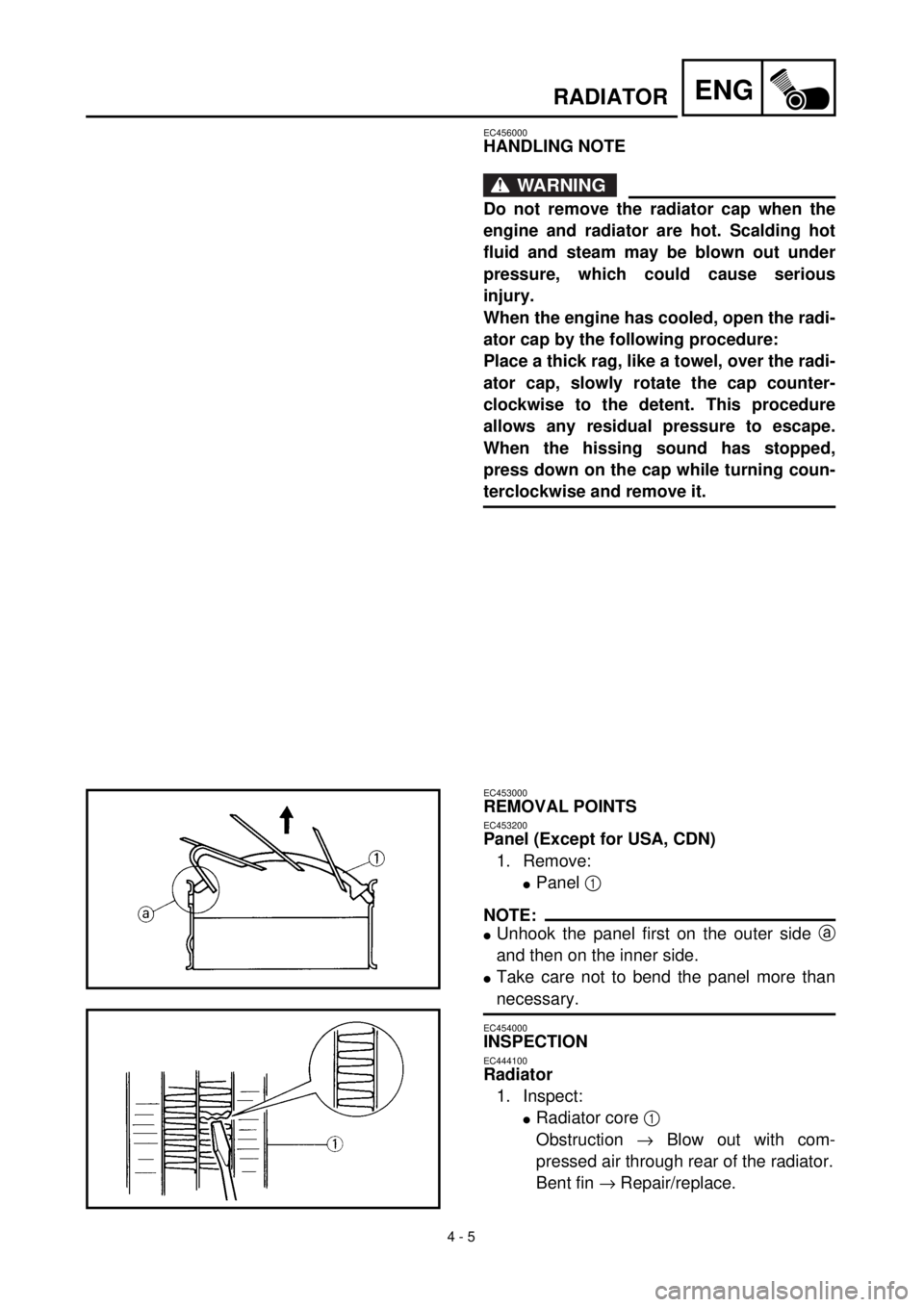
Panel (Except for USA, CDN)
1. Remove:
l
Panel
1
NOTE:
l
Unhook the panel first on the outer side
a
and then on the inner side.
l
Take care not to bend the panel more than
necessary.
EC454000
INSPECTION
EC444100
Radiator
1. Inspect:
l
Radiator core
1
Obstruction
®
Blow out with com-
pressed air through rear of the radiator.
Bent fin
®
Repair/replace.
Page 410 of 654
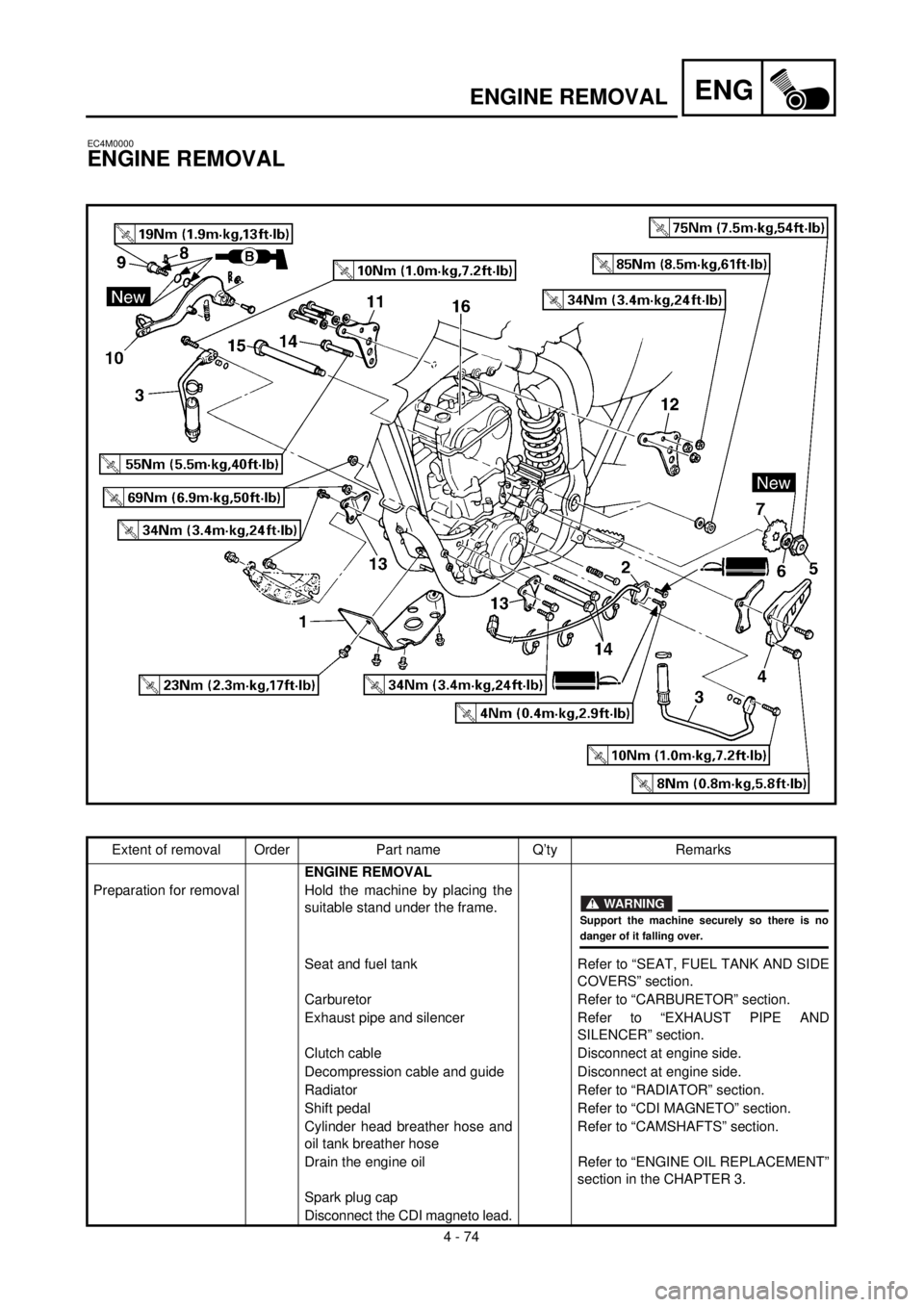
ENG
4 - 74
ENGINE REMOVAL
EC4M0000
ENGINE REMOVAL
Extent of removal Order Part name Q’ty Remarks
ENGINE REMOVAL
Preparation for removal Hold the machine by placing the
suitable stand under the frame.
Seat and fuel tank Refer to “SEAT, FUEL TANK AND SIDE
COVERS” section.
Carburetor Refer to “CARBURETOR” section.
Exhaust pipe and silencer Refer to “EXHAUST PIPE AND
SILENCER” section.
Clutch cable Disconnect at engine side.
Decompression cable and guide Disconnect at engine side.
Radiator Refer to “RADIATOR” section.
Shift pedal Refer to “CDI MAGNETO” section.
Cylinder head breather hose and
oil tank breather hoseRefer to “CAMSHAFTS” section.
Drain the engine oil Refer to “ENGINE OIL REPLACEMENT”
section in the CHAPTER 3.
Spark plug cap
Disconnect the CDI magneto lead.
WARNING
Support the machine securely so there is nodanger of it falling over.
Page 448 of 654
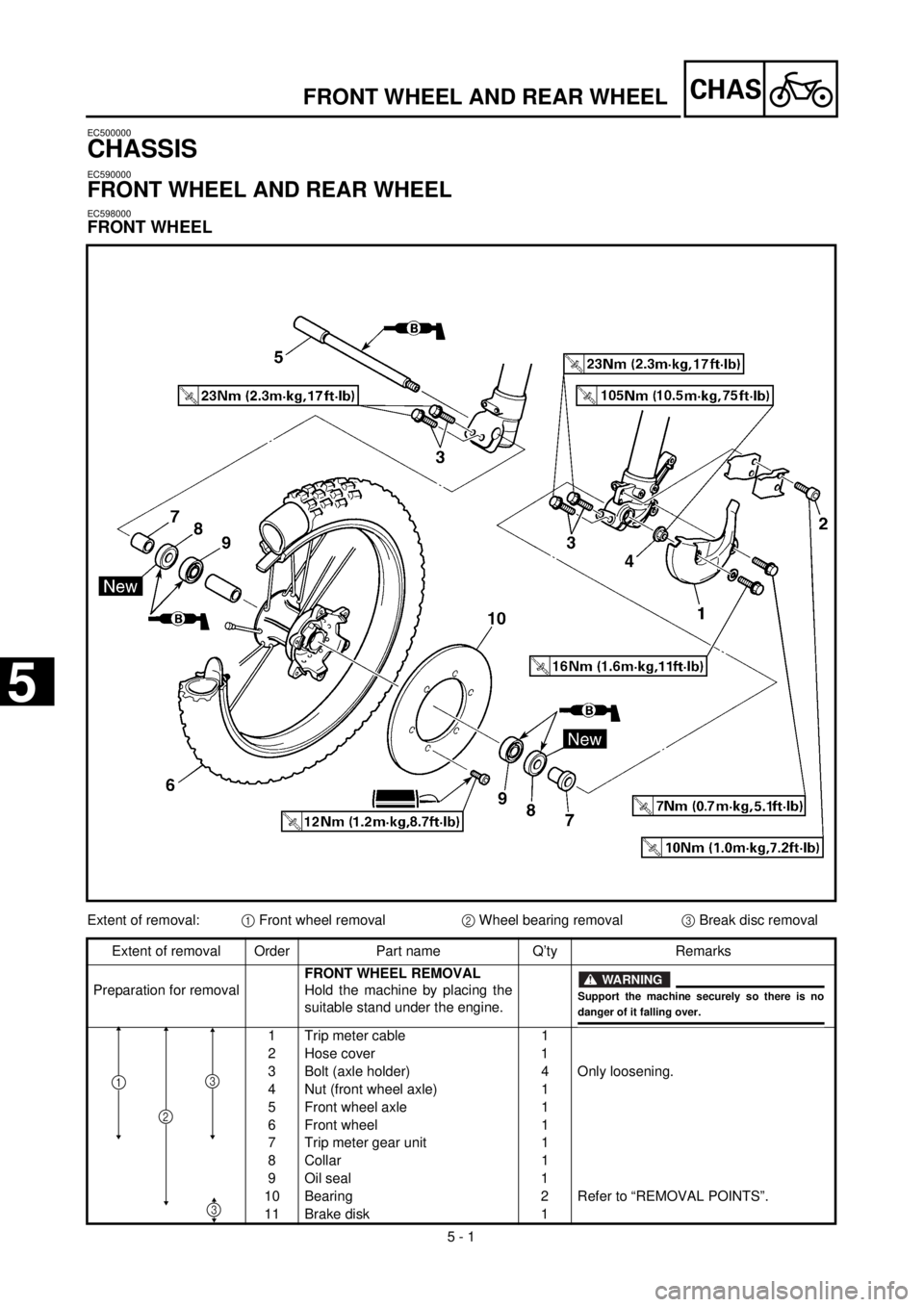
5 - 1
CHAS
EC500000
CHASSIS
EC590000
FRONT WHEEL AND REAR WHEEL
EC598000
FRONT WHEEL
FRONT WHEEL AND REAR WHEEL
Extent of removal:
1
Front wheel removal
2
Wheel bearing removal
3
Break disc removal
Extent of removal Order Part name Q’ty Remarks
Preparation for removal
FRONT WHEEL REMOVAL
Hold the machine by placing the
suitable stand under the engine.
1 Trip meter cable 1
2 Hose cover 1
3 Bolt (axle holder) 4 Only loosening.
4 Nut (front wheel axle) 1
5 Front wheel axle 1
6 Front wheel 1
7 Trip meter gear unit 1
8 Collar 1
9 Oil seal 1
10 Bearing 2 Refer to “REMOVAL POINTS”.
11 Brake disk 1
WARNING
Support the machine securely so there is nodanger of it falling over.
2
31
3
5