oil YAMAHA WR 450F 2006 Owners Manual
[x] Cancel search | Manufacturer: YAMAHA, Model Year: 2006, Model line: WR 450F, Model: YAMAHA WR 450F 2006Pages: 786, PDF Size: 22.49 MB
Page 533 of 786
5 - 3
CHAS
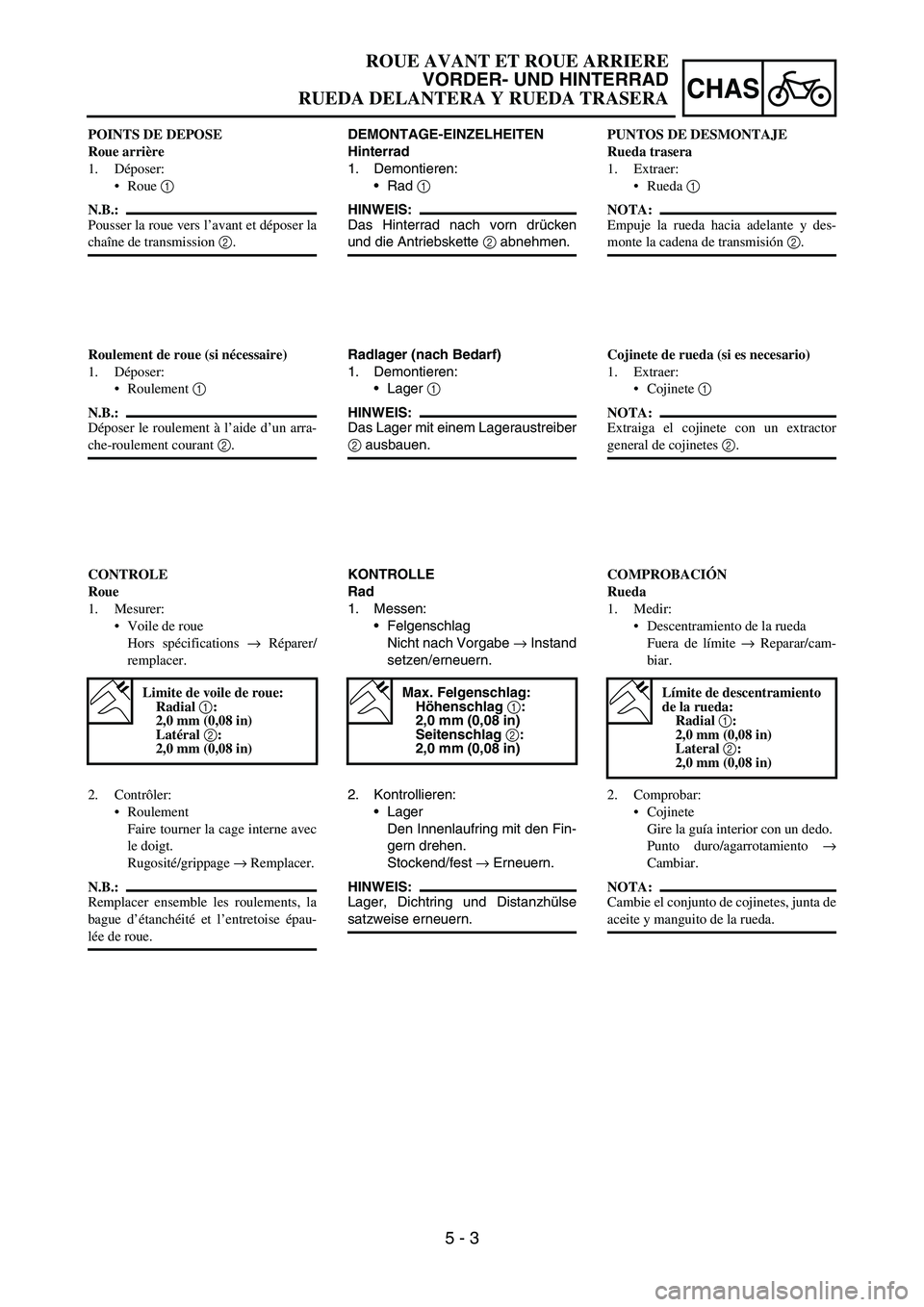
DEMONTAGE-EINZELHEITEN
Hinterrad
1. Demontieren:
Rad
1
HINWEIS:
Das Hinterrad nach vorn drücken
und die Antriebskette
2 abnehmen.
Radlager (nach Bedarf)
1. Demontieren:
Lager
1
HINWEIS:
Das Lager mit einem Lageraustreiber
2 ausbauen.
KONTROLLE
Rad
1. Messen:
Felgenschlag
Nicht nach Vorgabe
→ Instand
setzen/erneuern.
Max. Felgenschlag:
Höhenschlag 1:
2,0 mm (0,08 in)
Seitenschlag 2:
2,0 mm (0,08 in)
2. Kontrollieren:
Lager
Den Innenlaufring mit den Fin-
gern drehen.
Stockend/fest
→ Erneuern.
HINWEIS:
Lager, Dichtring und Distanzhülse
satzweise erneuern. POINTS DE DEPOSE
Roue arrière
1. Déposer:
Roue 1
N.B.:
Pousser la roue vers l’avant et déposer la
chaîne de transmission 2.
Roulement de roue (si nécessaire)
1. Déposer:
Roulement 1
N.B.:
Déposer le roulement à l’aide d’un arra-
che-roulement courant 2.
CONTROLE
Roue
1. Mesurer:
Voile de roue
Hors spécifications → Réparer/
remplacer.
Limite de voile de roue:
Radial 1:
2,0 mm (0,08 in)
Latéral 2:
2,0 mm (0,08 in)
2. Contrôler:
Roulement
Faire tourner la cage interne avec
le doigt.
Rugosité/grippage → Remplacer.
N.B.:
Remplacer ensemble les roulements, la
bague d’étanchéité et l’entretoise épau-
lée de roue.PUNTOS DE DESMONTAJE
Rueda trasera
1. Extraer:
Rueda 1
NOTA:
Empuje la rueda hacia adelante y des-
monte la cadena de transmisión 2.
Cojinete de rueda (si es necesario)
1. Extraer:
Cojinete 1
NOTA:
Extraiga el cojinete con un extractor
general de cojinetes 2.
COMPROBACIÓN
Rueda
1. Medir:
Descentramiento de la rueda
Fuera de límite → Reparar/cam-
biar.
Límite de descentramiento
de la rueda:
Radial 1:
2,0 mm (0,08 in)
Lateral 2:
2,0 mm (0,08 in)
2. Comprobar:
Cojinete
Gire la guía interior con un dedo.
Punto duro/agarrotamiento →
Cambiar.
NOTA:
Cambie el conjunto de cojinetes, junta de
aceite y manguito de la rueda.
ROUE AVANT ET ROUE ARRIERE
VORDER- UND HINTERRAD
RUEDA DELANTERA Y RUEDA TRASERA
Page 535 of 786
5 - 4
CHAS
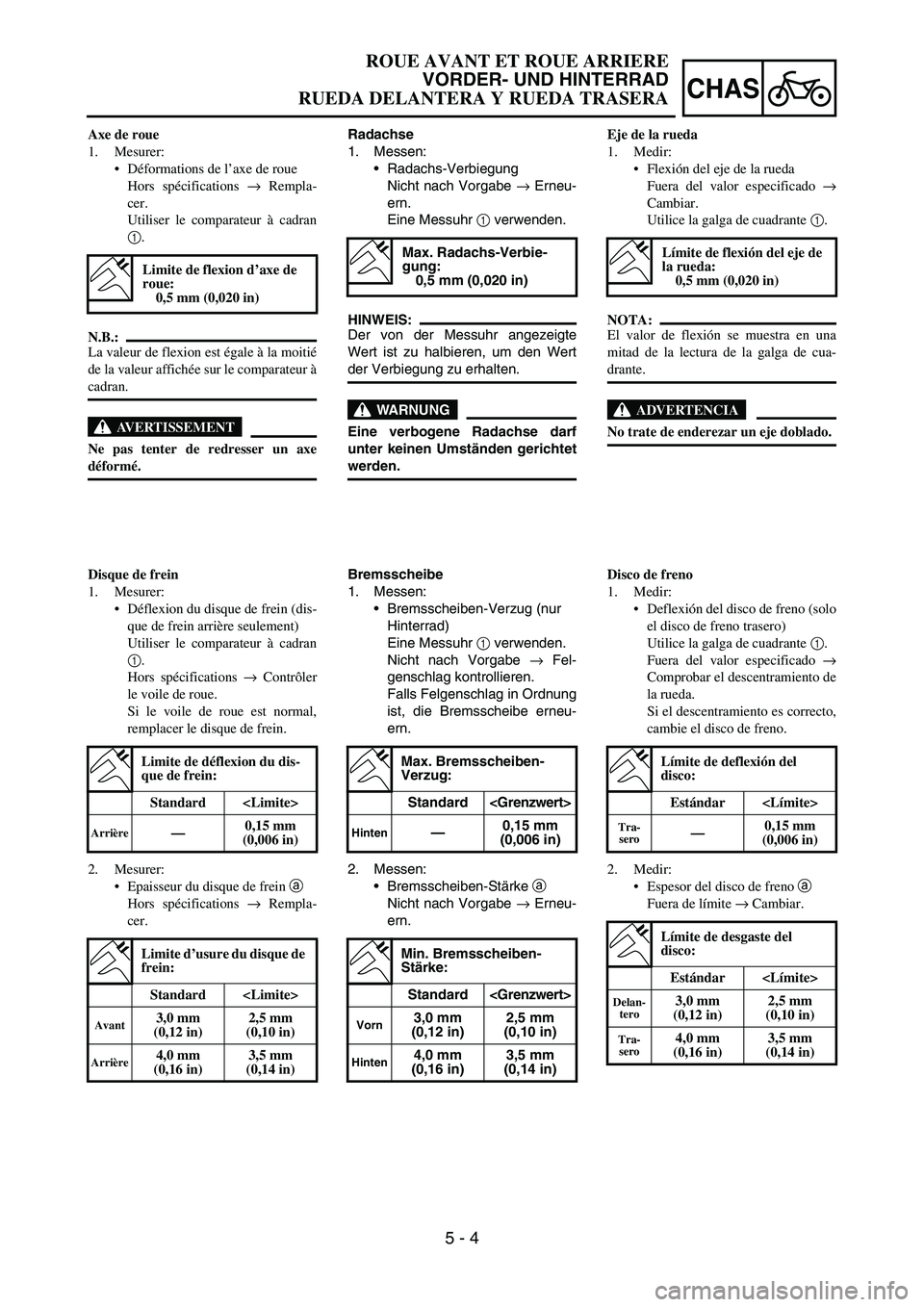
Radachse
1. Messen:
Radachs-Verbiegung
Nicht nach Vorgabe
→ Erneu-
ern.
Eine Messuhr
1 verwenden.
HINWEIS:
Der von der Messuhr angezeigte
Wert ist zu halbieren, um den Wert
der Verbiegung zu erhalten.
WARNUNG
Eine verbogene Radachse darf
unter keinen Umständen gerichtet
werden.
Max. Radachs-Verbie-
gung:
0,5 mm (0,020 in)
Bremsscheibe
1. Messen:
Bremsscheiben-Verzug (nur
Hinterrad)
Eine Messuhr
1 verwenden.
Nicht nach Vorgabe
→ Fel-
genschlag kontrollieren.
Falls Felgenschlag in Ordnung
ist, die Bremsscheibe erneu-
ern.
2. Messen:
Bremsscheiben-Stärke
a
Nicht nach Vorgabe
→ Erneu-
ern.
Max. Bremsscheiben-
Verzug:
Standard
Hinten—0,15 mm
(0,006 in)
Min. Bremsscheiben-
Stärke:
Standard
Vorn3,0 mm
(0,12 in)2,5 mm
(0,10 in)
Hinten4,0 mm
(0,16 in)3,5 mm
(0,14 in)
Axe de roue
1. Mesurer:
Déformations de l’axe de roue
Hors spécifications → Rempla-
cer.
Utiliser le comparateur à cadran
1.
N.B.:
La valeur de flexion est égale à la moitié
de la valeur affichée sur le comparateur à
cadran.
AVERTISSEMENT
Ne pas tenter de redresser un axe
déformé.
Limite de flexion d’axe de
roue:
0,5 mm (0,020 in)
Disque de frein
1. Mesurer:
Déflexion du disque de frein (dis-
que de frein arrière seulement)
Utiliser le comparateur à cadran
1.
Hors spécifications → Contrôler
le voile de roue.
Si le voile de roue est normal,
remplacer le disque de frein.
2. Mesurer:
Epaisseur du disque de frein a
Hors spécifications → Rempla-
cer.
Limite de déflexion du dis-
que de frein:
Standard
Arrière—0,15 mm
(0,006 in)
Limite d’usure du disque de
frein:
Standard
Avant3,0 mm
(0,12 in)2,5 mm
(0,10 in)
Arrière4,0 mm
(0,16 in)3,5 mm
(0,14 in)
Eje de la rueda
1. Medir:
Flexión del eje de la rueda
Fuera del valor especificado →
Cambiar.
Utilice la galga de cuadrante 1.
NOTA:
El valor de flexión se muestra en una
mitad de la lectura de la galga de cua-
drante.
ADVERTENCIA
No trate de enderezar un eje doblado.
Límite de flexión del eje de
la rueda:
0,5 mm (0,020 in)
Disco de freno
1. Medir:
Deflexión del disco de freno (solo
el disco de freno trasero)
Utilice la galga de cuadrante 1.
Fuera del valor especificado →
Comprobar el descentramiento de
la rueda.
Si el descentramiento es correcto,
cambie el disco de freno.
2. Medir:
Espesor del disco de freno a
Fuera de límite → Cambiar.
Límite de deflexión del
disco:
Estándar
Tra-
sero—0,15 mm
(0,006 in)
Límite de desgaste del
disco:
Estándar
Delan-
tero3,0 mm
(0,12 in)2,5 mm
(0,10 in)
Tra-
sero4,0 mm
(0,16 in)3,5 mm
(0,14 in)
ROUE AVANT ET ROUE ARRIERE
VORDER- UND HINTERRAD
RUEDA DELANTERA Y RUEDA TRASERA
Page 536 of 786

5 - 5
CHASFRONT WHEEL AND REAR WHEEL
EC595000
ASSEMBLY AND INSTALLATION
Front wheel
1. Install:
Bearing (left) 1
Spacer 2
Bearing (right) 3
Oil seal 4
NOTE:
Apply the lithium soap base grease on the
bearing and oil seal lip when installing.
Use a socket that matches the outside diam-
eter of the race of the bearing.
Left side of bearing shall be installed first.
Install the oil seal with its manufacture’s
marks or numbers facing outward.
CAUTION:
Do not strike the inner race of the bearing.
Contact should be made only with the outer
race.
2. Install:
Brake disc 1
Bolt (brake disc) 2
NOTE:
Tighten the bolts in stage, using a crisscross
pattern.
New
T R..12 Nm (1.2 m · kg, 8.7 ft · lb)
3. Install:
Collar 1
NOTE:
Apply the lithium soap base grease on the oil
seal lip.
4. Install:
Speed sensor 1
NOTE:
Apply the lithium soap base grease on the oil
seal lip of the speed sensor.
Make sure the two projections a in the
wheel hub are meshed with the two slots b
in the speed sensor.
b a1
B
Page 540 of 786
5 - 7
CHASFRONT WHEEL AND REAR WHEEL
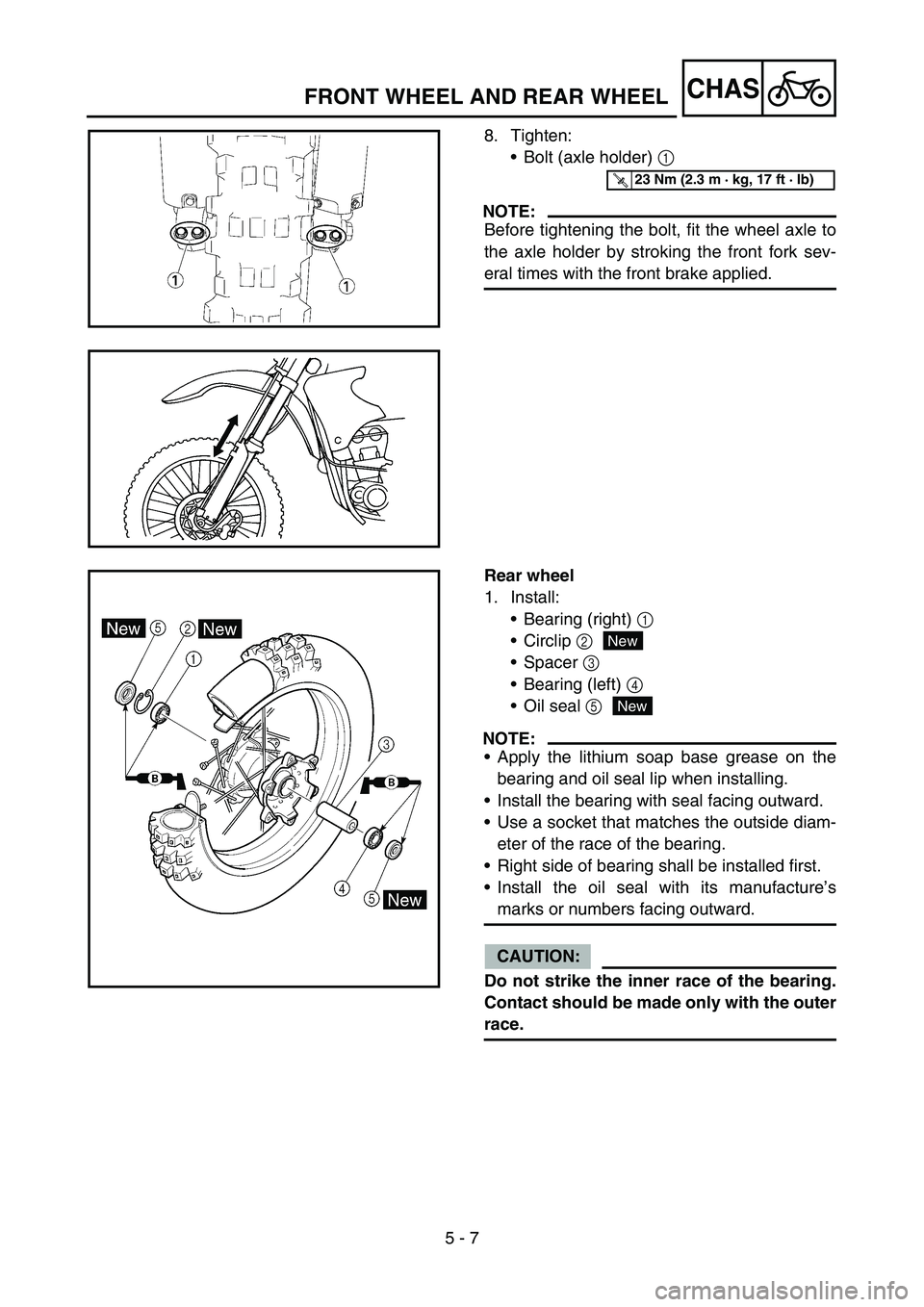
8. Tighten:
Bolt (axle holder) 1
NOTE:
Before tightening the bolt, fit the wheel axle to
the axle holder by stroking the front fork sev-
eral times with the front brake applied.
T R..23 Nm (2.3 m · kg, 17 ft · lb)
Rear wheel
1. Install:
Bearing (right) 1
Circlip 2
Spacer 3
Bearing (left) 4
Oil seal 5
NOTE:
Apply the lithium soap base grease on the
bearing and oil seal lip when installing.
Install the bearing with seal facing outward.
Use a socket that matches the outside diam-
eter of the race of the bearing.
Right side of bearing shall be installed first.
Install the oil seal with its manufacture’s
marks or numbers facing outward.
CAUTION:
Do not strike the inner race of the bearing.
Contact should be made only with the outer
race.
New
New
Page 542 of 786

5 - 8
CHAS
2. Install:
Brake disc 1
Bolt (brake disc) 2
NOTE:
Tighten the bolts in stage, using a crisscross
pattern.
T R..14 Nm (1.4 m · kg, 10 ft · lb)
3. Install:
Driven sprocket 1
Bolt (driven sprocket) 2
Plain washer (driven sprocket) 3
Nut (driven sprocket) 4
NOTE:
Tighten the nuts in stage, using a crisscross
pattern.
T R..50 Nm (5.0 m · kg, 36 ft · lb)
4. Install:
Collar 1
NOTE:
Apply the lithium soap base grease on the oil
seal lip.
5. Install:
Wheel
NOTE:
Install the brake disc 1 between the brake
pads 2 correctly.
6. Install:
Drive chain 1
NOTE:
Push the wheel 2 forward and install the drive
chain.
FRONT WHEEL AND REAR WHEEL
Page 574 of 786
5 - 24
CHASFRONT BRAKE AND REAR BRAKE
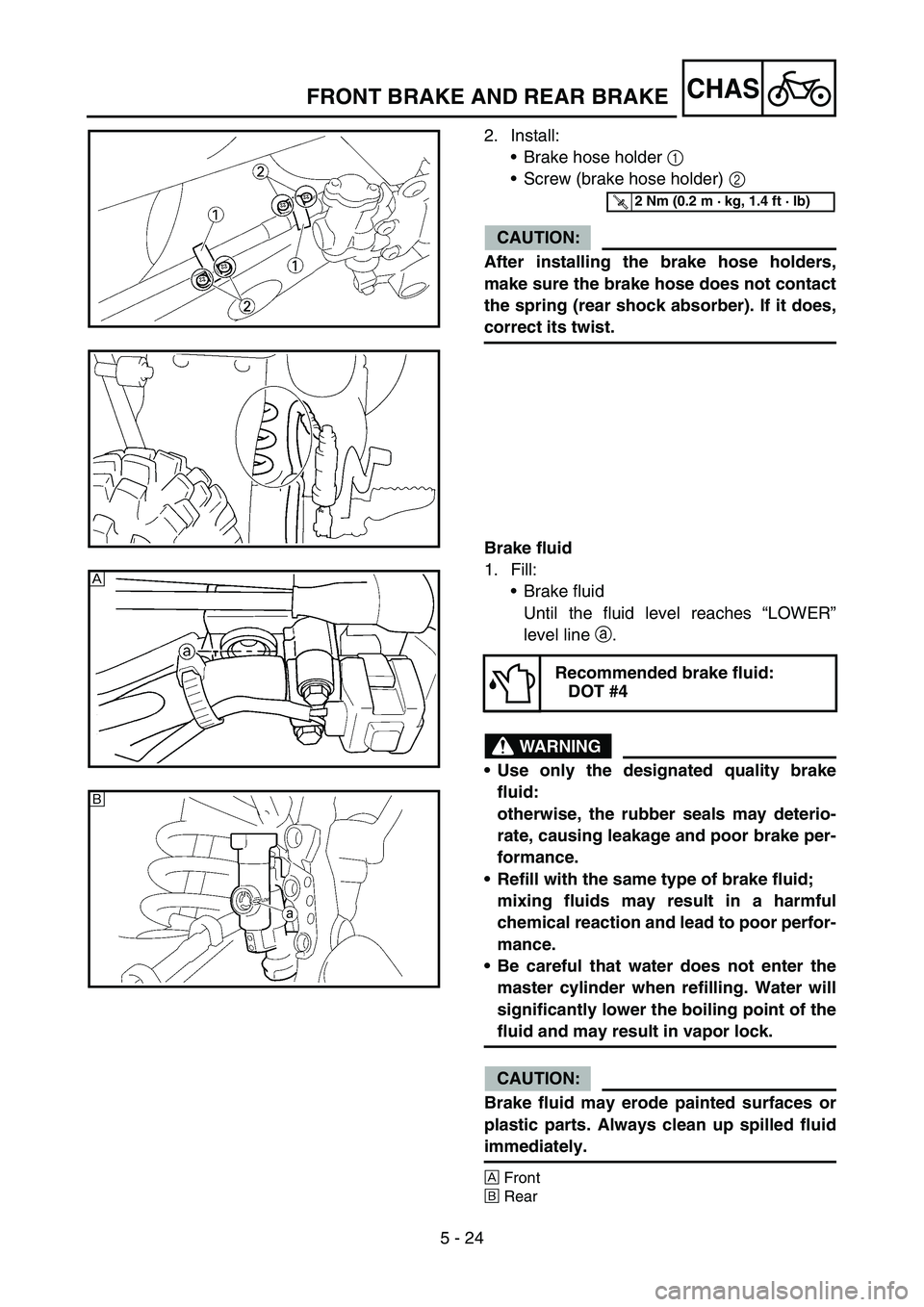
2. Install:
Brake hose holder 1
Screw (brake hose holder) 2
CAUTION:
After installing the brake hose holders,
make sure the brake hose does not contact
the spring (rear shock absorber). If it does,
correct its twist.
Brake fluid
1. Fill:
Brake fluid
Until the fluid level reaches “LOWER”
level line a.
WARNING
Use only the designated quality brake
fluid:
otherwise, the rubber seals may deterio-
rate, causing leakage and poor brake per-
formance.
Refill with the same type of brake fluid;
mixing fluids may result in a harmful
chemical reaction and lead to poor perfor-
mance.
Be careful that water does not enter the
master cylinder when refilling. Water will
significantly lower the boiling point of the
fluid and may result in vapor lock.
CAUTION:
Brake fluid may erode painted surfaces or
plastic parts. Always clean up spilled fluid
immediately.
ÈFront
ÉRear
Recommended brake fluid:
DOT #4
T R..2 Nm (0.2 m · kg, 1.4 ft · lb)
È
É
Page 580 of 786
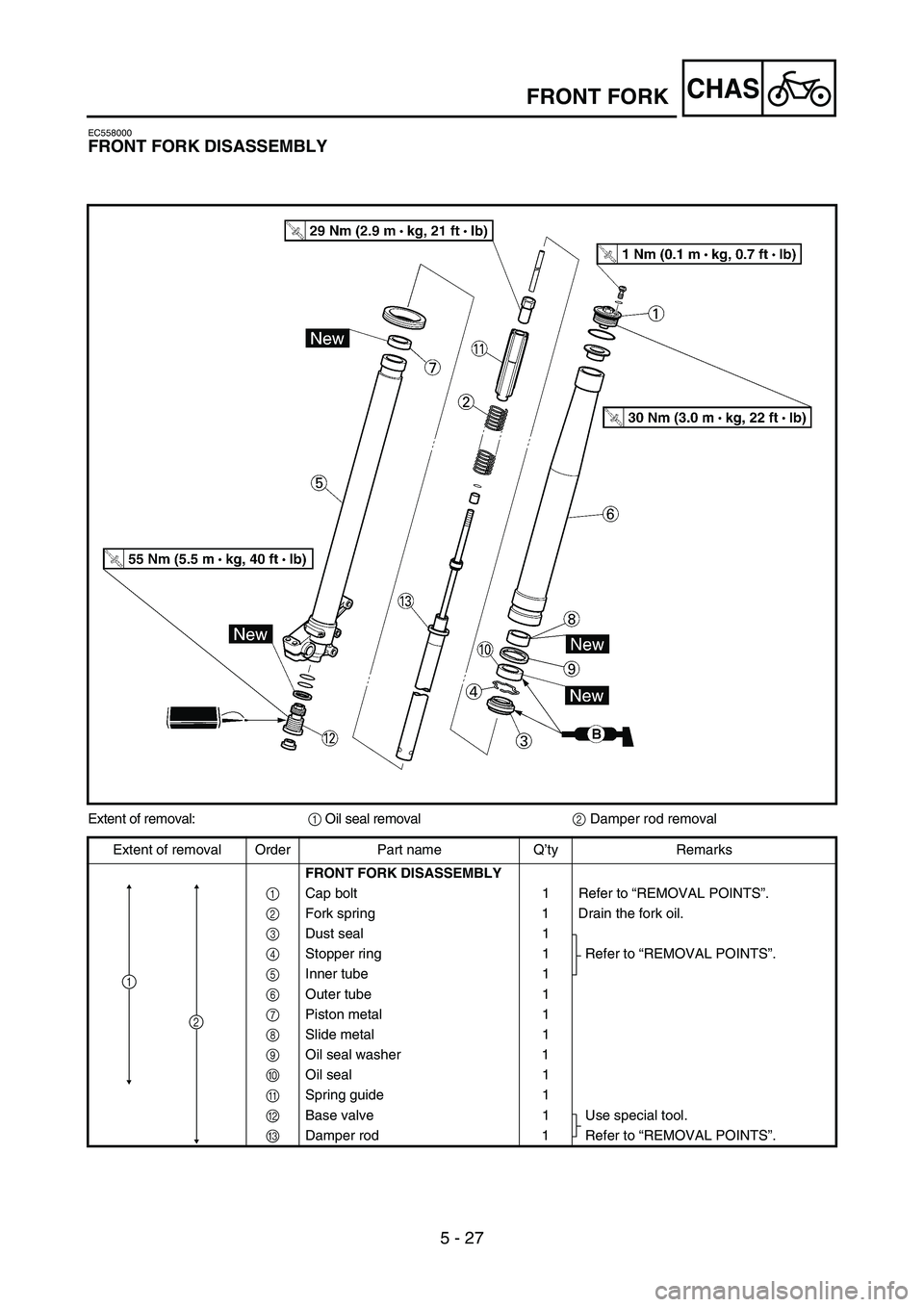
5 - 27
CHASFRONT FORK
EC558000
FRONT FORK DISASSEMBLY
Extent of removal:
1 Oil seal removal
2 Damper rod removal
Extent of removal Order Part name Q’ty Remarks
FRONT FORK DISASSEMBLY
1 Cap bolt 1 Refer to “REMOVAL POINTS”.
2 Fork spring 1 Drain the fork oil.
3 Dust seal 1
Refer to “REMOVAL POINTS”.
4 Stopper ring 1
5 Inner tube 1
6 Outer tube 1
7 Piston metal 1
8 Slide metal 1
9 Oil seal washer 1
0 Oil seal 1
A Spring guide 1
B Base valve 1 Use special tool.
C Damper rod 1 Refer to “REMOVAL POINTS”.
1
2
Page 582 of 786
5 - 28
CHASFRONT FORK
EC556000
HANDLING NOTE
NOTE:
The front fork requires careful attention. So it is
recommended that the front fork be maintained
at the dealers.
CAUTION:
To prevent an accidental explosion of air,
the following instructions should be
observed:
The front fork with a built-in piston rod
has a very sophisticated internal con-
struction and is particularly sensitive to
foreign material.
Use enough care not to allow any foreign
material to come in when the oil is
replaced or when the front fork is disas-
sembled and reassembled.
Before removing the cap bolts or front
forks, be sure to extract the air from the
air chamber completely.
EC553000
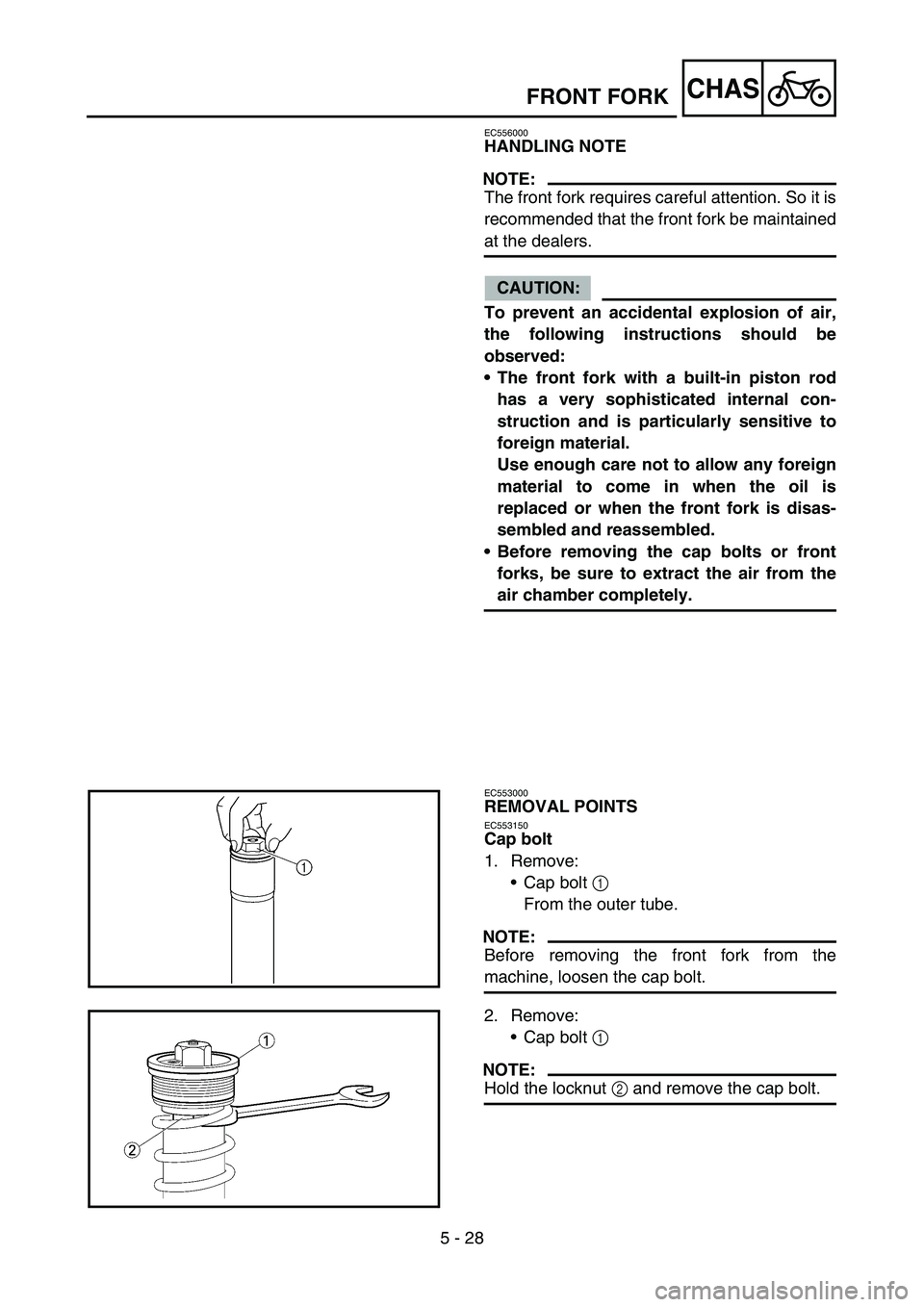
REMOVAL POINTS
EC553150
Cap bolt
1. Remove:
Cap bolt 1
From the outer tube.
NOTE:
Before removing the front fork from the
machine, loosen the cap bolt.
2. Remove:
Cap bolt 1
NOTE:
Hold the locknut 2 and remove the cap bolt.
Page 584 of 786
5 - 29
CHAS
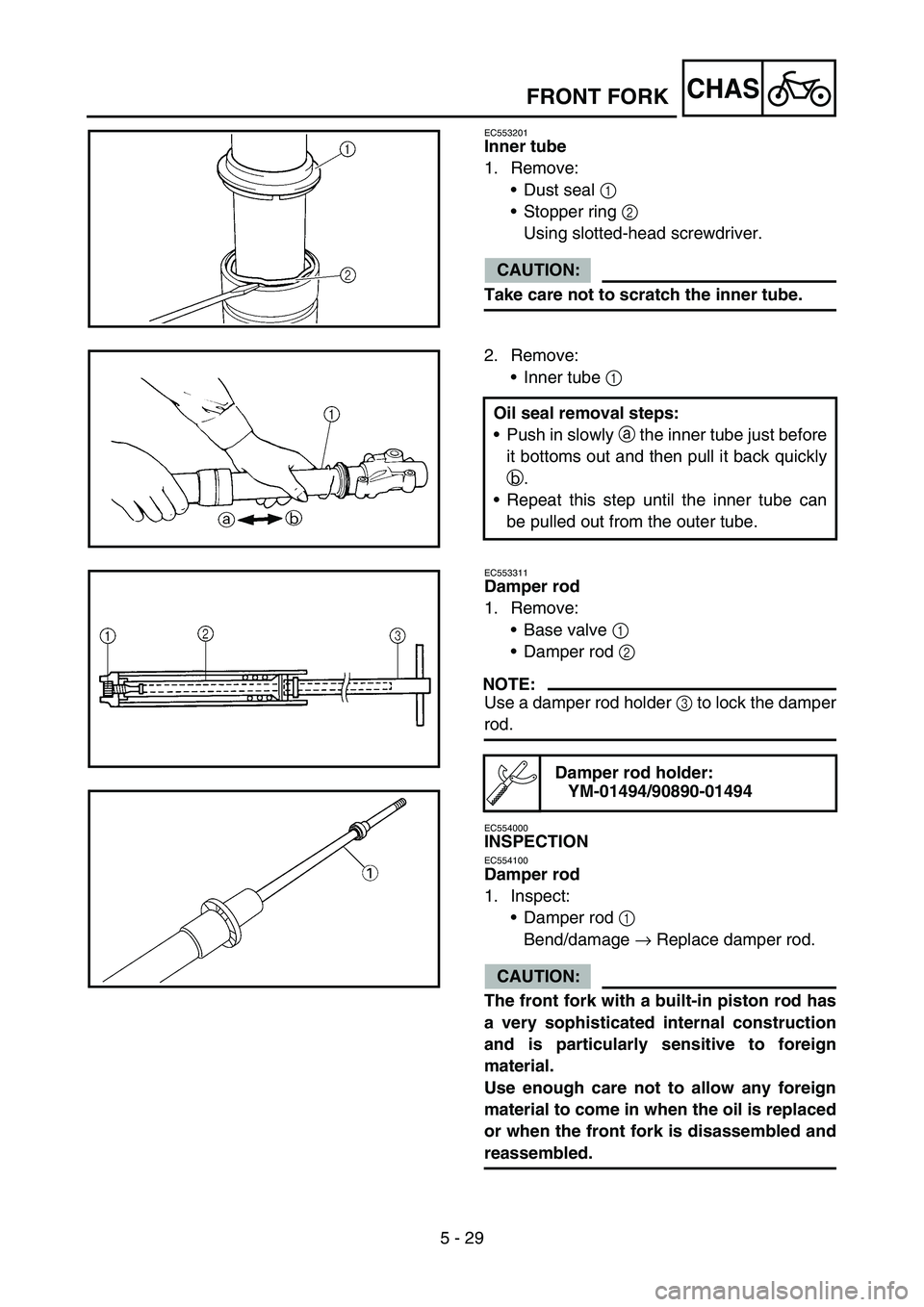
EC553201
Inner tube
1. Remove:
Dust seal 1
Stopper ring 2
Using slotted-head screwdriver.
CAUTION:
Take care not to scratch the inner tube.
2. Remove:
Inner tube 1
Oil seal removal steps:
Push in slowly a the inner tube just before
it bottoms out and then pull it back quickly
b.
Repeat this step until the inner tube can
be pulled out from the outer tube.
EC553311
Damper rod
1. Remove:
Base valve 1
Damper rod 2
NOTE:
Use a damper rod holder 3 to lock the damper
rod.
EC554000
INSPECTION
EC554100
Damper rod
1. Inspect:
Damper rod 1
Bend/damage → Replace damper rod.
CAUTION:
The front fork with a built-in piston rod has
a very sophisticated internal construction
and is particularly sensitive to foreign
material.
Use enough care not to allow any foreign
material to come in when the oil is replaced
or when the front fork is disassembled and
reassembled.
Damper rod holder:
YM-01494/90890-01494
FRONT FORK
Page 586 of 786
5 - 30
CHAS
EC554200
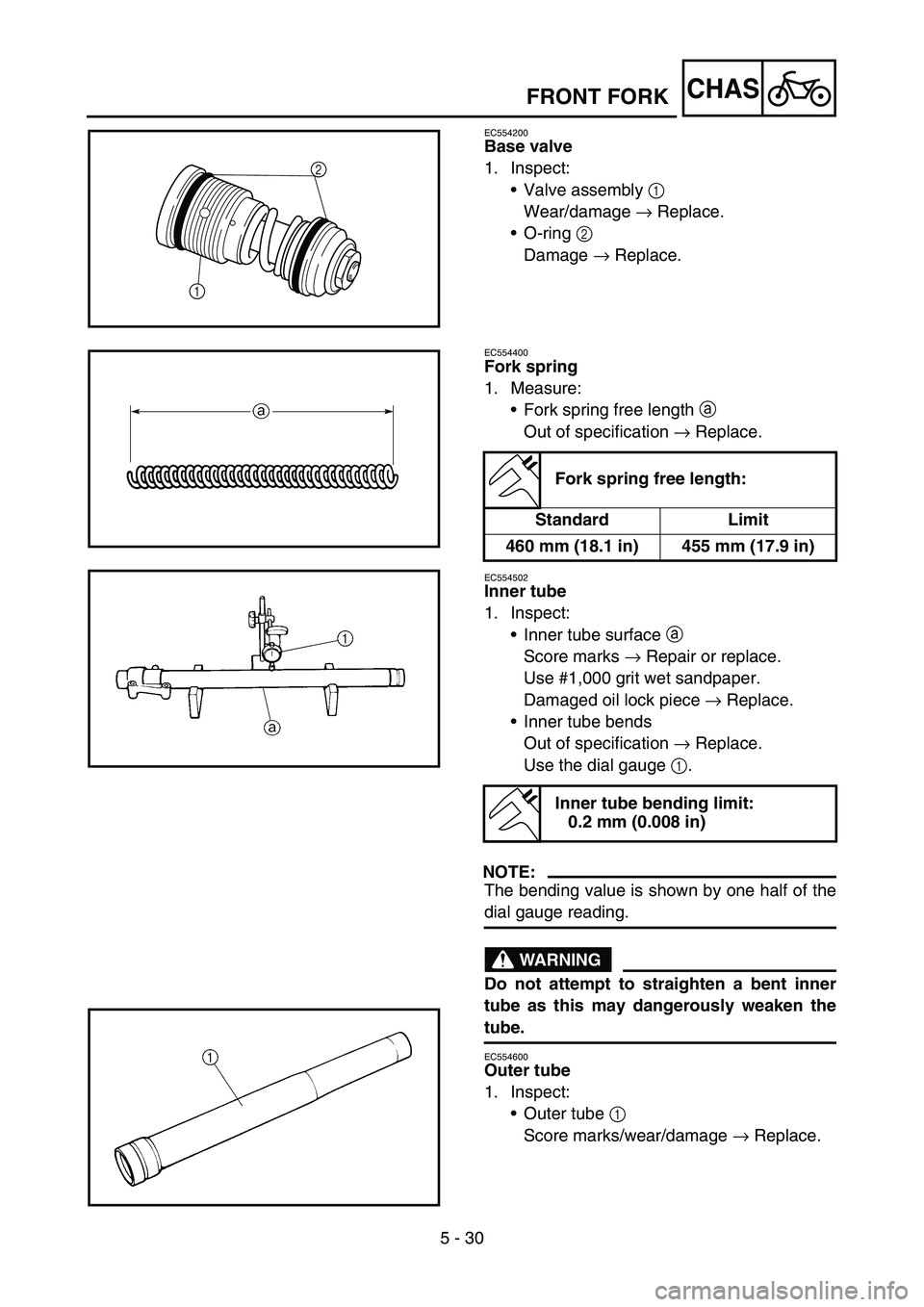
Base valve
1. Inspect:
Valve assembly 1
Wear/damage → Replace.
O-ring 2
Damage → Replace.
2
1
EC554400
Fork spring
1. Measure:
Fork spring free length a
Out of specification → Replace.
EC554502
Inner tube
1. Inspect:
Inner tube surface a
Score marks → Repair or replace.
Use #1,000 grit wet sandpaper.
Damaged oil lock piece → Replace.
Inner tube bends
Out of specification → Replace.
Use the dial gauge 1.
NOTE:
The bending value is shown by one half of the
dial gauge reading.
WARNING
Do not attempt to straighten a bent inner
tube as this may dangerously weaken the
tube.
EC554600
Outer tube
1. Inspect:
Outer tube 1
Score marks/wear/damage → Replace.
Fork spring free length:
Standard Limit
460 mm (18.1 in) 455 mm (17.9 in)
Inner tube bending limit:
0.2 mm (0.008 in)
FRONT FORK