checking oil YAMAHA WR 450F 2010 Owner's Manual
[x] Cancel search | Manufacturer: YAMAHA, Model Year: 2010, Model line: WR 450F, Model: YAMAHA WR 450F 2010Pages: 230, PDF Size: 13.87 MB
Page 164 of 230

5-61
CRANKCASE AND CRANKSHAFT
CHECKING THE CRANKSHAFT
1. Measure:
• Runout limit "a"
• Small end free play limit "b"
• Connecting rod big end side
clearance "c"
• Crank width "d"
Out of specification→Replace.
Use the dial gauge and a thick-
ness gauge.
CHECKING THE OIL STRAINER
1. Inspect:
• Oil strainer
Damage→Replace.INSTALLING THE CRANKCASE
BEARING
1. Install:
•Bearing
• Bearing stopper
• Bolt (bearing stopper)
• Screw (bearing stopper)
• Screw [bearing stopper (crank-
shaft)] "1"
To left and right crankcase.
• Install the bearing by pressing its
outer race parallel.
• To prevent the screw [bearing stop-
per (crankshaft)] from becoming
loose, crush the screw head periph-
ery "a" into the concave "b" using a
punch etc. In so doing, take care
not to damage the screwdriver re-
ceiving hole in the screw head.
INSTALLING THE CRANKSHAFT
1. Install:
• Crankshaft "1"
Use the crankshaft installing tool
"2", "3", "4" and "5".
• Hold the connecting rod at top dead
center with one hand while turning
the nut of the installing tool with the
other. Operate the installing tool un-
til the crankshaft bottoms against
the bearing.
• Before installing the crankshaft,
clean the contacting surface of
crankcase.
Do not use a hammer to drive in
the crankshaft.
A. For USA and CDN
B. Except for USA and CDN
2. Check:
• Shifter operation
• Transmission operation
Unsmooth operation→Repair.
3. Install:
• Oil strainer "1"
• Bolt (oil strainer) "2" Dial gauge and stand:
YU-3097/90890-01252
Standard
Runout
limit:0.03 mm
(0.0012 in)0.05 mm
(0.002 in)
Small
end
free
play:0.4–1.0 mm
(0.016–0.039
in)2.0 mm
(0.08 in)
Side
clear-
ance:0.15–0.45
mm (0.0059–
0.0177 in)0.50 mm
(0.02 in)
Crack
width:61.95–62.00
mm (2.439–
2.441 in)—
Bolt (bearing stopper):
10 Nm (1.0 m•kg, 7.2
ft•lb)
Screw (bearing stopper):
10 Nm (1.0 m•kg, 7.2
ft•lb)
Screw [bearing stopper
(crankshaft)]:
14 Nm (1.4 m•kg, 1.0
ft•lb)
Crankshaft installing pot
"2":
YU-90050/90890-01274
Crankshaft installing bolt
"3":
YU-90050/90890-01275
Adapter (M12) "4":
YU-90063/90890-01278
Spacer (crankshaft in-
staller) "5":
YM-91044/90890-04081
Bolt (oil strainer):
10 Nm (1.0 m•kg, 7.2
ft•lb)
Page 167 of 230
5-64
TRANSMISSION, SHIFT CAM AND SHIFT FORK
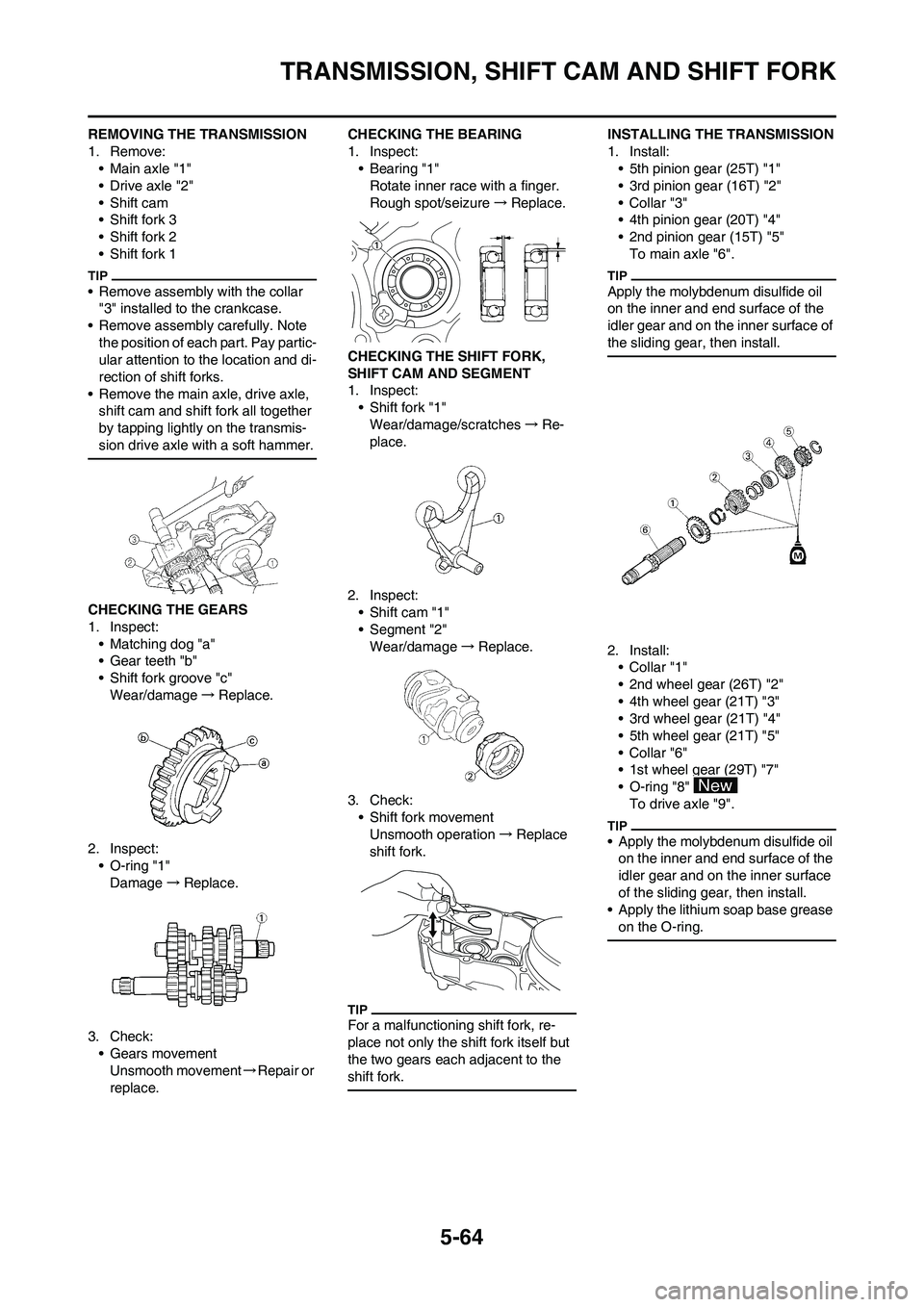
REMOVING THE TRANSMISSION
1. Remove:
• Main axle "1"
• Drive axle "2"
• Shift cam
• Shift fork 3
• Shift fork 2
• Shift fork 1
• Remove assembly with the collar
"3" installed to the crankcase.
• Remove assembly carefully. Note
the position of each part. Pay partic-
ular attention to the location and di-
rection of shift forks.
• Remove the main axle, drive axle,
shift cam and shift fork all together
by tapping lightly on the transmis-
sion drive axle with a soft hammer.
CHECKING THE GEARS
1. Inspect:
• Matching dog "a"
• Gear teeth "b"
• Shift fork groove "c"
Wear/damage→Replace.
2. Inspect:
• O-ring "1"
Damage→Replace.
3. Check:
• Gears movement
Unsmooth movement→Repair or
replace.CHECKING THE BEARING
1. Inspect:
•Bearing "1"
Rotate inner race with a finger.
Rough spot/seizure→Replace.
CHECKING THE SHIFT FORK,
SHIFT CAM AND SEGMENT
1. Inspect:
• Shift fork "1"
Wear/damage/scratches→Re-
place.
2. Inspect:
• Shift cam "1"
• Segment "2"
Wear/damage→Replace.
3. Check:
• Shift fork movement
Unsmooth operation→Replace
shift fork.
For a malfunctioning shift fork, re-
place not only the shift fork itself but
the two gears each adjacent to the
shift fork.
INSTALLING THE TRANSMISSION
1. Install:
• 5th pinion gear (25T) "1"
• 3rd pinion gear (16T) "2"
•Collar "3"
• 4th pinion gear (20T) "4"
• 2nd pinion gear (15T) "5"
To main axle "6".
Apply the molybdenum disulfide oil
on the inner and end surface of the
idler gear and on the inner surface of
the sliding gear, then install.
2. Install:
•Collar "1"
• 2nd wheel gear (26T) "2"
• 4th wheel gear (21T) "3"
• 3rd wheel gear (21T) "4"
• 5th wheel gear (21T) "5"
•Collar "6"
• 1st wheel gear (29T) "7"
• O-ring "8"
To drive axle "9".
• Apply the molybdenum disulfide oil
on the inner and end surface of the
idler gear and on the inner surface
of the sliding gear, then install.
• Apply the lithium soap base grease
on the O-ring.
Page 171 of 230
6-3
FRONT WHEEL AND REAR WHEEL
HANDLING NOTE
Support the machine securely so
there is no danger of it falling over.
REMOVING THE REAR WHEEL
1. Remove:
• Wheel "1"
Push the wheel forward and remove
the drive chain "2".
REMOVING THE WHEEL BEARING
1. Remove:
• Bearing "1"
Remove the bearing using a general
bearing puller "2".
CHECKING THE WHEEL
1. Measure:
• Wheel runout
Out of limit → Repair/replace.
2. Inspect:
• Bearing
Rotate inner race with a finger.
Rough spot/seizure → Replace.
Replace the bearings, oil seal and
wheel collar as a set.
CHECKING THE WHEEL AXLE
1. Measure:
• Wheel axle bends
Out of specification → Replace.
Use the dial gauge "1".
The bending value is shown by one
half of the dial gauge reading.
Do not attempt to straighten a bent
axle.
CHECKING THE BRAKE DISC
1. Measure:
• Brake disc deflection (only rear
brake disc)
Use the dial gauge "1".
Out of specification → Inspect
wheel runout.
If wheel runout is in good condi-
tion, replace the brake disc.
2. Measure:
• Brake disc thickness "a"
Out of limit → Replace.INSTALLING THE FRONT WHEEL
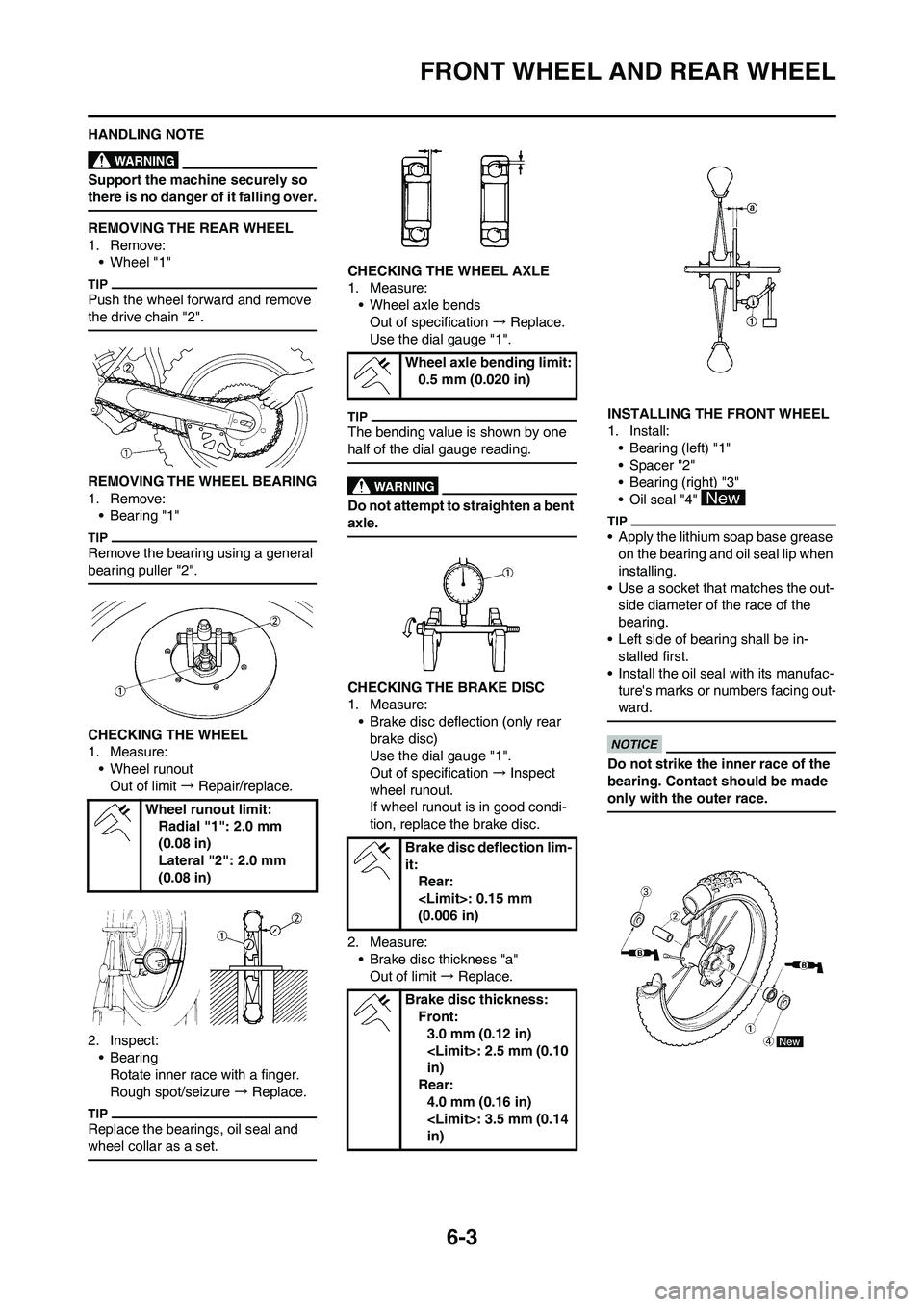
1. Install:
• Bearing (left) "1"
• Spacer "2"
• Bearing (right) "3"
• Oil seal "4"
• Apply the lithium soap base grease
on the bearing and oil seal lip when
installing.
• Use a socket that matches the out-
side diameter of the race of the
bearing.
• Left side of bearing shall be in-
stalled first.
• Install the oil seal with its manufac-
ture's marks or numbers facing out-
ward.
Do not strike the inner race of the
bearing. Contact should be made
only with the outer race.
Wheel runout limit:
Radial "1": 2.0 mm
(0.08 in)
Lateral "2": 2.0 mm
(0.08 in)
Wheel axle bending limit:
0.5 mm (0.020 in)
Brake disc deflection lim-
it:
Rear:
(0.006 in)
Brake disc thickness:
Front:
3.0 mm (0.12 in)
in)
Rear:
4.0 mm (0.16 in)
in)
Page 186 of 230
6-18
FRONT FORK
HANDLING NOTE
Support the machine securely so
there is no danger of it falling over.
The front fork requires careful atten-
tion. So it is recommended that the
front fork be maintained at the deal-
ers.
To prevent an accidental explosion
of air, the following instructions
should be observed:
• The front fork with a built-in pis-
ton rod has a very sophisticated
internal construction and is par-
ticularly sensitive to foreign ma-
terial. Use enough care not to
allow any foreign material to
come in when the oil is replaced
or when the front fork is disas-
sembled and reassembled.
• Before removing the cap bolts or
front forks, be sure to extract the
air from the air chamber com-
pletely.
REMOVING THE FRONT FORK
CAP BOLT
1. Remove:
• Front fork cap bolt "1"
From the outer tube.
Before removing the front fork from
the machine, loosen the front fork cap
bolt.
2. Remove:
• Front fork cap bolt "1"
Hold the locknut "2" and remove the
front fork cap bolt.
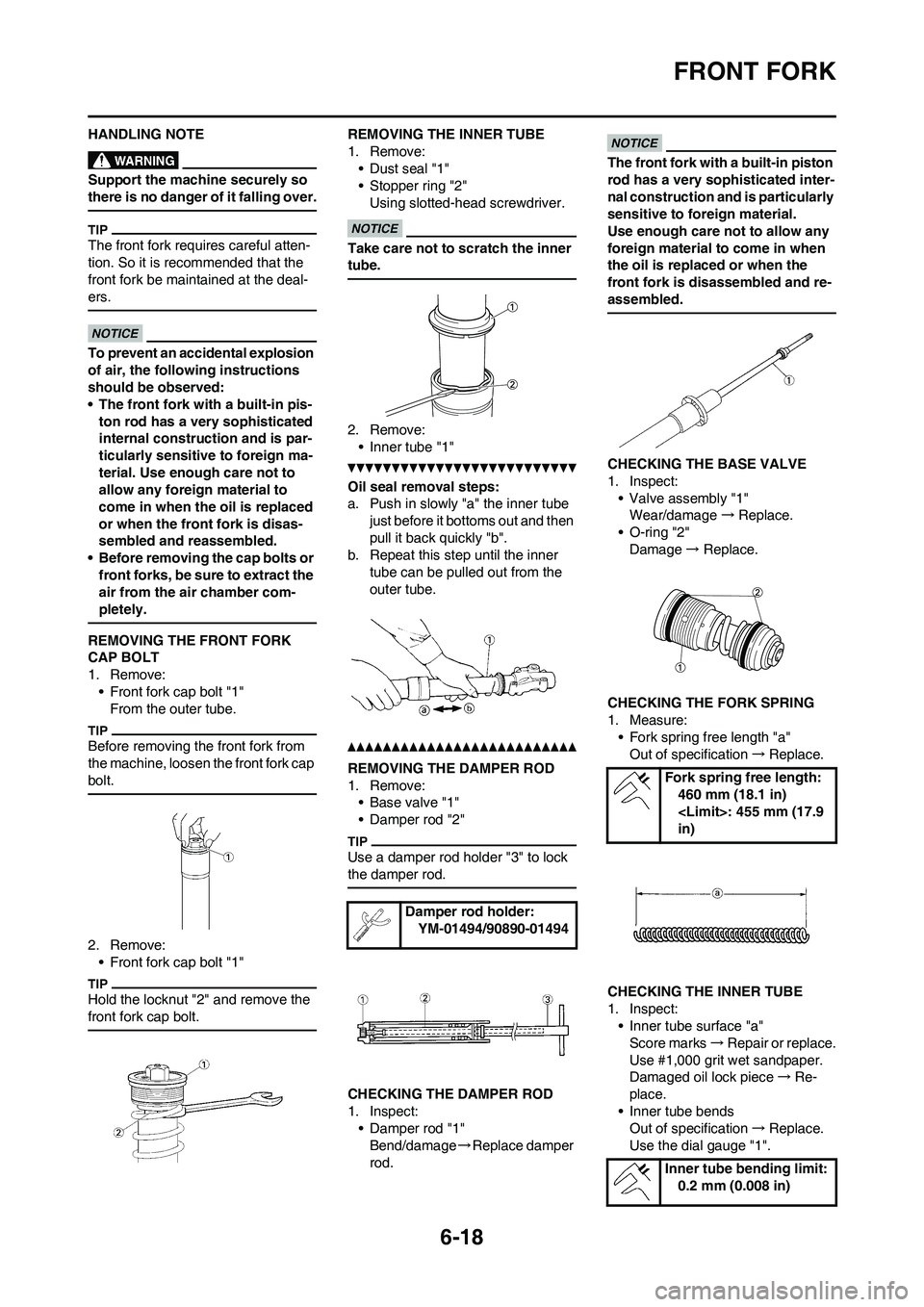
REMOVING THE INNER TUBE
1. Remove:
• Dust seal "1"
• Stopper ring "2"
Using slotted-head screwdriver.
Take care not to scratch the inner
tube.
2. Remove:
• Inner tube "1"
Oil seal removal steps:
a. Push in slowly "a" the inner tube
just before it bottoms out and then
pull it back quickly "b".
b. Repeat this step until the inner
tube can be pulled out from the
outer tube.
REMOVING THE DAMPER ROD
1. Remove:
• Base valve "1"
• Damper rod "2"
Use a damper rod holder "3" to lock
the damper rod.
CHECKING THE DAMPER ROD
1. Inspect:
• Damper rod "1"
Bend/damage→Replace damper
rod.
The front fork with a built-in piston
rod has a very sophisticated inter-
nal construction and is particularly
sensitive to foreign material.
Use enough care not to allow any
foreign material to come in when
the oil is replaced or when the
front fork is disassembled and re-
assembled.
CHECKING THE BASE VALVE
1. Inspect:
• Valve assembly "1"
Wear/damage →Replace.
• O-ring "2"
Damage→ Replace.
CHECKING THE FORK SPRING
1. Measure:
• Fork spring free length "a"
Out of specification→Replace.
CHECKING THE INNER TUBE
1. Inspect:
• Inner tube surface "a"
Score marks→Repair or replace.
Use #1,000 grit wet sandpaper.
Damaged oil lock piece→Re-
place.
• Inner tube bends
Out of specification→Replace.
Use the dial gauge "1".
Damper rod holder:
YM-01494/90890-01494
Fork spring free length:
460 mm (18.1 in)
in)
Inner tube bending limit:
0.2 mm (0.008 in)
Page 187 of 230
6-19
FRONT FORK
The bending value is shown by one
half of the dial gauge reading.
Do not attempt to straighten a bent
inner tube as this may dangerous-
ly weaken the tube.
CHECKING THE OUTER TUBE
1. Inspect:
• Outer tube "1"
Score marks/wear/damage→Re-
place.
CHECKING THE FRONT FORK
CAP BOLT
1. Inspect:
• Front fork cap bolt "1"
• O-ring "2"
• Air bleed screw "3"
Wear/damage→Replace.
ASSEMBLING THE FRONT FORK
1. Wash the all parts in a clean sol-
vent.
2. Install:
• Damper rod "1"
To inner tube "2".
To install the damper rod into the
inner tube, hold the inner tube
aslant. If the inner tube is held ver-
tically, the damper rod may fall into
it, damaging the valve inside.
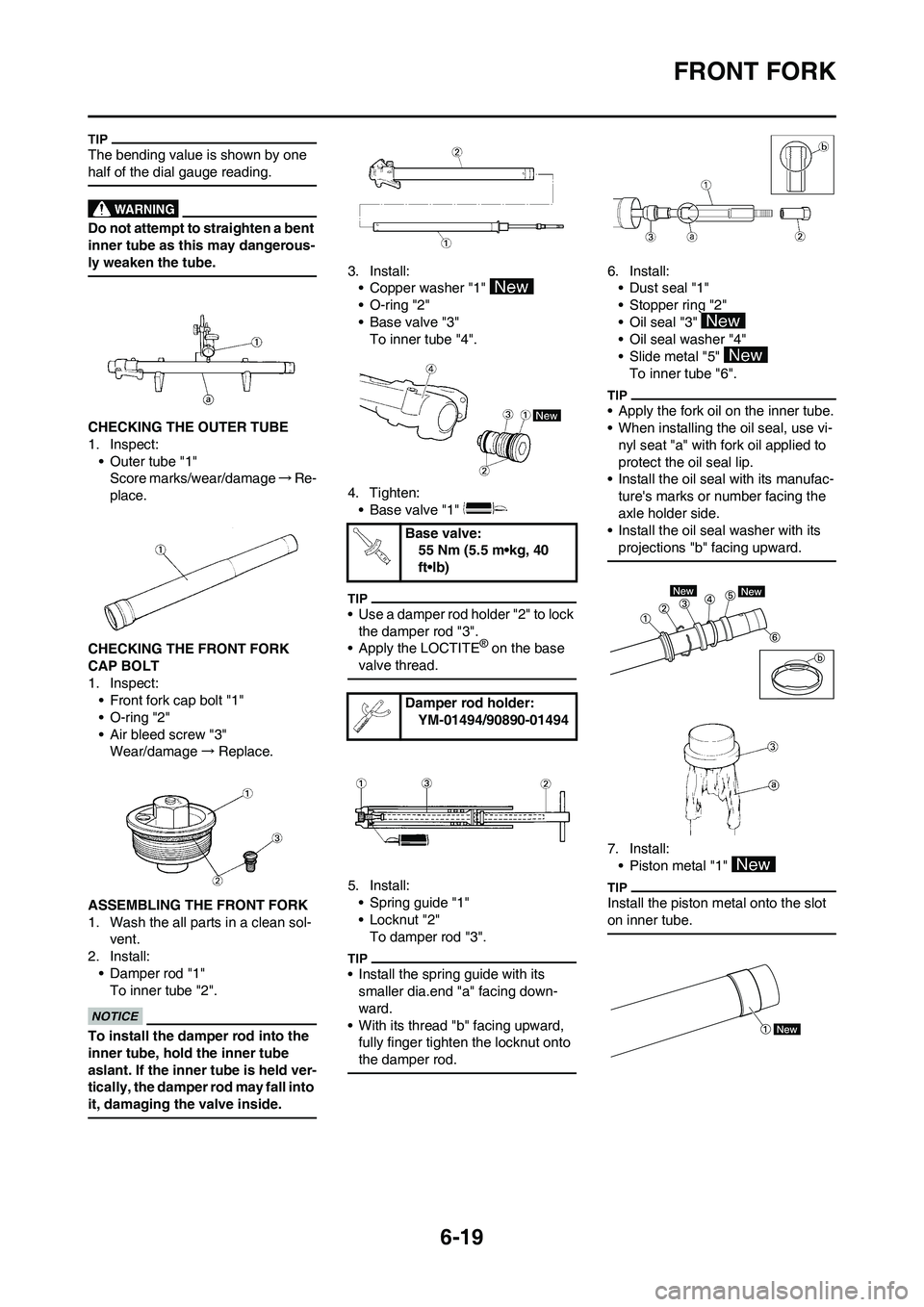
3. Install:
• Copper washer "1"
• O-ring "2"
• Base valve "3"
To inner tube "4".
4. Tighten:
• Base valve "1"
• Use a damper rod holder "2" to lock
the damper rod "3".
• Apply the LOCTITE
® on the base
valve thread.
5. Install:
• Spring guide "1"
• Locknut "2"
To damper rod "3".
• Install the spring guide with its
smaller dia.end "a" facing down-
ward.
• With its thread "b" facing upward,
fully finger tighten the locknut onto
the damper rod.
6. Install:
• Dust seal "1"
• Stopper ring "2"
• Oil seal "3"
• Oil seal washer "4"
• Slide metal "5"
To inner tube "6".
• Apply the fork oil on the inner tube.
• When installing the oil seal, use vi-
nyl seat "a" with fork oil applied to
protect the oil seal lip.
• Install the oil seal with its manufac-
ture's marks or number facing the
axle holder side.
• Install the oil seal washer with its
projections "b" facing upward.
7. Install:
• Piston metal "1"
Install the piston metal onto the slot
on inner tube.
Base valve:
55 Nm (5.5 m•kg, 40
ft•lb)
Damper rod holder:
YM-01494/90890-01494
Page 189 of 230
6-21
FRONT FORK
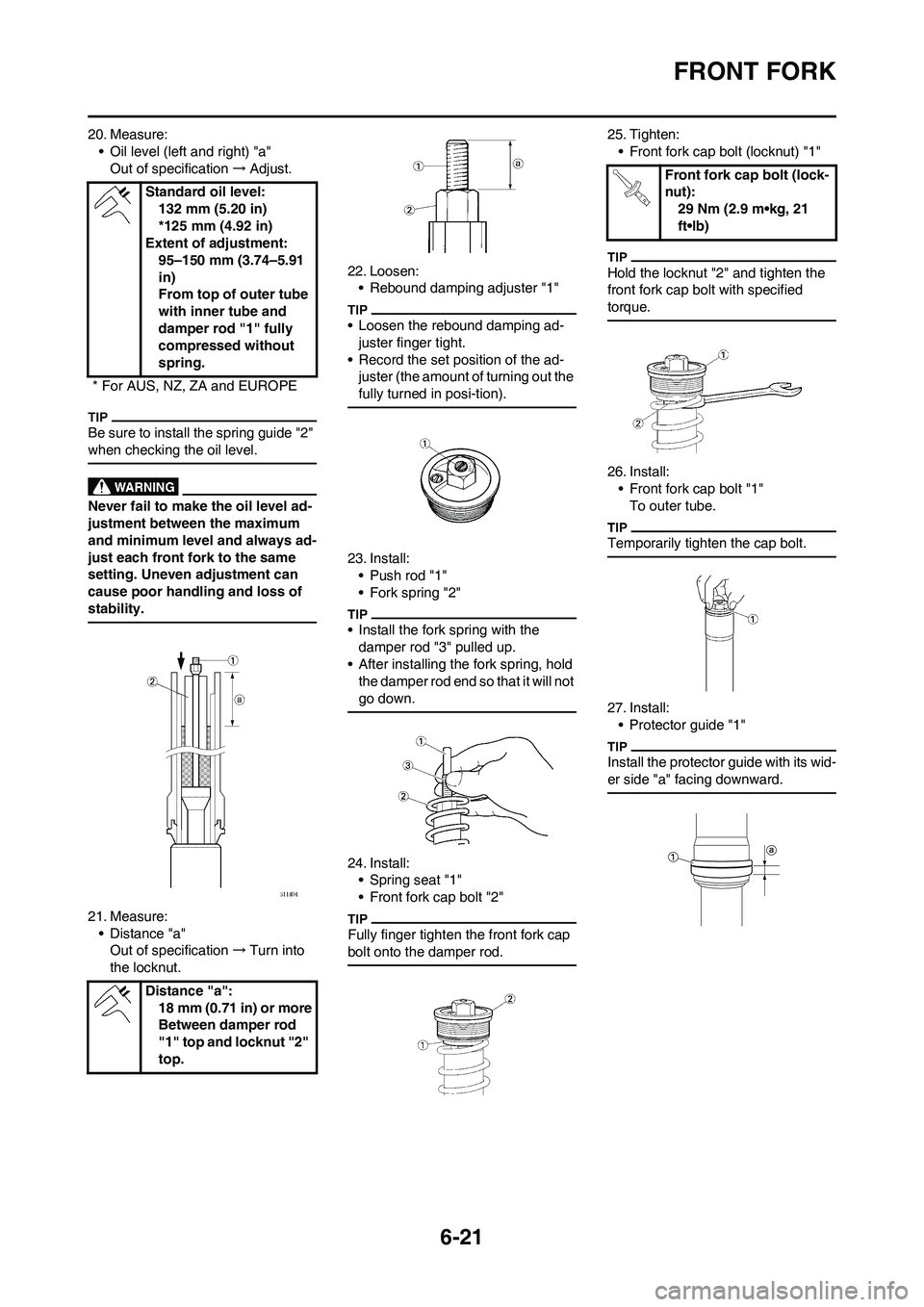
20. Measure:
• Oil level (left and right) "a"
Out of specification→Adjust.
Be sure to install the spring guide "2"
when checking the oil level.
Never fail to make the oil level ad-
justment between the maximum
and minimum level and always ad-
just each front fork to the same
setting. Uneven adjustment can
cause poor handling and loss of
stability.
21. Measure:
• Distance "a"
Out of specification→Turn into
the locknut.22. Loosen:
• Rebound damping adjuster "1"
• Loosen the rebound damping ad-
juster finger tight.
• Record the set position of the ad-
juster (the amount of turning out the
fully turned in posi-tion).
23. Install:
• Push rod "1"
• Fork spring "2"
• Install the fork spring with the
damper rod "3" pulled up.
• After installing the fork spring, hold
the damper rod end so that it will not
go down.
24. Install:
• Spring seat "1"
• Front fork cap bolt "2"
Fully finger tighten the front fork cap
bolt onto the damper rod.
25. Tighten:
• Front fork cap bolt (locknut) "1"
Hold the locknut "2" and tighten the
front fork cap bolt with specified
torque.
26. Install:
• Front fork cap bolt "1"
To outer tube.
Temporarily tighten the cap bolt.
27. Install:
• Protector guide "1"
Install the protector guide with its wid-
er side "a" facing downward.
Standard oil level:
132 mm (5.20 in)
*125 mm (4.92 in)
Extent of adjustment:
95–150 mm (3.74–5.91
in)
From top of outer tube
with inner tube and
damper rod "1" fully
compressed without
spring.
* For AUS, NZ, ZA and EUROPE
Distance "a":
18 mm (0.71 in) or more
Between damper rod
"1" top and locknut "2"
top.
Front fork cap bolt (lock-
nut):
29 Nm (2.9 m•kg, 21
ft•lb)
Page 192 of 230
6-24
HANDLEBAR
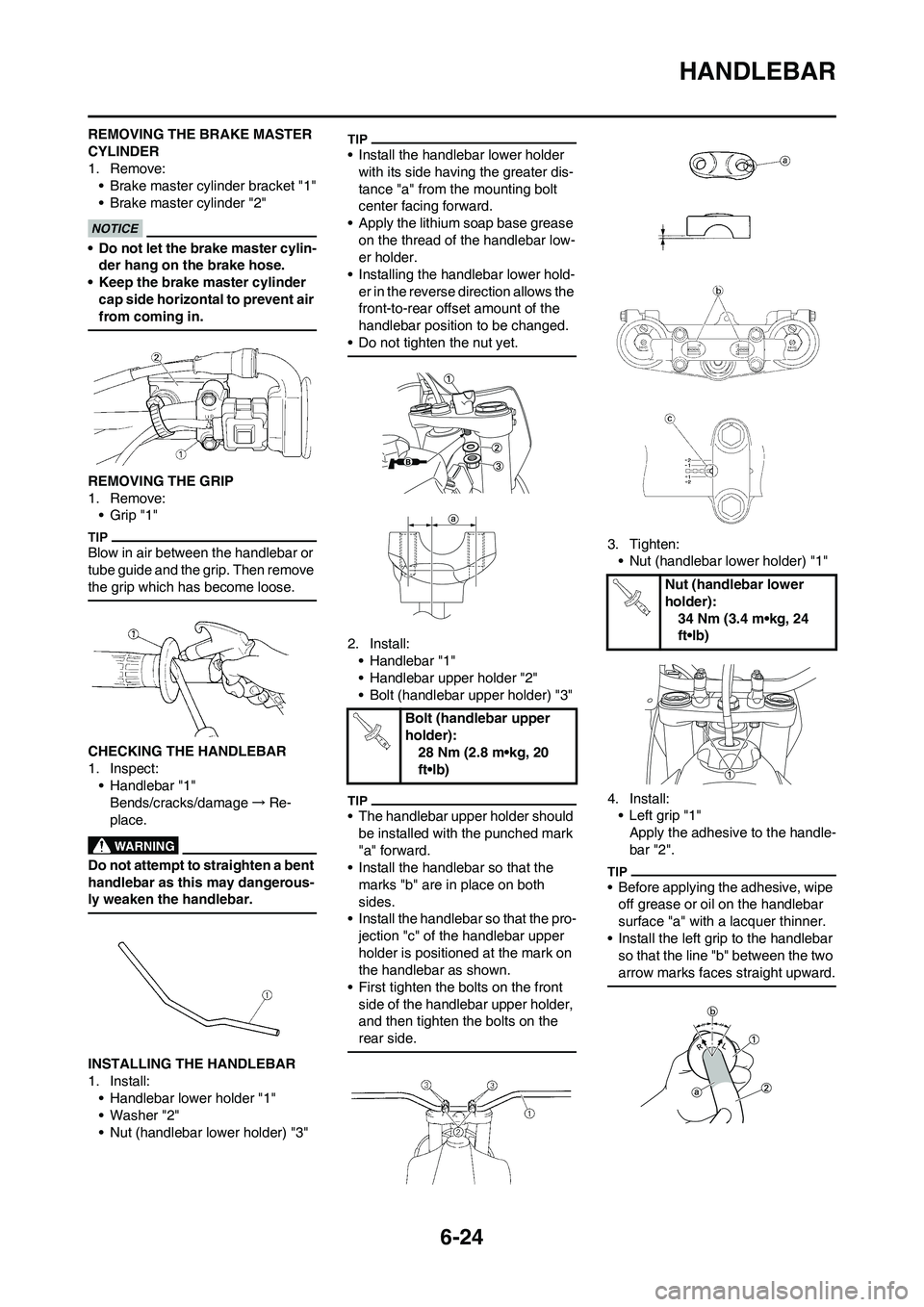
REMOVING THE BRAKE MASTER
CYLINDER
1. Remove:
• Brake master cylinder bracket "1"
• Brake master cylinder "2"
• Do not let the brake master cylin-
der hang on the brake hose.
• Keep the brake master cylinder
cap side horizontal to prevent air
from coming in.
REMOVING THE GRIP
1. Remove:
•Grip "1"
Blow in air between the handlebar or
tube guide and the grip. Then remove
the grip which has become loose.
CHECKING THE HANDLEBAR
1. Inspect:
• Handlebar "1"
Bends/cracks/damage→Re-
place.
Do not attempt to straighten a bent
handlebar as this may dangerous-
ly weaken the handlebar.
INSTALLING THE HANDLEBAR
1. Install:
• Handlebar lower holder "1"
• Washer "2"
• Nut (handlebar lower holder) "3"
• Install the handlebar lower holder
with its side having the greater dis-
tance "a" from the mounting bolt
center facing forward.
• Apply the lithium soap base grease
on the thread of the handlebar low-
er holder.
• Installing the handlebar lower hold-
er in the reverse direction allows the
front-to-rear offset amount of the
handlebar position to be changed.
• Do not tighten the nut yet.
2. Install:
• Handlebar "1"
• Handlebar upper holder "2"
• Bolt (handlebar upper holder) "3"
• The handlebar upper holder should
be installed with the punched mark
"a" forward.
• Install the handlebar so that the
marks "b" are in place on both
sides.
• Install the handlebar so that the pro-
jection "c" of the handlebar upper
holder is positioned at the mark on
the handlebar as shown.
• First tighten the bolts on the front
side of the handlebar upper holder,
and then tighten the bolts on the
rear side.
3. Tighten:
• Nut (handlebar lower holder) "1"
4. Install:
• Left grip "1"
Apply the adhesive to the handle-
bar "2".
• Before applying the adhesive, wipe
off grease or oil on the handlebar
surface "a" with a lacquer thinner.
• Install the left grip to the handlebar
so that the line "b" between the two
arrow marks faces straight upward.
Bolt (handlebar upper
holder):
28 Nm (2.8 m•kg, 20
ft•lb)
Nut (handlebar lower
holder):
34 Nm (3.4 m•kg, 24
ft•lb)
Page 201 of 230

6-33
SWINGARM
HANDLING NOTE
Support the machine securely so
there is no danger of it falling over.
REMOVING THE CAP
1. Remove:
• Left cap "1"
Remove with a slotted-head screw-
driver inserted under the mark "a" on
the left cap.
REMOVING THE BEARING
1. Remove:
• Bearing "1"
Remove the bearing by pressing its
outer race.
CHECKING THE SWINGARM
1. Inspect:
• Bearing "1"
• Bushing "2"
Free play exists/unsmooth revolu-
tion/rust →Replace bearing and
bushing as a set.
2. Inspect:
• Oil seal "3"
Damage→Replace.
CHECKING THE RELAY ARM
1. Inspect:
• Bearing "1"
•Collar "2"
Free play exists/unsmooth revolu-
tion/rust → Replace bearing and
collar as a set.2. Inspect:
• Oil seal "3"
Damage→Replace.
CHECKING THE CONNECTING
ROD
1. Inspect:
•Bearing "1"
• Collar "2"
Free play exists/unsmooth revolu-
tion/rust →Replace bearing and
collar as a set.
2. Inspect:
• Oil seal "3"
Damage→Replace.
INSTALLING THE BEARING AND
OIL SEAL
1. Install:
•Bearing "1"
• Oil seal "2"
To swingarm.
• Apply the molybdenum disulfide
grease on the bearing when install-
ing.
• Install the bearing by pressing it on
the side having the manufacture's
marks or numbers.
• First install the outer and then the
inner bearings to a specified depth
from inside.
2. Install:
• Bearing "1"
• Washer "2"
• Oil seal "3"
To relay arm.
• Apply the molybdenum disulfide
grease on the bearing when install-
ing.
• Install the bearing by pressing it on
the side having the manufacture's
marks or numbers.
• Apply the molybdenum disulfide
grease on the washer.
3. Install:
• Bearing "1"
• Oil seal "2"
To connecting rod.
• Apply the molybdenum disulfide
grease on the bearing when install-
ing.
• Install the bearing by pressing it on
the side having the manufacture's
marks or numbers.
Installed depth of bear-
ings:
Outer "a": Zero mm
(Zero in)
Inner "b": 6.5 mm (0.26
in)
Installed depth of bear-
ings "a":
Zero mm (Zero in)
Installed depth of bear-
ings "a":
Zero mm (Zero in)
Page 206 of 230
6-38
REAR SHOCK ABSORBER
HANDLING NOTE
• Support the machine securely so
there is no danger of it falling
over.
• This rear shock absorber is pro-
vided with a separate type tank
filled with high-pressure nitro-
gen gas. To prevent the danger
of explosion, read and under-
stand the following information
before handling the shock ab-
sorber. The manufacturer can
not be held responsible for prop-
erty damage or personal injury
that may result from improper
handling.
• Never tamper or attempt to dis-
assemble the cylinder or the
tank.
• Never throw the rear shock ab-
sorber into an open flame or
other high heat. The rear shock
absorber may explode as a re-
sult of nitrogen gas expansion
and/ or damage to the hose.
• Be careful not to damage any
part of the gas tank. A damaged
gas tank will impair the damp-
ing performance or cause a
malfunction.
• Take care not to scratch the
contact surface of the piston
rod with the cylinder; or oil
could leak out.
• Never attempt to remove the
plug at the bottom of the nitro-
gen gas tank. It is very danger-
ous to remove the plug.
• When scrapping the rear shock
absorber, follow the instruc-
tions on disposal.
NOTES ON DISPOSAL (YAMAHA
DEALERS ONLY)
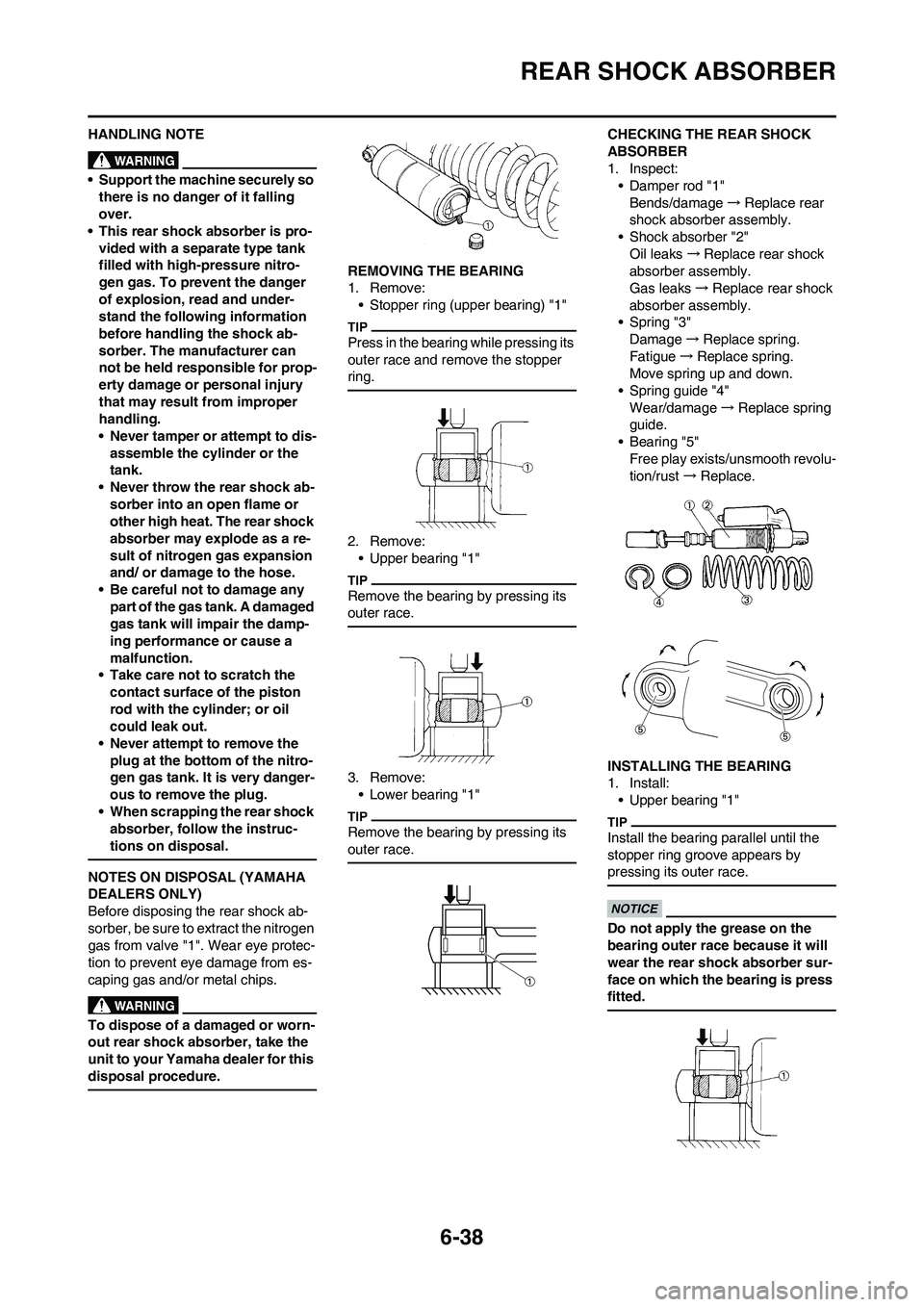
Before disposing the rear shock ab-
sorber, be sure to extract the nitrogen
gas from valve "1". Wear eye protec-
tion to prevent eye damage from es-
caping gas and/or metal chips.
To dispose of a damaged or worn-
out rear shock absorber, take the
unit to your Yamaha dealer for this
disposal procedure.
REMOVING THE BEARING
1. Remove:
• Stopper ring (upper bearing) "1"
Press in the bearing while pressing its
outer race and remove the stopper
ring.
2. Remove:
• Upper bearing "1"
Remove the bearing by pressing its
outer race.
3. Remove:
• Lower bearing "1"
Remove the bearing by pressing its
outer race.
CHECKING THE REAR SHOCK
ABSORBER
1. Inspect:
• Damper rod "1"
Bends/damage→Replace rear
shock absorber assembly.
• Shock absorber "2"
Oil leaks→Replace rear shock
absorber assembly.
Gas leaks→Replace rear shock
absorber assembly.
• Spring "3"
Damage→Replace spring.
Fatigue→Replace spring.
Move spring up and down.
• Spring guide "4"
Wear/damage→Replace spring
guide.
• Bearing "5"
Free play exists/unsmooth revolu-
tion/rust →Replace.
INSTALLING THE BEARING
1. Install:
• Upper bearing "1"
Install the bearing parallel until the
stopper ring groove appears by
pressing its outer race.
Do not apply the grease on the
bearing outer race because it will
wear the rear shock absorber sur-
face on which the bearing is press
fitted.
Page 211 of 230

7-3
IGNITION SYSTEM
IGNITION SYSTEM
INSPECTION STEPS
Use the following steps for checking the possibility of the malfunctioning engine being attributable to ignition system failure
and for checking the spark plug which will not spark.
*1 marked: Refer to "CHECKING THE FUSE" section in the CHAPTER 3.
*2 marked: Refer to "CHECKING AND CHARGING THE BATTERY" section in the CHAPTER 3.
*3 marked: Only when the ignition checker is used.
• Remove the following parts before inspection.
1. Seat
2. Fuel tank
• Use the following special tools in this inspection.
*1 Check fuse. No good→Replace fuse and check wire harness.
OK↓
*2 Check battery. No good→Recharge or replace.
OK↓
Spark gap test Spark→*3 Clean or replace spark plug.
No spark↓
Check entire ignition system for connection.
(couplers, leads and ignition coil)No good→
Repair or replace.
OK↓
Check engine stop switch. No good→Replace.
OK↓
Check main switch. No good→Replace.
OK↓
Check ignition coil. (primary coil and secondary
coil)No good→
Replace.
OK↓
Check AC magneto. (pickup coil) No good→Replace.
OK↓
Check neutral switch. No good→Repair or replace.
OK↓
Replace CDI unit.
Dynamic spark tester:
YM-34487
Ignition checker:
90890-06754
Pocket tester:
YU-3112-C/90890-03112